

Malachi 2:16

Hebrew (Westminster Leningrad Codex) Malachi 2:16 appears in the Hebrew Old Testament. The text above is from the Westminster Leningrad Codex. Each word links to its Strong’s number, a concise gloss, and parsing drawn from the Open Scriptures Hebrew Bible morphology. Click any word for its full Brown-Driver-Briggs (BDB) entry.
Download image
Cite this verse

Malachi 2:16 (World English Bible). Public Domain. Lemma interlinear Bible study tool, https://lemma.gebible.app/v/malachi/2/16.

Show BibTeX & RIS
BibTeX
RIS
English Translation
For I hate divorce," says Yahweh, the God of Israel, "and him who covers his garment with violence!' says Yahweh of Hosts. "Therefore take heed to your spirit, that you don't deal treacherously.
World English Bible · Public Domain
Download a study sheet

One document with this verse’s original text, its word-by-word gloss line, the meaning frame, cross-references with their text, attributed commentary, and full source and license credits — printable, and it pastes into notes with its structure intact.

This verse Autodidact and up

Study sheet (.html) Plain text (.txt)

A passage Seminary Student

Up to 50 verses in one chapter. A passage sheet keeps up to 6 commentary sources and 12 cross-references per verse, in the order this page ranks them, and says so on the sheet whenever that leaves anything out. Ask for a single verse and you get the Autodidact verse sheet above.

Everything on this page stays free to read, with no account — the sheet is a download of what is already on screen, not access to it.

Want to remove ads? Support Godless Engineer
Compare translations 3

The same verse in 3 English versions, stacked beneath the original-language interlinear above. Click any original word for its lexicon entry.

Each is an independent rendering of the whole verse — the interlinear is not word-aligned to these translations.

Highlighted words mark where these versions differ — a whole-verse word diff, not a word-by-word alignment.

  • World English Bible Public Domain
    For I hate divorce," says Yahweh, the God of Israel, "and him who covers his garment with violence!' says Yahweh of Hosts. "Therefore take heed to your spirit, that you don't deal treacherously.
  • King James Version Public Domain
    For the LORD, the God of Israel, saith that he hateth putting away: for one covereth violence with his garment, saith the LORD of hosts: therefore take heed to your spirit, that ye deal not treacherously.
  • unfoldingWord Literal Text CC BY-SA 4.0
    “For I hate divorce,” says Yahweh, the God of Israel, “and one covers over his garment with violence,” says Yahweh of Armies. “So guard yourselves in your spirit and do not deal treacherously.”

unfoldingWord Literal Text — © unfoldingWord, licensed CC BY-SA 4.0. Word-aligned USFM3 via Door43 (git.door43.org/unfoldingWord/en_ult).

Versions to compare (up to 4)

3 of 4 selected

Show all 18 translations

Every available English version of this verse, each an independent rendering of the whole verse.

  • World English Bible Public Domain
    For I hate divorce," says Yahweh, the God of Israel, "and him who covers his garment with violence!' says Yahweh of Hosts. "Therefore take heed to your spirit, that you don't deal treacherously.
  • Berean Standard Bible Public Domain
    “For I hate divorce,” says the LORD, the God of Israel. “He who divorces his wife covers his garment with violence,” says the LORD of Hosts. So guard yourselves in your spirit and do not break faith.
  • Majority Standard Bible Public Domain
    “For I hate divorce,” says the LORD, the God of Israel. “He who divorces his wife covers his garment with violence,” says the LORD of Hosts. So guard yourselves in your spirit and do not break faith.
  • King James Version Public Domain
    For the LORD, the God of Israel, saith that he hateth putting away: for one covereth violence with his garment, saith the LORD of hosts: therefore take heed to your spirit, that ye deal not treacherously.
  • American Standard Version (1901) Public Domain
    For I hate putting away, saith Jehovah, the God of Israel, and him that covereth his garment with violence, saith Jehovah of hosts: therefore take heed to your spirit, that ye deal not treacherously.
  • Revised Version (1885) Public Domain
    For I hate putting away, saith the LORD, the God of Israel, and him that covereth his garment with violence, saith the LORD of hosts: therefore take heed to your spirit, that ye deal not treacherously.
  • Geneva Bible (1599) Public Domain
    If thou hatest her, put her away, sayeth the Lord God of Israel, yet he couereth the iniurie vnder his garment, saieth the Lord of hosts: therefore keepe your selues in your spirite, and transgresse not.
  • Douay-Rheims (1899) Public Domain
    When thou shalt hate her put her away, saith the Lord the God of Israel: but iniquity shall cover his garment, saith the Lord of hosts, keep your spirit, and despise not.
  • Young's Literal Translation Public Domain
    For `I' hate sending away, said Jehovah, God of Israel, And He `who' hath covered violence with his clothing, said Jehovah of Hosts, And ye have been watchful over your spirit, And ye do not deal treacherously.
  • Literal Standard Version CC BY-SA 4.0
    “For He hates sending away,” said YHWH, God of Israel, || “And he [who] has covered violence with his clothing,” said YHWH of Hosts, || “And you have been watchful over your spirit, || And you do not deal treacherously.”
  • Unlocked Literal Bible CC BY-SA 4.0
    “For I hate divorce,” says Yahweh, the God of Israel, “and the one who covers his garment with violence,” says Yahweh of hosts. “So guard yourselves in your spirit and do not be faithless.”
  • unfoldingWord Literal Text CC BY-SA 4.0
    “For I hate divorce,” says Yahweh, the God of Israel, “and one covers over his garment with violence,” says Yahweh of Armies. “So guard yourselves in your spirit and do not deal treacherously.”
  • Darby Bible Public Domain
    (for I hate putting away, saith Jehovah the God of Israel;) and he covereth with violence his garment, saith Jehovah of hosts: take heed then to your spirit, that ye deal not unfaithfully.
  • World Messianic Bible Public Domain
    One who hates and divorces”, says the LORD, the God of Israel, “covers his garment with violence!” says the LORD of Hosts. “Therefore pay attention to your spirit, that you don’t be unfaithful.
  • Webster's Bible Public Domain
    For the LORD, the God of Israel, saith, that he hateth putting away: for one covereth violence with his garment, saith the LORD of hosts: therefore take heed to your spirit, that ye deal not treacherously.
  • Free Bible Version CC BY-SA 4.0
    For I hate divorce, says the Lord God of Israel, for it's a violent attack on the wife, says the Lord Almighty. So watch what you do, and don't be unfaithful.
  • Bible in Basic English Public Domain
    For I am against the putting away of a wife, says the Lord, the God of Israel, and against him who is clothed with violent acts, says the Lord of armies: so give thought to your spirit and do not be false in your acts.
  • JPS Tanakh (1917) Public Domain
    For I hate putting away, saith the LORD, the God of Israel, and him that covereth his garment with violence, saith the LORD of hosts; therefore take heed to your spirit, that ye deal not treacherously.

Literal Standard Version (2020), Covenant Press — licensed CC BY-SA 4.0. Text via the HelloAO Bible API (eBible.org). Unlocked Literal Bible (unfoldingWord) — licensed CC BY-SA 4.0. Text via the HelloAO Bible API (eBible.org). unfoldingWord Literal Text — © unfoldingWord, licensed CC BY-SA 4.0. Word-aligned USFM3 via Door43 (git.door43.org/unfoldingWord/en_ult). Free Bible Version, Dr. Jonathan Gallagher — licensed CC BY-SA 4.0. Text via the HelloAO Bible API (eBible.org).

Word by word

More ways to search: Search by grammar → Find every occurrence → Compare this word →

Practice this passage: Drill this verse → Learn its vocabulary →

לְבוּשׁ֔וֹ
lᵉbûwsh
H3830
“clothing · his”
Noun, Common, Masculine, Singular, Construct + Suffix, Personal, 3rd Person, Masculine, Singular
Part of Speech
Noun
Type
Common
Gender
Masculine
Number
Singular
State
Construct
Full BDB Definition

Origin: from H3847

TWOT: 1075a

clothing, garment, apparel, raiment
  1. כִּֽי kîy H3588 “that” Conjunction
  2. שָׂנֵ֣א sânêʼ H8130 “to hate” Verb, Qal, Perfect, 3rd Person, Masculine, Singular
  3. שַׁלַּ֗ח shâlach H7971 “to send” Verb, Piel, Infinitive Construct
  4. אָמַ֤ר ʼâmar H559 “to say” Verb, Qal, Perfect, 3rd Person, Masculine, Singular
  5. יְהוָה֙ Yᵉhôvâh H3068 “LORD” Noun, Proper
  6. אֱלֹהֵ֣י ʼĕlôhîym H430 “God(s) of” Noun, Common, Masculine, Plural, Construct
  7. יִשְׂרָאֵ֔ל Yisrâʼêl H3478 “Israel” Noun, Proper
  8. וְכִסָּ֤ה kâçâh H3680 “and · to cover” Conjunction + Verb, Piel, Sequential Perfect, 3rd Person, Masculine, Singular
  9. חָמָס֙ châmâç H2555 “violence” Noun, Common, Masculine, Singular, Absolute
  10. עַל ʻal H5921 “upon” Preposition
  11. אָמַ֖ר ʼâmar H559 “to say” Verb, Qal, Perfect, 3rd Person, Masculine, Singular
  12. יְהוָ֣ה Yᵉhôvâh H3068 “LORD” Noun, Proper
  13. צְבָא֑וֹת tsâbâʼ H6635 “armies” Noun, Common, Both, Plural, Absolute
  14. וְנִשְׁמַרְתֶּ֥ם shâmar H8104 “and · to keep” Conjunction + Verb, Niphal, Sequential Perfect, 2nd Person, Masculine, Plural
  15. בְּרוּחֲכֶ֖ם rûwach H7307 “in/at · spirit · your” Preposition + Noun, Common, Both, Singular, Construct + Suffix, Personal, 2nd Person, Masculine, Plural
  16. וְלֹ֥א lôʼ H3808 “and · not” Conjunction + Particle, Negative
  17. תִבְגֹּֽדוּ bâgad H898 “to betray” Verb, Qal, Imperfect, 2nd Person, Masculine, Plural

About this verse

These counts appear in no published source. They are computed here, from the morphology-tagged text and Lemma’s own curated glosses. What Lemma adds →

18
words
16
distinct lemmas
Prophets
section

Shared distinctive vocabulary

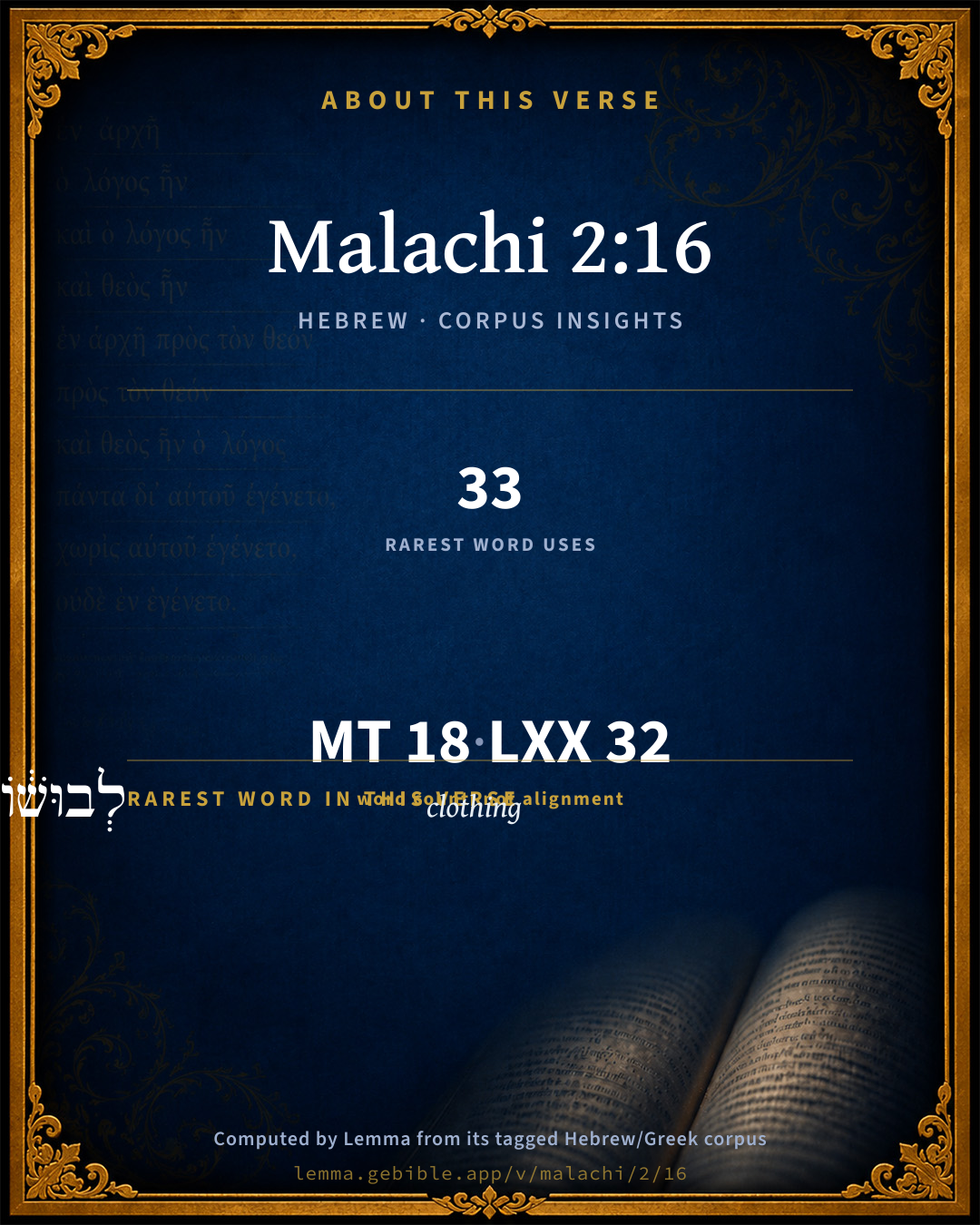
לְבוּשׁ֔וֹ clothing H3830 occurs in 33 verses of the Hebrew Bible. Also found in:

Grammatical profile

  • 7 verbs
  • 8 nouns
  • 1 preposition
  • 1 conjunction
  • 1 particle

Verb forms

  • שָׂנֵ֣א Qal · Perfect
  • שַׁלַּ֗ח Piel · Infinitive Construct
  • אָמַ֤ר Qal · Perfect
  • וְכִסָּ֤ה Piel · Sequential Perfect
  • אָמַ֖ר Qal · Perfect
  • וְנִשְׁמַרְתֶּ֥ם Niphal · Sequential Perfect
  • תִבְגֹּֽדוּ Qal · Imperfect

Repetition

Words recur within this verse — often emphatic in Hebrew:

  • אָמַ֤ר to say H559 ×2
  • יְהוָה֙ LORD H3068 ×2

Hebrew & Septuagint length

In English translation the verse runs 33 words from the Hebrew and 38 from the Septuagint (LXX English) — closely comparable.

A rough comparison of the two English renderings, which tokenize alike — not a word-level alignment.

Word counts can differ between the Hebrew and the Greek without any difference in meaning — e.g. the Hebrew direct-object marker אֵת has no separate Greek word, and Greek often adds the article ὁ.

In the original languages it is 18 Hebrew tokens and 32 Greek tokens — but the two are counted differently (Hebrew bundles its prefixes and suffixes into one token; the Greek is in lemma form), so that isn’t a like-for-like length.

Cross-references

9

Topical passages linked to Malachi 2:16 in the Treasury of Scripture Knowledge — connected by theme and wording, ordered by reader-vote popularity; previews shown in the World English Bible.

  • Matthew 19:3–9 Pharisees came to him, testing him, and saying, "Is it lawful for a man to divorce his wife for any reason?"
  • Matthew 5:31–32 "It was also said, 'Whoever shall put away his wife, let him give her a writing of divorce,'
  • Mark 10:2–12 Pharisees came to him testing him, and asked him, "Is it lawful for a man to divorce his wife?"
  • Luke 16:18 Everyone who divorces his wife, and marries another, commits adultery. He who marries one who is divorced from a husband commits adultery.
  • Proverbs 28:13 He who conceals his sins doesn't prosper, But whoever confesses and renounces them finds mercy.
  • Deuteronomy 24:1–4 When a man takes a wife, and marries her, then it shall be, if she find no favor in his eyes, because he has found some unseemly thing in her, that he shall write her a bill of divorce, and give it in her hand, and send her out of his house.
  • Isaiah 50:1 Thus says Yahweh, Where is the bill of your mother's divorce, with which I have put her away? or which of my creditors is it to whom I have sold you? Behold, for your iniquities were you sold, and for your transgressions was your mother put away.
  • Isaiah 59:6 Their webs shall not become garments, neither shall they cover themselves with their works: their works are works of iniquity, and the act of violence is in their hands.
  • Micah 7:2–3 The godly man has perished out of the earth, And there is no one upright among men. They all lie in wait for blood; Every man hunts his brother with a net.

Cross-references courtesy of OpenBible.info (CC BY 4.0).

Hebrew and Greek witnesses Masoretic Hebrew ↔ Greek Septuagint

The same verse in the two great witnesses to the Old Testament, shown verse-for-verse.

These are two independent witnesses, not word-aligned to each other, and the Septuagint is shown in lemma (dictionary) form.

Hebrew Malachi 2:16 Masoretic · Westminster Leningrad Codex

כִּֽי שָׂנֵ֣א שַׁלַּ֗ח אָמַ֤ר יְהוָה֙ אֱלֹהֵ֣י יִשְׂרָאֵ֔ל וְכִסָּ֤ה חָמָס֙ עַל לְבוּשׁ֔וֹ אָמַ֖ר יְהוָ֣ה צְבָא֑וֹת וְנִשְׁמַרְתֶּ֥ם בְּרוּחֲכֶ֖ם וְלֹ֥א תִבְגֹּֽדוּ

For I hate divorce," says Yahweh, the God of Israel, "and him who covers his garment with violence!' says Yahweh of Hosts. "Therefore take heed to your spirit, that you don't deal treacherously.

World English Bible · Public Domain

Greek LXX Malachi 2:16 Septuagint · lemma form

ἀλλά ἐάν μισέω ἐκ ἀποστέλλω λέγω κύριος ὁ θεός ὁ ἰσραήλ καί καλύπτω ἀσέβεια ἐπί ὁ ἐνθύμημα σύ λέγω κύριος παντοκράτωρ καί φυλάσσω ἐν ὁ πνεῦμα σύ καί οὐ μή ἐν καταλείπω

But if you should hate your wife and put her away, says the Lord God of Israel, then ungodliness shall cover your thoughts, says the Lord Almighty: therefore take you⌃ heed to your spirit, and forsake them not,

LXX2012 (modern English Septuagint) · Public Domain

On this verse, The Cambridge Bible for Schools and Colleges discusses the Septuagint’s reading. Read the note in Commentary ↓

Hebrew: Westminster Leningrad Codex (CC BY 4.0). Greek: Septuagint (public domain); English from LXX2012 (modern English Septuagint) (Public Domain). How the Septuagint differs from the Hebrew →

Targum (Aramaic paraphrase)

1

The Targum is the ancient Jewish Aramaic paraphrase of the Hebrew Scriptures — an interpretive translation, not the Hebrew text itself. Onkelos (literal) and Pseudo-Jonathan (expansive) render the Torah, and Jonathan the Prophets. Coverage is partial: where no permissively-licensed English translation exists for a verse, only the Aramaic is shown. This is verse-level text, not a word-by-word alignment to the Hebrew.

  1. Targum Jonathan Prophets (Joshua–Malachi)
    אֲרֵי אִם סְנֵיתָ לָהּ פַּטְרָהּ אֲמַר יְיָ אֱלָהָא דְיִשְׂרָאֵל וְלָא תְּכַסֵי חֶטְאָה בִּלְבוּשָׁךְ אֲמַר יְיָ צְבָאוֹת וְתִסְתַּמְרוּן בְּנַפְשַׁתְכוֹן וְלָא תְשַׁקְרוּן:

    (no public-domain English translation for this verse)

    Targum Jonathan — Aramaic: “Mikraot Gedolot” (public domain). English: “Sefaria Community Translation” (CC0 1.0 (public-domain dedication)); “London "Chaldee Paraphrase," 1871” (public domain). Text via Sefaria.

Commentary

Notes on Malachi 2:16 from classic Christian and Jewish commentators (each source and its license shown beneath its notes). The classic Christian expositions comment on the surrounding passage and are grouped to its opening verse, so a note may address several verses; the Jewish commentaries on the Tanakh (Rashi and others) are per-verse, so they appear only where the commentator wrote on this verse.

Lemma curates 59 commentaries, every one of them public domain or Creative Commons licensed, each selected and text-cleaned for this edition rather than reprinted as found. About our sources →

Trapp's Complete Commentary

John Trapp

Mal 2:16 For the LORD, the God of Israel, saith that he hateth putting away: for [one] covereth violence with his garment, saith the LORD of hosts: therefore take heed to your spirit, that ye deal not treacherously.

Ver. 16. For the Lord the God of Israel saith, that he hateth putting away] Heb. Put away: q.d. God hates that "Put her away, put her away," that is, so much in your mouths. For, because you are justly reproved for polygamy, for keeping two wives, you think to mend that fault by putting away your old ones, and plead you may do it by a law, licensing divorces. But the Lord would ye should know that he hates such practices; and the rather because you maliciously abuse his law, as a cloak of your wickedness. Divorce is a thing that God’s soul hateth, unless it be in case of adultery, which breaks the marriage knot, and malicious perpetual desertion, 1Co 7:15. This last was the ease of that noble Italian convert, Galeacius Caracciolus, Marquis of Vico (as is to be seen in his Life, written by my muchhonoured brother, Mr Samuel Clark, in the second part of his Marrow of Ecclesiastical History, p. 101), who by the consent of Mr Calvin, Peter Martyr, and other learned divines, who met and seriously debated the case, sued out a divorce against his former wife, who had first maliciously deserted him, and had it legally by the magistrate at Geneva granted unto him; after which he married another, A.D. 1560. The civil law of the empire permitted divorce for divers other causes. And these Jews, for every light cause (if but a blemish in the body, or crookedness of manners), pretending to hate their wives, would write them a bill of divorce, and turn them off. Our Saviour deals against this, Mat 5:19; see the notes there. This sin was also rife among both the Athenians (who were wont to put away their wives upon discontent, or hope of greater portions, &c.), and the Romans, whose Abscessionale, or writ of divorce, was this only, Res tuns tibi habeto; Take what is thine, and be gone. It is ordinary also among the Mahometans. But the Lord God of Israel saith here, that he hateth it; and it appeareth so by his practice to his spouse, the Church. See Jer 3:1; Joh 13:1, and then say, that God’s mercy is matchless; and that he takes not advantages against his revolting people, but follows them with his favour; no otherwise than as when a man goes from the sun, yet the sunbeams follow him, shine upon him, warm him, &e. Zanchy (and some others) reads the text thus, If thou hatest her, put her away, in that discourse of divorces, which he wrote upon the occasion of Andreas Pixzardus’s divorce, as indeed agreeing best with the matter he undertook to defend. But in another book of his he utterly disliketh the doings of Luther, and some other Dutch divines, who advised Philip, Landgrave of Hesse, to marry, alteram, hoc est, adulteram, his former lawful wife being yet alive. Archbishop Grindall, by cunning practices of his adversaries, Leicester and others, lost Queen Elizabeth’s favour, as if he favoured prophesyings, &c., but in truth, because he had condemned an unlawful marriage of Julio, an Italian physician, with another man’s wife, while Leicester in vain opposed against his proceedings therein. Archbishop Abbots also led in disgrace for opposing Somerset’s abhorred match with the Countess of Essex.

For one covereth violence with his garment] This text had been easy had not commentators (the Hebrew doctors especially) made it knotty. Rabbi David, in opening it, obscurior videtur, quam ipsa verba quae explicare conatur, seems to be more obscure than the words themselves which he undertaketh to open, saith Figueir, who also reciteth the expositions of several rabbins. Concerning which, I may say, as one did once, when being asked by another whether he should read such a comment upon Aristotle? answered, Yes; when Aristotle is understood, then read the comment. The plain sense is this: These wicked Jews pretended the law of God, as a cloak and cover of their sin, that it might be no sin to them. And though the Lord had protested to hate their divorces, yet they pleaded I know not what liberty permitted them by Moses; but this was but a political coverture of iniquity, Mat 18:8-9. The like whereunto was the sin of Saul, 1Sa 15:10-23; of Jezebel, 1Ki 21:13; of those Jews, Joh 19:7; of those libertines, 2Pe 2:1-3 Jas 2:8-9; of all heretics, that plead Scripture for their heresies; and some others impudently impious, who, lest they should seem to be mad without reason, abuse God’s holy word to the defence of their unreasonable and irreligious practices. These men’s judgments now of a long time lingereth not, and their damnation sleepeth not, 2Pe 2:3.

Therefore take heed to your spirit] A repetition of the dehortation; of which see Mal 3:16. Good things must be often inculcated, Php 3:1, one exhortation must peg in another, till they stick in our souls, as forked arrows in the flesh. Men do not use to lay ointments only upon their lame limbs, but rub them, and chafe them in; so here. Austin persuades the preacher so long to insist upon a necessary point till, by the gesture and countenance of the hearers, he perceiveth that they understand and relish it. Chrysostom, being asked by his people when he would stop preaching against swearing? answered, Never till you stop your swearing.

John Trapp, A Commentary or Exposition upon All the Books of the Old and New Testament (1647–1656) — public domain. Text from a community e-Sword module.

The Biblical Illustrator

Joseph S. Exell

Mal_2:16

For one covereth violence with his garment.

Evil covered up

Sin indulged gathers force and violence. The oozing stream from the bursting reservoir becomes a torrent, and the torrent becomes a deluge. Lust leads to treachery, treachery to cruelty, cruelty to violence. There is a terrible momentum in evil. Impetuosity in sin is human energy diabolically directed. The Jews that had put away their wives drove them from their houses with violence, and though conscious of the evils they were committing, yet appealed to the Mosaic law of divorce (Deu_24:1), and sought to make that law a garment to hide their sin. But the prophet reminded them that God was cognisant of their sin, and would reveal it.

I. There is a disposition in men to cover up their evil doings. Men especially seek to hide acts of violence. Passion makes a man disreputable. The wrong-doer must put himself right with society. This is attempted in various ways.

1. By appealing to the Scriptures. Its teachings are perverted, its examples are distorted, and its injunctions are separated from their context, and wrongly applied. Truth is woven into a garment of sophistries to hide their sin.

2. By subterfuges and false explanations. Men think that their real characters are not known by their fellow-men. They try to make their vices appear virtues.

3. By sheltering themselves behind the evil practices of the great. The lower classes make a garment of the vices of the upper, individual responsibility is forgotten. The moral character of a deed cannot be covered by prevailing customs, however elegant, nor by popular vices, however applauded or legalised.

4. By exercising themselves in the indulgence of their passions. Excuses are the garments which some men ever wear. They excuse themselves--

(1) Because passions are not self-implanted.

(2) Because of their strength.

(3) Because they are generally yielded to.

II. This disposition to cover up evil reveals a consciousness of guilt.

1. Man is conscious of moral emotions. His evil acts trouble him. The loudest witness to a mans guilt is in himself.

2. Man is conscious of a sense of shame in guilt. Years of persistent vice can hardly prevent trembling confusion in the evil-doer when discovered in his sin. He is self-condemned and ashamed.

3. This disposition often leads to an increase of guilt. Confession of sin brings mercy, cleansing, and peace; but the covering of sin, callousness, Divine displeasure, and ruin. It manifests obstinacy and determined rebellion. Men seek to cover up evil--

(1) From fear of dishonour.

(2) To escape punishment.

(3) To silence conscience.

(4) To avert the anger of God.

III. This disposition to cover up evil is recognised by the Lord of hosts. Vain are all subterfuges in an universe filled with God. Every evil is known by Him in its true character. Violence is not expedient pressure; it is violence.

1. His omniscience secures the detection of every evildoer.

2. His justice secures the avenging of the wronged.

3. His holiness secures the exposure and punishment of every wrong-doer, however carefully he may cover his violence as with a garment.

All covering of sin by man is folly. God alone can cover it by His mercy in Christ Jesus. (W. Osborne Lilley.)

The Biblical Illustrator, edited by Joseph S. Exell (c. 1880s–1900s) — public domain. Text from a community e-Sword module.

Joseph Benson's Commentary

Mal 2:16. For the Lord God of Israel saith that he hateth putting away — He allowed the Jews liberty of divorce only for the hardness of their hearts, Mat 19:8, not that it was a thing pleasing to him. For one covereth violence with his garment — Or, And when one puts violence upon his garment, or covers his garment with violence, as Dr. Pocock translates it, who hath given the clearest sense of this phrase, and showed, out of several eastern writers, that they usually call a wife by the name of a garment; the expression of Moses, Deu 22:30, agreeing with this way of speaking. According to this interpretation, the sense of the text will be, that God hates divorcing a former wife to take in one of a strange nation: and he hates that any should bring into his family an illegitimate wife, over and above one that he had legally married before.

Joseph Benson's Commentary on the Old and New Testaments (1811–1818) — public domain. Text from a community e-Sword module.

Tyndale Open Study Notes

Tyndale Open Resources

2:16 hate: God hates a broken covenant (see 1:3; Hos 9:15). This is appropriate because God’s relationship with people is characterized by faithfulness, and he expected no less from Israel (Exod 34:6; Deut 7:9). • To divorce (literally send away) means to expel a marriage partner. Malachi wanted to correct the abuse of the divorce laws (see Deut 24:1-4). • to overwhelm her with cruelty: Cruelty entails acts of violence or wrongdoing. The estrangement of divorce is a violent and cruel social crime. To divorce one’s wife is treachery against her and against the marriage covenant. It breaks the heart, destroys relationships, violates the integrity of the family, damages the children’s well-being, and puts the future in jeopardy.

Tyndale Open Study Notes — © Tyndale Open Resources, licensed CC BY-SA 4.0. Text via the HelloAO Bible API.

Geneva Bible (1599)

Geneva Bible translators

He thinketh it sufficient to keep his wife still, albeit he take others, and so as it were covereth his fault.

Not that he doth allow divorcement, but of two faults he showeth, which is the less.

Geneva Bible (1599) marginal notes — public domain. Text via Bolls.life.

Jamieson, Fausset & Brown

Robert Jamieson, A. R. Fausset & David Brown

putting away--that is, divorce.

for one covereth violence with . . . garment--MAURER translates, "And (Jehovah hateth him who) covereth his garment (that is, his wife, in Arabic idiom; compare Gen 20:16, 'He is to thee a covering of thy eyes'; the husband was so to the wife, and the wife to the husband; also Deu 22:30; Rut 3:9; Eze 16:8) with injury." The Hebrew favors "garment," being accusative of the thing covered. Compare with English Version, Psa 73:6, "violence covereth them as a garment." Their "violence" is the putting away of their wives; the "garment" with which they try to cover it is the plea of Moses' permission (Deu 24:1; compare Mat 19:6-9).

Jamieson, Fausset & Brown — Commentary Critical and Explanatory on the Whole Bible (1871) — public domain (CC PDM 1.0). Text via the HelloAO Bible API.

Adam Clarke's Commentary

Verse 16. For the Lord - hateth putting away] He abominates all such divorces, and him that makes them.

Covereth violence with his garment] And he also notes those who frame idle excuses to cover the violence they have done to the wives of their youth, by putting them away, and taking others in their place, whom they now happen to like better, when their own wives have been worn down in domestic services.

Adam Clarke's Commentary on the Bible (1810–1826) — public domain. Text from a community e-Sword/MySword module.

John Calvin's Commentaries

Here again the Prophet exaggerates the crime which the priests regarded as nothing; for he says, that they sinned more grievously than if they had repudiated their wives. We indeed know that repudiation, properly speaking, had never been allowed by God; for though it was not punished under the law, yet it was not permitted. It was the same as with a magistrate, who is constrained to bear many things which he does not approve; for we cannot so deal with mankind as to restrain all vices. It is indeed desirable, that no vice should be tolerated; but we must have a regard to what is possible. Hence Moses has specified no punishment, according to the heinousness of the crime, if one repudiated his wife; and yet it was never permitted.

But if a comparison be made, Malachi says, that it is a lighter crime to dismiss a wife than to marry many wives. We hence learn how abominable polygamy is in the sight of God. I do not consider polygamy to be what the foolish Papists have made it, who call not those polygamists who have many wives at the same time, but those who marry another when the former one is dead. This is gross ignorance. Polygamy, properly so called, is when a person takes many wives, as it was commonly done in the East: and those nations, we know, have always been libidinous, and never observe the marriage vow. As then their lasciviousness was so great that they were like brute beasts, every one married several wives; and this abuse continues at this day among the Turks and the Persian and other nations. Here, however, where God compares polygamy with divorce, he says that polygamy is the worse and more detestable crime; for the husband impurely connects himself with another woman, and then, not only deals unfaithfully with his wife to whom he is bound, but also forcibly detains her: thus his crime is doubled. For if he replies and says that he keeps the wife to whom he is bound, he is yet an adulterer as to the second wife: thus he blends, as they say, holy with profane things; and then to adultery and lasciviousness he adds cruelty, for he holds under his authority a miserable woman, who would prefer death to such a condition; for we know what power jealousy has over women. And when any one introduces a harlot, how can a lawful wife bear such an indignity without being miserably tormented?

This then is the reason why the Prophet now says, If thou hatest, dismiss; not that he grants indulgence to divorce, as we have said, but that he might by this circumstance enhance the crime; and hence he adds, For he covers by a cloak his violence. Some interpreters take violence here for spoil or prey, and think that the wife is thus called who is tyrannically compelled to remain with an adulterer, when yet she sees a harlot in her house, by whom she is driven from her conjugal bed: but this is too strained and too remote from the letter of the text. The Prophet here, I doubt not, shakes off from the Jews their false mask, because they thought that they could cover over their vice by retaining their first wives. “What else is this,” he says, “but to cover by a cloak your violence, or at least to excuse it? for ye do not openly manifest it: but God is not deceived, nor can his eye be dazzled by such a disguise: though then your iniquity is covered by a cloak, it is not yet hid from God; nay, it is thus doubled, because ye exercise your cruelty at home; for it would be better for robbers to remain in the wood and there to kill strangers, than to entice guests to their houses and to kill them there and to plunder them under the pretext of hospitality. This is the way in which you act; for ye destroy the bond of marriage, and ye afterwards deceive your miserable wives, and yet ye force them by your tyranny to continue at your houses, and thus ye torment your miserable wives, who might have enjoyed their freedom, if divorce had been granted them.”

He concludes again with these words, Watch over your spirit; that is, “Take heed; for this is an intolerable wickedness before God, however you may endeavor to extenuate its heinousness.”

John Calvin's Commentaries (1540-1563) — public domain. Text from the Calvin Translation Society English edition (1840s-50s) via the Christian Classics Ethereal Library (ccel.org). Calvin's coverage is partial (roughly two-thirds of the Bible); uncommented books and verses are honest gaps, never fabricated. The 19th-century editor's footnotes and remarks are omitted so the notes are faithfully Calvin's own voice.

Ellicott's Commentary for English Readers

(16) For [I] hate divorce [of the first wife], saith the God of Israel, and he [the divorcer of his first wife] covers his garment with injury, saith the LORD of Hosts; therefore take ye heed to your spirit, and do not be faithless. According to our interpretation, the whole of these two verses must be taken as the words of the prophet. Any superiority.—We take Heb. sh’âr, “remnant” in the sense of yithrôn, “superabundance,” “superiority.” Any superiority of spirit—i.e., any such essential superiority as to justify him in treating his wife as a mere slave, and divorcing her against her will. This passage coincides more nearly with the spirit of Mat_19:3 seqq. than with that of Deu_24:1-4. To yourselves, or to your spirit. The expressions are equivalent. (Comp. Jer_17:21; Deu_4:15; Jos_23:11.) Let none be . . .—Observe the change of person, so common in Hebrew. (Comp. Isa_1:29.) His garment.—Some take this to be an Oriental expression for “his wife.” (Comp. Al Koran, 2:—“Wives are your attire, and you are theirs.”) Or garment may be taken as the external symbol of the inner state of the man. (Comp. Zec_3:4; Isa_64:5; Pro_30:9, &c.) Injury.—Heb., châmâs. This word is especially used of ill-treatment of a wife. (Comp. Gen_16:5.) Keil takes the first verse as follows: No man who had ever a remnant of reason [or a sense of right and wrong] has done [sc., what ye are doing, viz., faithlessly putting away the wife of his youth. To this the people are supposed to object.] But what did the one [Abraham] do? [To this the prophet answers] He was seeking a seed of God [viz., the child of promise: i.e., he dismissed Hagar, because God promised to give him the desired posterity, not in Ishmael through the maid Hagar, but through Sarah in Isaac, so that in doing this he was simply acting in obedience to the word of God (Gen_21:12).] Others vary the translation slightly, and render, And has no one done this who has a remnant of spirit in him? [This being supposed to be the objection on the part of the people. To this the prophet answers.] Wherefore did he so act? He was seeking a godly seed. Moore takes the verse quite differently, and refers it to the saying of Mal_2:10. His words are, “The prophet at the outset had argued the return of the Jewish people . . . therefore these marriages that violated their oneness were wrong . . . He asks again . . . Did not [God] make [us] one? Did He not separate us from other nations into an isolated unity? Yet this was not done because the blessing was too narrow to be spread over other nations . . . for the residue of the spirit was with Him. There remained an inexhaustible fulness of spiritual blessing that might be given to other nations. Why [then did He choose] but one? He was seeking a seed of God [a nation which He should train up to be the repository of His covenant, the stock of His Messiah].” Many other interpretations have been proposed, but these are the only ones which are at all admissible.

A Bible Commentary for English Readers, edited by Charles John Ellicott (1878–1897) — public domain. Text from a community e-Sword module.

The Cambridge Bible for Schools and Colleges

gen. ed. J. J. S. Perowne

16. the God of Israel] who has given them His law. His relation to the people aggravates their guilt.

hateth putting away] Lit. For he (Jehovah) hateth putting away (divorce), saith Jehovah, &c.

It is true that divorce was permitted by the Law of Moses, in certain cases (Deu_24:1-4); but that, as our Lord teaches, was only a concession to “the hardness of their hearts” (Mat_19:8), and “from the beginning it was not so”. The rendering of A.V. margin, which is also that of the LXX. and Targum, “if he hate her, put her away”, makes the prophet call upon those whom he is rebuking to avail themselves of the provision of the Law, as the least of two evils: q.d. “better divorce her if you hate her, as the Law allows you to do, than retain her as your wife only to subject her to insult and cruelty”. But apart from other objections, this interpretation loses sight of the fact that the motive of divorce in the two cases was entirely different, and that such advice, in the case here under consideration, is tantamount to saying, “If you wish to marry a heathen woman, get rid of your lawful wife first by divorcing her.”

for one covereth … his garment] Rather, and him that covereth his garment with violence (R.V.) (do I hate), saith the Lord of hosts. Two things, in relation to the subject in hand, Almighty God declares that He hates. He hates “putting away”, for it is a violation of His primæval law, “What God hath joined together, let not man put asunder.” And He hates ill-treatment by the husband of his wife, which stains and pollutes, as it were, the garment of protection which he is bound to spread over her. By “his garment” many commentators understand “his wife”. But no such Hebrew use of the word has been adduced, and the Arabic use which is alleged is not conclusive.

The Cambridge Bible for Schools and Colleges (gen. ed. J. J. S. Perowne; Cambridge University Press, 1878–1918) — public domain. Text from a community e-Sword module.

John Gill's Exposition

For the Lord the God of Israel saith, that he hateth putting away,.... The divorcing of wives; for though this was suffered because of the hardness of their hearts, it was not approved of by the Lord; nor was it from the beginning; and it was disagreeable, and even hateful to him, Mat 19:8 in the margin of some Bibles the words are rendered, "if he hate her, put her away"; and so the Targum,

"but if thou hatest her, put her away;''

to which agree the Vulgate Latin, Septuagint, and Arabic versions; and this sense made mention of in both Talmuds, and is thought to be agreeable to the law in Deu 24:3 though the law there speaks of a fact that might be, and not of what ought to be; wherefore the former sense is best; and this other seems to have been at first calculated to favour the practice of the Jews, who put away their wives through hatred to them. The Jews were very much inclined to divorce their wives upon very trivial occasions; if they did not dress their food well, were not of good behaviour, or not so modest as became the daughters of Israel; if they did not find favour with their husbands; and, especially, if they had entertained a hatred of them: so says R. Judah (k),

"if he hate her, let him put her away:''

but this is by some of them restrained to a second wife; for of the first they say,

"it is not proper to be hasty to put away a first wife; but a second, if he hates her, let him put her away (l)''

and R. Eleazer says (m), whoever divorces his first wife, even the altar sheds tears for him, referring to the words in Mal 2:13 and divorces of this kind they only reckon lawful among the Israelites, and found it upon this passage; for so they make God to speak after this manner (n),

"in Israel I have granted divorces; among the nations of the world I have not granted divorces. R. Chananiah, in the name of R. Phinehas, observes, that in every other section it is written, "the Lord of hosts"; but here it is written, "the God of Israel", to teach thee that the holy blessed God does not put his name to divorces (or allow them) but in Israel only. R. Chayah Rabba says, the Gentiles have no divorces.''

But some of them have better understanding of these words, and more truly give the sense of them thus, as R. Jochanan does, who interprets them,

"the putting away of the wife is hateful (o);''

it is so to God, and ought not to be done by men but in case of adultery, as our Lord has taught, Mat 5:32 and which was the doctrine of the school of Shammai in Christ's time, who taught,

"that no man should divorce his wife, unless he found in her filthiness;''

i.e. that she was guilty of adultery; though this Maimonides restrains to the first wife, as before: but the house of Hillell, who lived in the same time, was of a different mind, and taught that

"if she burnt his food;''

either over dressed or over salted it, according to Deu 24:1. R. Akiba says, if he found another more beautiful than her, according to Deu 24:1, he might divorce her (p); of the form of a divorce; see Gill on Mat 5:31. Those interpreters among Christians that go this way do not look upon this as an approbation of divorce, on account of hatred; but that so to do is better than to retain them with hatred of them, seeing it was connived at, or than to take other wives with them.

For one covereth violence with his garment, or "on his garment",

saith the Lord of hosts; as he that puts away his wife does her an open injury, which though he may cover, pretending the law, which connives at divorces; yet the violence done to his wife is as manifest as the garment upon his back: though those who think the former words are an instruction to put away wives, when hated, consider this as a reason why they should do so; because, by retaining them, and yet hating them, and taking other wives to them, is doing them a real injury, whatever cover or pretence may be used; because, if dismissed, they might be loved by, and married to, other men. Aben Ezra seems to have hit the sense of these words, when he makes this to be the object of God's hatred, as well as the former; his note is,

"the Lord hateth him that putteth away his wife that is pure, and he hates him that covereth; or God sees his violence which is done in secret.''

Mr. Pocock proposes a conjecture, which is very ingenious and probable, that as the words will bear the construction Aben Ezra gives, that God hates putting away, and hates that one should put violence upon or over his garment; by "garment" he thinks may be meant a man's lawful wife, which is as a garment to him; and by "violence" a second wife, or other wives, taken to the injury, hurt, and vexation of the former; and the covering, or superinducing violence over the garment, is marrying an unlawful wife, over or with, or above his lawful one: and the sense is, that as God hates divorce, so he hates polygamy:

therefore take heed to your spirit, that you deal not treacherously; See Gill on Mal 2:15.

(k) T. Bab. Gittin, fol. 90. 2. (l) Maimon. Hilchot Gerushin, c. 10, 21, 22. (m) T. Bab. Gittin, ib. (n) T. Hieros. Kiddushin, c. 1. fol. 58. 3. (o) T. Bab. Gittin, ut supra. (p) Misn. Gittin, c. 9. sect. 10.

John Gill's Exposition of the Whole Bible (1746–1763) — public domain (CC PDM 1.0). Text via the HelloAO Bible API.

Albert Barnes' Notes on the Bible

He hateth putting away - o He had allowed it “for the hardness of their hearts,” yet only in the one case of some extreme bodily foulness discovered upon marriage, and which the woman, knowing the law, concealed at her own peril. Not subsequent illness or any consequences of it, however loathsome (as leprosy), were a ground of divorce, but only this concealed foulness, which the husband “found” upon marriage. The capricious tyrannical divorce, God saith, “He hateth:” a word Naturally used only as to sin, and so stamping such divorce as sin.

One covereth violence with his garment - o or, “and violence covereth his garment,” or, it might be, in the same sense, “he covereth his garment with violence” , so that it cannot be hid, nor washed away, nor removed, but envelopes him and his garment; and that, to his shame and punishment.

It was, as it were, an outer garment of violence, as Asaph says Psa 73:6, “violence covereth them as a garment;” or David Psa 109:18, “he clothed himself with cursing as with a garment.” It was like a garment with “fretting leprosy,” unclean and making unclean, to be burned with fire. Lev 13:47-58. Contrariwise, the redeemed saints had Rev 7:14 “washed their robes and made them white in the Blood of the Lamb.” Having declared God’s hatred of this their doing, he sums up in the same words, but more briefly; “and this being so, ye shall take heed to your spirit, and not deal treacherously.”

Albert Barnes' Notes on the Bible (1834–1885) — public domain. Text from a community e-Sword/MySword module.

Haydock's Catholic Bible Commentary

Garment; viz., of every man that putteth away his wife without just cause; notwithstanding that God permitted it in the law, to prevent the evil of murder. (Challoner) --- Septuagint, "iniquity shall cover your thoughts." (Haydock) --- It should be "garments," Greek: endumata, though St. Jerome and the printed edition read Greek: enthumemata, (Calmet) "thoughts." The first part contains the objection, and the second God’s reply. (St. Jerome) (Haydock)

George Leo Haydock (1774–1849), Haydock's Catholic Family Bible and Commentary, 1859 edition — public domain. Excludes Psalms (Douay-Rheims chapter numbering differs from Protestant) and Deuterocanonical books (Catholic canon only).

Matthew Poole's English Annotations

The prophet enforceth his former exhortation, Mal 2:15, with the arguments laid here close together from the odiousness of the thing he exhorts them to forbear. It is odious to the Lord, who changeth not, but resents this evil practice as much as ever. God, Judge of wrongs and the wronged, hates such wrong.

God of Israel by covenant, and in peculiar relation, and so much more engaged to punish it; and he now declares his hatred of these things.

Putting away; divorce, such putting away of wives as these petulant Jews used to make way for some new wives.

For one covereth violence with his garment; rather, and covering violence, &c., which God hates as much as divorcing or putting away. This superinducing of violence by a second wife taken in upon, or with, or over the first wife, called here a garment, God hateth. In sum, neither your divorces nor your polygamy may with safety be practised, for God hateth both.

Therefore take heed to your spirit, and therefore be advised, take heed, as you love your life, your souls, your peace, and welfare, that ye deal not treacherously; neither on dislike divorce, nor yet, with unbridled lust, take another wife in to the former; both are perfidious treachery against her, thy covenant, and thy God; and what canst thou expect from such courses that God hateth, but to be cut off.

Matthew Poole's English Annotations on the Holy Bible (1683–1685) — public domain. Text from a community e-Sword/MySword module.

The Pulpit Commentary

He hateth putting away. This is another reason against divorce: God hates it. It is contrary to his original institution, and was only allowed for the hardness of men"s hearts. (see Deu_24:1, etc.; Mat_19:3-9) Septuagint, "If thou hate her and dismiss her," etc.; Vulgate, "If thou hate her, put her away," which seems to encourage divorce, whereas in the context divorce is strongly condemned. Hence Jerome considers these words to be spoken by the Jews, quoting in their defence Moses" precept. Others think that they are ironical Put her away, if you please; but you must bear the consequences. For one covereth violence with his garment. He who thus divorces his wife shows himself openly to all beholders as an iniquitous man. So the clause is better rendered, And one (who does so) covereth his garment with violence, or, violence covereth his garment. Iniquity attaches itself to him plainly, encircling and enfolding him; the clothing of iniquity is the mark of the foul soul within. The notion of "garment" being here used figuratively for wife (as Hitzig supposes) is without proof. Such a metaphor is certainly unknown to Hebrew literature, though there is something like it in Arabic, "Wives are your attire, and ye are theirs" (Koran). Bishop Wordsworth considers that the phrase in the text refers to the custom of the bridegroom in espousals casting the skirt of his garment over her who was betrothed to him. (see Rth_3:9) So the idea would be, "Ye cast your skirt over iniquity, and betroth violence to yourselves for a bride." But this seems somewhat forced. Take heed... treacherously. A repetition of the warning in ver. 15.

The Pulpit Commentary (1880–1919), ed. H.D.M. Spence-Jones & Joseph S. Exell — public domain. Text from a community e-Sword module.

John Wesley's Explanatory Notes

Putting away - Divorce, such as these petulant Jews used to make way for some new wives, which God hates as much as putting away.

John Wesley, Explanatory Notes Upon the Whole Bible (1754–1765) — public domain. Text via the GEBible commentary corpus.

Rashi

Rabbi Shlomo Yitzchaki (Rashi)

If you hate [her], send [her] away Our Sages differ concerning it in tractate Gittin (90b). Some of them say: If you hate her, send her away with a bill of divorcement, so that she can marry someone else.

For injustice shall cover his garment But this - is it proper to do, that you spread your cloak over her to keep her for you as your wife, and you provoke her and torment her constantly?

Rashi on the Tanakh — English translations: “The Judaica Press complete Tanach with Rashi, translated by A. J. Rosenberg” (CC BY 4.0); “Pentateuch with Rashi's commentary by M. Rosenbaum and A.M. Silbermann, 1929-1934” (public domain); “The Metsudah Tanach series, Lakewood, N.J” (CC BY 4.0); and “The Book of Joshua, Metsudah Publications, 1997” (CC BY 4.0). Text via Sefaria.

Lesson kit

Teaching starters — assembled from the data on this page, not authored interpretation. Every prompt links to the verse data it draws on. Edit before teaching.

Malachi, in the Prophets, opens this verse with 18 words (16 distinct Hebrew lemmas). Its most distinctive word is lᵉbûwsh (“clothing”). A historical commentator’s framing appears above. Read the whole chapter for the surrounding context.

Discussion questions

  1. How does “clothing” (lᵉbûwsh) shape what this verse is saying?
  2. Genesis 49:11 shares the word «clothing» with this verse. How do the two illuminate each other?
  3. “to say” occurs 2× in this one verse. What is the effect of the repetition?
  4. These translations render this verse differently; the difference is in the English rendering, not the original. What questions does that raise?
  5. The verb «שָׂנֵ֣א» is Qal Perfect. How does its form color the action?
  6. Reading how Trapp's Complete Commentary and The Biblical Illustrator read this verse, where do the two commentators agree and where do they part?

Things to notice

Reading settings

Reading text

Shown beneath each verse's original-language words.

Old Testament
Old Testament edition

Read the OT as the Masoretic Hebrew (MT) or the Greek Septuagint (LXX).

English shown for the Greek Septuagint (in the Hebrew ↔ Greek comparison).

Comparing translations? Open the Compare panel on any verse page to stack up to four side by side.