
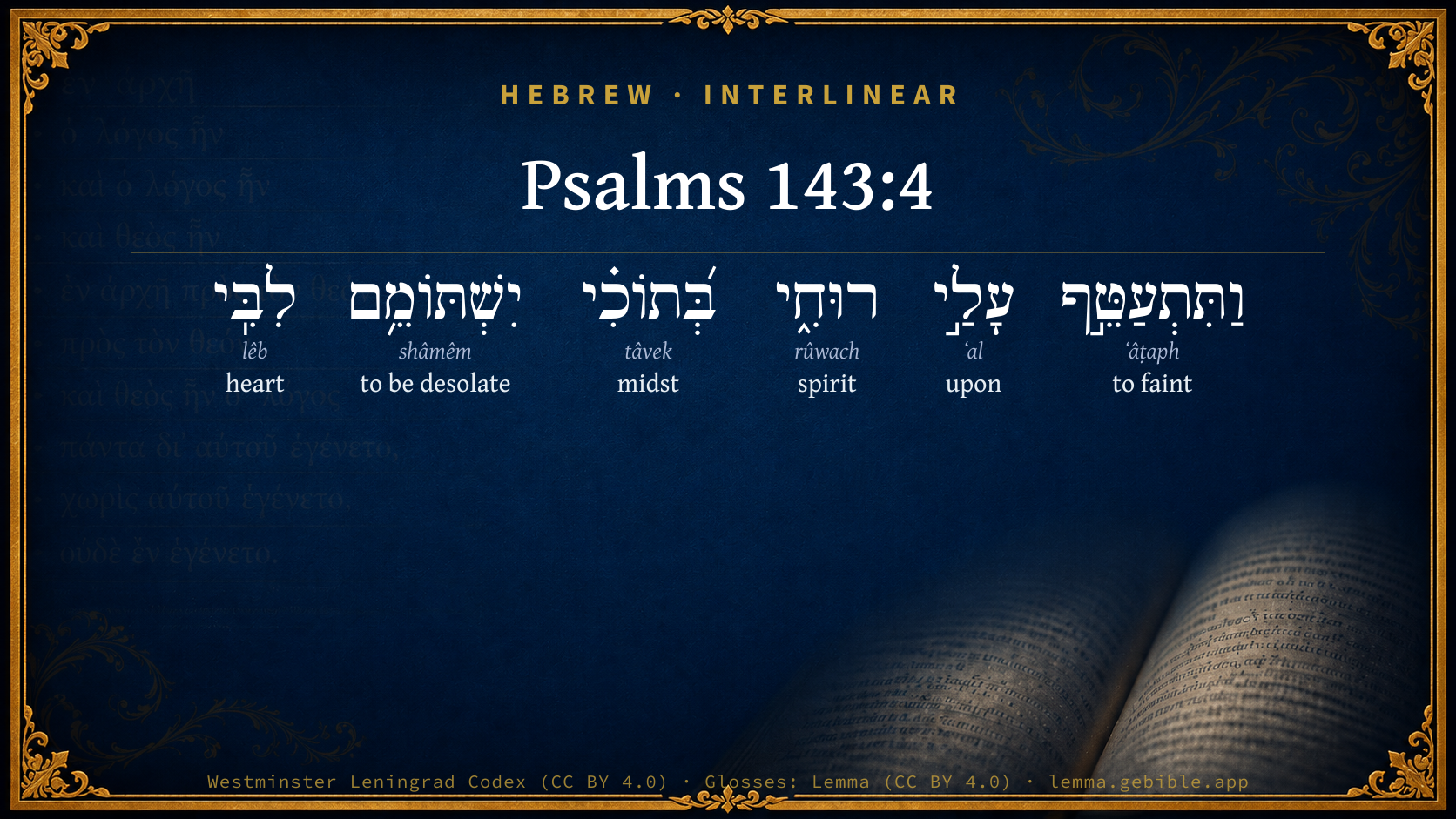
Psalms 143:4

Hebrew (Westminster Leningrad Codex) Psalms 143:4 appears in the Hebrew Old Testament. The text above is from the Westminster Leningrad Codex. Each word links to its Strong’s number, a concise gloss, and parsing drawn from the Open Scriptures Hebrew Bible morphology. Click any word for its full Brown-Driver-Briggs (BDB) entry.
Download image
Cite this verse

Psalms 143:4 (World English Bible). Public Domain. Lemma interlinear Bible study tool, https://lemma.gebible.app/v/psalms/143/4.

Show BibTeX & RIS
BibTeX
RIS
English Translation
Therefore my spirit is overwhelmed within me. My heart within me is desolate.
World English Bible · Public Domain
Download a study sheet

One document with this verse’s original text, its word-by-word gloss line, the meaning frame, cross-references with their text, attributed commentary, and full source and license credits — printable, and it pastes into notes with its structure intact.

This verse Autodidact and up

Study sheet (.html) Plain text (.txt)

A passage Seminary Student

Up to 50 verses in one chapter. A passage sheet keeps up to 6 commentary sources and 12 cross-references per verse, in the order this page ranks them, and says so on the sheet whenever that leaves anything out. Ask for a single verse and you get the Autodidact verse sheet above.

Everything on this page stays free to read, with no account — the sheet is a download of what is already on screen, not access to it.

Want to remove ads? Support Godless Engineer
Compare translations 3

The same verse in 3 English versions, stacked beneath the original-language interlinear above. Click any original word for its lexicon entry.

Each is an independent rendering of the whole verse — the interlinear is not word-aligned to these translations.

Highlighted words mark where these versions differ — a whole-verse word diff, not a word-by-word alignment.

  • World English Bible Public Domain
    Therefore my spirit is overwhelmed within me. My heart within me is desolate.
  • King James Version Public Domain
    Therefore is my spirit overwhelmed within me; my heart within me is desolate.
  • unfoldingWord Literal Text CC BY-SA 4.0
    So my spirit faints within me; my heart despairs inside me.

unfoldingWord Literal Text — © unfoldingWord, licensed CC BY-SA 4.0. Word-aligned USFM3 via Door43 (git.door43.org/unfoldingWord/en_ult).

Versions to compare (up to 4)

3 of 4 selected

Show all 18 translations

Every available English version of this verse, each an independent rendering of the whole verse.

  • World English Bible Public Domain
    Therefore my spirit is overwhelmed within me. My heart within me is desolate.
  • Berean Standard Bible Public Domain
    My spirit grows faint within me; my heart is dismayed inside me.
  • Majority Standard Bible Public Domain
    My spirit grows faint within me; my heart is dismayed inside me.
  • King James Version Public Domain
    Therefore is my spirit overwhelmed within me; my heart within me is desolate.
  • American Standard Version (1901) Public Domain
    Therefore is my spirit overwhelmed within me; My heart within me is desolate.
  • Revised Version (1885) Public Domain
    Therefore is my spirit overwhelmed within me; my heart within me is desolate.
  • Geneva Bible (1599) Public Domain
    And my spirit was in perplexitie in me, and mine heart within me was amased.
  • Douay-Rheims (1899) Public Domain
    When my spirit failed me, then thou newest my paths.
  • Young's Literal Translation Public Domain
    And my spirit in me is become feeble, Within me is my heart become desolate.
  • Literal Standard Version CC BY-SA 4.0
    And my spirit has become feeble in me, || My heart has become desolate within me.
  • Unlocked Literal Bible CC BY-SA 4.0
    My spirit is overwhelmed within me; my heart despairs.
  • unfoldingWord Literal Text CC BY-SA 4.0
    So my spirit faints within me; my heart despairs inside me.
  • Darby Bible Public Domain
    And my spirit is overwhelmed within me; my heart within me is desolate.
  • World Messianic Bible Public Domain
    Therefore my spirit is overwhelmed within me. My heart within me is desolate.
  • Webster's Bible Public Domain
    Therefore is my spirit overwhelmed within me; my heart within me is desolate.
  • Free Bible Version CC BY-SA 4.0
    I sense myself fading away inside; I am overwhelmed by a sense of desolation.
  • Bible in Basic English Public Domain
    Because of this my spirit is overcome; and my heart is full of fear.
  • JPS Tanakh (1917) Public Domain
    And my spirit fainteth within me; my heart within me is appalled.

Literal Standard Version (2020), Covenant Press — licensed CC BY-SA 4.0. Text via the HelloAO Bible API (eBible.org). Unlocked Literal Bible (unfoldingWord) — licensed CC BY-SA 4.0. Text via the HelloAO Bible API (eBible.org). unfoldingWord Literal Text — © unfoldingWord, licensed CC BY-SA 4.0. Word-aligned USFM3 via Door43 (git.door43.org/unfoldingWord/en_ult). Free Bible Version, Dr. Jonathan Gallagher — licensed CC BY-SA 4.0. Text via the HelloAO Bible API (eBible.org).

Word by word

More ways to search: Search by grammar → Find every occurrence → Compare this word →

Practice this passage: Drill this verse → Learn its vocabulary →

וַתִּתְעַטֵּ֣ף
ʻâṭaph
H5848
“and · to faint”
Conjunction + Verb, Hithpael, Sequential Imperfect, 3rd Person, Feminine, Singular
Part of Speech
Conjunction + Verb
Stem
Hithpael
Form
Sequential Imperfect
Person
3rd Person
Gender
Feminine
Number
Singular
Full BDB Definition

Origin: a primitive root

TWOT: 1605 , 1606 , 1607

to turn aside - (Qal) to turn aside, turn (in order to cover) - to envelop oneself - (Qal) to envelop oneself, cover - to be feeble, be faint, grow weak - (Qal) to be feeble, be faint - (Niphal) to faint - (Hiphil) to show feebleness - (Hithpael) to faint, faint away
  1. עָלַ֣י ʻal H5921 “upon · me” Preposition + Suffix, Personal, 1st Person, Common, Singular
  2. רוּחִ֑י rûwach H7307 “spirit · my” Noun, Common, Both, Singular, Construct + Suffix, Personal, 1st Person, Common, Singular
  3. בְּ֝תוֹכִ֗י tâvek H8432 “in/at · midst · my” Preposition + Noun, Common, Masculine, Singular, Construct + Suffix, Personal, 1st Person, Common, Singular
  4. יִשְׁתּוֹמֵ֥ם shâmêm H8074 “to be desolate” Verb, Hithpolel, Imperfect, 3rd Person, Masculine, Singular
  5. לִבִּֽי lêb H3820 “heart · my” Noun, Common, Masculine, Singular, Construct + Suffix, Personal, 1st Person, Common, Singular

About this verse

These counts appear in no published source. They are computed here, from the morphology-tagged text and Lemma’s own curated glosses. What Lemma adds →

6
words
6
distinct lemmas
Wisdom
section

Notable vocabulary

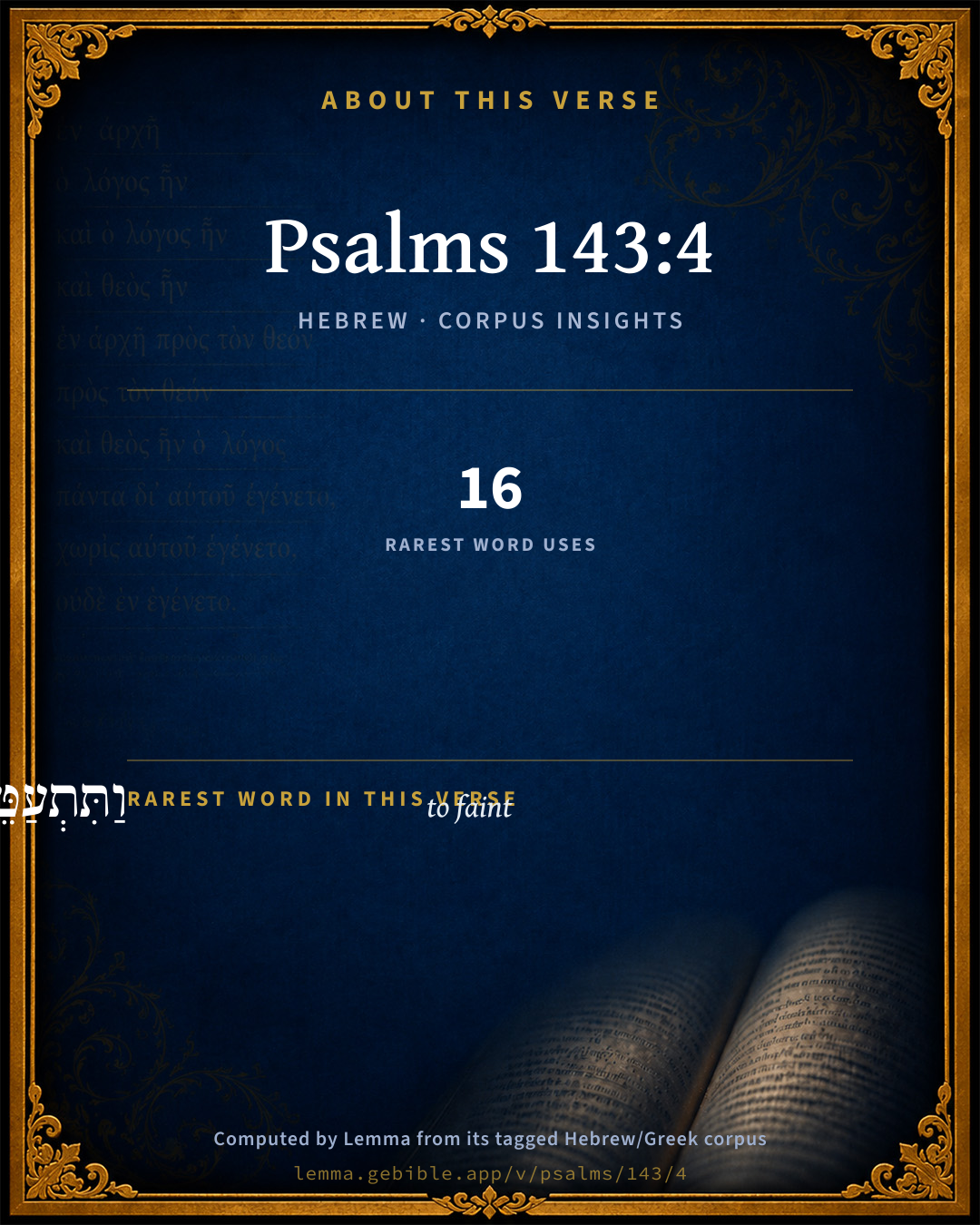
The rarest word here is וַתִּתְעַטֵּ֣ף to faint H5848 — appearing just 16 times in the whole Hebrew Bible.

Shared distinctive vocabulary

וַתִּתְעַטֵּ֣ף to faint H5848 occurs in 15 verses of the Hebrew Bible. Also found in:

Grammatical profile

  • 2 verbs
  • 3 nouns
  • 1 preposition

Verb forms

  • וַתִּתְעַטֵּ֣ף Hithpael · Sequential Imperfect
  • יִשְׁתּוֹמֵ֥ם Hithpolel · Imperfect

Hebrew & Septuagint length

In English translation the verse runs 13 words from the Hebrew and 13 from the Septuagint (LXX English) — the same length.

A rough comparison of the two English renderings, which tokenize alike — not a word-level alignment.

Word counts can differ between the Hebrew and the Greek without any difference in meaning — e.g. the Hebrew direct-object marker אֵת has no separate Greek word, and Greek often adds the article ὁ.

Cross-references

11

Topical passages linked to Psalms 143:4 in the Treasury of Scripture Knowledge — connected by theme and wording, ordered by reader-vote popularity; previews shown in the World English Bible.

  • Psalms 77:3 I remember God, and I groan. I complain, and my spirit is overwhelmed. Selah.
  • Psalms 142:3 When my spirit was overwhelmed within me, You knew my path. In the way in which I walk, They have hidden a snare for me.
  • Psalms 55:5 Fearfulness and trembling have come on me. Horror has overwhelmed me.
  • Psalms 102:3–4 For my days consume away like smoke. My bones are burned as a firebrand.
  • Luke 22:44 Being in agony he prayed more earnestly. His sweat became like great drops of blood falling down on the ground.
  • Job 6:27 Yes, you would even cast lots for the fatherless, And make merchandise of your friend.
  • Psalms 25:16 Turn to me, and have mercy on me, For I am desolate and afflicted.
  • Psalms 61:2 From the end of the earth, I will call to you, when my heart is overwhelmed. Lead me to the rock that is higher than I.
  • Psalms 102:1 Hear my prayer, Yahweh! Let my cry come to you.
  • Psalms 119:81–83 My soul faints for your salvation. I hope in your word.
  • Psalms 124:4 Then the waters would have overwhelmed us, The stream would have gone over our soul;

Cross-references courtesy of OpenBible.info (CC BY 4.0).

Hebrew and Greek witnesses Masoretic Hebrew ↔ Greek Septuagint

The same verse in the two great witnesses to the Old Testament, shown verse-for-verse.

You’re reading Greek Psalm 142 (Hebrew Psalm 143). The Septuagint counts the superscription, so verse numbers can differ from the Hebrew — chapter-level alignment, not verse-by-verse. Numbering follows Rahlfs.

These are two independent witnesses, not word-aligned to each other, and the Septuagint is shown in lemma (dictionary) form.

Hebrew Psalms 143:4 Masoretic · Westminster Leningrad Codex

וַתִּתְעַטֵּ֣ף עָלַ֣י רוּחִ֑י בְּ֝תוֹכִ֗י יִשְׁתּוֹמֵ֥ם לִבִּֽי

Therefore my spirit is overwhelmed within me. My heart within me is desolate.

World English Bible · Public Domain

Greek LXX Greek Psalm 142:4 Septuagint · lemma form

καί ἀκηδιάζω ἐπί ἐγώ ὁ πνεῦμα ἐγώ ἐν ἐγώ ταράσσω ὁ καρδία ἐγώ

Therefore my spirit was grieved in me; my heart was troubled within me.

LXX2012 (modern English Septuagint) · Public Domain

Hebrew: Westminster Leningrad Codex (CC BY 4.0). Greek: Septuagint (public domain); English from LXX2012 (modern English Septuagint) (Public Domain). How the Septuagint differs from the Hebrew →

Commentary

Notes on Psalms 143:4 from classic Christian and Jewish commentators (each source and its license shown beneath its notes). The classic Christian expositions comment on the surrounding passage and are grouped to its opening verse, so a note may address several verses; the Jewish commentaries on the Tanakh (Rashi and others) are per-verse, so they appear only where the commentator wrote on this verse.

Lemma curates 59 commentaries, every one of them public domain or Creative Commons licensed, each selected and text-cleaned for this edition rather than reprinted as found. About our sources →

Trapp's Complete Commentary

John Trapp

Psa 143:4 Therefore is my spirit overwhelmed within me; my heart within me is desolate.

Ver. 4. Therefore is my spirit overwhelmed] God’s dearest children have their passions; against that stoic apathy. A sheep bitten by a dog is no less sensible of the pain thereof than a swine is; though he make not such an outcry.

John Trapp, A Commentary or Exposition upon All the Books of the Old and New Testament (1647–1656) — public domain. Text from a community e-Sword module.

The Biblical Illustrator

Joseph S. Exell

Psa_143:4

My heart within me is desolate.

Trouble of soul

He spake before of his external calamities; now he confesseth the infirmities of his mind, that he was wonderfully cast down in heart and troubled in his soul, so that his strength was almost gone (not like the strength of a whale fish, or of a rock), but being ready to drown with sorrow, he was sustained by faith and Gods Spirit, he swam under these evils. Our Saviour Himself confessed of Himself, My soul is troubled to the death. God knoweth our mould, we are not stocks without passions or perturbations; we are not like lepers, whose flesh is senseless; but we are sensible of evils, that we may run to God for help and comfort. Had not Job his own perturbations and griefs, which made him utter hard speeches, for which God rebuked him, and he afterwards repented? yet God affirmed that he spake better of him than all his friends did. Can a ship sail along with such a constant and direct course in stormy weather as it were calm and before the wind? it is enough that it directeth the course ever towards the port, albeit it be forced to cast board twenty times. So God careth not albeit we be troubled in our course to heaven. Let us ever aim at the port of eternal glory, howsoever we be disquieted with contrary winds and tempests, God will pass by all those our frailties and imperfections, and will at last deliver us from them all, if in the midst of those our extremities our heart set itself toward heaven. (A. Symson.)

The Biblical Illustrator, edited by Joseph S. Exell (c. 1880s–1900s) — public domain. Text from a community e-Sword module.

J. A. Alexander on Psalms

Joseph Addison Alexander

4. (Psa 143:4) And overwhelmed within me is my spirit; in the midst of me desolated is my heart. With the first clause compare Psa 142:3; with the the second Psa 40:15.

Joseph Addison Alexander, The Psalms Translated and Explained (1850) — public domain. Text from a community e-Sword module.

Geneva Bible (1599)

Geneva Bible translators

So that only by faith and by the grace of God’s Spirit was he upheld.

Geneva Bible (1599) marginal notes — public domain. Text via Bolls.life.

Adam Clarke's Commentary

Verse 4. Therefore is my spirit] I am deeply depressed in spirit, and greatly afflicted in body.

My heart within me is desolate.] It has no companion of its sorrows, no sympathetic friend. I am utterly destitute of comfort.

Adam Clarke's Commentary on the Bible (1810–1826) — public domain. Text from a community e-Sword/MySword module.

John Calvin's Commentaries

4. And my spirit, etc. Hitherto he has spoken of the troubles that were without, now he acknowledges the feebleness of his spirits, from which it is evident that his strength, was not like that of the rock, imperturbable or without feeling, but that, while overwhelmed with grief as to the feeling of the flesh, he owed his support entirely to faith and the grace of the Spirit. We are taught by his example not to throw up the conflict in despair, however much we may be weakened, and even exanimated by afflictions, as God will enable us to surmount them, if we only rise to him with our hearts amidst all our anxieties.

In the next verse David mentions that he had diligently sought means whereby to mitigate his grief. It is not to be wondered at, that many who spontaneously give themselves up to inaction, should sink under their trials, not using means to invigorate themselves by calling to remembrance the grace of God. Sometimes, it is true, our trials are only more keenly felt when we recall the former kindness which God may have shown to us, the comparison tending to awaken our feelings, and render them more acute; but David proposed a different end than this to himself, and gathered confidence from the past mercies of God. The very best method in order to obtain relief in trouble, when we are about to faint under it, is to call to mind the former loving-kindness of the Lord. Nor does David mean such as he had experienced from childhood, as some have thought, adopting in my judgment too restricted a sense; for the word קדם, kedem, has a more extensive signification. I have no doubt, therefore, that he includes past history, as well as his own personal experience, it being easy to discover proofs there of God’s continued goodness to his people. We should ourselves learn by his example, in reflecting upon personal favors received from God, to remember also how often he has assisted those that served him, and improve the truth for our own benefit. Should this not immediately or at once abate the bitterness of our grief, yet the advantage of it will afterwards appear. In the passage before us, David complains that he did not get relief from his anxieties and cares from this consolatory source, but he prosecuted his meditations in expectation of finding the good result in due time. The verb שוה, suach, I have elsewhere observed, may mean either to declare with the tongue, or to revolve in the mind. Some accordingly read — “I have discoursed of thy works.” But as the verb הגה, hagah, means to meditate, I consider that the Psalmist repeats the same thing twice, and this in token of earnestness. We will often upon a slight exercise of the thoughts upon God’s works, start aside from them almost immediately; nor is it matter of surprise, that, in this case, there results no solid comfort. That our knowledge may be abiding we must call in the aid of constant attention.

John Calvin's Commentaries (1540-1563) — public domain. Text from the Calvin Translation Society English edition (1840s-50s) via the Christian Classics Ethereal Library (ccel.org). Calvin's coverage is partial (roughly two-thirds of the Bible); uncommented books and verses are honest gaps, never fabricated. The 19th-century editor's footnotes and remarks are omitted so the notes are faithfully Calvin's own voice.

Ellicott's Commentary for English Readers

(4) See Psa_142:3, and Notes.

Is desolate.—Or, more literally, as in Isa_59:16; Isa_63:5, &c, wondered; literally, fills itself with astonishment.

A Bible Commentary for English Readers, edited by Charles John Ellicott (1878–1897) — public domain. Text from a community e-Sword module.

The Cambridge Bible for Schools and Colleges

gen. ed. J. J. S. Perowne

4. And my spirit has fainted upon me;

My heart within me is appalled.

my spirit &c.] Cp. Psa_142:3, note.

is desolate] Rather, is appalled, stupefied and paralysed at the apparent hopelessness of my position. Cp. Dan_8:27. “The root-idea of the word seems to have been to be motionless,—sometimes in the stillness of desolation, sometimes through amazement” (Driver on Dan_4:19).

The Cambridge Bible for Schools and Colleges (gen. ed. J. J. S. Perowne; Cambridge University Press, 1878–1918) — public domain. Text from a community e-Sword module.

John Gill's Exposition

Therefore is my spirit overwhelmed within me,.... Covered over with grief, borne down with sorrow, ready to sink and fail; See Gill on Psa 142:3;

my heart within me is desolate; destitute of the spirit and presence of God, and with respect to the exercise of grace, and filled with fears and misgivings; or "astonished" (u), at the providence he was under, like one stunned and filled with sore amazement, not knowing what to make of things, or what the issue of them would be; so David's antitype was "sore amazed" in the garden, when his troubles and agonies came upon him, Mar 14:33.

(u) "attonitum est", Vatablus; "stupuit", Tigurine version; "stupet", Cocceius, Michaelis; "obstupuit", Gejerus.

John Gill's Exposition of the Whole Bible (1746–1763) — public domain (CC PDM 1.0). Text via the HelloAO Bible API.

Albert Barnes' Notes on the Bible

Therefore is my spirit overwhelmed within me - See the notes at Psa 77:3. Compare Psa 42:5-7. His spirit was broken and crushed. He was in a state of despair as to any human help.

My heart within me is desolate - I have no comfort; no cheerfulness; no hope. My soul is like the waste desert where there is no water; where nothing grows; where there are only rocks and sands.

Albert Barnes' Notes on the Bible (1834–1885) — public domain. Text from a community e-Sword/MySword module.

Matthew Poole's English Annotations

My spirit overwhelmed within me. See Poole "Psa 61:2" See Poole "Psa 142:3".

Is desolate; deprived of all hope and comfort. Or, is astonished.

Matthew Poole's English Annotations on the Holy Bible (1683–1685) — public domain. Text from a community e-Sword/MySword module.

The Treasury of David

Charles H. Spurgeon

Ver. 4. Therefore is my spirit overwhelmed within me; my heart within me is desolate. David was no stoic: he felt his banishment, and smarted under the cruel assaults which were made upon his character. He felt perplexed and overturned, lonely and afflicted. He was a man of thought and feeling, and suffered both in spirit and in heart from the undeserved and unprovoked hostility of his persecutors. Moreover, he laboured under the sense of fearful loneliness; he was for a while forsaken of his God, and his soul was exceeding heavy, even unto death. Such words our Lord Jesus might have used: in this the Head is like the members, and the members are as the Head.

Ver. 4. Therefore is my spirit overwhelmed, etc. David was not only a great saint, but a great soldier, and yet even he was sometimes ready to faint in the day of adversity. "Howl, fir trees, if the cedars be shaken." Matthew Henry.

Ver. 4. (second clause.) Within literally, "in the midst of me"; implying how deeply the feeling had penetrated. "Is desolate", or rather, "is stupefied", in a similar sense to that of the Hebrew (Isa 59:16 63:5 Da 8:27). So the Chaldaic, The 70., Vulgate, Arabic, and Syriac, "is agitated." Andrew Robert Fausset.

Ver. 4. Is desolate. Or rather, "is full of amazement", literally, "astonishes itself"; seeks to comprehend the mystery of its sufferings, and is ever beaten back upon itself in its perplexity: such is the full force of the reflexive conjugation here employed. J. J. Stewart Perowne.

Ver. 4-5. How poor a judgment can be formed of a man's state from the considerations of comfort only. A holy man, we clearly see, may be void of comfort; his spirit may be overwhelmed, and his heart desolate. Nay, was it not so even with the holy Jesus himself? was he not very heavy, and his soul exceeding sorrowful even unto death? But never did the Saviour's faith and submission to his Father's will shine more brightly than in that hour of darkness. And David's faith also rises to meet the occasion. His trial is great, and his faith is great also. Hardly when he is on the mount of praise, and singing his songs of Zion in the most triumphant strain, does he appear more admirable than when struggling through this painful conflict. He is troubled on every side, yet not removed; perplexed, but not in despair; persecuted, but not forsaken; cast down, but not destroyed. He has no arm of flesh to trust to, and nothing within himself to support his hope; but with what simplicity, and energy of trust, does he betake himself to God, revolving ill his memory past seasons of deliverance, and staying his mind on the power and truth of Jehovah! "I remember the days of old; I meditate on all thy works; I muse on the work of thy hands." John Fawcett.

Ver. 4-6.

1. Down in Despondency.

2. Deep in Meditation.

3. Determined in Supplication.

Psalms 143:5*

Charles H. Spurgeon's The Treasury of David (1869–1885) — public domain. Psalms only. Text from a community e-Sword/MySword module.

Whedon's Commentary on the Bible

Daniel D. Whedon

4. My heart… is desolate—A physical allusion signifying, “Is failing to beat,” “is getting torpid.” In sorrow the nervous currents diminish, and organic activity of the body declines.

Daniel D. Whedon (gen. ed.), Commentary on the Old and New Testaments (1874–1909) — public domain. Text from a community e-Sword module.

The Pulpit Commentary

Therefore is my spirit overwhelmed within me; or, "faint within me". (see Psa_42:3) My heart within me is desolate. (comp. Psa_40:15)

Our worst trials are in the sphere of feeling.

"Is desolate;" or, is full of amazement; astonishes itself; seeks to comprehend the mystery of its sufferings, and is ever beaten back upon itself in its perplexity; is dispirited. "How poor a judgment can be formed of a man"s state from the considerations of comfort only!" There are trials which are wholly kept in the physical sphere. There are aches and pains of body, and disabilities of bodily organs, which have no direct connection with sin, and so no bitterness through witnessing conscience; and which arouse no feeling save the simple feeling of enduring. There are trials which have no relation to the outer world of circumstances; they belong wholly to the inner world of feeling.

I TRIALS THAT KEEP IN THE BODILY SPHERES HAVE MANY RELIEFS. Especially may be noticed those that come by sympathy. Others can understand and estimate these trials. The comfortings they present are kin with the trials. There is no secrecy about these trials; they who suffer under them need not be lonely. And of God it can be said, "He knoweth our frame," and can be in closest sympathy with us. A grief that we can tell to another is not our worst grief.

II TRIALS THAT GET INTO THE SPHERE OF FEELING HAVE FEW RELIEFS. SO mysterious is human nature; so complex are the relations of body and mind; so strangely possible is it for a man to live an interior life distinct from bodily conditions and relations, that it is possible for a man to have trials wholly in the sphere of feeling. And these are the worst trials, because for them we can get little or no human sympathy. They put us apart from our fellow-men in loneliness. Our Lord suffered bodily on the cross; but the sufferings in feeling were his real sufferings. Yet even in these worst trials we are not separated from God. Indeed, as these belong to the spirit-region, they belong more especially to the sphere in which God works most freely. When the "heart" is desolate, there is the more need for its filling and comforting with that sense of God which may be so fully realized. R.T.

The Pulpit Commentary (1880–1919), ed. H.D.M. Spence-Jones & Joseph S. Exell — public domain. Text from a community e-Sword module.

Rashi

Rabbi Shlomo Yitzchaki (Rashi)

is appalled Heb. ישתומם, an expression of daze and astonishment, like (Ezek. 3:15): “and I remained there overwhelmed (משמים) among them seven days.” Also (II Sam. 13:20): “and Tamar sat, overwhelmed (ושוממה).”

Rashi on the Tanakh — English translations: “The Judaica Press complete Tanach with Rashi, translated by A. J. Rosenberg” (CC BY 4.0); “Pentateuch with Rashi's commentary by M. Rosenbaum and A.M. Silbermann, 1929-1934” (public domain); “The Metsudah Tanach series, Lakewood, N.J” (CC BY 4.0); and “The Book of Joshua, Metsudah Publications, 1997” (CC BY 4.0). Text via Sefaria.

Lesson kit

Teaching starters — assembled from the data on this page, not authored interpretation. Every prompt links to the verse data it draws on. Edit before teaching.

Psalms, in the Wisdom, opens this verse with 6 words (6 distinct Hebrew lemmas). Its most distinctive word is ʻâṭaph (“to faint”). A historical commentator’s framing appears above. Read the whole chapter for the surrounding context.

Discussion questions

  1. How does “to faint” (ʻâṭaph) shape what this verse is saying?
  2. Genesis 30:42 shares the word «to faint» with this verse. How do the two illuminate each other?
  3. These translations render this verse differently; the difference is in the English rendering, not the original. What questions does that raise?
  4. The verb «וַתִּתְעַטֵּ֣ף» is Hithpael Sequential Imperfect. How does its form color the action?
  5. Reading how Trapp's Complete Commentary and The Biblical Illustrator read this verse, where do the two commentators agree and where do they part?

Things to notice

Reading settings

Reading text

Shown beneath each verse's original-language words.

Old Testament
Old Testament edition

Read the OT as the Masoretic Hebrew (MT) or the Greek Septuagint (LXX).

English shown for the Greek Septuagint (in the Hebrew ↔ Greek comparison).

Comparing translations? Open the Compare panel on any verse page to stack up to four side by side.