
Ecclesiastes 2:11

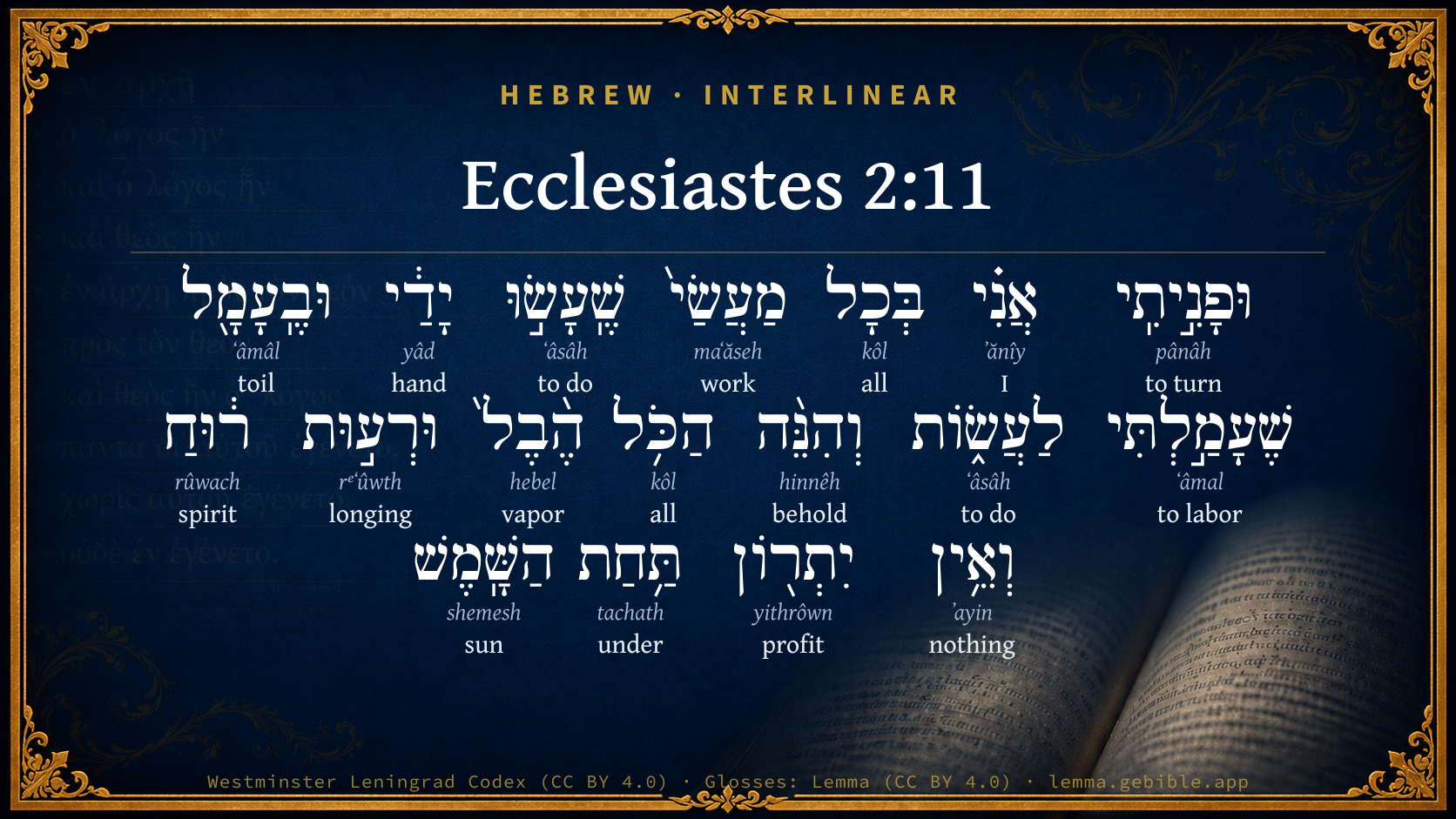
Hebrew (Westminster Leningrad Codex) Ecclesiastes 2:11 appears in the Hebrew Old Testament. The text above is from the Westminster Leningrad Codex. Each word links to its Strong’s number, a concise gloss, and parsing drawn from the Open Scriptures Hebrew Bible morphology. Click any word for its full Brown-Driver-Briggs (BDB) entry.
Download image
Cite this verse

Ecclesiastes 2:11 (World English Bible). Public Domain. Lemma interlinear Bible study tool, https://lemma.gebible.app/v/ecclesiastes/2/11.

Show BibTeX & RIS
BibTeX
RIS
English Translation
Then I looked at all the works that my hands had worked, and at the labor that I had labored to do; and, behold, all was vanity and a chasing after wind, and there was no profit under the sun.
World English Bible · Public Domain
Download a study sheet

One document with this verse’s original text, its word-by-word gloss line, the meaning frame, cross-references with their text, attributed commentary, and full source and license credits — printable, and it pastes into notes with its structure intact.

This verse Autodidact and up

Study sheet (.html) Plain text (.txt)

A passage Seminary Student

Up to 50 verses in one chapter. A passage sheet keeps up to 6 commentary sources and 12 cross-references per verse, in the order this page ranks them, and says so on the sheet whenever that leaves anything out. Ask for a single verse and you get the Autodidact verse sheet above.

Everything on this page stays free to read, with no account — the sheet is a download of what is already on screen, not access to it.

Want to remove ads? Support Godless Engineer
Compare translations 3

The same verse in 3 English versions, stacked beneath the original-language interlinear above. Click any original word for its lexicon entry.

Each is an independent rendering of the whole verse — the interlinear is not word-aligned to these translations.

Highlighted words mark where these versions differ — a whole-verse word diff, not a word-by-word alignment.

  • World English Bible Public Domain
    Then I looked at all the works that my hands had worked, and at the labor that I had labored to do; and, behold, all was vanity and a chasing after wind, and there was no profit under the sun.
  • King James Version Public Domain
    Then I looked on all the works that my hands had wrought, and on the labour that I had laboured to do: and, behold, all was vanity and vexation of spirit, and there was no profit under the sun.
  • unfoldingWord Literal Text CC BY-SA 4.0
    And I turned, I, to all my works that my hands had done and to toil that I toiled to do and look, everything vapor and pursuit of wind, and there was no profit under the sun.

unfoldingWord Literal Text — © unfoldingWord, licensed CC BY-SA 4.0. Word-aligned USFM3 via Door43 (git.door43.org/unfoldingWord/en_ult).

Versions to compare (up to 4)

3 of 4 selected

Show all 18 translations

Every available English version of this verse, each an independent rendering of the whole verse.

  • World English Bible Public Domain
    Then I looked at all the works that my hands had worked, and at the labor that I had labored to do; and, behold, all was vanity and a chasing after wind, and there was no profit under the sun.
  • Berean Standard Bible Public Domain
    Yet when I considered all the works that my hands had accomplished and what I had toiled to achieve, I found everything to be futile, a pursuit of the wind; there was nothing to be gained under the sun.
  • Majority Standard Bible Public Domain
    Yet when I considered all the works that my hands had accomplished and what I had toiled to achieve, I found everything to be futile, a pursuit of the wind; there was nothing to be gained under the sun.
  • King James Version Public Domain
    Then I looked on all the works that my hands had wrought, and on the labour that I had laboured to do: and, behold, all was vanity and vexation of spirit, and there was no profit under the sun.
  • American Standard Version (1901) Public Domain
    Then I looked on all the works that my hands had wrought, and on the labor that I had labored to do; and, behold, all was vanity and a striving after wind, and there was no profit under the sun.
  • Revised Version (1885) Public Domain
    Then I looked on all the works that my hands had wrought, and on the labour that I had laboured to do: and, behold, all was vanity and a striving after wind, and there was no profit under the sun.
  • Geneva Bible (1599) Public Domain
    Then I looked on all my workes that mine hands had wrought, and on the trauaile that I had laboured to doe: and beholde, all is vanitie and vexation of the spirit: and there is no profite vnder the sunne.
  • Douay-Rheims (1899) Public Domain
    And when I turned myself to all the works which my hands had wrought, and to the labours wherein I had laboured in vain, I saw in all things vanity, and vexation of mind, and that nothing was lasting under the sun.
  • Young's Literal Translation Public Domain
    and I have looked on all my works that my hands have done, and on the labour that I have laboured to do, and lo, the whole `is' vanity and vexation of spirit, and there is no advantage under the sun!
  • Literal Standard Version CC BY-SA 4.0
    and I have looked on all my works that my hands have done, and on the labor that I have labored to do, and behold, the whole [is] vanity and distress of spirit, and there is no advantage under the sun!
  • Unlocked Literal Bible CC BY-SA 4.0
    Then I looked on all the deeds that my hands had accomplished, and on the work that I had done, but again, everything was vapor and an attempt to shepherd the wind. There was no profit under the sun in it.
  • unfoldingWord Literal Text CC BY-SA 4.0
    And I turned, I, to all my works that my hands had done and to toil that I toiled to do and look, everything vapor and pursuit of wind, and there was no profit under the sun.
  • Darby Bible Public Domain
    Then I looked on all the works that my hands had wrought, and on the labour that it had cost me to do [them]; and behold, all was vanity and pursuit of the wind, and there was no profit under the sun.
  • World Messianic Bible Public Domain
    Then I looked at all the works that my hands had worked, and at the labor that I had labored to do; and behold, all was vanity and a chasing after wind, and there was no profit under the sun.
  • Webster's Bible Public Domain
    Then I looked on all the works that my hands had wrought, and on the labor that I had labored to do: and behold, all was vanity and vexation of spirit, and there was no profit under the sun.
  • Free Bible Version CC BY-SA 4.0
    But when I thought about what I had worked so hard to achieve, everything I'd done, it was so short-lived—as significant as someone trying to catch the wind. There really is no enduring benefit here on earth.
  • Bible in Basic English Public Domain
    Then I saw all the works which my hands had made, and everything I had been working to do; and I saw that all was to no purpose and desire for wind, and there was no profit under the sun.
  • JPS Tanakh (1917) Public Domain
    Then I looked on all the works that my hands had wrought, and on the labour that I had laboured to do; and, behold, all was vanity and a striving after wind, and there was no profit under the sun.

Literal Standard Version (2020), Covenant Press — licensed CC BY-SA 4.0. Text via the HelloAO Bible API (eBible.org). Unlocked Literal Bible (unfoldingWord) — licensed CC BY-SA 4.0. Text via the HelloAO Bible API (eBible.org). unfoldingWord Literal Text — © unfoldingWord, licensed CC BY-SA 4.0. Word-aligned USFM3 via Door43 (git.door43.org/unfoldingWord/en_ult). Free Bible Version, Dr. Jonathan Gallagher — licensed CC BY-SA 4.0. Text via the HelloAO Bible API (eBible.org).

Word by word

More ways to search: Search by grammar → Find every occurrence → Compare this word →

Practice this passage: Drill this verse → Learn its vocabulary →

וּרְע֣וּת
rᵉʻûwth
H7469
“and · longing of”
Conjunction + Noun, Common, Feminine, Singular, Construct
Part of Speech
Conjunction + Noun
Type
Common
Gender
Feminine
Number
Singular
State
Construct
Full BDB Definition

Origin: probably from H7462

TWOT: 2187b

longing, striving
  1. וּפָנִ֣יתִֽי pânâh H6437 “and · to turn” Conjunction + Verb, Qal, Perfect, 1st Person, Common, Singular
  2. אֲנִ֗י ʼănîy H589 “I” Pronoun, Personal, 1st Person, Common, Singular
  3. בְּכָל kôl H3605 “in/at · all of” Preposition + Noun, Common, Masculine, Singular, Construct
  4. מַעֲשַׂי֙ maʻăseh H4639 “works · my” Noun, Common, Masculine, Plural, Construct + Suffix, Personal, 1st Person, Common, Singular
  5. שֶֽׁעָשׂ֣וּ ʻâsâh H6213 “who/which · to do” Particle, Relative + Verb, Qal, Perfect, 3rd Person, Common, Plural
  6. יָדַ֔י yâd H3027 “hands · my” Noun, Common, Both, Dual, Construct + Suffix, Personal, 1st Person, Common, Singular
  7. וּבֶֽעָמָ֖ל ʻâmâl H5999 “and · in/at the · toil” Conjunction + Preposition, Determined + Noun, Common, Both, Singular, Absolute
  8. שֶׁעָמַ֣לְתִּי ʻâmal H5998 “who/which · to labor” Particle, Relative + Verb, Qal, Perfect, 1st Person, Common, Singular
  9. לַעֲשׂ֑וֹת ʻâsâh H6213 “to do” Preposition + Verb, Qal, Infinitive Construct
  10. וְהִנֵּ֨ה hinnêh H2009 “and · behold” Conjunction + Particle, Demonstrative
  11. הַכֹּ֥ל kôl H3605 “the · all” Particle, Definite Article + Noun, Common, Masculine, Singular, Absolute
  12. הֶ֨בֶל֙ hebel H1892 “vapor” Noun, Common, Masculine, Singular, Absolute
  13. ר֔וּחַ rûwach H7307 “spirit” Noun, Common, Both, Singular, Absolute
  14. וְאֵ֥ין ʼayin H369 “and · nothing” Conjunction + Particle, Negative
  15. יִתְר֖וֹן yithrôwn H3504 “profit” Noun, Common, Masculine, Singular, Absolute
  16. תַּ֥חַת tachath H8478 “under” Preposition
  17. הַשָּֽׁמֶשׁ shemesh H8121 “the · sun” Particle, Definite Article + Noun, Common, Both, Singular, Absolute

About this verse

These counts appear in no published source. They are computed here, from the morphology-tagged text and Lemma’s own curated glosses. What Lemma adds →

18
words
16
distinct lemmas
Wisdom
section

Notable vocabulary

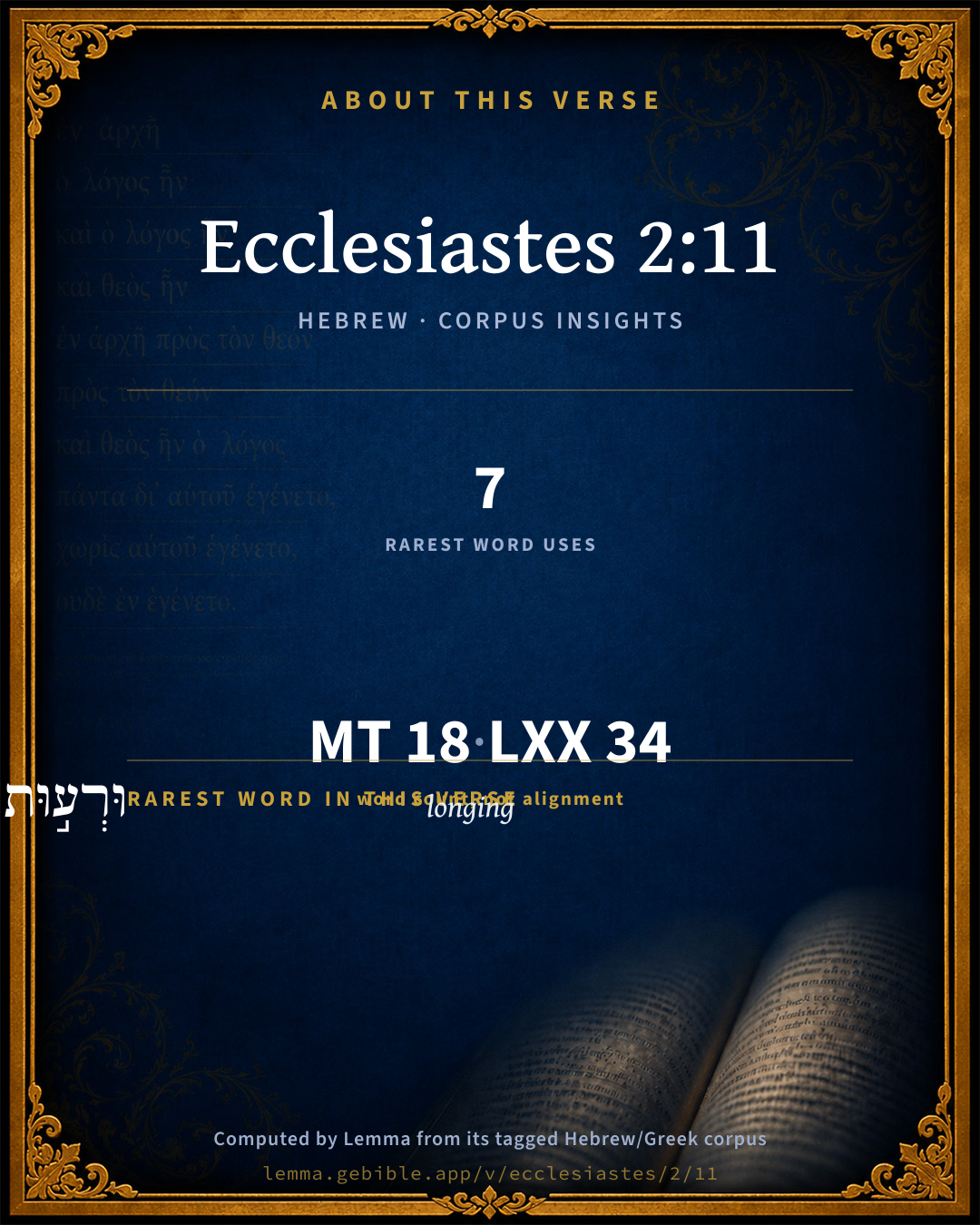
The rarest word here is וּרְע֣וּת longing H7469 — appearing just 7 times in the whole Hebrew Bible.

Shared distinctive vocabulary

וּרְע֣וּת longing H7469 occurs in 7 verses of the Hebrew Bible. Also found in:

Grammatical profile

  • 4 verbs
  • 10 nouns
  • 1 pronoun
  • 1 preposition
  • 2 particles

Verb forms

  • וּפָנִ֣יתִֽי Qal · Perfect
  • שֶֽׁעָשׂ֣וּ Qal · Perfect
  • שֶׁעָמַ֣לְתִּי Qal · Perfect
  • לַעֲשׂ֑וֹת Qal · Infinitive Construct

Repetition

Words recur within this verse — often emphatic in Hebrew:

  • בְּכָל all H3605 ×2
  • שֶֽׁעָשׂ֣וּ to do H6213 ×2

Hebrew & Septuagint length

In English translation the verse runs 40 words from the Hebrew and 38 from the Septuagint (LXX English) — closely comparable.

A rough comparison of the two English renderings, which tokenize alike — not a word-level alignment.

Word counts can differ between the Hebrew and the Greek without any difference in meaning — e.g. the Hebrew direct-object marker אֵת has no separate Greek word, and Greek often adds the article ὁ.

In the original languages it is 18 Hebrew tokens and 34 Greek tokens — but the two are counted differently (Hebrew bundles its prefixes and suffixes into one token; the Greek is in lemma form), so that isn’t a like-for-like length.

Cross-references

8

Topical passages linked to Ecclesiastes 2:11 in the Treasury of Scripture Knowledge — connected by theme and wording, ordered by reader-vote popularity; previews shown in the World English Bible.

  • Ecclesiastes 1:14 I have seen all the works that are done under the sun; and, behold, all is vanity and a chasing after wind.
  • 1 John 2:16–17 For all that is in the world, the lust of the flesh, the lust of the eyes, and the pride of life, isn't the Father's, but is the world's.
  • Ecclesiastes 1:3 What does man gain from all his labor in which he labors under the sun?
  • Genesis 1:31 God saw everything that he had made, and, behold, it was very good. There was evening and there was morning, the sixth day.
  • Exodus 39:43 Moses saw all the work, and, behold, they had done it as Yahweh had commanded, even so had they done it: and Moses blessed them.
  • 1 Timothy 6:6 But godliness with contentment is great gain.
  • Ecclesiastes 2:17–23 So I hated life, because the work that is worked under the sun was grievous to me; for all is vanity and a chasing after wind.
  • Habakkuk 2:13 Behold, isn't it of Yahweh of Hosts that the peoples labor for the fire, and the nations weary themselves for vanity?

Cross-references courtesy of OpenBible.info (CC BY 4.0).

Hebrew and Greek witnesses Masoretic Hebrew ↔ Greek Septuagint

The same verse in the two great witnesses to the Old Testament, shown verse-for-verse.

These are two independent witnesses, not word-aligned to each other, and the Septuagint is shown in lemma (dictionary) form.

Hebrew Ecclesiastes 2:11 Masoretic · Westminster Leningrad Codex

וּפָנִ֣יתִֽי אֲנִ֗י בְּכָל מַעֲשַׂי֙ שֶֽׁעָשׂ֣וּ יָדַ֔י וּבֶֽעָמָ֖ל שֶׁעָמַ֣לְתִּי לַעֲשׂ֑וֹת וְהִנֵּ֨ה הַכֹּ֥ל הֶ֨בֶל֙ וּרְע֣וּת ר֔וּחַ וְאֵ֥ין יִתְר֖וֹן תַּ֥חַת הַשָּֽׁמֶשׁ

Then I looked at all the works that my hands had worked, and at the labor that I had labored to do; and, behold, all was vanity and a chasing after wind, and there was no profit under the sun.

World English Bible · Public Domain

Greek LXX Ecclesiastes 2:11 Septuagint · lemma form

καί ἐπιβλέπω ἐγώ ἐν πᾶς ποίημα ἐγώ ὅς ποιέω ὁ χείρ ἐγώ καί ἐν μόχθος ὅς μοχθέω ὁ ποιέω καί ἰδού ὁ πᾶς ματαιότης καί προαίρεσις πνεῦμα καί οὐ εἰμί περισσεία ὑπό ὁ ἥλιος

And I looked on all my works which my hands had wrought, and on my labor which I laboured to perform: and behold, all was vanity and waywardness of spirit, and there is no advantage under the sun.

LXX2012 (modern English Septuagint) · Public Domain

Hebrew: Westminster Leningrad Codex (CC BY 4.0). Greek: Septuagint (public domain); English from LXX2012 (modern English Septuagint) (Public Domain). How the Septuagint differs from the Hebrew →

Commentary

Notes on Ecclesiastes 2:11 from classic Christian and Jewish commentators (each source and its license shown beneath its notes). The classic Christian expositions comment on the surrounding passage and are grouped to its opening verse, so a note may address several verses; the Jewish commentaries on the Tanakh (Rashi and others) are per-verse, so they appear only where the commentator wrote on this verse.

Lemma curates 59 commentaries, every one of them public domain or Creative Commons licensed, each selected and text-cleaned for this edition rather than reprinted as found. About our sources →

Trapp's Complete Commentary

John Trapp

Ecc 2:11 Then I looked on all the works that my hands had wrought, and on the labour that I had laboured to do: and, behold, all [was] vanity and vexation of spirit, and [there was] no profit under the sun.

Ver. 11. Then I looked on all the works.] A necessary and profitable practice, well worthy our imitation - viz., to recognise and review what we have done, and to how little purpose we have "wearied ourselves in the multitude of our counsels." {Isa 47:13} "God looketh upon men, and if any say, I have sinned and perverted that which was right, and it profited me not, he will deliver his soul from going into the pit, and his life shall see the light." {Job 33:27-28} Cicero {a} could tell Nevius, that if he had but well weighed with himself those two words, Quid ago? What do I? his lust and luxury would have been cooled and qualified.

And behold, all was vanity and vexation of spirit] In the very pursuit of them is much anguish, many grievances, fears, jealousies, disgraces, interruptions, discontentments. Next, it is seldom seen that God allows to the greatest darlings of the world a perfect contentment. Something they must have to complain of, that shall give an unsavoury verdure to their sweetest morsels, and make their very felicity miserable. "Yet all this avails me nothing so long as I see Mordecai," saith Haman the king’s minion. Lastly, after the unsanctified enjoyment follows the sting of conscience, that will inexpressibly vex and torture the soul throughout all eternity.

And there was no profit under the sun.] Nulla emolumenta laborum, nothing but labour for travail, no contentation but desperation, no satisfaction but endless vexation; as children tire themselves to catch a butterfly, which when they have caught profits them nothing, only fouls their fingers. Or rather as the dropsical body, by striving to quench thirst by drinking, doth but increase the disease, and in the end destroy itself.

{a} Orat. pro Quintio.

John Trapp, A Commentary or Exposition upon All the Books of the Old and New Testament (1647–1656) — public domain. Text from a community e-Sword module.

The Biblical Illustrator

Joseph S. Exell

Ecc_2:11

I looked on all the works that my hands had wrought, and on the labour that I had laboured to do.

The review

Our Lord pronounced the children of this world wise in their generation: and who can doubt that thousands who are lost would, with Gods blessing, be saved, did they bring the same prudence, and diligence, and energy to their eternal, as they do to their temporal interests? Some years ago a man was called to decide between preserving his life, and parting with the gains of his lifetime. A gold-digger, he stood on the deck of a ship that, coming from Australian shores, had--as some all but reach heaven--all but reached her harbour in safety. But, as the proverb runs, there is much between the cup and the lip. Night came lowering down; and with the night a storm that wrecked ship, and hopes, and fortunes, all together. The dawning light but revealed a scene of horror--death staring them in the face. The sea, lashed into fury, ran mountains high; no boat could live in her. One chance still remained. Pale women, weeping children, feeble and timid men, must die; but a stout, brave swimmer, with trust in God, and disencumbered of all impediment, s, might reach the shore, where hundreds stood ready to dash into the boiling surf, and, seizing, save him. One man was observed to go below. He bound around his waist a heavy belt, filled with gold, the hard gains of his life; and returned to the deck. One after another, he saw his fellow-passengers leap overboard. After a brief but terrible struggle, head after head went down--sunk by the gold they had fought hard to gain, and were loath to lose. Slowly he was seen to unbuckle his belt. If he parts with it, he is a beggar; but then if he keeps it, he dies. He poised it in his hand; balanced it for a while; took a long, sad look at it; and then with one strong, desperate effort, flung it far out into the roaring sea. Wise man! It sinks with a sullen plunge; and now he follows it--not to sink, but, disencumbered of its weight, to swim; to beat the billows manfully; and, riding on the foaming surge, to reach the shore. Well done, brave gold-digger! Aye, well done, and well chosen; but if a man will give all that he hath for his life, how much more should he give all he hath for his soul! Better to part with gold than with God; to bear the heaviest cross than miss a heavenly crown.

I. Inquire what we have done for god. We have had many, daily, innumerable, opportunities of serving Him, speaking for Him, working for Him, not sparing ourselves for Him who spared not His own Son for us. Yet, how little have we attempted; and how much less have we done in the spirit of our Saviours words, Wist ye not that I must be about my Fathers business? There is no moor in our country so barren as our hearts. They drink up Gods blessings as the sands of the Sahara heavens rain.

II. Inquire what we have done for ourselves. No profit? Do you reply, I have made large profits--my business has paid me, and yielded large returns--I have added acres to my lands. But, let me say that that, perhaps, is not all you have added. What if by every day you have lived without God and for the world, you have added difficulties to your salvation; shackles to your limbs; bars to your prison; guilt to your soul; sins to your debt; thorns to your dying pillow? Let no man be cast down; give way to despair! Years are lost; but the soul is not yet lost. There is still time to be saved. Haste, then, and away.

III. Inquire what we have done for others. Suppose that our blessed Lord, sitting down on Olivet to review the years of His busy life, had looked on all the works which His hands had wrought,--what a crowd, a long procession of miracles and mercies had passed before Him! I believe there were more good works crowded into one single day of Christs life than you will find spread over the lifelong history of any Christian. Trying our piety by this test, what testimony does our past life bear to its character? The tree is known by its fruits. In conclusion--

1. This review, Gods Spirit blessing it, should awaken careless sinners.

2. This review should stir up Gods people. (T. Guthrie, D. D.)

Love not the world

I. The habit of men in pursuing worldly objects.

1. By worldly objects we mean those which terminate entirely on the earth, and which occupy human thought and pursuit without any connection with spiritual and eternal things.

2. The cause to which the pursuit of worldly objects is to be ascribed it is of course of immense importance to assign and to remember; and that cause is to be found only in the moral corruption or depravity of human nature.

(1) Men from their depravity are prone to indulge in inordinate attachment to immediate and visible things.

(2) Men from their depravity are apt to indulge an entire and practical disbelief in the existence of eternal realities.

II. The evils by which the pursuit of worldly objects is invariably attended.

1. The pursuit of worldly objects is associated with much disappointment and sorrow in the present state.

(1) Notice the dissatisfaction and sorrow connected with the attainment of worldly objects. When the imagined good is grasped, it leaves an aching void, a still unsatiated craving, revealing itself at the last but as a detected imposture, which only excited that it might exhaust, which only promised that it might betray, and which only attracted that it might sting.

(2) Observe the disappointment and sorrow connected with the actual or threatened loss of worldly objects. How often has it been, that what man has painfully and laboriously acquired, has been torn suddenly and rapidly away! The fountains of pleasure, honour, and power are dried up and exhaled, like the dew-drop before the sunbeam; and those who have had them are left at last in disgrace, beggary, and penury emphatically as being the very bankrupts and paupers of the world. And then, while worldly objects are actually held within the grasp, how much of anxiety arises from the thought that they may be lost, from the complicated contingency to which human affairs are liable; and especially from the reflection that they must at last be lost, by the arrival of death!

(3) Again: we remind you of the disappointment and sorrow connected with the remembrance of sins committed for the sake of worldly objects. Take especially the cases which have occurred in the pursuit, for instance, of wealth, pleasure, or power. There has been the flagrant violation of moral principle, the perpetration of fraud in the pursuit of wealth, the perpetration of lewdness in the pursuit of pleasure, the perpetration of oppression and cruelty in the pursuit of power.

2. The pursuit of worldly objects places in jeopardy the final and immortal happiness of the soul.

III. The vast importance of turning our attention from worldly objects, and of seeking the attainment of far higher blessings.

1. As we are devoted to religion, in the present world we obtain solid satisfaction and peace. There is no disappointment in religion; all that it confers is solid and lasting; nor is there one who under Divine grace has been led to yield his heart to its power, who does not at once, according to its legitimate operation, find the storms and tempests of the spirit subside into one placid and beautiful calm.

2. As we are devoted to religion, we secure, beyond the present state, the salvation and immortal happiness of the soul. (J. Parsons.)

The failure of pleasures

I. The pleasures of great and good men may be vanity and vexation of spirit. Solomon was great, and he was good. This is the inspired judgment of him (Neh_13:26). But he had for the time declined from greatness, swerved from goodness, and it was in this search for pleasure. Here we see how degraded a man of high rank, splendid genius, rich character, may become. Truly the pinnacle overhangs the precipice.

II. The pleasures of skill and toil may become vanity and vexation of spirit. Those that Solomon found so utterly dissatisfying were not alone pleasures of appetite and of indulgence. There were thought, contrivance, taste, effort involved. So pleasures along the lines even of art, and science, and literature may, as Dundas, and David Scott, and Chesterfield all prove, become vanity and vexation of spirit.

III. Pleasures in themselves fitted to delight may become vanity and vexation of spirit. The abundance of life, the hues of the flowers, the fragrance and melodies and shade, all make gardens sources of exquisite delight, and it may be of innocent and high delight, for God planted a garden for unfallen man. Yet these gardens gave no satisfaction to Solomon; and similarly many real pleasures give no joy to men. So it has with many become an adage, that Life would be very tolerable if it were not for its amusements.

IV. In all these cases the selfish search for pleasure has made it vanity and vexation of spirit. It was thus with Solomon: it will be thus with all. Selfishness is the cankerworm in the flower of such pleasures, the alloy that the laboratory of such experiences as Solomon discovers in such would-be delights. (R. Thomas.)

The vanity of worldly happiness

There is no man living can ever expect to be in more happy outward circumstances than Solomon was, or to enjoy more of this worlds good than Solomon did. And if he, after all, found nothing but labour and trouble, and dissatisfaction and emptiness, no real profit, no advantage in any worldly thing, what must we expect to find? Certainly no better fortune than he did. And if this be the case of mankind, how unaccountable is it that any of us should fix our thoughts and designs, our comforts and expectancies upon anything under the sun. It is just the same folly that those men are guilty of, that being tossed up and down at sea, yet nevertheless desire to be still there, and cannot endure to think of coming to a port. It is the madness of those, that being condemned to dig in the mines, are so much in love with toil and labour, with chains and darkness, that they despise a life above ground, a life of light and liberty. In a word, it is the fantastic punishment of Tantalus in the poets that these men wish for themselves: they desire to spend their time for ever in gaping after those lovely pleasant fruits which (they fancy) seem almost to touch their mouths. Yet all their labour is in vain; and as they never did, so they never shall be able to come at them.

1. Let us consider the continual toil and labour that mankind in this world are exposed to. The despatching of one business is but the making room for some other, and possibly more troublesome one, that is presently to follow after. We toil till we are weary, and have exhausted our strength and spirits, and then we think to refresh and recruit ourselves; but, alas! that refreshment is only to prepare and enable us for the bearing the next hours burthen, which will inevitably come upon us.

2. But this is not all: we might, possibly, find some comfort in that pains and labour we take in this world, at least they would be much more supportable if we were sure our designs would always succeed; if we were sure to attain that which we labour for; but, alas! it is oftentimes quite otherwise. We meet with frequent disappointments in our endeavours; nay, we cannot say beforehand of anything we undertake that it shall certainly come to pass as we would have it. And this is a matter that renders the world a place of still more restlessness and disquiet.

3. Supposing, after several disappointments, and with much difficulty, we do attain our ends, and get what our souls desired, yet doth the thing answer our expectation? Do we find that it is fit, and good, and convenient for us? If so, then we seem to have laboured to some purpose. But if not, then we are but still where we were; nay, we had better never have troubled our heads about it. In all our labours we either hit, or miss; we either succeed, or are disappointed. If we be disappointed, we are certainly troubled; and if we do succeed, for anything we know, that very success may prove our greatest unhappiness.

4. But let us suppose that we have brought no inconvenience upon ourselves by our choice. Let us suppose our designs were reasonable, and they rightly succeeded, and the circumstances of our condition are every way fit and proper for us; yet, is this sufficient to procure us content? Alas! there is too much reason to fear the contrary; for such is the constitution of this world, that let us be in what circumstances we will, yet we shall meet with many troubles and inconveniencies that do necessarily flow from the nature of that condition which we are in, though otherwise it may be the fittest for us of all others. There is no sincere unmingled good to be met with. Every state of life, as it hath something of good in it, so the best hath some evil displeasing appendages inseparable adhering to it. Nay, perhaps, in true speaking, the worldly happiness of any mans condition is not to be measured by the multitude of goods he enjoyeth in it, but rather by the fewness of the evils it brings upon him.

5. But let us suppose we find no inconvenience in the circumstances of our lives: we will suppose we are possessed of many goods from the enjoyment of which we may promise to ourselves solid contentment and satisfaction. These are our present thoughts. But are we sure we shall always continue in the same mind? Are we sure that that which is now very grateful and agreeable, and affects us with a sensible pleasure and delight, will continue always to do so? On the contrary, have we not much reason to fear, that, in a little time, it will grow dull and unaffecting; nay, possibly, very irksome and displeasing?

6. To all these things let us add the numberless daily troubles and discomposures of mind, not peculiar to any condition, as those I spoke of before, but common to all, arising from mens minds and tempers, and the things and persons they converse with in the world. It is a melancholy consideration; but I believe the experience of mankind will make it good, that there is scarce a day in our lives that we pass in perfect uninterrupted peace and content, but something or other every day happens that gives us trouble, and makes us uneasy to ourselves.

7. But what must we say of the many sad accidents and more grievous and weighty afflictions that do frequently exercise the patience of mankind? If in the best condition of human life men are not happy, but everything is able to ruffle and disorder them; O how miserable are they in the worst! So long as we have mortal bodies exposed to sickness and diseases, to sad accidents and casualties; so long as we have a frail nature that betrays us to a thousand follies and sins; so long as we have dear friends and relations, or children, that we may be deprived of; so long as we may prove unfortunate in our marriage, or in our posterity, or in the condition of life we have chosen; so long as there are men to slander us, or to rob us, or to undermine us; so long as there are storms at sea, or fire upon land; so long as there are enemies abroad, or tumults, seditions, and turns of state at home: I say, so long as we are exposed to these things, we must, every one of us, expect, in some degree or other, to bear a share in the miseries of the world. And now, all these things considered, judge ye whether this world doth look like a place of rest; whether it is not rather a stage of calamities and sad events. Judge ye whether the best of human things be not vanity: but the worst of them intolerable vexation of spirit.

8. Which will still appear the more evident if we add this, that though all we have hitherto said did go for nothing; though we could be supposed to be exempted from all those inconveniencies and mischiefs I have mentioned; though we could be supposed to be capable of an uninterrupted enjoyment of the good things of this life as long as we live; yet even this would not satisfy much to the making our state in this world easy and happy; for there is one thing still would spoil all such hopes and pretences, and that is, the fear of death, which hath made mankind all their lifetime subject to bondage (Heb_2:15). O what a dismal reflection must this needs be to a man who bath set up his rest in this world, and dreams of no other happiness but what he hath here! To think that in a few years at the farthest, but possibly in a few months or days, he shall lie down in the dust, and then all that he hath here possessed and enjoyed is lost and gone, irrecoverably gone! O that we would seriously think upon these things! We should certainly have this advantage by it, that we should not any longer be cheated with the gaudy appearances of this world, but look after something more solid, more substantial, than anything we find here to live for, to set our hearts and affections upon. (Abp. Sharp.)

The vanity of life

Consider the vanity of the present state of being, considered as our only state. Suppose, first, that a decree were to go forth perpetuating your present condition--pronouncing that you should remain eternally just as you are now. How would you receive such a decree? Is there one of you who would be willing to stop the wheel of fortune now and for ever? If you will look into your own hearts you will find that you are living more in the future than in the present, more in your plans than in your possessions,.

that you depend more on what you think that you are laying up for time to come than on any means of enjoyment actually in hand. But what will this future on which you are building bring to you? Incompleteness, vexation, disappointment, bereavement, sorrow. Few of your blossoms will ripen into fruit; few of your plans will be realized; very little of what you now clearly see in the future will shape itself as you see it. The farther you go on in life, the more blighted hopes will lie behind you, the more vacant places will there be in the circle of your kindred and friendship, the more will there be in your outward condition to make you feel that there is no rest or home for you on this side of the grave. Again, if you would look into your hearts, in the gayest and most gladsome moments of earthly enjoyment, you will perceive much of this same emptiness and vanity. Who has not at such times been conscious, as it were, of a double self, of an uneasiness in the midst of gratification, of a restless feeling in the very fulness of seeming joy, of a voice that whispers, Up and be doing, while many voices bid us stay, and drown all other thoughts in the scene before ha? But though at these seasons such thoughts will come over us, we crowd them out. There are, however, times when they are forced upon us, and we cannot expel them. There are times of sudden and overwhelming grief, when calamity breaks in upon us like a swift flood, and seems to wash away the very ground on which we stand--that earths fairest mansions are but whited sepulchres, her choicest fruit but dust and ashes. We are then conscious of the frailty of what remains to us, no less than of what has been taken from us, and can say from the heart that there is nothing here below on which we can place the least dependence,--nothing which we dare to love as we have loved, or to trust as we have trusted. Then, were it not for the words of eternal life, we could say in intense anguish,--All is vanity and vexation of spirit, and there is no profit under the sun. But after all, though we walk in a vain show, there is enjoyment in life,--in our mere earthly life. Yet from what does it flow? Not from the ever-changing scene, not from the winter-frozen and summer-dried fountains around us, but from the unchanging love of God, the bow of whose promise remains fixed over the stream of time and the waves of unceasing vicissitude. He who gives the ravens their food feeds also His human children, and by filling all things with His love makes us happy. And, blessed be God, there is that in life which is not vanity or vexation. The outer man may perish, the desire of eyes and the pride of life may fail; but the signature of Gods spirit on the inner man time cannot efface, or the waves of death wash away. The soul, character, virtue, piety, remain, amidst the reverses of fortune, the desolation of our households, the wasting of disease, and the thunder-blast of death. (A. P. Peabody.)

The Biblical Illustrator, edited by Joseph S. Exell (c. 1880s–1900s) — public domain. Text from a community e-Sword module.

Joseph Benson's Commentary

Ecc 2:11. I looked on all the works, &c. — I made a serious review of my former works and labours, and considered whether I had obtained that satisfaction in them which I had expected to find; and behold, all was vanity — I found myself disappointed, and wholly dissatisfied in this course. And there was no profit, &c. — The pleasure was past, and I was never the better for it, but as empty as before.

Joseph Benson's Commentary on the Old and New Testaments (1811–1818) — public domain. Text from a community e-Sword module.

Tyndale Open Study Notes

Tyndale Open Resources

2:11 meaningless . . . nothing really worthwhile: Accomplishment only brings hopelessness and discouragement because the accomplishment itself has no lasting meaning (2:18-23).

Tyndale Open Study Notes — © Tyndale Open Resources, licensed CC BY-SA 4.0. Text via the HelloAO Bible API.

Jamieson, Fausset & Brown

Robert Jamieson, A. R. Fausset & David Brown

But all these I felt were only "vanity," and of "no profit" as to the chief good. "Wisdom" (worldly common sense, sagacity), which still "remained with me" (Ecc 2:9), showed me that these could not give solid happiness.

Jamieson, Fausset & Brown — Commentary Critical and Explanatory on the Whole Bible (1871) — public domain (CC PDM 1.0). Text via the HelloAO Bible API.

Adam Clarke's Commentary

Verse 11. And, behold, all was vanity] Emptiness and insufficiency in itself.

And vexation of spirit] Because it promised the good I wished for, but did not, could not, perform the promise; and left my soul discontented and chagrined.

Adam Clarke's Commentary on the Bible (1810–1826) — public domain. Text from a community e-Sword/MySword module.

The Cambridge Bible for Schools and Colleges

gen. ed. J. J. S. Perowne

11. Then I looked] Here also, however, the result was as before. There came the afterthought which scrutinised the enjoyments and found them wanting. The pursuit of pleasure was as unsatisfying as the pursuit of knowledge. Like others who have trodden the same path, he had to confess that

“Medio de fonte leporum

Surgit amari aliquid.”

“E’en from the centre of the fount of joys

There springs an element of bitterness.”

Lucret., De Rer. Nat. iv. 1127.

All was vanity and feeding on the wind. There was no real “profit” (see note on chap. Ecc_1:3) that could take its place among his permanent possessions, no surplus to his credit on the balance-sheet of life. In the more solemn words of Mat_16:26, “What is a man profited if he shall gain the whole world, and lose his own soul?” we have substantially the same teaching.

The Cambridge Bible for Schools and Colleges (gen. ed. J. J. S. Perowne; Cambridge University Press, 1878–1918) — public domain. Text from a community e-Sword module.

John Gill's Exposition

Then I looked on all the works that my hands had wrought, and on the labour that I had laboured to do,.... He had looked at them, and on them, over and over again, and had taken pleasure therein; but now he sits down and enters into a serious consideration of them, what prodigious expenses he had been at; what care and thought, what toil and labour of mind, he had taken in contriving, designing, and bringing these works to perfection; what pleasure and delight he had found in them, and what happiness upon the whole arose from them: he now passes his judgment, and gives his sentiments concerning these things, having had it in his power to make himself master of everything delightful, which he did; was a competent judge, and thoroughly qualified to give a just estimate of matters; and it is as follows;

and, behold, all was vanity and vexation of spirit; nothing solid and substantial in the whole; no true pleasure and real joy, and no satisfaction or happiness in that pleasure; these pleasing things perished with the using, and the pleasure of them faded and died in the enjoyment of them; and instead of yielding solid delight, only proved vexations, because the pleasure was so soon over, and left a thirst for more, and what was not to be had; at most and best, only the outward senses were fed, the mind not at all improved, nor the heart made better, and much less contented; it was only pleasing the fancy and imagination, and feeding on wind;

and there was no profit under the sun; by those things; to improve and satisfy the mind of man, to raise him to true happiness, to be of any service to him in the hour of death, or fit him for an eternal world. Alshech interprets the labour mentioned in this text of the labour of the law, which brings no reward to a man in this world.

John Gill's Exposition of the Whole Bible (1746–1763) — public domain (CC PDM 1.0). Text via the HelloAO Bible API.

Matthew Poole's English Annotations

I made a serious review of my former works and labours, and considered whether I had obtained that satisfaction in them which I designed and expected;

and, behold, all was vanity and vexation of spirit; I found myself suddenly disappointed and wholly dissatisfied in this course.

There was no profit; the pleasure was past and gone, and I was never the better for it, but as empty as before, and had nothing left but sorrowful reflections upon it.

Matthew Poole's English Annotations on the Holy Bible (1683–1685) — public domain. Text from a community e-Sword/MySword module.

Whedon's Commentary on the Bible

Daniel D. Whedon

11. Then I looked — Hebrew, Then I turned. The result is, that not one or all of these gathered delights quieted the craving of the mind or gave lasting happiness. All was vanity and a grasping at wind, and there was no gain from them at all.

Now follows a comparison of wisdom and folly, as Koheleth tried them. Wisdom has the advantage in value, but not so very much, for neither can exempt a man from the common lot of suffering and sorrow.

Daniel D. Whedon (gen. ed.), Commentary on the Old and New Testaments (1874–1909) — public domain. Text from a community e-Sword module.

The Pulpit Commentary

Then I looked on I turned to contemplateall the works which my hands had wrought. He examined carefully the effects of the conduct and proceedings mentioned in vers. 1-10, and he now gives his matured judgment concerning them. They had contributed nothing to his anxious inquiry for man"s real good. His sorrowful conclusion again is that all was vanity, a hunting of wind; in all the pursuits and labors that men undertake there is no real profit, (Ecc_1:3) no lasting happiness, nothing to satisfy the cravings of the spirit.

The Pulpit Commentary (1880–1919), ed. H.D.M. Spence-Jones & Joseph S. Exell — public domain. Text from a community e-Sword module.

John Wesley's Explanatory Notes

Vexation - I found myself wholly dissatisfied. No profit - The pleasure was past, and I was never the better for it, but as empty as before.

John Wesley, Explanatory Notes Upon the Whole Bible (1754–1765) — public domain. Text via the GEBible commentary corpus.

unfoldingWord translationNotes

Door43 World Missions Community

all the deeds that my hands had accomplished

Here the author refers to himself by his "hands." AT: "all that I had accomplished" (See: Synecdoche)

vapor ... an attempt to shepherd the wind

These two phrases are both metaphors that emphasize the idea of things being useless and futile. (See: Parallelism)

vapor

"mist." The author speaks of useless and meaningless things as if they were "vapor." See how you translated this in Ecclesiastes 1:14. AT: "as useless as vapor" or "meaningless" (See: Metaphor)

an attempt to shepherd the wind

The author says that everything that people do is as useless as if they were trying to control the wind. See how you translated this in Ecclesiastes 1:14. AT: "are as useless as trying to control the wind" (See: Metaphor)

There was no profit under the sun in it

"But it had no profit under the sun"

under the sun

This refers to things that are done on earth. See how you translated this in Ecclesiastes 1:3. AT: "on the earth" (See: Idiom)

madness and folly

The words "madness" and "folly" have similar meanings and refer to foolish thinking and behavior, respectively. See how you translated this in Ecclesiastes 1:17. (See: Doublet)

For what can the next king do who comes after the king, which has not already been done?

The author uses this rhetorical question to emphasize his point that the next king will not be able to do anything more valuable that what he had already done. This question can be written as a statement. AT: "For the next king who comes after the king can do nothing that a king before him has not already done." (See: Rhetorical Question)

the next king ... who comes after the king

"the king ... who succeeds the current king" or "the next king ... who comes after me"

translationWords

works

hand

shepherd

profit

fool

unfoldingWord translationNotes — © Distant Shores Media and the Door43 World Missions Community, licensed CC BY-SA 4.0. Source: git.door43.org/Door43/en_tn.

Rashi

Rabbi Shlomo Yitzchaki (Rashi)

Then I turned now in all my deeds, and I see that there is no profit in them, for from all of them I am lacking.

Rashi on the Tanakh — English translations: “The Judaica Press complete Tanach with Rashi, translated by A. J. Rosenberg” (CC BY 4.0); “Pentateuch with Rashi's commentary by M. Rosenbaum and A.M. Silbermann, 1929-1934” (public domain); “The Metsudah Tanach series, Lakewood, N.J” (CC BY 4.0); and “The Book of Joshua, Metsudah Publications, 1997” (CC BY 4.0). Text via Sefaria.

Lesson kit

Teaching starters — assembled from the data on this page, not authored interpretation. Every prompt links to the verse data it draws on. Edit before teaching.

Ecclesiastes, in the Wisdom, opens this verse with 18 words (16 distinct Hebrew lemmas). Its most distinctive word is rᵉʻûwth (“longing”). A historical commentator’s framing appears above. Read the whole chapter for the surrounding context.

Discussion questions

  1. What does “longing” (rᵉʻûwth) contribute to the verse as a whole?
  2. Ecclesiastes 1:14 shares the word «longing» with this verse. How do the two illuminate each other?
  3. “all” occurs 2× in this one verse. What is the effect of the repetition?
  4. These translations render this verse differently; the difference is in the English rendering, not the original. What questions does that raise?
  5. The verb «וּפָנִ֣יתִֽי» is Qal Perfect. How does its form color the action?
  6. Reading how Trapp's Complete Commentary and The Biblical Illustrator read this verse, where do the two commentators agree and where do they part?

Things to notice

Reading settings

Reading text

Shown beneath each verse's original-language words.

Old Testament
Old Testament edition

Read the OT as the Masoretic Hebrew (MT) or the Greek Septuagint (LXX).

English shown for the Greek Septuagint (in the Hebrew ↔ Greek comparison).

Comparing translations? Open the Compare panel on any verse page to stack up to four side by side.