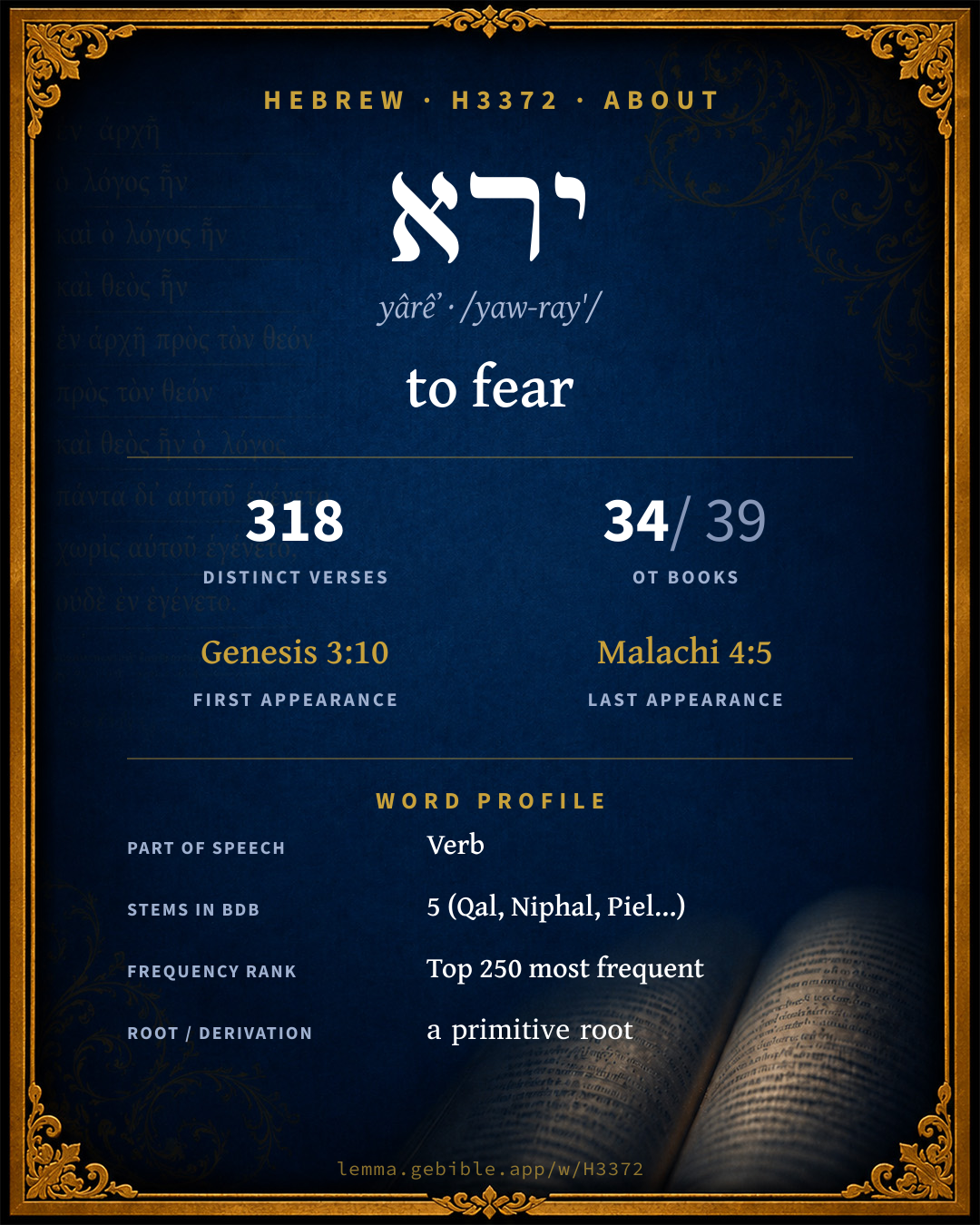
יָרֵא
to fear
also: revere, be afraid fuller range ↓
Full lexicon entry — Brown-Driver-Briggs (BDB)
From Brown-Driver-Briggs (BDB)
Where this word appears
See every Qal verb in the Hebrew Bible →
Grammar key — what these labels mean
Part of speech
- Verb
- An action or state-of-being word.
- Adjective
- A word that describes or qualifies a noun.
Stem
- Qal
- The basic, simple active stem — the plain form of the verb (“he wrote”). Here: ‘fear’
- Niphal
- Usually the simple passive or reflexive of the Qal (“he was written”). Here: ‘be fearful’
- Piel
- An intensive or resultative active stem.
Form
- Jussive
- A third- or second-person volitional form expressing wish or command (“let him write”).
- Sequential Imperfect
- An imperfect with prefixed waw — the standard past-narrative form (waw-consecutive imperfect).
- Participle Active
- A verbal adjective expressing ongoing or characteristic action (“writing / one who writes”).
- Infinitive Construct
- A bound verbal noun, frequently with prepositions (“to write / in writing”).
- Imperfect
- An incomplete, ongoing, or future action (“he will / would write”).
- Perfect
- A completed action or state — Hebrew marks aspect (completeness) more than strict tense (“he wrote”).
- Sequential Perfect
- A perfect with prefixed waw continuing a preceding imperfect or command (waw-consecutive perfect).
- Imperative
- A direct command (“write!”).
- Cohortative
- A first-person volitional form expressing wish or resolve (“let me / let us write”).
State
- Absolute
- The independent form of a noun, not bound to a following word.
- Construct
- A noun bound to a following noun in a possessive / “of” relationship (the construct chain).
Person
- 2nd Person
- The one addressed (“you”).
- 3rd Person
- The one spoken about (“he / she / it / they”).
- 1st Person
- The speaker (“I / we”).
Gender
- Masculine
- Grammatically masculine.
- Feminine
- Grammatically feminine.
- Common
- Either gender — not distinguished for this form.
Number
- Singular
- One.
- Plural
- More than one (in Hebrew, generally three or more).
Grammatical forms 44 distinct
- Verb, Qal, Jussive, 2nd Person, Masculine, Singular 40 times (12%)
- Verb, Niphal, Participle Active, Masculine, Singular, Absolute 32 times (10%)
- Verb, Qal, Jussive, 2nd Person, Masculine, Plural 27 times (8%)
- Verb, Qal, Sequential Imperfect, 3rd Person, Masculine, Plural 23 times (7%)
- Verb, Qal, Imperfect, 3rd Person, Masculine, Plural 23 times (7%)
- Verb, Qal, Infinitive Construct 17 times (5%)
- Verb, Qal, Imperfect, 2nd Person, Masculine, Plural 17 times (5%)
- Verb, Qal, Sequential Imperfect, 3rd Person, Masculine, Singular 13 times (4%)
+36 more forms (137 occurrences)
Parsed forms decoded from the imported morphology (morphhb / Westminster Leningrad Codex — WLC text public domain, morphhb tagging CC BY 4.0), counted across 329 parsed occurrences — not distinct verses.
Page 1 of 2 — showing verses 1–200 of 318 distinct verses where H3372 appears, across 34 books. Click any verse to open its interlinear word-by-word view. Verse text shown in the World English Bible for context — . Each verse’s Hebrew form is shown with its reference; the English is not keyword-highlighted, since the data carries no word-level English alignment. Use “Compare translations” on any verse to read it across multiple English versions. This concordance covers the Hebrew Bible; Septuagint (Greek Old Testament) occurrences are not indexed here.
Genesis 19 verses
- Genesis 3:10 וָ/אִירָ֛א conj + Qal wimpf 1cs The man said, "I heard your voice in the garden, and I was afraid, because I was naked; and I hid myself."
- Genesis 15:1 תִּירָ֣א Qal juss 2ms After these things the word of Yahweh came to Abram in a vision, saying, "Don't be afraid, Abram. I am your shield, your exceedingly great reward."
- Genesis 18:15 יָרֵ֑אָה Qal pf 3fs Then Sarah denied, saying, "I didn't laugh," for she was afraid." He said, "No, but you did laugh."
- Genesis 19:30 יָרֵ֖א Qal pf 3ms Lot went up out of Zoar, and lived in the mountain, and his two daughters with him; for he was afraid to live in Zoar. He lived in a cave with his two daughters.
- Genesis 20:8 וַ/יִּֽירְא֥וּ conj + Qal wimpf 3mp Abimelech rose early in the morning, and called all his servants, and told all these things in their ear. The men were very scared.
- Genesis 21:17 תִּ֣ירְאִ֔י Qal juss 2fs God heard the voice of the boy. The angel of God called to Hagar out of the sky, and said to her, "What ails you, Hagar? Don't be afraid. For God has heard the voice of the boy where he is.
- Genesis 26:7 יָרֵא֙ Qal pf 3ms The men of the place asked him about his wife. He said, "She is my sister," for he was afraid to say, "My wife," lest, he thought, the men of the place might kill me for Rebekah, because she was beautiful to look on.
- Genesis 26:24 תִּירָא֙ Qal juss 2ms Yahweh appeared to him the same night, and said, "I am the God of Abraham your father. Don't be afraid, for I am with you, and will bless you, and multiply your seed for my servant Abraham's sake."
- Genesis 28:17 וַ/יִּירָא֙ נּוֹרָ֖א conj + Qal wimpf 3ms Niphal ptcp.act ms He was afraid, and said, "How dreadful is this place! This is none other than God's house, and this is the gate of heaven."
- Genesis 31:31 יָרֵ֔אתִי Qal pf 1cs Jacob answered Laban, "Because I was afraid, for I said, 'Lest you should take your daughters from me by force.'
- Genesis 32:7 וַ/יִּירָ֧א conj + Qal wimpf 3ms Then Jacob was greatly afraid and was distressed: and he divided the people who were with him, and the flocks, and the herds, and the camels, into two companies;
- Genesis 35:17 תִּ֣ירְאִ֔י Qal juss 2fs It happened that, when she was in hard labor, that the midwife said to her, "Don't be afraid, for now you will have another son."
- Genesis 42:18 יָרֵֽא Qal ptcp.act ms Joseph said to them the third day, "Do this, and live, for I fear God.
- Genesis 42:35 וַ/יִּירָֽאוּ conj + Qal wimpf 3mp It happened as they emptied their sacks, that behold, every man's bundle of money was in his sack. When they and their father saw their bundles of money, they were afraid.
- Genesis 43:18 וַ/יִּֽירְא֣וּ conj + Qal wimpf 3mp The men were afraid, because they were brought to Joseph's house; and they said, "Because of the money that was returned in our sacks at the first time are we brought in; that he may seek occasion against us, and fall on us, and take us for bondservants, along with our donkeys."
- Genesis 43:23 תִּירָ֗אוּ Qal juss 2mp He said, "Peace be to you. Don't be afraid. Your God, and the God of your father, has given you treasure in your sacks. I received your money." He brought Simeon out to them.
- Genesis 46:3 תִּירָא֙ Qal juss 2ms He said, "I am God, the God of your father. Don't be afraid to go down into Egypt; for there I will make of you a great nation.
- Genesis 50:19 תִּירָ֑אוּ Qal juss 2mp Joseph said to them, "Don't be afraid, for am I in the place of God?
- Genesis 50:21 תִּירָ֔אוּ Qal juss 2mp Now therefore don't be afraid. I will nourish you and your little ones." He comforted them, and spoke kindly to them.
Exodus 13 verses
- Exodus 1:17 וַ/תִּירֶ֤אןָ conj + Qal wimpf 3fp But the midwives feared God, and didn't do what the king of Egypt commanded them, but saved the baby boys alive.
- Exodus 1:21 יָֽרְא֥וּ Qal pf 3cp It happened, because the midwives feared God, that he gave them families.
- Exodus 2:14 וַ/יִּירָ֤א conj + Qal wimpf 3ms He said, "Who made you a prince and a judge over us? Do you plan to kill me, as you killed the Egyptian?" Moses was afraid, and said, "Surely this thing is known."
- Exodus 3:6 יָרֵ֔א Qal pf 3ms Moreover he said, "I am the God of your father, the God of Abraham, the God of Isaac, and the God of Jacob." Moses hid his face; for he was afraid to look at God.
- Exodus 9:20 הַ/יָּרֵא֙ ptcl def.art + Qal ptcp.act ms Those who feared the word of Yahweh among the servants of Pharaoh made their servants and their cattle flee into the houses.
- Exodus 9:30 תִּֽירְא֔וּ/ן Qal impf 2mp + sfx n But as for you and your servants, I know that you don't yet fear Yahweh God."
- Exodus 14:10 וַ/יִּֽירְאוּ֙ conj + Qal wimpf 3mp When Pharaoh drew near, the children of Israel lifted up their eyes, and behold, the Egyptians were marching after them; and they were very afraid. The children of Israel cried out to Yahweh.
- Exodus 14:13 תִּירָאוּ֒ Qal juss 2mp Moses said to the people, "Don't be afraid. Stand still, and see the salvation of Yahweh, which he will work for you today: for the Egyptians whom you have seen today, you shall never see them again.
- Exodus 14:31 וַ/יִּֽירְא֥וּ conj + Qal wimpf 3mp Israel saw the great work which Yahweh did to the Egyptians, and the people feared Yahweh; and they believed in Yahweh, and in his servant Moses.
- Exodus 15:11 נוֹרָ֥א Niphal ptcp.act ms Who is like you, Yahweh, among the gods? Who is like you, glorious in holiness, Fearful in praises, doing wonders?
- Exodus 20:20 תִּירָאוּ֒ Qal juss 2mp Moses said to the people, "Don't be afraid, for God has come to test you, and that his fear may be before you, that you won't sin."
- Exodus 34:10 נוֹרָ֣א Niphal ptcp.act ms He said, "Behold, I make a covenant: before all your people I will do marvels, such as have not been worked in all the earth, nor in any nation; and all the people among which you are shall see the work of Yahweh; for it is an awesome thing that I do with you.
- Exodus 34:30 וַ/יִּֽירְא֖וּ conj + Qal wimpf 3mp When Aaron and all the children of Israel saw Moses, behold, the skin of his face shone; and they were afraid to come near him.
Leviticus 8 verses
- Leviticus 19:3 תִּירָ֔אוּ Qal impf 2mp "'Each one of you shall respect his mother and his father. You shall keep my Sabbaths. I am Yahweh your God.
- Leviticus 19:14 וְ/יָרֵ֥אתָ conj + Qal wpf 2ms "'You shall not curse the deaf, nor put a stumbling block before the blind; but you shall fear your God. I am Yahweh.
- Leviticus 19:30 תִּירָ֑אוּ Qal impf 2mp "'You shall keep my Sabbaths, and reverence my sanctuary; I am Yahweh.
- Leviticus 19:32 וְ/יָרֵ֥אתָ conj + Qal wpf 2ms You shall rise up before the gray head, and honor the face of an old man, and you shall fear your God. I am Yahweh.
- Leviticus 25:17 וְ/יָרֵ֖אתָ conj + Qal wpf 2ms You shall not wrong one another; but you shall fear your God: for I am Yahweh your God.
- Leviticus 25:36 וְ/יָרֵ֖אתָ conj + Qal wpf 2ms Take no interest from him or profit, but fear your God; that your brother may live among you.
- Leviticus 25:43 וְ/יָרֵ֖אתָ conj + Qal wpf 2ms You shall not rule over him with harshness, but shall fear your God.
- Leviticus 26:2 תִּירָ֑אוּ Qal impf 2mp "'You shall keep my Sabbaths, and have reverence for my sanctuary. I am Yahweh.
Numbers 3 verses
- Numbers 12:8 יְרֵאתֶ֔ם Qal pf 2mp with him will I speak mouth to mouth, even manifestly, and not in dark speeches; and the form of Yahweh shall he see: why then were you not afraid to speak against my servant, against Moses?
- Numbers 14:9 תִּֽירְאוּ֙ תִּירָאֻֽ/ם Qal juss 2mp Qal juss 2mp + sfx pers 3mp Only don't rebel against Yahweh, neither fear the people of the land; for they are bread for us: their defense is removed from over them, and Yahweh is with us: don't fear them.
- Numbers 21:34 תִּירָ֣א Qal juss 2ms Yahweh said to Moses, Don't fear him: for I have delivered him into your hand, and all his people, and his land; and you shall do to him as you did to Sihon king of the Amorites, who lived at Heshbon.
Deuteronomy 35 verses
- Deuteronomy 1:19 וְ/הַ/נּוֹרָ֨א conj + ptcl def.art + Niphal ptcp.act ms We traveled from Horeb, and went through all that great and terrible wilderness which you saw, by the way to the hill-country of the Amorites, as Yahweh our God commanded us; and we came to Kadesh-barnea.
- Deuteronomy 1:21 תִּירָ֖א Qal juss 2ms Behold, Yahweh your God has set the land before you: go up, take possession, as Yahweh, the God of your fathers, has spoken to you; don't be afraid, neither be dismayed.
- Deuteronomy 1:29 תִֽירְא֖וּ/ן Qal impf 2mp + sfx n Then I said to you, Don't dread, neither be afraid of them.
- Deuteronomy 2:4 וְ/יִֽירְא֣וּ conj + Qal impf 3mp Command you the people, saying, You are to pass through the border of your brothers the children of Esau, who dwell in Seir; and they will be afraid of you: take good heed to yourselves therefore;
- Deuteronomy 3:2 תִּירָ֣א Qal juss 2ms Yahweh said to me, Don't fear him; for I have delivered him, and all his people, and his land, into your hand; and you shall do to him as you did to Sihon king of the Amorites, who lived at Heshbon.
- Deuteronomy 3:22 תְִּירָא֑וּ/ם Qal impf 2mp + sfx pers 3mp You shall not fear them; for Yahweh your God, he it is who fights for you.
- Deuteronomy 4:10 לְ/יִרְאָ֣ה prep + Qal inf.cs the day that you stood before Yahweh your God in Horeb, when Yahweh said to me, Assemble me the people, and I will make them hear my words, that they may learn to fear me all the days that they live on the earth, and that they may teach their children.
- Deuteronomy 5:5 יְרֵאתֶם֙ Qal pf 2mp (I stood between Yahweh and you at that time, to show you the word of Yahweh: for you were afraid because of the fire, and didn't go up onto the mountain;) saying,
- Deuteronomy 5:29 לְ/יִרְאָ֥ה prep + Qal inf.cs Oh that there were such a heart in them, that they would fear me, and keep all my commandments always, that it might be well with them, and with their children forever!
- Deuteronomy 6:2 תִּירָ֜א Qal impf 2ms that you might fear Yahweh your God, to keep all his statutes and his commandments, which I command you, you, and your son, and your son's son, all the days of your life; and that your days may be prolonged.
- Deuteronomy 6:13 תִּירָ֖א Qal impf 2ms You shall fear Yahweh your God; and him shall you serve, and shall swear by his name.
- Deuteronomy 6:24 לְ/יִרְאָ֖ה prep + Qal inf.cs Yahweh commanded us to do all these statutes, to fear Yahweh our God, for our good always, that he might preserve us alive, as at this day.
- Deuteronomy 7:18 תִירָ֖א Qal impf 2ms you shall not be afraid of them: you shall well remember what Yahweh your God did to Pharaoh, and to all Egypt;
- Deuteronomy 7:21 וְ/נוֹרָֽא conj + Niphal ptcp.act ms You shall not be scared of them; for Yahweh your God is in the midst of you, a great and awesome God.
- Deuteronomy 8:6 וּ/לְ/יִרְאָ֥ה conj + prep + Qal inf.cs You shall keep the commandments of Yahweh your God, to walk in his ways, and to fear him.
- Deuteronomy 8:15 וְ/הַ/נּוֹרָ֗א conj + ptcl def.art + Niphal ptcp.act ms who led you through the great and terrible wilderness, [in which were] fiery serpents and scorpions, and thirsty ground where was no water; who brought you forth water out of the rock of flint;
- Deuteronomy 10:12 לְ֠/יִרְאָה prep + Qal inf.cs Now, Israel, what does Yahweh your God require of you, but to fear Yahweh your God, to walk in all his ways, and to love him, and to serve Yahweh your God with all your heart and with all your soul,
- Deuteronomy 10:17 וְ/הַ/נּוֹרָ֔א conj + ptcl def.art + Niphal ptcp.act ms For Yahweh your God, he is God of gods, and Lord of lords, the great God, the mighty, and the awesome, who doesn't regard persons, nor takes reward.
- Deuteronomy 10:20 תִּירָ֖א Qal impf 2ms You shall fear Yahweh your God; him shall you serve; and to him shall you cleave, and by his name shall you swear.
- Deuteronomy 10:21 הַ/נּֽוֹרָאֹת֙ ptcl def.art + Niphal ptcp.act fp He is your praise, and he is your God, who has done for you these great and awesome things, which your eyes have seen.
- Deuteronomy 13:4 תִירָ֑אוּ Qal impf 2mp You shall walk after Yahweh your God, and fear him, and keep his commandments, and obey his voice, and you shall serve him, and cleave to him.
- Deuteronomy 13:11 וְ/יִֽרָא֑וּ/ן conj + Qal impf 3mp + sfx n All Israel shall hear, and fear, and shall not do any more such wickedness as this is in the midst of you.
- Deuteronomy 14:23 לְ/יִרְאָ֛ה prep + Qal inf.cs You shall eat before Yahweh your God, in the place which he shall choose, to cause his name to dwell there, the tithe of your grain, of your new wine, and of your oil, and the firstborn of your herd and of your flock; that you may learn to fear Yahweh your God always.
- Deuteronomy 17:13 וְ/יִרָ֑אוּ conj + Qal impf 3mp All the people shall hear, and fear, and do no more presumptuously.
- Deuteronomy 17:19 לְ/יִרְאָה֙ prep + Qal inf.cs and it shall be with him, and he shall read therein all the days of his life; that he may learn to fear Yahweh his God, to keep all the words of this law and these statutes, to do them;
- Deuteronomy 19:20 וְ/יִרָ֑אוּ conj + Qal impf 3mp Those who remain shall hear, and fear, and shall henceforth commit no more any such evil in the midst of you.
- Deuteronomy 20:1 תִירָ֖א Qal impf 2ms When you go forth to battle against your enemies, and see horses, and chariots, [and] a people more than you, you shall not be afraid of them; for Yahweh your God is with you, who brought you up out of the land of Egypt.
- Deuteronomy 20:3 תִּֽירְא֧וּ Qal juss 2mp and shall tell them, Hear, Israel, you draw near this day to battle against your enemies: don't let your heart faint; don't be afraid, nor tremble, neither be scared of them;
- Deuteronomy 21:21 וְ/יִרָֽאוּ conj + Qal impf 3mp All the men of his city shall stone him to death with stones: so shall you put away the evil from the midst of you; and all Israel shall hear, and fear.
- Deuteronomy 28:10 וְ/יָֽרְא֖וּ conj + Qal wpf 3cp All the peoples of the earth shall see that you are called by the name of Yahweh; and they shall be afraid of you.
- Deuteronomy 28:58 לְ֠/יִרְאָה וְ/הַ/נּוֹרָא֙ prep + Qal inf.cs conj + ptcl def.art + Niphal ptcp.act ms If you will not observe to do all the words of this law that are written in this book, that you may fear this glorious and fearful name, YAHWEH YOUR GOD;
- Deuteronomy 31:6 תִּֽירְא֥וּ Qal juss 2mp Be strong and of good courage, don't be afraid, nor be scared of them: for Yahweh your God, he it is who does go with you; he will not fail you, nor forsake you.
- Deuteronomy 31:8 תִירָ֖א Qal impf 2ms Yahweh, he it is who does go before you; he will be with you, he will not fail you, neither forsake you: don't be afraid, neither be dismayed.
- Deuteronomy 31:12 וְ/יָֽרְאוּ֙ conj + Qal wpf 3cp Assemble the people, the men and the women and the little ones, and your foreigner who is within your gates, that they may hear, and that they may learn, and fear Yahweh your God, and observe to do all the words of this law;
- Deuteronomy 31:13 לְ/יִרְאָ֖ה prep + Qal inf.cs and that their children, who have not known, may hear, and learn to fear Yahweh your God, as long as you live in the land where you go over the Jordan to possess it.
Joshua 10 verses
- Joshua 4:14 וַ/יִּֽרְא֣וּ יָרְא֥וּ conj + Qal wimpf 3mp Qal pf 3cp On that day Yahweh magnified Joshua in the sight of all Israel; and they feared him, as they feared Moses, all the days of his life.
- Joshua 4:24 יְרָאתֶ֛ם Qal pf 2mp that all the peoples of the earth may know the hand of Yahweh, that it is mighty; that you may fear Yahweh your God forever.
- Joshua 8:1 תִּירָ֣א Qal juss 2ms Yahweh said to Joshua, Don't be afraid, neither be dismayed: take all the people of war with you, and arise, go up to Ai; behold, I have given into your hand the king of Ai, and his people, and his city, and his land;
- Joshua 9:24 וַ/נִּירָ֨א conj + Qal wimpf 1cp They answered Joshua, and said, Because it was certainly told your servants, how that Yahweh your God commanded his servant Moses to give you all the land, and to destroy all the inhabitants of the land from before you; therefore we were sore afraid for our lives because of you, and have done this thing.
- Joshua 10:2 וַ/יִּֽירְא֣וּ conj + Qal wimpf 3mp that they feared greatly, because Gibeon was a great city, as one of the royal cities, and because it was greater than Ai, and all the men of it were mighty.
- Joshua 10:8 תִּירָ֣א Qal juss 2ms Yahweh said to Joshua, Don't fear them: for I have delivered them into your hands; there shall not a man of them stand before you.
- Joshua 10:25 תִּֽירְא֖וּ Qal juss 2mp Joshua said to them, Don't be afraid, nor be dismayed; be strong and of good courage: for thus shall Yahweh do to all your enemies against whom you fight.
- Joshua 11:6 תִּירָ֣א Qal juss 2ms Yahweh said to Joshua, Don't be afraid because of them; for tomorrow at this time will I deliver them up all slain before Israel: you shall hamstring their horses, and burn their chariots with fire.
- Joshua 22:25 יְרֹ֥א Qal inf.cs for Yahweh has made the Jordan a border between us and you, you children of Reuben and children of Gad; you have no portion in Yahweh: so might your children make our children cease from fearing Yahweh.
- Joshua 24:14 יְר֧אוּ Qal impv 2mp Now therefore fear Yahweh, and serve him in sincerity and in truth; and put away the gods which your fathers served beyond the River, and in Egypt; and serve you Yahweh.
Judges 6 verses
- Judges 4:18 תִּירָ֑א Qal juss 2ms Jael went out to meet Sisera, and said to him, Turn in, my lord, turn in to me; don't be afraid. He came in to her into the tent, and she covered him with a rug.
- Judges 6:10 תִֽירְאוּ֙ Qal impf 2mp and I said to you, I am Yahweh your God; you shall not fear the gods of the Amorites, in whose land you dwell. But you have not listened to my voice.
- Judges 6:23 תִּירָ֑א Qal juss 2ms Yahweh said to him, Peace be to you; don't be afraid: you shall not die.
- Judges 6:27 יָרֵא֩ Qal pf 3ms Then Gideon took ten men of his servants, and did as Yahweh had spoken to him: and it happened, because he feared his father's household and the men of the city, so that he could not do it by day, that he did it by night.
- Judges 8:20 יָרֵ֔א Qal pf 3ms He said to Jether his firstborn, Up, and kill them. But the youth didn't draw his sword; for he feared, because he was yet a youth.
- Judges 13:6 נוֹרָ֣א Niphal ptcp.act ms Then the woman came and told her husband, saying, A man of God came to me, and his face was like the face of the angel of God, very awesome; and I didn't ask him whence he was, neither did he tell me his name:
Ruth 1 verse
1 Samuel 22 verses
- 1 Samuel 3:15 יָרֵ֔א Qal pf 3ms Samuel lay until the morning, and opened the doors of the house of Yahweh. Samuel feared to show Eli the vision.
- 1 Samuel 4:7 וַ/יִּֽרְאוּ֙ conj + Qal wimpf 3mp The Philistines were afraid, for they said, God is come into the camp. They said, Woe to us! for there has not been such a thing heretofore.
- 1 Samuel 4:20 תִּֽירְאִ֖י Qal juss 2fs About the time of her death the women who stood by her said to her, Don't be afraid; for you have brought forth a son. But she didn't answer, neither did she regard it.
- 1 Samuel 7:7 וַ/יִּֽרְא֖וּ conj + Qal wimpf 3mp When the Philistines heard that the children of Israel were gathered together at Mizpah, the lords of the Philistines went up against Israel. When the children of Israel heard it, they were afraid of the Philistines.
- 1 Samuel 12:14 תִּֽירְא֣וּ Qal impf 2mp If you will fear Yahweh, and serve him, and listen to his voice, and not rebel against the commandment of Yahweh, and both you and also the king who reigns over you are followers of Yahweh your God, [well]:
- 1 Samuel 12:18 וַ/יִּירָ֨א conj + Qal wimpf 3ms So Samuel called to Yahweh; and Yahweh sent thunder and rain that day: and all the people greatly feared Yahweh and Samuel.
- 1 Samuel 12:20 תִּירָ֔אוּ Qal juss 2mp Samuel said to the people, "Don't be afraid; you have indeed done all this evil; yet don't turn aside from following Yahweh, but serve Yahweh with all your heart:
- 1 Samuel 12:24 יְר֣אוּ Qal impv 2mp Only fear Yahweh, and serve him in truth with all your heart; for consider how great things he has done for you.
- 1 Samuel 14:26 יָרֵ֥א Qal pf 3ms When the people were come to the forest, behold, the honey dropped: but no man put his hand to his mouth; for the people feared the oath.
- 1 Samuel 15:24 יָרֵ֨אתִי֙ Qal pf 1cs Saul said to Samuel, I have sinned; for I have transgressed the commandment of Yahweh, and your words, because I feared the people, and obeyed their voice.
- 1 Samuel 17:11 וַ/יִּֽרְא֖וּ conj + Qal wimpf 3mp When Saul and all Israel heard those words of the Philistine, they were dismayed, and greatly afraid.
- 1 Samuel 17:24 וַ/יִּֽירְא֖וּ conj + Qal wimpf 3mp All the men of Israel, when they saw the man, fled from him, and were sore afraid.
- 1 Samuel 18:12 וַ/יִּרָ֥א conj + Qal wimpf 3ms Saul was afraid of David, because Yahweh was with him, and was departed from Saul.
- 1 Samuel 18:29 לֵ/רֹ֛א prep + Qal inf.cs Saul was yet the more afraid of David; and Saul was David's enemy continually.
- 1 Samuel 21:12 וַ/יִּרָ֣א conj + Qal wimpf 3ms David laid up these words in his heart, and was very afraid of Achish the king of Gath.
- 1 Samuel 22:23 תִּירָ֔א Qal juss 2ms Abide you with me, don't be afraid; for he who seeks my life seeks your life: for with me you shall be in safeguard.
- 1 Samuel 23:3 יְרֵאִ֑ים adj Adjective mp David's men said to him, Behold, we are afraid here in Judah: how much more then if we go to Keilah against the armies of the Philistines?
- 1 Samuel 23:17 תִּירָ֗א Qal juss 2ms He said to him, Don't be afraid; for the hand of Saul my father shall not find you; and you shall be king over Israel, and I shall be next to you; and that also Saul my father knows.
- 1 Samuel 28:5 וַ/יִּרָ֕א conj + Qal wimpf 3ms When Saul saw the host of the Philistines, he was afraid, and his heart trembled greatly.
- 1 Samuel 28:13 תִּֽירְאִ֖י Qal juss 2fs The king said to her, Don't be afraid: for what do you see? The woman said to Saul, I see a god coming up out of the earth.
- 1 Samuel 28:20 וַ/יִּרָ֥א conj + Qal wimpf 3ms Then Saul fell immediately his full length on the earth, and was sore afraid, because of the words of Samuel: and there was no strength in him; for he had eaten no bread all the day, nor all the night.
- 1 Samuel 31:4 יָרֵ֖א Qal pf 3ms Then said Saul to his armor bearer, Draw your sword, and thrust me through therewith, lest these uncircumcised come and thrust me through, and abuse me. But his armor bearer would not; for he was sore afraid. Therefore Saul took his sword, and fell on it.
2 Samuel 9 verses
- 2 Samuel 1:14 יָרֵ֔אתָ Qal pf 2ms David said to him, How were you not afraid to put forth your hand to destroy Yahweh's anointed?
- 2 Samuel 3:11 מִ/יִּרְאָת֖/וֹ prep + Qal inf.cs + sfx pers 3ms He could not answer Abner another word, because he feared him.
- 2 Samuel 6:9 וַ/יִּרָ֥א conj + Qal wimpf 3ms David was afraid of Yahweh that day; and he said, How shall the ark of Yahweh come to me?
- 2 Samuel 7:23 וְ/נֹֽרָאוֹת֙ conj + Niphal ptcp.act fp What one nation in the earth is like your people, even like Israel, whom God went to redeem to himself for a people, and to make him a name, and to do great things for you, and awesome things for your land, before your people, whom you redeem to you out of Egypt, [from] the nations and their gods?
- 2 Samuel 9:7 תִּירָ֗א Qal juss 2ms David said to him, "Don't be afraid of him; for I will surely show you kindness for Jonathan your father's sake, and will restore you all the land of Saul your father; and you shall eat bread at my table continually."
- 2 Samuel 10:19 וַ/יִּֽרְא֣וּ conj + Qal wimpf 3mp When all the kings who were servants to Hadarezer saw that they were put to the worse before Israel, they made peace with Israel, and served them. So the Syrians feared to help the children of Ammon any more.
- 2 Samuel 12:18 וַ/יִּֽרְאוּ֩ conj + Qal wimpf 3mp It happened on the seventh day, that the child died. The servants of David feared to tell him that the child was dead; for they said, Behold, while the child was yet alive, we spoke to him, and he didn't listen to our voice: how will he then vex himself, if we tell him that the child is dead!
- 2 Samuel 13:28 תִּירָ֑אוּ Qal juss 2mp Absalom commanded his servants, saying, Mark you now, when Amnon's heart is merry with wine; and when I tell you, Smite Amnon, then kill him; don't be afraid; haven't I commanded you? be courageous, and be valiant.
- 2 Samuel 14:15 יֵֽרְאֻ֖/נִי Piel impf 3mp + sfx pers 1cs Now therefore seeing that I have come to speak this word to my lord the king, it is because the people have made me afraid: and your handmaid said, I will now speak to the king; it may be that the king will perform the request of his servant.
1 Kings 7 verses
- 1 Kings 1:50 יָרֵ֖א Qal pf 3ms Adonijah feared because of Solomon; and he arose, and went, and caught hold on the horns of the altar.
- 1 Kings 1:51 יָרֵ֖א Qal pf 3ms It was told Solomon, saying, Behold, Adonijah fears king Solomon; for, behold, he has laid hold on the horns of the altar, saying, Let king Solomon swear to me first that he will not kill his servant with the sword.
- 1 Kings 3:28 וַ/יִּֽרְא֖וּ conj + Qal wimpf 3mp All Israel heard of the judgment which the king had judged; and they feared the king: for they saw that the wisdom of God was in him, to do justice.
- 1 Kings 8:40 יִֽרָא֔וּ/ךָ Qal impf 3mp + sfx pers 2ms that they may fear you all the days that they live in the land which you gave to our fathers.
- 1 Kings 8:43 לְ/יִרְאָ֤ה prep + Qal inf.cs hear in heaven, your dwelling-place, and do according to all that the foreigner calls to you for; that all the peoples of the earth may know your name, to fear you, as does your people Israel, and that they may know that this house which I have built is called by my name.
- 1 Kings 17:13 תִּ֣ירְאִ֔י Qal juss 2fs Elijah said to her, Don't be afraid; go and do as you have said; but make me of it a little cake first, and bring it forth to me, and afterward make for you and for your son.
- 1 Kings 18:12 יָרֵ֥א adj Adjective ms It will happen, as soon as I am gone from you, that the Spirit of Yahweh will carry you I don't know where; and so when I come and tell Ahab, and he can't find you, he will kill me: but I your servant fear Yahweh from my youth.
2 Kings 19 verses
- 2 Kings 1:15 תִּירָ֖א Qal juss 2ms The angel of Yahweh said to Elijah, Go down with him: don't be afraid of him. He arose, and went down with him to the king.
- 2 Kings 4:1 יָרֵ֖א Qal ptcp.act ms Now there cried a certain woman of the wives of the sons of the prophets to Elisha, saying, Your servant my husband is dead; and you know that your servant did fear Yahweh: and the creditor is come to take to him my two children to be bondservants.
- 2 Kings 6:16 תִּירָ֑א Qal juss 2ms He answered, Don't be afraid; for those who are with us are more than those who are with them.
- 2 Kings 10:4 וַ/יִּֽרְאוּ֙ conj + Qal wimpf 3mp But they were exceedingly afraid, and said, Behold, the two kings didn't stand before him: how then shall we stand?
- 2 Kings 17:7 וַ/יִּֽירְא֖וּ conj + Qal wimpf 3mp It was so, because the children of Israel had sinned against Yahweh their God, who brought them up out of the land of Egypt from under the hand of Pharaoh king of Egypt, and had feared other gods,
- 2 Kings 17:25 יָרְא֖וּ Qal pf 3cp So it was, at the beginning of their dwelling there, that they didn't fear Yahweh: therefore Yahweh sent lions among them, which killed some of them.
- 2 Kings 17:28 יִֽירְא֥וּ Qal impf 3mp So one of the priests whom they had carried away from Samaria came and lived in Bethel, and taught them how they should fear Yahweh.
- 2 Kings 17:32 יְרֵאִ֖ים adj Adjective mp So they feared Yahweh, and made to them from among themselves priests of the high places, who sacrificed for them in the houses of the high places.
- 2 Kings 17:33 יְרֵאִ֑ים adj Adjective mp They feared Yahweh, and served their own gods, after the manner of the nations from among whom they had been carried away.
- 2 Kings 17:34 יְרֵאִים֙ adj Adjective mp To this day they do after the former manner: they don't fear Yahweh, neither do they after their statutes, or after their ordinances, or after the law or after the commandment which Yahweh commanded the children of Jacob, whom he named Israel;
- 2 Kings 17:35 תִֽירְא֖וּ Qal impf 2mp with whom Yahweh had made a covenant, and charged them, saying, You shall not fear other gods, nor bow yourselves to them, nor serve them, nor sacrifice to them:
- 2 Kings 17:36 תִירָ֑אוּ Qal impf 2mp but Yahweh, who brought you up out of the land of Egypt with great power and with an outstretched arm, him shall you fear, and to him shall you bow yourselves, and to him shall you sacrifice:
- 2 Kings 17:37 תִֽירְא֖וּ Qal impf 2mp and the statutes and the ordinances, and the law and the commandment, which he wrote for you, you shall observe to do forevermore; and you shall not fear other gods:
- 2 Kings 17:38 תִֽירְא֖וּ Qal impf 2mp and the covenant that I have made with you you shall not forget; neither shall you fear other gods:
- 2 Kings 17:39 תִּירָ֑אוּ Qal impf 2mp but Yahweh your God shall you fear; and he will deliver you out of the hand of all your enemies.
- 2 Kings 17:41 יְרֵאִים֙ adj Adjective mp So these nations feared Yahweh, and served their engraved images; their children likewise, and their children's children, as did their fathers, so do they to this day.
- 2 Kings 19:6 תִּירָא֙ Qal juss 2ms Isaiah said to them, Thus shall you tell your master, Thus says Yahweh, Don't be afraid of the words that you have heard, with which the servants of the king of Assyria have blasphemed me.
- 2 Kings 25:24 תִּֽירְא֖וּ Qal juss 2mp Gedaliah swore to them and to their men, and said to them, Don't be afraid because of the servants of the Chaldeans: dwell in the land, and serve the king of Babylon, and it shall be well with you.
- 2 Kings 25:26 יָרְא֖וּ Qal pf 3cp All the people, both small and great, and the captains of the forces, arose, and came to Egypt; for they were afraid of the Chaldeans.
1 Chronicles 6 verses
- 1 Chronicles 10:4 יָרֵ֖א Qal pf 3ms Then said Saul to his armor-bearer, Draw your sword, and thrust me through therewith, lest these uncircumcised come and abuse me. But his armor-bearer would not; for he was sore afraid. Therefore Saul took his sword, and fell on it.
- 1 Chronicles 13:12 וַ/יִּירָ֤א conj + Qal wimpf 3ms David was afraid of God that day, saying, How shall I bring the ark of God home to me?
- 1 Chronicles 16:25 וְ/נוֹרָ֥א conj + Niphal ptcp.act ms For great is Yahweh, and greatly to be praised: He also is to be feared above all gods.
- 1 Chronicles 17:21 וְ/נֹרָא֔וֹת conj + Niphal ptcp.act fp What one nation in the earth is like your people Israel, whom God went to redeem to himself for a people, to make you a name by great and awesome things, in driving out nations from before your people, whom you redeem out of Egypt?
- 1 Chronicles 22:13 תִּירָ֖א Qal juss 2ms Then shall you prosper, if you observe to do the statutes and the ordinances which Yahweh gave Moses concerning Israel. Be strong, and of good courage. Don't be afraid, neither be dismayed.
- 1 Chronicles 28:20 תִּירָ֖א Qal juss 2ms David said to Solomon his son, Be strong and of good courage, and do it: don't be afraid, nor be dismayed; for Yahweh God, even my God, is with you; he will not fail you, nor forsake you, until all the work for the service of the house of Yahweh is finished.
2 Chronicles 7 verses
- 2 Chronicles 6:31 יִֽירָא֗וּ/ךָ Qal impf 3mp + sfx pers 2ms that they may fear you, to walk in your ways, so long as they live in the land which you gave to our fathers.
- 2 Chronicles 6:33 וּ/לְ/יִרְאָ֤ה conj + prep + Qal inf.cs then hear from heaven, even from your dwelling-place, and do according to all that the foreigner calls to you for; that all the peoples of the earth may know your name, and fear you, as does your people Israel, and that they may know that this house which I have built is called by your name.
- 2 Chronicles 20:3 וַ/יִּרָ֕א conj + Qal wimpf 3ms Jehoshaphat feared, and set himself to seek to Yahweh; and he proclaimed a fast throughout all Judah.
- 2 Chronicles 20:15 תִּֽירְא֤וּ Qal juss 2mp and he said, Listen you, all Judah, and you inhabitants of Jerusalem, and you king Jehoshaphat: Thus says Yahweh to you, Don't be afraid you, neither be dismayed by reason of this great multitude; for the battle is not yours, but God's.
- 2 Chronicles 20:17 תִּֽירְאוּ֙ Qal juss 2mp You shall not need to fight in this [battle]: set yourselves, stand you still, and see the salvation of Yahweh with you, O Judah and Jerusalem; don't be afraid, nor be dismayed: tomorrow go out against them: for Yahweh is with you.
- 2 Chronicles 32:7 תִּֽירְא֣וּ Qal juss 2mp Be strong and of good courage, don't be afraid nor dismayed for the king of Assyria, nor for all the multitude who is with him; for there is a greater with us than with him:
- 2 Chronicles 32:18 לְ/יָֽרְאָ֖/ם prep + Piel inf.cs + sfx pers 3mp They cried with a loud voice in the Jews' language to the people of Jerusalem who were on the wall, to frighten them, and to trouble them; that they might take the city.
Nehemiah 10 verses
- Nehemiah 1:5 וְ/הַ/נּוֹרָ֑א conj + ptcl def.art + Niphal ptcp.act ms and said, I beg you, Yahweh, the God of heaven, the great and awesome God, who keeps covenant and loving kindness with those who love him and keep his commandments:
- Nehemiah 1:11 לְ/יִרְאָ֣ה prep + Qal inf.cs Lord, I beg you, let now your ear be attentive to the prayer of your servant, and to the prayer of your servants, who delight to fear your name; and please prosper your servant this day, and grant him mercy in the sight of this man. Now I was cup bearer to the king.
- Nehemiah 2:2 וָ/אִירָ֖א conj + Qal wimpf 1cs The king said to me, Why is your face sad, seeing you are not sick? this is nothing else but sorrow of heart. Then I was very sore afraid.
- Nehemiah 4:14 תִּֽירְא֖וּ וְ/הַ/נּוֹרָא֙ Qal juss 2mp conj + ptcl def.art + Niphal ptcp.act ms I looked, and rose up, and said to the nobles, and to the rulers, and to the rest of the people, Don't be you afraid of them: remember the Lord, who is great and awesome, and fight for your brothers, your sons, and your daughters, your wives, and your houses.
- Nehemiah 6:9 מְיָֽרְאִ֤ים Piel ptcp.act mp For they all would have made us afraid, saying, Their hands shall be weakened from the work, that it not be done. But now, [God], strengthen you my hands.
- Nehemiah 6:13 אִירָ֥א Qal impf 1cs For this cause was he hired, that I should be afraid, and do so, and sin, and that they might have matter for an evil report, that they might reproach me.
- Nehemiah 6:14 מְיָֽרְאִ֥ים Piel ptcp.act mp Remember, my God, Tobiah and Sanballat according to these their works, and also the prophetess Noadiah, and the rest of the prophets, that would have put me in fear.
- Nehemiah 6:19 לְ/יָֽרְאֵֽ/נִי prep + Piel inf.cs + sfx pers 1cs Also they spoke of his good deeds before me, and reported my words to him. Tobiah sent letters to put me in fear.
- Nehemiah 7:2 וְ/יָרֵ֥א conj + Qal pf 3ms that I gave my brother Hanani, and Hananiah the governor of the castle, charge over Jerusalem; for he was a faithful man, and feared God above many.
- Nehemiah 9:32 וְ/הַ/נּוֹרָא֮ conj + ptcl def.art + Niphal ptcp.act ms Now therefore, our God, the great, the mighty, and the awesome God, who keep covenant and loving kindness, don't let all the travail seem little before you, that has come on us, on our kings, on our princes, and on our priests, and on our prophets, and on our fathers, and on all your people, since the time of the kings of Assyria to this day.
Job 9 verses
- Job 1:9 יָרֵ֥א Qal pf 3ms Then Satan answered Yahweh, and said, "Does Job fear God for nothing?
- Job 5:21 תִירָ֥א Qal impf 2ms You shall be hidden from the scourge of the tongue, Neither shall you be afraid of destruction when it comes.
- Job 5:22 תִּירָֽא Qal juss 2ms At destruction and famine you shall laugh, Neither shall you be afraid of the animals of the earth.
- Job 6:21 וַ/תִּירָֽאוּ conj + Qal wimpf 2mp For now you are nothing. You see a terror, and are afraid.
- Job 9:35 אִירָאֶ֑/נּוּ Qal impf 1cs + sfx pers 3ms Then I would speak, and not fear him, For I am not so in myself.
- Job 11:15 תִירָֽא Qal impf 2ms Surely then shall you lift up your face without spot; Yes, you shall be steadfast, and shall not fear:
- Job 32:6 וָֽ/אִירָ֓א conj + Qal wimpf 1cs Elihu the son of Barachel the Buzite answered, "I am young, and you are very old; Therefore I held back, and didn't dare show you my opinion.
- Job 37:22 נ֣וֹרָא Niphal ptcp.act ms cs Out of the north comes golden splendor; With God is awesome majesty.
- Job 37:24 יְרֵא֣וּ/הוּ Qal pf 3cp + sfx pers 3ms Therefore men revere him. He doesn't regard any who are wise of heart."
Psalms 46 verses
- Psalms 3:6 אִ֭ירָא Qal impf 1cs I will not be afraid of tens of thousands of people Who have set themselves against me on every side.
- Psalms 23:4 אִ֘ירָ֤א Qal impf 1cs Even though I walk through the valley of the shadow of death, I will fear no evil, for you are with me. Your rod and your staff, they comfort me.
- Psalms 27:1 אִירָ֑א Qal impf 1cs Yahweh is my light and my salvation. Whom shall I fear? Yahweh is the strength of my life. Of whom shall I be afraid?
- Psalms 27:3 יִירָ֪א Qal impf 3ms Though a host should encamp against me, My heart shall not fear. Though war should rise against me, Even then I will be confident.
- Psalms 33:8 יִֽירְא֣וּ Qal impf 3mp Let all the earth fear Yahweh. Let all the inhabitants of the world stand in awe of him.
- Psalms 34:9 יְר֣אוּ Qal impv 2mp Oh fear Yahweh, you his saints, For there is no lack with those who fear him.
- Psalms 40:3 וְ/יִירָ֑אוּ conj + Qal impf 3mp He has put a new song in my mouth, even praise to our God. Many shall see it, and fear, and shall trust in Yahweh.
- Psalms 45:4 נוֹרָא֣וֹת Niphal ptcp.act fp In your majesty ride on victoriously on behalf of truth, humility, and righteousness. Let your right hand display awesome deeds.
- Psalms 46:2 נִ֭ירָא Qal impf 1cp Therefore we won't be afraid, though the earth changes, Though the mountains are shaken into the heart of the seas;
- Psalms 47:2 נוֹרָ֑א Niphal ptcp.act ms For Yahweh Most High is awesome. He is a great King over all the earth.
- Psalms 49:5 אִ֭ירָא Qal impf 1cs Why should I fear in the days of evil, When iniquity at my heels surrounds me?
- Psalms 49:16 תִּ֭ירָא Qal juss 2ms Don't be afraid when a man is made rich, When the glory of his house is increased.
- Psalms 52:6 וְ/יִירָ֗אוּ conj + Qal impf 3mp The righteous also will see it, and fear, And laugh at him, saying,
- Psalms 55:19 יָרְא֣וּ Qal pf 3cp God, who is enthroned forever, Will hear, and answer them. Selah. They never change, Who don't fear God.
- Psalms 56:3 אִירָ֑א Qal impf 1cs When I am afraid, I will put my trust in you.
- Psalms 56:4 אִירָ֑א Qal impf 1cs In God, I praise his word. In God, I put my trust. I will not be afraid. What can flesh do to me?
About this entry
At a glance — auto-summarized from this page’s data, not written by a person. Every figure links to its source below. This summary describes the numbers; it doesn’t interpret them.
At its core, ירא (yârêʼ) means “to fear.” Where the King James Version says “fear,” newer translations reach for “be afraid” (Berean Standard Bible); the renderings breakdown has the detail. It appears 318 verses across 34 books of the Hebrew Bible, among its common vocabulary. First canonically at Genesis 3:10, it enters the text early. Read the stem: it spans 5 stems, including Qal and Niphal. Each statement above links to its evidence; the full detail follows below.
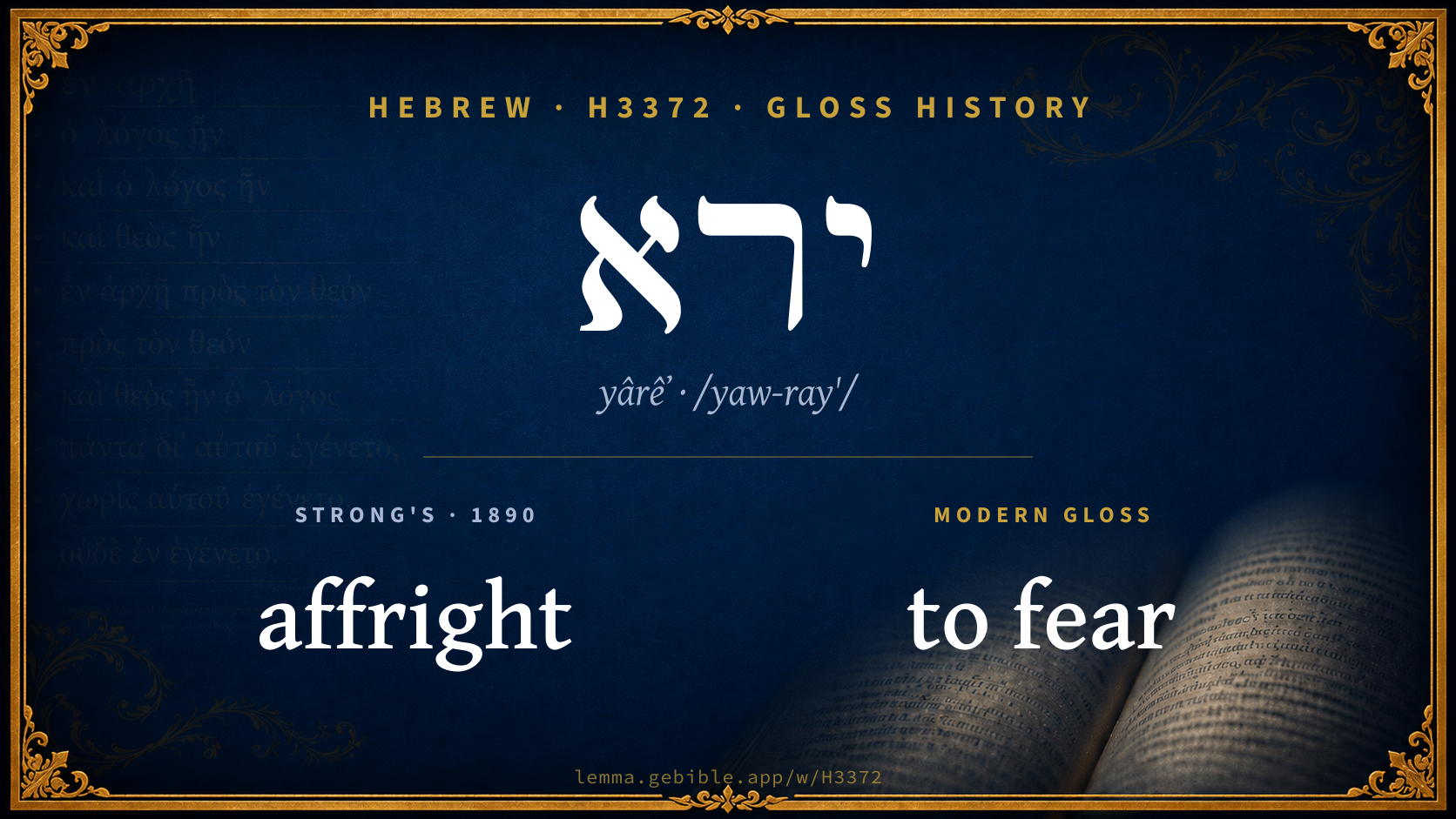
Gloss history
Strong's 1890 vs modern scholarship
About this word
Strong's H3372 catalogs a Hebrew word from the Hebrew Old Testament.
These counts are not copied from any lexicon or concordance. They are computed here, from the morphology-tagged Hebrew Old Testament. What Lemma adds →
- 318
- distinct verses
- The word appears in 318 distinct verses.
- 34 / 39
- OT books
- The word appears in 34 of 39 Old Testament books.
- #150
- by frequency
- Top 250 most frequent Hebrew words (rank 150 of 8,640 Hebrew words by occurrence).
View all 318 occurrences in the concordance →
Most concentrated in
- Psalms 46 verses 14%
- Deuteronomy 35 verses 11%
- Isaiah 24 verses 8%
By section of the Old Testament
By traditional corpus
Conventional, traditional groupings — biblical authorship is debated, so this is a traditional corpus grouping, not an authorship claim. Each share is this word’s portion of its verses in that division of the Hebrew canon. Each figure is a share of the word’s 318 distinct verses.
- Prophets (Nevi'im) 147 verses · 46%
- Writings (Ketuvim) 93 verses · 29%
- Torah (Pentateuch) 78 verses · 25%
How translations render this word
Counts come from each version’s own published word-to-Strong’s tagging or interlinear alignment — an approximate guide to how each version renders this word, not a word-level alignment the data otherwise carries. Because each total is that version’s own tagged count, the per-version totals vary from one another and need not match the appearance or distinct-verse counts above. These counts may also differ from a printed concordance because Lemma counts each distinctly tagged rendering and does not collapse phrase taggings into a single head-word total. This is a fixed set of word-tagged versions (KJV, ASV, BSB, ULT) and does not change with the reading translation you choose elsewhere. Each version’s license is shown beside its name below (and on Sources).
BDB lists this Strong’s number as 3 distinct words (homographs). Each count above pools all of them and is not split by sense — see the Senses section below. A low-frequency rendering may belong to a different one of those words, not the primary meaning.
- King James Version†: Fear 82×, Be not afraid 16×, Feared 16×
- American Standard Version†: Fear 58×, Terrible 17×, Be not afraid 14×
- Berean Standard Bible†: Be afraid 76×, Fear 66×, Awesome 20×
- unfoldingWord Literal Text†: Fear 103×, Do 43×, Be afraid 35×
King James Version Public Domain
Renders H3372 across 313† tagged occurrences — most commonly:
Plus other, less common renderings. Plus 83 renderings that appear only once — usually multi-word phrases or single function words the recovered tagging swept in, not distinct renderings. Not rendered by a distinct English word in 1 further occurrence.
American Standard Version Public Domain
Renders H3372 across 313† tagged occurrences — most commonly:
Plus other, less common renderings. Plus 94 renderings that appear only once — usually multi-word phrases or single function words the recovered tagging swept in, not distinct renderings.
Berean Standard Bible Public Domain
Renders H3372 across 312† tagged occurrences — most commonly:
Plus other, less common renderings. Plus 61 renderings that appear only once — usually multi-word phrases or single function words the recovered tagging swept in, not distinct renderings. Not rendered by a distinct English word in 3 further occurrences.
unfoldingWord Literal Text CC BY-SA 4.0
Renders H3372 across 454† tagged occurrences — most commonly:
Plus other, less common renderings. Plus 63 renderings that appear only once — usually multi-word phrases or single function words the recovered tagging swept in, not distinct renderings.
22 senses and sub-senses in the full BDB
Hebrew verbs can shift meaning by stem (binyan): Qal is the basic action, Niphal is often passive or reflexive, Piel often intensifies or makes it factitive, and Hiphil is typically causative. The senses below are grouped under the stem BDB assigns to each. This entry also uses Hophal (the passive of Hiphil).
What do BDB’s symbols mean?
BDB uses these scholarly abbreviations:
| Symbol | Meaning |
|---|---|
| 𝔊 | the Septuagint (the ancient Greek translation, LXX) |
| 𝔙 | the Vulgate (the Latin translation) |
| 𝔖 | the Syriac version (the Peshitta) |
| 𝔗 | the Targum (the Aramaic translation) |
| ψ | the Psalms |
| √ | root (the underlying root or stem) |
| ‖ | parallel passage (a synonymous or contrasted parallel) |
| † | the dagger: every passage where the word occurs is cited |
The 22 senses and sub-senses the full Brown-Driver-Briggs lexicon distinguishes for this word, in lexicon order (not ranked by frequency), with BDB’s own verbatim wording and sub-sense lettering. Shown in Hebrew script with BDB’s own scholarly abbreviations. The condensed entry is in the Lexicon Entry tab. See also the Forms in the corpus table below.
ירא I fear (NH id.
Qal
- Pf. יר׳ Gn 19:30 + 14 times; 3 f. יָֽרְאָה Je 3:8 ψ 76:9; יָרֵ֑אָה Gn 18:15; pl. 2 m. יְרֵאתֶם Nu 12:8 + 2 times; + 23 times Pf.; Impf. יִירָא Am 3:8 + 3 times; וַיִּירָא Gn 28:17 + 5 times; וַיִּרָא Je 26:21 + 5 times; pl. יִירְאוּ (יִֽרְאוּ) 23:4 +; יִרָאוּן Dt 13:12, +, etc.; 136 times Impf.; Imv. יְרָא Pr 3:7 + 3 times; יְראוּ Jos 24:14 + 2 times; Inf. cstr. יְרֹא Jos 22:25; לֵרֹא 1 S 18:29 (Ges§ 69, R. i.); לְיִרְאָה Dt 4:10 + 13 times; sf. יִרְאָתוֹ 2 S 3:11; יִרְאָתָם Is 29:13; יְרָאתֶם Jos 4:24 (read יִרְאָתָם Bö§ 1081 a Ew337 b Di etc.); Pt. יָרֵא Gn 32:12 + 15 times; cstr. יְרֵא 22:12 + 10 times; pl. יְרֵאִים Je 42:11 + 6 times; cstr. יִרְאֵי Ex 18:21 + 12 times; f. cstr. יִרְאַת Pr 31:30;— e.g. Genesis 19:30
- 1. fear, be afraid (not in P):
- a. abs. Gn 3:10; 18:15; 32:8; 43:18 Ex 14:10 (J), Gn 20:8; 28:17; 42:35 Ex 2:14 Jos 10:2 (E), Dt 20:8; 31:8 Ju 7:3; 8:20 1 S 4:7; 17:11, 24; 23:3; 28:5; 31:4 = 1 Ch 10:4, 2 K 10:4 2 Ch 20:3 Ne 2:2; 6:13 Is 54:14 Je 3:8; 23:4; 26:21 Am 3:8 Jon 1:5, 10 ψ 27:3; 46:3; 49:6 (but Bae reads ראה) 56:4, 5, 12; 64:5, 10; 76:9; 112:8; 118:6 Pr 14:16 Jb 6:21; 11:15; (וּ, י)אַל־תִּירָא fear not Gn 15:1; 21:17; 35:17; 50:19, 21 Ex 20:20 Jos 10:25 (E), Gn 26:24; 43:23 Ex 14:13 Jos 8:1 (J), Dt 1:21; 20:3; 31:6 Ju 4:18; 6:23 1 S 4:20; 12:20; 22:23; 23:17; 28:13 2 S 9:7; 13:28 1 K 17:13 2 K 6:16 1 Ch 22:13; 28:20 2 Ch 20:17 Is 7:4; 35:4; 40:9; 41:10, 13, 14; 43:1, 5; 44:2; 54:4 Je 30:10; 46:27, 28 Jo 2:21, 22 Zp 3:16 Hg 2:5 Zc 8:13, 15 ψ 49:17 La 3:57 Dn 10:12, 19 Ru 3:11; יִשְׁמְעוּ וי׳ hear and fear Dt 13:12; 17:13; 19:20; 21:21; (י)ראו וי׳ see and fear ψ 40:4; 52:8 Is 41:5 Zc 9:5. e.g. Genesis 3:10
- b. c. acc. rei or pers. Nu 14:9(×2) (J), 21:34 (E), Dt 3:2, 22 Ju 6:27 1 S 15:24 2 S 3:11 1 K 1:51 Is 8:12; 51:7; 57:11 Ez 3:9; 11:8 Hb 3:2 (acc. פעלךָ in corrected rhythm), ψ 23:4 Dn 1:10; acc. of God (י׳) 1 S 12:18 2 S 6:9 = 1 Ch 13:12 Is 57:11 Je 5:22 Jon 1:16 Jb 9:35; 37:24. e.g. Numbers 14:9
- c. with מִן be afraid of, Dt 1:29; 2:4; 7:18; 20:1; 28:10 Jos 10:8 (D) 1 S 28:20 2 K 25:24 Is 10:24; 51:12 Je 10:5; 42:11, 16 Ez 2:6(×3) Mi 7:17 ψ 3:7; 27:1; 65:9; 91:5; 112:7; 119:120 Pr 3:25; 31:21 Jb 5:21, 22 Ec 12:5; with מִפְּנֵי Dt 5:5; 7:19 Jos 9:24; 11:6 (D), 1 S 7:7; 18:29; 21:13 1 K 1:50 2 K 1:15; 19:6 (= Is 37:6) 25:26 2 Ch 20:15; 32:7 Ne 4:8 Je 1:8; 41:18; 42:11(×2); מִלִּפְנֵי 1 S 18:12, with בְּ because of, for Je 51:46. e.g. Deuteronomy 1:29
- d. with inf. and לְ fear to do a thing Gn 19:30; 26:7 (J), Nu 12:8 (E), Ju 7:10 2 S 1:14; 10:19; 12:18; with infin. and מִן, afraid of doing Gn 46:3 Ex 3:6 (E), 1 S 3:15 Je 40:9 Jb 32:6. e.g. Genesis 19:30
- e. with פֶּן fear lest Gn 31:31 (E) 32:12 (J). e.g. Genesis 31:31
- 2. stand in awe of, with מן and inf. וַיִּירְאוּ מִגֶּשֶׁת אֵלָיו Ex 34:30 (P) and they stood in awe of drawing nigh unto him; יִירְאוּ מֵיהוה וגו׳ ψ 33:8 let all the earth stand in awe of Yahweh; וְיָרֵאתָ מֵאֱלהֶיךָ and thou shalt stand in awe of thy God Lv 19:14, 32; 25:17, 36, 43 (all H); with מִפְּנֵי, of the king Solomon 1 K 3:28; מִפְּנֵי י׳ אלהים Ex 9:30 (J?); מפני י׳ Hg 1:12; (אלהים) י׳ מלפני stand in awe before (God) Ec 3:14; 8:12, 13. e.g. Exodus 34:30
- 3. fear, reverence, honour, e.g. parents Lv 19:3 (H), Moses and Joshua Jos 4:14(×2), the oath 1 S 14:26 Ec 9:2, commandment Pr 13:13, the sanctuary Lv 19:30; 26:2 (H), other gods Ju 6:10 2 K 17:7, 35, 37, 38; elsewhere of God: e.g. Leviticus 19:3
- a. abs. Je 44:10. e.g. Jeremiah 44:10
- b. with acc. (ה)אלהים Gn 42:18 Ex 1:17, 21; 18:21 (E), Dt 25:18 ψ 55:20; 66:16 Jb 1:1, 8, 9; 2:3 Ec 5:6; 7:18; 8:12; 12:13 Ne 7:2; יר׳ יהוה Ex 14:31 (J), Jos 22:25 (P), 24:14 (E), 1 S 12:14, 24 1 K 18:3, 12 2 K 4:1; 17:25, 28, 32, 33, 34, 41 Is 50:10 Je 26:19 Ho 10:3 Jon 1:9 Mal 3:16(×2) ψ 15:4; 22:24; 25:12; 34:10; 112:1; 115:11, 13; 118:4; 128:1, 4; 135:20 Pr 3:7; 14:2; 24:21; 31:30; יר׳ י׳ אֱלֹהֶיךָ (and other sfs.) Dt 6:2, 13, 24; 10:12, 20; 14:23; 17:19; 31:12, 13 Jos 4:24 (D), 2 K 17:39 Je 5:24; with sfs. referring to Yahweh or Elohim Dt 4:10; 5:26; 8:6; 13:5 1 K 8:40, 43 = 2 Ch 6:31, 33, 2 K 17:36 Is 25:3; 29:13 Je 10:7; 32:39 Mal 2:5; 3:5 Zp 3:7 ψ 22:26; 25:14; 31:20; 33:18; 34:8, 10; 60:6; 67:8; 72:5; 85:10; 103:11, 13, 17; 111:5; 119:63, 74, 79; 145:19; 147:11; הַיָּרֵא אֶת־דְּבַר י׳ Ex 9:20 he that feared the word of Yahweh (J); the name (of Yahweh) Dt 28:58 Is 59:19 Mal 3:20 ψ 61:6; 86:11; 102:16 Ne 1:11. e.g. Genesis 42:18
Niphal
- Impf. 2 m. תִּוָּרֵא ψ 130:4; Pt. נוֹרָא Gn 28:17 + 33 times; f. נוֹרָאָה Is 21:1; pl. נוֹרָאוֹת 64:2 + 5 times; נוֹרָאֹת Dt 10:21; נֹרָאוֹת 2 S 7:23; sf. נוֹרְאוֹתֶיךָ ψ 145:6;— e.g. Psalms 130:4
- 1. be fearful, dreadful, e.g. wilderness Dt 1:19; 8:15, land Is 21:1, people 18:2, 7 Hb 1:7, ice (in sim.) כְּעֵין הַקֶּרַח הנ׳ Ez 1:22 (del. 𝔊 Co). e.g. Deuteronomy 1:19
- 2. cause astonishment and awe: of Yahweh himself ψ 47:3; 68:36; 76:8; נוֹרָא תְהִלֹּת awe-inspiring in praises Ex 15:11 (song); עַל־אלוהּ נוֹרָא הוֹד awe-inspiring majesty (is) upon Eloah Jb 37:22; c. לְ, to kings of the earth ψ 76:13; c. על of hostile nations Zp 2:11; of י׳’s doings Ex 34:10 (J) ψ 66:3, 5; (ה)נוראות wonderful, glorious things, of Messianic king 45:5; of Yahweh himself Dt 10:21 2 S 7:23 = 1 Ch 17:21 Is 64:2 ψ 106:22; 145:6; נו׳ adverbially in ψ 65:6; 139:14 Ges§ 118. 5. b DaSynt. § 70(b); יוֹם י׳ הגדול והנורא the great and awful day of Yahweh Jo 3:4 Mal 3:23 cf. Jo 2:11. e.g. Psalms 47:3
- 3. inspire reverence, godly fear, and awe:
- a. as attribute of God, לְמַעַן תִּוָּרֵא that thou mightest be revered ψ 130:4; (ה)גָּדוֹל ו(ה)נוֹרָא (the) great and awful (God) Dt 7:21; 10:17 Ne 1:5; 4:8; 9:32 Dn 9:4; with עַל, above all gods ψ 96:4 = 1 Ch 16:25; above the angels round about him ψ 89:8. e.g. Psalms 130:4
- b. of the name of Yahweh Dt 28:58 ψ 99:3; 111:9 Mal 1:14. e.g. Deuteronomy 28:58
- c. of sacred things: מלאךְ האלהים Ju 13:6; place of theophany Gn 28:17 (E). e.g. Judges 13:6
Piel
- Pf. 3 m. sf. יֵֽרְאֻנִי 2 S 14:15; Inf. sf. לְיָֽרְאֵנִי Ne 6:19; לְיָֽרְאָם 2 Ch 32:18; Pt. pl. מְיָֽרְאִים Ne 6:9, 14 make afraid, terrify, with acc. e.g. 2 Samuel 14:15
ירא II verb. v. supr. Pt.
ירא III shoot, pour (Aramaic orthogr. of יָרָה q.v.)
Qal
- Inf. cstr. לִירוֹא בַּחִצִּים 2 Ch 26:15 shoot with arrows. e.g. 2 Chronicles 26:15
Hiphil
- Impf. וַיֹּרא֯וּ 2 S 11:24 and they shot at (אֶל־); Pt. pl. הַמּוֹרִא֯ים v 24 the shooters, archers; Kt to be read וַיֹּרִאוּ, הַמּוֹרִאִים; but Mas, noting א as superfluous, would read וַיֹּרוּ, הַמּוֹרִים from יָרָה (Bö§ 1083 (8), (9)). e.g. 2 Samuel 11:24
Hophal
- Impf. only in וּמַרְוֶה גַּם הוּא יוֹרֶ֑א Pr 11:25 he that watereth shall himself also be watered (Fl De MV al. derive—‘non bene,’ Thes—from √ רוה, q.v., יוֹרֶא for יָרְוֶה; but v. Thes Ew§ 131 f. Bö§ 161 (4) SS Buhl Köi. 585; cf. ירה 4). e.g. Proverbs 11:25
Senses from the full Brown-Driver-Briggs lexicon (Brown, Driver, Briggs; Oxford 1906 — public domain), digitized via Sefaria, supplemented by the OpenScriptures HebrewLexicon (CC BY 4.0). Full attribution on Sources.
Word origin
I. vb. fear (NH id.; Assyrian îrû, id.; Hpt KAT2 Gloss i., COTGloss)—
II. adj. verb. v. supr. Pt.
I. vb. shoot, pour (Aramaic orthogr. of יָרָה q.v.)—
— Brown-Driver-Briggs (Oxford 1906, public domain), digitized via Sefaria, supplemented by the OpenScriptures HebrewLexicon (CC BY 4.0). See Sources.
Origin: a primitive root
Jastrow Dictionary
A second Hebrew/Aramaic lexicon for comparison, covering Aramaic and post-biblical (Talmudic, Targumic, Midrashic) usage that the biblical-Hebrew BDB does not. Matched by lemma rather than by Strong’s number, so a lemma may carry more than one Jastrow headword (shown separately below), and the entries cover usage well beyond the Bible.
יָרֵא
- (b. h.) to tremble, fear; to revere; to shun. Sabb. 88ᵃ (ref. to Ps. LXXVI, 9) אם יָרְאָה וכ׳ if she (the earth) trembled, how could she be at rest, &c.?—Ber. 16ᵇ ליִרְאָה את שמך so as to fear thy name.—(Usu. as participle or adjective) יָרֵא m. Ned. 8ᵇ (ref. to Mal. III, 20) אלו … שהן יְרֵאִין להוציא וכ׳ who are afraid to utter the name of the Lord in vain.—יְרֵא חֵטא shunning sin, of careful conduct, conscientious. Ab. II, 5. Ib. 8; a. fr.—יְרֵא שָׁמַיִם God-fearing, pious. Ber. 8ᵃ גדול … יותר מי׳ ש׳ he who lives on the (honest) labor of his hand, stands higher than the pious man. Succ. 49ᵇ, v. יָרַע; a. fr.—Fem. יְרֵאָה, constr. יְרֵאַת. Lam. R. to II, 13 (play on י̇ר̇ושׁל̇ם̇) הבת שי̇ר̇אה ומשׁול̇מ̇ת לי the daughter that fears (me) and is at peace with me. Ib. כשאת יְרֵיאָה את מושלמת לי Ar. (missing in ed.) when thou art God-fearing, thou art at peace with me. Yeb. 62ᵇ.—Part. pass. יָראוּי. Ber. 33ᵇ; Meg. 25ᵃ Ms. M. (v. Rabb. D. S. a. l. note). e.g. Psalms 76:9
- , fut. יִוָּרֵא to be feared. Koh. R. to IX, 7; Pesik. Ul’kaḥ., p. 183ᵇ, a. e. למען תִּוָּרֵא וכ׳ (Ps. CXXX, 4) ‘in order that thou mayest be feared’, that the fear of thee be put on mankind.—Part. נוֹרָא fearful, awe-inspiring. Ber. l. c. Yoma 69ᵇ לא אמר נ׳ Jeremiah did not say nora (only gadol a. gibbor, Jer. XXXII, 18).—Fem. pl. ניֹרָאוֹת awe-inspiring deeds. Ib. אתא … נכרים … איה נוֹרְאוֹתָיו came Jeremiah and said, Strangers dance on His temple ruins, where are His awful deeds?; Y. Ber. VII, 11ᶜ. Ib. לזה נאה לקרות נורא בנ׳ וכ׳ (Daniel said) Him it is becoming to call awe-inspiring for the awful deeds He performed for us &c.; Midr. Till. to Ps. XIX; a. fr. e.g. Psalms 130:4
- , Nithpa. נִתְיָירֵא
- 1. to be feared, revered. Zeb. 115ᵇ (ref. to Ps. LXVIII, 36) בשעה … מִתְיָירֵא ומתעלה וכ׳ when the Lord executes judgment on His saints, He is feared and praised &c.; Yalk. Lev. 525. e.g. Psalms 68:36
- 2. to be afraid. Ber. 61ᵇ אי אתה מתי׳ מפני וכ׳ art thou not afraid of the (Roman) government?—Midr. Till. l. c. שנכנסו … וכא נִתְיָירְאוּ the enemy entered His house and were not afraid (of the Lord). Ex. R. s. 29 אם המטרונה מִתְיָירֵאת וכ׳ if the queen is afraid, what shall the servants … do?; a. fr.
A Dictionary of the Targumim, the Talmud Babli and Yerushalmi, and the Midrashic Literature (Marcus Jastrow; London, Luzac, 1903) — Public Domain. Digitized via Sefaria. Digitized via Sefaria. Full attribution on Sources.
Forms in the corpus
The 212 distinct written forms H3372 takes in the Hebrew Bible, most frequent first — each parse links to that stem’s occurrences in the concordance. Hebrew forms include their vowel points and cantillation, so a single lemma takes many written forms.
The 60 most common forms are shown; 152 rarer forms follow in the full concordance.
Same root — word family
Other BDB entries built from the same root as H3372, grouped by Strong’s listed origin. These share a root / origin per the lexicon — not necessarily a shared meaning. Each links to that word’s own entry.
Derived from this word
Proper names from this root
People and places named from this root — a name, not an additional meaning of the word.
Compare all same-root words → Showing 4 of 5 — not the complete family. 2 of the same-root words are proper names (people or places). They share a root, not necessarily a meaning.
Septuagint verse parallels
This word appears in 294 verses that also exist in the Greek Old Testament (Septuagint), out of the 318 Hebrew verses it occurs in. You can read those verses in Greek by switching the Old Testament edition to the Septuagint.
Read these verses in the Septuagint
- Genesis 3:10
- Exodus 1:17
- Leviticus 19:3
- Numbers 12:8
- Deuteronomy 1:19
- Joshua 4:14
- Judges 4:18
- Ruth 3:11
- 1 Samuel 3:15
- 2 Samuel 1:14
- 1 Kings 1:50
- 2 Kings 1:15
This is a verse-level parallel only — the same verses exist in both the Hebrew and Greek Old Testaments. No word-level Hebrew↔Greek correspondence is claimed: the data carries no such alignment, so no Greek word is shown as this Hebrew word’s translation. Coverage is not total — the Septuagint omits the deuterocanon and renumbers the Psalms, so some Hebrew verses have no direct Greek parallel.