
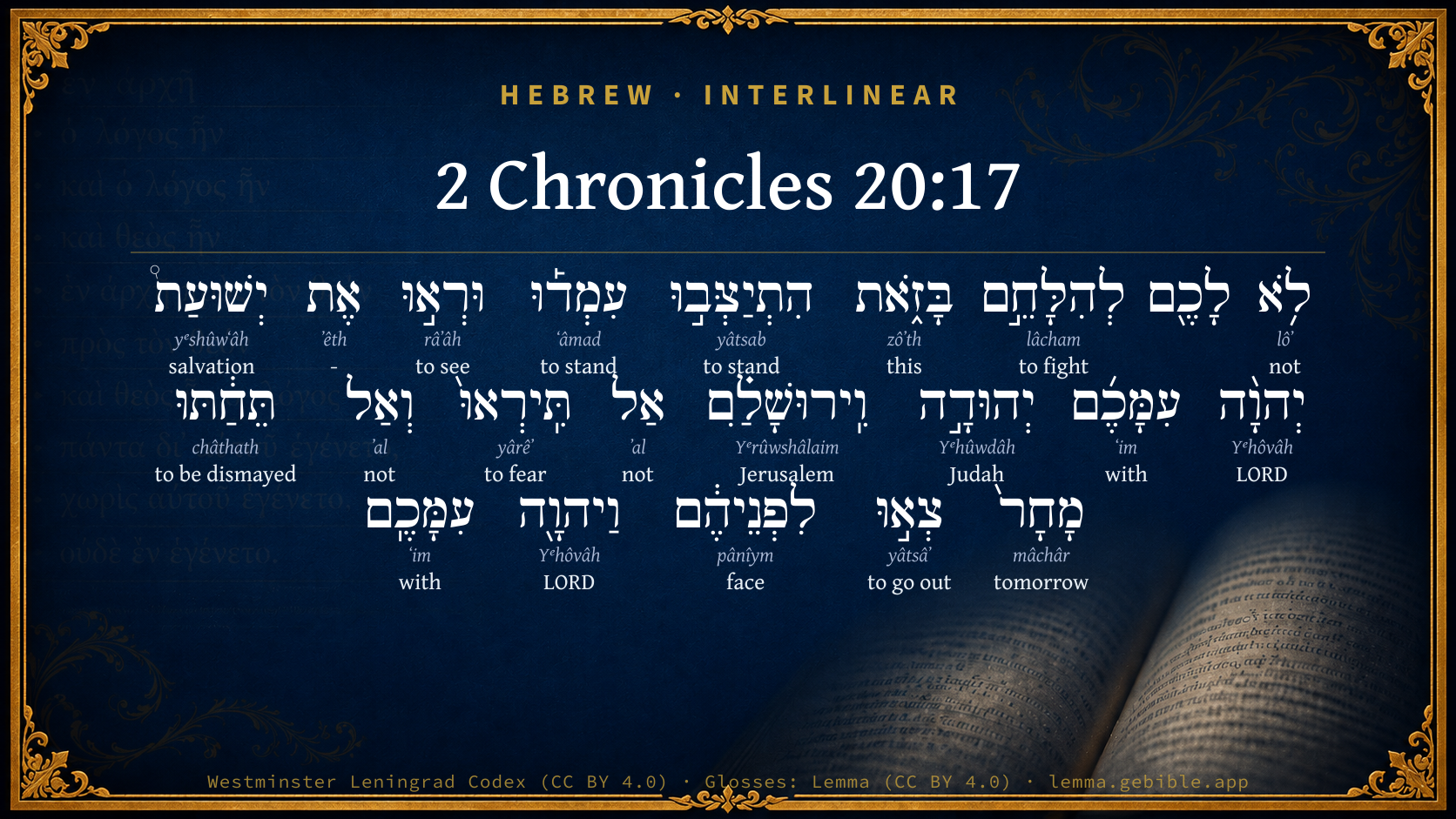
2 Chronicles 20:17

Hebrew (Westminster Leningrad Codex) 2 Chronicles 20:17 appears in the Hebrew Old Testament. The text above is from the Westminster Leningrad Codex. Each word links to its Strong’s number, a concise gloss, and parsing drawn from the Open Scriptures Hebrew Bible morphology. Click any word for its full Brown-Driver-Briggs (BDB) entry.
Download image
Cite this verse

2 Chronicles 20:17 (World English Bible). Public Domain. Lemma interlinear Bible study tool, https://lemma.gebible.app/v/2-chronicles/20/17.

Show BibTeX & RIS
BibTeX
RIS
English Translation
You shall not need to fight in this [battle]: set yourselves, stand you still, and see the salvation of Yahweh with you, O Judah and Jerusalem; don't be afraid, nor be dismayed: tomorrow go out against them: for Yahweh is with you.
World English Bible · Public Domain
Download a study sheet

One document with this verse’s original text, its word-by-word gloss line, the meaning frame, cross-references with their text, attributed commentary, and full source and license credits — printable, and it pastes into notes with its structure intact.

This verse Autodidact and up

Study sheet (.html) Plain text (.txt)

A passage Seminary Student

Up to 50 verses in one chapter. A passage sheet keeps up to 6 commentary sources and 12 cross-references per verse, in the order this page ranks them, and says so on the sheet whenever that leaves anything out. Ask for a single verse and you get the Autodidact verse sheet above.

Everything on this page stays free to read, with no account — the sheet is a download of what is already on screen, not access to it.

Want to remove ads? Support Godless Engineer
Compare translations 3

The same verse in 3 English versions, stacked beneath the original-language interlinear above. Click any original word for its lexicon entry.

Each is an independent rendering of the whole verse — the interlinear is not word-aligned to these translations.

Highlighted words mark where these versions differ — a whole-verse word diff, not a word-by-word alignment.

  • World English Bible Public Domain
    You shall not need to fight in this [battle]: set yourselves, stand you still, and see the salvation of Yahweh with you, O Judah and Jerusalem; don't be afraid, nor be dismayed: tomorrow go out against them: for Yahweh is with you.
  • King James Version Public Domain
    Ye shall not need to fight in this battle: set yourselves, stand ye still, and see the salvation of the LORD with you, O Judah and Jerusalem: fear not, nor be dismayed; to morrow go out against them: for the LORD will be with you.
  • unfoldingWord Literal Text CC BY-SA 4.0
    Not to you all is it to fight in this. Station yourselves, stand and see the deliverance of Yahweh with you all, Judah and Jerusalem. Do not fear and do not be dismayed. Tomorrow, go out before them, and Yahweh is with you all.’”

unfoldingWord Literal Text — © unfoldingWord, licensed CC BY-SA 4.0. Word-aligned USFM3 via Door43 (git.door43.org/unfoldingWord/en_ult).

Versions to compare (up to 4)

3 of 4 selected

Show all 18 translations

Every available English version of this verse, each an independent rendering of the whole verse.

  • World English Bible Public Domain
    You shall not need to fight in this [battle]: set yourselves, stand you still, and see the salvation of Yahweh with you, O Judah and Jerusalem; don't be afraid, nor be dismayed: tomorrow go out against them: for Yahweh is with you.
  • Berean Standard Bible Public Domain
    You need not fight this battle. Take up your positions, stand firm, and see the salvation of the LORD on your behalf, O Judah and Jerusalem. Do not be afraid or discouraged. Go out and face them tomorrow, for the LORD is with you.’”
  • Majority Standard Bible Public Domain
    You need not fight this battle. Take up your positions, stand firm, and see the salvation of the LORD on your behalf, O Judah and Jerusalem. Do not be afraid or discouraged. Go out and face them tomorrow, for the LORD is with you.’”
  • King James Version Public Domain
    Ye shall not need to fight in this battle: set yourselves, stand ye still, and see the salvation of the LORD with you, O Judah and Jerusalem: fear not, nor be dismayed; to morrow go out against them: for the LORD will be with you.
  • American Standard Version (1901) Public Domain
    Ye shall not need to fight in this `battle': set yourselves, stand ye still, and see the salvation of Jehovah with you, O Judah and Jerusalem; fear not, nor be dismayed: to-morrow go out against them: for Jehovah is with you.
  • Revised Version (1885) Public Domain
    Ye shall not need to fight in this battle: set yourselves, stand ye still, and see the salvation of the LORD with you, O Judah and Jerusalem: fear not, nor be dismayed: tomorrow go out against them; for the LORD is with you.
  • Geneva Bible (1599) Public Domain
    Ye shall not neede to fight in this battell: stand still, moue not, and behold the saluation of the Lord towardes you: O Iudah, and Ierusalem, feare ye not, neither be afraid: to morow goe out against them, and the Lord wilbe with you.
  • Douay-Rheims (1899) Public Domain
    It shall not be you that shall fight, but only stand with confidence, and you shall see the help of the Lord over you, O Juda, and Jerusalem: fear ye not, nor be you dismayed: to morrow you shall go out against them, and the Lord will be with you.
  • Young's Literal Translation Public Domain
    Not for you to fight in this; station yourselves, stand, and see the salvation of Jehovah with you, O Judah and Jerusalem -- be not afraid nor fear ye -- to-morrow go out before them, and Jehovah `is' with you.'
  • Literal Standard Version CC BY-SA 4.0
    [It is] not for you to fight in this; station yourselves, stand, and see the salvation of YHWH with you, O Judah and Jerusalem—do not be afraid nor fear—tomorrow go out before them, and YHWH [is] with you.”
  • Unlocked Literal Bible CC BY-SA 4.0
    You will not need to fight in this battle. Stand in your positions, stand still, and see the rescue of Yahweh with you, Judah and Jerusalem. Do not fear nor be discouraged. Go out against them tomorrow, for Yahweh is with you.'”
  • unfoldingWord Literal Text CC BY-SA 4.0
    Not to you all is it to fight in this. Station yourselves, stand and see the deliverance of Yahweh with you all, Judah and Jerusalem. Do not fear and do not be dismayed. Tomorrow, go out before them, and Yahweh is with you all.’”
  • Darby Bible Public Domain
    Ye shall not have to fight on this occasion: set yourselves, stand and see the salvation of Jehovah [who is] with you! Judah and Jerusalem, fear not nor be dismayed; to-morrow go out against them, and Jehovah will be with you.
  • World Messianic Bible Public Domain
    You will not need to fight this battle. Set yourselves, stand still, and see the salvation of the LORD with you, O Judah and Jerusalem. Don’t be afraid, nor be dismayed. Go out against them tomorrow, for the LORD is with you.’”
  • Webster's Bible Public Domain
    Ye shall not need to fight in this battle: set yourselves, stand ye still, and see the salvation of the LORD with you, O Judah and Jerusalem: fear not, nor be dismayed; to-morrow go out against them: for the LORD will be with you.
  • Free Bible Version CC BY-SA 4.0
    But you do not need to fight this battle. Just stand still and watch the Lord's victory. He is with you, Judah and Jerusalem! Don't be afraid or discouraged! March down to face them, for the Lord is with you!”
  • Bible in Basic English Public Domain
    There will be no need for you to take up arms in this fight; put yourselves in position, and keep where you are, and you will see the salvation of the Lord with you, O Judah and Jerusalem: have no fear and do not be troubled: go out against them tomorrow, for the Lord is with you.
  • JPS Tanakh (1917) Public Domain
    Ye shall not need to fight in this battle; set yourselves, stand ye still, and see the salvation of the LORD with you, O Judah and Jerusalem; fear not, nor be dismayed; to-morrow go out against them; for the LORD is with you.'

Literal Standard Version (2020), Covenant Press — licensed CC BY-SA 4.0. Text via the HelloAO Bible API (eBible.org). Unlocked Literal Bible (unfoldingWord) — licensed CC BY-SA 4.0. Text via the HelloAO Bible API (eBible.org). unfoldingWord Literal Text — © unfoldingWord, licensed CC BY-SA 4.0. Word-aligned USFM3 via Door43 (git.door43.org/unfoldingWord/en_ult). Free Bible Version, Dr. Jonathan Gallagher — licensed CC BY-SA 4.0. Text via the HelloAO Bible API (eBible.org).

Word by word

More ways to search: Search by grammar → Find every occurrence → Compare this word →

Practice this passage: Drill this verse → Learn its vocabulary →

הִתְיַצְּב֣וּ
yâtsab
H3320
“stand”
Verb, Hithpael, Imperative, 2nd Person, Masculine, Plural
Part of Speech
Verb
Stem
Hithpael
Form
Imperative
Person
2nd Person
Gender
Masculine
Number
Plural
Full BDB Definition

Origin: a primitive root

TWOT: 894

to place, set, stand, set or station oneself, present oneself - (Hithpael) to station oneself, take one's stand, stand, present oneself, stand with someone
  1. לֹ֥א lôʼ H3808 “not” Particle, Negative
  2. לְהִלָּחֵ֣ם lâcham H3898 “to fight” Preposition + Verb, Niphal, Infinitive Construct
  3. בָּזֹ֑את zôʼth H2063 “in/at · this” Preposition + Pronoun, Demonstrative, Feminine, Singular
  4. עִמְד֡וּ ʻâmad H5975 “stand” Verb, Qal, Imperative, 2nd Person, Masculine, Plural
  5. וּרְא֣וּ râʼâh H7200 “and · see” Conjunction + Verb, Qal, Imperative, 2nd Person, Masculine, Plural
  6. אֶת ʼêth H853 “-” Particle, Direct Object
  7. יְשׁוּעַת֩ yᵉshûwʻâh H3444 “salvation of” Noun, Common, Feminine, Singular, Construct
  8. יְהוָ֨ה Yᵉhôvâh H3068 “LORD” Noun, Proper
  9. עִמָּכֶ֜ם ʻim H5973 “with · you” Preposition + Suffix, Personal, 2nd Person, Masculine, Plural
  10. יְהוּדָ֣ה Yᵉhûwdâh H3063 “Judah” Noun, Proper
  11. וִֽירוּשָׁלִַ֗ם Yᵉrûwshâlaim H3389 “and · Jerusalem” Conjunction + Noun, Proper
  12. אַל ʼal H408 “not” Particle, Negative
  13. תִּֽירְאוּ֙ yârêʼ H3372 “to fear” Verb, Qal, Jussive, 2nd Person, Masculine, Plural
  14. וְאַל ʼal H408 “and · not” Conjunction + Particle, Negative
  15. תֵּחַ֔תּוּ châthath H2865 “to be dismayed” Verb, Niphal, Jussive, 2nd Person, Masculine, Plural
  16. מָחָר֙ mâchâr H4279 “tomorrow” Noun, Common, Masculine, Singular, Absolute
  17. צְא֣וּ yâtsâʼ H3318 “go out” Verb, Qal, Imperative, 2nd Person, Masculine, Plural
  18. לִפְנֵיהֶ֔ם pânîym H6440 “to/for · face(s) · their” Preposition + Noun, Common, Both, Plural, Construct + Suffix, Personal, 3rd Person, Masculine, Plural
  19. וַיהוָ֖ה Yᵉhôvâh H3068 “and · LORD” Conjunction + Noun, Proper
  20. עִמָּכֶֽם ʻim H5973 “with · you” Preposition + Suffix, Personal, 2nd Person, Masculine, Plural

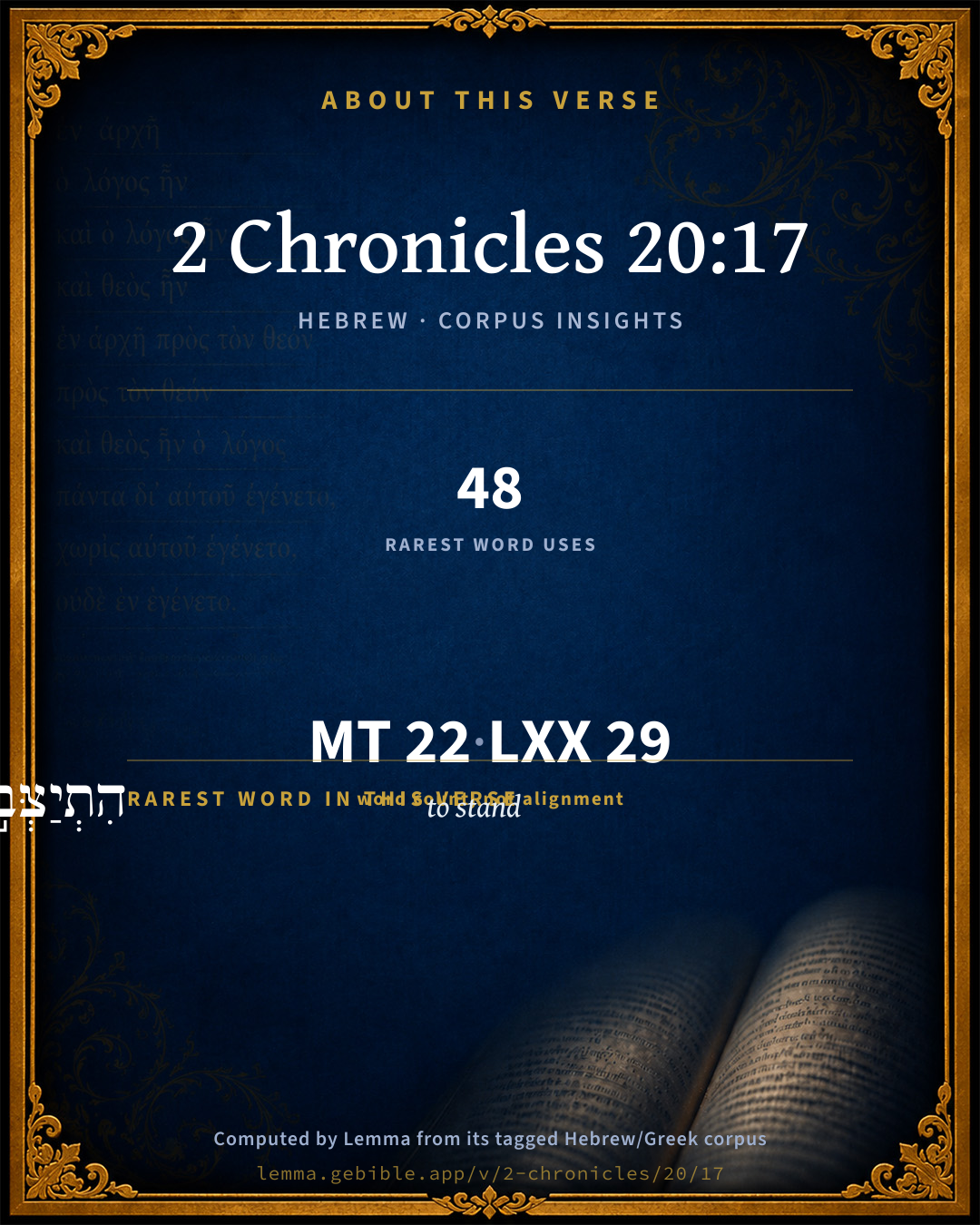
About this verse

These counts appear in no published source. They are computed here, from the morphology-tagged text and Lemma’s own curated glosses. What Lemma adds →

22
words
18
distinct lemmas
Historical
section

Shared distinctive vocabulary

הִתְיַצְּב֣וּ to stand H3320 occurs in 45 verses of the Hebrew Bible. Also found in:

Grammatical profile

  • 7 verbs
  • 7 nouns
  • 1 pronoun
  • 3 prepositions
  • 4 particles

Verb forms

  • לְהִלָּחֵ֣ם Niphal · Infinitive Construct
  • הִתְיַצְּב֣וּ Hithpael · Imperative
  • עִמְד֡וּ Qal · Imperative
  • וּרְא֣וּ Qal · Imperative
  • תִּֽירְאוּ֙ Qal · Jussive
  • תֵּחַ֔תּוּ Niphal · Jussive
  • צְא֣וּ Qal · Imperative

Repetition

Words recur within this verse — often emphatic in Hebrew:

  • יְהוָ֨ה LORD H3068 ×2
  • עִמָּכֶ֜ם with H5973 ×2
  • אַל not H408 ×2

Hebrew & Septuagint length

In English translation the verse runs 42 words from the Hebrew and 41 from the Septuagint (LXX English) — closely comparable.

A rough comparison of the two English renderings, which tokenize alike — not a word-level alignment.

Word counts can differ between the Hebrew and the Greek without any difference in meaning — e.g. the Hebrew direct-object marker אֵת has no separate Greek word, and Greek often adds the article ὁ.

In the original languages it is 22 Hebrew tokens and 29 Greek tokens — but the two are counted differently (Hebrew bundles its prefixes and suffixes into one token; the Greek is in lemma form), so that isn’t a like-for-like length.

Cross-references

18

Topical passages linked to 2 Chronicles 20:17 in the Treasury of Scripture Knowledge — connected by theme and wording, ordered by reader-vote popularity; previews shown in the World English Bible.

  • Exodus 14:13–14 Moses said to the people, "Don't be afraid. Stand still, and see the salvation of Yahweh, which he will work for you today: for the Egyptians whom you have seen today, you shall never see them again.
  • 2 Chronicles 15:2 and he went out to meet Asa, and said to him, Hear you me, Asa, and all Judah and Benjamin: Yahweh is with you, while you are with him; and if you seek him, he will be found of you; but if you forsake him, he will forsake you.
  • Isaiah 41:10 Don't you be afraid, for I am with you; don't be dismayed, for I am your God; I will strengthen you; yes, I will help you; yes, I will uphold you with the right hand of my righteousness.
  • Psalms 46:10–11 "Be still, and know that I am God. I will be exalted among the nations. I will be exalted in the earth."
  • Matthew 28:20 teaching them to observe all things that I commanded you. Behold, I am with you always, even to the end of the age." Amen.
  • 2 Chronicles 32:8 with him is an arm of flesh; but with us is Yahweh our God to help us, and to fight our battles. The people rested themselves on the words of Hezekiah king of Judah.
  • Lamentations 3:26 It is good that a man should hope and quietly wait for the salvation of Yahweh.
  • Numbers 14:9 Only don't rebel against Yahweh, neither fear the people of the land; for they are bread for us: their defense is removed from over them, and Yahweh is with us: don't fear them.
  • Psalms 46:7 Yahweh of Hosts is with us. The God of Jacob is our refuge. Selah.
  • Romans 8:31 What then shall we say about these things? If God is for us, who can be against us?
  • Isaiah 30:15 For thus said the Lord Yahweh, the Holy One of Israel, In returning and rest shall you be saved; in quietness and in confidence shall be your strength. You would not:
  • Matthew 1:23 "Behold, the virgin shall be with child, And shall bring forth a son. They shall call his name Immanuel;" Which is, being interpreted, "God with us."
  • Isaiah 8:9–10 Make an uproar, O you peoples, and be broken in pieces! And give ear, all you of far countries: gird yourselves, and be broken in pieces! Gird yourselves, and be broken in pieces!
  • 2 Chronicles 20:22–23 When they began to sing and to praise, Yahweh set liers-in-wait against the children of Ammon, Moab, and Mount Seir, who had come against Judah; and they were struck.
  • Amos 5:14 Seek good, and not evil, That you may live; And so Yahweh, the God of hosts, will be with you, As you say.
  • 2 Timothy 4:22 The Lord Jesus Christ be with your spirit. Grace be with you. Amen.
  • Exodus 14:25 He took off their chariot wheels, and they drove them heavily; so that the Egyptians said, "Let's flee from the face of Israel, for Yahweh fights for them against the Egyptians!"
  • Isaiah 30:7 For Egypt helps in vain, and to no purpose: therefore have I called her Rahab who sits still.

Cross-references courtesy of OpenBible.info (CC BY 4.0).

Hebrew and Greek witnesses Masoretic Hebrew ↔ Greek Septuagint

The same verse in the two great witnesses to the Old Testament, shown verse-for-verse.

These are two independent witnesses, not word-aligned to each other, and the Septuagint is shown in lemma (dictionary) form.

Hebrew 2 Chronicles 20:17 Masoretic · Westminster Leningrad Codex

לֹ֥א לָכֶ֖ם לְהִלָּחֵ֣ם בָּזֹ֑את הִתְיַצְּב֣וּ עִמְד֡וּ וּרְא֣וּ אֶת יְשׁוּעַת֩ יְהוָ֨ה עִמָּכֶ֜ם יְהוּדָ֣ה וִֽירוּשָׁלִַ֗ם אַל תִּֽירְאוּ֙ וְאַל תֵּחַ֔תּוּ מָחָר֙ צְא֣וּ לִפְנֵיהֶ֔ם וַיהוָ֖ה עִמָּכֶֽם

You shall not need to fight in this [battle]: set yourselves, stand you still, and see the salvation of Yahweh with you, O Judah and Jerusalem; don't be afraid, nor be dismayed: tomorrow go out against them: for Yahweh is with you.

World English Bible · Public Domain

Greek LXX 2 Chronicles 20:17 Septuagint · lemma form

οὐ σύ εἰμί πολεμέω οὗτος συνἵημι καί ὁράω ὁ σωτηρία κύριος μετά σύ ἰουδά καί ἰερουσαλήμ μή φοβέω μηδέ πτοέω αὔριον ἐκἔρχομαι εἰς ἀπάντησις αὐτός καί κύριος μετά σύ

It is not for you to fight: understand these things, and see the deliverance of the Lord with you, Juda and Jerusalem: fear not, neither be afraid to go forth to-morrow to meet them; and the Lord shall be with you.

LXX2012 (modern English Septuagint) · Public Domain

Hebrew: Westminster Leningrad Codex (CC BY 4.0). Greek: Septuagint (public domain); English from LXX2012 (modern English Septuagint) (Public Domain). How the Septuagint differs from the Hebrew →

Commentary

Notes on 2 Chronicles 20:17 from classic Christian and Jewish commentators (each source and its license shown beneath its notes). The classic Christian expositions comment on the surrounding passage and are grouped to its opening verse, so a note may address several verses; the Jewish commentaries on the Tanakh (Rashi and others) are per-verse, so they appear only where the commentator wrote on this verse.

Lemma curates 59 commentaries, every one of them public domain or Creative Commons licensed, each selected and text-cleaned for this edition rather than reprinted as found. About our sources →

Trapp's Complete Commentary

John Trapp

2Ch 20:17 Ye shall not [need] to fight in this [battle]: set yourselves, stand ye [still], and see the salvation of the LORD with you, O Judah and Jerusalem: fear not, nor be dismayed; to morrow go out against them: for the LORD [will be] with you.

Ver. 17. Set yourselves, stand ye still.] The soldier’s motto is, Nec fugere nec sequi: Neither flee nor follow. the true Christian’s is, Nec temere, nec timide. Neither rashly nor fearful. So here, neither fly upon your enemies, nor flee from them.

John Trapp, A Commentary or Exposition upon All the Books of the Old and New Testament (1647–1656) — public domain. Text from a community e-Sword module.

The Biblical Illustrator

Joseph S. Exell

2Ch_20:17

Ye shall not need to fight in this battle.

The conditions and certainty of obtaining Gods deliverance

I. That since our enemies designs are known to us, we ought to set ourselves, that is, make what provision we can against them.

II. That having thus set ourselves, we must then stand still, that is, do nothing which is unlawful, although it be for, our own preservation.

1. By doing any unlawful action we deprive ourselves of Gods care and protection.

2. By doing anything unlawful we bring a scandal upon our religion.

3. To do evil, although for our own preservation, would be most likely to unsettle and ruin us. When once we break down the fences of duty, who can tell where we shall stop? If we allow ourselves the liberty of doing one sinful act, we may easily be prompted on to commit a thousand.

III. Repentance and amendment of life being supposed, we haste all reason to hope that we shall see the salvation of God.

1. Whatever our danger, God hath sufficient power to save and deliver us.

2. This is to be inferred from the design of Gods sending judgments upon any nation. (Jer_18:7). (Thomas Lynford, A.M.)

For the Lord is with you.--

The power behind us

In my firewood factory we use a circular saw for cutting timber. Until recently this saw was worked by a crank turned by men. It was slow work, and we bought a gas engine. The saw, driven by this engine, does more work and at less cost. It is the same saw, but the difference lies in the power that drives it. It was driven by hand-power, now by an equivalent for steam, we only need to keep the connecting band tight. It is not a question of our abilities, but of the power behind us. (F. B. Meyer.)

The Biblical Illustrator, edited by Joseph S. Exell (c. 1880s–1900s) — public domain. Text from a community e-Sword module.

Geneva Bible (1599)

Geneva Bible translators

Or, deliverance.

Geneva Bible (1599) marginal notes — public domain. Text via Bolls.life.

Adam Clarke's Commentary

Verse 17. For the Lord will be with you.] "The WORD of the Lord shall be your Helper." - Targum.

Adam Clarke's Commentary on the Bible (1810–1826) — public domain. Text from a community e-Sword/MySword module.

Ellicott's Commentary for English Readers

(17) Ye shall not need to fight.—It is not for you to fight. (Comp. 1Ch_5:1; 1Ch_15:2.)

In this.—Herein, in this instance. (Comp. for the phrase, 2Ch_19:2.)

Set yourselves (i.e., “withstand,” 2Ch_20:6).—Station yourselves, take your stand. Here the next verb, stand ye still, seems added as an explanation, and is, perhaps, a marginal gloss. “Fear not: take your stand, and see the salvation of the Lord,” was the command of Moses to Israel at the Red Sea, just before the Great Deliverance (Exo_14:13). (Comp. also the words of Psa_46:8, “Come, behold the works of the Lord, what desolations he hath made in the earth.”)

The Lord with you.—Some explain the connection thus: “The Lord (who is) with you.” Iahveh ‘immdkhem may, perhaps, be compared with ‘immânû êl, “with us God” (Isa_7:14; Isa_8:8); it will then be a Divine title, suited to the present emergency. But, more probably, the stop should be at the Lord; and with you, O Judah and Jerusalem! is an elliptic expression, meaning “He is, or will be with you,” &c, as in 2Ch_19:6. (Comp. the refrain of Psalms 46, “The Lord of hosts is with us! The God of Jacob is our refuge.”)

A Bible Commentary for English Readers, edited by Charles John Ellicott (1878–1897) — public domain. Text from a community e-Sword module.

The Cambridge Bible for Schools and Colleges

gen. ed. J. J. S. Perowne

17. see the salvation] Cp. Exo_14:13.

will be with you] R.V. is with you; cp. 2Ch_15:2.

The Cambridge Bible for Schools and Colleges (gen. ed. J. J. S. Perowne; Cambridge University Press, 1878–1918) — public domain. Text from a community e-Sword module.

John Gill's Exposition

Ye shall not need to fight in this battle,.... Since the Lord would fight for them:

set yourselves, stand ye still; present themselves they might, as if ready to engage; and keep their ground, not giving way in the least, but would have no need to strike a stroke:

and see the salvation of the Lord with you; which he would work for them, see Exo 14:13,

and Judah, and Jerusalem, fear not, nor be dismayed; which is repeated for the confirmation of them:

tomorrow go out against them, for the Lord will be with you; to protect them, fight for them, and give them victory; the Targum is,"the Word of the Lord shall be your help.''

John Gill's Exposition of the Whole Bible (1746–1763) — public domain (CC PDM 1.0). Text via the HelloAO Bible API.

Whedon's Commentary on the Bible

Daniel D. Whedon

17. Stand… and see the salvation of the Lord — So Moses commanded Israel when Jehovah was about to destroy their enemies in the Red Sea. Compare Exo_14:13-14.

Daniel D. Whedon (gen. ed.), Commentary on the Old and New Testaments (1874–1909) — public domain. Text from a community e-Sword module.

The Pulpit Commentary

Stand and see the salvation of the Lord with you. The grand original of these words (Exo_14:13) would be known to both Jahaziel and Jehoshaphat.

The Pulpit Commentary (1880–1919), ed. H.D.M. Spence-Jones & Joseph S. Exell — public domain. Text from a community e-Sword module.

Rashi

Rabbi Shlomo Yitzchaki (Rashi)

set yourself This refers back to (verse 15) “for the war is not yours.”

and see the salvation of the Lord This refers back to the above: “Have You, our God, not caused us to inherit (sic)?” And the Holy One, blessed be He, said to them, “You are right. It is up to Me to preserve it in your hands.”

Tomorrow go forth before them and I shall wage war on your behalf. And they believed, and hurried, and arose early in the morning.

Rashi on the Tanakh — English translations: “The Judaica Press complete Tanach with Rashi, translated by A. J. Rosenberg” (CC BY 4.0); “Pentateuch with Rashi's commentary by M. Rosenbaum and A.M. Silbermann, 1929-1934” (public domain); “The Metsudah Tanach series, Lakewood, N.J” (CC BY 4.0); and “The Book of Joshua, Metsudah Publications, 1997” (CC BY 4.0). Text via Sefaria.

Lesson kit

Teaching starters — assembled from the data on this page, not authored interpretation. Every prompt links to the verse data it draws on. Edit before teaching.

2 Chronicles, in the Historical, opens this verse with 22 words (18 distinct Hebrew lemmas). Its most distinctive word is yâtsab (“to stand”). A historical commentator’s framing appears above. Read the whole chapter for the surrounding context.

Discussion questions

  1. The word yâtsab carries the sense “to stand.” How does it shape the verse?
  2. Exodus 2:4 shares the word «to stand» with this verse. How do the two illuminate each other?
  3. “LORD” occurs 2× in this one verse. What is the effect of the repetition?
  4. The translations on this page render this verse differently — a whole-verse word diff, not a word-by-word alignment. What might account for the different wordings?
  5. The verb «לְהִלָּחֵ֣ם» is Niphal Infinitive Construct. How does its form color the action?
  6. Reading how Trapp's Complete Commentary and The Biblical Illustrator read this verse, where do the two commentators agree and where do they part?

Things to notice

Reading settings

Reading text

Shown beneath each verse's original-language words.

Old Testament
Old Testament edition

Read the OT as the Masoretic Hebrew (MT) or the Greek Septuagint (LXX).

English shown for the Greek Septuagint (in the Hebrew ↔ Greek comparison).

Comparing translations? Open the Compare panel on any verse page to stack up to four side by side.