Deuteronomy 28:10

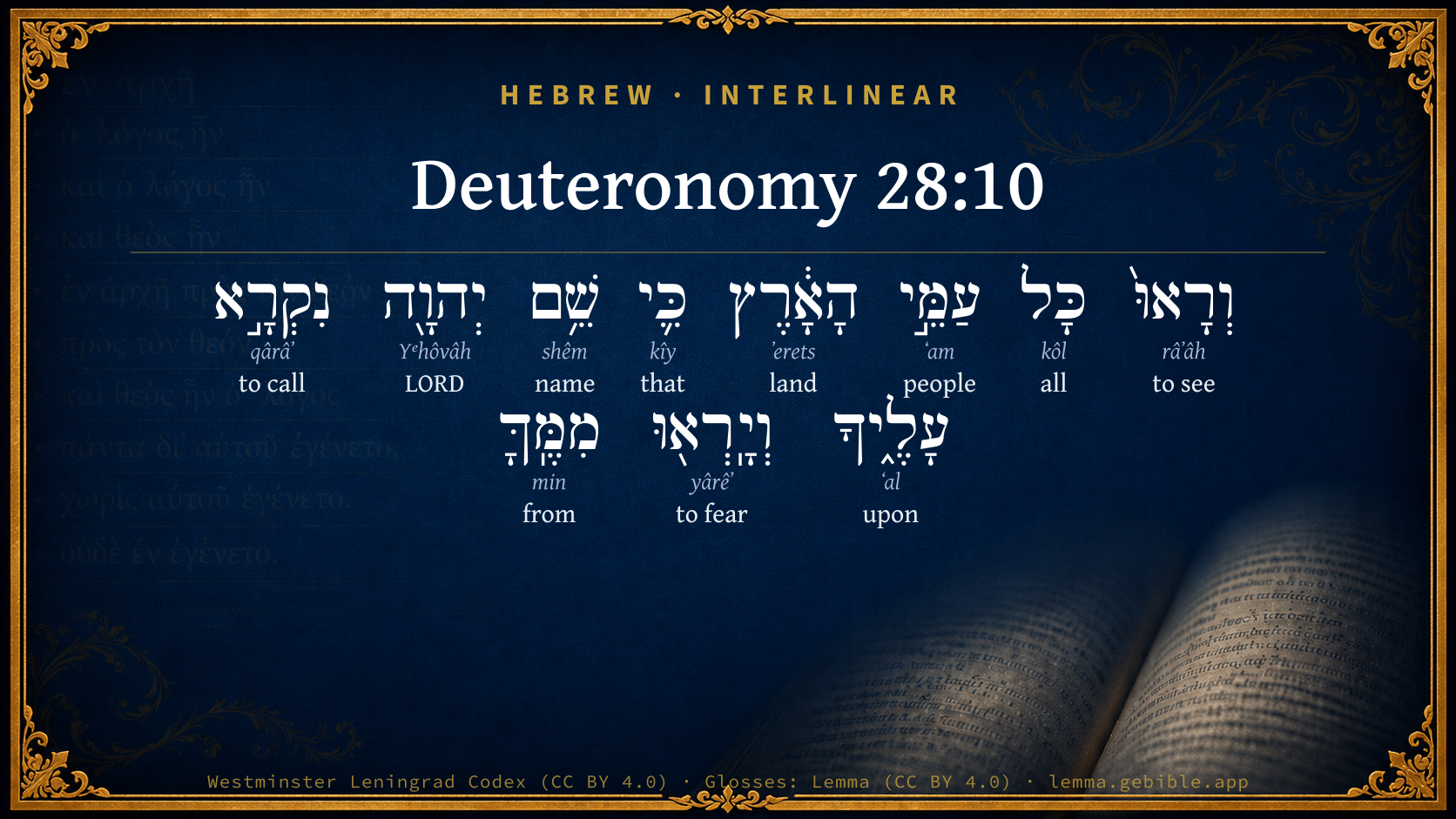
Hebrew (Westminster Leningrad Codex) Deuteronomy 28:10 appears in the Hebrew Old Testament. The text above is from the Westminster Leningrad Codex. Each word links to its Strong’s number, a concise gloss, and parsing drawn from the Open Scriptures Hebrew Bible morphology. Click any word for its full Brown-Driver-Briggs (BDB) entry.
Download image
Cite this verse

Deuteronomy 28:10 (World English Bible). Public Domain. Lemma interlinear Bible study tool, https://lemma.gebible.app/v/deuteronomy/28/10.

Show BibTeX & RIS
BibTeX
RIS
English Translation
All the peoples of the earth shall see that you are called by the name of Yahweh; and they shall be afraid of you.
World English Bible · Public Domain
Download a study sheet

One document with this verse’s original text, its word-by-word gloss line, the meaning frame, cross-references with their text, attributed commentary, and full source and license credits — printable, and it pastes into notes with its structure intact.

This verse Autodidact and up

Study sheet (.html) Plain text (.txt)

A passage Seminary Student

Up to 50 verses in one chapter. A passage sheet keeps up to 6 commentary sources and 12 cross-references per verse, in the order this page ranks them, and says so on the sheet whenever that leaves anything out. Ask for a single verse and you get the Autodidact verse sheet above.

Everything on this page stays free to read, with no account — the sheet is a download of what is already on screen, not access to it.

Want to remove ads? Support Godless Engineer
Compare translations 3

The same verse in 3 English versions, stacked beneath the original-language interlinear above. Click any original word for its lexicon entry.

Each is an independent rendering of the whole verse — the interlinear is not word-aligned to these translations.

Highlighted words mark where these versions differ — a whole-verse word diff, not a word-by-word alignment.

  • World English Bible Public Domain
    All the peoples of the earth shall see that you are called by the name of Yahweh; and they shall be afraid of you.
  • King James Version Public Domain
    And all people of the earth shall see that thou art called by the name of the LORD; and they shall be afraid of thee.
  • unfoldingWord Literal Text CC BY-SA 4.0
    And all the peoples of the earth will see that the name of Yahweh is called upon you, and they will be afraid of you.

unfoldingWord Literal Text — © unfoldingWord, licensed CC BY-SA 4.0. Word-aligned USFM3 via Door43 (git.door43.org/unfoldingWord/en_ult).

Versions to compare (up to 4)

3 of 4 selected

Show all 18 translations

Every available English version of this verse, each an independent rendering of the whole verse.

  • World English Bible Public Domain
    All the peoples of the earth shall see that you are called by the name of Yahweh; and they shall be afraid of you.
  • Berean Standard Bible Public Domain
    Then all the peoples of the earth will see that you are called by the name of the LORD, and they will stand in awe of you.
  • Majority Standard Bible Public Domain
    Then all the peoples of the earth will see that you are called by the name of the LORD, and they will stand in awe of you.
  • King James Version Public Domain
    And all people of the earth shall see that thou art called by the name of the LORD; and they shall be afraid of thee.
  • American Standard Version (1901) Public Domain
    And all the peoples of the earth shall see that thou art called by the name of Jehovah; and they shall be afraid of thee.
  • Revised Version (1885) Public Domain
    And all the peoples of the earth shall see that thou art called by the name of the LORD; and they shall be afraid of thee.
  • Geneva Bible (1599) Public Domain
    Then all people of the earth shall see that the Name of the Lord is called vpon ouer thee, and they shalbe afrayde of thee.
  • Douay-Rheims (1899) Public Domain
    And all the people of the earth shall see that the name of the Lord is invocated upon thee, and they shall fear thee.
  • Young's Literal Translation Public Domain
    and all the peoples of the land have seen that the name of Jehovah is called upon thee, and they have been afraid of thee.
  • Literal Standard Version CC BY-SA 4.0
    and all the peoples of the land have seen that the Name of YHWH is called by you, and they have been afraid of you.
  • Unlocked Literal Bible CC BY-SA 4.0
    All the peoples of the earth will see that you are called by the name of Yahweh, and they will be afraid of you.
  • unfoldingWord Literal Text CC BY-SA 4.0
    And all the peoples of the earth will see that the name of Yahweh is called upon you, and they will be afraid of you.
  • Darby Bible Public Domain
    And all peoples of the earth shall see that thou art called by the name of Jehovah, and they shall be afraid of thee.
  • World Messianic Bible Public Domain
    All the peoples of the earth shall see that you are called by the LORD’s name, and they will be afraid of you.
  • Webster's Bible Public Domain
    And all the people of the earth shall see that thou art called by the name of the LORD; and they shall be afraid of thee.
  • Free Bible Version CC BY-SA 4.0
    Then everyone on earth will see that the Lord has chosen you to be his, and they will be afraid of you.
  • Bible in Basic English Public Domain
    And all the peoples of the earth will see that the name of the Lord is on you, and they will go in fear of you.
  • JPS Tanakh (1917) Public Domain
    And all the peoples of the earth shall see that the name of the LORD is called upon thee; and they shall be afraid of thee.

Literal Standard Version (2020), Covenant Press — licensed CC BY-SA 4.0. Text via the HelloAO Bible API (eBible.org). Unlocked Literal Bible (unfoldingWord) — licensed CC BY-SA 4.0. Text via the HelloAO Bible API (eBible.org). unfoldingWord Literal Text — © unfoldingWord, licensed CC BY-SA 4.0. Word-aligned USFM3 via Door43 (git.door43.org/unfoldingWord/en_ult). Free Bible Version, Dr. Jonathan Gallagher — licensed CC BY-SA 4.0. Text via the HelloAO Bible API (eBible.org).

Word by word

More ways to search: Search by grammar → Find every occurrence → Compare this word →

Practice this passage: Drill this verse → Learn its vocabulary →

וְיָֽרְא֖וּ
yârêʼ
H3372
“and · to fear”
Conjunction + Verb, Qal, Sequential Perfect, 3rd Person, Common, Plural
Part of Speech
Conjunction + Verb
Stem
Qal
Form
Sequential Perfect
Person
3rd Person
Gender
Common
Number
Plural
Full BDB Definition

Origin: a primitive root

TWOT: 907 , 908

to fear, revere, be afraid - (Qal) - to fear, be afraid - to stand in awe of, be awed - to fear, reverence, honour, respect - (Niphal) - to be fearful, be dreadful, be feared - to cause astonishment and awe, be held in awe - to inspire reverence or godly fear or awe - (Piel) to make afraid, terrify - (TWOT) to shoot, pour
  1. וְרָאוּ֙ râʼâh H7200 “and · to see” Conjunction + Verb, Qal, Sequential Perfect, 3rd Person, Common, Plural
  2. כָּל kôl H3605 “all of” Noun, Common, Masculine, Singular, Construct
  3. עַמֵּ֣י ʻam H5971 “peoples of” Noun, Common, Masculine, Plural, Construct
  4. הָאָ֔רֶץ ʼerets H776 “the · land” Particle, Definite Article + Noun, Common, Both, Singular, Absolute
  5. כִּ֛י kîy H3588 “that” Conjunction
  6. שֵׁ֥ם shêm H8034 “name of” Noun, Common, Masculine, Singular, Construct
  7. יְהוָ֖ה Yᵉhôvâh H3068 “LORD” Noun, Proper
  8. נִקְרָ֣א qârâʼ H7121 “to call” Verb, Niphal, Perfect, 3rd Person, Masculine, Singular
  9. עָלֶ֑יךָ ʻal H5921 “upon · you” Preposition + Suffix, Personal, 2nd Person, Masculine, Singular
  10. מִמֶּֽךָּ min H4480 “from · you” Preposition + Suffix, Personal, 2nd Person, Masculine, Singular

About this verse

These counts appear in no published source. They are computed here, from the morphology-tagged text and Lemma’s own curated glosses. What Lemma adds →

11
words
11
distinct lemmas
Pentateuch
section

Grammatical profile

  • 3 verbs
  • 5 nouns
  • 2 prepositions
  • 1 conjunction

Verb forms

  • וְרָאוּ֙ Qal · Sequential Perfect
  • נִקְרָ֣א Niphal · Perfect
  • וְיָֽרְא֖וּ Qal · Sequential Perfect

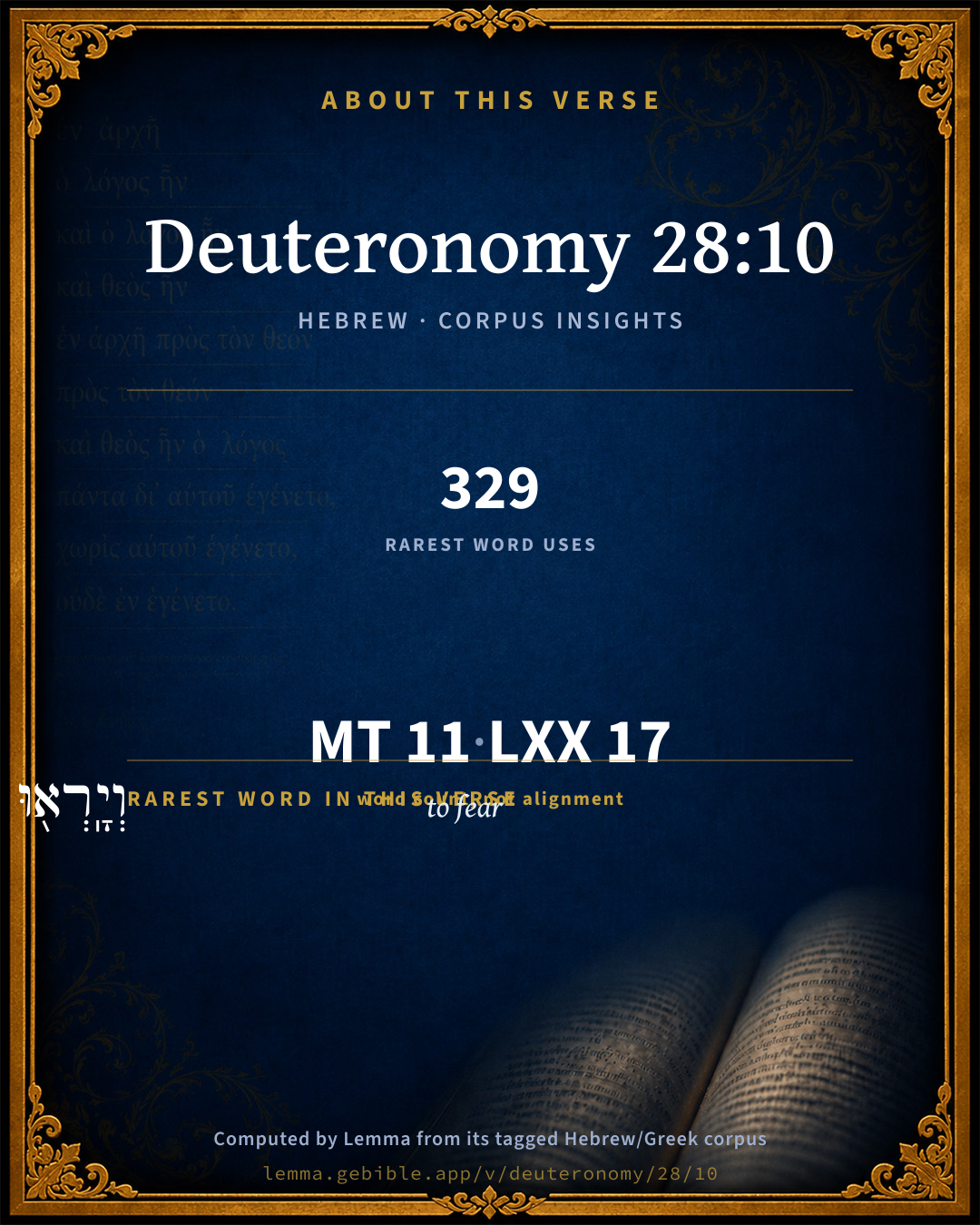
Hebrew & Septuagint length

In English translation the verse runs 24 words from the Hebrew and 28 from the Septuagint (LXX English) — closely comparable.

A rough comparison of the two English renderings, which tokenize alike — not a word-level alignment.

Word counts can differ between the Hebrew and the Greek without any difference in meaning — e.g. the Hebrew direct-object marker אֵת has no separate Greek word, and Greek often adds the article ὁ.

In the original languages it is 11 Hebrew tokens and 17 Greek tokens — but the two are counted differently (Hebrew bundles its prefixes and suffixes into one token; the Greek is in lemma form), so that isn’t a like-for-like length.

Cross-references

15

Topical passages linked to Deuteronomy 28:10 in the Treasury of Scripture Knowledge — connected by theme and wording, ordered by reader-vote popularity; previews shown in the World English Bible.

  • 2 Chronicles 7:14 if my people, who are called by my name, shall humble themselves, and pray, and seek my face, and turn from their wicked ways; then will I hear from heaven, and will forgive their sin, and will heal their land.
  • Deuteronomy 11:25 There shall no man be able to stand before you: Yahweh your God shall lay the fear of you and the dread of you on all the land that you shall tread on, as he has spoken to you.
  • Jeremiah 33:9 [This city] shall be to me for a name of joy, for a praise and for a glory, before all the nations of the earth, which shall hear all the good that I do to them, and shall fear and tremble for all the good and for all the peace that I procure to it.
  • Exodus 12:33 The Egyptians were urgent with the people, to send them out of the land in haste, for they said, "We are all dead men."
  • Numbers 6:27 "So they shall put my name on the children of Israel; and I will bless them."
  • Deuteronomy 4:6–8 Keep therefore and do them; for this is your wisdom and your understanding in the sight of the peoples, who shall hear all these statutes, and say, Surely this great nation is a wise and understanding people.
  • Daniel 9:18–19 My God, turn your ear, and hear; open your eyes, and see our desolations, and the city which is called by your name: for we do not present our petitions before you for our righteousness, but for your great mercies' sake.
  • Malachi 3:12 "All nations shall call you blessed, for you will be a delightful land," says Yahweh of Hosts.
  • Exodus 14:25 He took off their chariot wheels, and they drove them heavily; so that the Egyptians said, "Let's flee from the face of Israel, for Yahweh fights for them against the Egyptians!"
  • Joshua 5:1 It happened, when all the kings of the Amorites, who were beyond the Jordan westward, and all the kings of the Canaanites, who were by the sea, heard how that Yahweh had dried up the waters of the Jordan from before the children of Israel, until we were passed over, that their heart melted, neither was there spirit in them any more, because of the children of Israel.
  • 1 Samuel 18:28–29 Saul saw and knew that Yahweh was with David; and Michal, Saul's daughter, loved him.
  • 1 Chronicles 14:17 The fame of David went out into all lands; and Yahweh brought the fear of him on all nations.
  • 1 Samuel 18:12–15 Saul was afraid of David, because Yahweh was with him, and was departed from Saul.
  • Isaiah 63:19 We are become as they over whom you never bear rule, as those who were not called by your name.
  • Revelation 3:9 Behold, I give of the synagogue of Satan, of those who say they are Jews, and they are not, but lie. Behold, I will make them to come and worship before your feet, and to know that I have loved you.

Cross-references courtesy of OpenBible.info (CC BY 4.0).

Hebrew and Greek witnesses Masoretic Hebrew ↔ Greek Septuagint

The same verse in the two great witnesses to the Old Testament, shown verse-for-verse.

These are two independent witnesses, not word-aligned to each other, and the Septuagint is shown in lemma (dictionary) form.

Hebrew Deuteronomy 28:10 Masoretic · Westminster Leningrad Codex

וְרָאוּ֙ כָּל עַמֵּ֣י הָאָ֔רֶץ כִּ֛י שֵׁ֥ם יְהוָ֖ה נִקְרָ֣א עָלֶ֑יךָ וְיָֽרְא֖וּ מִמֶּֽךָּ

All the peoples of the earth shall see that you are called by the name of Yahweh; and they shall be afraid of you.

World English Bible · Public Domain

Greek LXX Deuteronomy 28:10 Septuagint · lemma form

καί ὁράω σύ πᾶς ὁ ἔθνος ὁ γῆ ὅτι ὁ ὄνομα κύριος ἐπικαλέω σύ καί φοβέω σύ

And all the nations of the earth shall see you, that the name of the Lord is called upon you, and they shall stand in awe of you.

LXX2012 (modern English Septuagint) · Public Domain

Hebrew: Westminster Leningrad Codex (CC BY 4.0). Greek: Septuagint (public domain); English from LXX2012 (modern English Septuagint) (Public Domain). How the Septuagint differs from the Hebrew →

Targum (Aramaic paraphrase)

2

The Targum is the ancient Jewish Aramaic paraphrase of the Hebrew Scriptures — an interpretive translation, not the Hebrew text itself. Onkelos (literal) and Pseudo-Jonathan (expansive) render the Torah, and Jonathan the Prophets. Coverage is partial: where no permissively-licensed English translation exists for a verse, only the Aramaic is shown. This is verse-level text, not a word-by-word alignment to the Hebrew.

  1. Targum Onkelos Torah (Genesis–Deuteronomy)
    וְיֶחֱזוּן כָּל עַמְמֵי אַרְעָא אֲרֵי שְׁמָא דַיְיָ אִתְקְרֵי עֲלָךְ וְיִדְחֲלוּן מִנָךְ

    (no public-domain English translation for this verse)

    Targum Onkelos — Aramaic: “Onkelos Genesis” (public domain); “Onkelos Exodus” (public domain); “Onkelos Leviticus” (public domain); “Onkelos Numbers” (public domain); “Onkelos Deuteronomy” (public domain). English: “Sefaria Community Translation” (CC0 1.0 (public-domain dedication)); “J.W. Etheridge. The Targums of Onkelos and Jonathan Ben Uzziel on the Pentateuch. London: Longmans, Green, 1862” (public domain). Text via Sefaria.

  2. Targum Pseudo-Jonathan Torah (Genesis–Deuteronomy)
    וְיֶחֱמוּן כָּל עַמְמֵי אַרְעָא אֲרוּם שְׁמָא דַיְיָ חָקִיק בִּזְמַן דִתְּפִילִין עֲלָךְ וִידַחֲלוּן מִנָךְ

    And all the nations of the earth will see that the Name is written by (His own) appointment on the tephillin that are upon thee, and will be afraid of thee.

    Targum Pseudo-Jonathan — Aramaic: “Targum Jonathan on Genesis” (public domain); “Targum Jonathan on Exodus” (public domain); “Targum Jonathan on Leviticus” (public domain); “Targum Jonathan on Numbers” (public domain); “Targum Jonathan on Deuteronomy” (public domain). English: “The Targum of Jonathan ben Uzziel, trans. J. W. Etheridge, London, 1862” (public domain). Text via Sefaria.

Commentary

Notes on Deuteronomy 28:10 from classic Christian and Jewish commentators (each source and its license shown beneath its notes). The classic Christian expositions comment on the surrounding passage and are grouped to its opening verse, so a note may address several verses; the Jewish commentaries on the Tanakh (Rashi and others) are per-verse, so they appear only where the commentator wrote on this verse.

Lemma curates 59 commentaries, every one of them public domain or Creative Commons licensed, each selected and text-cleaned for this edition rather than reprinted as found. About our sources →

Trapp's Complete Commentary

John Trapp

Deu 28:10 And all people of the earth shall see that thou art called by the name of the LORD; and they shall be afraid of thee.

Ver. 10. And they shall be afraid of thee.] Natural conscience cannot but do homage to the image of God stamped upon the natures and works of the godly. When they see in them that which is above the ordinary nature of men, or their expectation, they are afraid of the name of God, whereby they are called; their very hearts ache and quake within them; as is to be seen in Nebuchadnezzar, Darius, Herod, Dioclesian, who was so amazed at the singular piety and invincible patience of the primitive Christians, that he laid down the empire in a humour, Quod Christi nomen se deleturum, uti cupiverat, desperasset, {a} because that when he sought to root out religion, he saw he could do no good on it.

{a} Bucholcer.

John Trapp, A Commentary or Exposition upon All the Books of the Old and New Testament (1647–1656) — public domain. Text from a community e-Sword module.

Tyndale Open Study Notes

Tyndale Open Resources

28:10 When the nations saw the blessings of Israel, they would know that it had happened because you are a people claimed by the Lord (literally the name of the Lord is called over you). When the nations saw Israel, they would think of the Lord and his faithfulness.

Tyndale Open Study Notes — © Tyndale Open Resources, licensed CC BY-SA 4.0. Text via the HelloAO Bible API.

Geneva Bible (1599)

Geneva Bible translators

In that he is thy God, and thou art his people.

Geneva Bible (1599) marginal notes — public domain. Text via Bolls.life.

Jamieson, Fausset & Brown

Robert Jamieson, A. R. Fausset & David Brown

called by the name of the Lord--That they are really and actually His people (Deu 14:1; Deu 26:18).

Jamieson, Fausset & Brown — Commentary Critical and Explanatory on the Whole Bible (1871) — public domain (CC PDM 1.0). Text via the HelloAO Bible API.

Ellicott's Commentary for English Readers

(10) That thou art called.—Literally, that the name of Jehovah has been called upon thee.

And they shall be afraid of thee.—Comp. Jer_33:9 : “And they shall fear and tremble for all the goodness and for all the prosperity, that I procure unto it” (Jerusalem).

A Bible Commentary for English Readers, edited by Charles John Ellicott (1878–1897) — public domain. Text from a community e-Sword module.

The Cambridge Bible for Schools and Colleges

gen. ed. J. J. S. Perowne

10. thou art called by the name of the Lord] Lit. the name of Jehovah is called over thee, as that of thine owner. Other instances of the figure in 2Sa_12:28, Amo_9:12, Jer_7:10 f., Deu_14:9, Deu_15:16, etc., Isa_13:19.

The Cambridge Bible for Schools and Colleges (gen. ed. J. J. S. Perowne; Cambridge University Press, 1878–1918) — public domain. Text from a community e-Sword module.

John Gill's Exposition

And the Lord shall make thee plenteous in goods,.... In all temporal good things, give them an affluence of them, even all things richly to enjoy; the Targum of Jonathan is,"the Word of the Lord shall, &c."

in the fruit of thy body, and in the fruit of thy cattle, and in the fruit of thy ground: increase their children, cattle, and substance, as before, Deu 28:4,

in the land which the Lord sware unto thy fathers to give thee; the land of Canaan, often thus described.

John Gill's Exposition of the Whole Bible (1746–1763) — public domain (CC PDM 1.0). Text via the HelloAO Bible API.

Haydock's Catholic Bible Commentary

Upon thee; so that thou art called God’s people (Calmet) with truth. (Menochius) --- He has taken thee under his protection, and defended them [thee?] against every attack. (Haydock)

George Leo Haydock (1774–1849), Haydock's Catholic Family Bible and Commentary, 1859 edition — public domain. Excludes Psalms (Douay-Rheims chapter numbering differs from Protestant) and Deuterocanonical books (Catholic canon only).

Matthew Poole's English Annotations

i.e. That you are in deed and truth his people and children: see Deu 14:1; 26:18. For to be called ofttimes signifies to be, as Isa 47:1,5; 56:7; Mat 5:9,19; 21:13.

Matthew Poole's English Annotations on the Holy Bible (1683–1685) — public domain. Text from a community e-Sword/MySword module.

The Pulpit Commentary

Thou art called by the name of the Lord; rather, the Name of Jehovah called upon thee. The Name of God is God himself as revealed; and this Name is called or named upon men when they are adopted by him, made wholly his, and transformed into his likeness. This blessing Israel enjoyed as a nation was the adoption and the glory" (Rom_9:4) but it was theirs only in symbol and in shadow; (Heb_10:1) the reality belongs only to the spiritual Israel, and this came to men in all its fullness when he who is "the image of the invisible God" appeared and set up his tent among men, full of grace and truth. (Joh_1:12, Joh_1:14)

The world afraid of the godly.

I GOD"S PEOPLE CALLED BY HIS NAME. God calls or names his Name upon them, i.e. distinguishes, owns, chooses, recognizes them as his, by dwelling among them, (2Co_3:16) by causing his blessing to rest upon them, by answering their prayers, by favoring their cause, by establishing their work. (Psa_90:13-17) "God is love". (1Jn_4:8) His "Name" expresses pre-eminently that attribute of his character. (Exo_34:6, Exo_34:7) It can, therefore, be revealed only upon or in relation to his own people.

II NOMINAL AND REAL CALLING. "They are not all Israel which are of Israel". (Rom_9:6) Real, as distinguished from nominal, saints are marked:

1. By obedience to the Divine commands. . ((ver. 9; Mat_7:22)

2. By separation from the world. (2Co 7:17, 2Co 7:18)

3. By the power of holiness dwelling in them.

4. By manifold tokens of the Divine favor.

Thus the world "sees" them to be what they are. (Act_4:13)

III THOSE KNOWN TO BE CALLED BY GOD"S NAME ARE FEARED. Worldly men fear them. They fear the holiness that resides in them. They fear their prayers. They fear their power with God. They feel that there dwells in them a Presence whom they have every reason to dread. J.O. (Act_2:43)

The Pulpit Commentary (1880–1919), ed. H.D.M. Spence-Jones & Joseph S. Exell — public domain. Text from a community e-Sword module.

John Wesley's Explanatory Notes

Of the Lord - That you are in truth his people and children: A most excellent and glorious people, under the peculiar care and countenance of the great God.

John Wesley, Explanatory Notes Upon the Whole Bible (1754–1765) — public domain. Text via the GEBible commentary corpus.

Lesson kit

Teaching starters — assembled from the data on this page, not authored interpretation. Every prompt links to the verse data it draws on. Edit before teaching.

Deuteronomy, in the Pentateuch, opens this verse with 11 words (11 distinct Hebrew lemmas). Its most distinctive word is yârêʼ (“to fear”). A historical commentator’s framing appears above. Read the whole chapter for the surrounding context.

Discussion questions

  1. The word yârêʼ carries the sense “to fear.” How does it shape the verse?
  2. 2 Chronicles 7:14 shares this passage’s theme. How do the two illuminate each other?
  3. These translations render this verse differently. What is at stake in choosing one wording over another?
  4. The verb «וְרָאוּ֙» is Qal Sequential Perfect. How does its form color the action?
  5. Reading how Trapp's Complete Commentary and Tyndale Open Study Notes read this verse, where do the two commentators agree and where do they part?

Things to notice

Reading settings

Reading text

Shown beneath each verse's original-language words.

Old Testament
Old Testament edition

Read the OT as the Masoretic Hebrew (MT) or the Greek Septuagint (LXX).

English shown for the Greek Septuagint (in the Hebrew ↔ Greek comparison).

Comparing translations? Open the Compare panel on any verse page to stack up to four side by side.