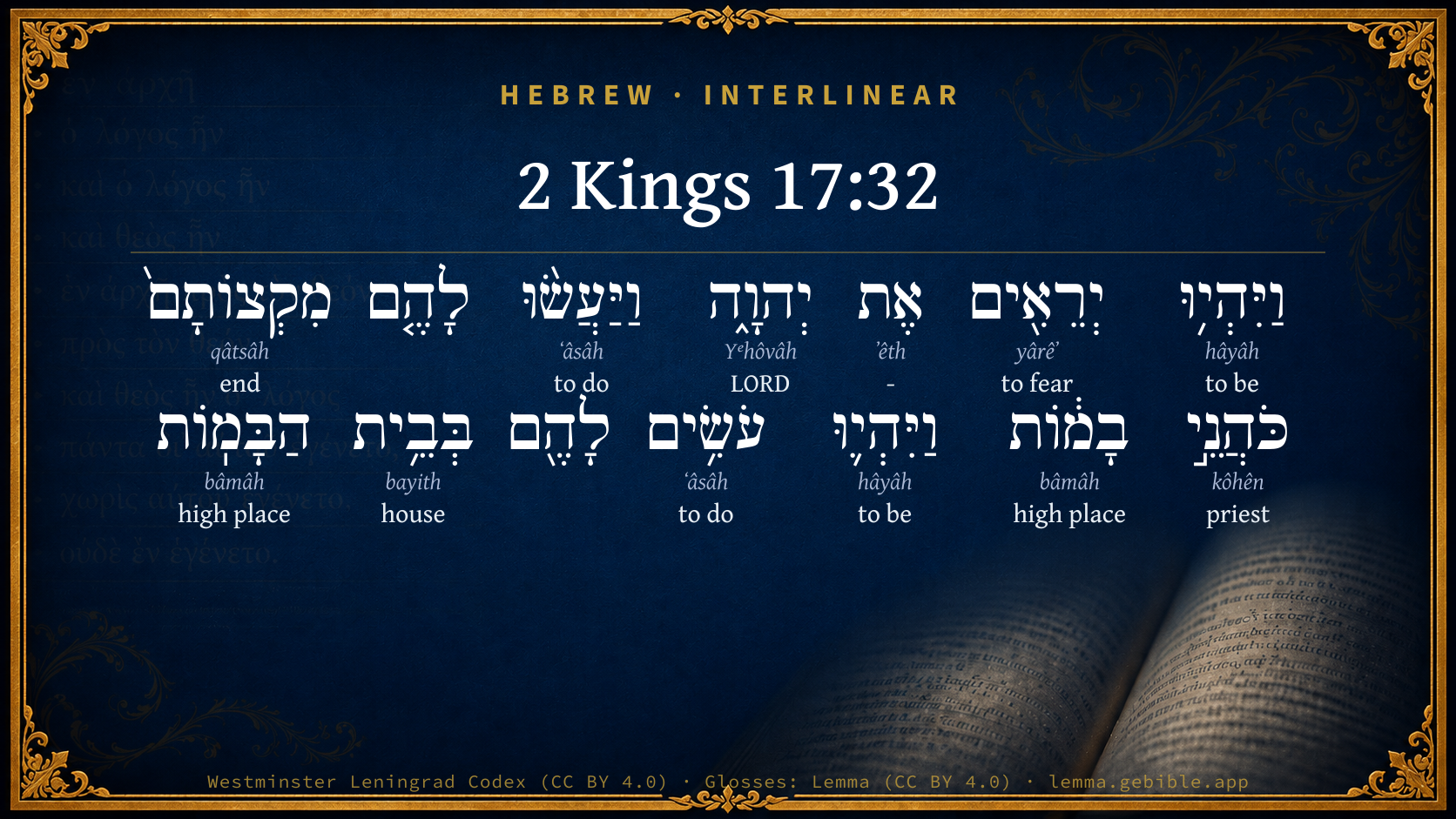
2 Kings 17:32

Hebrew (Westminster Leningrad Codex) 2 Kings 17:32 appears in the Hebrew Old Testament. The text above is from the Westminster Leningrad Codex. Each word links to its Strong’s number, a concise gloss, and parsing drawn from the Open Scriptures Hebrew Bible morphology. Click any word for its full Brown-Driver-Briggs (BDB) entry.
Download image
Cite this verse

2 Kings 17:32 (World English Bible). Public Domain. Lemma interlinear Bible study tool, https://lemma.gebible.app/v/2-kings/17/32.

Show BibTeX & RIS
BibTeX
RIS
English Translation
So they feared Yahweh, and made to them from among themselves priests of the high places, who sacrificed for them in the houses of the high places.
World English Bible · Public Domain
Download a study sheet

One document with this verse’s original text, its word-by-word gloss line, the meaning frame, cross-references with their text, attributed commentary, and full source and license credits — printable, and it pastes into notes with its structure intact.

This verse Autodidact and up

Study sheet (.html) Plain text (.txt)

A passage Seminary Student

Up to 50 verses in one chapter. A passage sheet keeps up to 6 commentary sources and 12 cross-references per verse, in the order this page ranks them, and says so on the sheet whenever that leaves anything out. Ask for a single verse and you get the Autodidact verse sheet above.

Everything on this page stays free to read, with no account — the sheet is a download of what is already on screen, not access to it.

Want to remove ads? Support Godless Engineer
Compare translations 3

The same verse in 3 English versions, stacked beneath the original-language interlinear above. Click any original word for its lexicon entry.

Each is an independent rendering of the whole verse — the interlinear is not word-aligned to these translations.

Highlighted words mark where these versions differ — a whole-verse word diff, not a word-by-word alignment.

  • World English Bible Public Domain
    So they feared Yahweh, and made to them from among themselves priests of the high places, who sacrificed for them in the houses of the high places.
  • King James Version Public Domain
    So they feared the LORD, and made unto themselves of the lowest of them priests of the high places, which sacrificed for them in the houses of the high places.
  • unfoldingWord Literal Text CC BY-SA 4.0
    And they were fearing Yahweh, but they made for themselves priests of high places from their extremities, and they were making to them in the house of the high places.

unfoldingWord Literal Text — © unfoldingWord, licensed CC BY-SA 4.0. Word-aligned USFM3 via Door43 (git.door43.org/unfoldingWord/en_ult).

Versions to compare (up to 4)

3 of 4 selected

Show all 18 translations

Every available English version of this verse, each an independent rendering of the whole verse.

  • World English Bible Public Domain
    So they feared Yahweh, and made to them from among themselves priests of the high places, who sacrificed for them in the houses of the high places.
  • Berean Standard Bible Public Domain
    So the new residents worshiped the LORD, but they also appointed for themselves priests of all sorts to serve in the shrines of the high places.
  • Majority Standard Bible Public Domain
    So the new residents worshiped the LORD, but they also appointed for themselves priests of all sorts to serve in the shrines of the high places.
  • King James Version Public Domain
    So they feared the LORD, and made unto themselves of the lowest of them priests of the high places, which sacrificed for them in the houses of the high places.
  • American Standard Version (1901) Public Domain
    So they feared Jehovah, and made unto them from among themselves priests of the high places, who sacrificed for them in the houses of the high places.
  • Revised Version (1885) Public Domain
    So they feared the LORD, and made unto them from among themselves priests of the high places, which sacrificed for them in the houses of the high places.
  • Geneva Bible (1599) Public Domain
    Thus they feared the Lord, and appoynted out Priestes out of them selues for the hie places, who prepared for them sacrifices in the houses of the hie places.
  • Douay-Rheims (1899) Public Domain
    And nevertheless they worshipped the Lord. And they made to themselves, of the lowest of the people, priests of the high places, and they placed them in the temples of the high places.
  • Young's Literal Translation Public Domain
    And they are fearing Jehovah, and make to themselves from their extremities priests of high places, and they are acting for them in the house of the high places.
  • Literal Standard Version CC BY-SA 4.0
    And they are fearing YHWH, and make for themselves from their extremities priests of high places, and they are working for them in the house of the high places.
  • Unlocked Literal Bible CC BY-SA 4.0
    They also honored Yahweh, and appointed from among themselves priests of the high places, who sacrificed for them in the temples at the high places.
  • unfoldingWord Literal Text CC BY-SA 4.0
    And they were fearing Yahweh, but they made for themselves priests of high places from their extremities, and they were making to them in the house of the high places.
  • Darby Bible Public Domain
    So they feared Jehovah, and made to themselves from all classes of them priests of the high places, who offered [sacrifices] for them in the houses of the high places.
  • World Messianic Bible Public Domain
    So they feared the LORD, and also made from among themselves priests of the high places for themselves, who sacrificed for them in the houses of the high places.
  • Webster's Bible Public Domain
    So they feared the LORD, and made to themselves of the lowest of them priests of the high places, who sacrificed for them in the houses of the high places.
  • Free Bible Version CC BY-SA 4.0
    While they worshiped the Lord, they also appointed priests from all kinds of their own people to offer sacrifices for them in the shrines of the high places.
  • Bible in Basic English Public Domain
    So they went on worshipping the Lord, and made for themselves, from among all the people, priests for the high places, to make offerings for them in the houses of the high places.
  • JPS Tanakh (1917) Public Domain
    So they feared the LORD, and made unto them from among themselves priests of the high places, who sacrificed for them in the houses of the high places.

Literal Standard Version (2020), Covenant Press — licensed CC BY-SA 4.0. Text via the HelloAO Bible API (eBible.org). Unlocked Literal Bible (unfoldingWord) — licensed CC BY-SA 4.0. Text via the HelloAO Bible API (eBible.org). unfoldingWord Literal Text — © unfoldingWord, licensed CC BY-SA 4.0. Word-aligned USFM3 via Door43 (git.door43.org/unfoldingWord/en_ult). Free Bible Version, Dr. Jonathan Gallagher — licensed CC BY-SA 4.0. Text via the HelloAO Bible API (eBible.org).

Word by word

More ways to search: Search by grammar → Find every occurrence → Compare this word →

Practice this passage: Drill this verse → Learn its vocabulary →

מִקְצוֹתָם֙
qâtsâh
H7098
“from · ends · their”
Preposition + Noun, Common, Both, Plural, Construct + Suffix, Personal, 3rd Person, Masculine, Plural
Part of Speech
Preposition + Noun
Type
Common
Gender
Both
Number
Plural
State
Construct
Full BDB Definition

Origin: fem. of H7097

TWOT: 2053b

end, extremity - end - from the whole of, from among (of what is included between extremities)
  1. וַיִּהְי֥וּ hâyâh H1961 “and · to be” Conjunction + Verb, Qal, Sequential Imperfect, 3rd Person, Masculine, Plural
  2. יְרֵאִ֖ים yârêʼ H3372 “fearing” Adjective, Adjective, Masculine, Plural, Absolute
  3. אֶת ʼêth H853 “-” Particle, Direct Object
  4. יְהוָ֑ה Yᵉhôvâh H3068 “LORD” Noun, Proper
  5. וַיַּעֲשׂ֨וּ ʻâsâh H6213 “and · to do” Conjunction + Verb, Qal, Sequential Imperfect, 3rd Person, Masculine, Plural
  6. כֹּהֲנֵ֣י kôhên H3548 “priests of” Noun, Common, Masculine, Plural, Construct
  7. בָמ֔וֹת bâmâh H1116 “high places” Noun, Common, Feminine, Plural, Absolute
  8. וַיִּהְי֛וּ hâyâh H1961 “and · to be” Conjunction + Verb, Qal, Sequential Imperfect, 3rd Person, Masculine, Plural
  9. עֹשִׂ֥ים ʻâsâh H6213 “doing” Verb, Qal, Participle Active, Masculine, Plural, Absolute
  10. בְּבֵ֥ית bayith H1004 “in/at · house of” Preposition + Noun, Common, Masculine, Singular, Construct
  11. הַבָּמֽוֹת bâmâh H1116 “the · high places” Particle, Definite Article + Noun, Common, Feminine, Plural, Absolute

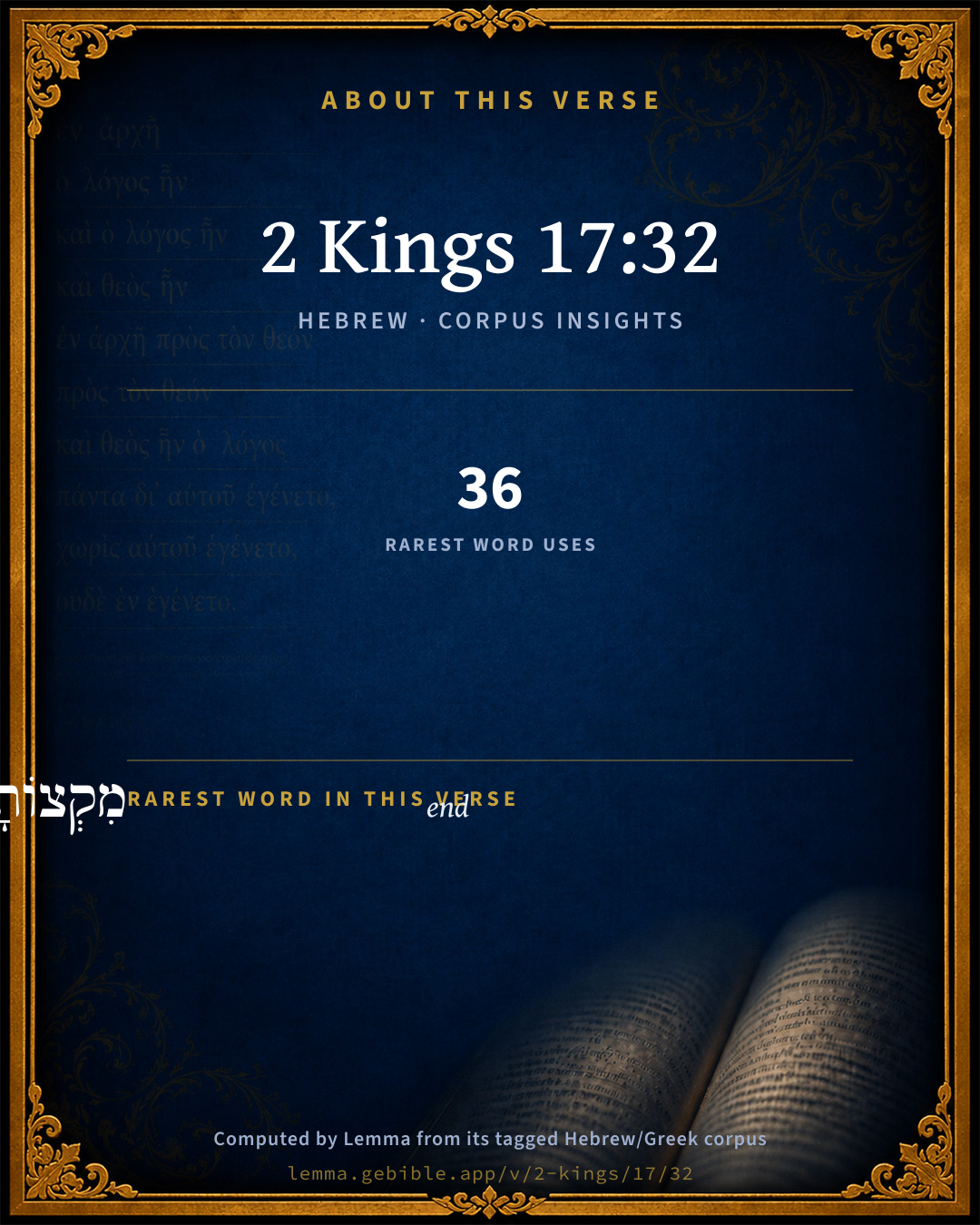
About this verse

These counts appear in no published source. They are computed here, from the morphology-tagged text and Lemma’s own curated glosses. What Lemma adds →

14
words
9
distinct lemmas
Historical
section

Shared distinctive vocabulary

מִקְצוֹתָם֙ end H7098 occurs in 31 verses of the Hebrew Bible. Also found in:

Grammatical profile

  • 4 verbs
  • 6 nouns
  • 1 adjective
  • 2 prepositions
  • 1 particle

Verb forms

  • וַיִּהְי֥וּ Qal · Sequential Imperfect
  • וַיַּעֲשׂ֨וּ Qal · Sequential Imperfect
  • וַיִּהְי֛וּ Qal · Sequential Imperfect
  • עֹשִׂ֥ים Qal · Participle Active

Repetition

Words recur within this verse — often emphatic in Hebrew:

  • וַיִּהְי֥וּ to be H1961 ×2
  • וַיַּעֲשׂ֨וּ to do H6213 ×2
  • בָמ֔וֹת high place H1116 ×2

Hebrew & Septuagint length

In English translation the verse runs 27 words from the Hebrew and 57 from the Septuagint (LXX English) — the Septuagint runs noticeably longer here. See the side-by-side →

A rough comparison of the two English renderings, which tokenize alike — not a word-level alignment.

Word counts can differ between the Hebrew and the Greek without any difference in meaning — e.g. the Hebrew direct-object marker אֵת has no separate Greek word, and Greek often adds the article ὁ.

Cross-references

6

Topical passages linked to 2 Kings 17:32 in the Treasury of Scripture Knowledge — connected by theme and wording, ordered by reader-vote popularity; previews shown in the World English Bible.

  • 1 Kings 12:31 He made houses of high places, and made priests from among all the people, who were not of the sons of Levi.
  • 2 Kings 17:29 However every nation made gods of their own, and put them in the houses of the high places which the Samaritans had made, every nation in their cities in which they lived.
  • 1 Kings 13:33 After this thing Jeroboam didn't return from his evil way, but made again from among all the people priests of the high places: whoever would, he consecrated him, that there might be priests of the high places.
  • 2 Kings 23:19 All the houses also of the high places that were in the cities of Samaria, which the kings of Israel had made to provoke [Yahweh] to anger, Josiah took away, and did to them according to all the acts that he had done in Bethel.
  • Zephaniah 1:5 those who worship the host of the sky on the housetops, those who worship and swear by Yahweh and also swear by Malcam,
  • 1 Kings 13:31 It happened, after he had buried him, that he spoke to his sons, saying, When I am dead, then bury me in the tomb in which the man of God is buried; lay my bones beside his bones.

Cross-references courtesy of OpenBible.info (CC BY 4.0).

Hebrew and Greek witnesses Masoretic Hebrew ↔ Greek Septuagint

The same verse in the two great witnesses to the Old Testament, shown verse-for-verse.

Here the Septuagint runs noticeably longer than the Hebrew — LXX2012 (modern English Septuagint) 57 words vs World English Bible 27. A rough length comparison of the two English translations, not a word-level alignment — read both below.

These are two independent witnesses, not word-aligned to each other, and the Septuagint is shown in lemma (dictionary) form.

Hebrew 2 Kings 17:32 Masoretic · Westminster Leningrad Codex

וַיִּהְי֥וּ יְרֵאִ֖ים אֶת יְהוָ֑ה וַיַּעֲשׂ֨וּ לָהֶ֤ם מִקְצוֹתָם֙ כֹּהֲנֵ֣י בָמ֔וֹת וַיִּהְי֛וּ עֹשִׂ֥ים לָהֶ֖ם בְּבֵ֥ית הַבָּמֽוֹת

So they feared Yahweh, and made to them from among themselves priests of the high places, who sacrificed for them in the houses of the high places.

World English Bible · Public Domain

Greek LXX 2 Kings 17:32 Septuagint · lemma form

καί εἰμί φοβέω ὁ κύριος καί καταοἰκίζω ὁ βδέλυγμα αὐτός ἐν ὁ οἶκος ὁ ὑψηλός ὅς ποιέω ἐν σαμαρεία ἔθνος ἔθνος ἐν πόλις ἐν ὅς καταοἰκέω ἐν αὐτός καί εἰμί φοβέω ὁ κύριος καί ποιέω ἑαυτοῦ ἱερεύς ὁ ὑψηλός καί ποιέω ἑαυτοῦ ἐν οἶκος ὁ ὑψηλός

And they feared the Lord, yet they established their abominations in the houses of the high places which they made in Samaria, each nation in the city in which they lived: and they feared the Lord, and they made for themselves priests of the high places, and sacrificed for themselves in the house of the high places.

LXX2012 (modern English Septuagint) · Public Domain

Hebrew: Westminster Leningrad Codex (CC BY 4.0). Greek: Septuagint (public domain); English from LXX2012 (modern English Septuagint) (Public Domain). How the Septuagint differs from the Hebrew →

Targum (Aramaic paraphrase)

1

The Targum is the ancient Jewish Aramaic paraphrase of the Hebrew Scriptures — an interpretive translation, not the Hebrew text itself. Onkelos (literal) and Pseudo-Jonathan (expansive) render the Torah, and Jonathan the Prophets. Coverage is partial: where no permissively-licensed English translation exists for a verse, only the Aramaic is shown. This is verse-level text, not a word-by-word alignment to the Hebrew.

  1. Targum Jonathan Prophets (Joshua–Malachi)
    וַהֲווֹ דַחֲלִין מִן קֳדָם יְיָ וַעֲבַדוּ לְהוֹן מִקְצַתְהוֹן כּוּמָרֵי בָמָתָא וַהֲווֹ עָבְדִין לְהוֹן בְּבֵית בָּמָתָא:

    (no public-domain English translation for this verse)

    Targum Jonathan — Aramaic: “Mikraot Gedolot” (public domain). English: “Sefaria Community Translation” (CC0 1.0 (public-domain dedication)); “London "Chaldee Paraphrase," 1871” (public domain). Text via Sefaria.

Commentary

Notes on 2 Kings 17:32 from classic Christian and Jewish commentators (each source and its license shown beneath its notes). The classic Christian expositions comment on the surrounding passage and are grouped to its opening verse, so a note may address several verses; the Jewish commentaries on the Tanakh (Rashi and others) are per-verse, so they appear only where the commentator wrote on this verse.

Lemma curates 59 commentaries, every one of them public domain or Creative Commons licensed, each selected and text-cleaned for this edition rather than reprinted as found. About our sources →

Trapp's Complete Commentary

John Trapp

2Ki 17:32 So they feared the LORD, and made unto themselves of the lowest of them priests of the high places, which sacrificed for them in the houses of the high places.

Ver. 32. So they feared the Lord.] They did, and they did not; {2Ki 17:34} they feared him for his lions, as the old Romans served their Veioves, that they might not hurt them, and their gods Rubigus, Orbona, Febris, &c., for the same reason. {a} So the poor Indians do at this day worship the devil, that he may not whip them.

{a} Rosin., Ant., ii. 21.

John Trapp, A Commentary or Exposition upon All the Books of the Old and New Testament (1647–1656) — public domain. Text from a community e-Sword module.

Joseph Benson's Commentary

2Ki 17:32. So they feared the Lord — Worshipped him externally in that way which the Israelites had used: having and serving gods of their own besides. And made unto themselves of the lowest of them priests, &c. — See note on 1Ki 12:31. Which sacrificed in the high places — Unto the true God; for as to the worship of their own gods, they needed no instruction, and would not permit a person of another religion to minister therein.

Joseph Benson's Commentary on the Old and New Testaments (1811–1818) — public domain. Text from a community e-Sword module.

Tyndale Open Study Notes

Tyndale Open Resources

17:32-34 worshiped the Lord, but . . . continued to follow their own gods: Hebrew faith, already blended with the religion of Jeroboam I, was now mixed with many different foreign religious customs. Genuine worship of the Lord virtually disappeared. Only a handful of faithful Israelites remained to respond to Hezekiah’s later invitation to come to Judah for the Passover celebration (2 Chr 30:10-19).

Tyndale Open Study Notes — © Tyndale Open Resources, licensed CC BY-SA 4.0. Text via the HelloAO Bible API.

Adam Clarke's Commentary

Verse 32. Of the lowest of them priests] One priest was not enough for this motley population; and, as the priesthood was probably neither respectable nor lucrative, it was only the lowest of the people who would enter into the employment.

Adam Clarke's Commentary on the Bible (1810–1826) — public domain. Text from a community e-Sword/MySword module.

Ellicott's Commentary for English Readers

(32) They feared.—They were fearing. (See Note on 2Ki_17:25; 2Ki_17:28, supra.)

Of the lowest of them.—Rather, of all orders, or promiscuously. (Comp. 1Ki_12:31.) This is another indication that it was Jeroboam’s mode of worship which was now restored.

Which sacrificed.—Heb., and they used to do. The verb do is used in the sense of sacra facere, just like the Greek - ποιεῗν ἔρδειν ρέζειν.

Priests of the high places.—Rather, bâmâh-priests (omit the). Bamah-priests are opposed to the priests of Jehovah’s Temple.

A Bible Commentary for English Readers, edited by Charles John Ellicott (1878–1897) — public domain. Text from a community e-Sword module.

The Cambridge Bible for Schools and Colleges

gen. ed. J. J. S. Perowne

32. So they feared the Lord] i.e. In the way in which their ideas of the worship of the local divinity demanded. This they did, says Bp Hall, ‘not for devotion, but for impunity. Vain politicians to think to satisfy God by patching up religions … What a prodigious mixture was here, true with false, Jewish with paganish, divine with devilish … No beggar’s cloak is more pieced than the religion of these new inhabitants of Israel. I know not how their bodies sped for the lions. I am sure their souls fared the worse for this medley. Above all things God hates a mongrel devotion. If we be not all Israel, it were better to be all Asshur. It cannot so much displease God to be unknown or neglected as to be consorted with idols’.

and made unto themselves of the lowest of them priests] R.V. and made unto them from among themselves priests. See note on 1Ki_12:31. The word represented by ‘lowest’ means an ‘end’ or ‘extremity’, but the idea of the phrase is that the choice of these priests was made anywhere, from the whole mass of the nation, from all that was comprised in it between one extremity and the other. This was distinctly contrary to what the Jews had been taught, that the priests were to come exclusively from one tribe, and the high priests from a special family.

houses of the high places] Hence it seems that not an altar only, bat a temple of some kind was erected on the high places.

The Cambridge Bible for Schools and Colleges (gen. ed. J. J. S. Perowne; Cambridge University Press, 1878–1918) — public domain. Text from a community e-Sword module.

John Gill's Exposition

They feared the Lord, and served their own gods,.... Worshipped both:

after the manner of the nations whom they carried away from thence; the Israelites, whom they had carried captive from Samaria; they worshipped the Lord in their idols, as they did, who pretended to worship God in the calves; so they worshipped the supreme God in and by their idols, and made use of them as mediators with him.

John Gill's Exposition of the Whole Bible (1746–1763) — public domain (CC PDM 1.0). Text via the HelloAO Bible API.

Albert Barnes' Notes on the Bible

Of the lowest of them - Rather, “from all ranks.” See marginal reference note.

Albert Barnes' Notes on the Bible (1834–1885) — public domain. Text from a community e-Sword/MySword module.

Haydock's Catholic Bible Commentary

Worshipped, or appeared to worship: for true religion admits of no false god. (Worthington) --- Lowest. This expression sometimes means the most noble. (Haydock) --- But the priests were chosen from the midst of the people, without examination. They employed the priest, whom the king had sent for the worship of the true God, whilst others were appointed to serve the idols. (Calmet)

George Leo Haydock (1774–1849), Haydock's Catholic Family Bible and Commentary, 1859 edition — public domain. Excludes Psalms (Douay-Rheims chapter numbering differs from Protestant) and Deuterocanonical books (Catholic canon only).

Matthew Poole's English Annotations

Of the lowest of them priests of the high places: See Poole "1Ki 12:31".

Which sacrificed for them, to wit, unto the true God; for as to the worship of their own gods, they needed no instruction, and would not permit a person of another religion to minister therein.

Matthew Poole's English Annotations on the Holy Bible (1683–1685) — public domain. Text from a community e-Sword/MySword module.

Whedon's Commentary on the Bible

Daniel D. Whedon

32. The lowest of them priests — As Jeroboam had done. See note on 1Ki_12:31. This fact further argues (compare note on 2Ki_17:28) that the priest who taught these nations the fear of Jehovah was one of Jeroboam’s order.

Daniel D. Whedon (gen. ed.), Commentary on the Old and New Testaments (1874–1909) — public domain. Text from a community e-Sword module.

The Pulpit Commentary

So they feared the Lord rather, and they (also) honored Jehovah; i.e. with their idolatrous worship they combined also the worship of Jehovah (comp. ver. 28)and made unto themselves of the lowest of them priests of the high places i.e. , followed the example of Jeroboam in taking for priests persons of all ranks, even the lowest (see the comment on 1Ki_12:31) which sacrificed for them in the houses of the high places (comp. ver. 29).

The Pulpit Commentary (1880–1919), ed. H.D.M. Spence-Jones & Joseph S. Exell — public domain. Text from a community e-Sword module.

John Wesley's Explanatory Notes

Sacrificed - Unto the true God: for as to the worship of their own gods, they needed no instruction, and would not permit a person of another religion to minister therein.

John Wesley, Explanatory Notes Upon the Whole Bible (1754–1765) — public domain. Text via the GEBible commentary corpus.

unfoldingWord translationNotes

Door43 World Missions Community

They

This refers to the pagan people that the king of Assyria moved into the cities of Samaria.

translationWords

honor

Yahweh

appoint

high place

sacrifice

temple

nation

unfoldingWord translationNotes — © Distant Shores Media and the Door43 World Missions Community, licensed CC BY-SA 4.0. Source: git.door43.org/Door43/en_tn.

Lesson kit

Teaching starters — assembled from the data on this page, not authored interpretation. Every prompt links to the verse data it draws on. Edit before teaching.

2 Kings, in the Historical, opens this verse with 14 words (9 distinct Hebrew lemmas). Its most distinctive word is qâtsâh (“end”). The Greek Septuagint runs longer here. A historical commentator’s framing appears above. Read the whole chapter for the surrounding context.

Discussion questions

  1. How does “end” (qâtsâh) shape what this verse is saying?
  2. How does Exodus 25:18, which shares the word «end», read alongside this verse?
  3. What does the repetition of “to be” (2× in this one verse) do in this verse?
  4. The Septuagint runs longer here than the Hebrew. What might account for the difference?
  5. The translations on this page render this verse differently — a whole-verse word diff, not a word-by-word alignment. What might account for the different wordings?
  6. «וַיִּהְי֥וּ» is a Qal Sequential Imperfect verb. How does that grammatical form shape the action described?
  7. Compare how Trapp's Complete Commentary and Joseph Benson's Commentary read this verse. Where do they agree or differ?

Things to notice

Reading settings

Reading text

Shown beneath each verse's original-language words.

Old Testament
Old Testament edition

Read the OT as the Masoretic Hebrew (MT) or the Greek Septuagint (LXX).

English shown for the Greek Septuagint (in the Hebrew ↔ Greek comparison).

Comparing translations? Open the Compare panel on any verse page to stack up to four side by side.