1 Kings 1:50

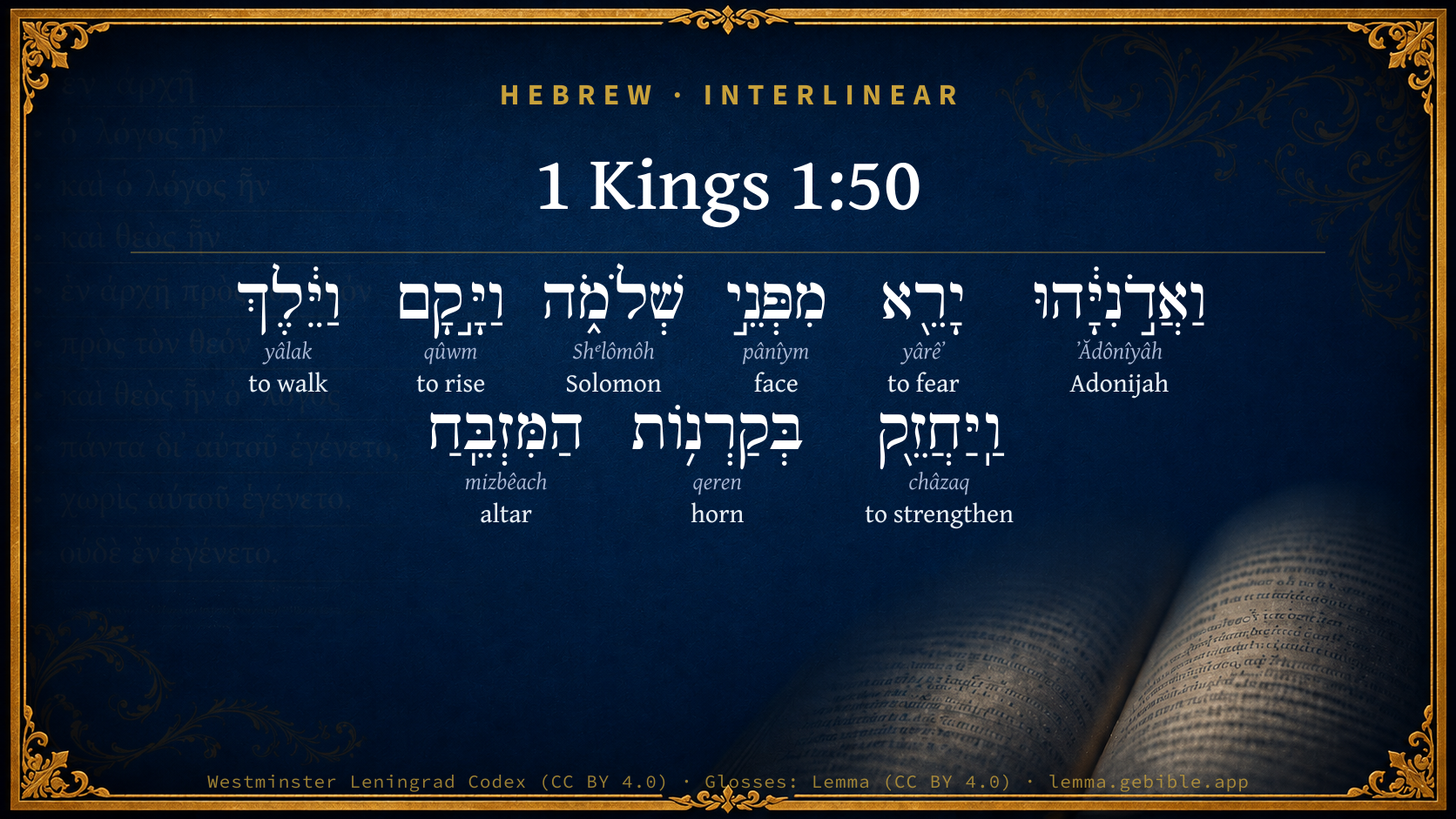
Hebrew (Westminster Leningrad Codex) 1 Kings 1:50 appears in the Hebrew Old Testament. The text above is from the Westminster Leningrad Codex. Each word links to its Strong’s number, a concise gloss, and parsing drawn from the Open Scriptures Hebrew Bible morphology. Click any word for its full Brown-Driver-Briggs (BDB) entry.
Download image
Cite this verse

1 Kings 1:50 (World English Bible). Public Domain. Lemma interlinear Bible study tool, https://lemma.gebible.app/v/1-kings/1/50.

Show BibTeX & RIS
BibTeX
RIS
English Translation
Adonijah feared because of Solomon; and he arose, and went, and caught hold on the horns of the altar.
World English Bible · Public Domain
Download a study sheet

One document with this verse’s original text, its word-by-word gloss line, the meaning frame, cross-references with their text, attributed commentary, and full source and license credits — printable, and it pastes into notes with its structure intact.

This verse Autodidact and up

Study sheet (.html) Plain text (.txt)

A passage Seminary Student

Up to 50 verses in one chapter. A passage sheet keeps up to 6 commentary sources and 12 cross-references per verse, in the order this page ranks them, and says so on the sheet whenever that leaves anything out. Ask for a single verse and you get the Autodidact verse sheet above.

Everything on this page stays free to read, with no account — the sheet is a download of what is already on screen, not access to it.

Want to remove ads? Support Godless Engineer
Compare translations 3

The same verse in 3 English versions, stacked beneath the original-language interlinear above. Click any original word for its lexicon entry.

Each is an independent rendering of the whole verse — the interlinear is not word-aligned to these translations.

Highlighted words mark where these versions differ — a whole-verse word diff, not a word-by-word alignment.

  • World English Bible Public Domain
    Adonijah feared because of Solomon; and he arose, and went, and caught hold on the horns of the altar.
  • King James Version Public Domain
    And Adonijah feared because of Solomon, and arose, and went, and caught hold on the horns of the altar.
  • unfoldingWord Literal Text CC BY-SA 4.0
    And Adonijah was afraid from the face of Solomon. And he arose and went and grasped the horns of the altar.

unfoldingWord Literal Text — © unfoldingWord, licensed CC BY-SA 4.0. Word-aligned USFM3 via Door43 (git.door43.org/unfoldingWord/en_ult).

Versions to compare (up to 4)

3 of 4 selected

Show all 18 translations

Every available English version of this verse, each an independent rendering of the whole verse.

  • World English Bible Public Domain
    Adonijah feared because of Solomon; and he arose, and went, and caught hold on the horns of the altar.
  • Berean Standard Bible Public Domain
    But Adonijah, in fear of Solomon, got up and went to take hold of the horns of the altar.
  • Majority Standard Bible Public Domain
    But Adonijah, in fear of Solomon, got up and went to take hold of the horns of the altar.
  • King James Version Public Domain
    And Adonijah feared because of Solomon, and arose, and went, and caught hold on the horns of the altar.
  • American Standard Version (1901) Public Domain
    And Adonijah feared because of Solomon; and he arose, and went, and caught hold on the horns of the altar.
  • Revised Version (1885) Public Domain
    And Adonijah feared because of Solomon; and he arose, and went, and caught hold on the horns of the altar.
  • Geneva Bible (1599) Public Domain
    And Adonijah fearing the presence of Salomon, arose and went, and tooke holde on the hornes of the altar.
  • Douay-Rheims (1899) Public Domain
    And Adonias fearing Solomon, arose, and went, and took hold on the horn of the altar.
  • Young's Literal Translation Public Domain
    and Adonijah feareth because of Solomon, and riseth, and goeth, and layeth hold on the horns of the altar.
  • Literal Standard Version CC BY-SA 4.0
    and Adonijah fears because of Solomon, and rises, and goes, and lays hold on the horns of the altar.
  • Unlocked Literal Bible CC BY-SA 4.0
    Adonijah was afraid of Solomon and rose up, went, and took hold of the horns of the altar.
  • unfoldingWord Literal Text CC BY-SA 4.0
    And Adonijah was afraid from the face of Solomon. And he arose and went and grasped the horns of the altar.
  • Darby Bible Public Domain
    And Adonijah feared because of Solomon, and arose and went and caught hold of the horns of the altar.
  • World Messianic Bible Public Domain
    Adonijah was afraid because of Solomon; and he arose, and went, and hung onto the horns of the altar.
  • Webster's Bible Public Domain
    And Adonijah feared because of Solomon, and arose, and went, and caught hold on the horns of the altar.
  • Free Bible Version CC BY-SA 4.0
    Adonijah was terrified of Solomon, so he ran off. He went and grabbed hold of the horns of the altar.
  • Bible in Basic English Public Domain
    And Adonijah himself was full of fear because of Solomon; and he got up and went to the altar, and put his hands on its horns.
  • JPS Tanakh (1917) Public Domain
    And Adonijah feared because of Solomon; and he arose, and went, and caught hold on the horns of the altar.

Literal Standard Version (2020), Covenant Press — licensed CC BY-SA 4.0. Text via the HelloAO Bible API (eBible.org). Unlocked Literal Bible (unfoldingWord) — licensed CC BY-SA 4.0. Text via the HelloAO Bible API (eBible.org). unfoldingWord Literal Text — © unfoldingWord, licensed CC BY-SA 4.0. Word-aligned USFM3 via Door43 (git.door43.org/unfoldingWord/en_ult). Free Bible Version, Dr. Jonathan Gallagher — licensed CC BY-SA 4.0. Text via the HelloAO Bible API (eBible.org).

Word by word

More ways to search: Search by grammar → Find every occurrence → Compare this word →

Practice this passage: Drill this verse → Learn its vocabulary →

וַאֲדֹ֣נִיָּ֔הוּ
ʼĂdônîyâh
H138
“and · Adonijah”
Conjunction + Noun, Proper
Part of Speech
Conjunction + Noun
Type
Proper
Full BDB Definition

Origin: from H113 and H3050

TWOT: None

Adonijah = "my lord is Jehovah" - fourth son of David and Solomon's rival for the throne - Levite sent by Jehoshaphat to teach the Law - a chief of the people who co-operated with Nehemiah
  1. יָרֵ֖א yârêʼ H3372 “to fear” Verb, Qal, Perfect, 3rd Person, Masculine, Singular
  2. מִפְּנֵ֣י pânîym H6440 “from · face(s) of” Preposition + Noun, Common, Both, Plural, Construct
  3. שְׁלֹמֹ֑ה Shᵉlômôh H8010 “Solomon” Noun, Proper
  4. וַיָּ֣קָם qûwm H6965 “and · to rise” Conjunction + Verb, Qal, Sequential Imperfect, 3rd Person, Masculine, Singular
  5. וַיֵּ֔לֶךְ yâlak H3212 “and · to walk” Conjunction + Verb, Qal, Sequential Imperfect, 3rd Person, Masculine, Singular
  6. וַֽיַּחֲזֵ֖ק châzaq H2388 “and · to strengthen” Conjunction + Verb, Hiphil, Sequential Imperfect, 3rd Person, Masculine, Singular
  7. בְּקַרְנ֥וֹת qeren H7161 “in/at · horns of” Preposition + Noun, Common, Both, Plural, Construct
  8. הַמִּזְבֵּֽחַ mizbêach H4196 “the · altar” Particle, Definite Article + Noun, Common, Masculine, Singular, Absolute

About this verse

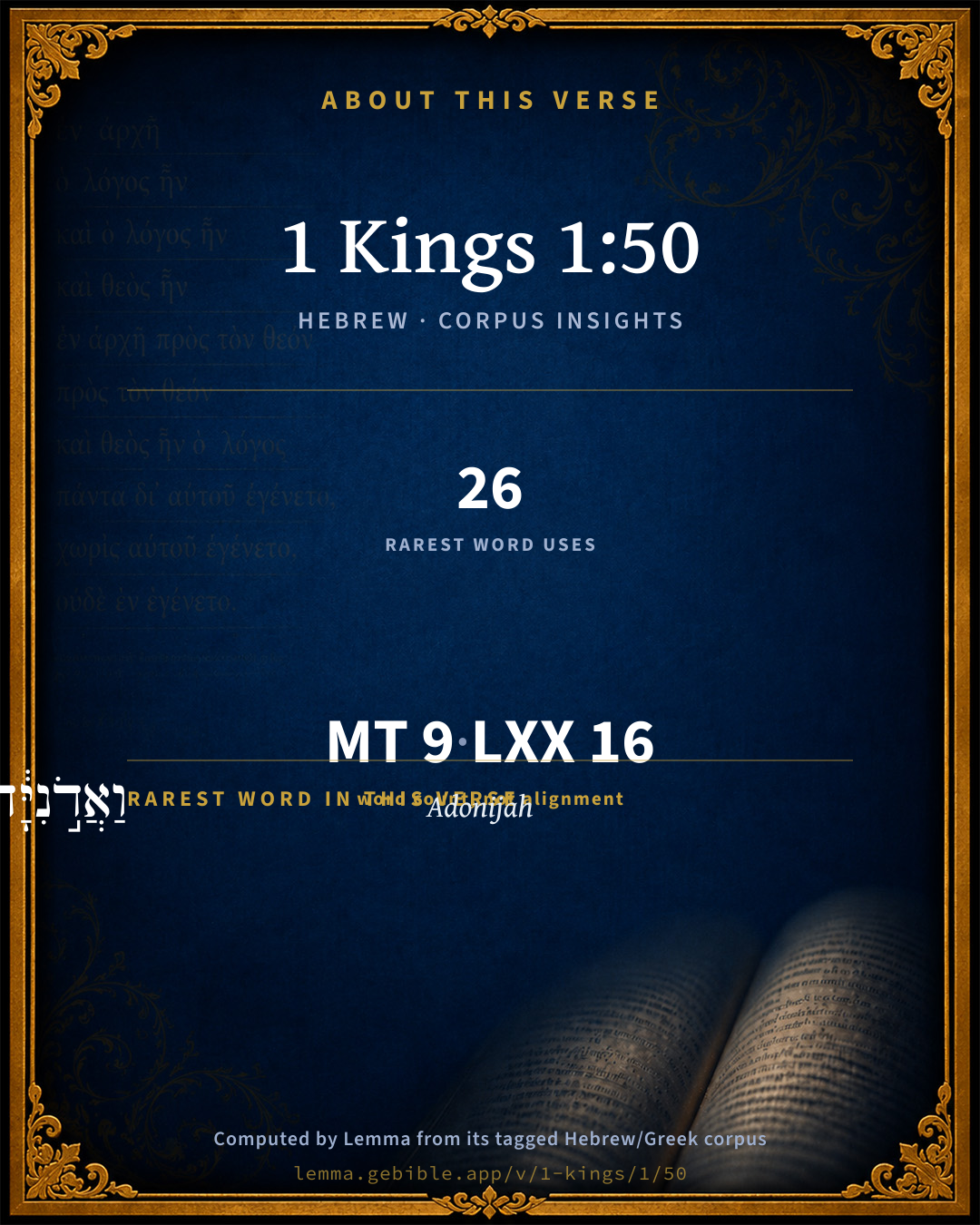
These counts appear in no published source. They are computed here, from the morphology-tagged text and Lemma’s own curated glosses. What Lemma adds →

9
words
9
distinct lemmas
Historical
section

Shared distinctive vocabulary

וַאֲדֹ֣נִיָּ֔הוּ Adonijah H138 occurs in 26 verses of the Hebrew Bible. Also found in:

Grammatical profile

  • 4 verbs
  • 5 nouns

Verb forms

  • יָרֵ֖א Qal · Perfect
  • וַיָּ֣קָם Qal · Sequential Imperfect
  • וַיֵּ֔לֶךְ Qal · Sequential Imperfect
  • וַֽיַּחֲזֵ֖ק Hiphil · Sequential Imperfect

Hebrew & Septuagint length

In English translation the verse runs 19 words from the Hebrew and 19 from the Septuagint (LXX English) — the same length.

A rough comparison of the two English renderings, which tokenize alike — not a word-level alignment.

Word counts can differ between the Hebrew and the Greek without any difference in meaning — e.g. the Hebrew direct-object marker אֵת has no separate Greek word, and Greek often adds the article ὁ.

In the original languages it is 9 Hebrew tokens and 16 Greek tokens — but the two are counted differently (Hebrew bundles its prefixes and suffixes into one token; the Greek is in lemma form), so that isn’t a like-for-like length.

Cross-references

5

Topical passages linked to 1 Kings 1:50 in the Treasury of Scripture Knowledge — connected by theme and wording, ordered by reader-vote popularity; previews shown in the World English Bible.

  • 1 Kings 2:28 The news came to Joab; for Joab had turned after Adonijah, though he didn't turn after Absalom. Joab fled to the Tent of Yahweh, and caught hold on the horns of the altar.
  • Exodus 21:14 If a man schemes and comes presumptuously on his neighbor to kill him, you shall take him from my altar, that he may die.
  • Exodus 27:2 You shall make its horns on its four corners; its horns shall be of one piece with it; and you shall overlay it with brass.
  • Exodus 38:2 He made its horns on its four corners. Its horns were of one piece with it, and he overlaid it with brass.
  • Psalms 118:27 Yahweh is God, and he has given us light. Bind the sacrifice with cords, even to the horns of the altar.

Cross-references courtesy of OpenBible.info (CC BY 4.0).

Hebrew and Greek witnesses Masoretic Hebrew ↔ Greek Septuagint

The same verse in the two great witnesses to the Old Testament, shown verse-for-verse.

These are two independent witnesses, not word-aligned to each other, and the Septuagint is shown in lemma (dictionary) form.

Hebrew 1 Kings 1:50 Masoretic · Westminster Leningrad Codex

וַאֲדֹ֣נִיָּ֔הוּ יָרֵ֖א מִפְּנֵ֣י שְׁלֹמֹ֑ה וַיָּ֣קָם וַיֵּ֔לֶךְ וַֽיַּחֲזֵ֖ק בְּקַרְנ֥וֹת הַמִּזְבֵּֽחַ

Adonijah feared because of Solomon; and he arose, and went, and caught hold on the horns of the altar.

World English Bible · Public Domain

Greek LXX 1 Kings 1:50 Septuagint · lemma form

καί αδωνίας φοβέω ἀπό πρόσωπον σαλωμών καί ἀναἵστημι καί ἀποἔρχομαι καί ἐπιλαμβάνω ὁ κέρας ὁ θυσιαστήριον

And Adonias feared because of Solomon, and arose, and departed, and laid hold on the horns of the altar.

LXX2012 (modern English Septuagint) · Public Domain

Hebrew: Westminster Leningrad Codex (CC BY 4.0). Greek: Septuagint (public domain); English from LXX2012 (modern English Septuagint) (Public Domain). How the Septuagint differs from the Hebrew →

Targum (Aramaic paraphrase)

1

The Targum is the ancient Jewish Aramaic paraphrase of the Hebrew Scriptures — an interpretive translation, not the Hebrew text itself. Onkelos (literal) and Pseudo-Jonathan (expansive) render the Torah, and Jonathan the Prophets. Coverage is partial: where no permissively-licensed English translation exists for a verse, only the Aramaic is shown. This is verse-level text, not a word-by-word alignment to the Hebrew.

  1. Targum Jonathan Prophets (Joshua–Malachi)
    וַאֲדֹנִיָהוּ דָחִיל מִן קֳדָם שְׁלֹמֹה וְקָם וַאֲזַל וְאַתְקֵיף בְּקַרְנַת מַדְבְּחָא:

    (no public-domain English translation for this verse)

    Targum Jonathan — Aramaic: “Mikraot Gedolot” (public domain). English: “Sefaria Community Translation” (CC0 1.0 (public-domain dedication)); “London "Chaldee Paraphrase," 1871” (public domain). Text via Sefaria.

Commentary

Notes on 1 Kings 1:50 from classic Christian and Jewish commentators (each source and its license shown beneath its notes). The classic Christian expositions comment on the surrounding passage and are grouped to its opening verse, so a note may address several verses; the Jewish commentaries on the Tanakh (Rashi and others) are per-verse, so they appear only where the commentator wrote on this verse.

Lemma curates 59 commentaries, every one of them public domain or Creative Commons licensed, each selected and text-cleaned for this edition rather than reprinted as found. About our sources →

Jamieson, Fausset & Brown

Robert Jamieson, A. R. Fausset & David Brown

ADONIJAH, FLEEING TO THE HORNS OF THE ALTAR, IS DISMISSED BY SOLOMON. (Kg1 1:50-53)

Adonijah . . . went, and caught hold on the horns of the altar--most probably the altar of burnt offering which had been erected on Mount Zion, where Abiathar, one of his partisans, presided as high priest. The horns or projections at the four corners of the altar, to which the sacrifices were bound, and which were tipped with the blood of the victim, were symbols of grace and salvation to the sinner. Hence the altar was regarded as a sanctuary (Exo 21:14), but not to murderers, rebels, or deliberate perpetrators. Adonijah, having acted in opposition to the will of the reigning king, was guilty of rebellion, and stood self-condemned. Solomon spared his life on the express condition of his good behavior--living in strict privacy, leading a quiet, peaceable life, and meddling with the affairs of neither the court nor the kingdom.

Jamieson, Fausset & Brown — Commentary Critical and Explanatory on the Whole Bible (1871) — public domain (CC PDM 1.0). Text via the HelloAO Bible API.

Trapp's Complete Commentary

John Trapp

1Ki 1:50 And Adonijah feared because of Solomon, and arose, and went, and caught hold on the horns of the altar.

Ver. 50. On the horns of the altar.] Which hitherto, haply, he had despised.

John Trapp, A Commentary or Exposition upon All the Books of the Old and New Testament (1647–1656) — public domain. Text from a community e-Sword module.

The Biblical Illustrator

Joseph S. Exell

1Ki_1:50

Adonijah feared because of Solomon.

The best way of overcoming

David did not directly attack this false kingdom of Adonijahs. He did set up the true kingdom in the place of the false. So the false fell because there was no room for it in the presence of the true. Here is admirable illustration of the best way of overcoming. Deduce the principle--crown the right, the true, the trustful, and these, thus resolutely set up, will crowd out and take the place of the bad and the false. Apply the principle--

1. To the overcoming of evil thoughts. They are a common trouble. From the evil nature within us, the evil world without us, from the suggestions of Satan, from the laws of association under the action of which much of our thinking emerges, it is not surprising that evil thoughts should assault. What is to be done with them? How are they to be overcome? A frequent attempt is that of the sheer set of the will against them. But this is wearying, and frequently unsuccessful. A better way is to simply enthrone the true. Crown Solomon. Summon attention to the right. And thus in the presence of the crowned right thought and pure, the evil thought will fade and fail. Here is a test for the right sort of reading--a book which suggests evil is a book which ought not to be read. Here we can see the importance of daffy devotion--study of the Bible and prayer These things suggest and crown right thoughts and pure, and the mind, being occupied with these, will have no room or care for evil thoughts.

2. Apply this principle to the overcoming of despondency. Even the bravest and most hopeful are sometimes despondent--Moses, Elijah A simple determination not to be despondent wilt not much help one. But there is a way of overcoming The opposite of despondency is action. Crown that opposite. Set yourself, however despondent you may feel, bravely at the duty next you. The doing the duty will scatter the despondency.

3. Apply this principle to the overcoming of care and worry. Take hold of a promise. Crown that. The promise is the antidote for worry.

4. Apply this principle in the direction of social reform. It is not enough simply to attack the bad. Positively set up the good. A merely negative tearer-down is a poor sort of a reformer.

5. Let us sum up the whole thing--the best way to overcome the bad is to crown the good; and the Solomon for us to crown over thought, motive, deed, is Jesus Christ. The Christ-crowned in us will vanquish Adonijah. (Homiletic Review.)

The triumph of truth

The way to preach down error is to preach up truth. Never tackle Satan unless you are sure you can lay him. A great many men by opposing error have magnified it, have glorified it, have given dignity to a hitherto unseen and comparatively unknown foe. The most that churchgoing people have learned of some forms d error, they have learned from Christian pulpits. Now, the Christian pulpit is not erected to preach evils, but to preach the glory of God. Infidelity is noisy, but it is shallow. It is a failure, an ignominious failure. A little time ago in the history of New York, Thomas Paine said, In five years there will not be a Bible in America. How we smile to-day when we read his words! Truth is to triumph just in proportion as we preach Christ, for as we liberate truth we will oppose error. (R. S. Storrs.)

.

The Biblical Illustrator, edited by Joseph S. Exell (c. 1880s–1900s) — public domain. Text from a community e-Sword module.

Joseph Benson's Commentary

1Ki 1:50-51. Adonijah feared, &c. — He fled to the altar for protection and safety, it being a privileged place; not, indeed, by the appointment of the law, but by the custom of all nations. And caught hold on the horns of the altar — With a resolution, it seems, of not stirring therefrom till Solomon had given his oath, or solemn word, not to take away his life. And by thus doing Adonijah appears to have hindered the offering of sacrifices on the altar till such time as Solomon granted his pardon. Let King Solomon swear that he will not slay his servant — He owns Solomon as his king, and himself as his servant and subject; and being sensible of his guilt, and of the jealousy which kings have of their competitors, could not be satisfied without Solomon’s oath.

Joseph Benson's Commentary on the Old and New Testaments (1811–1818) — public domain. Text from a community e-Sword module.

The Preacher's Complete Homiletical Commentary

Joseph S. Exell (gen. ed.)

CRITICAL AND EXPLANATORY NOTES.—

1Ki_1:50. Caught hold on the horns of the altar: an act by which he appealed to God and man that his life, forfeited by his attempted usurpation of the throne, might be spared. Originally the place was appointed as an asylum for accidental homicides (Exo_21:12 sq.), but later on other transgressors sought and found refuge there, befriended from the penalty of their crimes.

1Ki_1:53. Go to thine house: be content with privacy, remain in seclusion, as, the not again; in so doing he was to show himself a worthy man, vir probus. Such an act of clemency by Solomon towards his rival was a noble inauguration of his kingly rule, and must have both favourably affected the nation and conciliated the followers of Adonijah.

HOMILETICS OF 1Ki_1:50-53

ROYAL CLEMENCY

I. Here we have royal clemency earnestly and humbly sought (1Ki_1:50-51). The reckless adventurer is liable to great and sudden changes he may be a monarch in the morning, and a beggar before night. He who issues commands and pardons to others may himself have to sue for mercy. Adonijah confesses his crime, acknowledges the kingship of Solomon, declares his subjection, and seeks forgiveness. The fear of death, the sense of sin, and the alarming consequences it involves, the yearning of the soul to be reconciled to the Being whom we have offended, lend unutterable pathos and fervency to our prayers. The deepest want of the soul, and that which is expressed in its most thrilling cry, is mercy. The sincere penitent seeks not in vain (Isa_55:6-7). Forgiveness is a blessing worthy of the most diligent search.

II. Here we have royal clemency moved by the distress of the vanquished. Adonijah, who a few hours ago was the proudest and gayest in Judah, elevated to the pinnacle of confident success (1Ki_1:5; 1Ki_1:42), was now a crushed and disappointed man. He fears the vengeance of his successful brother, flies to the altar for safety, and becomes a trembling suppliant for mercy. It may be, Adonijah had before slighted the religious services of the altar; but, as with many others, in the time of distress it is the first place to which he runs. Whatever drives the sinner to the mercy-seat is an unspeakable blessing. Solomon hears of Adonijah’s penitence and terror; he remembers he is his brother; that this was perhaps his first offence; that he will be more serviceable as a peaceful subject than as a restless agitator of rebellion; and the heart of the young prince is moved to clemency. The victor can afford to be generous, and the most fitting exercise of newly-acquired power is to show mercy. So God hears the cry of distress—the sad monotone of woe, ever surging up from the throbbing sea of human experience. He beholds, too, the voiceless anguish under which thousands writhe; and His great heart melts with pity, and His arm is outstretched to save.

III. Here we have the conditions on which royal clemency is exercised (1Ki_1:52). Indiscriminate lenity is fatal to good government. The continuance of mercy is conditioned on the moral conduct of the pardoned. Adonijah is put on his good behaviour. If he show himself a worthy man [Hebrew, a son of valour], controlling himself and quietly submitting to the reigning power, he shall remain secure and unmolested; but if he hatches a new treason, or otherwise misconducts himself, his life is imperilled. Let not the veteran in wickedness delude himself with the belief that he will go unpunished, or that in the boundlessness of the Divine goodness his sins will be overlooked. The Righteousness that provides an outflow of the richest mercy is also inflexibly rigorous in inflicting deserved vengeance (Ecc_12:14; Rom_1:18; 2Co_5:10). The moral character we form on earth will be the basis of our condition and destiny in the future world: and that character will be inevitably developed, or blasted, according to the degree in which we gain or forfeit the clemency and approbation of God.

IV. Here we have royal clemency generously declared. “So king Solomon sent, and they brought him down from the altar; and Solomon said unto him, Go to thine house” (1Ki_1:53). His crime is pardoned, his life is spared, and he is reinstated in his position and inheritance. Considering the custom of Eastern monarchies, the marvel is that Adonijah was so generously dealt with. In some Oriental countries, not only are pretenders almost always punished with death, but it has often been the custom for each king, upon his accession, to put to death all his brothers as mere possible pretenders. In Turkey this custom continued into the present century. Pardon brings no comfort to the stricken penitent unless it is distinctly declared and consciously realized. God delighteth in mercy and in assuring the trembling but believing soul of the joy-creating fact of forgiveness. To forgive is the most difficult and the most God-like; it is here that the flood-tide of generosity registers its highest summit.

V. Here we have royal clemency gratefully acknowledged. “And he came and bowed himself to king Solomon” (1Ki_1:53). Subdued more by the generous spirit of his victorious brother than by the failure of his own boasted enterprize, Adonijah renders thankful homage at once to the clemency and the dignity of the king. Man forgets the gracious power that delivers him from misery far more quickly than the pungency of the misery itself when endured. Of the ten lepers cleansed, only one returned to give thanks to the Great Healer. To be grateful is the least that man can do, and it is a grace of which he shows the least. Life should be one glad expression of thankfulness and humble obedience.

LESSONS:—

1. Power loses none of its dignity or efficiency by showing mercy.

2. To be forgiven increases the obligation to live uprightly.

3. The pardon earnestly sought should be humbly and gratefully acknowledged.

GERM NOTES ON THE VERSES

1Ki_1:50. The altar, the refuge for the guilty.

1. It is the place of sacrifice and atonement.

2. It is the symbol of reconciliation.

3. It is the scene of divine manifestations.

4. It is suggestive of worship.

5. It is the sanctuary of the distressed in all ages.

1Ki_1:52. Destiny decided by moral character.

1. Man is a free moral agent.

2. He is therefore responsible for his beliefs, words, and actions.

3. Every provision has been made to aid man in the right conduct of life.

4. The position of man in the future is decided by the character and results of his present life.

5. To abuse religious privileges entails unutterable disaster.

1Ki_1:53. “Go to thine house.” The uncertainty of earthly greatness.

1. It is possible to be one day in affluence, the next a pauper.

2. True greatness is permanent only when it rests on a moral basis.

3. It is a bitter experience to descend from a proud popularity to obscurity.

The Preacher's Complete Homiletical Commentary (gen. ed. Joseph S. Exell; Funk & Wagnalls, c. 1892) — public domain (pre-1929). A full-Bible homiletical/sermon-outline anthology covering 65 of 66 books (2 John is absent from the source module). Text from a community e-Sword module.

Tyndale Open Study Notes

Tyndale Open Resources

1:50-53 Fearing for his life, Adonijah sought refuge at the horns (projections at the corners) of the altar (Exod 27:2), hoping for mercy according to biblical precedent (cp. Exod 21:12-14). However, such protection was provided only for unintentional homicide, so Adonijah’s treason could only be forgiven by the king. Solomon treated him graciously on the condition that he remain loyal. Appearances aside, Adonijah was still looking for ways to usurp the kingship and was later killed as a troublemaker (1 Kgs 2:13-25).

Tyndale Open Study Notes — © Tyndale Open Resources, licensed CC BY-SA 4.0. Text via the HelloAO Bible API.

Geneva Bible (1599)

Geneva Bible translators

Which David his father had built in the floor of Araunah, 2 Sam. 24:25.

Geneva Bible (1599) marginal notes — public domain. Text via Bolls.life.

Adam Clarke's Commentary

Verse 50. Adonijah feared] He knew he had usurped the kingdom, and had not his father's consent; and, as he finds now that Solomon is appointed by David, he knows well that the people will immediately respect that appointment, and that his case is hopeless; he therefore took sanctuary, and, fleeing to the tabernacle, laid hold on one of the horns of the altar, as if appealing to the protection of God against the violence of men. The altar was a privileged place, and it was deemed sacrilege to molest a man who had taken refuge there. See 1Kg 2:28.

Adam Clarke's Commentary on the Bible (1810–1826) — public domain. Text from a community e-Sword/MySword module.

Ellicott's Commentary for English Readers

(50) The horns of the altar.—The horns were projections from the altar, to which (see Psa_118:27) the victims were fastened, and on which the blood was sprinkled (Exo_29:12). To take hold of them was, of course, to claim the right of sanctuary—a right, however, which the Law, ruled as usual by moral considerations, formally denied to wilful murder (Exo_21:14), and which accordingly (see 1Ki_2:30-31) was refused hereafter to Joab. Adonijah, by the acknowledgment of “King Solomon,” seems to represent his usurpation as one of those acts of haste and inadvertency, to which alone sanctuary was conceded.

A Bible Commentary for English Readers, edited by Charles John Ellicott (1878–1897) — public domain. Text from a community e-Sword module.

The Cambridge Bible for Schools and Colleges

gen. ed. J. J. S. Perowne

50. caught hold on the horns of the altar] In his terror Adonijah takes sanctuary, apparently at the altar which had been erected when the ark was brought to Mt. Zion. That an altar was set up there is clear from 2Sa_6:17-18, where we have an account of the burnt offerings and peace offerings presented there. As this sanctuary was specially under the care of Abiathar, it was natural that Adonijah should go there. It may have been by Abiathar’s advice.

The horns of the altar are described Exo_27:2 seqq. They were wooden projections overlaid with brass. On the occasion of a sacrifice the priest with his finger was to smear them with the blood of the victim (Exo_29:12), and this ceremonial was a sign of atonement (Exo_30:10). Thus the spot to which Adonijah fled was of special sanctity.

The Cambridge Bible for Schools and Colleges (gen. ed. J. J. S. Perowne; Cambridge University Press, 1878–1918) — public domain. Text from a community e-Sword module.

John Gill's Exposition

And Adonijah feared because of Solomon,.... Lest he should seize him as an usurper and traitor, and put him to death:

and arose, and went, and caught hold on the horns of the altar; either that which was at Gibeon, where the tabernacle now was; see Kg1 3:4; so Jarchi; or rather that which was nearest, the altar that David had built in the threshingfloor of Araunah, Sa2 24:25; the altar was a sort of asylum, or refuge, for such who had committed any crime worthy of death; not by divine appointment, but by custom, it being supposed that none would presume to defile with blood that which was sacred to the Lord; or shed the blood of men where the blood of beasts was poured; or use severity and strict justice, but mercy, where sacrifices were offered to atone for sin, and mercy was shown on account of them; these were notions, and this a custom, which obtained very early, and even among the Jews; see Exo 21:14; as well as among Gentiles; with whom it was usual, as to flee to the statues of their emperors, and to the temples of their deities, so likewise to their altars; this was customary among the Molossians, Samothracians, Crotoniatae, and Messenians; and particularly the altar of Jupiter Servator was an asylum, or place of refuge, to the Ithacians (l). Cornelius Nepos (m) has given us an instance of one that fled to a temple of Neptune, and sat upon the altar for his security, as here Adonijah laid hold on the horns of this, that none might force him from it.

(l) Alexander ab Alex. Genial. Dier. l. 3. c. 20. (m) Vit. Pausan l. 4. c. 4.

John Gill's Exposition of the Whole Bible (1746–1763) — public domain (CC PDM 1.0). Text via the HelloAO Bible API.

Albert Barnes' Notes on the Bible

On the “horns” of the altar, see Exo 27:2 note. The altar to which Adonijah fled was probably in the “tabernacle” already referred to 1Ki 1:39.

Albert Barnes' Notes on the Bible (1834–1885) — public domain. Text from a community e-Sword/MySword module.

Matthew Poole's English Annotations

Either that which was at Gibeon, as appears from 1Ch 16:39; 2Ch 1:3; and was made with four horns, Exo 38:2; to which the sacrifices were bound Psa 118:27. Or rather, that which set David had lately up in the threshing-floor of Araunah, which doubtless was made after the same form as that at Gibeon; for, first, This was next at hand. Secondly, The altar only is mentioned here, whereas in Joab’s case there is mention of the tabernacle and altar both, 1Ki 2:28,29, which seems to be noted to distinguish the two altars; for Adonijah being the king’s son, he might safely go to Araunah’s altar, and the people would not be forward to seize upon him, or bring him to justice: but Joab truly thought it was not safe for him to venture himself there, and therefore he fleeth to Gibeon, as a place more remote from Jerusalem. Hither he fled, either to implore God’s mercy; or rather, to avoid Solomon’s rage; supposing that his reverence to that sacred place would not permit him to pollute it with his brother’s blood; or that the consideration of God’s grace and mercy, which himself needed and begged of God, in pardoning his offences, and accepting the sacrifices which he should offer there, would engage and dispose him to show mercy to his offending and now penitent brother; or that his piety would not allow him violently to pluck him as it were out of the arms of God, into which he had put himself. And for these or such-like reasons the altar was esteemed a kind of sanctuary or place of refuge, not only among the Gentiles, but also among the Hebrews, though it be not called by that name, as may be gathered from Exo 21:14; 1Ki 2:28.

Matthew Poole's English Annotations on the Holy Bible (1683–1685) — public domain. Text from a community e-Sword/MySword module.

Whedon's Commentary on the Bible

Daniel D. Whedon

50. Adonijah feared — For he judged Solomon by himself, and had he obtained the kingdom, Solomon would doubtless speedily have been destroyed. He also knew that he was guilty of conspiracy against the lawful authority of the king, his father.

Caught hold on the horns of the altar — The altar in the tabernacle on Zion, where Abiathar officiated, who, according to 1Ki_1:7, was in sympathy with the ambitious prince, and whose friendly services Adonijah probably expected to receive. The horns of the altar were the emblems of security, and indicated the saving strength and grace of God, so that it was sacrilege to commit violence on any person who fled there for safety, unless he were guilty of the most flagrant crime. Compare Exo_21:14.

Daniel D. Whedon (gen. ed.), Commentary on the Old and New Testaments (1874–1909) — public domain. Text from a community e-Sword module.

The Pulpit Commentary

And Adonijah feared because of Solomon and he arose and went and caught hold of the horns of the altar. Cf. 1Ki_2:28. Probably the altar of Mount Zion, 1Ki_3:15; 2 Samuel

1. Though it is impossible to say positively whether this or the altar atGibeon (chap. 3:4) or that recently erected on the threshing floor of Araunah (2Sa_24:25) is meant. For the "horns," see Exo_27:2 Exo_38:2; and compare 30:2. They were of shittim (i.e., acacia) wood overlaid with brass, and served a double purpose. Victims were bound to, (Psa_118:27) and blood was put upon them, Exodus

2. As to the altar as a place of sanctuary, see on 1Ki_2:28. Evidently a right of sanctuary existed amongst both Jews and Gentiles at the time of the Exodus, and probably from time immemorial. It is referred Exo_21:14, but it was much circumscribed by the appointment of the cities of refuge (Num_35:10 sqq.) By "laying hold of the horns the offender thereby placed himself under the protection of the saving and helping grace of God" (Bahr, "Symbolik," 1:474)

The Pulpit Commentary (1880–1919), ed. H.D.M. Spence-Jones & Joseph S. Exell — public domain. Text from a community e-Sword module.

Rashi

Rabbi Shlomo Yitzchaki (Rashi)

Of the horns [of the corners] of the Altar. Which was in Givon. He said, “Those who are executed by Beis Din are buried in the graves of Beis Din. I will die here, and be buried in the graves of my forefathers.” Thus did Rabbi Tanchuma expound.

Rashi on the Tanakh — English translations: “The Judaica Press complete Tanach with Rashi, translated by A. J. Rosenberg” (CC BY 4.0); “Pentateuch with Rashi's commentary by M. Rosenbaum and A.M. Silbermann, 1929-1934” (public domain); “The Metsudah Tanach series, Lakewood, N.J” (CC BY 4.0); and “The Book of Joshua, Metsudah Publications, 1997” (CC BY 4.0). Text via Sefaria.

Lesson kit

Teaching starters — assembled from the data on this page, not authored interpretation. Every prompt links to the verse data it draws on. Edit before teaching.

1 Kings, in the Historical, opens this verse with 9 words (9 distinct Hebrew lemmas). Its most distinctive word is ʼĂdônîyâh (“Adonijah”). A historical commentator’s framing appears above. Read the whole chapter for the surrounding context.

Discussion questions

  1. How does “Adonijah” (ʼĂdônîyâh) shape what this verse is saying?
  2. How does 2 Samuel 3:4, which shares the word «Adonijah», read alongside this verse?
  3. The translations on this page render this verse differently — a whole-verse word diff, not a word-by-word alignment. What might account for the different wordings?
  4. «יָרֵ֖א» is a Qal Perfect verb. How does that grammatical form shape the action described?
  5. Compare how Jamieson, Fausset & Brown and Trapp's Complete Commentary read this verse. Where do they agree or differ?

Things to notice

Reading settings

Reading text

Shown beneath each verse's original-language words.

Old Testament
Old Testament edition

Read the OT as the Masoretic Hebrew (MT) or the Greek Septuagint (LXX).

English shown for the Greek Septuagint (in the Hebrew ↔ Greek comparison).

Comparing translations? Open the Compare panel on any verse page to stack up to four side by side.