
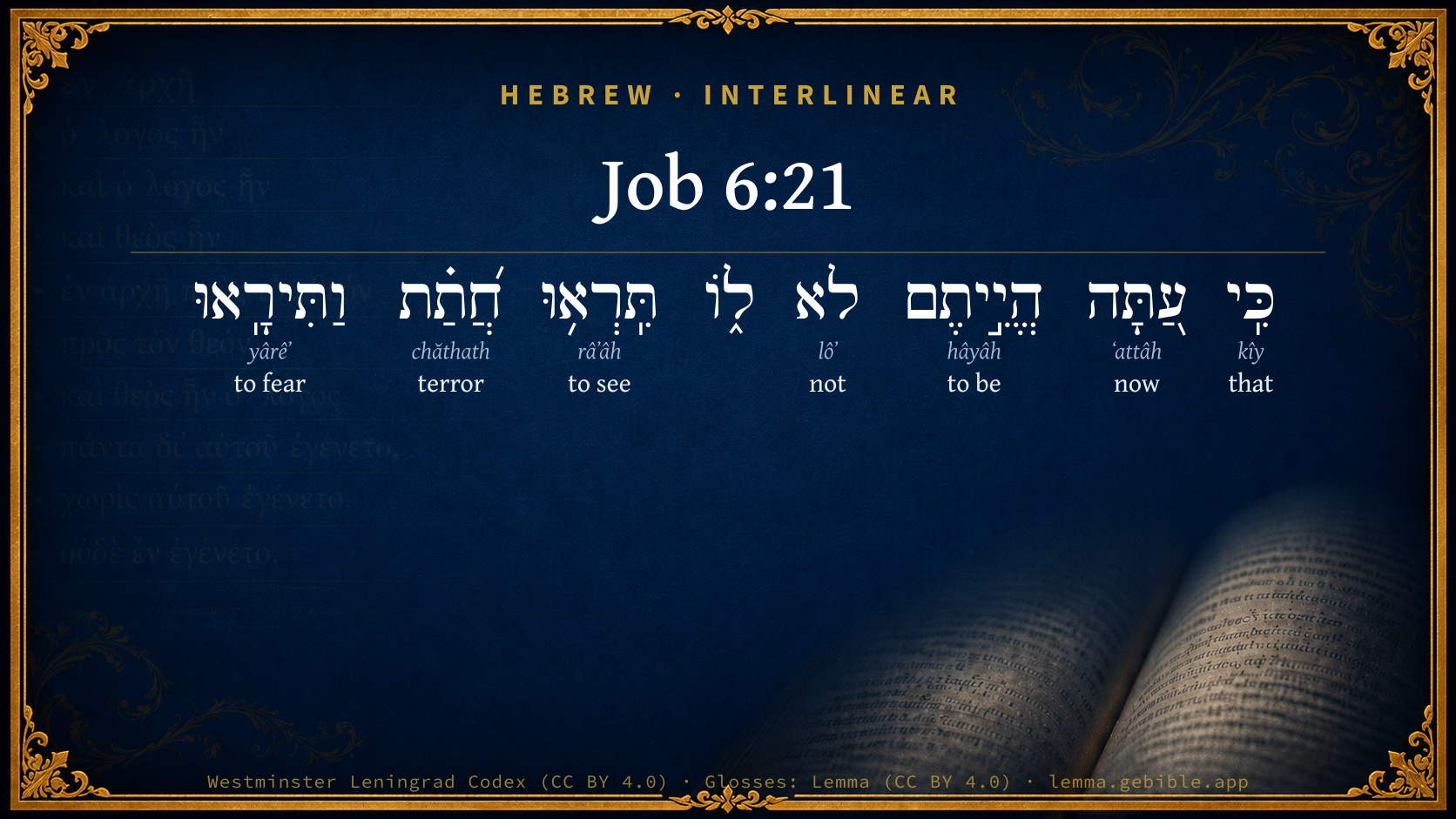
Job 6:21

Hebrew (Westminster Leningrad Codex) Job 6:21 appears in the Hebrew Old Testament. The text above is from the Westminster Leningrad Codex. Each word links to its Strong’s number, a concise gloss, and parsing drawn from the Open Scriptures Hebrew Bible morphology. Click any word for its full Brown-Driver-Briggs (BDB) entry.
Download image
Cite this verse

Job 6:21 (World English Bible). Public Domain. Lemma interlinear Bible study tool, https://lemma.gebible.app/v/job/6/21.

Show BibTeX & RIS
BibTeX
RIS
English Translation
For now you are nothing. You see a terror, and are afraid.
World English Bible · Public Domain
Highlights Full analysis ↓
Download a study sheet

One document with this verse’s original text, its word-by-word gloss line, the meaning frame, cross-references with their text, attributed commentary, and full source and license credits — printable, and it pastes into notes with its structure intact.

This verse Autodidact and up

Study sheet (.html) Plain text (.txt)

A passage Seminary Student

Up to 50 verses in one chapter. A passage sheet keeps up to 6 commentary sources and 12 cross-references per verse, in the order this page ranks them, and says so on the sheet whenever that leaves anything out. Ask for a single verse and you get the Autodidact verse sheet above.

Everything on this page stays free to read, with no account — the sheet is a download of what is already on screen, not access to it.

Want to remove ads? Support Godless Engineer
Compare translations 3

The same verse in 3 English versions, stacked beneath the original-language interlinear above. Click any original word for its lexicon entry.

Each is an independent rendering of the whole verse — the interlinear is not word-aligned to these translations.

Highlighted words mark where these versions differ — a whole-verse word diff, not a word-by-word alignment.

  • World English Bible Public Domain
    For now you are nothing. You see a terror, and are afraid.
  • King James Version Public Domain
    For now ye are nothing; ye see my casting down, and are afraid.
  • unfoldingWord Literal Text CC BY-SA 4.0
    For now you are nothing; you see a terror and you fear.

unfoldingWord Literal Text — © unfoldingWord, licensed CC BY-SA 4.0. Word-aligned USFM3 via Door43 (git.door43.org/unfoldingWord/en_ult).

Versions to compare (up to 4)

3 of 4 selected

Show all 18 translations

Every available English version of this verse, each an independent rendering of the whole verse.

  • World English Bible Public Domain
    For now you are nothing. You see a terror, and are afraid.
  • Berean Standard Bible Public Domain
    For now you are of no help; you see terror, and you are afraid.
  • Majority Standard Bible Public Domain
    For now you are of no help; you see terror, and you are afraid.
  • King James Version Public Domain
    For now ye are nothing; ye see my casting down, and are afraid.
  • American Standard Version (1901) Public Domain
    For now ye are nothing; Ye see a terror, and are afraid.
  • Revised Version (1885) Public Domain
    For now ye are nothing; ye see a terror, and are afraid.
  • Geneva Bible (1599) Public Domain
    Surely nowe are ye like vnto it: ye haue seene my fearefull plague, and are afraide.
  • Douay-Rheims (1899) Public Domain
    Now you are come: and now seeing my affliction you are afraid.
  • Young's Literal Translation Public Domain
    Surely now ye have become the same! Ye see a downfall, and are afraid.
  • Literal Standard Version CC BY-SA 4.0
    Surely now you have become the same! You see a downfall, and are afraid.
  • Unlocked Literal Bible CC BY-SA 4.0
    For now you friends are nothing to me; you see my dreadful situation and are afraid.
  • unfoldingWord Literal Text CC BY-SA 4.0
    For now you are nothing; you see a terror and you fear.
  • Darby Bible Public Domain
    So now ye are nothing; ye see a terrible object and are afraid.
  • World Messianic Bible Public Domain
    For now you are nothing. You see a terror, and are afraid.
  • Webster's Bible Public Domain
    For now ye are nothing: ye see my casting down, and are afraid.
  • Free Bible Version CC BY-SA 4.0
    Now you are no help, just like that —you see my trouble and you're afraid.
  • Bible in Basic English Public Domain
    So have you now become to me; you see my sad condition and are in fear.
  • JPS Tanakh (1917) Public Domain
    For now ye are become His; ye see a terror, and are afraid.

Literal Standard Version (2020), Covenant Press — licensed CC BY-SA 4.0. Text via the HelloAO Bible API (eBible.org). Unlocked Literal Bible (unfoldingWord) — licensed CC BY-SA 4.0. Text via the HelloAO Bible API (eBible.org). unfoldingWord Literal Text — © unfoldingWord, licensed CC BY-SA 4.0. Word-aligned USFM3 via Door43 (git.door43.org/unfoldingWord/en_ult). Free Bible Version, Dr. Jonathan Gallagher — licensed CC BY-SA 4.0. Text via the HelloAO Bible API (eBible.org).

Word by word

More ways to search: Search by grammar → Find every occurrence → Compare this word →

Practice this passage: Drill this verse → Learn its vocabulary →

About this verse

These counts appear in no published source. They are computed here, from the morphology-tagged text and Lemma’s own curated glosses. What Lemma adds →

8
words
7
distinct lemmas
Wisdom
section

Notable vocabulary

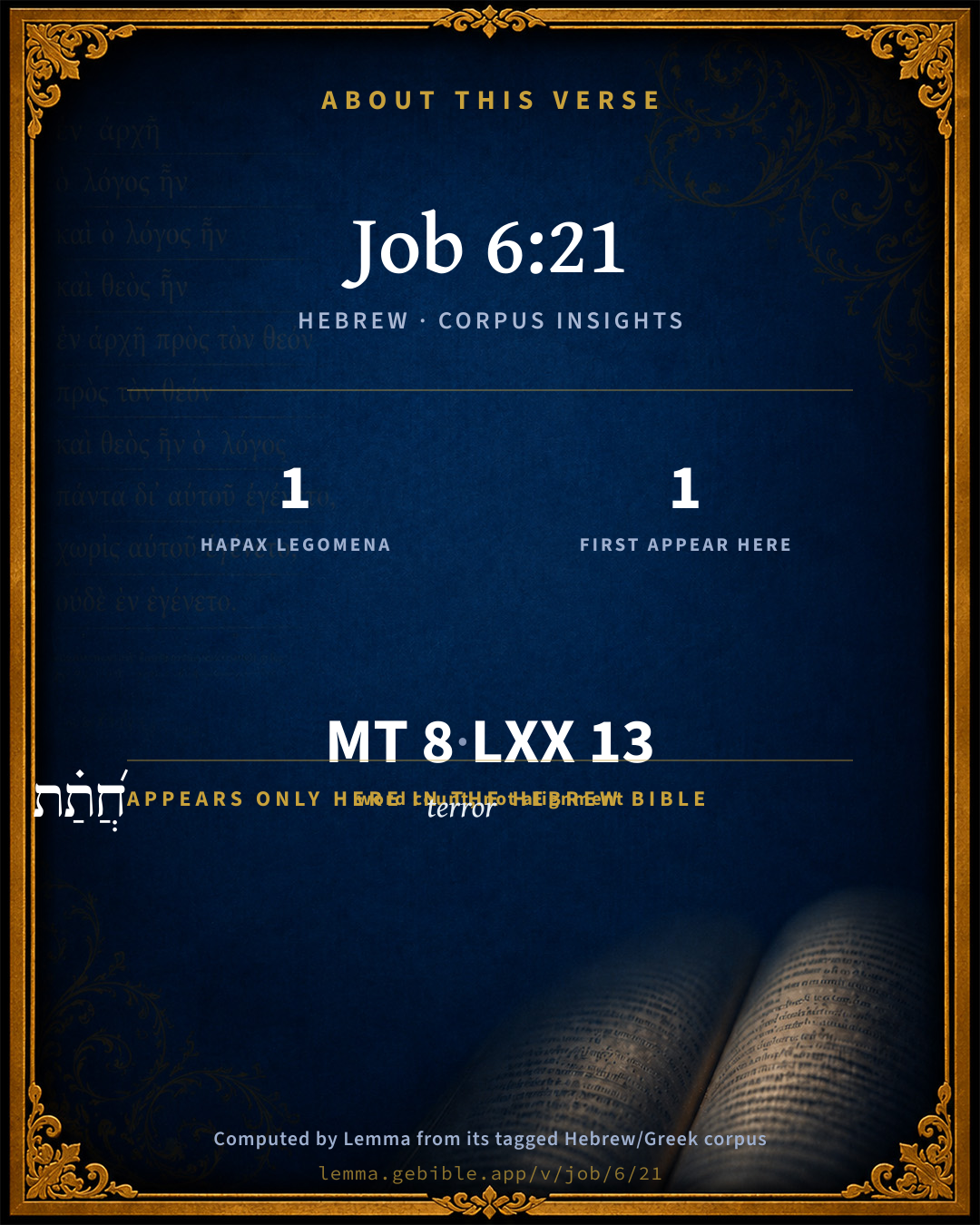
1 hapax legomenon — a word that appears only here in the entire Hebrew Bible:

  • חֲ֝תַ֗ת terror H2866

First appearance in Scripture

This word makes its first canonical appearance in the Hebrew Bible here:

  • חֲ֝תַ֗ת terror H2866

Grammatical profile

  • 3 verbs
  • 1 noun
  • 1 preposition
  • 1 conjunction
  • 1 adverb
  • 1 particle

Verb forms

  • הֱיִ֣יתֶם Qal · Perfect
  • תִּֽרְא֥וּ Qal · Imperfect
  • וַתִּירָֽאוּ Qal · Sequential Imperfect

Hebrew & Septuagint length

In English translation the verse runs 12 words from the Hebrew and 17 from the Septuagint (LXX English) — the Septuagint runs noticeably longer here. See the side-by-side →

A rough comparison of the two English renderings, which tokenize alike — not a word-level alignment.

Word counts can differ between the Hebrew and the Greek without any difference in meaning — e.g. the Hebrew direct-object marker אֵת has no separate Greek word, and Greek often adds the article ὁ.

In the original languages it is 8 Hebrew tokens and 13 Greek tokens — but the two are counted differently (Hebrew bundles its prefixes and suffixes into one token; the Greek is in lemma form), so that isn’t a like-for-like length.

Cross-references

14

Topical passages linked to Job 6:21 in the Treasury of Scripture Knowledge — connected by theme and wording, ordered by reader-vote popularity; previews shown in the World English Bible.

  • Psalms 38:11 My lovers and my friends stand aloof from my plague. My kinsmen stand far away.
  • 2 Timothy 4:16 At my first defense, no one came to help me, but all left me. May it not be held against them.
  • Jeremiah 17:5–6 Thus says Yahweh: Cursed is the man who trusts in man, and makes flesh his arm, and whose heart departs from Yahweh.
  • Job 2:11–13 Now when Job's three friends heard of all this evil that had come on him, they each came from his own place: Eliphaz the Temanite, Bildad the Shuhite, and Zophar the Naamathite, and they made an appointment together to come to sympathize with him and to comfort him.
  • Job 6:15 My brothers have dealt deceitfully as a brook, As the channel of brooks that pass away;
  • Job 13:4 But you are forgers of lies. You are all physicians of no value.
  • Psalms 62:9 Surely men of low degree are just a breath, And men of high degree are a lie. In the balances they will go up. They are together lighter than a breath.
  • Proverbs 19:7 All the relatives of the poor shun him: How much more do his friends avoid him! He pursues them with pleas, but they are gone.
  • Isaiah 2:22 Stop trusting in man, whose breath is in his nostrils; For of what account is he?
  • Jeremiah 51:9 We would have healed Babylon, but she is not healed: forsake her, and let us go everyone into his own country; for her judgment reaches to heaven, and is lifted up even to the skies.
  • Matthew 26:31 Then Jesus said to them, "All of you will be made to stumble because of me tonight, for it is written, 'I will strike the shepherd, and the sheep of the flock will be scattered.'
  • Matthew 26:56 But all this has happened, that the Scriptures of the prophets might be fulfilled." Then all the disciples left him, and fled.
  • Revelation 18:9–10 The kings of the earth, who committed sexual immorality and lived wantonly with her, will weep and wail over her, when they look at the smoke of her burning,
  • Revelation 18:17–18 For in an hour such great riches are made desolate.' Every shipmaster, and everyone who sails anywhere, and mariners, and as many as gain their living by sea, stood far away,

Cross-references courtesy of OpenBible.info (CC BY 4.0).

Hebrew and Greek witnesses Masoretic Hebrew ↔ Greek Septuagint

The same verse in the two great witnesses to the Old Testament, shown verse-for-verse.

Here the Septuagint runs noticeably longer than the Hebrew — LXX2012 (modern English Septuagint) 17 words vs World English Bible 12. A rough length comparison of the two English translations, not a word-level alignment — read both below.

These are two independent witnesses, not word-aligned to each other, and the Septuagint is shown in lemma (dictionary) form.

Hebrew Job 6:21 Masoretic · Westminster Leningrad Codex

כִּֽי עַ֭תָּה הֱיִ֣יתֶם לא ל֑וֹ תִּֽרְא֥וּ חֲ֝תַ֗ת וַתִּירָֽאוּ

For now you are nothing. You see a terror, and are afraid.

World English Bible · Public Domain

Greek LXX Job 6:21 Septuagint · lemma form

ἀτάρ δέ καί σύ ἐπιβαίνω ἐγώ ἀνελεημόνως ὥστε ὁράω ὁ ἐμός τραῦμα φοβέω

But you⌃ also have come to me without pity; so that beholding my wound you⌃ are afraid.

LXX2012 (modern English Septuagint) · Public Domain

On this verse, Trapp's Complete Commentary discusses the Septuagint’s reading. Read the note in Commentary ↓

Hebrew: Westminster Leningrad Codex (CC BY 4.0). Greek: Septuagint (public domain); English from LXX2012 (modern English Septuagint) (Public Domain). How the Septuagint differs from the Hebrew →

Commentary

Notes on Job 6:21 from classic Christian and Jewish commentators (each source and its license shown beneath its notes). The classic Christian expositions comment on the surrounding passage and are grouped to its opening verse, so a note may address several verses; the Jewish commentaries on the Tanakh (Rashi and others) are per-verse, so they appear only where the commentator wrote on this verse.

Lemma curates 59 commentaries, every one of them public domain or Creative Commons licensed, each selected and text-cleaned for this edition rather than reprinted as found. About our sources →

Trapp's Complete Commentary

John Trapp

Job 6:21 For now ye are nothing; ye see [my] casting down, and are afraid.

Ver. 21. For now ye are nothing] i.e. To me nothing worth; I have no more joy of you than if you were not at all; ye are not unlike him who said to his friend, I am all yours, except body and goods; ye are not so much as friends at a sneeze, who will come out with a God bless you; or as those great benefactors in St James, Jas 2:15-16, that were free of their mouth mercy; ye are mere mutes and ciphers, nullities, as to me just nothing; that is, ye are no such thing as I expected. And here Job brings the foregoing similitude home to his friends by close application. And according to the Hebrew margin called keri, it may be rendered, Fuistis ei similes, sc. torrenti; ye are like to it, that is, to the brook before mentioned; ye fail me as much as it did the thirsty passengers (Drus.).

For ye see my casting down, and are afraid] There is an elegance in the original that cannot be Englished; your eyes see what you had before heard of only by the hearing of the ear, that I am at a great under, dejected and impovershed; you are therefore afraid of me, lest I should ask you something for the supply of my wants; or else you keep at a distance, as more afraid of catching mine evil than desirous of curing it; ye visit me, but are not moved with any compassion towards me, Horrore perculsi resiluistis a me veluti si quispiam viperam calcasset (Lay.). So the Septuagint.

John Trapp, A Commentary or Exposition upon All the Books of the Old and New Testament (1647–1656) — public domain. Text from a community e-Sword module.

Joseph Benson's Commentary

Job 6:21. For now ye are nothing, &c. — Just such are you, who, seeing my calamity, afford me no comfort, and seem afraid lest I should want something of you. Thus Job very properly applies the preceding most beautiful description of the torrents in the hot climates, to his three friends who thus disappointed his expectations. Indeed, it is a very fine image of pretended friends in adversity. When their help is most wanted and coveted, they are too apt to fail the expectations of those that trusted in them. They may properly enough be said to be either frozen or melted away by adversity. All their warm professions are congealed, as it were, when adverse circumstances have laid hold on their friends, and their friendship is quite dissolved and melted away. Ye see my casting down, and are afraid — You are shy of me, and afraid for yourselves, lest some further plague should come upon me, wherein you, for my sake, should be involved; or, lest I should be burdensome to you. Therefore you are to me as if you had never come; you are nothing to me, for I have no help or comfort from you.

Joseph Benson's Commentary on the Old and New Testaments (1811–1818) — public domain. Text from a community e-Sword module.

Whedon's Commentary on the Bible

Daniel D. Whedon

Third long strophe — A FURTHER CONFIRMATION OF THE FALSENESS OF HIS FRIENDS, Job_6:21-30.

First strophe — Job proceeds to apply the preceding illustration, Job_6:21-23.

21. Ye are nothing — Like the streams the perishing host looked for.

My casting down — Fearful state, (Furst,) or terror. Job was fearful to behold. The disposition of the three friends is like that of the priest and Levite — they look on and lend no succour. The original has a figure of beauty — a paronomasia, (ותיראו… תראו) that cannot be translated.

Daniel D. Whedon (gen. ed.), Commentary on the Old and New Testaments (1874–1909) — public domain. Text from a community e-Sword module.

Keil & Delitzsch

C. F. Keil & F. Delitzsch

21 For now ye are become nothing;

You see misfortune, and are affrighted.

22 Have I then said, Give unto me,

And give a present for me from your substance,

23 And deliver me from the enemy's hand,

And redeem me from the hand of the tyrant?

In Job 6:21, the reading wavers between לו and לא, with the Keri לו; but לו, which is consequently the lectio recepta, gives no suitable meaning, only in a slight degree appropriate, as this: ye are become it, i.e., such a mountain brook; for הייתם is not to be translated, with Stickel and others, estis, but facti estis. The Targum, however, translates after the Chethib: ye are become as though ye had never been, i.e., nothingness. Now, since לא, Aramaic לה, can (as Dan 4:32 shows) be used as a substantive (a not = a null), and the thought: ye are become nothing, your friendship proves itself equal to null, suits the imagery just used, we decide in favour of the Chethib; then in the figure the בתּהוּ עלה corresponds most to this, and is also, therefore, not to be explained away. The lxx, Syr., Vulg., translate לי instead of לו: ye are become it (such deceitful brooks) to me. Ewald proposes to read לי הייתם עתה כן (comp. the explanation, Ges. 137, rem. 3), - a conjecture which puts aside all difficulty; but the sentence with לא commends itself as being bolder and more expressive. All the rest explains itself. It is remarkable that in Job 6:21 the reading תּירוּ is also found, instead of תּראוּ: ye dreaded misfortune, and ye were then affrighted. הבוּ is here, as an exception, properispomenon, according to Ges. 29, 3. כּח, as Pro 5:10; Lev 26:20, what one has obtained by putting forth one's strength, syn. חיל, outward strength.

Keil & Delitzsch — Biblical Commentary on the Old Testament (1861–1891) — public domain (CC PDM 1.0). Text via the HelloAO Bible API. (Old Testament only.)

Geneva Bible (1599)

Geneva Bible translators

That is, like to this brook which deceiveth them that think to have water there in their need, as I looked for consolation at your hands.

Geneva Bible (1599) marginal notes — public domain. Text via Bolls.life.

Jamieson, Fausset & Brown

Robert Jamieson, A. R. Fausset & David Brown

As the dried-up brook is to the caravan, so are ye to me, namely, a nothing; ye might as well not be in existence [UMBREIT]. The Margin "like to them," or "to it" (namely, the waters of the brook), is not so good a reading.

ye see, and are afraid--Ye are struck aghast at the sight of my misery, and ye lose presence of mind. Job puts this mild construction on their failing to relieve him with affectionate consolation.

Jamieson, Fausset & Brown — Commentary Critical and Explanatory on the Whole Bible (1871) — public domain (CC PDM 1.0). Text via the HelloAO Bible API.

Adam Clarke's Commentary

Verse 21. For now ye are nothing] Ye are just to me as those deceitful torrents to the caravans of Tema and Sheba; they were nothing to them; ye are nothing to me.

Ye see my casting down] Ye see that I have been hurried from my eminence into want and misery, as the flood from the top of the mountains, which is divided, evaporated, and lost in the desert.

And are afraid.] Ye are terrified at the calamity that has come upon me; and instead of drawing near to comfort me, ye start back at my appearance.

Adam Clarke's Commentary on the Bible (1810–1826) — public domain. Text from a community e-Sword/MySword module.

Ellicott's Commentary for English Readers

(21) For now ye are nothing.—“Surely now ye are become like it” i.e., that wady; or, according to another reading followed in the text of the Authorised Version, “Ye have become nothing: ye have seen an object of terror, and are terrified: ye have seen my broken-down condition, and are dismayed at it.”

A Bible Commentary for English Readers, edited by Charles John Ellicott (1878–1897) — public domain. Text from a community e-Sword module.

The Cambridge Bible for Schools and Colleges

gen. ed. J. J. S. Perowne

21. ye are nothing] Or, are become nothing. Job applies his comparison. Another reading is: ye are become it, i. e. the deceitful, disappointing brook. The general sense remains the same.

my casting down] lit. ye see a terror. Job’s comparison of his friends to the brook is graphic and telling. In winter these brooks are full, but in summer when the thirsty caravan needs them and looks for them they are found to have disappeared before the heat. And Job’s friends may have been effusive in their offers of friendship when friendships were abundant, but now when he needs their aid, the sight of his terrible affliction, like the summer heat, dissipates their sympathy and makes them “nothing,” without power to help. In the words “ye see a terror and are afraid” Job insinuates more than that his friends are paralysed at the sight of his calamity, he means probably that, judging his calamity to be from God, they have not courage to shew him sympathy, cf. Job_13:7 seq.

The Cambridge Bible for Schools and Colleges (gen. ed. J. J. S. Perowne; Cambridge University Press, 1878–1918) — public domain. Text from a community e-Sword module.

John Gill's Exposition

Did I say, bring unto me?.... Or, "give unto me" (b); did I invite you to come to me, and bring in your hands presents for me, to support me under my necessitous circumstances?

or give a reward for me of your substance? did I ever ask anything of you? if I had, it would have been but your duty to have given freely to me in my deplorable circumstances; and it might have been expected you would have given without asking, seeing my necessities so great: or did I desire you to communicate out of the great wealth and abundant riches you are possessed of to others on my behalf, to plead my cause among men, and to get a favourable sentence upon me, that I might not be traduced as a wicked man by censorious tongues? had I ever been troublesome to you in any respect, you might have been provoked to use me ill; but since nothing of this kind has ever been requested of you, you might have forborne ill language and hard words; which are often given to beggars; for when a man is fallen to decay, and becomes troublesome by his importunity, twenty things are raked up by his friends against his character; as that he has been lazy and indolent, or lavish and extravagant, &c. to save their money, and excuse them from acts of charity; but this was not the case here.

(b) "date mihi", Junius & Tremellius, Piscator, Drusius, Cocceius, Michaelis.

John Gill's Exposition of the Whole Bible (1746–1763) — public domain (CC PDM 1.0). Text via the HelloAO Bible API.

Albert Barnes' Notes on the Bible

For now ye are as nothing - Margin, “or, Ye are like to it, or them.” In the margin also the word “nothing” is rendered “not.” This variety arises from a difference of reading in the Hebrew text, many MSS. having instead of (לא lô'), not, (לו lô'), to him, or to it. Which is correct, it is not easy to determine. Rosenmuller supposes that it is only a variety in writing the word לא l', where the waw is often used for .א The probability is, that it means, that they were as nothing - like the stream that had disappeared. This is the point of the comparison; and this Job now applies to his friends. They had promised much by their coming - like the streams when swollen by rains and melted ice. But now they were found to be nothing.

Ye see my casting down - חתת chăthath - my being broken or crushed; my calamity. Vulgate, plugam. Septuagint, τραῦμα trauma, wound.

And are afraid - Are timid and fearful. You shrink back; you dare not approach the subject boldly, or come to me with words of consolation. You came with a professed intention to administer comfort, but your courage fails.

Albert Barnes' Notes on the Bible (1834–1885) — public domain. Text from a community e-Sword/MySword module.

Haydock's Catholic Bible Commentary

Come. Hebrew, "are good for nothing." (Calmet) --- Protestant marginal note, "like to them."

George Leo Haydock (1774–1849), Haydock's Catholic Family Bible and Commentary, 1859 edition — public domain. Excludes Psalms (Douay-Rheims chapter numbering differs from Protestant) and Deuterocanonical books (Catholic canon only).

Matthew Poole's English Annotations

He gives the reason why he charged them with deceitfulness, and compared them to these deceitful brooks. Nothing, or, as nothing; the note of similitude being oft understood. Heb. as not, i.e. you are to me as if you had not been, or as if you had never come to me, for I have no benefit nor comfort from you and your discourse, but only an increase of my misery.

Ye see my casting down, and are afraid: when you come near to me, and perceive my great and manifold calamities, you stand as it were at a distance; you are shy of me, and afraid for yourselves, either lest my sores or breath should infect you; or lest some further plagues-should come upon me, wherein yourselves for my sake, or because you are in my company, should be involved; or lest I should be burdensome to you, and need and call for your charitable contribution to support myself and the small remainders of my poor family, or for your helping hand to assist and save me from mine enemies, who may possibly fall upon me in this place, as the Chaldeans and Sabeans did upon my servants and cattle elsewhere; which is implied in the next verses. So far are you from being true friends and comforts to me, as you would seem to be.

Matthew Poole's English Annotations on the Holy Bible (1683–1685) — public domain. Text from a community e-Sword/MySword module.

The Pulpit Commentary

For now ye are nothing. Like the dried-up torrents, the comforters had come to nought; were wholly useless and unprofitable. Another reading gives the sense, "Ye are like to them comforters," i.e. , "are like the winter torrents, and have misled me, as they misled the caravans." Ye see my casting down, and are afraid. Here Job penetrates to the motive which had produced the conduct of his friends. They had come with good intentions, meaning to comfort and console him; but when they came, and saw what a wreck he was, how utterly "broken up" and ruined, they began to be afraid of showing too much friendliness. They thought him an object of the Divine vengeance, and feared lest, if they showed him sympathy, they might involve themselves in his punishment.

The Pulpit Commentary (1880–1919), ed. H.D.M. Spence-Jones & Joseph S. Exell — public domain. Text from a community e-Sword module.

John Wesley's Explanatory Notes

Nothing - You are to me as if you had never come to me; for I have no comfort from you. Afraid - You are shy of me, and afraid for yourselves, lest some further plagues should come upon me, wherein you for my sake, should be involved: or, lest I should be burdensome to you.

John Wesley, Explanatory Notes Upon the Whole Bible (1754–1765) — public domain. Text via the GEBible commentary corpus.

unfoldingWord translationNotes

Door43 World Missions Community

General Information:

In these verses, Job poses four questions to rebuke his friends and to emphasize that he did not ask for help from any of them. (See: Rhetorical Question)

For now

Job uses this phrase to introduce the main part of what he is saying.

you friends are nothing to me

"you friends have not helped me at all"

are afraid

This means that they see the trouble Job has and are afraid of being in the same situation. AT: "you are afraid that God might do similar things to you" (See: Assumed Knowledge and Implicit Information)

Did I say to you, 'Give something to me?' Or, 'Offer me a gift from your wealth?' Or, 'Save me from my adversary's hand?' Or, 'Ransom me from the hand of my oppressors?'

Job uses rhetorical questions to emphasize that he did not ask his friends to give him anything or to help him. AT: "I did ask you to give me money or a gift. Nor did I ask you to save me from my adversary or oppressors." (See: Rhetorical Question)

Save me from my adversary's hand ... Ransom me from the hand of my oppressors

Both of these statements mean the same thing. Also, here "hand" represents power or control. AT: "Save me from my adversary or my oppressors" or "Save me from my adversary" (See: Parallelism and Metonymy)

Ransom me

"Rescue me"

translationWords

fear

gift

save

adversary

hand

ransom

oppress

unfoldingWord translationNotes — © Distant Shores Media and the Door43 World Missions Community, licensed CC BY-SA 4.0. Source: git.door43.org/Door43/en_tn.

Rashi

Rabbi Shlomo Yitzchaki (Rashi)

For now you are like it You are compared to that stream

you fear ruin The fear of the plague, and you are afraid to say the truth, thereby flattering my opponent.

Rashi on the Tanakh — English translations: “The Judaica Press complete Tanach with Rashi, translated by A. J. Rosenberg” (CC BY 4.0); “Pentateuch with Rashi's commentary by M. Rosenbaum and A.M. Silbermann, 1929-1934” (public domain); “The Metsudah Tanach series, Lakewood, N.J” (CC BY 4.0); and “The Book of Joshua, Metsudah Publications, 1997” (CC BY 4.0). Text via Sefaria.

Lesson kit

Teaching starters — assembled from the data on this page, not authored interpretation. Every prompt links to the verse data it draws on. Edit before teaching.

Job, in the Wisdom, opens this verse with 8 words (7 distinct Hebrew lemmas). Its most distinctive word is chăthath (“terror”). The Greek Septuagint runs longer here. A historical commentator’s framing appears above. Read the whole chapter for the surrounding context.

Discussion questions

  1. How does “terror” (chăthath) shape what this verse is saying?
  2. This verse holds 1 word here found nowhere else in the Hebrew Bible. What might the rare word draw attention to?
  3. The word “terror” first appears here in Scripture. What is being introduced at this debut?
  4. Psalms 38:11 shares this passage’s theme. How do the two illuminate each other?
  5. Compared with the Hebrew, the Septuagint runs longer here. What questions does that raise?
  6. These translations render this verse differently. What is at stake in choosing one wording over another?
  7. The verb «הֱיִ֣יתֶם» is Qal Perfect. How does its form color the action?
  8. Reading how Trapp's Complete Commentary and Joseph Benson's Commentary read this verse, where do the two commentators agree and where do they part?

Things to notice

Reading settings

Reading text

Shown beneath each verse's original-language words.

Old Testament
Old Testament edition

Read the OT as the Masoretic Hebrew (MT) or the Greek Septuagint (LXX).

English shown for the Greek Septuagint (in the Hebrew ↔ Greek comparison).

Comparing translations? Open the Compare panel on any verse page to stack up to four side by side.