
Jeremiah 44:10

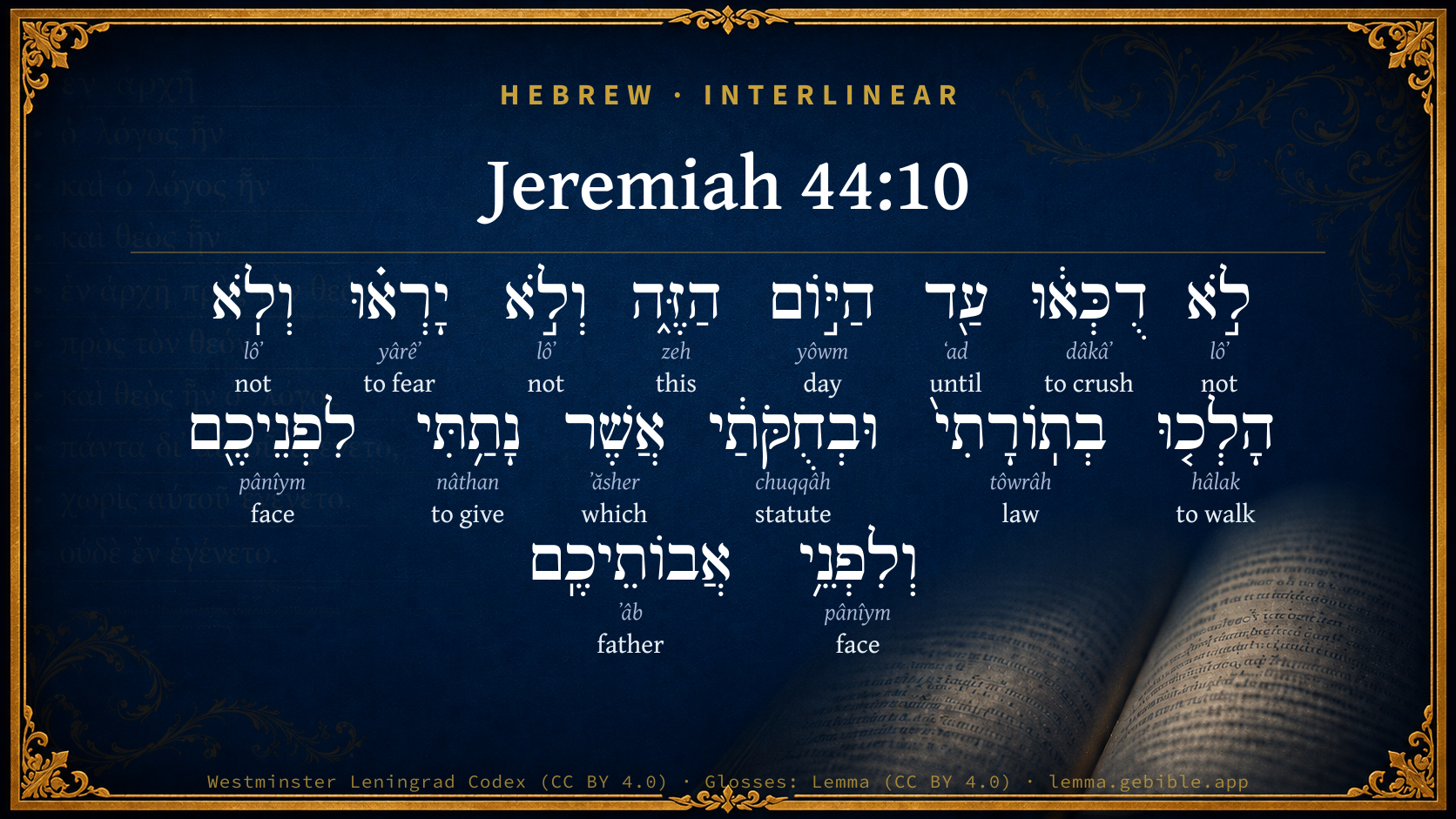
Hebrew (Westminster Leningrad Codex) Jeremiah 44:10 appears in the Hebrew Old Testament. The text above is from the Westminster Leningrad Codex. Each word links to its Strong’s number, a concise gloss, and parsing drawn from the Open Scriptures Hebrew Bible morphology. Click any word for its full Brown-Driver-Briggs (BDB) entry.
Download image
Cite this verse

Jeremiah 44:10 (World English Bible). Public Domain. Lemma interlinear Bible study tool, https://lemma.gebible.app/v/jeremiah/44/10.

Show BibTeX & RIS
BibTeX
RIS
English Translation
They are not humbled even to this day, neither have they feared, nor walked in my law, nor in my statutes, that I set before you and before your fathers.
World English Bible · Public Domain
Download a study sheet

One document with this verse’s original text, its word-by-word gloss line, the meaning frame, cross-references with their text, attributed commentary, and full source and license credits — printable, and it pastes into notes with its structure intact.

This verse Autodidact and up

Study sheet (.html) Plain text (.txt)

A passage Seminary Student

Up to 50 verses in one chapter. A passage sheet keeps up to 6 commentary sources and 12 cross-references per verse, in the order this page ranks them, and says so on the sheet whenever that leaves anything out. Ask for a single verse and you get the Autodidact verse sheet above.

Everything on this page stays free to read, with no account — the sheet is a download of what is already on screen, not access to it.

Want to remove ads? Support Godless Engineer
Compare translations 3

The same verse in 3 English versions, stacked beneath the original-language interlinear above. Click any original word for its lexicon entry.

Each is an independent rendering of the whole verse — the interlinear is not word-aligned to these translations.

Highlighted words mark where these versions differ — a whole-verse word diff, not a word-by-word alignment.

  • World English Bible Public Domain
    They are not humbled even to this day, neither have they feared, nor walked in my law, nor in my statutes, that I set before you and before your fathers.
  • King James Version Public Domain
    They are not humbled even unto this day, neither have they feared, nor walked in my law, nor in my statutes, that I set before you and before your fathers.
  • unfoldingWord Literal Text CC BY-SA 4.0
    To this day, they still are not humbled. They do not honor my law or decrees that I placed before them and their ancestors, nor do they walk in them.’

unfoldingWord Literal Text — © unfoldingWord, licensed CC BY-SA 4.0. Word-aligned USFM3 via Door43 (git.door43.org/unfoldingWord/en_ult).

Versions to compare (up to 4)

3 of 4 selected

Show all 18 translations

Every available English version of this verse, each an independent rendering of the whole verse.

  • World English Bible Public Domain
    They are not humbled even to this day, neither have they feared, nor walked in my law, nor in my statutes, that I set before you and before your fathers.
  • Berean Standard Bible Public Domain
    To this day they have not humbled themselves or shown reverence, nor have they followed My instruction or the statutes that I set before you and your fathers.
  • Majority Standard Bible Public Domain
    To this day they have not humbled themselves or shown reverence, nor have they followed My instruction or the statutes that I set before you and your fathers.
  • King James Version Public Domain
    They are not humbled even unto this day, neither have they feared, nor walked in my law, nor in my statutes, that I set before you and before your fathers.
  • American Standard Version (1901) Public Domain
    They are not humbled even unto this day, neither have they feared, nor walked in my law, nor in my statutes, that I set before you and before your fathers.
  • Revised Version (1885) Public Domain
    They are not humbled even unto this day, neither have they feared, nor walked in my law, nor in my statutes, that I set before you and before your fathers.
  • Geneva Bible (1599) Public Domain
    They are not humbled vnto this day, neither haue they feared nor walked in my lawe nor in my statutes, that I set before you and before your fathers.
  • Douay-Rheims (1899) Public Domain
    They are not cleansed even to this day: neither have they feared, nor walked in the law of the Lord, nor in my commandments, which I set before you and your fathers.
  • Young's Literal Translation Public Domain
    They have not been humbled unto this day, nor have they been afraid, nor have they walked in My law, and in My statutes, that I have set before you and before your fathers.
  • Literal Standard Version CC BY-SA 4.0
    They have not been humbled to this day, nor have they been afraid, nor have they walked in My law, and in My statutes, that I have set before you and before your fathers.
  • Unlocked Literal Bible CC BY-SA 4.0
    To this day, they still are not humbled. They do not honor my law or decrees that I placed before them and their ancestors, nor do they walk in them.'
  • unfoldingWord Literal Text CC BY-SA 4.0
    To this day, they still are not humbled. They do not honor my law or decrees that I placed before them and their ancestors, nor do they walk in them.’
  • Darby Bible Public Domain
    They are not humbled unto this day, neither have they feared, nor walked in my law, nor in my statutes which I set before you and before your fathers.
  • World Messianic Bible Public Domain
    They are not humbled even to this day, neither have they feared, nor walked in my law, nor in my statutes, that I set before you and before your fathers.’
  • Webster's Bible Public Domain
    They are not humbled even to this day, neither have they feared, nor walked in my law, nor in my statutes, that I set before you and before your fathers.
  • Free Bible Version CC BY-SA 4.0
    Even up to now you haven't shown any remorse or reverence. You haven't followed my rules and regulations I gave you and your forefathers.
  • Bible in Basic English Public Domain
    Even to this day their hearts are not broken, and they have no fear, and have not gone in the way of my law or of my rules which I gave to you and to your fathers.
  • JPS Tanakh (1917) Public Domain
    They are not humbled even unto this day, neither have they feared, nor walked in My law, nor in My statutes, that I set before you and before your fathers.

Literal Standard Version (2020), Covenant Press — licensed CC BY-SA 4.0. Text via the HelloAO Bible API (eBible.org). Unlocked Literal Bible (unfoldingWord) — licensed CC BY-SA 4.0. Text via the HelloAO Bible API (eBible.org). unfoldingWord Literal Text — © unfoldingWord, licensed CC BY-SA 4.0. Word-aligned USFM3 via Door43 (git.door43.org/unfoldingWord/en_ult). Free Bible Version, Dr. Jonathan Gallagher — licensed CC BY-SA 4.0. Text via the HelloAO Bible API (eBible.org).

Word by word

More ways to search: Search by grammar → Find every occurrence → Compare this word →

Practice this passage: Drill this verse → Learn its vocabulary →

דֻכְּא֔וּ
dâkâʼ
H1792
“to crush”
Verb, Pual, Perfect, 3rd Person, Common, Plural
Part of Speech
Verb
Stem
Pual
Form
Perfect
Person
3rd Person
Gender
Common
Number
Plural
Full BDB Definition

Origin: a primitive root (compare H1794 )

TWOT: 427

to crush, be crushed, be contrite, be broken - (Niphal) - to be crushed - to be contrite (figuratively) - (Piel) to crush - (Pual) - to be crushed, be shattered - to be made contrite - (Hithpael) to allow oneself to be crushed
  1. לֹ֣א lôʼ H3808 “not” Particle, Negative
  2. עַ֖ד ʻad H5704 “until” Preposition
  3. הַיּ֣וֹם yôwm H3117 “the · day” Particle, Definite Article + Noun, Common, Masculine, Singular, Absolute
  4. הַזֶּ֑ה zeh H2088 “the · this” Particle, Definite Article + Pronoun, Demonstrative, Masculine, Singular
  5. וְלֹ֣א lôʼ H3808 “and · not” Conjunction + Particle, Negative
  6. יָרְא֗וּ yârêʼ H3372 “to fear” Verb, Qal, Perfect, 3rd Person, Common, Plural
  7. וְלֹֽא lôʼ H3808 “and · not” Conjunction + Particle, Negative
  8. הָלְכ֤וּ hâlak H1980 “to walk” Verb, Qal, Perfect, 3rd Person, Common, Plural
  9. בְתֽוֹרָתִי֙ tôwrâh H8451 “in/at · law · my” Preposition + Noun, Common, Feminine, Singular, Construct + Suffix, Personal, 1st Person, Common, Singular
  10. וּבְחֻקֹּתַ֔י chuqqâh H2708 “and · in/at · statutes · my” Conjunction + Preposition + Noun, Common, Both, Plural, Construct + Suffix, Personal, 1st Person, Common, Singular
  11. אֲשֶׁר ʼăsher H834 “which” Particle, Relative
  12. נָתַ֥תִּי nâthan H5414 “to give” Verb, Qal, Perfect, 1st Person, Common, Singular
  13. לִפְנֵיכֶ֖ם pânîym H6440 “to/for · face(s) · your” Preposition + Noun, Common, Both, Plural, Construct + Suffix, Personal, 2nd Person, Masculine, Plural
  14. וְלִפְנֵ֥י pânîym H6440 “and · to/for · face(s) of” Conjunction + Preposition + Noun, Common, Both, Plural, Construct
  15. אֲבוֹתֵיכֶֽם ʼâb H1 “fathers · your” Noun, Common, Masculine, Plural, Construct + Suffix, Personal, 2nd Person, Masculine, Plural

About this verse

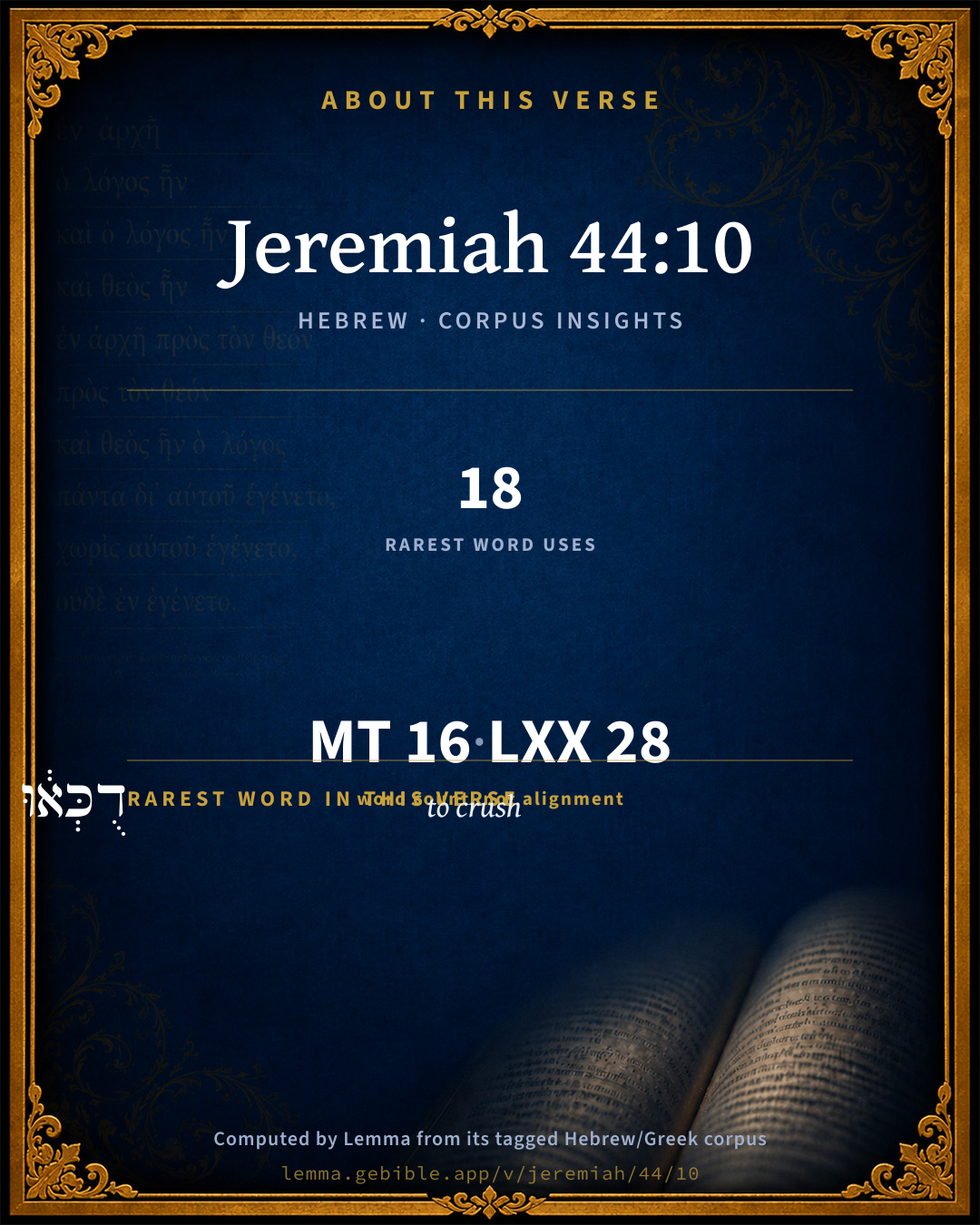
These counts appear in no published source. They are computed here, from the morphology-tagged text and Lemma’s own curated glosses. What Lemma adds →

16
words
13
distinct lemmas
Prophets
section

Notable vocabulary

The rarest word here is דֻכְּא֔וּ to crush H1792 — appearing just 18 times in the whole Hebrew Bible.

Shared distinctive vocabulary

דֻכְּא֔וּ to crush H1792 occurs in 18 verses of the Hebrew Bible. Also found in:

Grammatical profile

  • 4 verbs
  • 6 nouns
  • 1 pronoun
  • 1 preposition
  • 4 particles

Verb forms

  • דֻכְּא֔וּ Pual · Perfect
  • יָרְא֗וּ Qal · Perfect
  • הָלְכ֤וּ Qal · Perfect
  • נָתַ֥תִּי Qal · Perfect

Repetition

Words recur within this verse — often emphatic in Hebrew:

  • לִפְנֵיכֶ֖ם face H6440 ×2
  • לֹ֣א not H3808 ×3

Hebrew & Septuagint length

In the original languages it is 16 Hebrew tokens and 28 Greek tokens — but the two are counted differently (Hebrew bundles its prefixes and suffixes into one token; the Greek is in lemma form), so that isn’t a like-for-like length.

Cross-references

31

Topical passages linked to Jeremiah 44:10 in the Treasury of Scripture Knowledge — connected by theme and wording, ordered by reader-vote popularity; previews shown in the World English Bible.

  • Proverbs 28:14 Blessed is the man who always fears; But one who hardens his heart falls into trouble.
  • Jeremiah 8:12 Were they ashamed when they had committed abomination? nay, they were not at all ashamed, neither could they blush: therefore shall they fall among those who fall; in the time of their visitation they shall be cast down, says Yahweh.
  • 1 Peter 5:6 Humble yourselves therefore under the mighty hand of God, that he may exalt you in due time;
  • Revelation 15:4 Who wouldn't fear you, Lord, And glorify your name? For you only are holy. For all the nations will come and worship before you. For your righteous acts have been revealed."
  • Exodus 9:17 as you still exalt yourself against my people, that you won't let them go.
  • Exodus 9:30 But as for you and your servants, I know that you don't yet fear Yahweh God."
  • Exodus 10:3 Moses and Aaron went in to Pharaoh, and said to him, "This is what Yahweh, the God of the Hebrews, says: 'How long will you refuse to humble yourself before me? Let my people go, that they may serve me.
  • 1 Kings 21:29 See you how Ahab humbles himself before me? because he humbles himself before me, I will not bring the evil in his days; but in his son's days will I bring the evil on his house.
  • 2 Kings 22:19 because your heart was tender, and you did humble yourself before Yahweh, when you heard what I spoke against this place, and against the inhabitants of it, that they should become a desolation and a curse, and have torn your clothes, and wept before me; I also have heard you, says Yahweh.
  • 2 Chronicles 12:6–12 Then the princes of Israel and the king humbled themselves; and they said, Yahweh is righteous.
  • 2 Chronicles 32:26 Notwithstanding Hezekiah humbled himself for the pride of his heart, both he and the inhabitants of Jerusalem, so that the wrath of Yahweh didn't come on them in the days of Hezekiah.
  • 2 Chronicles 33:12 When he was in distress, he begged Yahweh his God, and humbled himself greatly before the God of his fathers.
  • 2 Chronicles 33:19 His prayer also, and how [God] was entreated of him, and all his sin and his trespass, and the places in which he built high places, and set up the Asherim and the engraved images, before he humbled himself: behold, they are written in the history of Hozai.
  • 2 Chronicles 34:27 because your heart was tender, and you did humble yourself before God, when you heard his words against this place, and against the inhabitants of it, and have humbled yourself before me, and have torn your clothes, and wept before me; I also have heard you, says Yahweh.
  • Psalms 34:18 Yahweh is near to those who have a broken heart, And saves those who have a crushed spirit.
  • Psalms 51:17 The sacrifices of God are a broken spirit. A broken and contrite heart, O God, you will not despise.
  • Proverbs 8:13 The fear of Yahweh is to hate evil. I hate pride, arrogance, the evil way, and the perverse mouth.
  • Proverbs 14:16 A wise man fears, and shuns evil, But the fool is hotheaded and reckless.
  • Proverbs 16:6 By mercy and truth iniquity is atoned for. By the fear of Yahweh men depart from evil.
  • Ecclesiastes 8:12–13 Though a sinner commits crimes a hundred times, and lives long, yet surely I know that it will be better with those who fear God, who are reverent before him.
  • Isaiah 57:15 For thus says the high and lofty One who inhabits eternity, whose name is Holy: I dwell in the high and holy place, with him also who is of a contrite and humble spirit, to revive the spirit of the humble, and to revive the heart of the contrite.
  • Isaiah 66:2 For all these things has my hand made, and [so] all these things came to be, says Yahweh: but to this man will I look, even to him who is poor and of a contrite spirit, and who trembles at my word.
  • Jeremiah 10:7 Who should not fear you, King of the nations? for to you does it appertain; because among all the wise men of the nations, and in all their royal estate, there is none like you.
  • Jeremiah 36:24 They were not afraid, nor tore their garments, neither the king, nor any of his servants who heard all these words.
  • Ezekiel 9:4 Yahweh said to him, Go through the midst of the city, through the midst of Jerusalem, and set a mark on the foreheads of the men that sigh and that cry over all the abominations that are done in the midst of it.
  • Daniel 5:20–22 But when his heart was lifted up, and his spirit was hardened so that he dealt proudly, he was deposed from his kingly throne, and they took his glory from him:
  • Malachi 4:2 But to you who fear my name shall the sun of righteousness arise with healing in its wings. You will go out, and leap like calves of the stall.
  • Matthew 27:54 Now the centurion, and those who were with him watching Jesus, when they saw the earthquake, and the things that were done, feared exceedingly, saying, "Truly this was the Son of God."
  • Luke 23:40 But the other answered, and rebuking him said, "Don't you even fear God, seeing you are under the same condemnation?
  • Romans 11:20 True; by their unbelief they were broken off, and you stand by your faith. Don't be conceited, but fear;
  • James 4:6–10 But he gives more grace. Therefore it says, "God resists the proud, but gives grace to the humble."

Cross-references courtesy of OpenBible.info (CC BY 4.0).

Hebrew and Greek witnesses Masoretic Hebrew ↔ Greek Septuagint

The same verse in the two great witnesses to the Old Testament, shown verse-for-verse.

These are two independent witnesses, not word-aligned to each other, and the Septuagint is shown in lemma (dictionary) form.

Hebrew Jeremiah 44:10 Masoretic · Westminster Leningrad Codex

לֹ֣א דֻכְּא֔וּ עַ֖ד הַיּ֣וֹם הַזֶּ֑ה וְלֹ֣א יָרְא֗וּ וְלֹֽא הָלְכ֤וּ בְתֽוֹרָתִי֙ וּבְחֻקֹּתַ֔י אֲשֶׁר נָתַ֥תִּי לִפְנֵיכֶ֖ם וְלִפְנֵ֥י אֲבוֹתֵיכֶֽם

They are not humbled even to this day, neither have they feared, nor walked in my law, nor in my statutes, that I set before you and before your fathers.

World English Bible · Public Domain

Greek LXX Structure differs

In the Septuagint, Jeremiah is about an eighth shorter than the Hebrew and arranges its material differently — the Oracles Against the Nations (Hebrew chapters 46–51) appear in the middle of the Greek book, after 25:13. Because the chapter and verse boundaries do not line up, a verse-for-verse comparison with the Hebrew is not shown.

A verse-for-verse comparison isn’t shown here because the chapters and verses don’t line up. Switch to the LXX edition with the MT / LXX toggle above to read the Greek directly.

Hebrew: Westminster Leningrad Codex (CC BY 4.0). Greek: Septuagint (public domain); English from a public-domain English Septuagint. How the Septuagint differs from the Hebrew →

Targum (Aramaic paraphrase)

1

The Targum is the ancient Jewish Aramaic paraphrase of the Hebrew Scriptures — an interpretive translation, not the Hebrew text itself. Onkelos (literal) and Pseudo-Jonathan (expansive) render the Torah, and Jonathan the Prophets. Coverage is partial: where no permissively-licensed English translation exists for a verse, only the Aramaic is shown. This is verse-level text, not a word-by-word alignment to the Hebrew.

  1. Targum Jonathan Prophets (Joshua–Malachi)
    לָא פְּסַקוּ עַד יוֹמָא הָדֵין וְלָא דְחִילוּ וְלָא הֲלִיכוּ בְּאוֹרַיְתִי וּבִקְיָמִי דִיהָבֵית קֳדָמֵיכוֹן וְקָדָם אֲבָהָתְכוֹן:

    (no public-domain English translation for this verse)

    Targum Jonathan — Aramaic: “Mikraot Gedolot” (public domain). English: “Sefaria Community Translation” (CC0 1.0 (public-domain dedication)); “London "Chaldee Paraphrase," 1871” (public domain). Text via Sefaria.

Commentary

Notes on Jeremiah 44:10 from classic Christian and Jewish commentators (each source and its license shown beneath its notes). The classic Christian expositions comment on the surrounding passage and are grouped to its opening verse, so a note may address several verses; the Jewish commentaries on the Tanakh (Rashi and others) are per-verse, so they appear only where the commentator wrote on this verse.

Lemma curates 59 commentaries, every one of them public domain or Creative Commons licensed, each selected and text-cleaned for this edition rather than reprinted as found. About our sources →

Trapp's Complete Commentary

John Trapp

Jer 44:10 They are not humbled [even] unto this day, neither have they feared, nor walked in my law, nor in my statutes, that I set before you and before your fathers.

Ver. 10. They are not humbled.] Not tamed, not affected with attrition, much less with contrition for their sins. This I tell thee, Jeremiah, for to them I am weary with talking to so little purpose. Plectuntur sed non flectuntur: corripiuntur sed non corriguntur.

John Trapp, A Commentary or Exposition upon All the Books of the Old and New Testament (1647–1656) — public domain. Text from a community e-Sword module.

Geneva Bible (1599)

Geneva Bible translators

Or, beaten down.

Geneva Bible (1599) marginal notes — public domain. Text via Bolls.life.

Jamieson, Fausset & Brown

Robert Jamieson, A. R. Fausset & David Brown

They . . . you--The third person puts them to a distance from God on account of their alienating themselves from Him. The second person implies that God formerly had directly addressed them.

humbled--literally, "contrite" (Psa 51:17).

neither . . . feared-- (Pro 28:14).

Jamieson, Fausset & Brown — Commentary Critical and Explanatory on the Whole Bible (1871) — public domain (CC PDM 1.0). Text via the HelloAO Bible API.

John Calvin's Commentaries

He afterwards mentions how great had been the perverseness of that people, They are not humbled, he says, to this day, though they had been most severely smitten by the rods of God. Even fools, when smitten, become wise, as the old proverb says. As the Jews then had been so grievously chastised by God’s hand, and had experienced extreme rigor, ought they not to have considered what they had deserved? But the Prophet shews that their wickedness was past remedy, for though broken down they were not yet humbled, like those who are of a perverse disposition, who could not be reformed were they broken down a hundred times. Then the Prophet upbraids the Jews with their obstinacy, for not even the greatest calamity had brought them to obedience.

They were not then humbled to that day, nor did they fear Fear ought also to be referred here to the calamities which they had experienced, for God had sufficiently shewn that he had been grievously offended with their impiety. As then God’s dreadful judgment had been made conspicuous to all, the Prophet here condemns their dullness, because they had not been brought back to a sound mind so as to fear God. He now adds another instance of obstinacy, that they had not walked in the Law of God and in his commandments. Then he shows that their obstinacy was twofold, that they had profited nothing by his teaching, and that they had disregarded his punishments. The Law itself was to them a rule according to which they were to worship God, nor ought they to have sought elsewhere what they were to do. As, then, they had in the Law a revelation as to true religion, it was an intolerable contempt to depart from it of their own accord, and to abandon themselves to all kinds of errors. But the Prophet shews that they had been extremely unteachable, because they had not only cast aside every regard for the Law, but they had also despised God’s hand, and refused to be corrected by any punishments.

That he might shew still further that they had sinned through sheer wickedness, he says, They have not walked in my Law nor in my statutes This second clause seems to be superfluous; but the Prophet here commends the clear teaching of the Law, as though God had said that he had not only shewn in a brief manner what was true and right, but that he had also by many statutes taught the Jews, so that they had no pretext for their ignorance. And he confirms the same thing in other words, when he says that he had put these statutes before their face; for by these words he intimates that there is nothing obscure in the Law, and that the Jews therefore had not gone astray through want of knowledge; for men always extenuate by evasions their sins, when their impiety is condemned. The Prophet then says that the Jews were inexcusable, because the rule of true religion had been set before their eyes.

Now this passage testifies that the teaching of the Law is not doubtful, as some profane men say, who hold that Scripture may be turned anyhow like a nose of wax. But God declares that he had not spoken ambiguously. Since, then, the Prophet affirms that the Law had been set before the eyes of the Jews, that they might surely know the will of God, we ought to maintain at this day, that in the Gospel, clearly discovered to us by the coming of Christ, there is nothing obscure, but that the treasures of all knowledge have been made known to us, as far as it is necessary, so that they who now go astray in vain pretend that they do so because the will of God is hid from them; for in no other way can they err than by dissembling and willfully closing their eyes, lest the brightness of the sun should reach them. Let us yet know that the more plainly God is made known to us, the more grievously we sin when we turn aside from his true worship and service; for he has omitted nothing in his word which is necessary in order to worship him acceptably. Since, then, we have before our eyes the rule of a godly life, except we follow it this reproof belongs to us, that God has set before our eyes his statutes. It now follows, —

John Calvin's Commentaries (1540-1563) — public domain. Text from the Calvin Translation Society English edition (1840s-50s) via the Christian Classics Ethereal Library (ccel.org). Calvin's coverage is partial (roughly two-thirds of the Bible); uncommented books and verses are honest gaps, never fabricated. The 19th-century editor's footnotes and remarks are omitted so the notes are faithfully Calvin's own voice.

John Gill's Exposition

They are not humbled even unto this day,.... Not contrite under a sense of their sins, nor truly penitent for them; not humbled before God nor man, so as to acknowledge them, mourn over them, and forsake them. The Targum is,

"they cease not unto this day;''

that is, from committing the same things; which shows they had no true humiliation and contrition for them. This is to be understood, not of the Jews in Babylon only, but chiefly of those in Egypt; there being a change of person from you to they; the Lord not vouchsafing to speak to them who were so obdurate and impenitent, but of them, and to some other, as the prophet, concerning them:

neither have they feared; the Lord; neither his goodness nor his judgments; or served and worshipped him with reverence and godly fear, as became them:

nor walked in my law, nor in my statutes, that I set before you, and before your fathers; a full proof this that they neither had true repentance for their sins, nor the fear of God in their hearts; for, had they, these would have led them to obedience to the divine will.

John Gill's Exposition of the Whole Bible (1746–1763) — public domain (CC PDM 1.0). Text via the HelloAO Bible API.

Matthew Poole's English Annotations

They are not humbled even unto this day, neither have they feared: neither they nor you are humbled; for the prophet’s passing from the second person to the third, and by and by from the third person again to the second, lets us know that he intendeth what he spake as well of them to whom he spake, as of them concerning whom he speaks.

Nor walked in my law, nor in my statutes; from whence we also learn that reformation and obedience are the first-fruits of contrition, or true humiliation. God accounteth those not humbled, but hardened, who are not reformed, and become obedient to his will, let their pretended attrition, contrition, or humiliation be in outward appearance what it will.

Matthew Poole's English Annotations on the Holy Bible (1683–1685) — public domain. Text from a community e-Sword/MySword module.

Whedon's Commentary on the Bible

Daniel D. Whedon

10. Not humbled — Not contrite and penitent. Literally, they have not been crushed.

Daniel D. Whedon (gen. ed.), Commentary on the Old and New Testaments (1874–1909) — public domain. Text from a community e-Sword module.

The Pulpit Commentary

They are not humbled; rather, not made contrite (literally, not crushed, viz. by repentance).

The Pulpit Commentary (1880–1919), ed. H.D.M. Spence-Jones & Joseph S. Exell — public domain. Text from a community e-Sword module.

Scofield Reference Notes

C. I. Scofield

feared

(See Scofield "Psa 19:9").

The Scofield Reference Bible (1917 edition), notes by C. I. Scofield — public domain. Text from a community e-Sword module.

Rashi

Rabbi Shlomo Yitzchaki (Rashi)

They were not crushed Their hearts were not crushed because of their evil.

Rashi on the Tanakh — English translations: “The Judaica Press complete Tanach with Rashi, translated by A. J. Rosenberg” (CC BY 4.0); “Pentateuch with Rashi's commentary by M. Rosenbaum and A.M. Silbermann, 1929-1934” (public domain); “The Metsudah Tanach series, Lakewood, N.J” (CC BY 4.0); and “The Book of Joshua, Metsudah Publications, 1997” (CC BY 4.0). Text via Sefaria.

Lesson kit

Teaching starters — assembled from the data on this page, not authored interpretation. Every prompt links to the verse data it draws on. Edit before teaching.

Jeremiah, in the Prophets, opens this verse with 16 words (13 distinct Hebrew lemmas). Its most distinctive word is dâkâʼ (“to crush”). A historical commentator’s framing appears above. Read the whole chapter for the surrounding context.

Discussion questions

  1. How does “to crush” (dâkâʼ) shape what this verse is saying?
  2. Job 4:19 shares the word «to crush» with this verse. How do the two illuminate each other?
  3. “face” occurs 2× in this one verse. What is the effect of the repetition?
  4. These translations render this verse differently. What is at stake in choosing one wording over another?
  5. The verb «דֻכְּא֔וּ» is Pual Perfect. How does its form color the action?
  6. Reading how Trapp's Complete Commentary and Geneva Bible (1599) read this verse, where do the two commentators agree and where do they part?

Things to notice

Reading settings

Reading text

Shown beneath each verse's original-language words.

Old Testament
Old Testament edition

Read the OT as the Masoretic Hebrew (MT) or the Greek Septuagint (LXX).

English shown for the Greek Septuagint (in the Hebrew ↔ Greek comparison).

Comparing translations? Open the Compare panel on any verse page to stack up to four side by side.