
Exodus 14:31

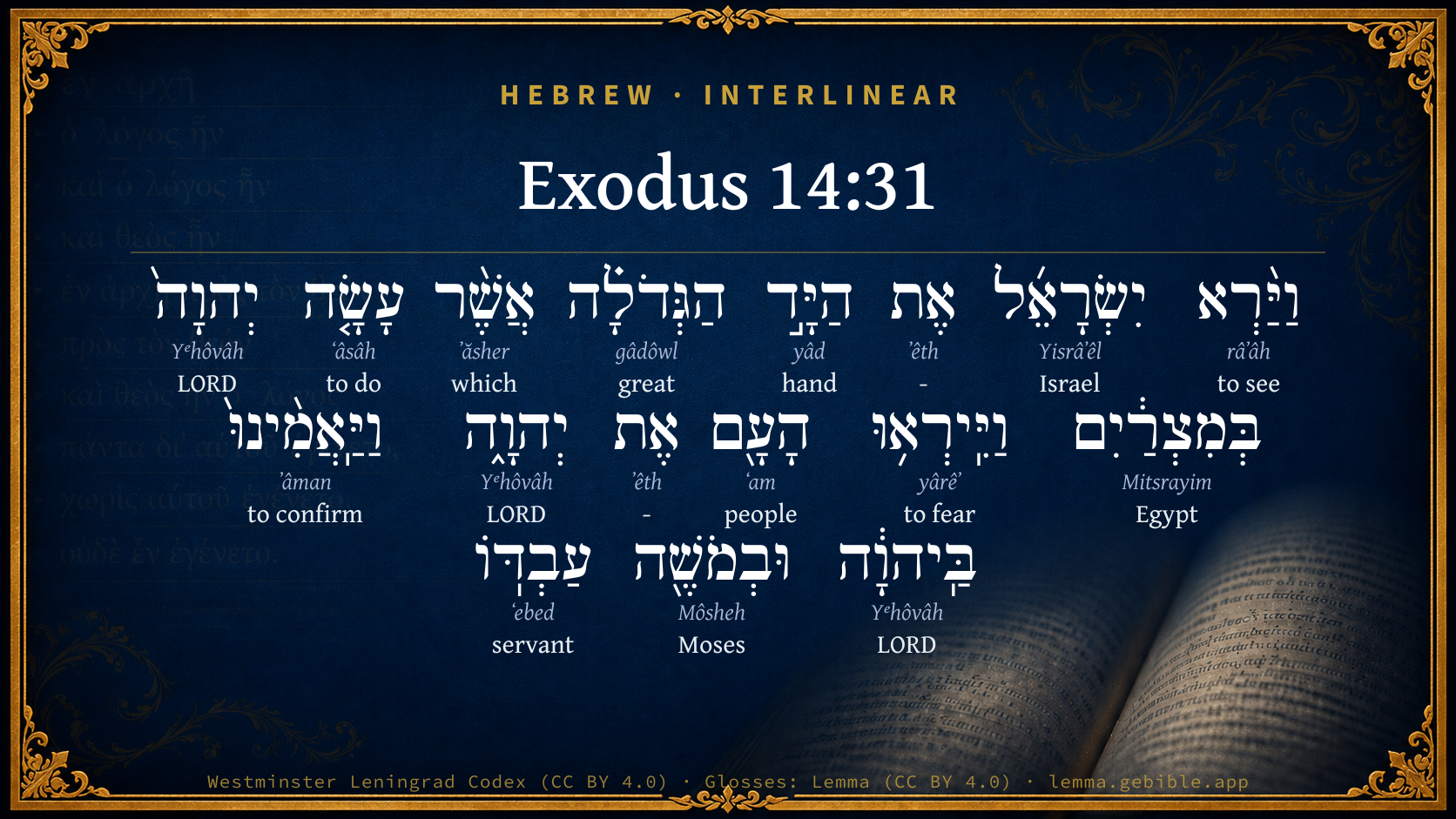
Hebrew (Westminster Leningrad Codex) Exodus 14:31 appears in the Hebrew Old Testament. The text above is from the Westminster Leningrad Codex. Each word links to its Strong’s number, a concise gloss, and parsing drawn from the Open Scriptures Hebrew Bible morphology. Click any word for its full Brown-Driver-Briggs (BDB) entry.
Download image
Cite this verse

Exodus 14:31 (World English Bible). Public Domain. Lemma interlinear Bible study tool, https://lemma.gebible.app/v/exodus/14/31.

Show BibTeX & RIS
BibTeX
RIS
English Translation
Israel saw the great work which Yahweh did to the Egyptians, and the people feared Yahweh; and they believed in Yahweh, and in his servant Moses.
World English Bible · Public Domain
Download a study sheet

One document with this verse’s original text, its word-by-word gloss line, the meaning frame, cross-references with their text, attributed commentary, and full source and license credits — printable, and it pastes into notes with its structure intact.

This verse Autodidact and up

Study sheet (.html) Plain text (.txt)

A passage Seminary Student

Up to 50 verses in one chapter. A passage sheet keeps up to 6 commentary sources and 12 cross-references per verse, in the order this page ranks them, and says so on the sheet whenever that leaves anything out. Ask for a single verse and you get the Autodidact verse sheet above.

Everything on this page stays free to read, with no account — the sheet is a download of what is already on screen, not access to it.

Want to remove ads? Support Godless Engineer
Compare translations 3

The same verse in 3 English versions, stacked beneath the original-language interlinear above. Click any original word for its lexicon entry.

Each is an independent rendering of the whole verse — the interlinear is not word-aligned to these translations.

Highlighted words mark where these versions differ — a whole-verse word diff, not a word-by-word alignment.

  • World English Bible Public Domain
    Israel saw the great work which Yahweh did to the Egyptians, and the people feared Yahweh; and they believed in Yahweh, and in his servant Moses.
  • King James Version Public Domain
    And Israel saw that great work which the LORD did upon the Egyptians: and the people feared the LORD, and believed the LORD, and his servant Moses.
  • unfoldingWord Literal Text CC BY-SA 4.0
    And Israel saw the great hand that Yahweh used against the Egyptians, and the people feared Yahweh, and they believed in Yahweh and in his servant Moses.

unfoldingWord Literal Text — © unfoldingWord, licensed CC BY-SA 4.0. Word-aligned USFM3 via Door43 (git.door43.org/unfoldingWord/en_ult).

Versions to compare (up to 4)

3 of 4 selected

Show all 18 translations

Every available English version of this verse, each an independent rendering of the whole verse.

  • World English Bible Public Domain
    Israel saw the great work which Yahweh did to the Egyptians, and the people feared Yahweh; and they believed in Yahweh, and in his servant Moses.
  • Berean Standard Bible Public Domain
    When Israel saw the great power that the LORD had exercised over the Egyptians, the people feared the LORD and believed in Him and in His servant Moses.
  • Majority Standard Bible Public Domain
    When Israel saw the great power that the LORD had exercised over the Egyptians, the people feared the LORD and believed in Him and in His servant Moses.
  • King James Version Public Domain
    And Israel saw that great work which the LORD did upon the Egyptians: and the people feared the LORD, and believed the LORD, and his servant Moses.
  • American Standard Version (1901) Public Domain
    And Israel saw the great work which Jehovah did upon the Egyptians, and the people feared Jehovah: and they believed in Jehovah, and in his servant Moses.
  • Revised Version (1885) Public Domain
    And Israel saw the great work which the LORD did upon the Egyptians, and the people feared the LORD: and they believed in the LORD, and in his servant Moses.
  • Geneva Bible (1599) Public Domain
    And Israel saw the mightie power, which the Lord shewed vpon the Egyptians: so the people feared the Lord, and beleeued the Lord, and his seruant Moses.
  • Douay-Rheims (1899) Public Domain
    And they saw the Egyptians dead upon the sea shore, and the mighty hand that the Lord had used against them: and the people feared the Lord, and they believed the Lord, and Moses his servant.
  • Young's Literal Translation Public Domain
    and Israel seeth the great hand with which Jehovah hath wrought against the Egyptians, and the people fear Jehovah, and remain stedfast in Jehovah, and in Moses His servant.
  • Literal Standard Version CC BY-SA 4.0
    and Israel sees the great hand with which YHWH has worked against the Egyptians, and the people fear YHWH, and remain steadfast in YHWH, and in His servant Moses.
  • Unlocked Literal Bible CC BY-SA 4.0
    When Israel saw the great power that Yahweh used against the Egyptians, the people honored Yahweh, and they trusted in Yahweh and in his servant Moses.
  • unfoldingWord Literal Text CC BY-SA 4.0
    And Israel saw the great hand that Yahweh used against the Egyptians, and the people feared Yahweh, and they believed in Yahweh and in his servant Moses.
  • Darby Bible Public Domain
    And Israel saw the great power [with] which Jehovah had wrought against the Egyptians; and the people feared Jehovah, and believed in Jehovah, and in Moses his bondman.
  • World Messianic Bible Public Domain
    Israel saw the great work which the LORD did to the Egyptians, and the people feared the LORD; and they believed in the LORD and in his servant Moses.
  • Webster's Bible Public Domain
    And Israel saw that great work which the LORD did upon the Egyptians: and the people feared the LORD, and believed the LORD, and his servant Moses.
  • Free Bible Version CC BY-SA 4.0
    When the Israelites saw the great power that the Lord had used against the Egyptians, they were in awe of the Lord, and they trusted in him and in his servant Moses.
  • Bible in Basic English Public Domain
    And Israel saw the great work which the Lord had done against the Egyptians, and the fear of the Lord came on the people and they had faith in the Lord and in his servant Moses.
  • JPS Tanakh (1917) Public Domain
    And Israel saw the great work which the LORD did upon the Egyptians, and the people feared the LORD; and they believed in the LORD, and in His servant Moses.

Literal Standard Version (2020), Covenant Press — licensed CC BY-SA 4.0. Text via the HelloAO Bible API (eBible.org). Unlocked Literal Bible (unfoldingWord) — licensed CC BY-SA 4.0. Text via the HelloAO Bible API (eBible.org). unfoldingWord Literal Text — © unfoldingWord, licensed CC BY-SA 4.0. Word-aligned USFM3 via Door43 (git.door43.org/unfoldingWord/en_ult). Free Bible Version, Dr. Jonathan Gallagher — licensed CC BY-SA 4.0. Text via the HelloAO Bible API (eBible.org).

Word by word

More ways to search: Search by grammar → Find every occurrence → Compare this word →

Practice this passage: Drill this verse → Learn its vocabulary →

וַיַּֽאֲמִ֨ינוּ֙
ʼâman
H539
“and · to confirm”
Conjunction + Verb, Hiphil, Sequential Imperfect, 3rd Person, Masculine, Plural
Part of Speech
Conjunction + Verb
Stem
Hiphil
Form
Sequential Imperfect
Person
3rd Person
Gender
Masculine
Number
Plural
Full BDB Definition

Origin: a primitive root

TWOT: 116

to support, confirm, be faithful - (Qal) - to support, confirm, be faithful, uphold, nourish - foster-father (substantive) - foster-mother, nurse - pillars, supporters of the door - (Niphal) - to be established, be faithful, be carried, make firm - to be carried by a nurse - made firm, sure, lasting - confirmed, established, sure - verified, confirmed - reliable, faithful, trusty - (Hiphil) - to stand firm, to trust, to be certain, to believe in - stand firm - trust, believe
  1. וַיַּ֨רְא râʼâh H7200 “and · to see” Conjunction + Verb, Qal, Sequential Imperfect, 3rd Person, Masculine, Singular
  2. יִשְׂרָאֵ֜ל Yisrâʼêl H3478 “Israel” Noun, Proper
  3. אֶת ʼêth H853 “-” Particle, Direct Object
  4. הַיָּ֣ד yâd H3027 “the · hand” Particle, Definite Article + Noun, Common, Both, Singular, Absolute
  5. הַגְּדֹלָ֗ה gâdôwl H1419 “the · great” Particle, Definite Article + Adjective, Adjective, Feminine, Singular, Absolute
  6. אֲשֶׁ֨ר ʼăsher H834 “which” Particle, Relative
  7. עָשָׂ֤ה ʻâsâh H6213 “to do” Verb, Qal, Perfect, 3rd Person, Masculine, Singular
  8. יְהוָה֙ Yᵉhôvâh H3068 “LORD” Noun, Proper
  9. בְּמִצְרַ֔יִם Mitsrayim H4714 “in/at · Egypt” Preposition + Noun, Proper
  10. וַיִּֽירְא֥וּ yârêʼ H3372 “and · to fear” Conjunction + Verb, Qal, Sequential Imperfect, 3rd Person, Masculine, Plural
  11. הָעָ֖ם ʻam H5971 “the · people” Particle, Definite Article + Noun, Common, Masculine, Singular, Absolute
  12. אֶת ʼêth H853 “-” Particle, Direct Object
  13. יְהוָ֑ה Yᵉhôvâh H3068 “LORD” Noun, Proper
  14. בַּֽיהוָ֔ה Yᵉhôvâh H3068 “in/at · LORD” Preposition + Noun, Proper
  15. וּבְמֹשֶׁ֖ה Môsheh H4872 “and · in/at · Moses” Conjunction + Preposition + Noun, Proper
  16. עַבְדּֽוֹ ʻebed H5650 “servant · his” Noun, Common, Masculine, Singular, Construct + Suffix, Personal, 3rd Person, Masculine, Singular

About this verse

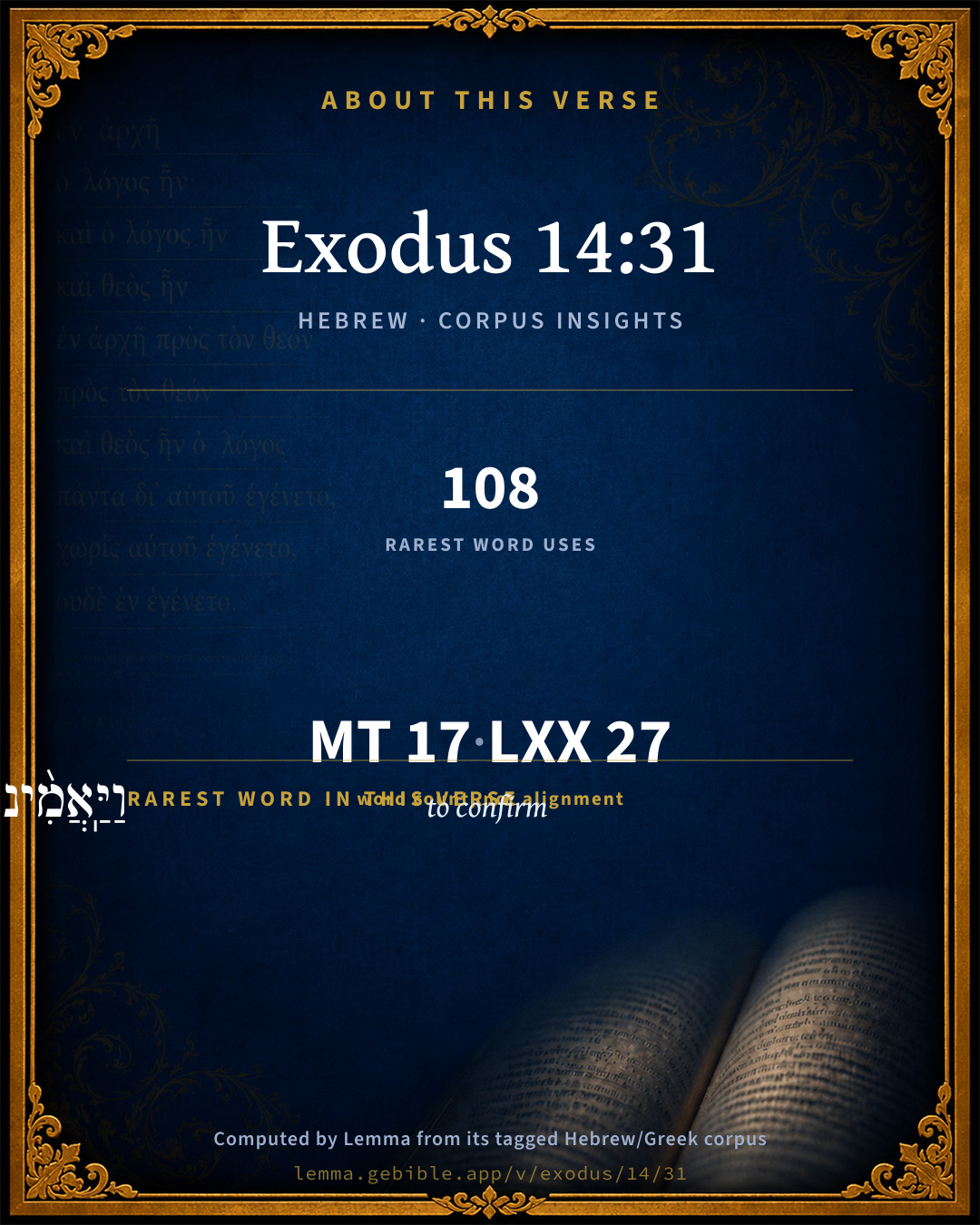
These counts appear in no published source. They are computed here, from the morphology-tagged text and Lemma’s own curated glosses. What Lemma adds →

17
words
14
distinct lemmas
Pentateuch
section

Grammatical profile

  • 4 verbs
  • 9 nouns
  • 1 adjective
  • 3 particles

Verb forms

  • וַיַּ֨רְא Qal · Sequential Imperfect
  • עָשָׂ֤ה Qal · Perfect
  • וַיִּֽירְא֥וּ Qal · Sequential Imperfect
  • וַיַּֽאֲמִ֨ינוּ֙ Hiphil · Sequential Imperfect

Repetition

A word recurs within this verse — often emphatic in Hebrew:

  • יְהוָה֙ LORD H3068 ×3

Hebrew & Septuagint length

In English translation the verse runs 26 words from the Hebrew and 29 from the Septuagint (LXX English) — closely comparable.

A rough comparison of the two English renderings, which tokenize alike — not a word-level alignment.

Word counts can differ between the Hebrew and the Greek without any difference in meaning — e.g. the Hebrew direct-object marker אֵת has no separate Greek word, and Greek often adds the article ὁ.

In the original languages it is 17 Hebrew tokens and 27 Greek tokens — but the two are counted differently (Hebrew bundles its prefixes and suffixes into one token; the Greek is in lemma form), so that isn’t a like-for-like length.

Cross-references

12

Topical passages linked to Exodus 14:31 in the Treasury of Scripture Knowledge — connected by theme and wording, ordered by reader-vote popularity; previews shown in the World English Bible.

  • John 2:11 This beginning of his signs Jesus did in Cana of Galilee, and revealed his glory; and his disciples believed in him.
  • John 11:45 Therefore many of the Jews, who came to Mary and saw what Jesus did, believed in him.
  • John 2:23–25 Now when he was in Jerusalem at the Passover, during the feast, many believed in his name, observing his signs which he did.
  • John 8:30–32 As he spoke these things, many believed in him.
  • Exodus 4:31 The people believed, and when they heard that Yahweh had visited the children of Israel, and that he had seen their affliction, then they bowed their heads and worshiped.
  • Exodus 19:9 Yahweh said to Moses, "Behold, I come to you in a thick cloud, that the people may hear when I speak with you, and may also believe you forever." Moses told the words of the people to Yahweh.
  • 1 Samuel 12:18 So Samuel called to Yahweh; and Yahweh sent thunder and rain that day: and all the people greatly feared Yahweh and Samuel.
  • 2 Chronicles 20:20 They rose early in the morning, and went forth into the wilderness of Tekoa: and as they went forth, Jehoshaphat stood and said, Hear me, Judah, and you inhabitants of Jerusalem: believe in Yahweh your God, so shall you be established; believe his prophets, so shall you prosper.
  • Psalms 106:12–13 Then they believed his words. They sang his praise.
  • Psalms 119:120 My flesh trembles for fear of you. I am afraid of your judgments.
  • Luke 8:13 Those on the rock are they who, when they hear, receive the word with joy; but these have no root, who believe for a while, then fall away in time of temptation.
  • Acts 8:13 Simon himself also believed. Being baptized, he continued with Philip. Seeing signs and great miracles occuring, he was amazed.

Cross-references courtesy of OpenBible.info (CC BY 4.0).

Hebrew and Greek witnesses Masoretic Hebrew ↔ Greek Septuagint

The same verse in the two great witnesses to the Old Testament, shown verse-for-verse.

These are two independent witnesses, not word-aligned to each other, and the Septuagint is shown in lemma (dictionary) form.

Hebrew Exodus 14:31 Masoretic · Westminster Leningrad Codex

וַיַּ֨רְא יִשְׂרָאֵ֜ל אֶת הַיָּ֣ד הַגְּדֹלָ֗ה אֲשֶׁ֨ר עָשָׂ֤ה יְהוָה֙ בְּמִצְרַ֔יִם וַיִּֽירְא֥וּ הָעָ֖ם אֶת יְהוָ֑ה וַיַּֽאֲמִ֨ינוּ֙ בַּֽיהוָ֔ה וּבְמֹשֶׁ֖ה עַבְדּֽוֹ

Israel saw the great work which Yahweh did to the Egyptians, and the people feared Yahweh; and they believed in Yahweh, and in his servant Moses.

World English Bible · Public Domain

Greek LXX Exodus 14:31 Septuagint · lemma form

ὁράω δέ ἰσραήλ ὁ χείρ ὁ μέγας ὅς ποιέω κύριος ὁ αἰγύπτιος φοβέω δέ ὁ λαός ὁ κύριος καί πιστεύω ὁ θεός καί μωυσῆς ὁ θεράπων αὐτός

And Israel saw the mighty hand, the things which the Lord did to the Egyptians; and the people feared the Lord, and they believed God and Moses his servant.

LXX2012 (modern English Septuagint) · Public Domain

Hebrew: Westminster Leningrad Codex (CC BY 4.0). Greek: Septuagint (public domain); English from LXX2012 (modern English Septuagint) (Public Domain). How the Septuagint differs from the Hebrew →

Targum (Aramaic paraphrase)

2

The Targum is the ancient Jewish Aramaic paraphrase of the Hebrew Scriptures — an interpretive translation, not the Hebrew text itself. Onkelos (literal) and Pseudo-Jonathan (expansive) render the Torah, and Jonathan the Prophets. Coverage is partial: where no permissively-licensed English translation exists for a verse, only the Aramaic is shown. This is verse-level text, not a word-by-word alignment to the Hebrew.

  1. Targum Onkelos Torah (Genesis–Deuteronomy)
    וַחֲזָא יִשְׂרָאֵל יָת גְבוּרְתָּא יְדָא רַבְּתָא דִי עֲבַד יְיָ בְּמִצְרַיִם וּדְחִילוּ עַמָא מִן קֳדָם יְיָ וְהֵמִינוּ בְּמֵימְרָא דַיְיָ וּבִנְבִיאוּת משֶׁה עַבְדֵהּ:

    (no public-domain English translation for this verse)

    Targum Onkelos — Aramaic: “Onkelos Genesis” (public domain); “Onkelos Exodus” (public domain); “Onkelos Leviticus” (public domain); “Onkelos Numbers” (public domain); “Onkelos Deuteronomy” (public domain). English: “Sefaria Community Translation” (CC0 1.0 (public-domain dedication)); “J.W. Etheridge. The Targums of Onkelos and Jonathan Ben Uzziel on the Pentateuch. London: Longmans, Green, 1862” (public domain). Text via Sefaria.

  2. Targum Pseudo-Jonathan Torah (Genesis–Deuteronomy)
    וְחָמוּן יִשְרָאֵל יַת גְּבוּרַת יְדָא תַקִיפְתָּא דִי עָבַד יְיָ בָּהּ נִיסִין בְּמִצְרַיִם וּדְחִילוּ עַמָא מִן קֳדָם יְיָ וְהֵימִינוּן בְּשׁוּם מֵימְרָא דַיְיָ וּבִנְבוּאָתֵיהּ דְּמשֶׁה עַבְדֵיהּ

    And Israel saw the power of the mighty hand by which the Lord had wrought the miracles in Mizraim; and the people feared before the Lord, and believed in the Name of the Word of the Lord, and in the prophecies of Mosheh His servant.

    Targum Pseudo-Jonathan — Aramaic: “Targum Jonathan on Genesis” (public domain); “Targum Jonathan on Exodus” (public domain); “Targum Jonathan on Leviticus” (public domain); “Targum Jonathan on Numbers” (public domain); “Targum Jonathan on Deuteronomy” (public domain). English: “The Targum of Jonathan ben Uzziel, trans. J. W. Etheridge, London, 1862” (public domain). Text via Sefaria.

Commentary

Notes on Exodus 14:31 from classic Christian and Jewish commentators (each source and its license shown beneath its notes). The classic Christian expositions comment on the surrounding passage and are grouped to its opening verse, so a note may address several verses; the Jewish commentaries on the Tanakh (Rashi and others) are per-verse, so they appear only where the commentator wrote on this verse.

Lemma curates 59 commentaries, every one of them public domain or Creative Commons licensed, each selected and text-cleaned for this edition rather than reprinted as found. About our sources →

Trapp's Complete Commentary

John Trapp

Exo 14:31 And Israel saw that great work which the LORD did upon the Egyptians: and the people feared the LORD, and believed the LORD, and his servant Moses.

Ver. 31. {See Trapp on "Exo 14:30"}

John Trapp, A Commentary or Exposition upon All the Books of the Old and New Testament (1647–1656) — public domain. Text from a community e-Sword module.

Joseph Benson's Commentary

Exo 14:31. The people feared the Lord — This great work, which the Lord had done upon the Egyptians, was a means of begetting in them, for the present at least, awful thoughts of God, and devout affections toward him. And they believed the Lord and his servant Moses — Now they were ashamed of their distrusts and murmurings; and in the mind they were in, they would never again despair of help from heaven, no, not in the greatest straits! They would never again quarrel with Moses, nor talk of returning to Egypt. How well were it for us if we were always in as good a frame as we are in sometimes!

Joseph Benson's Commentary on the Old and New Testaments (1811–1818) — public domain. Text from a community e-Sword module.

Tyndale Open Study Notes

Tyndale Open Resources

14:31 Finally, the people of Israel were moved to put their faith in the Lord: Sadly, it was very short-lived (see 15:24; 16:3). • To be the Lord’s servant is a position of high honor (see Isa 42:1-4; Matt 12:18).

Tyndale Open Study Notes — © Tyndale Open Resources, licensed CC BY-SA 4.0. Text via the HelloAO Bible API.

Geneva Bible (1599)

Geneva Bible translators

That is, the doctrine which he taught them in the Name of the Lord.

Hebrew, hand.

Geneva Bible (1599) marginal notes — public domain. Text via Bolls.life.

Adam Clarke's Commentary

Verse 31. The people feared the Lord] They were convinced by the interference of Jehovah that his power was unlimited, and that he could do whatsoever he pleased, both in the way of judgment and in the way of mercy.

And believed the Lord, and his servant Moses.] They now clearly discerned that God had fulfilled all his promises; and that not one thing had failed of all the good which he had spoken concerning Israel. And they believed his servant Moses - they had now the fullest proof that he was Divinely appointed to work all these miracles, and to bring them out of Egypt into the promised land.

Thus God got himself honour upon Pharaoh and the Egyptians, and credit in the sight of Israel. After this overthrow of their king and his host, the Egyptians interrupted them no more in the journeyings, convinced of the omnipotence of their Protector: and how strange, that after such displays of the justice and mercy of Jehovah, the Israelites should ever have been deficient in faith, or have given place to murmuring!

1. THE events recorded in this chapter are truly astonishing; and they strongly mark what God can do, and what he will do, both against his enemies and in behalf of his followers. In vain are all the forces of Egypt united to destroy the Israelites: at the breath of God's mouth they perish; and his feeble, discouraged, unarmed followers take the prey! With such a history before their eyes, is it not strange that sinners should run on frowardly in the path of transgression; and that those who are redeemed from the world, should ever doubt of the all-sufficiency and goodness of their God! Had we not already known the sequel of the Israelitish history, we should have been led to conclude that this people would have gone on their way rejoicing, trusting in God with their whole heart, and never leaning to their own understanding; but alas! we find that as soon as any new difficulty occurred, they murmured against God and their leaders, despised the pleasant land, and gave no credence to his word.

2. Their case is not a solitary one: most of those who are called Christians are not more remarkable for faith and patience. Every reverse will necessarily pain and discompose the people who are seeking their portion in this life. And it is a sure mark of a worldly mind, when we trust the God of Providence and grace no farther than we see the operations of his hand in our immediate supply; and murmur and repine when the hand of his bounty seems closed, and the influences of his Spirit restrained, though our unthankful and unholy carriage has been the cause of this change. Those alone who humble themselves under the mighty hand of God, shall be lifted up in due season. Reader, thou canst never be deceived in trusting thy all, the concerns of thy body and soul, to Him who divided the sea, saved the Hebrews, and destroyed the Egyptians.

Adam Clarke's Commentary on the Bible (1810–1826) — public domain. Text from a community e-Sword/MySword module.

Ellicott's Commentary for English Readers

(31) Israel saw that great work.—The destruction of the Pharaoh’s chariot force and cavalry in the Red Sea secured the retreat of Israel, and saved them from any further molestation at the hands of the Egyptians. The spirit of the nation was effectually broken for the time; and it was not till after several reigns, and an interval of anarchy, that there was a revival. The king himself probably despaired of effecting anything against a foe that was supernaturally protected; and the army, having lost the flower of the chariot force, on which it mainly depended for success, desired no further contest. The Israelites, as will be seen further on, in their rapid march to Sinai avoided the Egyptian settlements, and having once reached the Sinaitic region, they were beyond the dominion of Egypt, and for forty years quite out of the path of Egyptian conquest. The episode in the life of the nation begun by the descent of Jacob into Egypt now terminated, and a fresh beginning was made. In the open air of the desert, cut off from all other races, admitted to close communion with Jehovah, the people entered upon that new and higher existence which culminated in the teaching of the prophets, in the noble struggles of Ezra and Nehemiah, and in the memorable stand on behalf of religious truth and national independence which was made by the Maccabees.

A Bible Commentary for English Readers, edited by Charles John Ellicott (1878–1897) — public domain. Text from a community e-Sword module.

The Cambridge Bible for Schools and Colleges

gen. ed. J. J. S. Perowne

31. The effects of the great deliverance thus wrought for Israel: an increased fear of God, and belief in God, and also in Moses’ Divine commission.

work] Heb. hand, fig. for act or work; cf. Deu_34:12, Psa_78:42.

believed in] ‘The idiom rendered “he believed in” (האמין ב) is a very striking one: the belief intended is, not merely a crediting of a testimony concerning a person or a thing (this would be האמין ל), but a laying firm hold morally on a person or a thing, without the help of any intermediate agency’ (Cheyne, s.v. Faith in EB.). Cf. Gen_15:6. The root idea of האמין is to shew firmness or steadiness towards (ל) or on (ב) a person or a word: cf. Job_39:24 RVm., and the cognate subst. in ch. Exo_17:12 (Lex. ‘Moses’ hands were firmness’).

his servant] A title applied to Moses elsewhere in the Pent. only Num_12:7-8, Deu_34:5 (both JE). It is very common in the book of Joshua (mostly in parts which are the work of the Deuteronomic editor): Jos_1:1-2; Jos_1:7; Jos_1:13; Jos_1:15, Jos_8:31; Jos_8:33, Jos_9:24, Jos_11:12; Jos_11:15, Jos_12:6, Jos_13:8, Jos_14:7, Jos_18:7, Jos_22:2; Jos_22:4-5.

The Cambridge Bible for Schools and Colleges (gen. ed. J. J. S. Perowne; Cambridge University Press, 1878–1918) — public domain. Text from a community e-Sword module.

John Gill's Exposition

And Israel saw the great work,.... Or "hand" (l); the hand of the Lord, the mighty power of God, and took notice of it, and seriously considered the greatness of it:

which the Lord did upon the Egyptians; which mighty hand he laid upon them, and which great power he exercised on them, and which great work, the effect thereof, he wrought in destroying them in such a manner, by causing the waters, which divided for them and their safety, to return upon the Egyptians to their utter destruction:

and the people feared the Lord; had an awe of his power and greatness upon their minds, and a sense of his goodness to them upon their hearts, which influenced their fear of him, and caused them to fear him with a filial and godly fear:

and believed the Lord and his servant Moses; they believed the Lord to be the only Jehovah, the supreme Being, the one only living and true God, faithful to his word, able to do all things, and wise to do them in the fittest season, for his own glory and his people's good; and they believed his promises, and the fulfilment of them; and that as he had now saved them out of the hands of the Egyptians, he would bring them to the land of Canaan, which he had promised their fathers to give unto them; and they believed Moses was sent of God to be their deliverer out of Egypt, and to be their leader to the promised land; see Psa 106:12 and who were now by the apostle said to be baptized unto Moses in the cloud and in the sea, Co1 10:1 and of their passage through the Red sea under the direction of Moses being an emblem of baptism; see Gill on Co1 10:1.

(l) Sept. Manum, Pagninus, Montanus, &c.

Next: Exodus Chapter 15

John Gill's Exposition of the Whole Bible (1746–1763) — public domain (CC PDM 1.0). Text via the HelloAO Bible API.

Haydock's Catholic Bible Commentary

Sea-shore. The Hebrews would thus again be enriched by their spoils. (Calmet) --- Servant. Those who believe God, submit to the directions of his ambassadors. (St. Jerome in Philemon 5.) In this merited catastrophe of the Egyptians, which fixed the last seal to the mission of Moses, the fathers contemplate how God’s servants are rescued by baptism, and by the merits of Jesus Christ, from Satan and from all sin. (1 Corinthians x. 1, 4; Origen, hom. 5.) (Haydock)

George Leo Haydock (1774–1849), Haydock's Catholic Family Bible and Commentary, 1859 edition — public domain. Excludes Psalms (Douay-Rheims chapter numbering differs from Protestant) and Deuterocanonical books (Catholic canon only).

The Pulpit Commentary

And Israel saw that great work. The work" was, at the least,

(1) the (almost) entire destruction of that arm of the service the chariot force-on which the Egyptian kings mainly relied for success in all their wars; and

(2) the defeat and disgrace of the Egyptian king himself, in an expedition for which he was alone responsible, involving permanent discredit to his military capacity, and naturally tending to shake his authority over his subjects. It secured the Israelites from further persecution, mainly by the reminiscences which it left behind, but partly also by removing them to a distance from the natural course of Egyptian warlike or commercial movement. Though Egypt had mining establishments in the Sinaitic peninsula, at Wady-Magharah and Sarabit-el-Khadim, yet as these were avoided by the Israelites on their way to Sinai, and never afterwards approached, there naturally was no collision between them and the Pharaonic garrisons at those sites. Still more remote were they during their wanderings from the Egyptian military route, which proceeded along the coast from Pelusium to Gaza, and then ran northwards through the Shephelah. Thus the Passage of the Red Sea brought one phase in the life of the people to an end, and was the commencement of another. It separated them from Egypt until the time came when their king would hold communication with its monarch on equal terms. (1Ki_3:1) It secured their independence, and raised them at once into a nation. It further caused them to exchange the artificial life of a bureaucratical and convention-loving community for the open space and untrammelled freedom of the desert. It thus rejuvenated and reinvigorated the race, and enabled them to enter on that career of conquest which culminated in the Kingdom may we not say the Empire? of David. some writers have supposed that the blow to the Egyptian power was greater than here represented. They believe the entire warrior caste or class to have taken part in the expedition, and to have been destroyed in the Red Sea Thus they describe the calamity as the total annihilation of the whole military force of the Egyptians" (Kalisch). They also believe the Pharaoh to have perished with his host. To the present writer it seems that the former opinion is contrary both to the text of Scripture, and to the after course of Egyptian history, for it is agreed on all hands that Egypt continued nearly as powerful as before, while the latter he regards as at least exceedingly doubtful. Psa_86:15, is quoted as asserting it; but it appears to him

(1) that overthrow" is not necessarily death; " and

(2) that Pharaoh and his host may be put for Pharaoh"s host" by hendiadys. The absence of any prophecy that God would take the Pharaoh"s life, and the entire silence of Moses on the subject in chs. 14. and 15. seems to be scarcely explicable on any other theory than that he escaped, not having accompanied his chariot force in its rash pursuit of the Israelites.

The Pulpit Commentary (1880–1919), ed. H.D.M. Spence-Jones & Joseph S. Exell — public domain. Text from a community e-Sword module.

John Wesley's Explanatory Notes

And Israel feared the Lord, and believed the Lord and his servant Moses - Now they were ashamed of their distrusts and murmurings; and in the mind they were in, they would never again despair of help from heaven; no not in the greatest straits! They would never again quarrel with Moses; nor talk of returning to Egypt. How well were it for us, if we were, always in as good a frame, as we are in sometimes!

John Wesley, Explanatory Notes Upon the Whole Bible (1754–1765) — public domain. Text via the GEBible commentary corpus.

Scofield Reference Notes

C. I. Scofield

feared

(See Scofield "Psa 19:9").

The Scofield Reference Bible (1917 edition), notes by C. I. Scofield — public domain. Text from a community e-Sword module.

Rashi

Rabbi Shlomo Yitzchaki (Rashi)

את היד הגדלה denotes THE GREAT power which the HAND of the Holy One, blessed be He, had exercised. There are many meanings that are appropriate to the expression יד, hand, but all of them really signify the actual hand, and he who is explaining it must adapt the language according to the meaning of the passage.

Rashi on the Tanakh — English translations: “The Judaica Press complete Tanach with Rashi, translated by A. J. Rosenberg” (CC BY 4.0); “Pentateuch with Rashi's commentary by M. Rosenbaum and A.M. Silbermann, 1929-1934” (public domain); “The Metsudah Tanach series, Lakewood, N.J” (CC BY 4.0); and “The Book of Joshua, Metsudah Publications, 1997” (CC BY 4.0). Text via Sefaria.

Ramban (Nachmanides)

Rabbi Moshe ben Nachman (Ramban / Nachmanides)

AND ISRAEL SAW THE GREAT HAND. “I.e., the great power which the hand of the Holy One, blessed be He, had exercised. There are many meanings that are appropriate for the word yad (hand), but all of them signify the actual hand, and the interpreter must adapt the meaning according to the theme of the subject discussed.” Thus the language of Rashi. But Onkelos did not explain the great hand as referring to power, for he translated: “the might of the great hand.” And Rabbi Abraham ibn Ezra commented that it means “the great blow.” And so it also says, Behold, the hand of the Eternal is upon the cattle, [which means that a great plague will overtake them]; The hand of G-d was very heavy there, [which means that a great calamity befell the Philistines].By way of the Truth, [the mystic teachings of the Cabala], the verse is stating that the great hand, which is the attribute of justice that G-d exercised upon the Egyptians, became revealed to them, since it was there inflicting punishment upon the Egyptians. This is like the verse, And upon earth He made thee to see His great fire. This is the right hand which dashes in pieces the enemy, and it is the arm of the Eternal, concerning which Scripture says, Awake, awake, put on strength, O arm of the Eternal; Art thou not it that dried up the sea?, Verse 10.

Ramban (Nachmanides) on the Tanakh — English translation: “Commentary on the Torah by Ramban (Nachmanides). Translated and annotated by Charles B. Chavel. New York, Shilo Pub. House, 1971-1976” (CC BY 4.0). Text via Sefaria.

Ibn Ezra

Rabbi Abraham ibn Ezra

[B’nei] Yisrael saw. When the people saw the tremendous blow that befell the Egyptians they feared Hashem.

And believed in Ad-noy. They believed that He is the true God and that Moshe was His faithful servant who never deviated from Hashem’s command.

Ibn Ezra on the Tanakh — English translations: “Sefaria Community Translation” (CC0 1.0 (public-domain dedication)); “Yalkut, Sifsei Chachomim Chumash, Metsudah Publications, 2009” (CC BY 4.0); and “Commentary of Ibn Ezra on Isaiah - trans. by M. Friedlander, 1873” (public domain). Text via Sefaria.

Lesson kit

Teaching starters — assembled from the data on this page, not authored interpretation. Every prompt links to the verse data it draws on. Edit before teaching.

Exodus, in the Pentateuch, opens this verse with 17 words (14 distinct Hebrew lemmas). Its most distinctive word is ʼâman (“to confirm”). A historical commentator’s framing appears above. Read the whole chapter for the surrounding context.

Discussion questions

  1. How does “to confirm” (ʼâman) shape what this verse is saying?
  2. How does John 2:11, which shares this passage’s theme, read alongside this verse?
  3. What does the repetition of “LORD” (3× in this one verse) do in this verse?
  4. The translations on this page render this verse differently — a whole-verse word diff, not a word-by-word alignment. What might account for the different wordings?
  5. «וַיַּ֨רְא» is a Qal Sequential Imperfect verb. How does that grammatical form shape the action described?
  6. Compare how Trapp's Complete Commentary and Joseph Benson's Commentary read this verse. Where do they agree or differ?

Things to notice

Reading settings

Reading text

Shown beneath each verse's original-language words.

Old Testament
Old Testament edition

Read the OT as the Masoretic Hebrew (MT) or the Greek Septuagint (LXX).

English shown for the Greek Septuagint (in the Hebrew ↔ Greek comparison).

Comparing translations? Open the Compare panel on any verse page to stack up to four side by side.