
2 Samuel 14:15

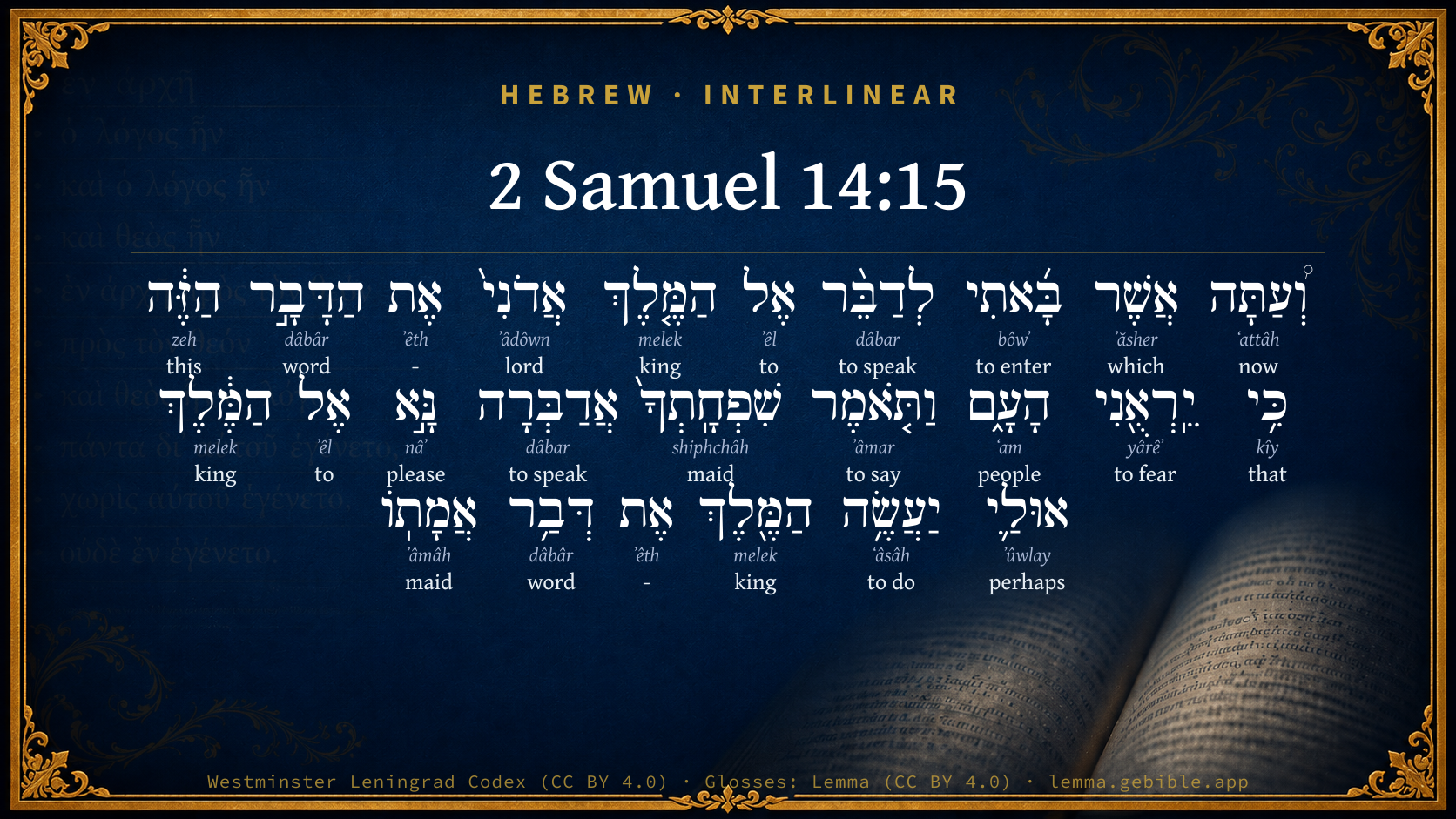
Hebrew (Westminster Leningrad Codex) 2 Samuel 14:15 appears in the Hebrew Old Testament. The text above is from the Westminster Leningrad Codex. Each word links to its Strong’s number, a concise gloss, and parsing drawn from the Open Scriptures Hebrew Bible morphology. Click any word for its full Brown-Driver-Briggs (BDB) entry.
Download image
Cite this verse

2 Samuel 14:15 (World English Bible). Public Domain. Lemma interlinear Bible study tool, https://lemma.gebible.app/v/2-samuel/14/15.

Show BibTeX & RIS
BibTeX
RIS
English Translation
Now therefore seeing that I have come to speak this word to my lord the king, it is because the people have made me afraid: and your handmaid said, I will now speak to the king; it may be that the king will perform the request of his servant.
World English Bible · Public Domain
Download a study sheet

One document with this verse’s original text, its word-by-word gloss line, the meaning frame, cross-references with their text, attributed commentary, and full source and license credits — printable, and it pastes into notes with its structure intact.

This verse Autodidact and up

Study sheet (.html) Plain text (.txt)

A passage Seminary Student

Up to 50 verses in one chapter. A passage sheet keeps up to 6 commentary sources and 12 cross-references per verse, in the order this page ranks them, and says so on the sheet whenever that leaves anything out. Ask for a single verse and you get the Autodidact verse sheet above.

Everything on this page stays free to read, with no account — the sheet is a download of what is already on screen, not access to it.

Want to remove ads? Support Godless Engineer
Compare translations 3

The same verse in 3 English versions, stacked beneath the original-language interlinear above. Click any original word for its lexicon entry.

Each is an independent rendering of the whole verse — the interlinear is not word-aligned to these translations.

Highlighted words mark where these versions differ — a whole-verse word diff, not a word-by-word alignment.

  • World English Bible Public Domain
    Now therefore seeing that I have come to speak this word to my lord the king, it is because the people have made me afraid: and your handmaid said, I will now speak to the king; it may be that the king will perform the request of his servant.
  • King James Version Public Domain
    Now therefore that I am come to speak of this thing unto my lord the king, it is because the people have made me afraid: and thy handmaid said, I will now speak unto the king; it may be that the king will perform the request of his handmaid.
  • unfoldingWord Literal Text CC BY-SA 4.0
    And now that I have come to speak this word to my lord the king, because the people have frightened me. And your maidservant said, ‘Let me now speak to the king. Perhaps the king will do the word of his female servant.

unfoldingWord Literal Text — © unfoldingWord, licensed CC BY-SA 4.0. Word-aligned USFM3 via Door43 (git.door43.org/unfoldingWord/en_ult).

Versions to compare (up to 4)

3 of 4 selected

Show all 18 translations

Every available English version of this verse, each an independent rendering of the whole verse.

  • World English Bible Public Domain
    Now therefore seeing that I have come to speak this word to my lord the king, it is because the people have made me afraid: and your handmaid said, I will now speak to the king; it may be that the king will perform the request of his servant.
  • Berean Standard Bible Public Domain
    Now therefore, I have come to present this matter to my lord the king because the people have made me afraid. Your servant thought, ‘I will speak to the king. Perhaps he will grant the request of his maidservant.
  • Majority Standard Bible Public Domain
    Now therefore, I have come to present this matter to my lord the king because the people have made me afraid. Your servant thought, ‘I will speak to the king. Perhaps he will grant the request of his maidservant.
  • King James Version Public Domain
    Now therefore that I am come to speak of this thing unto my lord the king, it is because the people have made me afraid: and thy handmaid said, I will now speak unto the king; it may be that the king will perform the request of his handmaid.
  • American Standard Version (1901) Public Domain
    Now therefore seeing that I am come to speak this word unto my lord the king, it is because the people have made me afraid: and thy handmaid said, I will now speak unto the king; it may be that the king will perform the request of his servant.
  • Revised Version (1885) Public Domain
    Now therefore seeing that I am come to speak this word unto my lord the king, it is because the people have made me afraid: and thy handmaid said, I will now speak unto the king; it may be that the king will perform the request of his servant.
  • Geneva Bible (1599) Public Domain
    Nowe therefore that I am come to speake of this thing vnto my lord the King, the cause is that the people haue made me afrayd: therefore thine handmayde sayd, Nowe will I speake vnto the King: it may be that the King will perfourme the request of his handmayde.
  • Douay-Rheims (1899) Public Domain
    Now therefore I am come, to speak this word to my lord the king before the people. And thy handmaid said: I will speak to the king, it maybe the king will perform the request of his handmaid.
  • Young's Literal Translation Public Domain
    `And now that I have come to speak unto the king my lord this word, `it is' because the people made me afraid, and thy maid-servant saith, Let me speak, I pray thee, unto the king; it may be the king doth do the word of his handmaid,
  • Literal Standard Version CC BY-SA 4.0
    And now that I have come to speak this word to my lord the king, [it is] because the people made me afraid, and your maidservant says, Please let me speak to the king; it may be the king does the word of his handmaid,
  • Unlocked Literal Bible CC BY-SA 4.0
    Now then, seeing that I have come to speak this thing to my master the king, it is because the people have made me afraid. So your servant said to herself, 'I will now speak to the king. It may be that the king will perform the request of his servant.
  • unfoldingWord Literal Text CC BY-SA 4.0
    And now that I have come to speak this word to my lord the king, because the people have frightened me. And your maidservant said, ‘Let me now speak to the king. Perhaps the king will do the word of his female servant.
  • Darby Bible Public Domain
    And now that I am come to speak of this thing to my lord the king, it is because the people have made me afraid; and thy bondmaid said, I will now speak to the king; perhaps the king will perform the request of his handmaid.
  • World Messianic Bible Public Domain
    Now therefore, seeing that I have come to speak this word to my lord the king, it is because the people have made me afraid. Your servant said, ‘I will now speak to the king; it may be that the king will perform the request of his servant.’
  • Webster's Bible Public Domain
    Now therefore that I have come to speak of this thing to my lord the king, it is because the people have made me afraid: and thy handmaid said, I will now speak to the king; it may be that the king will perform the request of his handmaid.
  • Free Bible Version CC BY-SA 4.0
    That's why I've come to explain this to Your Majesty, because someone has frightened me. So I thought to myself, I will go and speak to the king. Perhaps he will grant my request.
  • Bible in Basic English Public Domain
    And now it is my fear of the people which has made me come to say these words to my lord the king: and your servant said, I will put my cause before the king, and it may be that he will give effect to my request.
  • JPS Tanakh (1917) Public Domain
    Now therefore seeing that I am come to speak this word unto my lord the king, it is because the people have made me afraid; and thy handmaid said: I will now speak unto the king; it may be that the king will perform the request of his servant.

Literal Standard Version (2020), Covenant Press — licensed CC BY-SA 4.0. Text via the HelloAO Bible API (eBible.org). Unlocked Literal Bible (unfoldingWord) — licensed CC BY-SA 4.0. Text via the HelloAO Bible API (eBible.org). unfoldingWord Literal Text — © unfoldingWord, licensed CC BY-SA 4.0. Word-aligned USFM3 via Door43 (git.door43.org/unfoldingWord/en_ult). Free Bible Version, Dr. Jonathan Gallagher — licensed CC BY-SA 4.0. Text via the HelloAO Bible API (eBible.org).

Word by word

More ways to search: Search by grammar → Find every occurrence → Compare this word →

Practice this passage: Drill this verse → Learn its vocabulary →

אוּלַ֛י
ʼûwlay
H194
“perhaps”
Adverb
Part of Speech
Adverb
Full BDB Definition

Origin: from H176

TWOT: 46

perhaps, peradventure - if peradventure - unless - suppose
  1. וְ֠עַתָּה ʻattâh H6258 “and · now” Conjunction + Adverb
  2. אֲשֶׁר ʼăsher H834 “which” Particle, Relative
  3. בָּ֜אתִי bôwʼ H935 “to enter” Verb, Qal, Perfect, 1st Person, Common, Singular
  4. לְדַבֵּ֨ר dâbar H1696 “to speak” Preposition + Verb, Piel, Infinitive Construct
  5. אֶל ʼêl H413 “to” Preposition
  6. הַמֶּ֤לֶךְ melek H4428 “the · king” Particle, Definite Article + Noun, Common, Masculine, Singular, Absolute
  7. אֲדֹנִי֙ ʼâdôwn H113 “lord · my” Noun, Common, Masculine, Singular, Construct + Suffix, Personal, 1st Person, Common, Singular
  8. אֶת ʼêth H853 “-” Particle, Direct Object
  9. הַדָּבָ֣ר dâbâr H1697 “the · word” Particle, Definite Article + Noun, Common, Masculine, Singular, Absolute
  10. הַזֶּ֔ה zeh H2088 “the · this” Particle, Definite Article + Pronoun, Demonstrative, Masculine, Singular
  11. כִּ֥י kîy H3588 “that” Conjunction
  12. יֵֽרְאֻ֖נִי yârêʼ H3372 “to fear · me” Verb, Piel, Imperfect, 3rd Person, Masculine, Plural + Suffix, Personal, 1st Person, Common, Singular
  13. הָעָ֑ם ʻam H5971 “the · people” Particle, Definite Article + Noun, Common, Masculine, Singular, Absolute
  14. וַתֹּ֤אמֶר ʼâmar H559 “and · to say” Conjunction + Verb, Qal, Sequential Imperfect, 3rd Person, Feminine, Singular
  15. שִׁפְחָֽתְךָ֙ shiphchâh H8198 “maid · your” Noun, Common, Feminine, Singular, Construct + Suffix, Personal, 2nd Person, Masculine, Singular
  16. אֲדַבְּרָה dâbar H1696 “to speak” Verb, Piel, Cohortative, 1st Person, Common, Singular
  17. נָּ֣א nâʼ H4994 “please” Particle, Interjection
  18. אֶל ʼêl H413 “to” Preposition
  19. הַמֶּ֔לֶךְ melek H4428 “the · king” Particle, Definite Article + Noun, Common, Masculine, Singular, Absolute
  20. יַעֲשֶׂ֥ה ʻâsâh H6213 “to do” Verb, Qal, Imperfect, 3rd Person, Masculine, Singular
  21. הַמֶּ֖לֶךְ melek H4428 “the · king” Particle, Definite Article + Noun, Common, Masculine, Singular, Absolute
  22. אֶת ʼêth H853 “-” Particle, Direct Object
  23. דְּבַ֥ר dâbâr H1697 “word of” Noun, Common, Masculine, Singular, Construct
  24. אֲמָתֽוֹ ʼâmâh H519 “maid · his” Noun, Common, Feminine, Singular, Construct + Suffix, Personal, 3rd Person, Masculine, Singular

About this verse

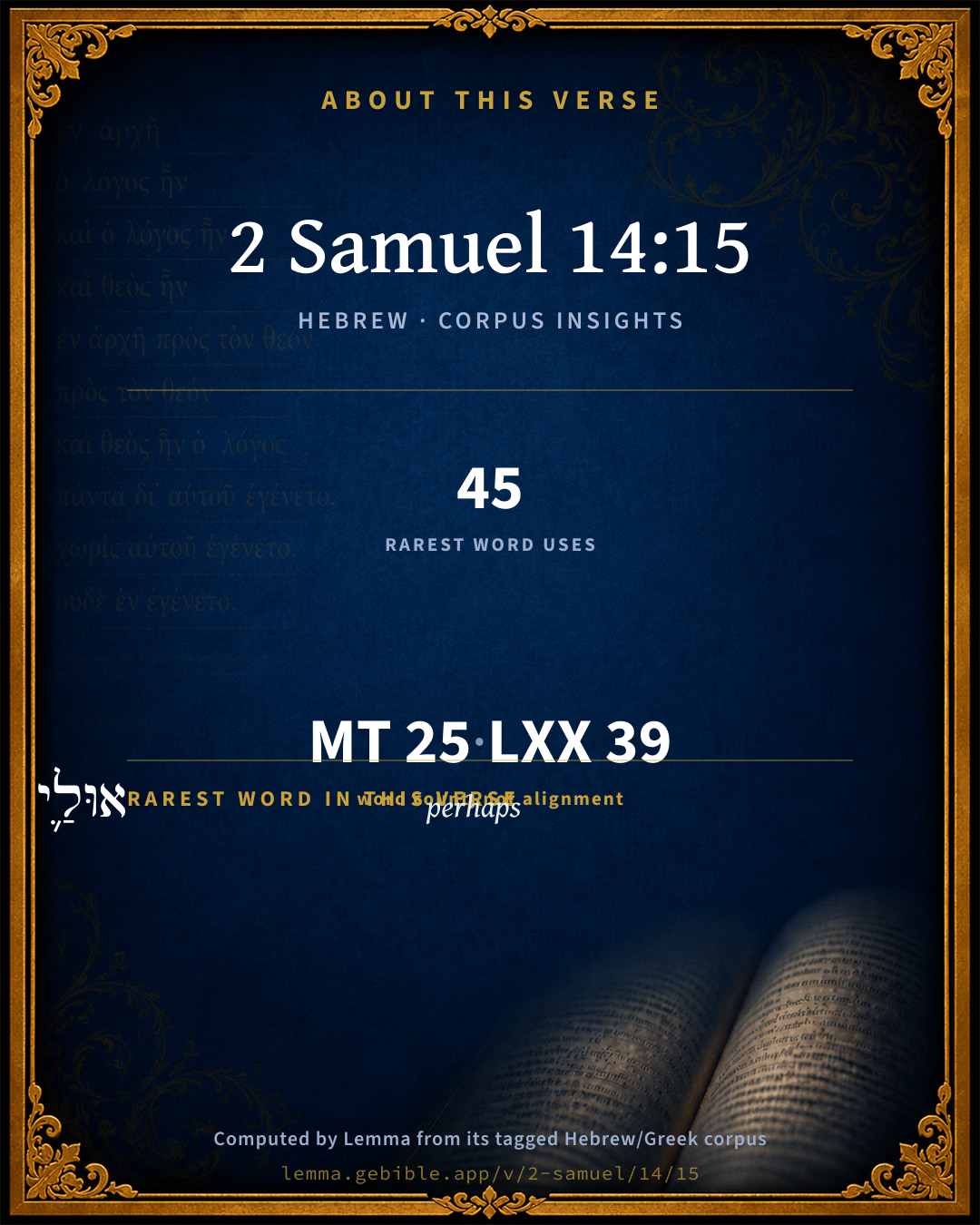
These counts appear in no published source. They are computed here, from the morphology-tagged text and Lemma’s own curated glosses. What Lemma adds →

25
words
19
distinct lemmas
Historical
section

Shared distinctive vocabulary

אוּלַ֛י perhaps H194 occurs in 44 verses of the Hebrew Bible. Also found in:

Grammatical profile

  • 6 verbs
  • 9 nouns
  • 1 pronoun
  • 2 prepositions
  • 1 conjunction
  • 2 adverbs
  • 4 particles

Verb forms

  • בָּ֜אתִי Qal · Perfect
  • לְדַבֵּ֨ר Piel · Infinitive Construct
  • יֵֽרְאֻ֖נִי Piel · Imperfect
  • וַתֹּ֤אמֶר Qal · Sequential Imperfect
  • אֲדַבְּרָה Piel · Cohortative
  • יַעֲשֶׂ֥ה Qal · Imperfect

Repetition

Words recur within this verse — often emphatic in Hebrew:

  • הַמֶּ֤לֶךְ king H4428 ×3
  • לְדַבֵּ֨ר to speak H1696 ×2
  • הַדָּבָ֣ר word H1697 ×2
  • אֶל to H413 ×2

Hebrew & Septuagint length

In English translation the verse runs 49 words from the Hebrew and 48 from the Septuagint (LXX English) — closely comparable.

A rough comparison of the two English renderings, which tokenize alike — not a word-level alignment.

Word counts can differ between the Hebrew and the Greek without any difference in meaning — e.g. the Hebrew direct-object marker אֵת has no separate Greek word, and Greek often adds the article ὁ.

In the original languages it is 25 Hebrew tokens and 39 Greek tokens — but the two are counted differently (Hebrew bundles its prefixes and suffixes into one token; the Greek is in lemma form), so that isn’t a like-for-like length.

Hebrew and Greek witnesses Masoretic Hebrew ↔ Greek Septuagint

The same verse in the two great witnesses to the Old Testament, shown verse-for-verse.

These are two independent witnesses, not word-aligned to each other, and the Septuagint is shown in lemma (dictionary) form.

Hebrew 2 Samuel 14:15 Masoretic · Westminster Leningrad Codex

וְ֠עַתָּה אֲשֶׁר בָּ֜אתִי לְדַבֵּ֨ר אֶל הַמֶּ֤לֶךְ אֲדֹנִי֙ אֶת הַדָּבָ֣ר הַזֶּ֔ה כִּ֥י יֵֽרְאֻ֖נִי הָעָ֑ם וַתֹּ֤אמֶר שִׁפְחָֽתְךָ֙ אֲדַבְּרָה נָּ֣א אֶל הַמֶּ֔לֶךְ אוּלַ֛י יַעֲשֶׂ֥ה הַמֶּ֖לֶךְ אֶת דְּבַ֥ר אֲמָתֽוֹ

Now therefore seeing that I have come to speak this word to my lord the king, it is because the people have made me afraid: and your handmaid said, I will now speak to the king; it may be that the king will perform the request of his servant.

World English Bible · Public Domain

Greek LXX 2 Samuel 14:15 Septuagint · lemma form

καί νῦν ὅς ἔρχομαι λαλέω πρός ὁ βασιλεύς ὁ κύριος ἐγώ ὁ ῥῆμα οὗτος ὅτι ὁράω ἐγώ ὁ λαός καί εἶπον ὁ δούλη σύ λαλέω δή πρός ὁ βασιλεύς εἰ πως ποιέω ὁ βασιλεύς ὁ ῥῆμα ὁ δούλη αὐτός

And now whereas I came to speak this word to my lord the king, the reason is that the people will see me, and your handmaid will say, Let one now speak to my lord the king, if perhaps the king will perform the request of his handmaid;

LXX2012 (modern English Septuagint) · Public Domain

Hebrew: Westminster Leningrad Codex (CC BY 4.0). Greek: Septuagint (public domain); English from LXX2012 (modern English Septuagint) (Public Domain). How the Septuagint differs from the Hebrew →

Targum (Aramaic paraphrase)

1

The Targum is the ancient Jewish Aramaic paraphrase of the Hebrew Scriptures — an interpretive translation, not the Hebrew text itself. Onkelos (literal) and Pseudo-Jonathan (expansive) render the Torah, and Jonathan the Prophets. Coverage is partial: where no permissively-licensed English translation exists for a verse, only the Aramaic is shown. This is verse-level text, not a word-by-word alignment to the Hebrew.

  1. Targum Jonathan Prophets (Joshua–Malachi)
    וּכְעַן דַאֲתֵיתִי לְמַלָלָא קֳדָם מַלְכָּא רִבּוֹנִי יַת פִּתְגָמָא הָדֵין אֲרֵי דַחֲלוּנַנִי עַמָא וַאֲמַרַת אַמְתָךְ אֲמַלֵיל כְּעַן קֳדָם מַלְכָא מְאִים יַעְבֵּד מַלְכָּא יַת פִּתְגָמָא דְאַמְתֵיהּ:

    (no public-domain English translation for this verse)

    Targum Jonathan — Aramaic: “Mikraot Gedolot” (public domain). English: “Sefaria Community Translation” (CC0 1.0 (public-domain dedication)); “London "Chaldee Paraphrase," 1871” (public domain). Text via Sefaria.

Commentary

Notes on 2 Samuel 14:15 from classic Christian and Jewish commentators (each source and its license shown beneath its notes). The classic Christian expositions comment on the surrounding passage and are grouped to its opening verse, so a note may address several verses; the Jewish commentaries on the Tanakh (Rashi and others) are per-verse, so they appear only where the commentator wrote on this verse.

Lemma curates 59 commentaries, every one of them public domain or Creative Commons licensed, each selected and text-cleaned for this edition rather than reprinted as found. About our sources →

Trapp's Complete Commentary

John Trapp

2Sa 14:15 Now therefore that I am come to speak of this thing unto my lord the king, [it is] because the people have made me afraid: and thy handmaid said, I will now speak unto the king; it may be that the king will perform the request of his handmaid.

Ver. 15. It is because the people have made me afraid,] viz, Lest they should be left in a desolate condition: as myself should be, losing my second, and now only son; since Absalom is the hope of the people.

I will now speak unto the king.] Others durst not; but I have adventured to speak, however I shall speed.

John Trapp, A Commentary or Exposition upon All the Books of the Old and New Testament (1647–1656) — public domain. Text from a community e-Sword module.

Joseph Benson's Commentary

2Sa 14:15. Now, therefore, that I am come, &c. — “But here, apprehending she might have gone too far, and made too free with majesty, in expostulating so plainly upon a point of such importance, she excused this presumption, from the force put upon her by her people; who had so severely threatened her, that, in this extremity, she plainly saw she had no resource, or hope of relief, but in laying her son’s case before the king: which she, confiding in his mercy, had, at length, adventured to do.” — Delaney.

Joseph Benson's Commentary on the Old and New Testaments (1811–1818) — public domain. Text from a community e-Sword module.

Geneva Bible (1599)

Geneva Bible translators

For I thought they would kill this mine heir.

Geneva Bible (1599) marginal notes — public domain. Text via Bolls.life.

Ellicott's Commentary for English Readers

(15) Because the people have made me afraid.—The woman here seeks to excuse her boldness in addressing the king by the pressure brought to bear upon her from without; but whether she means this in regard to what she has said of Absalom, or of her own. affairs, is very doubtful. In the former case the people would mean the nation generally; in the latter, her own family connections. Certainly in the next verse she returns to her own affairs to keep up the pretence of reality; but here there seems to be an intentional and studied ambiguity.

A Bible Commentary for English Readers, edited by Charles John Ellicott (1878–1897) — public domain. Text from a community e-Sword module.

The Cambridge Bible for Schools and Colleges

gen. ed. J. J. S. Perowne

15. Now therefore, &c.] Simply, And now. There seems to be a studied ambiguity about this verse. If “the people” means the family who had demanded the surrender of her son, she is artfully returning to her own petition, to prevent the king from suspecting that her whole story is a fiction: if, as is more natural, “the people” means the nation, she is excusing her boldness on the ground that she was forced by them into speaking thus.

The Cambridge Bible for Schools and Colleges (gen. ed. J. J. S. Perowne; Cambridge University Press, 1878–1918) — public domain. Text from a community e-Sword module.

John Gill's Exposition

Now therefore that I am come to speak of this thing unto my lord the king,.... Of the case of Absalom, under a feigned one of hers:

it is because the people have made me afraid; having heard of their whisperings, murmurings, and uneasiness among them, because Absalom was not sent for home, fearing there would be an insurrection in the nation, or an invasion of it by Absalom at the request of his friends; in which he might be supported by the king of Geshur; or however that disputes would arise about the succession, at the death of David; on these accounts she determined to speak to the king, and him them to him in the manner she had done; though some understand this of the discouragement the people laid her under, telling her the king would not hear her; nevertheless she was resolved to make trial:

and thy handmaid said, I will now speak unto the king; it may be the king will perform the request of his handmaid; not only with respect to her own son, as feigned; but with respect to Absalom, the grand thing in view.

John Gill's Exposition of the Whole Bible (1746–1763) — public domain (CC PDM 1.0). Text via the HelloAO Bible API.

Albert Barnes' Notes on the Bible

The people have made me afraid - She pretends still that her suit was a real one, and that she was in fear of the people (“the whole family,” 2Sa 14:7) setting upon her and her son.

Albert Barnes' Notes on the Bible (1834–1885) — public domain. Text from a community e-Sword/MySword module.

Haydock's Catholic Bible Commentary

Before the people. Hebrew also, "through fear, or respect for the people," who generally wished that Absalom might return. (Haydock) --- Joab was present, (ver. 21) and no doubt many others; who, if requisite, might join their prayers with hers. (Calmet)

George Leo Haydock (1774–1849), Haydock's Catholic Family Bible and Commentary, 1859 edition — public domain. Excludes Psalms (Douay-Rheims chapter numbering differs from Protestant) and Deuterocanonical books (Catholic canon only).

Matthew Poole's English Annotations

It is because the people have made me afraid; the truth is, I was even forced to this bold address to thee by the disposition and condition of thy people, who are discontented at Absalom’s perpetual banishment, and full of fears; either lest, upon thy death, which none knoweth how soon it may happen, they should be involved in a civil war about thy successor; or lest, in the mean time, if Absalom by his father-in-law’s assistance invade the land, and endeavour by force to regain and secure his right to the succession, the people, who have a great opinion of him, and kindness for him, and think he is very hardly used, should take up arms for him; or lest he who is thy heir and successor should by continual and familiar conversation with heathens be ensnared in their errors, or alienated from the true religion, and from God’s worship, from which he is now utterly excluded.

And thy handmaid said, or, therefore thy handmaid said; either within myself, i.e. I intended; or to the people, to quiet them.

Matthew Poole's English Annotations on the Holy Bible (1683–1685) — public domain. Text from a community e-Sword/MySword module.

Whedon's Commentary on the Bible

Daniel D. Whedon

15. The people have made me afraid — The whole family mentioned in 2Sa_14:7, who rose as blood avengers against the heir.

Daniel D. Whedon (gen. ed.), Commentary on the Old and New Testaments (1874–1909) — public domain. Text from a community e-Sword module.

The Pulpit Commentary

Vers. 15-17. Now therefore that I am come, etc. The woman now professes to return to her old story as the reason for her importunity, but she repeats it in so eager and indirect a manner as to indicate that it had another meaning. Instead, too, of thanking the king for fully granting her petition, she still flatters and coaxes as one whose purpose was as yet ungained. The king"s word is, for rest (see margin): it puts an end to vexation, and, by deciding matters, sets the disputants at peace. He is as an angel of God, as God"s messenger, whose words have Divine authority; and his office is, not to discern, but "to hear the good and the evil," unmoved, as the Vulgate renders it, by blessing and cursing. His mission is too high for him to be influenced either by good words or by evil, but having patiently heard both sides, and calmly thought over the reasons for and against, he will decide righteously. Finally, she ends with the prayer, And may Jehovah thy God be with thee! By such words she hoped to propitiate the king, who now could not fail to see that the errand of the woman was personal to himself.

The Pulpit Commentary (1880–1919), ed. H.D.M. Spence-Jones & Joseph S. Exell — public domain. Text from a community e-Sword module.

John Wesley's Explanatory Notes

The people - The truth is, I was even forced to this bold address to thee by the disposition of thy people, who are discontented at Absalom's perpetual banishment, lest, if Absalom by his father-in-law's assistance invade the land, the people who have a great kindness for him, and think he is very hard used, should take up arms.

John Wesley, Explanatory Notes Upon the Whole Bible (1754–1765) — public domain. Text via the GEBible commentary corpus.

unfoldingWord translationNotes

Door43 World Missions Community

because the people have made me afraid

The understood information may be supplied. AT: "because the people have made me afraid that I have come" (See: Ellipsis)

your servant

To show respect for the king the woman refers to herself as "your servant"

from the hand of the man

This phrase is an idiom. Also, "the hand" is a metonym referring to the man's control. AT: "out of the control of the man" (See: Metonymy)

the word of my master the king

"the message of my master the king"

for as an angel of God, so is my master ... from evil

Here David, the king, is compared to an "angel of God." AT: "for the king is like an angel of God because they both know how to tell good from evil" (See: Simile)

translationWords

people group

hand

inherit

pray

word

angel

unfoldingWord translationNotes — © Distant Shores Media and the Door43 World Missions Community, licensed CC BY-SA 4.0. Source: git.door43.org/Door43/en_tn.

Rashi

Rabbi Shlomo Yitzchaki (Rashi)

And now I came to speak to my master, the king these words. As a parable about myself and my son

Because the people frightened me. They frightened me [away] from imploring my master concerning [the plight of] his son lest he become angry with me.

Your handmaiden said, "I will speak." In this way [with a parable], perhaps he will take action etc.

Rashi on the Tanakh — English translations: “The Judaica Press complete Tanach with Rashi, translated by A. J. Rosenberg” (CC BY 4.0); “Pentateuch with Rashi's commentary by M. Rosenbaum and A.M. Silbermann, 1929-1934” (public domain); “The Metsudah Tanach series, Lakewood, N.J” (CC BY 4.0); and “The Book of Joshua, Metsudah Publications, 1997” (CC BY 4.0). Text via Sefaria.

Lesson kit

Teaching starters — assembled from the data on this page, not authored interpretation. Every prompt links to the verse data it draws on. Edit before teaching.

2 Samuel, in the Historical, opens this verse with 25 words (19 distinct Hebrew lemmas). Its most distinctive word is ʼûwlay (“perhaps”). A historical commentator’s framing appears above. Read the whole chapter for the surrounding context.

Discussion questions

  1. The word ʼûwlay carries the sense “perhaps.” How does it shape the verse?
  2. Genesis 16:2 shares the word «perhaps» with this verse. How do the two illuminate each other?
  3. “king” occurs 3× in this one verse. What is the effect of the repetition?
  4. These translations render this verse differently. What is at stake in choosing one wording over another?
  5. The verb «בָּ֜אתִי» is Qal Perfect. How does its form color the action?
  6. Reading how Trapp's Complete Commentary and Joseph Benson's Commentary read this verse, where do the two commentators agree and where do they part?

Things to notice

Reading settings

Reading text

Shown beneath each verse's original-language words.

Old Testament
Old Testament edition

Read the OT as the Masoretic Hebrew (MT) or the Greek Septuagint (LXX).

English shown for the Greek Septuagint (in the Hebrew ↔ Greek comparison).

Comparing translations? Open the Compare panel on any verse page to stack up to four side by side.