
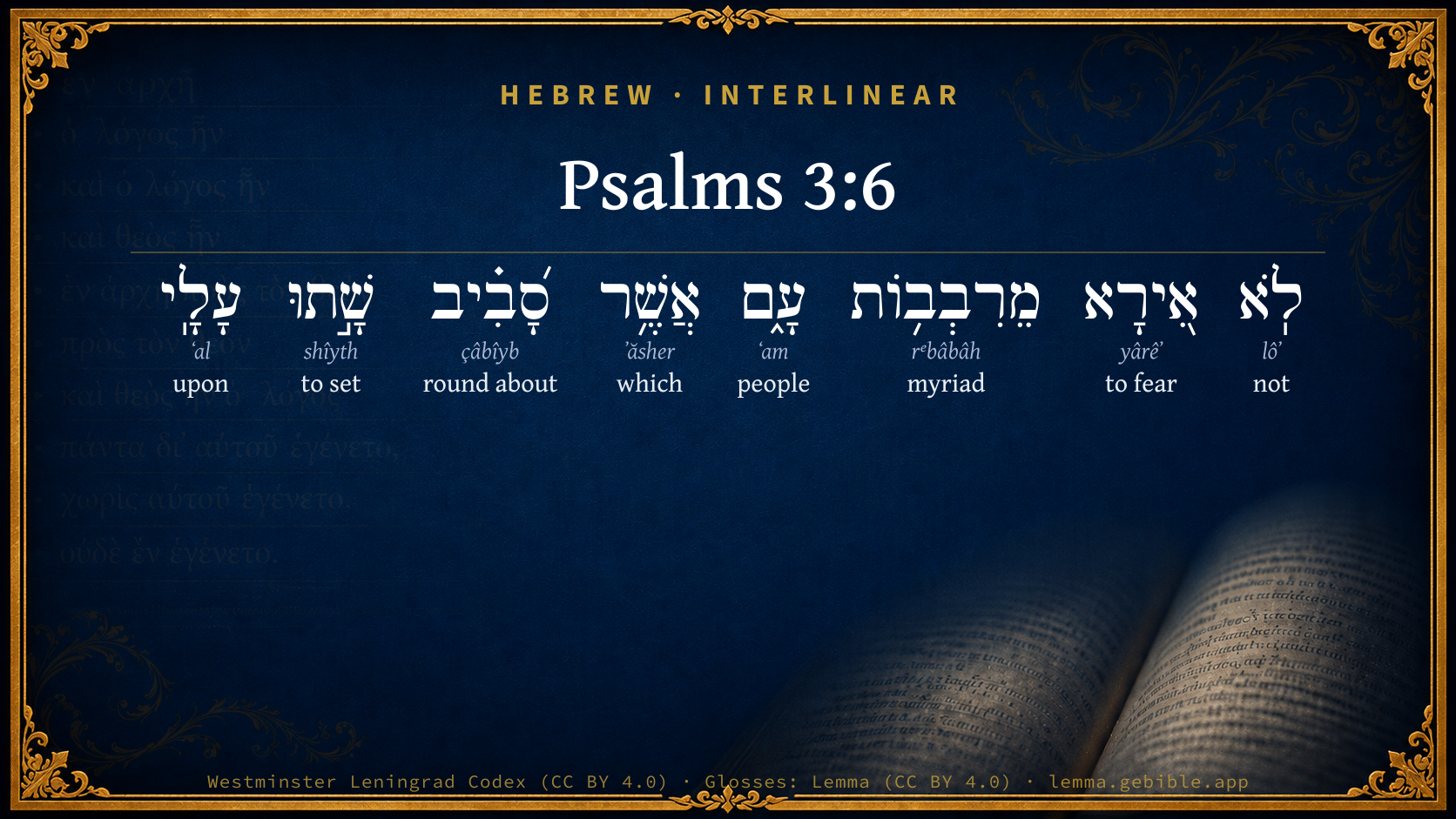
Psalms 3:6

Hebrew (Westminster Leningrad Codex) Psalms 3:6 appears in the Hebrew Old Testament. The text above is from the Westminster Leningrad Codex. Each word links to its Strong’s number, a concise gloss, and parsing drawn from the Open Scriptures Hebrew Bible morphology. Click any word for its full Brown-Driver-Briggs (BDB) entry.
Download image
Cite this verse

Psalms 3:6 (World English Bible). Public Domain. Lemma interlinear Bible study tool, https://lemma.gebible.app/v/psalms/3/6.

Show BibTeX & RIS
BibTeX
RIS
English Translation
I will not be afraid of tens of thousands of people Who have set themselves against me on every side.
World English Bible · Public Domain
Download a study sheet

One document with this verse’s original text, its word-by-word gloss line, the meaning frame, cross-references with their text, attributed commentary, and full source and license credits — printable, and it pastes into notes with its structure intact.

This verse Autodidact and up

Study sheet (.html) Plain text (.txt)

A passage Seminary Student

Up to 50 verses in one chapter. A passage sheet keeps up to 6 commentary sources and 12 cross-references per verse, in the order this page ranks them, and says so on the sheet whenever that leaves anything out. Ask for a single verse and you get the Autodidact verse sheet above.

Everything on this page stays free to read, with no account — the sheet is a download of what is already on screen, not access to it.

Want to remove ads? Support Godless Engineer
Compare translations 3

The same verse in 3 English versions, stacked beneath the original-language interlinear above. Click any original word for its lexicon entry.

Each is an independent rendering of the whole verse — the interlinear is not word-aligned to these translations.

Highlighted words mark where these versions differ — a whole-verse word diff, not a word-by-word alignment.

  • World English Bible Public Domain
    I will not be afraid of tens of thousands of people Who have set themselves against me on every side.
  • King James Version Public Domain
    I will not be afraid of ten thousands of people, that have set themselves against me round about.
  • unfoldingWord Literal Text CC BY-SA 4.0
    I will not fear the multitudes of people who stand against me round about. ts\*

unfoldingWord Literal Text — © unfoldingWord, licensed CC BY-SA 4.0. Word-aligned USFM3 via Door43 (git.door43.org/unfoldingWord/en_ult).

Versions to compare (up to 4)

3 of 4 selected

Show all 18 translations

Every available English version of this verse, each an independent rendering of the whole verse.

  • World English Bible Public Domain
    I will not be afraid of tens of thousands of people Who have set themselves against me on every side.
  • Berean Standard Bible Public Domain
    I will not fear the myriads set against me on every side.
  • Majority Standard Bible Public Domain
    I will not fear the myriads set against me on every side.
  • King James Version Public Domain
    I will not be afraid of ten thousands of people, that have set themselves against me round about.
  • American Standard Version (1901) Public Domain
    I will not be afraid of ten thousands of the people That have set themselves against me round about.
  • Revised Version (1885) Public Domain
    I will not be afraid of ten thousands of the people, that have set themselves against me round about.
  • Geneva Bible (1599) Public Domain
    I will not be afrayde for ten thousand of the people, that should beset me round about.
  • Douay-Rheims (1899) Public Domain
    I have slept and taken my rest: and I have risen up, because the Lord hath protected me.
  • Young's Literal Translation Public Domain
    I am not afraid of myriads of people, That round about they have set against me.
  • Literal Standard Version CC BY-SA 4.0
    I am not afraid of myriads of people, || That they have set against me all around.
  • Unlocked Literal Bible CC BY-SA 4.0
    I will not be afraid of the multitudes of people who have set themselves against me on every side.
  • unfoldingWord Literal Text CC BY-SA 4.0
    I will not fear the multitudes of people who stand against me round about. ts\*
  • Darby Bible Public Domain
    I will not fear for myriads of the people that have set themselves against me round about.
  • World Messianic Bible Public Domain
    I will not be afraid of tens of thousands of people who have set themselves against me on every side.
  • Webster's Bible Public Domain
    \\3:5\\I laid me down and slept; I awaked; for the LORD sustained me.
  • Free Bible Version CC BY-SA 4.0
    I'm not afraid of tens of thousands who surround me, people who are against me.
  • Bible in Basic English Public Domain
    I will have no fear, though ten thousand have come round me, putting themselves against me.
  • JPS Tanakh (1917) Public Domain
    (3-7) I am not afraid of ten thousands of people, that have set themselves against me round about.

Literal Standard Version (2020), Covenant Press — licensed CC BY-SA 4.0. Text via the HelloAO Bible API (eBible.org). Unlocked Literal Bible (unfoldingWord) — licensed CC BY-SA 4.0. Text via the HelloAO Bible API (eBible.org). unfoldingWord Literal Text — © unfoldingWord, licensed CC BY-SA 4.0. Word-aligned USFM3 via Door43 (git.door43.org/unfoldingWord/en_ult). Free Bible Version, Dr. Jonathan Gallagher — licensed CC BY-SA 4.0. Text via the HelloAO Bible API (eBible.org).

Word by word

More ways to search: Search by grammar → Find every occurrence → Compare this word →

Practice this passage: Drill this verse → Learn its vocabulary →

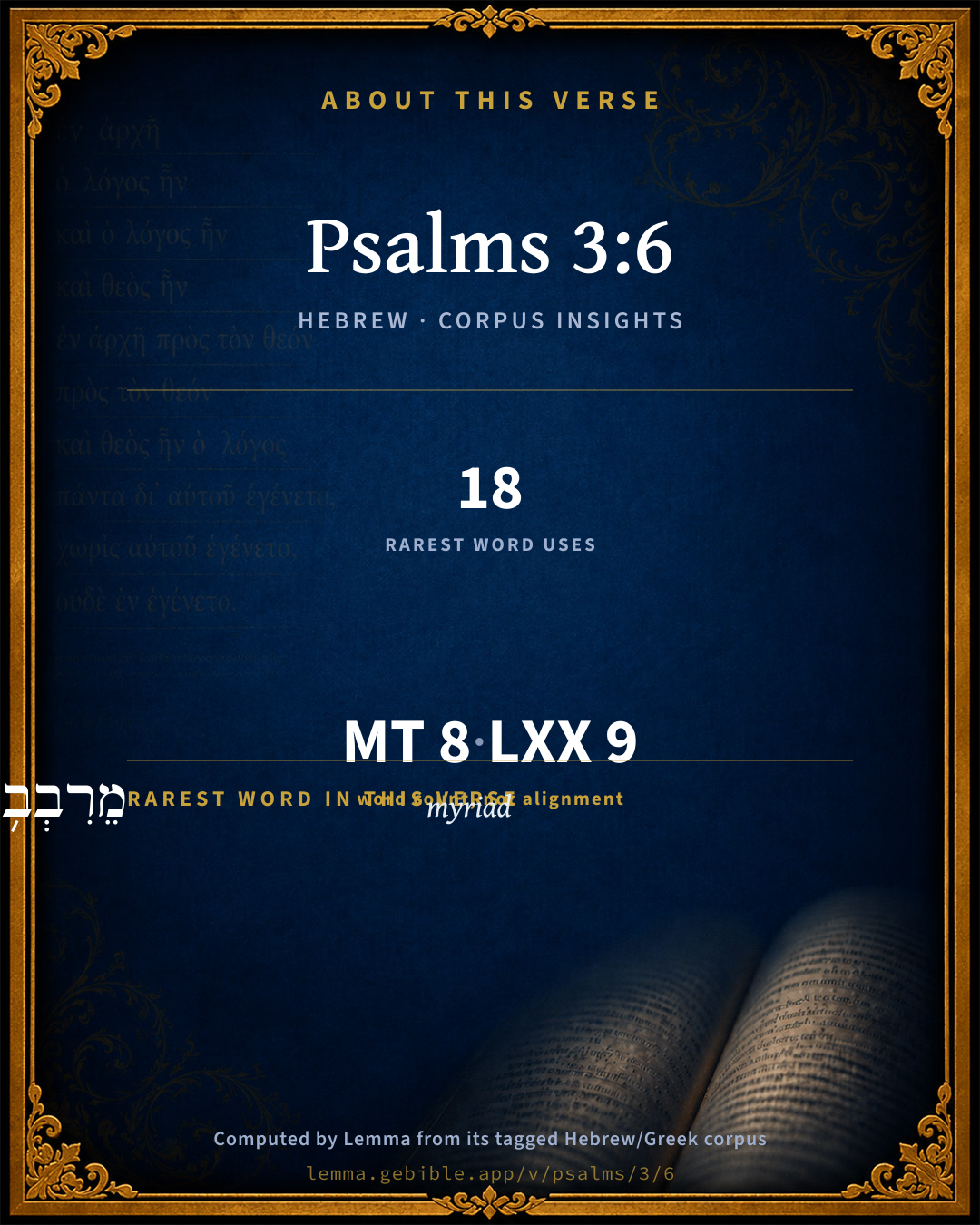
About this verse

These counts appear in no published source. They are computed here, from the morphology-tagged text and Lemma’s own curated glosses. What Lemma adds →

8
words
8
distinct lemmas
Wisdom
section

Notable vocabulary

The rarest word here is מֵרִבְב֥וֹת myriad H7233 — appearing just 18 times in the whole Hebrew Bible.

Shared distinctive vocabulary

מֵרִבְב֥וֹת myriad H7233 occurs in 16 verses of the Hebrew Bible. Also found in:

Grammatical profile

  • 2 verbs
  • 3 nouns
  • 1 preposition
  • 2 particles

Verb forms

  • אִ֭ירָא Qal · Imperfect
  • שָׁ֣תוּ Qal · Perfect

Hebrew & Septuagint length

In English translation the verse runs 20 words from the Hebrew and 15 from the Septuagint (LXX English) — closely comparable.

A rough comparison of the two English renderings, which tokenize alike — not a word-level alignment.

Word counts can differ between the Hebrew and the Greek without any difference in meaning — e.g. the Hebrew direct-object marker אֵת has no separate Greek word, and Greek often adds the article ὁ.

In the original languages it is 8 Hebrew tokens and 9 Greek tokens — but the two are counted differently (Hebrew bundles its prefixes and suffixes into one token; the Greek is in lemma form), so that isn’t a like-for-like length.

Cross-references

9

Topical passages linked to Psalms 3:6 in the Treasury of Scripture Knowledge — connected by theme and wording, ordered by reader-vote popularity; previews shown in the World English Bible.

  • Romans 8:31 What then shall we say about these things? If God is for us, who can be against us?
  • Psalms 27:1–3 Yahweh is my light and my salvation. Whom shall I fear? Yahweh is the strength of my life. Of whom shall I be afraid?
  • Psalms 118:10–12 All the nations surrounded me, But in the name of Yahweh, I cut them off.
  • Psalms 23:4 Even though I walk through the valley of the shadow of death, I will fear no evil, for you are with me. Your rod and your staff, they comfort me.
  • 2 Kings 6:15–17 When the servant of the man of God was risen early, and gone forth, behold, a host with horses and chariots was round about the city. His servant said to him, Alas, my master! how shall we do?
  • Psalms 46:7 Yahweh of Hosts is with us. The God of Jacob is our refuge. Selah.
  • 2 Samuel 18:7 The people of Israel were struck there before the servants of David, and there was a great slaughter there that day of twenty thousand men.
  • Psalms 2:2 The kings of the earth take a stand, And the rulers take counsel together, Against Yahweh, and against his anointed, saying,
  • Psalms 46:2 Therefore we won't be afraid, though the earth changes, Though the mountains are shaken into the heart of the seas;

Cross-references courtesy of OpenBible.info (CC BY 4.0).

Hebrew and Greek witnesses Masoretic Hebrew ↔ Greek Septuagint

The same verse in the two great witnesses to the Old Testament, shown verse-for-verse.

You’re reading Greek Psalm 3 (Hebrew Psalm 3). The Septuagint counts the superscription, so verse numbers can differ from the Hebrew — chapter-level alignment, not verse-by-verse. Numbering follows Rahlfs.

These are two independent witnesses, not word-aligned to each other, and the Septuagint is shown in lemma (dictionary) form.

Hebrew Psalms 3:6 Masoretic · Westminster Leningrad Codex

לֹֽא אִ֭ירָא מֵרִבְב֥וֹת עָ֑ם אֲשֶׁ֥ר סָ֝בִ֗יב שָׁ֣תוּ עָלָֽי

I will not be afraid of tens of thousands of people Who have set themselves against me on every side.

World English Bible · Public Domain

Greek LXX Greek Psalm 3:6 Septuagint · lemma form

ἐγώ κοιμάω καί ὑπνόω ἐκἐγείρω ὅτι κύριος ἀντιλαμβάνω ἐγώ

I will not be afraid of ten thousands of people, who beset me round about.

LXX2012 (modern English Septuagint) · Public Domain

Hebrew: Westminster Leningrad Codex (CC BY 4.0). Greek: Septuagint (public domain); English from LXX2012 (modern English Septuagint) (Public Domain). How the Septuagint differs from the Hebrew →

Commentary

Notes on Psalms 3:6 from classic Christian and Jewish commentators (each source and its license shown beneath its notes). The classic Christian expositions comment on the surrounding passage and are grouped to its opening verse, so a note may address several verses; the Jewish commentaries on the Tanakh (Rashi and others) are per-verse, so they appear only where the commentator wrote on this verse.

Lemma curates 59 commentaries, every one of them public domain or Creative Commons licensed, each selected and text-cleaned for this edition rather than reprinted as found. About our sources →

Trapp's Complete Commentary

John Trapp

Psa 3:6 I will not be afraid of ten thousands of people, that have set [themselves] against me round about.

Ver. 6. I will not be afraid of ten thousands of people, &c.] Quomodo timeret hominem homo in sinu Dei positus? saith an ancient. See here in David the triumph of trust in God, Gloriatio fidei elegantissima (Jun). David looketh not downward on the rushing and roaring streams of troubles that ran so swiftlv under him, for that would have made him giddy; but stedfastly fasteneth on the power and promise of God all sufficient, and is confident. This the world wondereth at; but little do they know the force of faith, nor the privy armour of proof that the saints have about their hearts. Achilles was said to be safe, because Styge armatus. A Christian is Deo armatus, and therefore he walketh about the world as a conqueror.

John Trapp, A Commentary or Exposition upon All the Books of the Old and New Testament (1647–1656) — public domain. Text from a community e-Sword module.

Joseph Benson's Commentary

Psa 3:6. I will not be afraid of ten thousands of people — Were I beset with as many nations as I see men now encamp themselves on all sides against me, I should not be at all daunted at it. “Faith,” says Dr. Horne, “revived and invigorated by prayer, and fixed on God alone, is a stranger to fear in the worst of times. The innumerable examples of saints rescued from tribulation, and, above all, the resurrection of the Son of God from the dead, render the believer bold as a lion, although the name of his adversary be legion.”

Joseph Benson's Commentary on the Old and New Testaments (1811–1818) — public domain. Text from a community e-Sword module.

Tyndale Open Study Notes

Tyndale Open Resources

3:6 The psalmist’s peaceful confidence in the Lord’s protection and care shields him from evil and gives him a new sense of reality (23:4; 27:1, 3; 46:1; 56:4, 11; 91:5-6; 118:6).

Tyndale Open Study Notes — © Tyndale Open Resources, licensed CC BY-SA 4.0. Text via the HelloAO Bible API.

Geneva Bible (1599)

Geneva Bible translators

When he considered the truth of God’s promise, and tried the same, his faith increased marvelously.

Geneva Bible (1599) marginal notes — public domain. Text via Bolls.life.

Jamieson, Fausset & Brown

Robert Jamieson, A. R. Fausset & David Brown

ten thousands of people--or, "myriads," any very great number (compare Sa2 16:18).

Jamieson, Fausset & Brown — Commentary Critical and Explanatory on the Whole Bible (1871) — public domain (CC PDM 1.0). Text via the HelloAO Bible API.

Adam Clarke's Commentary

Verse 6. I will not be afraid of ten thousands] Strength and numbers are nothing against the omnipotence of God. He who has made God his refuge certainly has no cause to fear.

Adam Clarke's Commentary on the Bible (1810–1826) — public domain. Text from a community e-Sword/MySword module.

Ellicott's Commentary for English Readers

(6) That have set themselves—i.e., have arrayed themselves as for battle. (See 1Ki_20:12.)

A Bible Commentary for English Readers, edited by Charles John Ellicott (1878–1897) — public domain. Text from a community e-Sword module.

The Cambridge Bible for Schools and Colleges

gen. ed. J. J. S. Perowne

6. Cp. Psa_27:3. Numbers were on the side of Absalom, and but for the divinely sent infatuation which made him reject Ahithophel’s clever advice, in all probability David’s handful of followers would have been overwhelmed without effort (2Sa_17:1 ff.).

set themselves against me] A private individual could hardly speak thus; and we are reminded of Ahithophel’s counsel to strike one blow at the king, and save a civil war.

The Cambridge Bible for Schools and Colleges (gen. ed. J. J. S. Perowne; Cambridge University Press, 1878–1918) — public domain. Text from a community e-Sword module.

John Gill's Exposition

I will not be afraid of ten thousands of the people,.... David was a man of courage from his youth; the instances of his attacking the lion and the bear, when he kept his father's sheep, his engaging with Goliath, and his military exploits, show it; and though there were now many thousands up in arms against him, and his own son at the head of them; all the tribes of Israel were revolting from him, and he was only attended with a few of his friends, yet he was not dismayed; for that he refers to this insurrection appears by what follows,

that have set themselves against me round about; and this was owing not to himself; but to the Lord's sustaining of him; see Psa 27:1; and such courage and greatness of soul did his antitype the Messiah express, and to a greater degree, when Judas, with his band of soldiers, and the multitude with clubs and staves, entered the garden to apprehend him; and when the prince of this world was marching towards him, and when he was engaged with all the powers of darkness, and when the sorrows of death compassed him about, yet he failed not, nor was he discouraged: and something of this spirit appears in true believers, When they are in the exercise of faith, have the presence of God, and the discoveries of his love; they are then not afraid what man can do unto them; nor are they afraid of devils themselves, but wrestle against them; nor of any nor all their enemies, they having victory over them, given by God through Christ.

John Gill's Exposition of the Whole Bible (1746–1763) — public domain (CC PDM 1.0). Text via the HelloAO Bible API.

Albert Barnes' Notes on the Bible

I will not be afraid - As the result of this new proof of the divine protection, and in view of all that God has done and has promised, the psalmist now says that he would not be afraid though any number of foes should rise up against him. Perhaps this confiding and exulting spirit may be regarded in some measure as the “result” of the calm and refreshing slumber which he had enjoyed. The mind as well as the body had been refreshed and invigorated. With the bright light of a new morning he looked with more cheerful views and hopes on the things around him, and felt new strength to meet the dangers to which he was exposed. Who in trouble and sorrow has not felt this? Who has not experienced the influence of the slumbers of a night and of the light of the morning, in giving new vigour and inspiring new hopes, as if the returning day was an emblem of brighter scenes in life, and the passing away of the shades of night a token that all trouble and sorrow would flee away?

Of ten thousands of people - Myriads: Though myriads are arrayed against me. He does not, of course, pretend to any exactness here; but he felt that the number of his enemies was very great. This “was” the case in the rebellion of Absalom. Ahithophel proposed to Absalom to “choose out twelve thousand men” with whom he might pursue after David, implying that the number with him was actually much greater than that, 2Sa 17:1)

That have set themselves against me - That have arrayed themselves against me; or that have risen up in rebellion against me.

Round about - Intending to hem me in on every side. Of course this was to be apprehended in such a rebellion; yet David says that he could now look with calmness on all this, for he had confidence in God. Compare Psa 56:3.

Albert Barnes' Notes on the Bible (1834–1885) — public domain. Text from a community e-Sword/MySword module.

Matthew Poole's English Annotations

So that I see no human way to escape.

Matthew Poole's English Annotations on the Holy Bible (1683–1685) — public domain. Text from a community e-Sword/MySword module.

The Treasury of David

Charles H. Spurgeon

Verse 6. Buckling on his harness for the day's battle, our hero sings, "I will not be afraid of ten thousands of people, that have set themselves against me round about." Observe that he does not attempt to under- estimate the number or wisdom of his enemies. He reckons them at tens of thousands, and he views them as cunning huntsmen chasing him with cruel skill. Yet he trembles not, but looking his foeman in the face he is ready for the battle. There may be no way of escape; they may hem me in as the deer are surrounded by a circle of hunters; they may surround me on every side, but in the name of God I will dash through them; or, if I remain in the midst of them, yet shall they not hurt me; I shall be free in my very prison.

But David is too wise to venture to the battle without prayer; he therefore betakes himself to his knees, and cries aloud to Jehovah.

Verse 6. "I will not be afraid of ten thousands of people, that have set themselves against me round about." The psalmist will trust, despite appearances. He will not be afraid though ten thousands of people have set themselves against him round about. Let us here limit our thoughts to this one idea, "despite appearances." What could look worse to human sight than this array of ten thousands of people? Ruin seemed to stare him in the face; wherever he looked an enemy was to be seen. What was one against ten thousand? It often happens that God's people come into circumstances like this; they say, "All these things are against me;" they seem scarce able to count their troubles; they cannot see a loophole through which to escape; things look very black indeed; it is great faith and trust which says under these circumstances, "I will not be afraid."

These were the circumstances under which Luther was placed, as he journeyed toward Worms. His friend Spalatin heard it said, by the enemies of the Reformation, that the safe conduct of a heretic ought not to be respected, and became alarmed for the reformer. "At the moment when the latter was approaching the city, a messenger appeared before him with this advice from the chaplain, 'Do not enter Worms!' And this from his best friend, the elector's confidant, from Spalatin himself! . . . . . But Luther, undismayed, turned his eyes upon the messenger, and replied, `Go, and tell your master, that even should there be as many devils in Worms as tiles upon the housetops, still I would enter it.' The messenger returned to Worms, with this astounding answer: `I was then undaunted,' said Luther, a few days before his death, `I feared nothing.'"

At such seasons as these, the reasonable men of the world, those who walk by sight and not by faith, will think it reasonable enough that the Christian should be afraid; they themselves would be very low if they were in such a predicament. Weak believers are now ready to make excuses for us, and we are only too ready to make them for ourselves; instead of rising above the weakness of the flesh, we take refuge under it, and use it as an excuse. But let us think prayerfully for a little while, and we shall see that it should not be thus with us. To trust only when appearances are favourable, is to sail only with the wind and tide, to believe only when we can see. Oh! let us follow the example of the psalmist, and seek that unreservedness of faith which will enable us to trust God, come what will, and to say as he said, "I will not be afraid of ten thousands of people, that have set themselves against me round about."

Philip Bennet Power's `I wills' of the Psalms, 1862.

Verse 6. "I will not be afraid," etc. It makes no matter what our enemies be, though for number, legions; for power, principalities; for subtlety, serpents; for cruelty, dragons; for vantage of place, a prince of the air; for maliciousness, spiritual wickedness; stronger is he that is in us, than they who are against us; nothing is able to separate us from the love of God. In Christ Jesus our Lord, we shall be more than conquerors.

William Cowper, 1612.

Verse 6. Faith surrounded by enemies and yet triumphant.

Charles H. Spurgeon's The Treasury of David (1869–1885) — public domain. Psalms only. Text from a community e-Sword/MySword module.

Whedon's Commentary on the Bible

Daniel D. Whedon

6. I will not be afraid—With the morning comes a clearer assurance. The perils of the night had passed. God had answered his prayer so far as to divide Absalom’s counsellors and defeat Ahithophel. See 2Sa_15:31; 2Sa_16:15-23. This gave David rest and safety through the night, and was the first visible pledge of the divine answer to his prayers. See Psa_3:4.

Ten thousands—Myriads, a definite number put for an indefinite; countless multitudes.

Set… against me—Formed in firm line of battle. The term is a military one.

Daniel D. Whedon (gen. ed.), Commentary on the Old and New Testaments (1874–1909) — public domain. Text from a community e-Sword module.

The Pulpit Commentary

I will not be afraid of ten thousands of people. (On the vast multitude of people that had collected to attack the fugitive king, see the comment on ver. 1) David, however, did not fear them. Like Asa (2Ch_14:11) and Judas Maccabeus, (RAPC 1Ma 3:18) he knew that there was no zeal might in," the multitude of a host". (Psa_33:16) God could save equally with many or with few, and against many or against few. (comp. 2Ki_6:15-17) That have set themselves against me round about; or, ranged themselves against me (Kay) a military term. (comp. Isa_22:7)

The truth about numbers.

We have heard of the vox regis, and in these last days we are threatened with the equally dangerous and delusive vox populi. Let us consider

I NUMBERS DO NOT DETERMINE THE QUESTION OF RIGHT. There is a tendency with many to shirk responsibility. They look to others. Surely what the many say must be right. But this is folly. God has given us reason and freedom. We must judge for ourselves. Only what we know to be true can be truth to us; only what we feel in our consciences to be right can be binding upon us as duty. Besides, we see how often in the past the few have been in the right, not the many. Noah by his faith condemned the world. Elijah stood alone against the priests of Baal. Shadrach, Meshach, and Abednego dared the fiery furnace rather than bow with the multitude before the golden idol. Only when the people are all righteous can they be all right.

II NUMBERS DO NOT DETERMINE THE QUESTION OF SUCCESS. No doubt there are times when numbers prevail. The few are crushed by the mere weight and force of the multitude. It has been said that "God is on the side of the biggest battalions;" but this is true in only a limited sense. Suppose the battalions are undisciplined or badly commanded, defeat may come instead of victory. But in the nobler fields in the strife of truth and falsehood how often has the victory been with the few, instead of the many! Besides, the question, in the deepest sense, is not What wilt succeed? but What is right? "He is a slave, who will not be In the right, with two or three.

Further, we must not measure success by the poor standards of this world. What seems failure to us may be victory in the sight of the holy angels and of God.

III NUMBERS DO NOT DETERMINE THE QUESTION OF HAPPINESS. It is hard to stand alone. It costs a struggle to dare to be singularly good. But better far have peace within than sacrifice conscience to convenience, and freedom to popularity. St. Peter was happier shut up in prison than when, in fear of men, he denied his Lord. St. Paul was infinitely more calm and joyous when he stood before Nero than when, with all the authority of the Sanhedrin, he set out on his fierce crusade against the Christians. Better be true than false; better be free than the slave of opinion; better, with St. Stephen and the martyrs, press heavenwards through "peril, toil, and pain," than follow a multitude to do evil. W.F.

The Pulpit Commentary (1880–1919), ed. H.D.M. Spence-Jones & Joseph S. Exell — public domain. Text from a community e-Sword module.

J. A. Alexander on Psalms

Joseph Addison Alexander

7. The fearlessness implied in the preceding verse is here expressed. I will not be ajraid of myriads, or multitudes, the Hebrew word being used both in a definite and vague sense. It also contains an allusion to the first verb in Psa 3:2, of which it is a derivative. I will not be afraid of myriads of people, either in the sense of persons, men, or by a poetic licence for the people, i:e. Israel, the great mass of whom had now revolted. JVhom they, my enemies, have set, or posted, round about against me. This is a simpler and more accurate construction than the reflexive one, who have set (themselves) against me round about, although the essential meaning still remains the same. The sum of the whole verse is, that the same courage which enabled him to sleep without disturbance in the midst of enemies and dangers, still sustained him when those enemies and dangers were presented to his waking senses.

Joseph Addison Alexander, The Psalms Translated and Explained (1850) — public domain. Text from a community e-Sword module.

Rashi

Rabbi Shlomo Yitzchaki (Rashi)

I lay down and slept My heart was clogged from worry and fear.

I awoke from my worry, because I trusted that the Lord would support me.

Rashi on the Tanakh — English translations: “The Judaica Press complete Tanach with Rashi, translated by A. J. Rosenberg” (CC BY 4.0); “Pentateuch with Rashi's commentary by M. Rosenbaum and A.M. Silbermann, 1929-1934” (public domain); “The Metsudah Tanach series, Lakewood, N.J” (CC BY 4.0); and “The Book of Joshua, Metsudah Publications, 1997” (CC BY 4.0). Text via Sefaria.

Radak

Rabbi David Kimhi (Radak)

I laid me down and slept: – I laid me down in safety and slept in peace as a man free from fear.

I awaked, – and was not troubled as is a man sleeping in the midst of distress who on waking is troubled; for while he sleeps he sees evil dreams according to what he has imagined because of his fear. And why am I confident in Thee to this full extent? Because I know that

(for) the Lord sustaineth me: – for so I saw in a dream. And in the Haggadic interpretation (Midrash, Shoher Tod, ad loc.): “I laid me down from prophecy, and slept from the Holy Spirit, and awaked by the agency of Hushai the Archite, for the Lord sustains me by means of Nathan the prophet.” His intention is to say that by reason of the toil and fear in which he was the Holy Spirit was withdrawn from David; and the Holy Spirit does not rest (dwell) except in the midst of joy (Babli, Shabbath 30b; Pesahim 117a). And when he saw Hushai the Archite he rejoiced in him, for he knew that he would frustrate for him the counsel of Ahithophel, and he awoke, and the Holy Spirit rested upon him, and he said For the Lord sustaineth me, by the agency of Nathan the prophet, who said to him, “The Lord also hath put away thy sin: thou shall not die” (2 Sam. 12:13).

Radak on the Tanakh — English translations: “Sefaria Community Translation” (CC0 1.0 (public-domain dedication)); “Eliyahu Munk, HaChut Hameshulash” (CC BY 4.0); “Rabbi Mike Feuer, Jerusalem Anthology” (CC BY 4.0); and “R. David Kimhi on the first book of Psalms, Translated by R.G. Finch, London, 1919” (public domain). Text via Sefaria.

Ibn Ezra

Rabbi Abraham ibn Ezra

I (אֲנִי - ani): Securely I will lie down and sleep (ashkevah ve-ishan) during the night that was [just before or just after] the morrow of the battle. And some say (v'yesh omrim) [interpreting allegorically]: That when a person's mazal (fortune/destiny) falls, he is comparable to one sleeping (yashen). And when the mazal awakens to benefit him, he is comparable to one waking up (mekitz).

Ibn Ezra on the Tanakh — English translations: “Sefaria Community Translation” (CC0 1.0 (public-domain dedication)); “Yalkut, Sifsei Chachomim Chumash, Metsudah Publications, 2009” (CC BY 4.0); and “Commentary of Ibn Ezra on Isaiah - trans. by M. Friedlander, 1873” (public domain). Text via Sefaria.

Lesson kit

Teaching starters — assembled from the data on this page, not authored interpretation. Every prompt links to the verse data it draws on. Edit before teaching.

Psalms, in the Wisdom, opens this verse with 8 words (8 distinct Hebrew lemmas). Its most distinctive word is rᵉbâbâh (“myriad”). A historical commentator’s framing appears above. Read the whole chapter for the surrounding context.

Discussion questions

  1. How does “myriad” (rᵉbâbâh) shape what this verse is saying?
  2. How does Genesis 24:60, which shares the word «myriad», read alongside this verse?
  3. These translations render this verse differently. What is at stake in choosing one wording over another?
  4. «אִ֭ירָא» is a Qal Imperfect verb. How does that grammatical form shape the action described?
  5. Compare how Trapp's Complete Commentary and Joseph Benson's Commentary read this verse. Where do they agree or differ?

Things to notice

Reading settings

Reading text

Shown beneath each verse's original-language words.

Old Testament
Old Testament edition

Read the OT as the Masoretic Hebrew (MT) or the Greek Septuagint (LXX).

English shown for the Greek Septuagint (in the Hebrew ↔ Greek comparison).

Comparing translations? Open the Compare panel on any verse page to stack up to four side by side.