
1 Chronicles 13:12

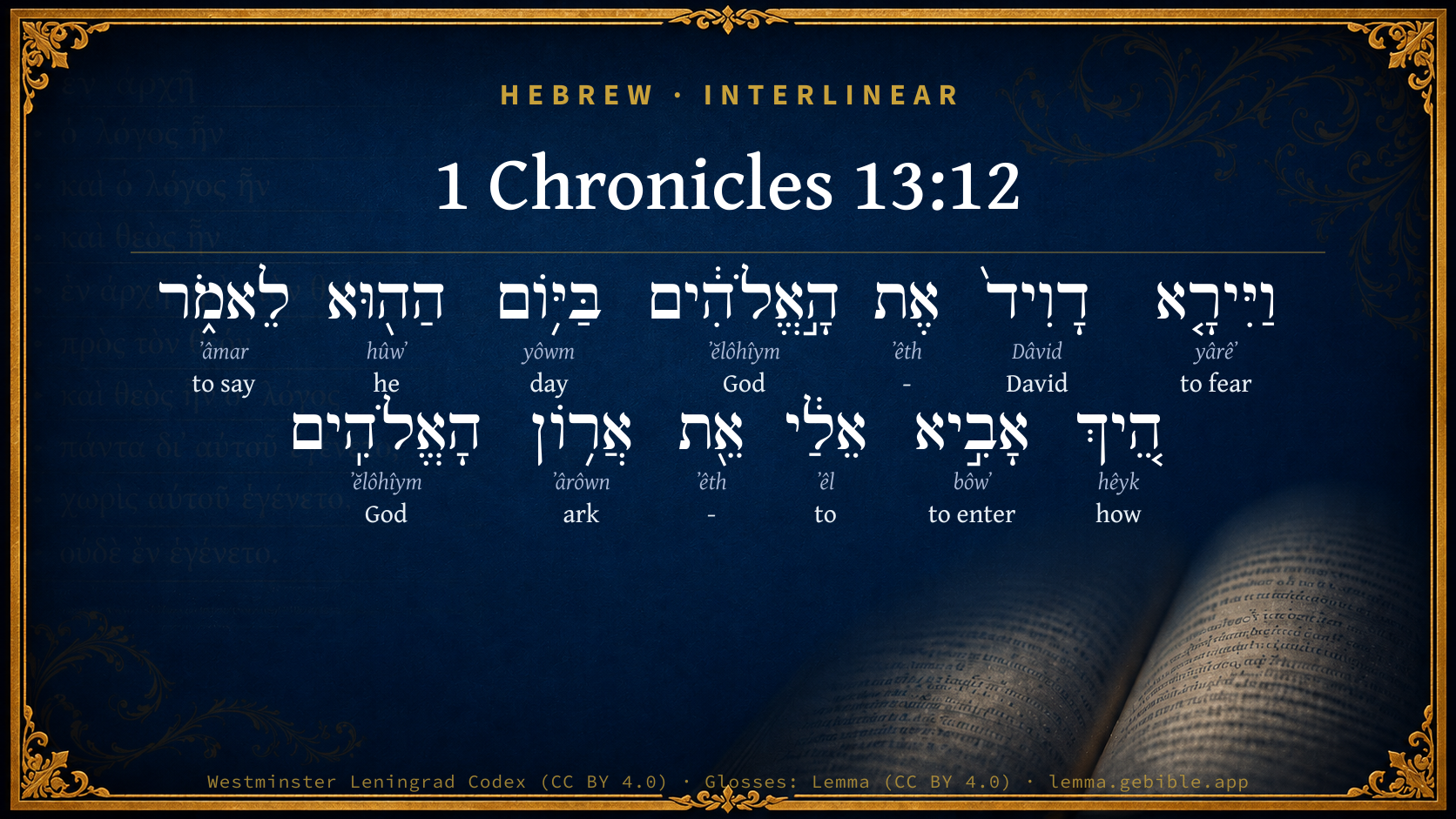
Hebrew (Westminster Leningrad Codex) 1 Chronicles 13:12 appears in the Hebrew Old Testament. The text above is from the Westminster Leningrad Codex. Each word links to its Strong’s number, a concise gloss, and parsing drawn from the Open Scriptures Hebrew Bible morphology. Click any word for its full Brown-Driver-Briggs (BDB) entry.
Download image
Cite this verse

1 Chronicles 13:12 (World English Bible). Public Domain. Lemma interlinear Bible study tool, https://lemma.gebible.app/v/1-chronicles/13/12.

Show BibTeX & RIS
BibTeX
RIS
English Translation
David was afraid of God that day, saying, How shall I bring the ark of God home to me?
World English Bible · Public Domain
Highlights
  • 1 first appearance in the Hebrew Bible
Full analysis ↓
Download a study sheet

One document with this verse’s original text, its word-by-word gloss line, the meaning frame, cross-references with their text, attributed commentary, and full source and license credits — printable, and it pastes into notes with its structure intact.

This verse Autodidact and up

Study sheet (.html) Plain text (.txt)

A passage Seminary Student

Up to 50 verses in one chapter. A passage sheet keeps up to 6 commentary sources and 12 cross-references per verse, in the order this page ranks them, and says so on the sheet whenever that leaves anything out. Ask for a single verse and you get the Autodidact verse sheet above.

Everything on this page stays free to read, with no account — the sheet is a download of what is already on screen, not access to it.

Want to remove ads? Support Godless Engineer
Compare translations 3

The same verse in 3 English versions, stacked beneath the original-language interlinear above. Click any original word for its lexicon entry.

Each is an independent rendering of the whole verse — the interlinear is not word-aligned to these translations.

Highlighted words mark where these versions differ — a whole-verse word diff, not a word-by-word alignment.

  • World English Bible Public Domain
    David was afraid of God that day, saying, How shall I bring the ark of God home to me?
  • King James Version Public Domain
    And David was afraid of God that day, saying, How shall I bring the ark of God home to me?
  • unfoldingWord Literal Text CC BY-SA 4.0
    And David feared God on that day, saying, “How shall I bring the Box of God to me?”

unfoldingWord Literal Text — © unfoldingWord, licensed CC BY-SA 4.0. Word-aligned USFM3 via Door43 (git.door43.org/unfoldingWord/en_ult).

Versions to compare (up to 4)

3 of 4 selected

Show all 18 translations

Every available English version of this verse, each an independent rendering of the whole verse.

  • World English Bible Public Domain
    David was afraid of God that day, saying, How shall I bring the ark of God home to me?
  • Berean Standard Bible Public Domain
    That day David feared God and asked, “How can I ever bring the ark of God to me?”
  • Majority Standard Bible Public Domain
    That day David feared God and asked, “How can I ever bring the ark of God to me?”
  • King James Version Public Domain
    And David was afraid of God that day, saying, How shall I bring the ark of God home to me?
  • American Standard Version (1901) Public Domain
    And David was afraid of God that day, saying, How shall I bring the ark of God home to me?
  • Revised Version (1885) Public Domain
    And David was afraid of God that day, saying, How shall I bring the ark of God home to me?
  • Geneva Bible (1599) Public Domain
    And Dauid feared God that day, saying, Howe shall I bring in to me the Arke of God?
  • Douay-Rheims (1899) Public Domain
    And he feared God at that time, saying: How can I bring in the ark of God to me?
  • Young's Literal Translation Public Domain
    And David feareth God on that day, saying, `How do I bring in unto me the ark of God?'
  • Literal Standard Version CC BY-SA 4.0
    And David fears God on that day, saying, “How do I bring the Ark of God to me?”
  • Unlocked Literal Bible CC BY-SA 4.0
    David was afraid of God that day. He said, “How can I bring the ark of God home to me?”
  • unfoldingWord Literal Text CC BY-SA 4.0
    And David feared God on that day, saying, “How shall I bring the Box of God to me?”
  • Darby Bible Public Domain
    And David was afraid of God that day, saying, How shall I bring the ark of God to me?
  • World Messianic Bible Public Domain
    David was afraid of God that day, saying, “How can I bring God’s ark home to me?”
  • Webster's Bible Public Domain
    And David was afraid of God that day, saying, How shall I bring the ark of God home to me?
  • Free Bible Version CC BY-SA 4.0
    David became afraid of God that day. “How can I ever bring back the Ark of God home to me?” he asked.
  • Bible in Basic English Public Domain
    And so great was David's fear of God that day, that he said, How may I let the ark of God come to me?
  • JPS Tanakh (1917) Public Domain
    And David was afraid of God that day, saying: 'How shall I bring the ark of God home to me?'

Literal Standard Version (2020), Covenant Press — licensed CC BY-SA 4.0. Text via the HelloAO Bible API (eBible.org). Unlocked Literal Bible (unfoldingWord) — licensed CC BY-SA 4.0. Text via the HelloAO Bible API (eBible.org). unfoldingWord Literal Text — © unfoldingWord, licensed CC BY-SA 4.0. Word-aligned USFM3 via Door43 (git.door43.org/unfoldingWord/en_ult). Free Bible Version, Dr. Jonathan Gallagher — licensed CC BY-SA 4.0. Text via the HelloAO Bible API (eBible.org).

Word by word

More ways to search: Search by grammar → Find every occurrence → Compare this word →

Practice this passage: Drill this verse → Learn its vocabulary →

הֵ֚יךְ
hêyk
H1963
“how”
Particle, Interrogative
Part of Speech
Particle
Type
Interrogative
Full BDB Definition

Origin: another form for H349

TWOT: 492

how
  1. וַיִּירָ֤א yârêʼ H3372 “and · to fear” Conjunction + Verb, Qal, Sequential Imperfect, 3rd Person, Masculine, Singular
  2. דָוִיד֙ Dâvid H1732 “David” Noun, Proper
  3. אֶת ʼêth H853 “-” Particle, Direct Object
  4. הָ֣אֱלֹהִ֔ים ʼĕlôhîym H430 “the · God(s)” Particle, Definite Article + Noun, Common, Masculine, Plural, Absolute
  5. בַּיּ֥וֹם yôwm H3117 “in/at the · day” Preposition, Determined + Noun, Common, Masculine, Singular, Absolute
  6. הַה֖וּא hûwʼ H1931 “the · he” Particle, Definite Article + Pronoun, Personal, 3rd Person, Masculine, Singular
  7. לֵאמֹ֑ר ʼâmar H559 “to say” Preposition + Verb, Qal, Infinitive Construct
  8. אָבִ֣יא bôwʼ H935 “to enter” Verb, Hiphil, Imperfect, 1st Person, Common, Singular
  9. אֵלַ֔י ʼêl H413 “to · me” Preposition + Suffix, Personal, 1st Person, Common, Singular
  10. אֵ֖ת ʼêth H853 “-” Particle, Direct Object
  11. אֲר֥וֹן ʼârôwn H727 “ark of” Noun, Common, Both, Singular, Construct
  12. הָאֱלֹהִֽים ʼĕlôhîym H430 “the · God(s)” Particle, Definite Article + Noun, Common, Masculine, Plural, Absolute

About this verse

These counts appear in no published source. They are computed here, from the morphology-tagged text and Lemma’s own curated glosses. What Lemma adds →

13
words
11
distinct lemmas
Historical
section

Notable vocabulary

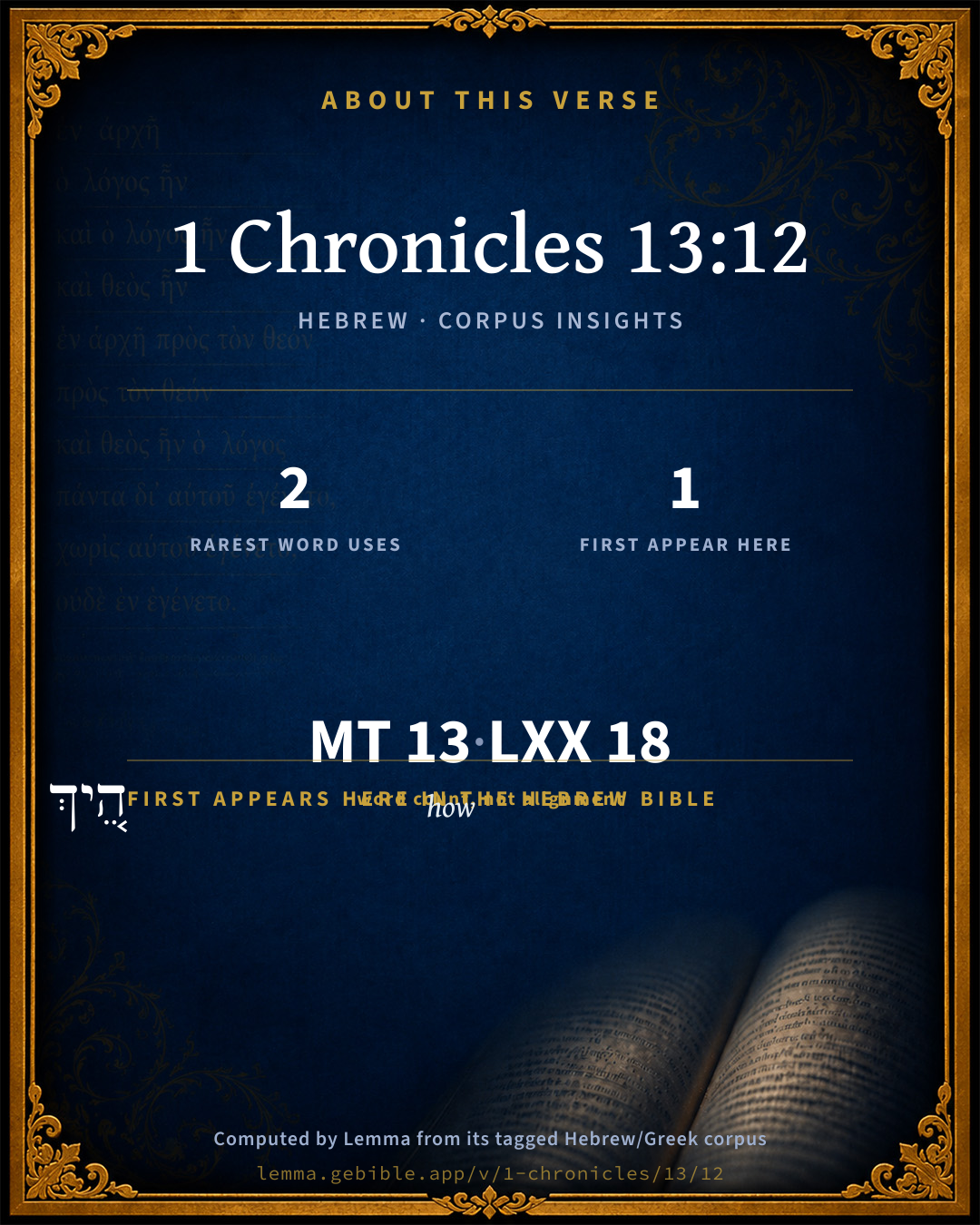
The rarest word here is הֵ֚יךְ how H1963 — appearing just 2 times in the whole Hebrew Bible.

First appearance in Scripture

This word makes its first canonical appearance in the Hebrew Bible here:

Shared distinctive vocabulary

הֵ֚יךְ how H1963 occurs in 2 verses of the Hebrew Bible. Also found in:

Grammatical profile

  • 3 verbs
  • 5 nouns
  • 1 pronoun
  • 1 preposition
  • 3 particles

Verb forms

  • וַיִּירָ֤א Qal · Sequential Imperfect
  • לֵאמֹ֑ר Qal · Infinitive Construct
  • אָבִ֣יא Hiphil · Imperfect

Repetition

A word recurs within this verse — often emphatic in Hebrew:

  • הָ֣אֱלֹהִ֔ים God H430 ×2

Hebrew & Septuagint length

In English translation the verse runs 19 words from the Hebrew and 18 from the Septuagint (LXX English) — closely comparable.

A rough comparison of the two English renderings, which tokenize alike — not a word-level alignment.

Word counts can differ between the Hebrew and the Greek without any difference in meaning — e.g. the Hebrew direct-object marker אֵת has no separate Greek word, and Greek often adds the article ὁ.

In the original languages it is 13 Hebrew tokens and 18 Greek tokens — but the two are counted differently (Hebrew bundles its prefixes and suffixes into one token; the Greek is in lemma form), so that isn’t a like-for-like length.

Cross-references

9

Topical passages linked to 1 Chronicles 13:12 in the Treasury of Scripture Knowledge — connected by theme and wording, ordered by reader-vote popularity; previews shown in the World English Bible.

  • Psalms 119:120 My flesh trembles for fear of you. I am afraid of your judgments.
  • Numbers 17:12–13 The children of Israel spoke to Moses, saying, Behold, we perish, we are undone, we are all undone.
  • 1 Samuel 5:10–11 So they sent the ark of God to Ekron. It happened, as the ark of God came to Ekron, that the Ekronites cried out, saying, They have brought about the ark of the God of Israel to us, to kill us and our people.
  • 1 Samuel 6:20 The men of Beth-shemesh said, Who is able to stand before Yahweh, this holy God? and to whom shall he go up from us?
  • 1 Kings 8:27 But will God in very deed dwell on the earth? behold, heaven and the heaven of heavens can't contain you; how much less this house that I have built!
  • Job 25:5–6 Behold, even the moon has no brightness, And the stars are not pure in his sight;
  • Isaiah 6:5 Then I said, "Woe is me! For I am undone, because I am a man of unclean lips, and I dwell in the midst of a people of unclean lips: for my eyes have seen the King, Yahweh of Hosts!"
  • Matthew 25:24 "He also who had received the one talent came and said, 'Lord, I knew you that you are a hard man, reaping where you did not sow, and gathering where you did not scatter.
  • Luke 5:8–9 But Simon Peter, when he saw it, fell down at Jesus' knees, saying, "Depart from me, for I am a sinful man, Lord."

Cross-references courtesy of OpenBible.info (CC BY 4.0).

Hebrew and Greek witnesses Masoretic Hebrew ↔ Greek Septuagint

The same verse in the two great witnesses to the Old Testament, shown verse-for-verse.

These are two independent witnesses, not word-aligned to each other, and the Septuagint is shown in lemma (dictionary) form.

Hebrew 1 Chronicles 13:12 Masoretic · Westminster Leningrad Codex

וַיִּירָ֤א דָוִיד֙ אֶת הָ֣אֱלֹהִ֔ים בַּיּ֥וֹם הַה֖וּא לֵאמֹ֑ר הֵ֚יךְ אָבִ֣יא אֵלַ֔י אֵ֖ת אֲר֥וֹן הָאֱלֹהִֽים

David was afraid of God that day, saying, How shall I bring the ark of God home to me?

World English Bible · Public Domain

Greek LXX 1 Chronicles 13:12 Septuagint · lemma form

καί φοβέω δαυίδ ὁ θεός ἐν ὁ ἡμέρα ἐκεῖνος λέγω πῶς εἰςφέρω πρός ἐμαυτοῦ ὁ κιβωτός ὁ θεός

And David feared God that day, saying, How shall I bring the ark of God in to myself?

LXX2012 (modern English Septuagint) · Public Domain

Hebrew: Westminster Leningrad Codex (CC BY 4.0). Greek: Septuagint (public domain); English from LXX2012 (modern English Septuagint) (Public Domain). How the Septuagint differs from the Hebrew →

Commentary

Notes on 1 Chronicles 13:12 from classic Christian and Jewish commentators (each source and its license shown beneath its notes). The classic Christian expositions comment on the surrounding passage and are grouped to its opening verse, so a note may address several verses; the Jewish commentaries on the Tanakh (Rashi and others) are per-verse, so they appear only where the commentator wrote on this verse.

Lemma curates 59 commentaries, every one of them public domain or Creative Commons licensed, each selected and text-cleaned for this edition rather than reprinted as found. About our sources →

Trapp's Complete Commentary

John Trapp

1Ch 13:12 And David was afraid of God that day, saying, How shall I bring the ark of God [home] to me?

Ver. 12. And David was afraid of God.] See on 2Sa 6:9.

How shall I bring the ark?] Why, well enough, if you will take but better heed to the manner; which is either the making or marring of any action. But David was frightened, and for present, unresolved. So suddenly can God change the scene; dash all our comforts, -

“ Nulla est sincera voluptas.

Sollicitumque aliquid laetis intervenit. ”

John Trapp, A Commentary or Exposition upon All the Books of the Old and New Testament (1647–1656) — public domain. Text from a community e-Sword module.

Tyndale Open Study Notes

Tyndale Open Resources

13:12 David’s response to Uzzah’s death might have been an expression of his own inadequacy to bring the Ark to Jerusalem.

Tyndale Open Study Notes — © Tyndale Open Resources, licensed CC BY-SA 4.0. Text via the HelloAO Bible API.

Ellicott's Commentary for English Readers

(12) God . . . ark of God.—Here and in 1Ch_13:8; 1Ch_13:14, &c. Samuel has Jehovah. The chronicler or his authority has avoided the frequent use of that most holy Name.

Saying.—Samuel, “and said.”

How.—Hêk, an Aramaic form, perhaps due to a transcriber rather than to the author.

Shall I bring.—Samuel, “shall come.” Two different voices of the same verb.

A Bible Commentary for English Readers, edited by Charles John Ellicott (1878–1897) — public domain. Text from a community e-Sword module.

The Pulpit Commentary

A mortifying stumble sanctified.

On the threshold of his reign David desired to dean act especially right, and on the threshold it seems that he is destined to encounter in that very attempt failure and keenest disappointment. With enthusiastic faith in the ark, it is his heart"s first and deepest desire to bring it again home at least to some place more like permanence and honour. And in the bringing of it, through no apparent fault of his own, the enterprise fails, disastrously and fatally. This issue he must feel equivalent to a personal and very severe rebuff. Yet there is scarcely room to doubt that honest motive, religious feeling and principle, and an ardent faith dictated his desire and attempt. And as little room is there apparently to doubt that David reckoned on the helpful protection of Providence against whatever could be called accident, and from his heart prayed for it. The facts, however, of that day"s journey and work we know; and they stand in painful contrast to what we had hoped. All the circumstances we do not know, and there may be explanations not given us which would easily mitigate our surprise and account for what happened. It may be that David did omit to give the most proper directions, and to urge the needful cautions, and to implore solemnly the Divine blessing. He may have been a little too confident of the mere act itself, a little too trustful in the good intentions of himself, and a little too uplifted because of the unanimous sentiment of all whom he had consulted. A stumble over the threshold may be very mortifying, very humbling, but no doubt it has often saved infinitely worse calamity further on. The very badness of an omen may turn confidence into care, and will work well for a cause, if it call special attention to some fact, or principle, or aspect of the whole matter liable to be overlooked or insufficiently regarded. Perhaps in the present instance, did we but know all, this might sufficiently explain all that at first looks hard on David and an ill encouragement for his pious zeal. Passing, therefore, interesting but uncertain conjecture, it is open to us to study some of the known and ascertained results of that same day and that same bitter experience of David. The passage before us proclaims plainly some of these, and proffers a leading illustration of the principle of present loss compensated by spiritual results. Notice

I THE BIRTH OF A DEEP RELIGIOUS FEELING OF FEAR OF GOD IN DAVID. "He was afraid of God that day." David was not like a very young man; still less was he like a very young man with little knowledge, and who had been stinted of opportunity of gaining experience. Much of this he had already accumulated, and especially of the kind that had brought lessons of God and his providence near to him. There is not a little evidence going to indicate that David had a certain predisposition to religious thought and feeling. There is a wonderful absence of indication of the contrary. His mind had largely opened to Divine manifestation, his thoughts frequently roved among the thoughts and ways of God. Dangers and actual sufferings and fears had often brought him into near converse with the kindness and watchfulness of the "chief Shepherd," of whom he knew how to speak so well. Perhaps it had never struck him (and perhaps it would have never struck us except for this incident) that there remained for him something especial to learn of God in a very different kind of direction from all before. His impressions of God were all most grateful, as well they might be. He had found God a "Sun and a Shield Light, Warmth, and Protection. He had found God one who "had lifted him up on high," and "had not suffered him to be cast down," nor "his foes to rejoice over him." He had been in earthly trial and persecution much, but in heavenly favour more, and in a wonderful assurance of all that gave him "boldness of access" to God. And he had not yet learned the other side not, indeed, of the benevolent character and beneficent working of God but the other side of himself, which might greatly need another sort of manifestation of the Divine power. Though he had often seen God"s justice and his anger, and had said, "God is angry with the wicked every day," he had never felt these, nor had dreamed that he was such that the time might come that he would have to feel them, and his experience become enlarged by so much as this," My flesh trembleth for fear of thee, and I am afraid of thy judgments". (Psa_119:120) To know a fear of God is one of. two things for the child of God. It is either to know the fear of one"s own sin in honest earnest; or to catch one humbling, overwhelming sight of the contrast between the finite and erring nature of the creature man and the infinite perfection of God. As Adam first "was afraid;" as Jacob "was afraid" when he woke from that transporting dream; as Peter was afraid in the presence of the mighty Master of miracle; so was David now "afraid of God." There were slight differences of detail in each case, and differences of form, but the fundamental facts were identical, and they were two in one a sinful creature seizing a moment"s real idea of the all-holy Almighty!and this was the birth of a deep religious feeling in David which he never forgot, and which no doubt served the rest of his life many a valuable end.

II CORRECTER AND FULLER KNOWLEDGE OF GOD, WHILE IT INTERPOSES DELAY, DOES NOT INVOLVE DESPAIR, BUT DOES ENSURE A MORE EXALTED ESTIMATE OF WHAT IT IS TO ENTERTAIN HIM. The ark, with the mercy-seat upon it and the overshadowing cherubim, symbolized the Divine presence, and was, when located in the sanctuary in its proper place, unseen except by the high priest. In it centred the reverential feeling of the people. It is exceedingly likely that something of the deep mysterious awe with which it was associated was lowered and impaired by its history, when taken by the Philistines and lost to its own People. David himself may have been among the number of those whose higher sense suffered some depreciation. He reverenced the ark and prized it; he thought it a necessity to the well-being of the nation, and ardently longed "to bring it to himself to the city of David." But something of this was form and the worship of form. Something of it was reliance on "means of grace," rather than vital dependence on the grace itself. Even David"s time was too late to let this in David"s own self be "winked at or in the self of any true Israelite. The Bible that is possessed must be intelligently used; it is not to be lowered to the place of a talisman. The God who is worshipped must be worshipped "in Spirit and in truth he seeketh such to worship him." And what David had thought could be sufficiently well done in a day or two, he learns will take "three months preparation. During all this time his estimate of what it was to have and to entertain the Divine representation was being raised. How many a time did he speak in this wise to himself, "How shall! bring the ark of God home to me?" And the very process of thought that was going on within him, the mingled perplexity, disappointment, humiliation, all wakened by an unusual fear, were at the same time raising his estimate of the guest he fain would welcome, and fitting him to entertain that guest. In this instance fear supplied the missing link, fear held the key-stone position, fear wakened the things that "were ready to die," unsuspectedly as the danger lurked. The theology must needs be radically weak that omits the justice of God, the integrity of man; the judgment of God, the fear of man. But the correcter and fuller knowledge of the Divine nature and relationship to man, which confessedly is most adapted to waken fear, to quicken it, to keep it a steady and strong force in our life, is not that which will permanently discourage, disappoint, or occasion desponding. It will interpose delay, it will occasion heart-searching, it will promote a wholesome self-renunciation. But thereupon it is provided that, long ere despair is touched, a ransom will be found, and a triumphant entrance for the ark more prized than ever. "Mercy and truth are met together, righteousness and peace have kissed each other."

The Pulpit Commentary (1880–1919), ed. H.D.M. Spence-Jones & Joseph S. Exell — public domain. Text from a community e-Sword module.

unfoldingWord translationNotes

Door43 World Missions Community

How can I bring the ark of God home to me?

David uses this question to emphasize that he is afraid to take the ark to Jerusalem. This can be translated as a statement. AT: "I am too afraid to bring the ark of Yahweh with me to Jerusalem." (See: Rhetorical Question)

Obed Edom the Gittite

This is the name of a man. A "Gittite" is a person from the city of Gath. (See: How to Translate Names)

in Obed Edom's household in his house

"with Obed Edom's family in his house"

three months

"3 months" (See: Numbers)

Yahweh blessed his house

Here the word "house" is a metonym for his family. AT: "Yahweh blessed his family" (See: Metonymy)

translationWords

David

fear

God

ark of the covenant

city of David

house

household

Yahweh

bless

possess

unfoldingWord translationNotes — © Distant Shores Media and the Door43 World Missions Community, licensed CC BY-SA 4.0. Source: git.door43.org/Door43/en_tn.

Rashi

Rabbi Shlomo Yitzchaki (Rashi)

And David feared God, etc. saying What did he fear? Saying - that he said, “How will I bring the Ark of God to me?”

Rashi on the Tanakh — English translations: “The Judaica Press complete Tanach with Rashi, translated by A. J. Rosenberg” (CC BY 4.0); “Pentateuch with Rashi's commentary by M. Rosenbaum and A.M. Silbermann, 1929-1934” (public domain); “The Metsudah Tanach series, Lakewood, N.J” (CC BY 4.0); and “The Book of Joshua, Metsudah Publications, 1997” (CC BY 4.0). Text via Sefaria.

Lesson kit

Teaching starters — assembled from the data on this page, not authored interpretation. Every prompt links to the verse data it draws on. Edit before teaching.

1 Chronicles, in the Historical, opens this verse with 13 words (11 distinct Hebrew lemmas). Its most distinctive word is hêyk (“how”). A historical commentator’s framing appears above. Read the whole chapter for the surrounding context.

Discussion questions

  1. How does “how” (hêyk) shape what this verse is saying?
  2. The word “how” first appears here in Scripture. What is being introduced at this debut?
  3. Daniel 10:17 shares the word «how» with this verse. How do the two illuminate each other?
  4. “God” occurs 2× in this one verse. What is the effect of the repetition?
  5. These translations render this verse differently. What is at stake in choosing one wording over another?
  6. The verb «וַיִּירָ֤א» is Qal Sequential Imperfect. How does its form color the action?
  7. Reading how Trapp's Complete Commentary and Tyndale Open Study Notes read this verse, where do the two commentators agree and where do they part?

Things to notice

Reading settings

Reading text

Shown beneath each verse's original-language words.

Old Testament
Old Testament edition

Read the OT as the Masoretic Hebrew (MT) or the Greek Septuagint (LXX).

English shown for the Greek Septuagint (in the Hebrew ↔ Greek comparison).

Comparing translations? Open the Compare panel on any verse page to stack up to four side by side.