Deuteronomy 10:20

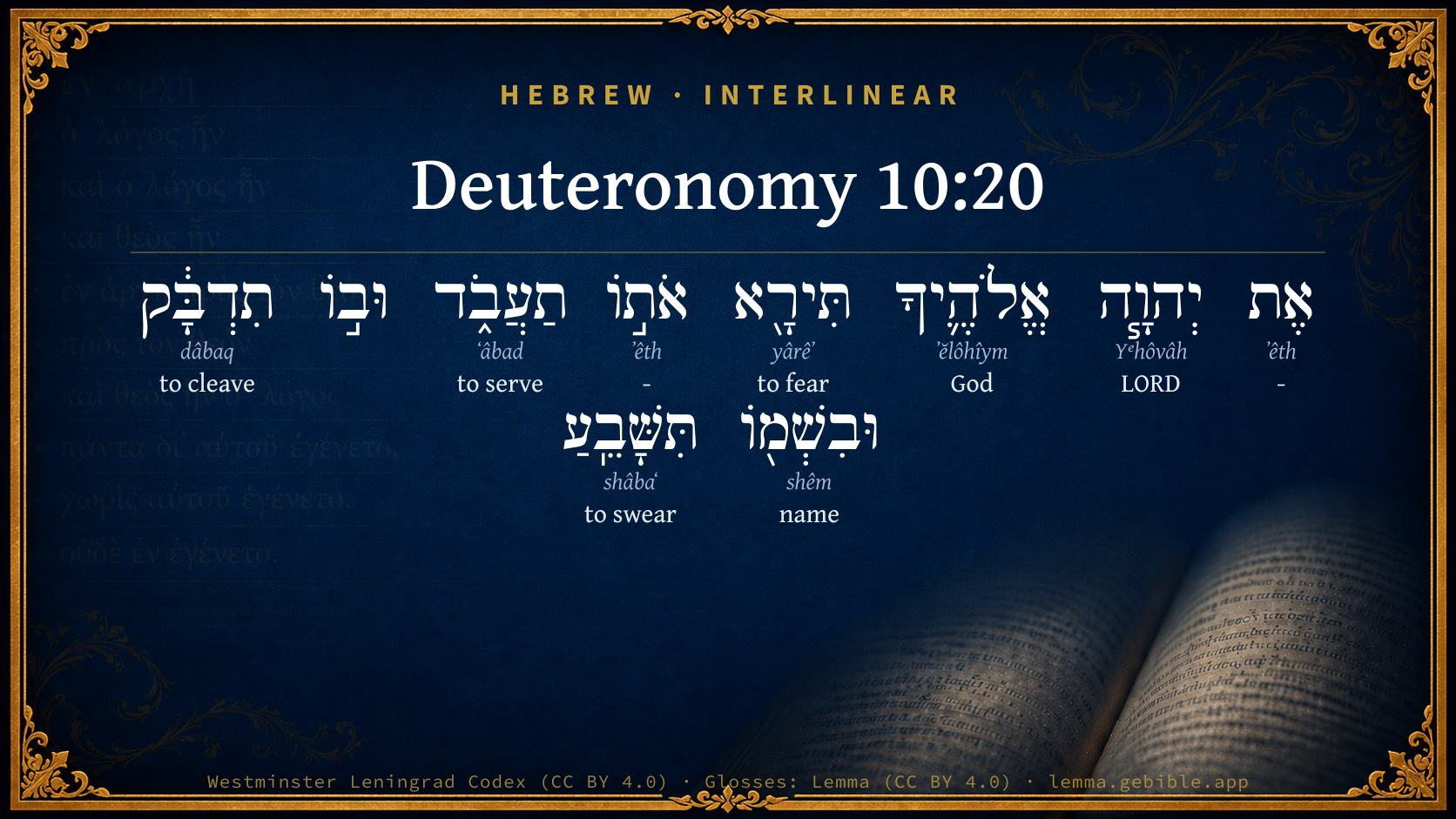
Hebrew (Westminster Leningrad Codex) Deuteronomy 10:20 appears in the Hebrew Old Testament. The text above is from the Westminster Leningrad Codex. Each word links to its Strong’s number, a concise gloss, and parsing drawn from the Open Scriptures Hebrew Bible morphology. Click any word for its full Brown-Driver-Briggs (BDB) entry.
Download image
Cite this verse

Deuteronomy 10:20 (World English Bible). Public Domain. Lemma interlinear Bible study tool, https://lemma.gebible.app/v/deuteronomy/10/20.

Show BibTeX & RIS
BibTeX
RIS
English Translation
You shall fear Yahweh your God; him shall you serve; and to him shall you cleave, and by his name shall you swear.
World English Bible · Public Domain
Download a study sheet

One document with this verse’s original text, its word-by-word gloss line, the meaning frame, cross-references with their text, attributed commentary, and full source and license credits — printable, and it pastes into notes with its structure intact.

This verse Autodidact and up

Study sheet (.html) Plain text (.txt)

A passage Seminary Student

Up to 50 verses in one chapter. A passage sheet keeps up to 6 commentary sources and 12 cross-references per verse, in the order this page ranks them, and says so on the sheet whenever that leaves anything out. Ask for a single verse and you get the Autodidact verse sheet above.

Everything on this page stays free to read, with no account — the sheet is a download of what is already on screen, not access to it.

Want to remove ads? Support Godless Engineer
Compare translations 3

The same verse in 3 English versions, stacked beneath the original-language interlinear above. Click any original word for its lexicon entry.

Each is an independent rendering of the whole verse — the interlinear is not word-aligned to these translations.

Highlighted words mark where these versions differ — a whole-verse word diff, not a word-by-word alignment.

  • World English Bible Public Domain
    You shall fear Yahweh your God; him shall you serve; and to him shall you cleave, and by his name shall you swear.
  • King James Version Public Domain
    Thou shalt fear the LORD thy God; him shalt thou serve, and to him shalt thou cleave, and swear by his name.
  • unfoldingWord Literal Text CC BY-SA 4.0
    Yahweh your God you shall fear, him you shall serve, and to him you shall cling, and by his name you shall swear.

unfoldingWord Literal Text — © unfoldingWord, licensed CC BY-SA 4.0. Word-aligned USFM3 via Door43 (git.door43.org/unfoldingWord/en_ult).

Versions to compare (up to 4)

3 of 4 selected

Show all 18 translations

Every available English version of this verse, each an independent rendering of the whole verse.

  • World English Bible Public Domain
    You shall fear Yahweh your God; him shall you serve; and to him shall you cleave, and by his name shall you swear.
  • Berean Standard Bible Public Domain
    You are to fear the LORD your God and serve Him. Hold fast to Him and take your oaths in His name.
  • Majority Standard Bible Public Domain
    You are to fear the LORD your God and serve Him. Hold fast to Him and take your oaths in His name.
  • King James Version Public Domain
    Thou shalt fear the LORD thy God; him shalt thou serve, and to him shalt thou cleave, and swear by his name.
  • American Standard Version (1901) Public Domain
    Thou shalt fear Jehovah thy God; him shalt thou serve; and to him shalt thou cleave, and by his name shalt thou swear.
  • Revised Version (1885) Public Domain
    Thou shalt fear the LORD thy God; him shalt thou serve; and to him shalt thou cleave, and by his name shalt thou swear.
  • Geneva Bible (1599) Public Domain
    Thou shalt feare the Lord thy God: thou shalt serue him, and thou shalt cleaue vnto him, and shalt sweare by his Name.
  • Douay-Rheims (1899) Public Domain
    Thou shalt fear the Lord thy God, and serve him only: to him thou shalt adhere, and shalt swear by his name.
  • Young's Literal Translation Public Domain
    `Jehovah thy God thou dost fear, Him thou dost serve, and to Him thou dost cleave, and by His name thou dost swear.
  • Literal Standard Version CC BY-SA 4.0
    You fear your God YHWH, you serve Him, and you cleave to Him, and you swear by His Name.
  • Unlocked Literal Bible CC BY-SA 4.0
    You will fear Yahweh your God; him will you worship. To him you must cling, and by his name will you swear.
  • unfoldingWord Literal Text CC BY-SA 4.0
    Yahweh your God you shall fear, him you shall serve, and to him you shall cling, and by his name you shall swear.
  • Darby Bible Public Domain
    Thou shalt fear Jehovah thy God; him thou shalt serve, and unto him shalt thou cleave, and swear by his name.
  • World Messianic Bible Public Domain
    You shall fear the LORD your God. You shall serve him. You shall cling to him, and you shall swear by his name.
  • Webster's Bible Public Domain
    Thou shalt fear the LORD thy God; him shalt thou serve, and to him shalt thou cleave, and swear by his name.
  • Free Bible Version CC BY-SA 4.0
    You must respect the Lord your God and worship him. Hold onto him and make your promises in his name.
  • Bible in Basic English Public Domain
    Let the fear of the Lord your God be before you, give him worship and be true to him at all times, taking your oaths in his name.
  • JPS Tanakh (1917) Public Domain
    Thou shalt fear the LORD thy God; Him shalt thou serve; and to Him shalt thou cleave, and by His name shalt thou swear.

Literal Standard Version (2020), Covenant Press — licensed CC BY-SA 4.0. Text via the HelloAO Bible API (eBible.org). Unlocked Literal Bible (unfoldingWord) — licensed CC BY-SA 4.0. Text via the HelloAO Bible API (eBible.org). unfoldingWord Literal Text — © unfoldingWord, licensed CC BY-SA 4.0. Word-aligned USFM3 via Door43 (git.door43.org/unfoldingWord/en_ult). Free Bible Version, Dr. Jonathan Gallagher — licensed CC BY-SA 4.0. Text via the HelloAO Bible API (eBible.org).

Word by word

More ways to search: Search by grammar → Find every occurrence → Compare this word →

Practice this passage: Drill this verse → Learn its vocabulary →

תִדְבָּ֔ק
dâbaq
H1692
“to cleave”
Verb, Qal, Imperfect, 2nd Person, Masculine, Singular
Part of Speech
Verb
Stem
Qal
Form
Imperfect
Person
2nd Person
Gender
Masculine
Number
Singular
Full BDB Definition

Origin: a primitive root

TWOT: 398

to cling, stick, stay close, cleave, keep close, stick to, stick with, follow closely, join to, overtake, catch - (Qal) - to cling, cleave to - to stay with - (Pual) to be joined together - (Hiphil) - to cause to cleave to - to pursue closely - to overtake - (Hophal) to be made to cleave
  1. אֶת ʼêth H853 “-” Particle, Direct Object
  2. יְהוָ֧ה Yᵉhôvâh H3068 “LORD” Noun, Proper
  3. אֱלֹהֶ֛יךָ ʼĕlôhîym H430 “God(s) · your” Noun, Common, Masculine, Plural, Construct + Suffix, Personal, 2nd Person, Masculine, Singular
  4. תִּירָ֖א yârêʼ H3372 “to fear” Verb, Qal, Imperfect, 2nd Person, Masculine, Singular
  5. אֹת֣וֹ ʼêth H853 “- · him” Particle, Direct Object + Suffix, Personal, 3rd Person, Masculine, Singular
  6. תַעֲבֹ֑ד ʻâbad H5647 “to serve” Verb, Qal, Imperfect, 2nd Person, Masculine, Singular
  7. וּבִשְׁמ֖וֹ shêm H8034 “and · in/at · name · his” Conjunction + Preposition + Noun, Common, Masculine, Singular, Construct + Suffix, Personal, 3rd Person, Masculine, Singular
  8. תִּשָּׁבֵֽעַ shâbaʻ H7650 “to swear” Verb, Niphal, Imperfect, 2nd Person, Masculine, Singular

About this verse

These counts appear in no published source. They are computed here, from the morphology-tagged text and Lemma’s own curated glosses. What Lemma adds →

10
words
8
distinct lemmas
Pentateuch
section

Shared distinctive vocabulary

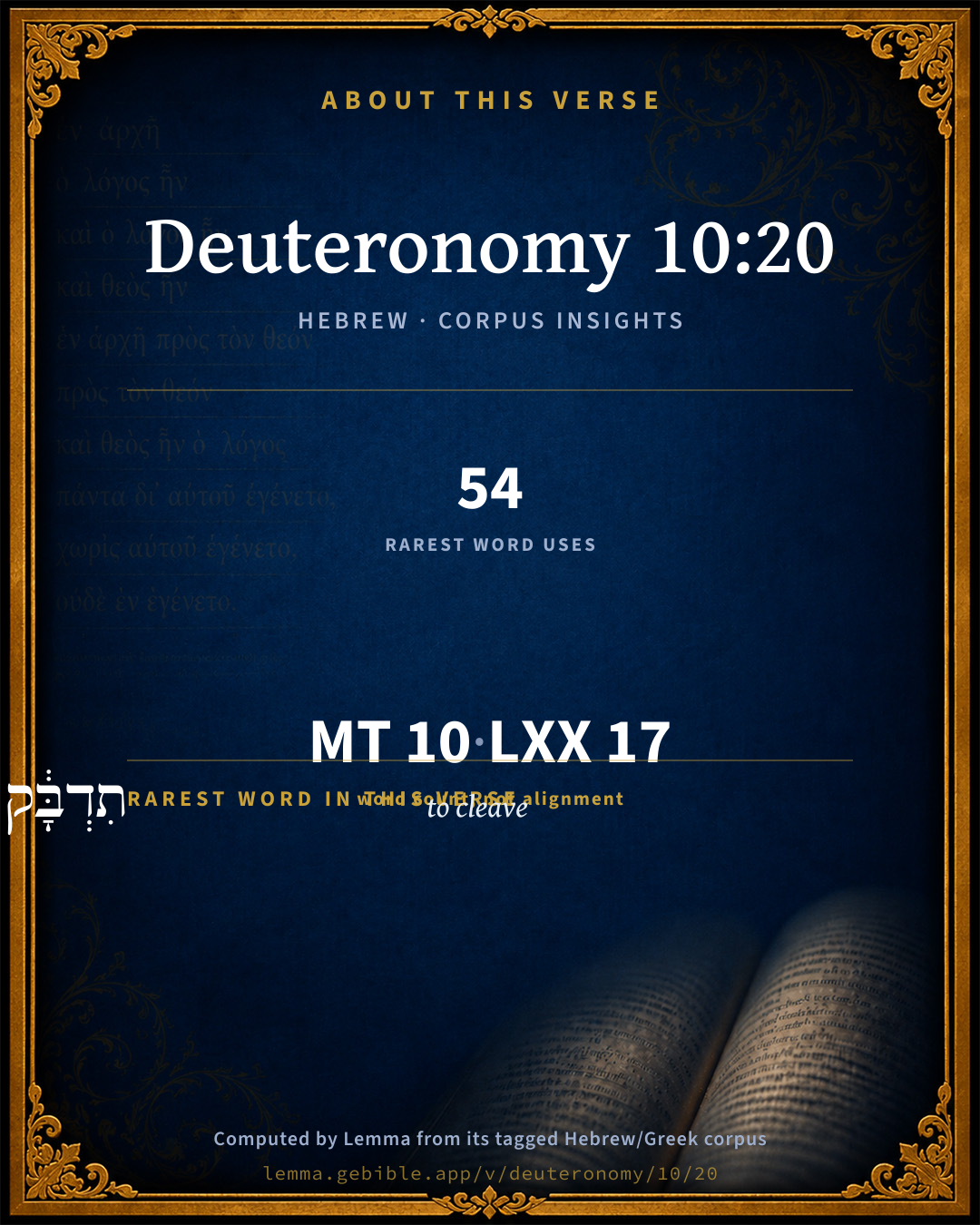
תִדְבָּ֔ק to cleave H1692 occurs in 52 verses of the Hebrew Bible. Also found in:

Grammatical profile

  • 4 verbs
  • 3 nouns
  • 1 preposition
  • 2 particles

Verb forms

  • תִּירָ֖א Qal · Imperfect
  • תַעֲבֹ֑ד Qal · Imperfect
  • תִדְבָּ֔ק Qal · Imperfect
  • תִּשָּׁבֵֽעַ Niphal · Imperfect

Hebrew & Septuagint length

In English translation the verse runs 23 words from the Hebrew and 21 from the Septuagint (LXX English) — closely comparable.

A rough comparison of the two English renderings, which tokenize alike — not a word-level alignment.

Word counts can differ between the Hebrew and the Greek without any difference in meaning — e.g. the Hebrew direct-object marker אֵת has no separate Greek word, and Greek often adds the article ὁ.

In the original languages it is 10 Hebrew tokens and 17 Greek tokens — but the two are counted differently (Hebrew bundles its prefixes and suffixes into one token; the Greek is in lemma form), so that isn’t a like-for-like length.

Cross-references

11

Topical passages linked to Deuteronomy 10:20 in the Treasury of Scripture Knowledge — connected by theme and wording, ordered by reader-vote popularity; previews shown in the World English Bible.

  • Deuteronomy 6:13 You shall fear Yahweh your God; and him shall you serve, and shall swear by his name.
  • Deuteronomy 13:4 You shall walk after Yahweh your God, and fear him, and keep his commandments, and obey his voice, and you shall serve him, and cleave to him.
  • Luke 4:8 Jesus answered him, "Get behind me Satan! For it is written, 'You shall worship the Lord your God, and him only shall you serve.'"
  • Deuteronomy 11:22 For if you shall diligently keep all this commandment which I command you, to do it, to love Yahweh your God, to walk in all his ways, and to cleave to him;
  • Psalms 63:11 But the king shall rejoice in God. Everyone who swears by him will praise him, For the mouth of those who speak lies shall be silenced.
  • Matthew 4:10 Then Jesus said to him, "Get behind me, Satan! For it is written, 'You shall worship the Lord your God, and him only shall you serve.'"
  • Isaiah 45:23 By myself have I sworn, the word is gone forth from my mouth [in] righteousness, and shall not return, that to me every knee shall bow, every tongue shall swear.
  • Deuteronomy 4:4 But you who did cleave to Yahweh your God are alive everyone of you this day.
  • Joshua 23:8 but cleave to Yahweh your God, as you have done to this day.
  • Acts 11:23 who, when he had come, and had seen the grace of God, was glad. He exhorted them all, that with purpose of heart they should remain near to the Lord.
  • Romans 12:9 Let love be without hypocrisy. Abhor that which is evil. Cling to that which is good.

Cross-references courtesy of OpenBible.info (CC BY 4.0).

Hebrew and Greek witnesses Masoretic Hebrew ↔ Greek Septuagint

The same verse in the two great witnesses to the Old Testament, shown verse-for-verse.

These are two independent witnesses, not word-aligned to each other, and the Septuagint is shown in lemma (dictionary) form.

Hebrew Deuteronomy 10:20 Masoretic · Westminster Leningrad Codex

אֶת יְהוָ֧ה אֱלֹהֶ֛יךָ תִּירָ֖א אֹת֣וֹ תַעֲבֹ֑ד וּב֣וֹ תִדְבָּ֔ק וּבִשְׁמ֖וֹ תִּשָּׁבֵֽעַ

You shall fear Yahweh your God; him shall you serve; and to him shall you cleave, and by his name shall you swear.

World English Bible · Public Domain

Greek LXX Deuteronomy 10:20 Septuagint · lemma form

κύριος ὁ θεός σύ φοβέω καί αὐτός λατρεύω καί πρός αὐτός κολλάω καί ὁ ὄνομα αὐτός ὄμνυμι

You shall fear the Lord your God, and serve him, and shall cleave to him, and shall swear by his name.

LXX2012 (modern English Septuagint) · Public Domain

On this verse, The Cambridge Bible for Schools and Colleges discusses the Septuagint’s reading. Read the note in Commentary ↓

Hebrew: Westminster Leningrad Codex (CC BY 4.0). Greek: Septuagint (public domain); English from LXX2012 (modern English Septuagint) (Public Domain). How the Septuagint differs from the Hebrew →

Targum (Aramaic paraphrase)

2

The Targum is the ancient Jewish Aramaic paraphrase of the Hebrew Scriptures — an interpretive translation, not the Hebrew text itself. Onkelos (literal) and Pseudo-Jonathan (expansive) render the Torah, and Jonathan the Prophets. Coverage is partial: where no permissively-licensed English translation exists for a verse, only the Aramaic is shown. This is verse-level text, not a word-by-word alignment to the Hebrew.

  1. Targum Onkelos Torah (Genesis–Deuteronomy)
    יָת יְיָ אֱלָהָךְ תִּדְחַל וְקָדָמוֹהִי תִפְלָח וּלְדַחַלְתֵּהּ תִּקְרַב וּבִשְׁמֵהּ תְּקַיַם

    (no public-domain English translation for this verse)

    Targum Onkelos — Aramaic: “Onkelos Genesis” (public domain); “Onkelos Exodus” (public domain); “Onkelos Leviticus” (public domain); “Onkelos Numbers” (public domain); “Onkelos Deuteronomy” (public domain). English: “Sefaria Community Translation” (CC0 1.0 (public-domain dedication)); “J.W. Etheridge. The Targums of Onkelos and Jonathan Ben Uzziel on the Pentateuch. London: Longmans, Green, 1862” (public domain). Text via Sefaria.

  2. Targum Pseudo-Jonathan Torah (Genesis–Deuteronomy)
    מִן קֳדָם יְיָ אֱלָהָכוֹן תְּדַחֲלוּן וּקְדָמוֹי תִפְלְחוּן וּבְדַחַלְתֵּיהּ תִּתְקַרְבוּן וּבִשְׁמֵיהּ תּוֹמוּן

    Revere the Lord your God, and worship before Him, and cleave closely to His fear, and swear by His Name.

    Targum Pseudo-Jonathan — Aramaic: “Targum Jonathan on Genesis” (public domain); “Targum Jonathan on Exodus” (public domain); “Targum Jonathan on Leviticus” (public domain); “Targum Jonathan on Numbers” (public domain); “Targum Jonathan on Deuteronomy” (public domain). English: “The Targum of Jonathan ben Uzziel, trans. J. W. Etheridge, London, 1862” (public domain). Text via Sefaria.

Commentary

Notes on Deuteronomy 10:20 from classic Christian and Jewish commentators (each source and its license shown beneath its notes). The classic Christian expositions comment on the surrounding passage and are grouped to its opening verse, so a note may address several verses; the Jewish commentaries on the Tanakh (Rashi and others) are per-verse, so they appear only where the commentator wrote on this verse.

Lemma curates 59 commentaries, every one of them public domain or Creative Commons licensed, each selected and text-cleaned for this edition rather than reprinted as found. About our sources →

The Cambridge Bible for Schools and Colleges

gen. ed. J. J. S. Perowne

20. See on Deu_6:13, which this repeats (with LXX, Sam., read, as there, and him) but adds another clause,

and to him shalt thou cleave] This verb dabaḳ is used in J of close and warm affection from man to woman (Gen_2:24; Gen_34:3), and in J and D of the adhesion of evil (Gen_19:19; Deu_13:17 (18) of the devoted thing, Deu_28:21; Deu_28:60 of diseases). It is not applied to the relation of Israel to God in the Pent, except in D, Deu_10:20, Deu_11:22, Deu_13:4 (5), Deu_30:20, in which passages it is combined with some or other of the verbs love, fear, obey, serve, walk after. In Deu_4:4 the adj. dabeḳ is used by itself. Cp. deuteronomic passages in Jos_22:5; Jos_23:8.

The Cambridge Bible for Schools and Colleges (gen. ed. J. J. S. Perowne; Cambridge University Press, 1878–1918) — public domain. Text from a community e-Sword module.

Trapp's Complete Commentary

John Trapp

Deu 10:20 Thou shalt fear the LORD thy God; him shalt thou serve, and to him shalt thou cleave, and swear by his name.

Ver. 20. To him shalt thou cleave, and swear by his name.] Cleaving will call for swearing. {Act 11:23} Broken bones must have strong bands to close them fast again. A crazy piece of building must be crampt with iron bars, to keep it up from tottering.

John Trapp, A Commentary or Exposition upon All the Books of the Old and New Testament (1647–1656) — public domain. Text from a community e-Sword module.

Joseph Benson's Commentary

Deu 10:20-21. To him shalt thou cleave — With firm confidence, true affection, and constant obedience. He is thy praise — The object and matter of thy praise, as Exo 15:2. It is thy greatest honour to belong to him, to be his subject and servant, his child and spouse, and it should be thy chief duty and delight to praise and glorify him.

Joseph Benson's Commentary on the Old and New Testaments (1811–1818) — public domain. Text from a community e-Sword module.

Geneva Bible (1599)

Geneva Bible translators

Read Deut. 6:13.

Geneva Bible (1599) marginal notes — public domain. Text via Bolls.life.

Ellicott's Commentary for English Readers

(20) Thou shalt fear the Lord thy God; him shalt thou serve.—In the New Testament, “Thou shalt worship the Lord thy God, and him only shalt thou serve.” It was our Lord’s last answer to the tempter in the wilderness. The order of the Hebrew gives the emphasis. “Jehovah thy God shalt thou fear, Him shalt thou serve, and to Him shalt thou cleave;” “and (adds Rashi) after all these qualities are established in thee, then thou shalt swear by His name.” At least His name would not be profaned in such a case.

A Bible Commentary for English Readers, edited by Charles John Ellicott (1878–1897) — public domain. Text from a community e-Sword module.

John Gill's Exposition

Thou shalt fear the Lord thy God,.... Which includes the whole worship of him, external and internal:

him shalt thou serve; heartily and sincerely, according to his revealed will, and him only:

and to him shall thou cleave; and not turn aside to follow other gods, and worship them:

and swear by his name; and his only, whenever it is necessary to take an oath, which should not be done rashly or on trivial accounts; and never by any creature, but by the living God; see Deu 6:13.

John Gill's Exposition of the Whole Bible (1746–1763) — public domain (CC PDM 1.0). Text via the HelloAO Bible API.

Haydock's Catholic Bible Commentary

Only, a word not found in the Hebrew, but deemed necessary by the Septuagint to express the true meaning of this passage. See chap. vi. 13. (Calmet) --- Name, when an oath is necessary. Thou shalt never swear by false gods. (Worthington)

George Leo Haydock (1774–1849), Haydock's Catholic Family Bible and Commentary, 1859 edition — public domain. Excludes Psalms (Douay-Rheims chapter numbering differs from Protestant) and Deuterocanonical books (Catholic canon only).

Matthew Poole's English Annotations

To him shalt thou cleave, with firm confidence, true affection, and constant attendance and obedience.

Matthew Poole's English Annotations on the Holy Bible (1683–1685) — public domain. Text from a community e-Sword/MySword module.

The Pulpit Commentary

Reverting to his main theme, Moses anew exhorts Israel to fear Jehovah their God, and to show true reverence to him by serving him, by cleaving to him, and by swearing in his Name (cf. Deu_4:4; Act_11:23) Such reverence was due from Israel to God, because of the great things he had done for them, and those terrible acts by which his mighty power had been displayed on their behalf.

Religion in brief.

A text made illustrious by our Savior"s use of it. Like ver. 12, a summary of duty, but in a form giving prominence to the truth that fear of God works from within outwards. This central religious principle particularizes itself into

I SERVING HIM or religion in deed. In resistance of all seductions to a counter-service. (Mat_4:10) In the faithful and diligent discharge of all duties.

II CLEAVING TO HIM or religion in heart. Fear and love, rooted in faith, here reveal themselves as an energy of trust and adherence. They dread separation from God as the worst evil. They hold by him for support, for keeping, for strength, for direction.

III SWEARING BY HIS NAME or religion in word. This includes religious oaths, but denotes also willingness at any time to make public confession of God.

IV REJOICING IN HIM. "He is thy praise". J.O. (cf. Php_4:4)

The Pulpit Commentary (1880–1919), ed. H.D.M. Spence-Jones & Joseph S. Exell — public domain. Text from a community e-Sword module.

John Wesley's Explanatory Notes

To him shalt thou cleave - With firm confidence, true affection, and constant obedience.

John Wesley, Explanatory Notes Upon the Whole Bible (1754–1765) — public domain. Text via the GEBible commentary corpus.

Keil & Delitzsch

C. F. Keil & F. Delitzsch

After laying down the fundamental condition of a proper relation towards God, Moses describes the fear of God, i.e., true reverence of God, in its threefold manifestation, in deed (serving God), in heart (cleaving to Him; cf. Deu 4:4), and with the mouth (swearing by His name; cf. Deu 6:13). Such reverence as this Israel owed to its God; for "He is thy praise, and He is thy God" (Deu 10:21). He has given thee strong inducements to praise. By the great and terrible things which thine eyes have seen, He has manifested Himself as God to thee. "Terrible things" are those acts of divine omnipotence, which fill men with fear and trembling at the majesty of the Almighty (cf. Exo 15:11). אתּך עשׂה, "done with thee," i.e., shown to thee (את in the sense of practical help).

Keil & Delitzsch — Biblical Commentary on the Old Testament (1861–1891) — public domain (CC PDM 1.0). Text via the HelloAO Bible API. (Old Testament only.)

Scofield Reference Notes

C. I. Scofield

fear

(See Scofield "Psa 19:9").

The Scofield Reference Bible (1917 edition), notes by C. I. Scofield — public domain. Text from a community e-Sword module.

unfoldingWord translationNotes

Door43 World Missions Community

General Information:

Moses speaks to the Israelites as if they were one man, so all instances of "you" and "your" are singular. (See: Forms of You)

him will you worship

"he is the one you must worship"

To him you must cling

To have a good relationship with Yahweh and to completely rely on him is spoken of as if the person were clinging to Yahweh. AT: "You must rely on him" or "He is the one you must rely on" (See: Metaphor)

by his name will you swear

To swear by the name of Yahweh means to make Yahweh the basis or the power on which the oath is made. Here "name" represents Yahweh himself. See how you translated a similar phrase in Deuteronomy 6:13. AT: "you will swear and ask Yahweh to confirm it" or "when you swear you will speak his name" (See: Metonymy)

which your eyes have seen

Here "eyes" refers to the whole person. AT: "which you yourselves have seen" (See: Synecdoche)

He is your praise

Possible meanings are 1) "He is the one you must praise" or 2) "It is because you worship him that other peoples will praise you"

translationWords

fear

Yahweh

God

worship

name

oath

praise

unfoldingWord translationNotes — © Distant Shores Media and the Door43 World Missions Community, licensed CC BY-SA 4.0. Source: git.door43.org/Door43/en_tn.

Rashi

Rabbi Shlomo Yitzchaki (Rashi)

את ה׳ אלוהיך תירא THOU SHALT FEAR THE LORD THY GOD, and serve Him and cleave to Him; and after you possess all these qualities, then you may swear by His Name (cf. Rashi on 6:13 and Note thereon).

Rashi on the Tanakh — English translations: “The Judaica Press complete Tanach with Rashi, translated by A. J. Rosenberg” (CC BY 4.0); “Pentateuch with Rashi's commentary by M. Rosenbaum and A.M. Silbermann, 1929-1934” (public domain); “The Metsudah Tanach series, Lakewood, N.J” (CC BY 4.0); and “The Book of Joshua, Metsudah Publications, 1997” (CC BY 4.0). Text via Sefaria.

Lesson kit

Teaching starters — assembled from the data on this page, not authored interpretation. Every prompt links to the verse data it draws on. Edit before teaching.

Deuteronomy, in the Pentateuch, opens this verse with 10 words (8 distinct Hebrew lemmas). Its most distinctive word is dâbaq (“to cleave”). A historical commentator’s framing appears above. Read the whole chapter for the surrounding context.

Discussion questions

  1. The word dâbaq carries the sense “to cleave.” How does it shape the verse?
  2. Genesis 2:24 shares the word «to cleave» with this verse. How do the two illuminate each other?
  3. These translations render this verse differently; the difference is in the English rendering, not the original. What questions does that raise?
  4. The verb «תִּירָ֖א» is Qal Imperfect. How does its form color the action?
  5. Reading how The Cambridge Bible for Schools and Colleges and Trapp's Complete Commentary read this verse, where do the two commentators agree and where do they part?

Things to notice

Reading settings

Reading text

Shown beneath each verse's original-language words.

Old Testament
Old Testament edition

Read the OT as the Masoretic Hebrew (MT) or the Greek Septuagint (LXX).

English shown for the Greek Septuagint (in the Hebrew ↔ Greek comparison).

Comparing translations? Open the Compare panel on any verse page to stack up to four side by side.