

Nehemiah 1:5

Hebrew (Westminster Leningrad Codex) Nehemiah 1:5 appears in the Hebrew Old Testament. The text above is from the Westminster Leningrad Codex. Each word links to its Strong’s number, a concise gloss, and parsing drawn from the Open Scriptures Hebrew Bible morphology. Click any word for its full Brown-Driver-Briggs (BDB) entry.
Download image
Cite this verse

Nehemiah 1:5 (World English Bible). Public Domain. Lemma interlinear Bible study tool, https://lemma.gebible.app/v/nehemiah/1/5.

Show BibTeX & RIS
BibTeX
RIS
English Translation
and said, I beg you, Yahweh, the God of heaven, the great and awesome God, who keeps covenant and loving kindness with those who love him and keep his commandments:
World English Bible · Public Domain
Download a study sheet

One document with this verse’s original text, its word-by-word gloss line, the meaning frame, cross-references with their text, attributed commentary, and full source and license credits — printable, and it pastes into notes with its structure intact.

This verse Autodidact and up

Study sheet (.html) Plain text (.txt)

A passage Seminary Student

Up to 50 verses in one chapter. A passage sheet keeps up to 6 commentary sources and 12 cross-references per verse, in the order this page ranks them, and says so on the sheet whenever that leaves anything out. Ask for a single verse and you get the Autodidact verse sheet above.

Everything on this page stays free to read, with no account — the sheet is a download of what is already on screen, not access to it.

Want to remove ads? Support Godless Engineer
Compare translations 3

The same verse in 3 English versions, stacked beneath the original-language interlinear above. Click any original word for its lexicon entry.

Each is an independent rendering of the whole verse — the interlinear is not word-aligned to these translations.

Highlighted words mark where these versions differ — a whole-verse word diff, not a word-by-word alignment.

  • World English Bible Public Domain
    and said, I beg you, Yahweh, the God of heaven, the great and awesome God, who keeps covenant and loving kindness with those who love him and keep his commandments:
  • King James Version Public Domain
    And said, I beseech thee, O LORD God of heaven, the great and terrible God, that keepeth covenant and mercy for them that love him and observe his commandments:
  • unfoldingWord Literal Text CC BY-SA 4.0
    And I said, “Ah! Yahweh, the God of heaven, the great and fearsome God, who keeps the covenant and covenant faithfulness to those who love him and to those who keep his commandments:

unfoldingWord Literal Text — © unfoldingWord, licensed CC BY-SA 4.0. Word-aligned USFM3 via Door43 (git.door43.org/unfoldingWord/en_ult).

Versions to compare (up to 4)

3 of 4 selected

Show all 18 translations

Every available English version of this verse, each an independent rendering of the whole verse.

  • World English Bible Public Domain
    and said, I beg you, Yahweh, the God of heaven, the great and awesome God, who keeps covenant and loving kindness with those who love him and keep his commandments:
  • Berean Standard Bible Public Domain
    Then I said: “O LORD, God of heaven, the great and awesome God who keeps His covenant of loving devotion with those who love Him and keep His commandments,
  • Majority Standard Bible Public Domain
    Then I said: “O LORD, God of heaven, the great and awesome God who keeps His covenant of loving devotion with those who love Him and keep His commandments,
  • King James Version Public Domain
    And said, I beseech thee, O LORD God of heaven, the great and terrible God, that keepeth covenant and mercy for them that love him and observe his commandments:
  • American Standard Version (1901) Public Domain
    and said, I beseech thee, O Jehovah, the God of heaven, the great and terrible God, that keepeth covenant and lovingkindness with them that love him and keep his commandments:
  • Revised Version (1885) Public Domain
    and said, I beseech thee, O LORD, the God of heaven, the great and terrible God, that keepeth covenant and mercy with them that love him and keep his commandments:
  • Geneva Bible (1599) Public Domain
    And sayde, O Lord God of heauen, the great and terrible God, that keepeth couenant and mercy for them that loue him, and obserue his commandements,
  • Douay-Rheims (1899) Public Domain
    And I said: WI beseech thee, 0 Lord God of heaven, strong, great, and terrible, who keepest covenant and mercy with those that love thee, and keep thy commandments:
  • Young's Literal Translation Public Domain
    And I say, `I beseech thee, O Jehovah, God of the heavens, God, the great and the fearful, keeping the covenant and kindness for those loving Him, and for those keeping His commands,
  • Literal Standard Version CC BY-SA 4.0
    And I say, “Ah, now, O YHWH, God of the heavens, God, the great and the fearful, keeping the covenant and kindness for those loving Him, and for those keeping His commands,
  • Unlocked Literal Bible CC BY-SA 4.0
    Then I said, “You are Yahweh, God of heaven, the God who is great and awesome, who keeps the covenant and steadfast love with those who love him and keep his commandments.
  • unfoldingWord Literal Text CC BY-SA 4.0
    And I said, “Ah! Yahweh, the God of heaven, the great and fearsome God, who keeps the covenant and covenant faithfulness to those who love him and to those who keep his commandments:
  • Darby Bible Public Domain
    and said, I beseech thee, Jehovah, God of the heavens, the great and terrible ùGod, that keepeth covenant and mercy for them that love him and keep his commandments.
  • World Messianic Bible Public Domain
    and said, “I beg you, LORD, the God of heaven, the great and awesome God who keeps covenant and loving kindness with those who love him and keep his commandments,
  • Webster's Bible Public Domain
    And said, I beseech thee, O LORD God of heaven, the great and terrible God, that keepeth covenant and mercy for them that love him and observe his commandments:
  • Free Bible Version CC BY-SA 4.0
    Then I prayed, “Please, Lord God of heaven—the great and awesome God who keeps his agreement of trustworthy love with those who love him and keep his commandments—
  • Bible in Basic English Public Domain
    And said, O Lord, the God of heaven, the great God, greatly to be feared, keeping faith and mercy with those who have love for him and are true to his laws:
  • JPS Tanakh (1917) Public Domain
    and said: 'I beseech Thee, O LORD, the God of heaven, the great and awful God, that keepeth covenant and mercy with them that love Him and keep His commandments;

Literal Standard Version (2020), Covenant Press — licensed CC BY-SA 4.0. Text via the HelloAO Bible API (eBible.org). Unlocked Literal Bible (unfoldingWord) — licensed CC BY-SA 4.0. Text via the HelloAO Bible API (eBible.org). unfoldingWord Literal Text — © unfoldingWord, licensed CC BY-SA 4.0. Word-aligned USFM3 via Door43 (git.door43.org/unfoldingWord/en_ult). Free Bible Version, Dr. Jonathan Gallagher — licensed CC BY-SA 4.0. Text via the HelloAO Bible API (eBible.org).

Word by word

More ways to search: Search by grammar → Find every occurrence → Compare this word →

Practice this passage: Drill this verse → Learn its vocabulary →

אָֽנָּ֤א
ʼânnâʼ
H577
“I beseech you”
Particle, Exhortation
Part of Speech
Particle
Type
Exhortation
Full BDB Definition

Origin: apparent contracted from H160 and H4994

TWOT: 122

ah now! I/we beseech you, oh now!, pray now! (participle of entreaty usually followed by the imperative verb)
  1. וָאֹמַ֗ר ʼâmar H559 “and · to say” Conjunction + Verb, Qal, Sequential Imperfect, 1st Person, Common, Singular
  2. יְהוָה֙ Yᵉhôvâh H3068 “LORD” Noun, Proper
  3. אֱלֹהֵ֣י ʼĕlôhîym H430 “God(s) of” Noun, Common, Masculine, Plural, Construct
  4. הַשָּׁמַ֔יִם shâmayim H8064 “the · heaven(s)” Particle, Definite Article + Noun, Common, Masculine, Plural, Absolute
  5. הָאֵ֥ל ʼêl H410 “the · God” Particle, Definite Article + Noun, Common, Masculine, Singular, Absolute
  6. הַגָּד֖וֹל gâdôwl H1419 “the · great” Particle, Definite Article + Adjective, Adjective, Masculine, Singular, Absolute
  7. וְהַנּוֹרָ֑א yârêʼ H3372 “and · the · fearing” Conjunction + Particle, Definite Article + Verb, Niphal, Participle Active, Masculine, Singular, Absolute
  8. שֹׁמֵ֤ר shâmar H8104 “keeping” Verb, Qal, Participle Active, Masculine, Singular, Absolute
  9. הַבְּרִית֙ bᵉrîyth H1285 “the · covenant” Particle, Definite Article + Noun, Common, Feminine, Singular, Absolute
  10. וָחֶ֔סֶד chêçêd H2617 “and · kindness” Conjunction + Noun, Common, Masculine, Singular, Absolute
  11. לְאֹהֲבָ֖יו ʼâhab H157 “to/for · loving · him” Preposition + Verb, Qal, Participle Active, Masculine, Plural, Construct + Suffix, Personal, 3rd Person, Masculine, Singular
  12. וּלְשֹׁמְרֵ֥י shâmar H8104 “and · to/for · keeping” Conjunction + Preposition + Verb, Qal, Participle Active, Masculine, Plural, Construct
  13. מִצְוֺתָֽיו mitsvâh H4687 “commandments · his” Noun, Common, Feminine, Plural, Construct + Suffix, Personal, 3rd Person, Masculine, Singular

About this verse

These counts appear in no published source. They are computed here, from the morphology-tagged text and Lemma’s own curated glosses. What Lemma adds →

14
words
13
distinct lemmas
Historical
section

Notable vocabulary

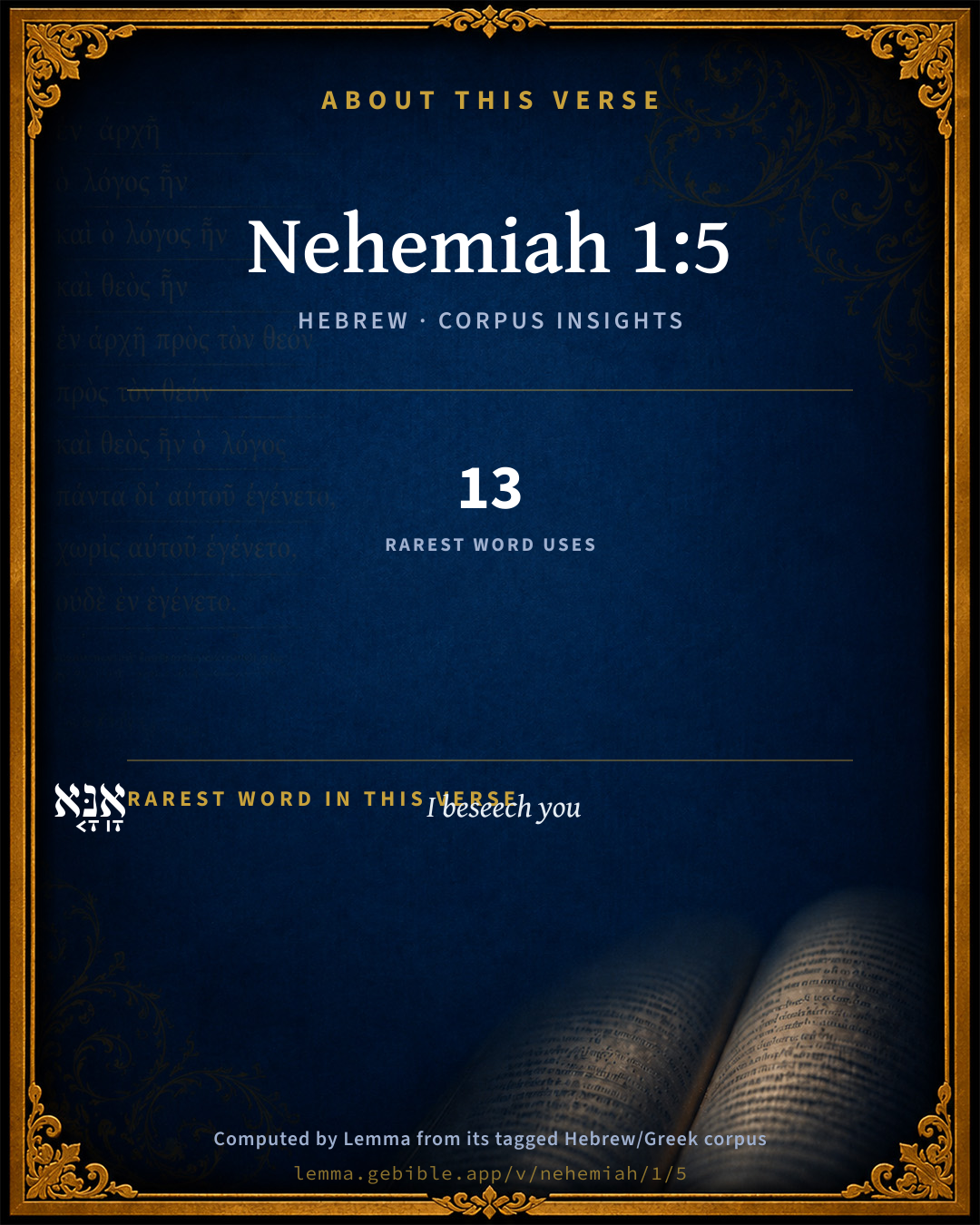
The rarest word here is אָֽנָּ֤א I beseech you H577 — appearing just 13 times in the whole Hebrew Bible.

Shared distinctive vocabulary

אָֽנָּ֤א I beseech you H577 occurs in 12 verses of the Hebrew Bible. Also found in:

Grammatical profile

  • 5 verbs
  • 7 nouns
  • 1 adjective
  • 1 particle

Verb forms

  • וָאֹמַ֗ר Qal · Sequential Imperfect
  • וְהַנּוֹרָ֑א Niphal · Participle Active
  • שֹׁמֵ֤ר Qal · Participle Active
  • לְאֹהֲבָ֖יו Qal · Participle Active
  • וּלְשֹׁמְרֵ֥י Qal · Participle Active

Repetition

A word recurs within this verse — often emphatic in Hebrew:

  • שֹׁמֵ֤ר to keep H8104 ×2

Cross-references

10

Topical passages linked to Nehemiah 1:5 in the Treasury of Scripture Knowledge — connected by theme and wording, ordered by reader-vote popularity; previews shown in the World English Bible.

  • Exodus 20:6 and showing loving kindness to thousands of those who love me and keep my commandments.
  • Daniel 9:4–19 I prayed to Yahweh my God, and made confession, and said, Oh, Lord, the great and dreadful God, who keeps covenant and loving kindness with those who love him and keep his commandments,
  • Deuteronomy 7:21 You shall not be scared of them; for Yahweh your God is in the midst of you, a great and awesome God.
  • Deuteronomy 7:9 Know therefore that Yahweh your God, he is God, the faithful God, who keeps covenant and loving kindness with them who love him and keep his commandments to a thousand generations,
  • Nehemiah 4:14 I looked, and rose up, and said to the nobles, and to the rulers, and to the rest of the people, Don't be you afraid of them: remember the Lord, who is great and awesome, and fight for your brothers, your sons, and your daughters, your wives, and your houses.
  • 1 Kings 8:23 and he said, Yahweh, the God of Israel, there is no God like you, in heaven above, or on earth beneath; who keep covenant and loving kindness with your servants, who walk before you with all their heart;
  • Nehemiah 9:32 Now therefore, our God, the great, the mighty, and the awesome God, who keep covenant and loving kindness, don't let all the travail seem little before you, that has come on us, on our kings, on our princes, and on our priests, and on our prophets, and on our fathers, and on all your people, since the time of the kings of Assyria to this day.
  • Hebrews 6:13–18 For when God made a promise to Abraham, since he could swear by none greater, he swore by himself,
  • 1 Chronicles 17:21 What one nation in the earth is like your people Israel, whom God went to redeem to himself for a people, to make you a name by great and awesome things, in driving out nations from before your people, whom you redeem out of Egypt?
  • Psalms 47:2 For Yahweh Most High is awesome. He is a great King over all the earth.

Cross-references courtesy of OpenBible.info (CC BY 4.0).

Hebrew and Greek witnesses Masoretic Hebrew ↔ Greek Septuagint

The same verse in the two great witnesses to the Old Testament, shown verse-for-verse.

These are two independent witnesses, not word-aligned to each other, and the Septuagint is shown in lemma (dictionary) form.

Hebrew Nehemiah 1:5 Masoretic · Westminster Leningrad Codex

וָאֹמַ֗ר אָֽנָּ֤א יְהוָה֙ אֱלֹהֵ֣י הַשָּׁמַ֔יִם הָאֵ֥ל הַגָּד֖וֹל וְהַנּוֹרָ֑א שֹׁמֵ֤ר הַבְּרִית֙ וָחֶ֔סֶד לְאֹהֲבָ֖יו וּלְשֹׁמְרֵ֥י מִצְוֺתָֽיו

and said, I beg you, Yahweh, the God of heaven, the great and awesome God, who keeps covenant and loving kindness with those who love him and keep his commandments:

World English Bible · Public Domain

Greek LXX Structure differs

The Septuagint has no separate book of Nehemiah. Its Greek text is the second half of Esdras B (2 Esdras), chapters 11–23; Ezra is the first half (1–10).

A verse-for-verse comparison isn’t shown here because the chapters and verses don’t line up. Switch to the LXX edition with the MT / LXX toggle above to read the Greek directly.

Hebrew: Westminster Leningrad Codex (CC BY 4.0). Greek: Septuagint (public domain); English from a public-domain English Septuagint. How the Septuagint differs from the Hebrew →

Commentary

Notes on Nehemiah 1:5 from classic Christian and Jewish commentators (each source and its license shown beneath its notes). The classic Christian expositions comment on the surrounding passage and are grouped to its opening verse, so a note may address several verses; the Jewish commentaries on the Tanakh (Rashi and others) are per-verse, so they appear only where the commentator wrote on this verse.

Lemma curates 59 commentaries, every one of them public domain or Creative Commons licensed, each selected and text-cleaned for this edition rather than reprinted as found. About our sources →

Matthew Henry's Commentary

We have here Nehemiah's prayer, a prayer that has reference to all the prayers which he had for some time before been putting up to God day and night, while he continued his sorrows for the desolations of Jerusalem, and withal to the petition he was now intending to present to the king his master for his favour to Jerusalem. We may observe in this prayer,

I. His humble and reverent address to God, in which he prostrates himself before him, and gives unto him the glory due unto his name, Neh 1:5. It is much the same with that of Daniel, Dan 9:4. It teaches us to draw near to God, 1. With a holy awe of his majesty and glory, remembering that he is the God of heaven, infinitely above us, and sovereign Lord over us, and that he is the great and terrible God, infinitely excelling all the principalities and powers both of the upper and of the lower world, angels and kings; and he is a God to be worshipped with fear by all his people, and whose powerful wrath all his enemies have reason to be afraid of. Even the terrors of the Lord are improvable for the comfort and encouragement of those that trust in him. 2. With a holy confidence in his grace and truth, for he keepeth covenant and mercy for those that love him, not only the mercy that is promised, but even more than he promised: nothing shall be thought too much to be done for those that love him and keep his commandments.

II. His general request for the audience and acceptance of all the prayers and confessions he now made to God (Neh 1:6): "Let thy ear be attentive to the prayer, not which I say (barely saying prayer will not serve), but which I pray before thee (then we are likely to speed in praying when we pray in praying), and let they eyes be open upon the heart from which the prayer comes, and the case which is in prayer laid before thee." God formed the eye and planted the ear; and therefore shall he not see clearly? shall not he hear attentively?

III. His penitent confession of sin; not only Israel has sinned (it was no great mortification to him to own that), but I and my father's house have sinned, Neh 1:6. Thus does he humble himself, and take shame to himself, in this confession. We have (I and my family among the rest) dealt very corruptly against thee, Neh 1:7. In the confession of sin, let these two things be owned as the malignity of it - that it is a corruption of ourselves and an affront to God; it is dealing corruptly against God, setting up the corruptions of our own hearts in opposition to the commands of God.

IV. The pleas he urges for mercy for his people Israel.

1. He pleads what God had of old said to them, the rule he had settled of his proceedings towards them, which might be the rule of their expectations from him, Neh 1:8, Neh 1:9. He had said indeed that, if they broke covenant with him, he would scatter them among the nations, and that threatening was fulfilled in their captivity: never was people so widely dispersed as Israel was at this time, though at first so closely incorporated; but he had said withal that if they turned to him (as now they began to do, having renounced idolatry and kept to the temple service) he would gather them again. This he quotes from Deu 30:1-5, and begs leave to put God in mind of it (though the Eternal Mind needs no remembrancer) as that which he guided his desires by, and grounded his faith and hope upon, in praying this prayer: Remember, I beseech thee, that word; for thou hast said, Put me in remembrance. He had owned (Neh 1:7), We have not kept the judgments which thou commandedst thy servant Moses; yet he begs (Neh 1:8), Lord, remember the word which thou commandedst thy servant Moses; for the covenant is often said to be commanded. If God were not more mindful of his promises than we are of his precepts we should be undone. Our best pleas therefore in prayer are those that are taken from the promise of God, the word on which he has caused us to hope, Psa 119:49.

2. He pleads the relation wherein of old they stood to God: "These are thy servants and thy people (Neh 1:10), whom thou hast set apart for thyself, and taken into covenant with thee. Wilt thou suffer thy sworn enemies to trample upon and oppress thy sworn servants? If thou wilt not appear for thy people, whom wilt thou appear for?" See Isa 63:19. As an evidence of their being God's servants he gives them this character (Neh 1:11): "They desire to fear thy name; they are not only called by thy name, but really have a reverence for thy name; they now worship thee, and thee only, according to thy will, and have an awe of all the discoveries thou art pleased to make of thyself; this they have a desire to do," which denotes, (1.) Their good will to it. "It is their constant care and endeavour to be found in the way of their duty, and they aim at it, though in many instances they come short." (2.) Their complacency in it. "They take pleasure to fear thy name (so it may be read), not only do their duty, but do it with delight." Those shall graciously be accepted of God that truly desire to fear his name; for such a desire is his own work.

3. He pleads the great things God had formerly done for them (Neh 1:10): "Whom thou hast redeemed by thy great power, in the days of old. Thy power is still the same; wilt thou not therefore still redeem them and perfect their redemption? Let not those be overpowered by the enemy that have a God of infinite power on their side."

Lastly, He concludes with a particular petition, that God would prosper him in his undertaking, and give him favour with the king: this man he calls him, for the greatest of men are but men before God; they must know themselves to be so (Psa 9:20), and others must know them to be so. Who art thou that thou shouldst be afraid of a man? Mercy in the sight of this man is what he prays for, meaning not the king's mercy, but mercy from God in his address to the king. Favour with men is then comfortable when we can see it springing from the mercy of God.

Matthew Henry's Commentary on the Whole Bible (1708–1710) — public domain (CC PDM 1.0). Text via the HelloAO Bible API.

The Cambridge Bible for Schools and Colleges

gen. ed. J. J. S. Perowne

5. The opening address blends the Divine attributes of might and majesty with those of faithfulness and mercy. Divine forgiveness alone could vouchsafe the restoration, which Divine power alone could effect.

I beseech thee, O Lord God of heaven] R.V. O Lord, the God of heaven. See on Ezr_1:2.

‘I beseech thee.’ (Vulg. quaeso). In the original one strong supplicatory word, ‘anah,’ used also in Neh_1:11; 2Ki_20:3; Psa_116:4; Psa_118:25; Isa_38:3; Jon_1:14.

On ‘the God of heaven’ see note on Neh_1:4.

the great and terrible God] This phrase, as in Dan_9:4, with its use of the Divine name ‘Êl’ is derived from Deu_7:21 (Neh_10:17). See the very similar expressions in chap. Neh_4:14, Neh_9:32.

God in the manifestation of His strength (Êl) is ‘terrible.’ Cf. Psa_47:2; Psa_66:3; Psa_68:35; Psa_99:3. For the fear which Jehovah inspires cf. Isa_8:13; Jer_5:22; Mal_1:6.

that keepeth covenant and mercy for them that love him and observe (R.V. keep) his commandments] The reciprocity of the covenant relation, denoted by the use of the same Hebrew word for ‘keeping’ ‘covenant and mercy’ as for keeping commandments, is thus brought out in the R.V. The sentence which is borrowed from Deu_7:9; cf. Deu_5:12, is also found in 1Ki_8:23; Neh_9:32; Dan_9:4, in each case, as here, being made use of in a prayer.

‘Keepeth covenant and mercy,’ a condensed phrase for ‘keepeth covenant and sheweth mercy.’ On the Divine side, the keeping of the covenant consisted in shewing ‘mercy.’ God will not break His covenant, cf. Jdg_2:1; Psa_89:34.

‘for them that love him and keep his commandments,’ as in Exo_20:6; Deu_5:10. One class is described in motive and act. The love of those who are in covenant with the Lord is shown in obedience. Compare the New Covenant, ‘if ye love me keep my commandments’ (Joh_14:15). ‘Love to God,’ in the Pentateuch, is only expressed in Exo_20:6 and in Deuteronomy (Deu_5:10, Deu_6:5, Deu_7:9, Deu_10:12, Deu_11:1; Deu_11:13; Deu_11:22, Deu_13:3, Deu_19:9, Deu_30:6; Deu_30:16; Deu_30:20); it is found in the historical books, Jos_22:5; Jos_23:11; Jdg_5:31; 1Ki_3:3 : in the Psalms, Psa_18:1; Psa_31:23; Psa_97:10; Psa_116:1; Psa_145:20 (Psa_5:11, Psa_69:36, Psa_119:132). Elsewhere in the O.T. the thought of love to God is hardly directly found except in the parallel passage Dan_9:4, and less definitely in Isa_56:6; Mal_2:11.

It is as if the writers of the O.T. shrank from expressing the thought of devotion to God by a term familiarly used of human friendship and earthly affection. The relation of sinful man to the Almighty was that of the subject to the sovereign, of the servant to the master. Devotion was realized in obedience to His law.

5–11. Nehemiah’s Prayer

This prayer falls into five portions: (1) the opening address, Neh_1:5; (2) the humble approach, Neh_1:6 a; (3) the confession of sins, Neh_1:6 b, 7; (4) the appeal to the Divine Promise, Neh_1:8-10; (5) the closing supplication for (a) the people, and (b) Nehemiah as their representative at the royal court, Neh_1:11.

Points of resemblance may be noted with the prayer of Ezra (Ezr_9:5-15), and, in particular, with that of Daniel (Dan_9:4-19). The opening words (Neh_1:5), which are almost word for word the same as we find in Dan_9:4 (the only variations being ‘Adonai’ for ‘Jehovah’ and the additional title ‘God of heaven’), were very probably a recognised formula of prayer based on the language of Deuteronomy.

The Cambridge Bible for Schools and Colleges (gen. ed. J. J. S. Perowne; Cambridge University Press, 1878–1918) — public domain. Text from a community e-Sword module.

Trapp's Complete Commentary

John Trapp

Neh 1:5 And said, I beseech thee, O LORD God of heaven, the great and terrible God, that keepeth covenant and mercy for them that love him and observe his commandments:

Ver. 5. I beseech thee, O Lord] Annah Jehovah; an insinuating preface; whereby he seeketh first to get in with God speaking him fair; as doth likewise David, in a real and heavenly compliment, Psa 116:16. Obsecro Iehovah, I beseech, O Lord (I am thy servant, I am thy servant, the son of thine handmaid), break thou my bands. So the Church, Isa 64:9, "Behold, see, we beseech thee, we are all thy people."

The great and terrible God] A great King above all gods, Exo 15:11. Aξιωματικωτατς εστιν ο βασιλευς ημων, saith a Greek father: "glorious in holiness, fearful in praises, doing wonders," saith Moses in one place; as in another, "The Lord our God is God of gods, and Lord of lords, a great God, a mighty, and a terrible," Deu 10:17. Vere verendus et venerandus. Truly reverence and will worship. Thus Nehemiah begins his prayer, and counts it a great mercy that he may creep in at a corner, and present himself before this most majestic Monarch of the world with greatest self-abasement.

That keepeth covenant and mercy] That he may at once both tremble before him and trust upon him; he describeth God by his goodness as well as by greatness, and so helpeth his own faith by contemplating God’s faithfulness and lovingkindness. God hath hitherto kept covenant with heaven and earth, with nights and days, Jer 33:20; Jer 33:25, that one shall succeed the other; and shall he break with his people? no, verily. Be sure to keep faith in heart, or you will pray but poorly. And for this, learn in the preface to your prayers to propound God to yourselves in such notions, and under such terms and titles, as may most conduce thereunto, pleading the covenant.

That love him and observe his commandments] That love to be his servants, Isa 56:6, that wait for his law, Isa 42:4, that think upon his commandments to do them, Psa 103:18.

John Trapp, A Commentary or Exposition upon All the Books of the Old and New Testament (1647–1656) — public domain. Text from a community e-Sword module.

Keil & Delitzsch

C. F. Keil & F. Delitzsch

Nehemiah's prayer, as given in these verses, comprises the prayers which he prayed day and night, during the period of his mourning and fasting (Neh 1:4 comp. Neh 1:6), to his faithful and covenant God, to obtain mercy for his people, and the divine blessing upon his project for their assistance.

Neh 1:5

The invocation of Jahve as: Thou God of heaven, alludes to God's almighty government of the world, and the further predicates of God, to His covenant faithfulness. "Thou great and terrible God" recalls Deu 7:21, and "who keepest covenant and mercy," etc., Deu 7:9 and Exo 20:5-6.

Neh 1:6

"Let Thine ear be attentive, and Thine eyes open," like Ch2 6:40; Ch2 7:15 - לשׁמע, that Thou mayest hearken to the prayer of Thy servant, which I pray, and how I confess concerning ... מתדּה still depends upon אשׁר in the sense of: and what I confess concerning the sins. היּום does not here mean to-day, but now, at this time, as the addition "day and night" compared with ימים in Neh 1:4 shows. To strengthen the communicative form לך חטאנוּ, and to acknowledge before God how deeply penetrated he was by the feeling of his own sin and guilt, he adds: and I and my father's house have sinned.

Neh 1:7

We have dealt very corruptly against Thee. חבל is the inf. constr. instead of the infin. abs., which, before the finite verb, and by reason of its close connection therewith, becomes the infin. constr., like אהיה היות, Psa 50:21; comp. Ewald, 240, c. The dealing corruptly against God consists in not having kept the commandments, statutes, and judgments of the law.

Neh 1:8-10

With his confession of grievous transgression, Nehemiah combines the petition that the Lord would be mindful of His word declared by Moses, that if His people, whom He had scattered among the heathen for their sins, should turn to Him and keep His commandments, He would gather them from all places where He had scattered them, and bring them back to the place which He had chosen to place His name there. This word (הדּבר) he designates, as that which God had commanded to His servant Moses, inasmuch as it formed a part of that covenant law which was prescribed to the Israelites as their rule of life. The matter of this word is introduced by לאמר: ye transgress, I will scatter; i.e., if ye transgress by revolting from me, I will scatter you among the nations, - and ye turn to me and keep my commandments (i.e., if ye turn to me and ... ), if there were of you cast out to the end of heaven (i.e., to the most distant regions where the end of heaven touches the earth), thence will I gather you, etc. נדּח, pat. Niphal, with a collective meaning, cast-out ones, like Deu 30:4. These words are no verbal quotation, but a free summary, in which Nehemiah had Deu 30:1-5 chiefly in view, of what God had proclaimed in the law of Moses concerning the dispersion of His people among the heathen if they sinned against Him, and of their return to the land of their fathers if they repented and turned to Him. The clause: if the cast-out ones were at the end of heaven, etc., stands verbally in Neh 1:4. The last words, Neh 1:9, "(I will bring them) to the place which I have chosen, that my name may dwell there," are a special application of the general promise of the law to the present case. Jerusalem is meant, where the Lord caused His name to dwell in the temple; comp. Deu 12:11. The entreaty to remember this word and to fulfil it, seems ill adapted to existing circumstances, for a portion of the people were already brought back to Jerusalem; and Nehemiah's immediate purpose was to pray, not for the return of those still sojourning among the heathen, but for the removal of the affliction and reproach resting on those who were now at Jerusalem. Still less appropriate seems the citation of the words: If ye transgress, I will scatter you among the nations. It must, however, be remembered that Nehemiah is not so much invoking the divine compassion as the righteousness and faithfulness of a covenant God, the great and terrible God that keepeth covenant and mercy (Neh 1:5). Now this, God had shown Himself to be, by fulfilling the threats of His law that He would scatter His faithless and transgressing people among the nations. Thus His fulfilment of this one side of the covenant strengthened the hope that God would also keep His other covenant word to His people who turned to Him, viz., that He would bring them again to the land of their fathers, to the place of His gracious presence. Hence the reference to the dispersion of the nation among the heathen, forms the actual substructure for the request that so much of the promise as yet remained unfulfilled might come to pass. Nehemiah, moreover, views this promise in the full depth of its import, as securing to Israel not merely an external return to their native land, but their restoration as a community, in the midst of whom the Lord had His dwelling, and manifested Himself as the defence and refuge of His people. To the re-establishment of this covenant relation very much was still wanting. Those who had returned from captivity had indeed settled in the land of their fathers; and the temple in which they might worship God with sacrifices, according to the law, was rebuilt at Jerusalem. But notwithstanding all this, Jerusalem, with its ruined walls and burned gates, was still like a city lying waste, and exposed to attacks of all kinds; while the inhabitants of Jerusalem and the cities of Judah were loaded with shame and contempt by their heathen neighbours. In this sense, Jerusalem was not yet restored, and the community dwelling therein not yet brought to the place where the name of the Lord dwelt. In this respect, the promise that Jahve would again manifest Himself to His repentant people as the God of the covenant was still unfulfilled, and the petition that He would gather His people to the place which He had chosen to put His name there, i.e., to manifest Himself according to His nature, as testified in His covenant (Exo 34:6-7), quite justifiable. In Neh 1:10 Nehemiah supports his petition by the words: And these (now dwelling in Judah and Jerusalem) are Thy servants and Thy people whom Thou hast redeemed, etc. His servants who worship Him in His temple, His people whom He has redeemed from Egypt by His great power and by His strong arm, God cannot leave in affliction and reproach. The words: "redeemed with great power" ... are reminiscences from Deu 7:8; Deu 9:26, Deu 9:29, and other passages in the Pentateuch, and refer to the deliverance from Egypt.

Neh 1:11

The prayer closes with the reiterated entreaty that God would hearken to the prayer of His servant (i.e., Nehemiah), and to the prayer of His servants who delight to fear His name (יראה, infin. like Deu 4:10 and elsewhere), i.e., of all Israelites who, like Nehemiah, prayed to God to redeem Israel from all his troubles. For himself in particular, Nehemiah also request: "Prosper Thy servant to-day (היּום like Neh 1:6; לעבדּך may be either the accusative of the person, like Ch2 26:5, or the dative: Prosper his design unto Thy servant, like Neh 2:20), and give him to mercy (i.e., cause him to find mercy; comp. Kg1 8:50; Psa 106:46) before the face of this man." What man he means is explained by the following supplementary remark, "And I was cup-bearer to the king," without whose favour and permission Nehemiah could not have carried his project into execution (as related in Neh 2).

Keil & Delitzsch — Biblical Commentary on the Old Testament (1861–1891) — public domain (CC PDM 1.0). Text via the HelloAO Bible API. (Old Testament only.)

MacLaren's Expositions of Holy Scripture

Alexander MacLaren

Nehemiah

A REFORMER’S SCHOOLING

Neh 1:1 - Neh 1:11.

The date of the completion of the Temple is 516 B.C.; that of Nehemiah’s arrival 445 B.C. The colony of returned exiles seems to have made little progress during that long period. Its members settled down, and much of their enthusiasm cooled, as we see from the reforms which Ezra had to inaugurate fourteen years before Nehemiah. The majority of men, even if touched by spiritual fervour, find it hard to keep on the high levels for long. Breathing is easier lower down. As is often the case, a brighter flame of zeal burned in the bosoms of sympathisers at a distance than in those of the actual workers, whose contact with hard realities and petty details disenchanted them. Thus the impulse to nobler action came, not from one of the colony, but from a Jew in the court of the Persian king.

This passage tells us how God prepared a man for a great work, and how the man prepared himself.

I. Sad tidings and their effect on a devout servant of God {Neh 1:1 - Neh 1:4}. The time and place are precisely given. ‘The month Chislev’ corresponds to the end of November and beginning of December. ‘The twentieth year’ is that of Artaxerxes {Neh 2:1}. ‘Shushan,’ or Susa, was the royal winter residence, and ‘the palace’ was ‘a distinct quarter of the city, occupying an artificial eminence.’ Note the absence of the name of the king. Nehemiah is so familiar with his greatness that he takes for granted that every reader can fill the gaps. But, though the omission shows how large a space the court occupied in his thoughts, a true Jewish heart beat below the courtier’s robe. That flexibility which enabled them to stand as trusted servants of the kings of many lands, and yet that inflexible adherence to, and undying love of, Israel, has always been a national characteristic. We can think of this youthful cup-bearer as yearning for one glimpse of the ‘mountains round about Jerusalem’ while he filled his post in Shushan.

His longings were kindled into resolve by intercourse with a little party of Jews from Judaea, among whom was his own brother. They had been to see how things went there, and the fact that one of them was a member of Nehemiah’s family seems to imply that the same sentiments belonged to the whole household. Eager questions brought out sorrowful answers. The condition of the ‘remnant’ was one of ‘great affliction and reproach,’ and the ground of the reproach was probably {Neh 2:17; Neh 4:2 - Neh 4:4} the still ruined fortifications.

It has been supposed that the breaking down of the walls and burning of the gates, mentioned in Neh 1:3, were recent, and subsequent to the events recorded in Ezra; but it is more probable that the project for rebuilding the defences, which had been stopped by superior orders {Ezr 4:12 - Ezr 4:16}, had not been resumed, and that the melancholy ruins were those which had met the eyes of Zerubbabel nearly a hundred years before. Communication between Shushan and Jerusalem cannot have been so infrequent that the facts now borne in on Nehemiah might not have been known before. But the impression made by facts depends largely on their narrator, and not a little on the mood of the hearer. It was one thing to hear general statements, and another to sit with one’s brother, and see through his eyes the dismal failure of the ‘remnant’ to carry out the purpose of their return. So the story, whether fresh or repeated with fresh force, made a deep dint in the young cupbearer’s heart, and changed his life’s outlook. God prepares His servants for their work by laying on their souls a sorrowful realisation of the miseries which other men regard, and they themselves have often regarded, very lightly. The men who have been raised up to do great work for God and men, have always to begin by greatly and sadly feeling the weight of the sins and sorrows which they are destined to remove. No man will do worthy work at rebuilding the walls who has not wept over the ruins.

So Nehemiah prepared himself for his work by brooding over the tidings with tears, by fasting and by prayer. There is no other way of preparation. Without the sad sense of men’s sorrows, there will be no earnestness in alleviating them, nor self-sacrificing devotion; and without much prayer there will be little consciousness of weakness or dependence on divine help.

Note the grand and apparently immediate resolution to throw up brilliant prospects and face a life of danger and suffering and toil. Nehemiah was evidently a favourite with the king, and had the ball at his foot. But the ruins on Zion were more attractive to him than the splendours of Shushan, and he willingly flung away his chances of a great career to take his share of ‘affliction and reproach.’ He has never had justice done him in popular estimation. He is not one of the well-known biblical examples of heroic self-abandonment; but he did just what Moses did, and the eulogium of the Epistle to the Hebrews fits him as well as the lawgiver; for he too chose ‘rather to suffer with the people of God than to enjoy pleasures for a season.’ So must we all, in our several ways, do, if we would have a share in building the walls of the city of God.

II. The prayer {Neh 1:5 - Neh 1:11}. The course of thought in this prayer is very instructive. It begins with solemnly laying before God His own great name, as the mightiest plea with Him, and the strongest encouragement to the suppliant. That commencement is no mere proper invocation, conventionally regarded as the right way of beginning, but it expresses the petitioner’s effort to lay hold on God’s character as the ground of his hope of answer. The terms employed remarkably blend what Nehemiah had learned from Persian religion and what from a better source. He calls upon Jehovah, the great name which was the special possession of Israel. He also uses the characteristic Persian designation of ‘the God of heaven,’ and identifies the bearer of that name, not with the god to whom it was originally applied, but with Israel’s Jehovah. He takes the crown from the head of the false deity, and lays it at the feet of the God of his fathers. Whatsoever names for the Supreme Excellence any tongues have coined, they all belong to our God, in so far as they are true and noble. The modern ‘science of comparative religion’ yields many treasures which should be laid up in Jehovah’s Temple.

But the rest of the designations are taken from the Old Testament, as was fitting. The prayer throughout is full of allusions and quotations, and shows how this cupbearer of Artaxerxes had fed his young soul on God’s word, and drawn thence the true nourishment of high and holy thoughts and strenuous resolutions and self-sacrificing deeds. Prayers which are cast in the mould of God’s own revelation of Himself will not fail of answer. True prayer catches up the promises that flutter down to us, and flings them up again like arrows.

The prayer here is all built, then, on that name of Jehovah, and on what the name involves, chiefly on the thought of God as keeping covenant and mercy. He has bound Himself in solemn, irrefragable compact, to a certain line of action. Men ‘know where to have Him,’ if we may venture on the familiar expression. He has given us a chart of His course, and He will adhere to it. Therefore we can go to Him with our prayers, so long as we keep these within the ample space of His covenant, and ourselves within its terms, by loving obedience.

The petition that God’s ears might be sharpened and His eyes open to the prayer is cast in a familiar mould. It boldly transfers to Him not only the semblance of man’s form, but also the likeness of His processes of action. Hearing the cry for help precedes active intervention in the case of men’s help, and the strong imagery of the prayer conceives of similar sequence in God. But the figure is transparent, and the ‘anthropomorphism’ so plain that no mistakes can arise in its interpretation.

Note, too, the light touch with which the suppliant’s relation to God {‘Thy servant’} and his long-continued cry {‘day and night’} are but just brought in for a moment as pleas for a gracious hearing. The prayer is ‘for Thy servants the children of Israel,’ in which designation, as the next clauses show, the relation established by God, and not the conduct of men, is pleaded as a reason for an answer.

The mention of that relation brings at once to Nehemiah’s mind the terrible unfaithfulness to it which had marked, and still continued to mark, the whole nation. So lowly confession follows {Neh 1:6 - Neh 1:7}. Unprofitable servants they had indeed been. The more loftily we think of our privileges, the more clearly should we discern our sins. Nothing leads a true heart to such self-ashamed penitence as reflection on God’s mercy. If a man thinks that God has taken him for a servant, the thought should bow him with conscious unworthiness, not lift him in self-satisfaction. Nehemiah’s confession not only sprung from the thought of Israel’s vocation, so poorly fulfilled, but it also laid the groundwork for further petitions. It is useless to ask God to help us to repair the wastes if we do not cast out the sins which have made them. The beginning of all true healing of sorrow is confession of sins. Many promising schemes for the alleviation of national and other distresses have come to nothing because, unlike Nehemiah’ s, they did not begin with prayer, or prayed for help without acknowledging sin.

And the man who is to do work for God and to get God to bless his work must not be content with acknowledging other people’s sins, but must always say, ‘We have sinned,’ and not seldom say, ‘I have sinned.’ That penitent consciousness of evil is indispensible to all who would make their fellows happier. God works with bruised reeds. The sense of individual transgression gives wonderful tenderness, patience amid gainsaying, submission in failure, dependence on God in difficulty, and lowliness in success. Without it we shall do little for ourselves or for anybody else.

The prayer next reminds God of His own words {Neh 1:8 - Neh 1:9}, freely quoted and combined from several passages {Lev 26:33 - Lev 26:45; Deu 4:25 - Deu 4:31, etc.}. The application of these passages to the then condition of things is at first sight somewhat loose, since part of the people were already restored; and the purport of the prayer is not the restoration of the remainder, but the deliverance of those already in the land from their distresses. Still, the promise gives encouragement to the prayer and is powerful with God, inasmuch as it could not be said to have been fulfilled by so incomplete a restoration as that as that at present realised. What God does must be perfectly done; and His great word is not exhausted so long as any fuller accomplishment of it can be imagined.

The reminder of the promise is clinched {v. 10} by the same appeal as formerly to the relation to Himself into which God had been pleased to bring the nation, with an added reference to former deeds, such as the Exodus, in which His strong hand had delivered them. We are always sure of an answer if we ask God not to contradict Himself. Since He has begun He will make an end. It will never be said of Him that He ‘began to build and was not able to finish.’ His past is a mirror in which we can read His future. The return from Babylon is implied in the Exodus.

A reiteration of earlier words follows, with the addition that Nehemiah now binds, as it were, his single prayer in a bundle with those of the like-minded in Israel. He gathers single ears into a sheaf, which he brings as a ‘wave-offering.’ And then, in one humble little sentence at the end, he puts his only personal request. The modesty of the man is lovely. His prayer has been all for the people. Remarkably enough, there is no definite petition in it. He never once says right out what he so earnestly desires, and the absence of specific requests might be laid hold of by sceptical critics as an argument against the genuineness of the prayer. But it is rather a subtle trait, on which no forger would have been likely to hit. Sometimes silence is the very result of entire occupation of mind with a thought. He says nothing about the particular nature of his request, just because he is so full of it. But he does ask for favour in the eyes of ‘this man,’ and that he may be prospered ‘this day.’

So this was his morning prayer on that eventful day, which was to settle his life’s work. The certain days of solitary meditation on his nation’s griefs had led to a resolution. He says nothing about his long brooding, his slow decision, his conflicts with lower projects of personal ambition. He ‘burns his own smoke,’ as we all should learn to do. But he asks that the capricious and potent will of the king may be inclined to grant his request. If our morning supplication is ‘Prosper Thy servant this day,’ and our purposes are for God’s glory, we need not fear facing anybody. However powerful Artaxerxes was, he was but ‘this man,’ not God. The phrase does not indicate contempt or undervaluing of the solid reality of his absolute power over Nehemiah, but simply expresses the conviction that the king, too, was a subject of God’ s, and that his heart was in the hand of Jehovah, to mould as He would. The consciousness of dependence on God and the habit of communion with Him give a man a clear sight of the limitations of earthly dignities, and a modest boldness which is equally remote from rudeness and servility.

Thus prepared for whatever might be the issue of that eventful day, the young cupbearer rose from his knees, drew a long breath, and went to his work. Well for us if we go to ours, whether it be a day of crisis or of commonplace, in like fashion! Then we shall have like defence and like calmness of heart.

Alexander MacLaren, Expositions of Holy Scripture (1904–1910) — public domain. Text from a community e-Sword module.

Tyndale Open Study Notes

Tyndale Open Resources

1:5-11 Nehemiah’s prayer includes praise (1:5), confession (1:6-7), remembrance of God’s promises (1:8-9), and petition (1:10-11). Nehemiah recognized that Israel’s current situation was not a failure of God’s covenant of unfailing love. Israel’s persistent sin had brought about the punishments entailed in the covenant.

Tyndale Open Study Notes — © Tyndale Open Resources, licensed CC BY-SA 4.0. Text via the HelloAO Bible API.

Adam Clarke's Commentary

Verse 5. Lord God of heaven] What was, before the captivity, Jehovah, God of hosts or armies.

Great] Able to do mighty things. Terrible - able to inflict the heaviest judgments.

Adam Clarke's Commentary on the Bible (1810–1826) — public domain. Text from a community e-Sword/MySword module.

John Gill's Exposition

And said, I beseech thee, O Lord God of heaven,.... He prayed not to the host of heaven, the sun in it, as the Persians, but to the God of it, in an humble supplicant manner:

the great and terrible God; who is to be feared, and had in reverence of all his creatures, because of his greatness and glory, being God over all, blessed for ever, and his name holy and reverend:

that keepeth covenant and mercy for them that love him, and observe his commandments; who keep them from a principle of love to him; to those he has made gracious promises in his covenant, which he truly and faithfully performs; and the consideration of these perfections in God animates and encourages good men in prayer to him.

John Gill's Exposition of the Whole Bible (1746–1763) — public domain (CC PDM 1.0). Text via the HelloAO Bible API.

Whedon's Commentary on the Bible

Daniel D. Whedon

5. The great and terrible God — As his fearful judgments on his own people showed.

Mercy for them that love him — As the law and his word by the prophets, and the whole history of Israel, abundantly testified.

Daniel D. Whedon (gen. ed.), Commentary on the Old and New Testaments (1874–1909) — public domain. Text from a community e-Sword module.

The Pulpit Commentary

And said, I beseech thee. The opening of Nehemiah"s prayer follows so closely the thoughts and words of Daniel"s, (Dan_9:4) that it is almost impossible to suppose that one of the two writers had not the words of the other before him. As there are no sufficient grounds for questioning the generally received date of Daniel"s prophecy (B.C. 536), we must suppose Nehemiah familiar with his writings, and an admirer of their tone and spirit. In this verse he differs from Daniel only in substituting "Jehovah" for "Lord" (Adonai), and introducing his own favourite phrase "God of heaven.

Love and obedience.

"God that keepeth covenant and mercy for them that love him and observe his commandments." We have here

I TWO CHARACTERISTICS OF GOD"S PEOPLE.

1. Love to God. Old Testament piety is sometimes wrongly represented as though it consisted mainly in a strict observance of outward rules, from fear, with little or no love. The "first commandment," and many of the Psalms, not to speak of other Scriptures, should have precluded such an idea. A just conception of Old Testament religion is not to be obtained from the Pharisees. God is presented in the Old Testament as an object of love on account of

(1) his character;

(2) his works of creation and providence;

(3) his redemption of Israel from Egypt, and constant goodness to them;

(4) his special favour to the true Israel, "those who love him," etc.

Much more, doubtless, are the manifestations of God in Christ adapted to awaken and nourish love to him.

1. Observance of his commandments. This includes obedience and watchful care ("observe") to obey; and therefore to obtain the knowledge of them, avoid or overcome temptations to neglect or disobedience, and to secure the grace needful for knowing and doing them. (see Ps 119 passim)

2. The combination of the two. They are essential to each other, and act and re-act for each other"s growth. Obedience without love is as nothing.

(1) Love to God necessarily produces obedience. It includes delight in his rule, reverence for his authority. It is love for his character, and therefore for those excellences which are "commanded because they are right." It will work confidence in the wisdom and goodness of such laws as rest simply on his authority, "right because they are commanded." The obedience of love will be spiritual not the mere service of the letter prompt, joyful, universal, constant, and persevering. Love will give strength for difficult duties, and to overcome all temptations to disobey.

(2) Obedience is a necessary evidence of love. No professions, knowledge, orthodoxy, devotional excitements, or gifts of money are sufficient without it. (Mat_7:21Jo Mat_14:21 1Jn_5:3)

II THEIR BLESSEDNESS.

1. They enjoy the friendship of "the great and terrible God.

2. They experience his mercy and faithfulness. To keep his covenant with them is to keep mercy.

Vers. 5-11. A godly patriot"s prayer.

Nehemiah"s prayer; the substance of the prayers which he offered day and night for a considerable period. It is in various respects a model for our intercessions. In it are

I Lowly and trustful ADORATION. He addresses God as "Jehovah," the self- existent, immutable, and everlasting, the God of Israel; "God of heaven," he who dwells and reigns in heaven, and thence rules the earth; "the great God," infinite in all his perfections, filling heaven and earth with his presence, exalted above all; "the terrible God," to be dreaded by his foes and revered by his friends; "that keepeth," etc., faithful to his engagements, merciful, and kind; yet discriminating, showing his truth and mercy to those who love and obey him. By these representations Nehemiah at once expresses and increases his own reverence and confidence in approaching God on behalf of his people.

II Earnest ENTREATY (vers. 5. 6, 8, 11). "I beseech thee" "Let thine ear be attentive, etc. Earnestness and importunity necessary to success in prayer. (Luk_11:8)

III Humble CONFESSIONS (vers. 6, 7). Of the sins not only of the people in general, but of his family and himself. It is easy to confess the sins of others, but may conduce to self-flattery. The holiest men will be deeply conscious of their own sins, and of their part in the sins of the community, and ready to associate themselves with others in the confession of sin. In his confessions Nehemiah mentions the aggravations of the guilt of Israel"s sins. They were committed

(1) By Israel, a people so favoured.

(2) Against God.

(3) Against specific commandments, statutes, and judgments,

(4) given by Moses, so distinguished a "servant" of God, and under circumstances so impressive.

Observe, that in seeking God"s mercy towards sinners we ought ever to acknowledge their ill deserts, and his justice in the punishment of their sins.

IV Powerful PLEAS.

1. The name of God (ver. 5). The representation of God with which he commences is virtually a plea. "Thou hast shown thyself to be all-powerful, faithful, merciful; act once more according to thy nature, and thy regard for thy servants.

2. The promise of God (vers. 8, 9). Nehemiah recognises that the threat to scatter the people had been fulfilled, and in effect prays that the promise to restore may be fulfilled also. "Do as thou hast said.

3. The relation of Israel to God. "Thy servants," "thy people.

4. His former exercise of power on their behalf. "Whom thou hast redeemed," etc. Referring to the deliverance of Israel from Egypt. (comp. Isa_51:9-11, and the Christian parallel, Rom_8:32)

5. The description of persons uniting in the prayer (ver. 11). Not only Nehemiah, but many others were praying for the returned Jews. It was

(1) united prayer

(2) of godly men servant," "thy servants, who desire delight to fear thy name.

6. Nehemiah"s own perseverance in the prayer (ver. 6). "The prayer which I pray before thee now, day and night.

V A PARTICULAR REQUEST (ver. 11). Purposing to apply to the king for a commission and all facilities for leading his brethren out of their difficulties, and feeling how much depended on his obtaining his request, he begs him in whose hand is the heart of kings (Pro_21:1) to grant success. It is remarkable that this is the only specific request. The prayer he and all good Jews were offering (vers. 6-11) is not set forth. For his own part, he may have seen that the one thing needed for the relief of his brethren was a ruler and leader of character, authority, and capacity, armed with sufficient powers from the monarch, and that this was the one thing-to pray for at present. His willingness to be their leader evinced the sincerity of his concern for them. His prayer made manifest the humble dependence on Divine aid with which he was looking forward to the responsibilities of the enterprise he hoped to undertake.

HOMILIES BY W. CLARKSON Vers. 5-11. A prayer: its characteristics.

We have many recorded prayers in the sacred Scriptures. They have various characteristics, as we should expect they would have; for our individuality that in which God has made us to be different from every one else should appear in prayer as much as in any other act. More rather than less, for if there be one thing more especially in which we should "be ourselves," it is when we approach him who requires "truth in the inward parts." Nevertheless, we shall find in the prayer of Nehemiah those characteristics which we should expect to find in any address to God from a holy man, and which should mark our devotion.

I REVERENCE. "I beseech thee, O Lord God of heaven, the great and terrible God" (ver. 5). "Let thine ear be attentive, and thine eyes open" (ver. 6). Nehemiah speaks as one who feels that it is an infinite condescension for the Majesty on high to "humble himself to behold the things which are done upon the earth." In our "access with boldness" there is danger lest we run into irreverence. Who can help marking a painful familiarity in the addresses of some men to the Saviour of mankind? If we feel that our Maker is our friend, we must never forget that our friend is our Maker.

II ADORATION. "Thou keepest covenant and mercy," etc. (ver. 5). Critics who raise an easy sneer about our "telling God the truth concerning himself" must not be allowed to deprive us of the privilege and drive us from the duty of adoration. It is a fitting thing, well sanctioned in Scripture, fruitful of humility and sacred joy, to ascribe in prayer "the greatness, and the power, and the glory, and the victory, and the majesty" to our God. (1Ch_29:11 Rev_4:11, etc.)

III CONFESSION. "The sins which we have sinned against thee," etc. (vers. 6, 7). Here is confession of national sin. Our consciousness tells us of our own guilt, and should lead us to confess

(a) our transgressions ("we have dealt corruptly") and

(b) our shortcomings ("we have not kept," etc.).

Our confession of sin should be simple and natural, not conventional or ostentatious. The truer, the more acceptable. Beside the acknowledgment of our own personal faultiness, our sympathy with our fellows (of the same family, Church, nation) will lead us to confess our sins as members of a community.

IV SUPPLICATION, PLEADING (vers. 8, 9, 10). Nehemiah pleads with God his ancient promises, and he reverently affirms that they for whom he is making intercession are such as these promises included. We cannot do better than plead (a) God"s word of promise, and (b) his past deliverances (ver. 10): "Thou hast delivered my soul from death: wilt thou not deliver my feet from falling?". (Psa_56:13)

V EARNESTNESS. In verse 11 Nehemiah urges his petition: "O Lord, I beseech thee," etc. Earnestness is not content with one clear utterance. It returns and repeats. The language of entreaty is naturally redundant. It does not spare words; it pleads and pleads again.

VI DEFINITENESS. "Prosper thy servant.. and grant him mercy in the sight of this man. For I was the king"s cupbearer" (ver. 11). Nehemiah prays not only generally for God"s merciful regard to be given to his people, but he asks especially that the mind of the king, Artaxerxes, may be favourably disposed towards himself. We should consider what we urgently require when we draw nigh to God in prayer, and ask him for those special and definite favours which are most calculated to meet the need of our circumstances and life. Only, as here, we must be unselfish and high-minded in the desires we cherish. C.

The Pulpit Commentary (1880–1919), ed. H.D.M. Spence-Jones & Joseph S. Exell — public domain. Text from a community e-Sword module.

Rashi

Rabbi Shlomo Yitzchaki (Rashi)

I beseech You Heb. אָנָא, an expression of request and supplication.

Rashi on the Tanakh — English translations: “The Judaica Press complete Tanach with Rashi, translated by A. J. Rosenberg” (CC BY 4.0); “Pentateuch with Rashi's commentary by M. Rosenbaum and A.M. Silbermann, 1929-1934” (public domain); “The Metsudah Tanach series, Lakewood, N.J” (CC BY 4.0); and “The Book of Joshua, Metsudah Publications, 1997” (CC BY 4.0). Text via Sefaria.

Lesson kit

Teaching starters — assembled from the data on this page, not authored interpretation. Every prompt links to the verse data it draws on. Edit before teaching.

Nehemiah, in the Historical, opens this verse with 14 words (13 distinct Hebrew lemmas). Its most distinctive word is ʼânnâʼ (“I beseech you”). A historical commentator’s framing appears above. Read the whole chapter for the surrounding context.

Discussion questions

  1. The word ʼânnâʼ carries the sense “I beseech you.” How does it shape the verse?
  2. How does Genesis 50:17, which shares the word «I beseech you», read alongside this verse?
  3. What does the repetition of “to keep” (2× in this one verse) do in this verse?
  4. These translations render this verse differently. What is at stake in choosing one wording over another?
  5. «וָאֹמַ֗ר» is a Qal Sequential Imperfect verb. How does that grammatical form shape the action described?
  6. Compare how Matthew Henry's Commentary and The Cambridge Bible for Schools and Colleges read this verse. Where do they agree or differ?

Things to notice

Reading settings

Reading text

Shown beneath each verse's original-language words.

Old Testament
Old Testament edition

Read the OT as the Masoretic Hebrew (MT) or the Greek Septuagint (LXX).

English shown for the Greek Septuagint (in the Hebrew ↔ Greek comparison).

Comparing translations? Open the Compare panel on any verse page to stack up to four side by side.