
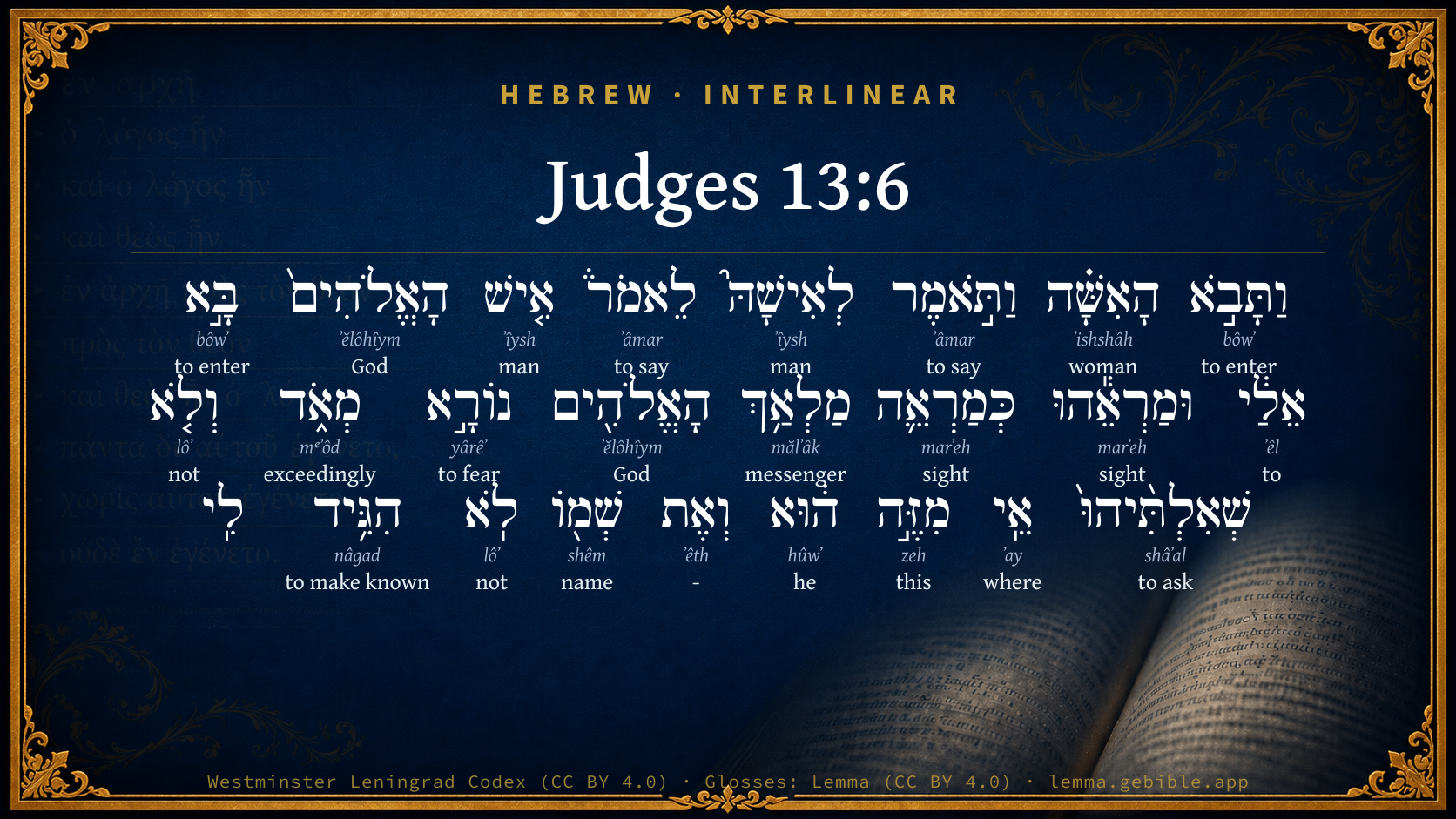
Judges 13:6

Hebrew (Westminster Leningrad Codex) Judges 13:6 appears in the Hebrew Old Testament. The text above is from the Westminster Leningrad Codex. Each word links to its Strong’s number, a concise gloss, and parsing drawn from the Open Scriptures Hebrew Bible morphology. Click any word for its full Brown-Driver-Briggs (BDB) entry.
Download image
Cite this verse

Judges 13:6 (World English Bible). Public Domain. Lemma interlinear Bible study tool, https://lemma.gebible.app/v/judges/13/6.

Show BibTeX & RIS
BibTeX
RIS
English Translation
Then the woman came and told her husband, saying, A man of God came to me, and his face was like the face of the angel of God, very awesome; and I didn't ask him whence he was, neither did he tell me his name:
World English Bible · Public Domain
Download a study sheet

One document with this verse’s original text, its word-by-word gloss line, the meaning frame, cross-references with their text, attributed commentary, and full source and license credits — printable, and it pastes into notes with its structure intact.

This verse Autodidact and up

Study sheet (.html) Plain text (.txt)

A passage Seminary Student

Up to 50 verses in one chapter. A passage sheet keeps up to 6 commentary sources and 12 cross-references per verse, in the order this page ranks them, and says so on the sheet whenever that leaves anything out. Ask for a single verse and you get the Autodidact verse sheet above.

Everything on this page stays free to read, with no account — the sheet is a download of what is already on screen, not access to it.

Want to remove ads? Support Godless Engineer
Compare translations 3

The same verse in 3 English versions, stacked beneath the original-language interlinear above. Click any original word for its lexicon entry.

Each is an independent rendering of the whole verse — the interlinear is not word-aligned to these translations.

Highlighted words mark where these versions differ — a whole-verse word diff, not a word-by-word alignment.

  • World English Bible Public Domain
    Then the woman came and told her husband, saying, A man of God came to me, and his face was like the face of the angel of God, very awesome; and I didn't ask him whence he was, neither did he tell me his name:
  • King James Version Public Domain
    Then the woman came and told her husband, saying, A man of God came unto me, and his countenance was like the countenance of an angel of God, very terrible: but I asked him not whence he was, neither told he me his name:
  • unfoldingWord Literal Text CC BY-SA 4.0
    And the woman came and said to her husband, saying, “A man of God came to me, and his appearance like the appearance of the angel of God, very awesome. And I did not ask him from where he, and he did not declare his name to me.

unfoldingWord Literal Text — © unfoldingWord, licensed CC BY-SA 4.0. Word-aligned USFM3 via Door43 (git.door43.org/unfoldingWord/en_ult).

Versions to compare (up to 4)

3 of 4 selected

Show all 18 translations

Every available English version of this verse, each an independent rendering of the whole verse.

  • World English Bible Public Domain
    Then the woman came and told her husband, saying, A man of God came to me, and his face was like the face of the angel of God, very awesome; and I didn't ask him whence he was, neither did he tell me his name:
  • Berean Standard Bible Public Domain
    So the woman went and told her husband, “A man of God came to me. His appearance was like the angel of God, exceedingly awesome. I did not ask him where he came from, and he did not tell me his name.
  • Majority Standard Bible Public Domain
    So the woman went and told her husband, “A man of God came to me. His appearance was like the angel of God, exceedingly awesome. I did not ask him where he came from, and he did not tell me his name.
  • King James Version Public Domain
    Then the woman came and told her husband, saying, A man of God came unto me, and his countenance was like the countenance of an angel of God, very terrible: but I asked him not whence he was, neither told he me his name:
  • American Standard Version (1901) Public Domain
    Then the woman came and told her husband, saying, A man of God came unto me, and his countenance was like the countenance of the angel of God, very terrible; and I asked him not whence he was, neither told he me his name:
  • Revised Version (1885) Public Domain
    Then the woman came and told her husband, saying, A man of God came unto me, and his countenance was like the countenance of the angel of God, very terrible; and I asked him not whence he was, neither told he me his name:
  • Geneva Bible (1599) Public Domain
    Then the wife came, and tolde her husband, saying, A man of God came vnto me, and the facion of him was like the facion of the Angel of God exceeding feareful, but I asked him not whence he was, neither told he me his name,
  • Douay-Rheims (1899) Public Domain
    And when she was come to her husband she said to him: A man of God came to me, having the countenance of an angel, very awful. And when I asked him who he was, and whence he came, and by what name he was called, he would not tell me.
  • Young's Literal Translation Public Domain
    And the woman cometh and speaketh to her husband, saying, `A man of God hath come unto me, and his appearance `is' as the appearance of a messenger of God, very fearful, and I have not asked him whence he `is', and his name he hath not declared to me;
  • Literal Standard Version CC BY-SA 4.0
    And the woman comes and speaks to her husband, saying, “A Man of God has come to me, and His appearance [is] as the appearance of the Messenger of God, very fearful, and I have not asked Him where He [is] from, and he has not declared His Name to me;
  • Unlocked Literal Bible CC BY-SA 4.0
    Then the woman came and told her husband, “A man of God came to me, and his appearance was like that of an angel of God, very terrible. I did not ask him where he came from, and he did not tell me his name.
  • unfoldingWord Literal Text CC BY-SA 4.0
    And the woman came and said to her husband, saying, “A man of God came to me, and his appearance like the appearance of the angel of God, very awesome. And I did not ask him from where he, and he did not declare his name to me.
  • Darby Bible Public Domain
    Then the woman came and told her husband, "A man of God came to me, and his countenance was like the countenance of the angel of God, very terrible; I did not ask him whence he was, and he did not tell me his name;
  • World Messianic Bible Public Domain
    Then the woman came and told her husband, saying, “A man of God came to me, and his face was like the face of the angel of God, very awesome. I didn’t ask him where he was from, neither did he tell me his name;
  • Webster's Bible Public Domain
    Then the woman came and told her husband, saying, A man of God came to me, and his countenance was like the countenance of an angel of God, very terrible: but I asked him not whence he was, neither did he tell me his name:
  • Free Bible Version CC BY-SA 4.0
    The woman went and told her husband, “A man of God came to me. He looked like the Angel of God, really frightening. I didn't ask him where he came from, and he didn't tell me his name.
  • Bible in Basic English Public Domain
    Then the woman came in, and said to her husband, A man came to me, and his form was like the form of a god, causing great fear; I put no question to him about where he came from, and he did not give me his name;
  • JPS Tanakh (1917) Public Domain
    Then the woman came and told her husband, saying: 'A man of God came unto me, and his countenance was like the countenance of the angel of God, very terrible; and I asked him not whence he was, neither told he me his name;

Literal Standard Version (2020), Covenant Press — licensed CC BY-SA 4.0. Text via the HelloAO Bible API (eBible.org). Unlocked Literal Bible (unfoldingWord) — licensed CC BY-SA 4.0. Text via the HelloAO Bible API (eBible.org). unfoldingWord Literal Text — © unfoldingWord, licensed CC BY-SA 4.0. Word-aligned USFM3 via Door43 (git.door43.org/unfoldingWord/en_ult). Free Bible Version, Dr. Jonathan Gallagher — licensed CC BY-SA 4.0. Text via the HelloAO Bible API (eBible.org).

Word by word

More ways to search: Search by grammar → Find every occurrence → Compare this word →

Practice this passage: Drill this verse → Learn its vocabulary →

אֵֽי
ʼay
H335
“where”
Particle, Interrogative
Part of Speech
Particle
Type
Interrogative
Full BDB Definition

Origin: perhaps from H370

TWOT: 75

where?, whence? - which?, how? (in prefix with other adverb)
  1. וַתָּבֹ֣א bôwʼ H935 “and · to enter” Conjunction + Verb, Qal, Sequential Imperfect, 3rd Person, Feminine, Singular
  2. הָאִשָּׁ֗ה ʼishshâh H802 “the · woman” Particle, Definite Article + Noun, Common, Feminine, Singular, Absolute
  3. וַתֹּ֣אמֶר ʼâmar H559 “and · to say” Conjunction + Verb, Qal, Sequential Imperfect, 3rd Person, Feminine, Singular
  4. לְאִישָׁהּ֮ ʼîysh H376 “to/for · man · her” Preposition + Noun, Common, Masculine, Singular, Construct + Suffix, Personal, 3rd Person, Feminine, Singular
  5. לֵאמֹר֒ ʼâmar H559 “to say” Preposition + Verb, Qal, Infinitive Construct
  6. אִ֤ישׁ ʼîysh H376 “man of” Noun, Common, Masculine, Singular, Construct
  7. הָאֱלֹהִים֙ ʼĕlôhîym H430 “the · God(s)” Particle, Definite Article + Noun, Common, Masculine, Plural, Absolute
  8. בָּ֣א bôwʼ H935 “to enter” Verb, Qal, Perfect, 3rd Person, Masculine, Singular
  9. אֵלַ֔י ʼêl H413 “to · me” Preposition + Suffix, Personal, 1st Person, Common, Singular
  10. וּמַרְאֵ֕הוּ marʼeh H4758 “and · sight · his” Conjunction + Noun, Common, Masculine, Singular, Construct + Suffix, Personal, 3rd Person, Masculine, Singular
  11. כְּמַרְאֵ֛ה marʼeh H4758 “like/as · sight of” Preposition + Noun, Common, Masculine, Singular, Construct
  12. מַלְאַ֥ךְ mălʼâk H4397 “messenger of” Noun, Common, Masculine, Singular, Construct
  13. הָאֱלֹהִ֖ים ʼĕlôhîym H430 “the · God(s)” Particle, Definite Article + Noun, Common, Masculine, Plural, Absolute
  14. נוֹרָ֣א yârêʼ H3372 “fearing” Verb, Niphal, Participle Active, Masculine, Singular, Absolute
  15. מְאֹ֑ד mᵉʼôd H3966 “exceedingly” Adverb
  16. וְלֹ֤א lôʼ H3808 “and · not” Conjunction + Particle, Negative
  17. שְׁאִלְתִּ֨יהוּ֙ shâʼal H7592 “to ask · him” Verb, Qal, Perfect, 1st Person, Common, Singular + Suffix, Personal, 3rd Person, Masculine, Singular
  18. מִזֶּ֣ה zeh H2088 “from · this” Preposition + Pronoun, Demonstrative, Masculine, Singular
  19. ה֔וּא hûwʼ H1931 “he” Pronoun, Personal, 3rd Person, Masculine, Singular
  20. וְאֶת ʼêth H853 “and · -” Conjunction + Particle, Direct Object
  21. שְׁמ֖וֹ shêm H8034 “name · his” Noun, Common, Masculine, Singular, Construct + Suffix, Personal, 3rd Person, Masculine, Singular
  22. לֹֽא lôʼ H3808 “not” Particle, Negative
  23. הִגִּ֥יד nâgad H5046 “to make known” Verb, Hiphil, Perfect, 3rd Person, Masculine, Singular

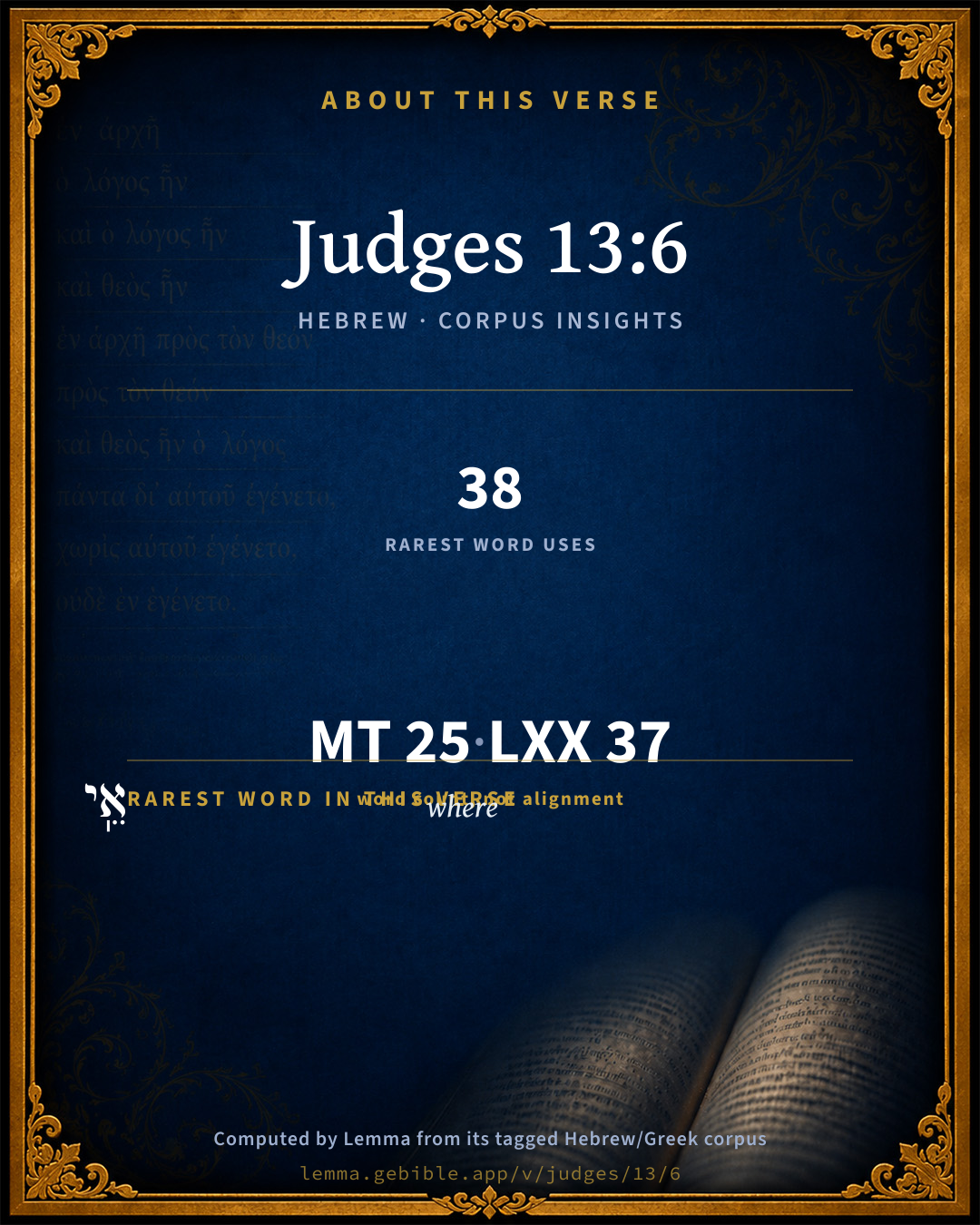
About this verse

These counts appear in no published source. They are computed here, from the morphology-tagged text and Lemma’s own curated glosses. What Lemma adds →

25
words
18
distinct lemmas
Historical
section

Shared distinctive vocabulary

אֵֽי where H335 occurs in 36 verses of the Hebrew Bible. Also found in:

Grammatical profile

  • 7 verbs
  • 9 nouns
  • 2 pronouns
  • 2 prepositions
  • 1 adverb
  • 4 particles

Verb forms

  • וַתָּבֹ֣א Qal · Sequential Imperfect
  • וַתֹּ֣אמֶר Qal · Sequential Imperfect
  • לֵאמֹר֒ Qal · Infinitive Construct
  • בָּ֣א Qal · Perfect
  • נוֹרָ֣א Niphal · Participle Active
  • שְׁאִלְתִּ֨יהוּ֙ Qal · Perfect
  • הִגִּ֥יד Hiphil · Perfect

Repetition

Words recur within this verse — often emphatic in Hebrew:

  • וַתָּבֹ֣א to enter H935 ×2
  • וַתֹּ֣אמֶר to say H559 ×2
  • לְאִישָׁהּ֮ man H376 ×2
  • הָאֱלֹהִים֙ God H430 ×2
  • וּמַרְאֵ֕הוּ sight H4758 ×2
  • וְלֹ֤א not H3808 ×2

Hebrew & Septuagint length

In English translation the verse runs 45 words from the Hebrew and 47 from the Septuagint (LXX English) — closely comparable.

A rough comparison of the two English renderings, which tokenize alike — not a word-level alignment.

Word counts can differ between the Hebrew and the Greek without any difference in meaning — e.g. the Hebrew direct-object marker אֵת has no separate Greek word, and Greek often adds the article ὁ.

In the original languages it is 25 Hebrew tokens and 37 Greek tokens — but the two are counted differently (Hebrew bundles its prefixes and suffixes into one token; the Greek is in lemma form), so that isn’t a like-for-like length.

Cross-references

24

Topical passages linked to Judges 13:6 in the Treasury of Scripture Knowledge — connected by theme and wording, ordered by reader-vote popularity; previews shown in the World English Bible.

  • Judges 13:17–18 Manoah said to the angel of Yahweh, What is your name, that when your words happen, we may honor you?
  • Matthew 28:3–4 His appearance was like lightning, and his clothing white as snow.
  • 1 Samuel 9:6 He said to him, See now, there is in this city a man of God, and he is a man who is held in honor; all that he says comes surely to pass: now let us go there; peradventure he can tell us concerning our journey whereon we go.
  • Revelation 1:17 When I saw him, I fell at his feet like a dead man. He laid his right hand on me, saying, "Don't be afraid. I am the first and the last,
  • Deuteronomy 33:1 This is the blessing, with which Moses the man of God blessed the children of Israel before his death.
  • 2 Kings 4:9 She said to her husband, See now, I perceive that this is a holy man of God, that passes by us continually.
  • Daniel 8:17 So he came near where I stood; and when he came, I was frightened, and fell on my face: but he said to me, Understand, son of man; for the vision belongs to the time of the end.
  • Daniel 10:5 I lifted up my eyes, and looked, and, behold, a man clothed in linen, whose loins were girded with pure gold of Uphaz:
  • Daniel 10:11 He said to me, Daniel, you man greatly beloved, understand the words that I speak to you, and stand upright; for to you am I now sent. When he had spoken this word to me, I stood trembling.
  • Luke 1:19 The angel answered him, "I am Gabriel, who stands in the presence of God. I was sent to speak to you, and to bring you this good news.
  • Luke 9:29 As he was praying, the appearance of his face was altered, and his clothing became white and dazzling.
  • Acts 6:15 All who sat in the council, fastening their eyes on him, saw his face like it was the face of an angel.
  • Genesis 32:29 Jacob asked him, "Please tell me your name." He said, "Why is it that you ask what my name is?" He blessed him there.
  • Exodus 3:2 The angel of Yahweh appeared to him in a flame of fire out of the midst of a bush. He looked, and behold, the bush burned with fire, and the bush was not consumed.
  • Exodus 3:6 Moreover he said, "I am the God of your father, the God of Abraham, the God of Isaac, and the God of Jacob." Moses hid his face; for he was afraid to look at God.
  • Joshua 14:6 Then the children of Judah drew near to Joshua in Gilgal: and Caleb the son of Jephunneh the Kenizzite said to him, You know the thing that Yahweh spoke to Moses the man of God concerning me and concerning you in Kadesh-barnea.
  • Judges 13:8 Then Manoah entreated Yahweh, and said, Oh, Lord, please let the man of God whom you did send come again to us, and teach us what we shall do to the child who shall be born.
  • Judges 13:22 Manoah said to his wife, We shall surely die, because we have seen God.
  • 1 Samuel 2:27 There came a man of God to Eli, and said to him, Thus says Yahweh, Did I reveal myself to the house of your father, when they were in Egypt [in bondage] to Pharaoh's house?
  • 1 Kings 17:18 She said to Elijah, What have I to do with you, you man of God? You have come to me to bring my sin to memory, and to kill my son!
  • 1 Kings 17:24 The woman said to Elijah, Now I know that you are a man of God, and that the word of Yahweh in your mouth is truth.
  • 2 Kings 4:16 He said, At this season, when the time comes round, you shall embrace a son. She said, No, my lord, you man of God, do not lie to your handmaid.
  • 1 Timothy 6:11 But you, man of God, flee these things, and follow after righteousness, godliness, faith, love, patience, and gentleness.
  • Genesis 28:16–17 Jacob awakened out of his sleep, and he said, "Surely Yahweh is in this place, and I didn't know it."

Cross-references courtesy of OpenBible.info (CC BY 4.0).

Hebrew and Greek witnesses Masoretic Hebrew ↔ Greek Septuagint

The same verse in the two great witnesses to the Old Testament, shown verse-for-verse.

These are two independent witnesses, not word-aligned to each other, and the Septuagint is shown in lemma (dictionary) form.

Hebrew Judges 13:6 Masoretic · Westminster Leningrad Codex

וַתָּבֹ֣א הָאִשָּׁ֗ה וַתֹּ֣אמֶר לְאִישָׁהּ֮ לֵאמֹר֒ אִ֤ישׁ הָאֱלֹהִים֙ בָּ֣א אֵלַ֔י וּמַרְאֵ֕הוּ כְּמַרְאֵ֛ה מַלְאַ֥ךְ הָאֱלֹהִ֖ים נוֹרָ֣א מְאֹ֑ד וְלֹ֤א שְׁאִלְתִּ֨יהוּ֙ אֵֽי מִזֶּ֣ה ה֔וּא וְאֶת שְׁמ֖וֹ לֹֽא הִגִּ֥יד לִֽי

Then the woman came and told her husband, saying, A man of God came to me, and his face was like the face of the angel of God, very awesome; and I didn't ask him whence he was, neither did he tell me his name:

World English Bible · Public Domain

Greek LXX Judges 13:6 Septuagint · lemma form

καί εἰςἔρχομαι ὁ γυνή καί εἶπον ὁ ἀνήρ αὐτός λέγω ἄνθρωπος θεός ἔρχομαι πρός ἐγώ καί εἶδος αὐτός ὡς εἶδος ἄγγελος θεός φοβερός σφόδρα καί οὐ ἐρωτάω αὐτός πόθεν εἰμί καί ὁ ὄνομα αὐτός οὐ ἀποἀγγέλλω ἐγώ

And the woman went in, and spoke to her husband, saying, A man of God came to me, and his appearance was as of an angel of God, very dreadful; and I did not ask him whence he was, and he did not tell me his name.

LXX2012 (modern English Septuagint) · Public Domain

On this verse, Adam Clarke's Commentary discusses the Septuagint’s reading. Read the note in Commentary ↓

Hebrew: Westminster Leningrad Codex (CC BY 4.0). Greek: Septuagint (public domain); English from LXX2012 (modern English Septuagint) (Public Domain). How the Septuagint differs from the Hebrew →

Targum (Aramaic paraphrase)

1

The Targum is the ancient Jewish Aramaic paraphrase of the Hebrew Scriptures — an interpretive translation, not the Hebrew text itself. Onkelos (literal) and Pseudo-Jonathan (expansive) render the Torah, and Jonathan the Prophets. Coverage is partial: where no permissively-licensed English translation exists for a verse, only the Aramaic is shown. This is verse-level text, not a word-by-word alignment to the Hebrew.

  1. Targum Jonathan Prophets (Joshua–Malachi)
    וַאֲתַת אִתְּתָא וַאֲמַרַת לְבַעֲלָהּ לְמֵימַר נְבִיָא דַייָ אֲתָא לְוָתִי וְחֶזְוֵיהּ כְּחֵיזוּ מַלְאָכָא דַייָ חָסִין לַחֲדָא וְלָא שְׁאִלְתֵּיהּ אֵי מִדֵין הוּא וְיַת שְׁמֵיהּ לָא חֲוֵי לִי:

    (no public-domain English translation for this verse)

    Targum Jonathan — Aramaic: “Mikraot Gedolot” (public domain). English: “Sefaria Community Translation” (CC0 1.0 (public-domain dedication)); “London "Chaldee Paraphrase," 1871” (public domain). Text via Sefaria.

Commentary

Notes on Judges 13:6 from classic Christian and Jewish commentators (each source and its license shown beneath its notes). The classic Christian expositions comment on the surrounding passage and are grouped to its opening verse, so a note may address several verses; the Jewish commentaries on the Tanakh (Rashi and others) are per-verse, so they appear only where the commentator wrote on this verse.

Lemma curates 59 commentaries, every one of them public domain or Creative Commons licensed, each selected and text-cleaned for this edition rather than reprinted as found. About our sources →

Trapp's Complete Commentary

John Trapp

Jdg 13:6 Then the woman came and told her husband, saying, A man of God came unto me, and his countenance [was] like the countenance of an angel of God, very terrible: but I asked him not whence he [was], neither told he me his name:

Ver. 6. Then the woman came and told her husband.] Which because the first woman did not, but held a parley with the serpent, great mischief ensued. Married couples must freely impart their minds one to another in things of common concernment. Coniugis illa sui Cor, Caput iste suae. Josephus tells us that Manoah was jealous of his wife: but who told him so?

A man of God.] A prophet: it was indeed the Arch-prophet.

Very terrible.] Majestic, glorious, and sparkling with divine light.

But I asked him not whence he was.] Modesty and taciturnity do well become women. Video, taceo, I see and say nothing, was Queen Elizabeth’s motto.

John Trapp, A Commentary or Exposition upon All the Books of the Old and New Testament (1647–1656) — public domain. Text from a community e-Sword module.

Joseph Benson's Commentary

Jdg 13:6. A man of God came unto me — A prophet, or sacred person, sent with a message from God. Like the countenance of an angel, very terrible — Or venerable, awful, full of majesty. Though Manoah’s wife had never seen an angel before, yet she might well say this, as it was a prevailing opinion among all people, that celestial beings were more excellent in their nature than mankind, and bore an extraordinary majesty in their countenances, which struck the human beholder with awe and admiration. But I asked not whence he was, &c. — The lustre of his aspect infused such an awe into her, as rendered her incapable of making such inquiry.

Joseph Benson's Commentary on the Old and New Testaments (1811–1818) — public domain. Text from a community e-Sword module.

Geneva Bible (1599)

Geneva Bible translators

If flesh be not able to abide the sight of an Angel, how much less the presence of God?

Geneva Bible (1599) marginal notes — public domain. Text via Bolls.life.

Jamieson, Fausset & Brown

Robert Jamieson, A. R. Fausset & David Brown

then Manoah entreated the Lord--On being informed by his wife of the welcome intimation, the husband made it the subject of earnest prayer to God. This is a remarkable instance, indicative of the connection which God has established between prayer and the fulfilment of His promises.

Jamieson, Fausset & Brown — Commentary Critical and Explanatory on the Whole Bible (1871) — public domain (CC PDM 1.0). Text via the HelloAO Bible API.

Adam Clarke's Commentary

Verse 6. But I asked him not whence he was, neither told he me his name] This clause is rendered very differently by the Vulgate, the negative NOT being omitted: Quem cum interrogassem quis esset, et unde venisset, et quo nomine vocaretur, noluit mihi dicere; sed hoc respondit. "Who, when I asked who he was and whence he came, and by what name he was called, would not tell me; but this he said," c.

The negative is also wanting in the Septuagint, as it stands in the Complutensian Polyglot: Και ηρωτων αυτον ποθεν εστιν, και το ονομα αυτου ουκ απηγγειλε μοι "And I asked him whence he was, and his name, but he did not tell me." This is also the reading of the Codex Alexandrinus; but the Septuagint, in the London Polyglot, together with the Chaldee, Syriac, and Arabic, read the negative particle with the Hebrew text, I asked NOT his name, &c.

Adam Clarke's Commentary on the Bible (1810–1826) — public domain. Text from a community e-Sword/MySword module.

Ellicott's Commentary for English Readers

(6) A man of God.—Angels always appeared in human form, and Manoah’s wife, though awe-struck by the majesty of the angel’s appearance, did not know him to be other than a prophet. Josephus, writing to please the coarse tastes of Gentile readers, describes the messenger as a tall and beautiful youth, who excited the jealousy of Manoah (Antt. v. 8, § 2).

Very terrible.—Comp. Mat_28:3-4.

I asked him not whence he was.—The LXX. omit the negative.

A Bible Commentary for English Readers, edited by Charles John Ellicott (1878–1897) — public domain. Text from a community e-Sword module.

The Cambridge Bible for Schools and Colleges

gen. ed. J. J. S. Perowne

6. A man of God] An inspired man; the phrase is used of a prophet, Deu_33:1; 1Sa_2:27; 1Sa_9:6-8; 1Ki_12:22 etc. Here the man of God seemed to be more than human.

and I asked him not] A strange visitor is first asked whence he comes (hence LXX. cod. A and Vulgate omit the negative), and then he is expected to give his name. Such is the rule of Eastern manners; the reticence on both sides in the present case is noted as unusual.

The Cambridge Bible for Schools and Colleges (gen. ed. J. J. S. Perowne; Cambridge University Press, 1878–1918) — public domain. Text from a community e-Sword module.

John Gill's Exposition

Then the woman came and told her husband,.... To whom it would be joyful news, as it was to her:

saying, a man of God came unto me; he appeared in an human form, and therefore she calls him a man; and by his mien and deportment, and the message he brought, she concluded he was a man of God, that is, a prophet; by which name such persons went in those days; and so the Targum calls him a prophet of the Lord: but it is a mere conceit of Ben Gersom that it was Phinehas, who in all probability was not living; besides what is after related shows that this was a divine Person, and no other than the Son of God:

and his countenance was like the countenance of an angel of God, very terrible; for though she might never have seen an angel, yet it being a common notion that angels were very illustrious, of a beautiful form and of a shining countenance, and very majestic, she compares the man she saw to one; for by being "very terrible", is not meant that he was frightful, and struck her with horror, but venerable and majestic, which filled her with admiration:

but I asked him not whence he was, neither told he me his name; this she added to prevent her husband's inquiring about his name and place of abode; and perhaps, as she came along, she reflected on herself that she did not ask those questions; which might be owing to the surprise she was in, partly at the awful and venerable appearance of the person, and partly at the joyful news he brought her; though it seems as if she did ask his name, but he did not tell her what it was.

John Gill's Exposition of the Whole Bible (1746–1763) — public domain (CC PDM 1.0). Text via the HelloAO Bible API.

Albert Barnes' Notes on the Bible

A man of God - The designation of a prophet, of frequent use in the books of Samuel and Kings 1Sa 2:27; 1Sa 9:6-8, 1Sa 9:10; 1Ki 12:22; 1Ki 13:1, 1Ki 13:5-6, 1Ki 13:11, and applied to Timothy by Paul in the New Testament 1Ti 6:11; 2Ti 3:17.

His countenance - Rather, “his appearance,” as the word is rendered in Dan 10:18.

Albert Barnes' Notes on the Bible (1834–1885) — public domain. Text from a community e-Sword/MySword module.

Haydock's Catholic Bible Commentary

And when, &c. Hebrew, Chaldean, Syriac, Arabic, and the Vatican Septuagint read a negation, "And I did not ask him whence he came; neither did he tell me his name." The other copies of the Septuagint, St. Augustine (q. 51.), &c., agree with the Vulgate though St. Augustine suspected that the negation was wanting. (Calmet)

George Leo Haydock (1774–1849), Haydock's Catholic Family Bible and Commentary, 1859 edition — public domain. Excludes Psalms (Douay-Rheims chapter numbering differs from Protestant) and Deuterocanonical books (Catholic canon only).

Matthew Poole's English Annotations

A man of God; a prophet, or sacred person, sent with a message from God.

Very terrible, or, venerable, or awful, full of majesty.

Matthew Poole's English Annotations on the Holy Bible (1683–1685) — public domain. Text from a community e-Sword/MySword module.

Whedon's Commentary on the Bible

Daniel D. Whedon

6. A man of God — The human form he bore led her to mistake the Angel for a prophet, and yet she thought that he was more than human.

Very terrible — Majestic. His presence was such as to command a holy fear.

Daniel D. Whedon (gen. ed.), Commentary on the Old and New Testaments (1874–1909) — public domain. Text from a community e-Sword module.

The Pulpit Commentary

A man of God, i.e. a prophet, applied to Moses, Samuel, David, Shemaiah, Elijah, Elisha, and other prophets, and to Timothy in the New Testament. Manoah"s wife applies it to the angel, not being sure that he was not human. It would not be improper to apply to an angel, seeing that Gabriel means man of God. I asked him not, etc. No doubt from awe. Jacob, on the contrary, asked the angel with whom he had wrestled, "Tell me, I pray thee, thy name". (Gen_32:29) See vers. 17, 18. In the Septuagint (Cod. Alex.) and Vulgate the not is omitted. "I asked him, but he did not tell me."

The Pulpit Commentary (1880–1919), ed. H.D.M. Spence-Jones & Joseph S. Exell — public domain. Text from a community e-Sword module.

John Wesley's Explanatory Notes

Man of God - A prophet, or sacred person, sent with a message from God. Terrible - Or, venerable, awful, full of Majesty.

John Wesley, Explanatory Notes Upon the Whole Bible (1754–1765) — public domain. Text via the GEBible commentary corpus.

Keil & Delitzsch

C. F. Keil & F. Delitzsch

The woman told her husband of this appearance: "A man of God," she said (lit., the man of God, viz., the one just referred to), "came to me, and his appearance was like the appearance of the angel of God, very terrible; and I asked him not whence he was, neither told he me his name," etc. "Man of God" was the expression used to denote a prophet, or a man who stood in immediate intercourse with God, such as Moses and others (see at Deu 33:1). "Angel of God" is equivalent to "angel of the Lord" (Jdg 2:1; Jdg 6:11), the angel in whom the invisible God reveals himself to men. The woman therefore imagined the person who appeared to her to have been a prophet, whose majestic appearance, however, had produced the impression that he was a superior being; consequently she had not ventured to ask him either his name or where he came from.

Keil & Delitzsch — Biblical Commentary on the Old Testament (1861–1891) — public domain (CC PDM 1.0). Text via the HelloAO Bible API. (Old Testament only.)

unfoldingWord translationNotes

Door43 World Missions Community

A man of God

This means that the man was sent by God. This can be made explicit. AT: "A man that God sent" (See: Assumed Knowledge and Implicit Information)

his appearance was like that of an angel of God, very terrible

Here "terrible" means "frightening." AT: "I was very afraid of him because he looked like an angel of God" (See: Simile)

Look

"Pay attention" or "Listen"

give birth to a son

This refers to childbirth. AT: "bear a son" or "have a baby boy" (See: Idiom)

any food that the law declares to be unclean

Something that Yahweh has stated is unfit to eat is spoken of as if it were physically unclean. (See: Metaphor)

a Nazirite to God

This means that he will be devoted to God as a Nazirite. See how you translated this in Judges 3:5. AT: "a Nazirite devoted to God" or "devoted to God as a Nazirite" (See: Assumed Knowledge and Implicit Information)

from the time he is in your womb until the day of his death

This emphasizes that it would be for his entire life. AT: "all his life" (See: Merism)

translationWords

God

angel

wine

strong drink

law

clean

Nazirite

womb

die

unfoldingWord translationNotes — © Distant Shores Media and the Door43 World Missions Community, licensed CC BY-SA 4.0. Source: git.door43.org/Door43/en_tn.

Lesson kit

Teaching starters — assembled from the data on this page, not authored interpretation. Every prompt links to the verse data it draws on. Edit before teaching.

Judges, in the Historical, opens this verse with 25 words (18 distinct Hebrew lemmas). Its most distinctive word is ʼay (“where”). A historical commentator’s framing appears above. Read the whole chapter for the surrounding context.

Discussion questions

  1. What does “where” (ʼay) contribute to the verse as a whole?
  2. Genesis 3:9 shares the word «where» with this verse. How do the two illuminate each other?
  3. “to enter” occurs 2× in this one verse. What is the effect of the repetition?
  4. These translations render this verse differently; the difference is in the English rendering, not the original. What questions does that raise?
  5. The verb «וַתָּבֹ֣א» is Qal Sequential Imperfect. How does its form color the action?
  6. Reading how Trapp's Complete Commentary and Joseph Benson's Commentary read this verse, where do the two commentators agree and where do they part?

Things to notice

Reading settings

Reading text

Shown beneath each verse's original-language words.

Old Testament
Old Testament edition

Read the OT as the Masoretic Hebrew (MT) or the Greek Septuagint (LXX).

English shown for the Greek Septuagint (in the Hebrew ↔ Greek comparison).

Comparing translations? Open the Compare panel on any verse page to stack up to four side by side.