
Numbers 12:8

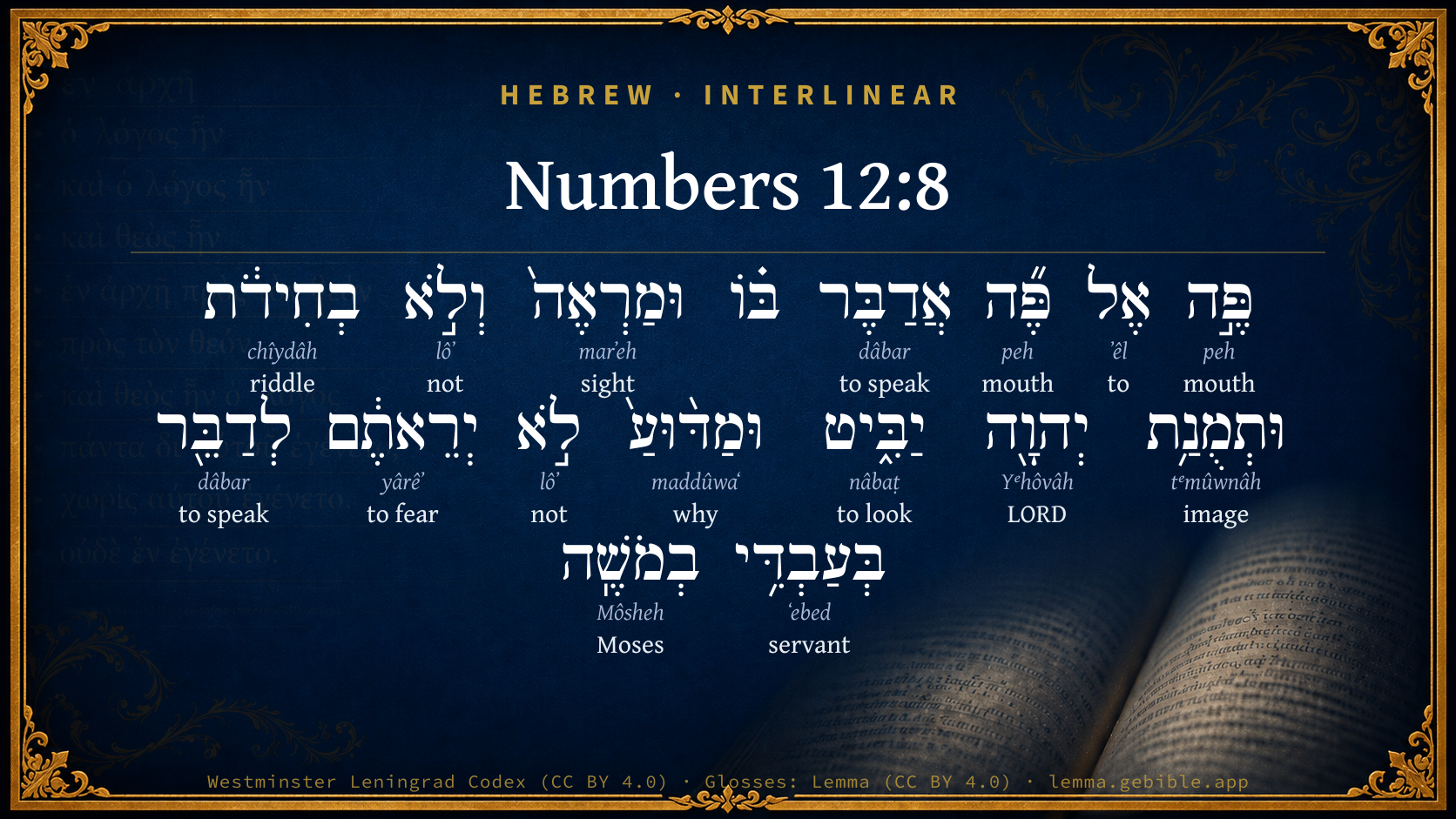
Hebrew (Westminster Leningrad Codex) Numbers 12:8 appears in the Hebrew Old Testament. The text above is from the Westminster Leningrad Codex. Each word links to its Strong’s number, a concise gloss, and parsing drawn from the Open Scriptures Hebrew Bible morphology. Click any word for its full Brown-Driver-Briggs (BDB) entry.
Download image
Cite this verse

Numbers 12:8 (World English Bible). Public Domain. Lemma interlinear Bible study tool, https://lemma.gebible.app/v/numbers/12/8.

Show BibTeX & RIS
BibTeX
RIS
English Translation
with him will I speak mouth to mouth, even manifestly, and not in dark speeches; and the form of Yahweh shall he see: why then were you not afraid to speak against my servant, against Moses?
World English Bible · Public Domain
Highlights
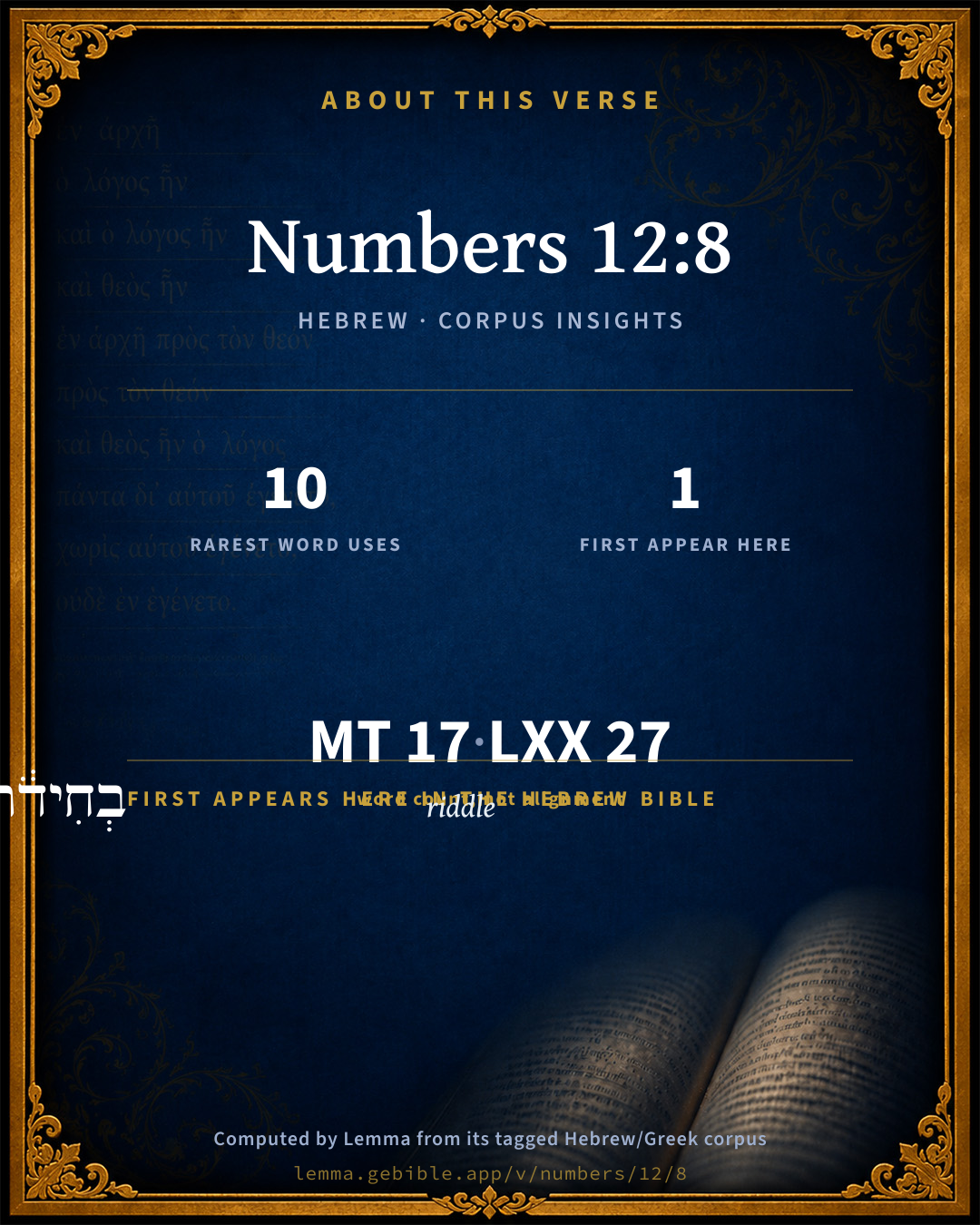
  • 1 first appearance in the Hebrew Bible
Full analysis ↓
Download a study sheet

One document with this verse’s original text, its word-by-word gloss line, the meaning frame, cross-references with their text, attributed commentary, and full source and license credits — printable, and it pastes into notes with its structure intact.

This verse Autodidact and up

Study sheet (.html) Plain text (.txt)

A passage Seminary Student

Up to 50 verses in one chapter. A passage sheet keeps up to 6 commentary sources and 12 cross-references per verse, in the order this page ranks them, and says so on the sheet whenever that leaves anything out. Ask for a single verse and you get the Autodidact verse sheet above.

Everything on this page stays free to read, with no account — the sheet is a download of what is already on screen, not access to it.

Want to remove ads? Support Godless Engineer
Compare translations 3

The same verse in 3 English versions, stacked beneath the original-language interlinear above. Click any original word for its lexicon entry.

Each is an independent rendering of the whole verse — the interlinear is not word-aligned to these translations.

Highlighted words mark where these versions differ — a whole-verse word diff, not a word-by-word alignment.

  • World English Bible Public Domain
    with him will I speak mouth to mouth, even manifestly, and not in dark speeches; and the form of Yahweh shall he see: why then were you not afraid to speak against my servant, against Moses?
  • King James Version Public Domain
    With him will I speak mouth to mouth, even apparently, and not in dark speeches; and the similitude of the LORD shall he behold: wherefore then were ye not afraid to speak against my servant Moses?
  • unfoldingWord Literal Text CC BY-SA 4.0
    Mouth to mouth I speak with him, and appearance and not in riddles, and he looks at the form of Yahweh. And why do you not fear to speak against my servant, against Moses?”

unfoldingWord Literal Text — © unfoldingWord, licensed CC BY-SA 4.0. Word-aligned USFM3 via Door43 (git.door43.org/unfoldingWord/en_ult).

Versions to compare (up to 4)

3 of 4 selected

Show all 18 translations

Every available English version of this verse, each an independent rendering of the whole verse.

  • World English Bible Public Domain
    with him will I speak mouth to mouth, even manifestly, and not in dark speeches; and the form of Yahweh shall he see: why then were you not afraid to speak against my servant, against Moses?
  • Berean Standard Bible Public Domain
    I speak with him face to face, clearly and not in riddles; he sees the form of the LORD. Why then were you unafraid to speak against My servant Moses?”
  • Majority Standard Bible Public Domain
    I speak with him face to face, clearly and not in riddles; he sees the form of the LORD. Why then were you unafraid to speak against My servant Moses?”
  • King James Version Public Domain
    With him will I speak mouth to mouth, even apparently, and not in dark speeches; and the similitude of the LORD shall he behold: wherefore then were ye not afraid to speak against my servant Moses?
  • American Standard Version (1901) Public Domain
    with him will I speak mouth to mouth, even manifestly, and not in dark speeches; and the form of Jehovah shall he behold: wherefore then were ye not afraid to speak against my servant, against Moses?
  • Revised Version (1885) Public Domain
    with him will I speak mouth to mouth, even manifestly, and not in dark speeches; and the form of the LORD shall he behold: wherefore then were ye not afraid to speak against my servant, against Moses?
  • Geneva Bible (1599) Public Domain
    Vnto him will I speake mouth to mouth, and by vision, and not in darke wordes, but hee shall see the similitude of the Lord. Wherefore then were ye not afraid to speake against my seruant, euen against Moses?
  • Douay-Rheims (1899) Public Domain
    For I speak to him mouth to mouth: and plainly, and not by riddles and figures doth he see the Lord. Why then were you not afraid to speak ill of my servant Moses?
  • Young's Literal Translation Public Domain
    mouth unto mouth I speak with him, and `by' an appearance, and not in riddles; and the form of Jehovah he beholdeth attentively; and wherefore have ye not been afraid to speak against My servant -- against Moses?'
  • Literal Standard Version CC BY-SA 4.0
    I speak with him mouth to mouth, || Even [by] an appearance, and not in riddles; And he beholds the form of YHWH attentively. Now why have you not been afraid || To speak against My servant—against Moses?”
  • Unlocked Literal Bible CC BY-SA 4.0
    I speak to Moses directly, not with visions or riddles. He sees my form. So why are you unafraid to speak against my servant, against Moses?”
  • unfoldingWord Literal Text CC BY-SA 4.0
    Mouth to mouth I speak with him, and appearance and not in riddles, and he looks at the form of Yahweh. And why do you not fear to speak against my servant, against Moses?”
  • Darby Bible Public Domain
    Mouth to mouth do I speak to him openly, and not in riddles; and the form of Jehovah doth he behold. Why then were ye not afraid to speak against my servant, against Moses?
  • World Messianic Bible Public Domain
    With him, I will speak mouth to mouth, even plainly, and not in riddles; and he shall see the LORD’s form. Why then were you not afraid to speak against my servant, against Moses?”
  • Webster's Bible Public Domain
    With him will I speak mouth to mouth, even apparently, and not in dark speeches; and the similitude of the LORD shall he behold: why then were ye not afraid to speak against my servant Moses?
  • Free Bible Version CC BY-SA 4.0
    I talk to him personally, face to face. I speak plainly, not in riddles. He sees the likeness of the Lord. So why weren't you afraid when you criticized my servant Moses?”
  • Bible in Basic English Public Domain
    With him I will have talk mouth to mouth, openly and not in dark sayings; and with his eyes he will see the form of the Lord: why then had you no fear of saying evil against my servant Moses?
  • JPS Tanakh (1917) Public Domain
    with him do I speak mouth to mouth, even manifestly, and not in dark speeches; and the similitude of the LORD doth he behold; wherefore then were ye not afraid to speak against My servant, against Moses?'

Literal Standard Version (2020), Covenant Press — licensed CC BY-SA 4.0. Text via the HelloAO Bible API (eBible.org). Unlocked Literal Bible (unfoldingWord) — licensed CC BY-SA 4.0. Text via the HelloAO Bible API (eBible.org). unfoldingWord Literal Text — © unfoldingWord, licensed CC BY-SA 4.0. Word-aligned USFM3 via Door43 (git.door43.org/unfoldingWord/en_ult). Free Bible Version, Dr. Jonathan Gallagher — licensed CC BY-SA 4.0. Text via the HelloAO Bible API (eBible.org).

Word by word

More ways to search: Search by grammar → Find every occurrence → Compare this word →

Practice this passage: Drill this verse → Learn its vocabulary →

וּתְמֻנַ֥ת
tᵉmûwnâh
H8544
“and · image of”
Conjunction + Noun, Common, Feminine, Singular, Construct
Part of Speech
Conjunction + Noun
Type
Common
Gender
Feminine
Number
Singular
State
Construct
Full BDB Definition

Origin: from H4327

TWOT: 1191b

form, image, likeness, representation, semblance
  1. פֶּ֣ה peh H6310 “mouth” Noun, Common, Masculine, Singular, Absolute
  2. אֶל ʼêl H413 “to” Preposition
  3. פֶּ֞ה peh H6310 “mouth” Noun, Common, Masculine, Singular, Absolute
  4. אֲדַבֶּר dâbar H1696 “to speak” Verb, Piel, Imperfect, 1st Person, Common, Singular
  5. וּמַרְאֶה֙ marʼeh H4758 “and · sight” Conjunction + Noun, Common, Masculine, Singular, Absolute
  6. וְלֹ֣א lôʼ H3808 “and · not” Conjunction + Particle, Negative
  7. בְחִידֹ֔ת chîydâh H2420 “in/at · riddles” Preposition + Noun, Common, Feminine, Plural, Absolute
  8. יְהוָ֖ה Yᵉhôvâh H3068 “LORD” Noun, Proper
  9. יַבִּ֑יט nâbaṭ H5027 “to look” Verb, Hiphil, Imperfect, 3rd Person, Masculine, Singular
  10. וּמַדּ֨וּעַ֙ maddûwaʻ H4069 “and · why” Conjunction + Particle, Interrogative
  11. לֹ֣א lôʼ H3808 “not” Particle, Negative
  12. יְרֵאתֶ֔ם yârêʼ H3372 “to fear” Verb, Qal, Perfect, 2nd Person, Masculine, Plural
  13. לְדַבֵּ֖ר dâbar H1696 “to speak” Preposition + Verb, Piel, Infinitive Construct
  14. בְּעַבְדִּ֥י ʻebed H5650 “in/at · servant · my” Preposition + Noun, Common, Masculine, Singular, Construct + Suffix, Personal, 1st Person, Common, Singular
  15. בְמֹשֶֽׁה Môsheh H4872 “in/at · Moses” Preposition + Noun, Proper

About this verse

These counts appear in no published source. They are computed here, from the morphology-tagged text and Lemma’s own curated glosses. What Lemma adds →

17
words
13
distinct lemmas
Pentateuch
section

Notable vocabulary

The rarest word here is וּתְמֻנַ֥ת image H8544 — appearing just 10 times in the whole Hebrew Bible.

First appearance in Scripture

This word makes its first canonical appearance in the Hebrew Bible here:

  • בְחִידֹ֔ת riddle H2420

Shared distinctive vocabulary

וּתְמֻנַ֥ת image H8544 occurs in 10 verses of the Hebrew Bible. Also found in:

Grammatical profile

  • 4 verbs
  • 8 nouns
  • 2 prepositions
  • 3 particles

Verb forms

  • אֲדַבֶּר Piel · Imperfect
  • יַבִּ֑יט Hiphil · Imperfect
  • יְרֵאתֶ֔ם Qal · Perfect
  • לְדַבֵּ֖ר Piel · Infinitive Construct

Repetition

Words recur within this verse — often emphatic in Hebrew:

  • פֶּ֣ה mouth H6310 ×2
  • אֲדַבֶּר to speak H1696 ×2
  • וְלֹ֣א not H3808 ×2

Hebrew & Septuagint length

In English translation the verse runs 36 words from the Hebrew and 35 from the Septuagint (LXX English) — closely comparable.

A rough comparison of the two English renderings, which tokenize alike — not a word-level alignment.

Word counts can differ between the Hebrew and the Greek without any difference in meaning — e.g. the Hebrew direct-object marker אֵת has no separate Greek word, and Greek often adds the article ὁ.

In the original languages it is 17 Hebrew tokens and 27 Greek tokens — but the two are counted differently (Hebrew bundles its prefixes and suffixes into one token; the Greek is in lemma form), so that isn’t a like-for-like length.

Cross-references

31

Topical passages linked to Numbers 12:8 in the Treasury of Scripture Knowledge — connected by theme and wording, ordered by reader-vote popularity; previews shown in the World English Bible.

  • Deuteronomy 34:10 There has not arisen a prophet since in Israel like Moses, whom Yahweh knew face to face,
  • 1 Corinthians 13:12 For now we see in a mirror, dimly, but then face to face. Now I know in part, but then I will know fully, even as I was also fully known.
  • Exodus 33:11 Yahweh spoke to Moses face to face, as a man speaks to his friend. He turned again into the camp, but his servant Joshua, the son of Nun, a young man, didn't depart out of the Tent.
  • Exodus 24:10–11 They saw the God of Israel. Under his feet was like a paved work of sapphire stone, like the skies for clearness.
  • Exodus 33:23 then I will take away my hand, and you will see my back; but my face shall not be seen."
  • Luke 10:16 Whoever listens to you listens to me, and whoever rejects you rejects me. Whoever rejects me rejects him who sent me."
  • John 14:7–10 If you had known me, you would have known my Father also. From now on, you know him, and have seen him."
  • John 15:15 No longer do I call you servants, for the servant doesn't know what his lord does. But I have called you friends, for everything that I heard from my Father, I have made known to you.
  • 2 Corinthians 4:4–6 in whom the god of this world has blinded the minds of the unbelieving, that the light of the Gospel of the glory of Christ, who is the image of God, should not dawn on them.
  • 2 Peter 2:10 but chiefly those who walk after the flesh in the lust of defilement, and despise authority. Daring, self-willed, they are not afraid to speak evil of dignitaries;
  • Psalms 17:15 As for me, I shall see your face in righteousness; I shall be satisfied, when I awake, with seeing your form.
  • John 15:24 If I hadn't done among them the works which no one else did, they wouldn't have had sin. But now have they seen and also hated both me and my Father.
  • 2 Corinthians 3:18 But we all, with unveiled face beholding as in a mirror the glory of the Lord, are transformed into the same image from glory to glory, even as from the Lord, the Spirit.
  • 1 Thessalonians 4:8 Therefore he who rejects doesn't reject man, but God, who has also given his Holy Spirit to you.
  • 1 Timothy 6:16 who alone has immortality, dwelling in unapproachable light; whom no man has seen, nor can see: to whom be honor and eternal power. Amen.
  • Hebrews 1:3 His Son is the radiance of his glory, the very image of his substance, and upholding all things by the word of his power, when he had by himself made purification for our sins, sat down on the right hand of the Majesty on high;
  • Jude 1:8 Yet in like manner these also in their dreaming defile the flesh, despise authority, and slander celestial beings.
  • Exodus 20:4 "You shall not make for yourselves an idol, nor any image of anything that is in the heavens above, or that is in the earth beneath, or that is in the water under the earth:
  • Exodus 34:5–7 Yahweh descended in the cloud, and stood with him there, and proclaimed the name of Yahweh.
  • Deuteronomy 4:15 Take therefore good heed to yourselves; for you saw no manner of form on the day that Yahweh spoke to you in Horeb out of the midst of the fire.
  • Psalms 49:4 I will incline my ear to a proverb. I will open my riddle on the harp.
  • Isaiah 40:18 To whom then will you liken God? or what likeness will you compare to him?
  • Isaiah 46:5 To whom will you liken me, and make me equal, and compare me, that we may be like?
  • Ezekiel 17:2 Son of man, put forth a riddle, and speak a parable to the house of Israel;
  • Ezekiel 20:49 Then said I, Ah Lord Yahweh! they say of me, Isn't he a speaker of parables?
  • Matthew 13:35 that it might be fulfilled which was spoken through the prophet, saying, "I will open my mouth in parables; I will utter things hidden from the foundation of the world."
  • John 1:18 No one has seen God at any time. The one and only Son, who is in the bosom of the Father, he has declared him.
  • Exodus 33:19 He said, "I will make all my goodness pass before you, and will proclaim the name of Yahweh before you. I will be gracious to whom I will be gracious, and will show mercy on whom I will show mercy."
  • Exodus 34:30 When Aaron and all the children of Israel saw Moses, behold, the skin of his face shone; and they were afraid to come near him.
  • Numbers 14:14 and they will tell it to the inhabitants of this land. They have heard that you Yahweh are in the midst of this people; for you Yahweh are seen face to face, and your cloud stands over them, and you go before them, in a pillar of cloud by day, and in a pillar of fire by night.
  • Colossians 1:15 who is the image of the invisible God, the firstborn of all creation.

Cross-references courtesy of OpenBible.info (CC BY 4.0).

Hebrew and Greek witnesses Masoretic Hebrew ↔ Greek Septuagint

The same verse in the two great witnesses to the Old Testament, shown verse-for-verse.

These are two independent witnesses, not word-aligned to each other, and the Septuagint is shown in lemma (dictionary) form.

Hebrew Numbers 12:8 Masoretic · Westminster Leningrad Codex

פֶּ֣ה אֶל פֶּ֞ה אֲדַבֶּר בּ֗וֹ וּמַרְאֶה֙ וְלֹ֣א בְחִידֹ֔ת וּתְמֻנַ֥ת יְהוָ֖ה יַבִּ֑יט וּמַדּ֨וּעַ֙ לֹ֣א יְרֵאתֶ֔ם לְדַבֵּ֖ר בְּעַבְדִּ֥י בְמֹשֶֽׁה

with him will I speak mouth to mouth, even manifestly, and not in dark speeches; and the form of Yahweh shall he see: why then were you not afraid to speak against my servant, against Moses?

World English Bible · Public Domain

Greek LXX Numbers 12:8 Septuagint · lemma form

στόμα κατά στόμα λαλέω αὐτός ἐν εἶδος καί οὐ διά αἴνιγμα καί ὁ δόξα κύριος ὁράω καί διά τίς οὐ φοβέω καταλαλέω κατά ὁ θεράπων ἐγώ μωυσῆς

I will speak to him mouth to mouth apparently, and not in dark speeches; and he has seen the glory of the Lord; and why were you⌃ not afraid to speak against my servant Moses?

LXX2012 (modern English Septuagint) · Public Domain

On this verse, The Pulpit Commentary discusses the Septuagint’s reading. Read the note in Commentary ↓

Hebrew: Westminster Leningrad Codex (CC BY 4.0). Greek: Septuagint (public domain); English from LXX2012 (modern English Septuagint) (Public Domain). How the Septuagint differs from the Hebrew →

Targum (Aramaic paraphrase)

2

The Targum is the ancient Jewish Aramaic paraphrase of the Hebrew Scriptures — an interpretive translation, not the Hebrew text itself. Onkelos (literal) and Pseudo-Jonathan (expansive) render the Torah, and Jonathan the Prophets. Coverage is partial: where no permissively-licensed English translation exists for a verse, only the Aramaic is shown. This is verse-level text, not a word-by-word alignment to the Hebrew.

  1. Targum Onkelos Torah (Genesis–Deuteronomy)
    מַמְלַל עִם מַמְלַל מַלֶלְנָא עִמֵהּ בְּחֵזוּ וְלָא בְחִדְוָן וּדְמוּת יְקָרָא דַיְיָ מִסְתַּכַּל וּמָא דֵין לָא דְחֶלְתּוּן לְמַלָלָא בְּעַבְדִי בְמשֶׁה

    (no public-domain English translation for this verse)

    Targum Onkelos — Aramaic: “Onkelos Genesis” (public domain); “Onkelos Exodus” (public domain); “Onkelos Leviticus” (public domain); “Onkelos Numbers” (public domain); “Onkelos Deuteronomy” (public domain). English: “Sefaria Community Translation” (CC0 1.0 (public-domain dedication)); “J.W. Etheridge. The Targums of Onkelos and Jonathan Ben Uzziel on the Pentateuch. London: Longmans, Green, 1862” (public domain). Text via Sefaria.

  2. Targum Pseudo-Jonathan Torah (Genesis–Deuteronomy)
    מַמְלַל עִם מַמְלַל מַלֵילִית עִמֵיהּ דְיִתְפְּרַשׁ מִתַּשְׁמִישׁ דְעָרִיס וְחֵיזוּ וְלָא בְּטוּמְרָא מִתְגְלֵינָא לֵיהּ בְּאַסָנָא וּדְמוּ דְבָתַר שְׁכִינְתִּי חָזֵי וּמָא דֵין לָא דְחַלְתּוּן לְאִשְׁתְּעוֹיֵי כַּהֲלֵין מִלַיָא בְּעַבְדִי בְמשֶׁה

    Speaker with speaker have I spoken with him, who hath separated himself from the married life; but in vision, and not with mystery, revealed I Myself to him at the bush, and he beheld the likeness of My Shekinah. And why have you not feared to speak such words of My servant Mosheh?

    Targum Pseudo-Jonathan — Aramaic: “Targum Jonathan on Genesis” (public domain); “Targum Jonathan on Exodus” (public domain); “Targum Jonathan on Leviticus” (public domain); “Targum Jonathan on Numbers” (public domain); “Targum Jonathan on Deuteronomy” (public domain). English: “The Targum of Jonathan ben Uzziel, trans. J. W. Etheridge, London, 1862” (public domain). Text via Sefaria.

Commentary

Notes on Numbers 12:8 from classic Christian and Jewish commentators (each source and its license shown beneath its notes). The classic Christian expositions comment on the surrounding passage and are grouped to its opening verse, so a note may address several verses; the Jewish commentaries on the Tanakh (Rashi and others) are per-verse, so they appear only where the commentator wrote on this verse.

Lemma curates 59 commentaries, every one of them public domain or Creative Commons licensed, each selected and text-cleaned for this edition rather than reprinted as found. About our sources →

Trapp's Complete Commentary

John Trapp

Num 12:8 With him will I speak mouth to mouth, even apparently, and not in dark speeches; and the similitude of the LORD shall he behold: wherefore then were ye not afraid to speak against my servant Moses?

Ver. 8. And the similitude.] {See Trapp on "Exo 33:20"}

John Trapp, A Commentary or Exposition upon All the Books of the Old and New Testament (1647–1656) — public domain. Text from a community e-Sword module.

Joseph Benson's Commentary

Num 12:8. Mouth to mouth — In a most familiar manner, distinctly, and by an articulate voice, as one friend discourses with another, or as two friends in conversation hear and answer each other by turns. Moses enjoyed this singular privilege, which was vouchsafed to no other of the prophets, that God spoke to him immediately, and not by an interpreter, nor by shadows, and representations in his fancy, as in visions and dreams, but by a distinct audible voice, and that upon all occasions. Even apparently — Plainly and certainly, so that there was no difficulty to apprehend his meaning. Not in dark speeches — Not in parables, similitudes, dark resemblances; as by showing a boiling pot and an almond-tree to Jeremiah; a basket of summer fruits to Amos; a chariot with wheels, &c., to Ezekiel. The similitude — Not the face or essence of God, which no man can see and live, (Exo 33:20,) but some singular manifestation of his glorious presence, as that spoken of Exo 33:11-23. Yea, the Son of God, it seems, appeared to him in a human shape, which he assumed for a time, that he might give Moses a fore-token of his future incarnation. Against my servant Moses — Who is such in so eminent and extraordinary a manner and degree.

Joseph Benson's Commentary on the Old and New Testaments (1811–1818) — public domain. Text from a community e-Sword module.

Geneva Bible (1599)

Geneva Bible translators

So far as any man was able to comprehend, which he calleth his back parts, Exod. 33:23.

Geneva Bible (1599) marginal notes — public domain. Text via Bolls.life.

Jamieson, Fausset & Brown

Robert Jamieson, A. R. Fausset & David Brown

with him will I speak mouth to mouth--immediately, not by an interpreter, nor by visionary symbols presented to his fancy.

apparently--plainly and surely.

not in dark speeches--parables or similitudes.

the similitude of the Lord shall he behold--not the face or essence of God, who is invisible (Exo 33:20; Col 1:15; Joh 1:18); but some unmistakable evidence of His glorious presence (Exo 33:2; Exo 34:5). The latter clause should have been conjoined with the preceding one, thus: "not in dark speeches, and in a figure shall he behold the Lord." The slight change in the punctuation removes all appearance of contradiction to Deu 4:15.

Jamieson, Fausset & Brown — Commentary Critical and Explanatory on the Whole Bible (1871) — public domain (CC PDM 1.0). Text via the HelloAO Bible API.

Ellicott's Commentary for English Readers

(8) With him will I speak.—Better, do I speak, mouth to mouth. Comp. Exo_33:11.

Even apparently.—The noun mareh, which is here used, is cognate with that which occurs with the preposition in Num_12:6, and which is rendered “a vision.” It differs from it only in punctuation, and is sometimes identical in meaning. It appears, however, here to denote an objective reality, as in Exo_3:3, where it is rendered sight. The clause might be rendered, and (as) an appearance, and not in riddles (or, enigmas).

And the similitude of the Lord . . . —Or, and the form of Jehovah doth he behold. The word which is here rendered similitude (temunah) is the same which occurs in Exo_20:4; Deu_4:15-16; Deu_4:23; Deu_4:25; Deu_5:8; Psa_17:15. It is sometimes rendered likeness, and sometimes similitude. The noun mareh, which is here rendered “apparently,” and that which is rendered similitude, are found in conjunction in Job_4:16 : “I could not discern the form (or appearance), mareh, thereof: an image (or form), temunah, was before mine eyes.” (Comp. Exo_33:20-23.)

A Bible Commentary for English Readers, edited by Charles John Ellicott (1878–1897) — public domain. Text from a community e-Sword module.

The Cambridge Bible for Schools and Colleges

gen. ed. J. J. S. Perowne

8. even manifestly] This is not a translation of the Heb., which is corrupt. It is the sort of meaning required, but no satisfactory emendation has been proposed. The versions suggest בְּמַרְאֶה (for וּמַרְאֶה), which could perhaps mean ‘in appearance,’ i.e. in a personal manifestation.

and not in riddles] A reference to the enigmatical utterances of oracles.

The Cambridge Bible for Schools and Colleges (gen. ed. J. J. S. Perowne; Cambridge University Press, 1878–1918) — public domain. Text from a community e-Sword module.

John Gill's Exposition

With him will I speak mouth to mouth,.... And face to face, as he had done, Exo 33:11; in a free, friendly, and familiar manner, as one friend speaks to another, without injecting any fear or dread, and consternation of mind, which was sometimes the case of the prophets; or without a middle person, a mediator, as Aben Ezra, not by means of an angel, as in some cases, but the Lord himself spake to him:

even apparently, and not in dark speeches; the word "apparently", or "vision", being opposed to "dark speeches", shows that this is not to be understood of the appearance or vision of an object presented to the sight, or to the mind, which is denied of Moses, though usual with other prophets; but of the vision, or plain sense and meaning of words, which are so plainly expressed, that the sense is easily seen and understood; it was not under figures and allegories, and parables and dark representations of things, that the law of the decalogue, and other laws, statutes, and ordinances, and the proclamation the Lord made of himself, as the Lord gracious, merciful, &c. were delivered unto Moses, but in plain words and clear expressions; not in such enigmatical, parabolical, and allegorical terms as many of the visions and prophecies of Jeremiah, Ezekiel, Daniel, Amos, and Zechariah, were exhibited to them; See Gill on Num 12:6,

and the similitude of the Lord shall he behold: as he had at the burning bush, and at Mount Sinai, with the elders of Israel, and when the Lord proclaimed his name before him; at which several times it is highly probable he beheld the Lord, even the Lord Christ, in an human form, as a presage of his future incarnation, and as he might also after this: the Targum of Jonathan is,"the similitude which is after my Shechinah (or divine Majesty) he saw;''that is, his back parts, as Jarchi, and other Jewish writers, interpret it; but Bishop Patrick thinks the word not should be repeated from the preceding clause, and that the sense is, that he did not behold him in similitudes, nor did the Lord speak to him by them, as to other prophets, see Hos 12:10,

wherefore then were ye not afraid to speak against my servant Moses? or against my servant, against Moses; against any servant of mine, but especially against Moses, so faithful in my house, so much approved of and honoured by me, and so superior to all other prophets.

John Gill's Exposition of the Whole Bible (1746–1763) — public domain (CC PDM 1.0). Text via the HelloAO Bible API.

Matthew Poole's English Annotations

Mouth to mouth, i.e. distinctly, by an articulate voice; immediately, not by an interpreter, nor by shadows and representations in his fancy, as it is in visions and dreams; and familiarly. This is called speaking face to face, 2Jo 1:12; 3Jo 1:14.

Apparently; plainly and certainly. Not in dark speeches; not in parables, similitudes, riddles, dark resemblances; as by showing a boiling pot, an almond tree, &c. to Jeremiah, a chariot with wheels, &c. to Ezekiel.

The similitude of the Lord; not the face or essence of God, which no man can see and live, Exo 33:20; it being invisible, Col 1:15, and never seen by man, Joh 1:18; but some singular manifestation of his glorious presence, as Exo 33:11,20, &c.; Exo 34:5, &c.; Deu 34:10. Yea, the Son of God appeared to him in a human shape, which he took up for a time, that he might give him a foretaste of his future incarnation.

My servant; who is so in such an eminent and extraordinary manner.

Matthew Poole's English Annotations on the Holy Bible (1683–1685) — public domain. Text from a community e-Sword/MySword module.

Whedon's Commentary on the Bible

Daniel D. Whedon

8. Mouth to mouth — This answers to “face to face” in Exo_33:11. It implies great familiarity, mutual confidence and esteem, and the absence of all reserve and of any mediation. Such converse is the highest honour bestowed upon man under the Old Testament dispensation.

Even apparently — Literally, as an appearance; R.V., “manifestly,” implying sight, or rather insight, and not vision. Dreams and visions are subjective; that is, pertain to the internal perception of the thinking subject. But the phenomena attending the intercourse of Jehovah with Moses were not intuitive and subjective, but objective; that is, outward and addressing the senses.

Dark speeches — Riddles or enigmas. These are a test to one on probation who is not yet approved and taken into the fullest confidence. Moses was treated as a man of fixed fidelity who had passed his probation.

The similitude of the Lord — The form of Jehovah was not the essential nature of God, his unveiled glory, for this no mortal can see, (Exo_33:18-20,) “but some unmistakable evidence of his glorious presence.” — Bible Commentary. He talked with Moses without figure, addressing his spiritual intuitions in such a way as to give to him infallible certainty. Thus since the day of Pentecost, Jesus manifests himself to the advanced believer. Joh_14:21, note. “Here (in Num_12:2-8) we have, as it were, in epitome, the mystery of the prophetic gift and function; and in such a manner as to exhibit the strength of this credential most impressively. It is the voice of Jehovah, jealous of his own honour and of the honour of his servants, at once describing and defending the prophetic law of revelation.” — W.B. Pope.

Were ye not afraid — In view of the extraordinary honour which God had bestowed upon Moses they should have restrained all murmuring and envious words.

Daniel D. Whedon (gen. ed.), Commentary on the Old and New Testaments (1874–1909) — public domain. Text from a community e-Sword module.

The Pulpit Commentary

Mouth to mouth. Equivalent to face to face in Exo_33:11. What the exact facts of the case were it is not possible to know, scarcely to imagine; but the words seem to imply a familiar speaking with an audible voice on the part of God, as distinguished from the internal voice, inaudible to the ear, with which he spake "in" the prophets. To assert that the revelations accorded to Moses were only subjective modifications of his own consciousness is to evacuate these strong words of any meaning whatever. Apparently. harm (Septuagint en eidei ) is an accusative in apposition to what goes before by way (apparently) of further definition. It is the same word translated "vision" in verse 6; but its meaning here must be determined by the expression "in riddles," which stands in antithesis to it. It was confessed]y the case with most prophetic utterances that the language in which they were couched was quite as much intended to conceal as to express their full meaning; but to Moses God spake without any such concealments. The similitude of the Lord shall he behold. harm. Not the essential nature of God, which no man can see, but a form (wholly unknown and unimaginable to us) in which it pleased him to veil his glory. The Septuagint has thxan Kuriou eide , referring, apparently, to the vision promised in Exo_33:22; and the Targum Palestine speaks here of the vision of the burning bush. The motive for this alteration is no doubt to be sought in a profound jealousy for the great truth declared in such texts as Deu_4:15 Isa_40:18, and afterwards in Joh_1:18 1Ti_6:16. But the statement in the text is a general one, and can only mean that Moses habitually in his intercourse with God had before his eyes some visible manifestation of the invisible God, which helped to make that intercourse at once more awfully real and more intensely blessed. Such manifestation to the sense of sight must be distinguished both from the visionary (or subjective) sight of God in human figure accorded to Ezekiel, (Eze_1:26) to Isaiah, (Isa_6:1) to St. John, (Rev_4:2, Rev_4:8) and perhaps to others, and also from such theophanies in angel guise as are recorded in Gen_32:30 Jud_1:13:9, 2, and elsewhere. On the other hand, the seventy elders seem to have seen the "Temunah" of the Lord upon that one occasion when they were called up into Mount Sinai. (Exo_24:10, Exo_24:11) Wherefore then were ye not afraid to speak against my servant Moses! No doubt it was the double fact of their relationship to Moses after the flesh, and of their sharing with him in certain spiritual gifts and prerogatives, which made them oblivious of the great distinction which lifted him above their rivalry, and should have lifted him above their contradiction. That contradiction, however, served to bring out in the clearest way the singular and unapproached position of the mediator of Israel; and it serves still to enable us to estimate aright the peculiar dignity of his legislation and his writings. The substance of prophetic teaching may be of deeper interest and of wider import titan "the law," but this latter will still rank higher in the scale of inspiration, as having been more directly communicated front on high. Thus "the law" (as the Jews rightly taught) remained the body of Divine revelation until "that Prophet" came who was "like unto" Moses in the fact that he enjoyed constant, open, and direct communication with the Godhead.

The Pulpit Commentary (1880–1919), ed. H.D.M. Spence-Jones & Joseph S. Exell — public domain. Text from a community e-Sword module.

John Wesley's Explanatory Notes

Mouth to mouth - That is, distinctly, by an articulate voice; immediately, not by an interpreter, nor by shadows and representations in his fancy, as it is in visions and dreams; and familiarly. Apparently - Plainly and certainly. Dark speeches - Not in parables, similitudes, dark resemblances; as by shewing a boiling pot, an almond tree, &c. to Jeremiah, a chariot with wheels, &c. to Ezekiel. The similitude - Not the face or essence of God, which no man can see and live, Exod. xxxiii, 20, but some singular manifestation of his glorious presence, as Exod. xxxiii, 11, 20. Yea the Son of God appeared to him in an human shape, which he took up for a time, that he might give him a foretaste of his future incarnation. My servant - Who is so in such an eminent and extraordinary manner.

John Wesley, Explanatory Notes Upon the Whole Bible (1754–1765) — public domain. Text via the GEBible commentary corpus.

Rashi

Rabbi Shlomo Yitzchaki (Rashi)

פה אל פה MOUTH TO MOUTH [I HAVE SPOKEN WITH HIM] — I have Myself told him to separate from his wife. And where did I tell him this? On Sinai, when I said to him, (Deuteronomy 5:27 Deuteronomy 5:28) “Go, say to them (to the people), ‘Get you into your tents (rejoin your wives). But as for thee, remain thou here by Me, [and I will speak unto thee]’” (Shabbat 87a; cf. Sifrei Bamidbar 103).

ומראה ולא בחידת AND IN A מראה AND NOT IN RIDDLES — When it says מראה, this refers to the clearness of the Divine communication, i.e. that I express My communication unto him in the clearest form in which it can be put and do not obscure it in riddles, as e.g. was the manner in which it was said to Ezekiel: (Ezekiel 17:2), “Put forth a riddle etc.” — One might, however, think that it refers to the “appearance of the Shechinah” (i.e. that he saw God)! It, however, states, (Exodus 33:20) “Thou cannot see My face” (Sifrei Bamidbar 103).

ותמנת ה' יביט AND THE SIMILITUDE OF THE LORD DID HE BEHOLD — This refers to beholding the after-effects of God’s Providence, just as it is stated, (Exodus 33:22 Exodus 33:23) “[And it shall be when My glory passeth by] thou shalt see what is behind Me” (Sifrei Bamidbar 103).

בעבדי במשה [WHY WERE YE NOT AFRAID TO SPEAK] AGAINST MY SERVANT, AGAINST MOSES — It does not state “against My servant Moses”, but “against My servant, against Moses”, which suggests: why were ye not afraid to speak against My servant, even though he were not a Moses; and why were ye not afraid to speak against a Moses — even though he were not My servant — in either of these cases you ought to have feared him! How much the more ought you to be afraid to speak against him (Moses) he being also My servant — and the servant of a king is a king (a noble person) himself! You should have said: The King does not love him without reason! — But if you reply that I am not cognizant of his doings (i. e. that I love him though he does not deserve it, since I am not aware of his treatment of his wife) — then this statement is even worse than your previous one (Midrash Tanchuma, Tzav 13; cf. Sifrei Bamidbar 103).

Rashi on the Tanakh — English translations: “The Judaica Press complete Tanach with Rashi, translated by A. J. Rosenberg” (CC BY 4.0); “Pentateuch with Rashi's commentary by M. Rosenbaum and A.M. Silbermann, 1929-1934” (public domain); “The Metsudah Tanach series, Lakewood, N.J” (CC BY 4.0); and “The Book of Joshua, Metsudah Publications, 1997” (CC BY 4.0). Text via Sefaria.

Sforno

Rabbi Ovadia Sforno

So why are you not afraid. It is inescapable that this was morally reprehensible. For if you thought that I do not know his deeds, then you thought I made a mistake, and that I favor wicked people. This is the opposite of what you should have thought, for I would not have lifted him up to this level unless he is worthy. Therefore, you should have feared speaking about such a person. And if you thought that I do not know his deeds, and that you know more about him that I do, because I thought he was worthy and it is not so, then you have accused Me of making a mistake in even stronger terms. Concerning this the Sages said: This (statement) is worse than the first.

Sforno on the Tanakh — English translation: “Yalkut, Sifsei Chachomim Chumash, Metsudah Publications, 2009” (CC BY 4.0). Text via Sefaria.

Lesson kit

Teaching starters — assembled from the data on this page, not authored interpretation. Every prompt links to the verse data it draws on. Edit before teaching.

Numbers, in the Pentateuch, opens this verse with 17 words (13 distinct Hebrew lemmas). Its most distinctive word is tᵉmûwnâh (“image”). A historical commentator’s framing appears above. Read the whole chapter for the surrounding context.

Discussion questions

  1. What does “image” (tᵉmûwnâh) contribute to the verse as a whole?
  2. This is the first place “riddle” appears in Scripture (first appears here). What does its debut here establish?
  3. How does Exodus 20:4, which shares the word «image», read alongside this verse?
  4. What does the repetition of “mouth” (2× in this one verse) do in this verse?
  5. The translations on this page render this verse differently — a whole-verse word diff, not a word-by-word alignment. What might account for the different wordings?
  6. «אֲדַבֶּר» is a Piel Imperfect verb. How does that grammatical form shape the action described?
  7. Compare how Trapp's Complete Commentary and Joseph Benson's Commentary read this verse. Where do they agree or differ?

Things to notice

Reading settings

Reading text

Shown beneath each verse's original-language words.

Old Testament
Old Testament edition

Read the OT as the Masoretic Hebrew (MT) or the Greek Septuagint (LXX).

English shown for the Greek Septuagint (in the Hebrew ↔ Greek comparison).

Comparing translations? Open the Compare panel on any verse page to stack up to four side by side.