
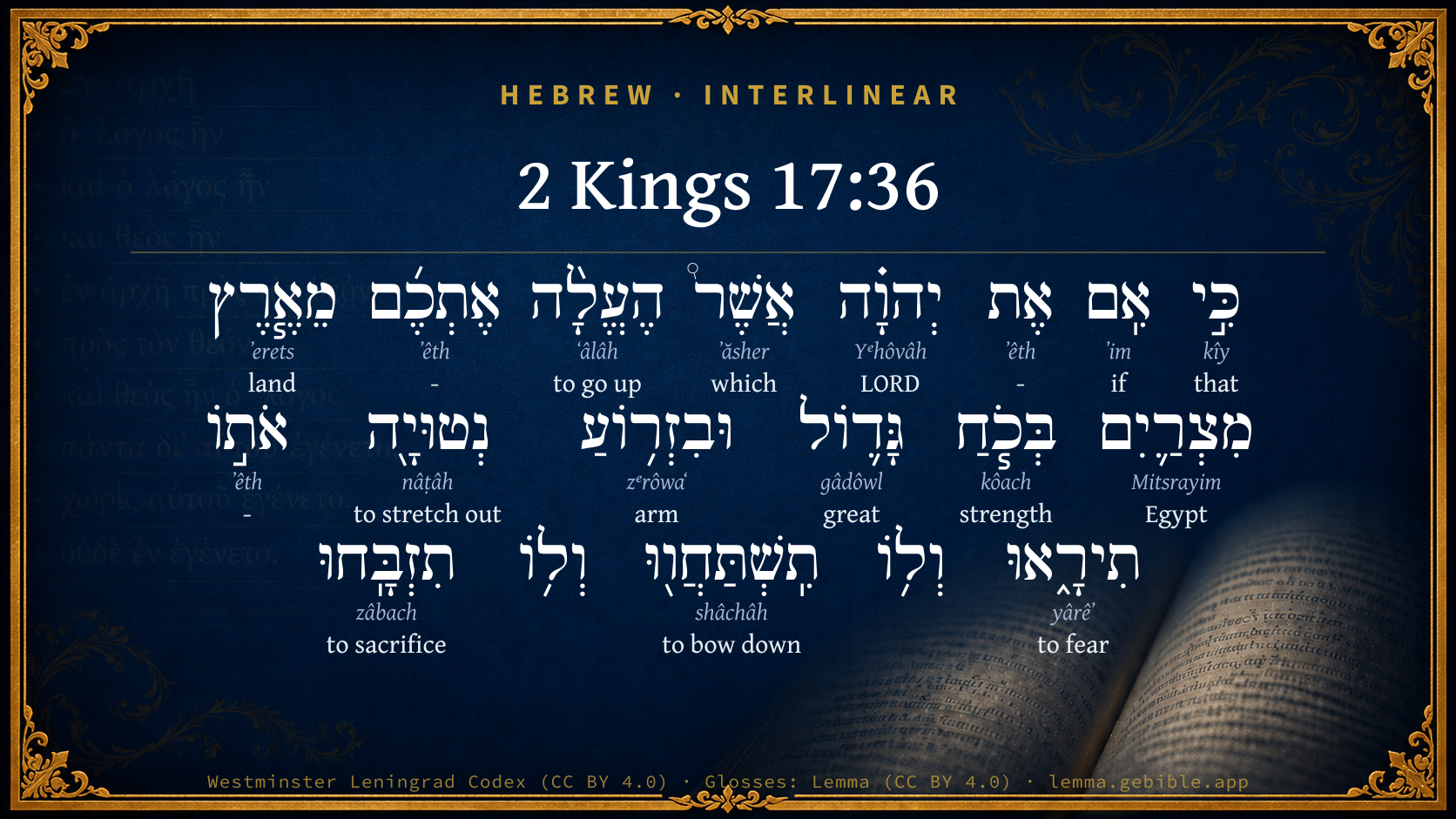
2 Kings 17:36

Hebrew (Westminster Leningrad Codex) 2 Kings 17:36 appears in the Hebrew Old Testament. The text above is from the Westminster Leningrad Codex. Each word links to its Strong’s number, a concise gloss, and parsing drawn from the Open Scriptures Hebrew Bible morphology. Click any word for its full Brown-Driver-Briggs (BDB) entry.
Download image
Cite this verse

2 Kings 17:36 (World English Bible). Public Domain. Lemma interlinear Bible study tool, https://lemma.gebible.app/v/2-kings/17/36.

Show BibTeX & RIS
BibTeX
RIS
English Translation
but Yahweh, who brought you up out of the land of Egypt with great power and with an outstretched arm, him shall you fear, and to him shall you bow yourselves, and to him shall you sacrifice:
World English Bible · Public Domain
Download a study sheet

One document with this verse’s original text, its word-by-word gloss line, the meaning frame, cross-references with their text, attributed commentary, and full source and license credits — printable, and it pastes into notes with its structure intact.

This verse Autodidact and up

Study sheet (.html) Plain text (.txt)

A passage Seminary Student

Up to 50 verses in one chapter. A passage sheet keeps up to 6 commentary sources and 12 cross-references per verse, in the order this page ranks them, and says so on the sheet whenever that leaves anything out. Ask for a single verse and you get the Autodidact verse sheet above.

Everything on this page stays free to read, with no account — the sheet is a download of what is already on screen, not access to it.

Want to remove ads? Support Godless Engineer
Compare translations 3

The same verse in 3 English versions, stacked beneath the original-language interlinear above. Click any original word for its lexicon entry.

Each is an independent rendering of the whole verse — the interlinear is not word-aligned to these translations.

Highlighted words mark where these versions differ — a whole-verse word diff, not a word-by-word alignment.

  • World English Bible Public Domain
    but Yahweh, who brought you up out of the land of Egypt with great power and with an outstretched arm, him shall you fear, and to him shall you bow yourselves, and to him shall you sacrifice:
  • King James Version Public Domain
    But the LORD, who brought you up out of the land of Egypt with great power and a stretched out arm, him shall ye fear, and him shall ye worship, and to him shall ye do sacrifice.
  • unfoldingWord Literal Text CC BY-SA 4.0
    except Yahweh, who brought you up from the land of Egypt with great power and an outstretched arm. You shall fear him, and you shall prostrate yourselves to him, and you shall sacrifice to him.

unfoldingWord Literal Text — © unfoldingWord, licensed CC BY-SA 4.0. Word-aligned USFM3 via Door43 (git.door43.org/unfoldingWord/en_ult).

Versions to compare (up to 4)

3 of 4 selected

Show all 18 translations

Every available English version of this verse, each an independent rendering of the whole verse.

  • World English Bible Public Domain
    but Yahweh, who brought you up out of the land of Egypt with great power and with an outstretched arm, him shall you fear, and to him shall you bow yourselves, and to him shall you sacrifice:
  • Berean Standard Bible Public Domain
    Instead, worship the LORD, who brought you out of the land of Egypt with great power and an outstretched arm. You are to bow down to Him and offer sacrifices to Him.
  • Majority Standard Bible Public Domain
    Instead, worship the LORD, who brought you out of the land of Egypt with great power and an outstretched arm. You are to bow down to Him and offer sacrifices to Him.
  • King James Version Public Domain
    But the LORD, who brought you up out of the land of Egypt with great power and a stretched out arm, him shall ye fear, and him shall ye worship, and to him shall ye do sacrifice.
  • American Standard Version (1901) Public Domain
    but Jehovah, who brought you up out of the land of Egypt with great power and with an outstretched arm, him shall ye fear, and unto him shall ye bow yourselves, and to him shall ye sacrifice:
  • Revised Version (1885) Public Domain
    but the LORD, who brought you up out of the land of Egypt with great power and with a stretched out arm, him shall ye fear, and unto him shall ye bow yourselves, and to him shall ye sacrifice:
  • Geneva Bible (1599) Public Domain
    But feare the Lord which brought you out of the land of Egypt with great power, and a stretched out arme: him feare ye, and worshippe him, and sacrifice to him.
  • Douay-Rheims (1899) Public Domain
    But the Lord your God, who brought you out of the land of Egypt with great power, and a stretched out arm, him shall you fear, and him shall you adore, and to him shall you sacrifice.
  • Young's Literal Translation Public Domain
    but Jehovah who brought you up out of the land of Egypt with great power, and with a stretched-out arm, Him ye do fear, and to Him ye bow yourselves, and to Him ye do sacrifice;
  • Literal Standard Version CC BY-SA 4.0
    but YHWH who brought you up out of the land of Egypt with great power, and with an outstretched arm, Him you fear, and to Him you bow yourselves, and to Him you sacrifice;
  • Unlocked Literal Bible CC BY-SA 4.0
    But Yahweh, who brought you up from the land of Egypt with great power and a raised arm, is the one you must honor; it is to him that you will prostrate yourselves, and it is to him that you will sacrifice.
  • unfoldingWord Literal Text CC BY-SA 4.0
    except Yahweh, who brought you up from the land of Egypt with great power and an outstretched arm. You shall fear him, and you shall prostrate yourselves to him, and you shall sacrifice to him.
  • Darby Bible Public Domain
    but Jehovah alone, who brought you up out of the land of Egypt with great power and a stretched-out arm, him shall ye fear, and him shall ye worship, and to him shall ye do sacrifice.
  • World Messianic Bible Public Domain
    but you shall fear the LORD, who brought you up out of the land of Egypt with great power and with an outstretched arm, and you shall bow yourselves to him, and you shall sacrifice to him.
  • Webster's Bible Public Domain
    But the LORD, who brought you out of the land of Egypt with great power and an out-stretched arm, him shall ye fear, and him shall ye worship, and to him shall ye do sacrifice.
  • Free Bible Version CC BY-SA 4.0
    You must worship only the Lord, who led you out of Egypt, helping you with his great power and strong arm. Only bow down to him; only offer sacrifices to him.
  • Bible in Basic English Public Domain
    But the Lord, who took you out of the land of Egypt with his great power and his outstretched arm, he is your God, to whom you are to give worship and make offerings:
  • JPS Tanakh (1917) Public Domain
    but the LORD, who brought you up out of the land of Egypt with great power and with an outstretched arm, Him shall ye fear, and Him shall ye worship, and to Him shall ye sacrifice;

Literal Standard Version (2020), Covenant Press — licensed CC BY-SA 4.0. Text via the HelloAO Bible API (eBible.org). Unlocked Literal Bible (unfoldingWord) — licensed CC BY-SA 4.0. Text via the HelloAO Bible API (eBible.org). unfoldingWord Literal Text — © unfoldingWord, licensed CC BY-SA 4.0. Word-aligned USFM3 via Door43 (git.door43.org/unfoldingWord/en_ult). Free Bible Version, Dr. Jonathan Gallagher — licensed CC BY-SA 4.0. Text via the HelloAO Bible API (eBible.org).

Word by word

More ways to search: Search by grammar → Find every occurrence → Compare this word →

Practice this passage: Drill this verse → Learn its vocabulary →

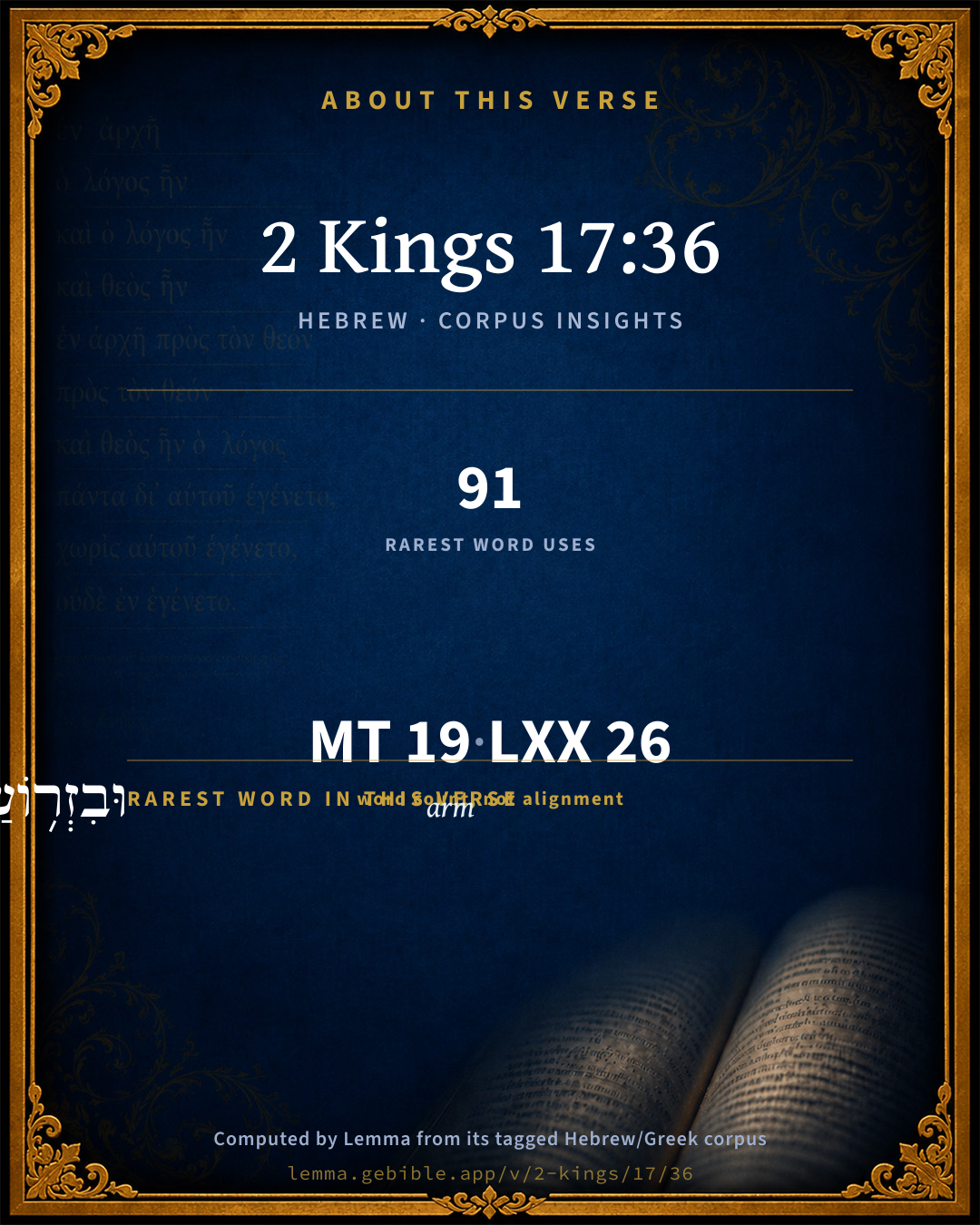
וּבִזְר֥וֹעַ
zᵉrôwaʻ
H2220
“and · in/at · arm”
Conjunction + Preposition + Noun, Common, Both, Singular, Absolute
Part of Speech
Conjunction + Preposition + Noun
Type
Common
Gender
Both
Number
Singular
State
Absolute
Full BDB Definition

Origin: from H2232

TWOT: 583a

arm, forearm, shoulder, strength - arm - arm (as symbol of strength) - forces (political and military) - shoulder (of animal sacrificed)
  1. כִּ֣י kîy H3588 “that” Conjunction
  2. אִֽם ʼim H518 “if” Conjunction
  3. אֶת ʼêth H853 “-” Particle, Direct Object
  4. יְהוָ֗ה Yᵉhôvâh H3068 “LORD” Noun, Proper
  5. אֲשֶׁר֩ ʼăsher H834 “which” Particle, Relative
  6. הֶעֱלָ֨ה ʻâlâh H5927 “to go up” Verb, Hiphil, Perfect, 3rd Person, Masculine, Singular
  7. אֶתְכֶ֜ם ʼêth H853 “- · you” Particle, Direct Object + Suffix, Personal, 2nd Person, Masculine, Plural
  8. מֵאֶ֧רֶץ ʼerets H776 “from · land of” Preposition + Noun, Common, Both, Singular, Construct
  9. מִצְרַ֛יִם Mitsrayim H4714 “Egypt” Noun, Proper
  10. בְּכֹ֧חַ kôach H3581 “in/at · strength” Preposition + Noun, Common, Masculine, Singular, Absolute
  11. גָּד֛וֹל gâdôwl H1419 “great” Adjective, Adjective, Masculine, Singular, Absolute
  12. נְטוּיָ֖ה nâṭâh H5186 “stretched out” Verb, Qal, Participle Passive, Feminine, Singular, Absolute
  13. אֹת֣וֹ ʼêth H853 “- · him” Particle, Direct Object + Suffix, Personal, 3rd Person, Masculine, Singular
  14. תִירָ֑אוּ yârêʼ H3372 “to fear” Verb, Qal, Imperfect, 2nd Person, Masculine, Plural
  15. תִֽשְׁתַּחֲו֖וּ shâchâh H7812 “to bow down” Verb, Hishtaphel, Imperfect, 2nd Person, Masculine, Plural
  16. תִזְבָּֽחוּ zâbach H2076 “to sacrifice” Verb, Qal, Imperfect, 2nd Person, Masculine, Plural

About this verse

These counts appear in no published source. They are computed here, from the morphology-tagged text and Lemma’s own curated glosses. What Lemma adds →

19
words
15
distinct lemmas
Historical
section

Grammatical profile

  • 5 verbs
  • 5 nouns
  • 1 adjective
  • 2 prepositions
  • 2 conjunctions
  • 4 particles

Verb forms

  • הֶעֱלָ֨ה Hiphil · Perfect
  • נְטוּיָ֖ה Qal · Participle Passive
  • תִירָ֑אוּ Qal · Imperfect
  • תִֽשְׁתַּחֲו֖וּ Hishtaphel · Imperfect
  • תִזְבָּֽחוּ Qal · Imperfect

Hebrew & Septuagint length

In English translation the verse runs 37 words from the Hebrew and 37 from the Septuagint (LXX English) — the same length.

A rough comparison of the two English renderings, which tokenize alike — not a word-level alignment.

Word counts can differ between the Hebrew and the Greek without any difference in meaning — e.g. the Hebrew direct-object marker אֵת has no separate Greek word, and Greek often adds the article ὁ.

In the original languages it is 19 Hebrew tokens and 26 Greek tokens — but the two are counted differently (Hebrew bundles its prefixes and suffixes into one token; the Greek is in lemma form), so that isn’t a like-for-like length.

Cross-references

12

Topical passages linked to 2 Kings 17:36 in the Treasury of Scripture Knowledge — connected by theme and wording, ordered by reader-vote popularity; previews shown in the World English Bible.

  • Exodus 6:6 Therefore tell the children of Israel, 'I am Yahweh, and I will bring you out from under the burdens of the Egyptians, and I will rid you out of their bondage, and I will redeem you with an outstretched arm, and with great judgments:
  • Deuteronomy 6:13 You shall fear Yahweh your God; and him shall you serve, and shall swear by his name.
  • Exodus 9:15 For now I would have put forth my hand, and struck you and your people with pestilence, and you would have been cut off from the earth;
  • Leviticus 19:32 You shall rise up before the gray head, and honor the face of an old man, and you shall fear your God. I am Yahweh.
  • Deuteronomy 5:15 You shall remember that you were a servant in the land of Egypt, and Yahweh your God brought you out of there by a mighty hand and by an outstretched arm: therefore Yahweh your God commanded you to keep the Sabbath day.
  • Deuteronomy 10:20 You shall fear Yahweh your God; him shall you serve; and to him shall you cleave, and by his name shall you swear.
  • Deuteronomy 12:5–6 But to the place which Yahweh your God shall choose out of all your tribes, to put his name there, even to his habitation shall you seek, and there you shall come;
  • Deuteronomy 12:11–12 then it shall happen that to the place which Yahweh your God shall choose, to cause his name to dwell there, there shall you bring all that I command you: your burnt offerings, and your sacrifices, your tithes, and the heave-offering of your hand, and all your choice vows which you vow to Yahweh.
  • Jeremiah 32:21 and brought forth your people Israel out of the land of Egypt with signs, and with wonders, and with a strong hand, and with an outstretched arm, and with great terror;
  • Matthew 10:28 Don't be afraid of those who kill the body, but are not able to kill the soul. Rather, fear him who is able to destroy both soul and body in Gehenna.
  • Acts 4:30 while you stretch out your hand to heal; and that signs and wonders may be done through the name of your holy Servant Jesus."
  • Revelation 15:4 Who wouldn't fear you, Lord, And glorify your name? For you only are holy. For all the nations will come and worship before you. For your righteous acts have been revealed."

Cross-references courtesy of OpenBible.info (CC BY 4.0).

Hebrew and Greek witnesses Masoretic Hebrew ↔ Greek Septuagint

The same verse in the two great witnesses to the Old Testament, shown verse-for-verse.

These are two independent witnesses, not word-aligned to each other, and the Septuagint is shown in lemma (dictionary) form.

Hebrew 2 Kings 17:36 Masoretic · Westminster Leningrad Codex

כִּ֣י אִֽם אֶת יְהוָ֗ה אֲשֶׁר֩ הֶעֱלָ֨ה אֶתְכֶ֜ם מֵאֶ֧רֶץ מִצְרַ֛יִם בְּכֹ֧חַ גָּד֛וֹל וּבִזְר֥וֹעַ נְטוּיָ֖ה אֹת֣וֹ תִירָ֑אוּ וְל֥וֹ תִֽשְׁתַּחֲו֖וּ וְל֥וֹ תִזְבָּֽחוּ

but Yahweh, who brought you up out of the land of Egypt with great power and with an outstretched arm, him shall you fear, and to him shall you bow yourselves, and to him shall you sacrifice:

World English Bible · Public Domain

Greek LXX 2 Kings 17:36 Septuagint · lemma form

ὅτι ἀλλά ἤ ὁ κύριος ὅς ἀναἄγω σύ ἐκ γῆ αἴγυπτος ἐν ἰσχύς μέγας καί ἐν βραχίων ὑψηλός αὐτός φοβέω καί αὐτός προςκυνέω καί αὐτός θύω

but only to the Lord, who brought you up out of the land of Egypt with great strength and with a high arm: him shall you⌃ fear, and him shall you⌃ worship; to him shall you⌃ sacrifice.

LXX2012 (modern English Septuagint) · Public Domain

Hebrew: Westminster Leningrad Codex (CC BY 4.0). Greek: Septuagint (public domain); English from LXX2012 (modern English Septuagint) (Public Domain). How the Septuagint differs from the Hebrew →

Targum (Aramaic paraphrase)

1

The Targum is the ancient Jewish Aramaic paraphrase of the Hebrew Scriptures — an interpretive translation, not the Hebrew text itself. Onkelos (literal) and Pseudo-Jonathan (expansive) render the Torah, and Jonathan the Prophets. Coverage is partial: where no permissively-licensed English translation exists for a verse, only the Aramaic is shown. This is verse-level text, not a word-by-word alignment to the Hebrew.

  1. Targum Jonathan Prophets (Joshua–Malachi)
    אֱלָהֵן קֳדָם יְיָ דְאַסֵיק יַתְכוֹן מֵאַרְעָא דְמִצְרַיִם בְּחֵיל רַב וּבִדְרַע מְרָמַם יָתֵיהּ תִדְחֲלוּן וּקְדָמוֹהִי תִסְגְדוּן וְעַל מַדְבְּחֵיהּ תְּדַבְחוּן:

    (no public-domain English translation for this verse)

    Targum Jonathan — Aramaic: “Mikraot Gedolot” (public domain). English: “Sefaria Community Translation” (CC0 1.0 (public-domain dedication)); “London "Chaldee Paraphrase," 1871” (public domain). Text via Sefaria.

Commentary

Notes on 2 Kings 17:36 from classic Christian and Jewish commentators (each source and its license shown beneath its notes). The classic Christian expositions comment on the surrounding passage and are grouped to its opening verse, so a note may address several verses; the Jewish commentaries on the Tanakh (Rashi and others) are per-verse, so they appear only where the commentator wrote on this verse.

Lemma curates 59 commentaries, every one of them public domain or Creative Commons licensed, each selected and text-cleaned for this edition rather than reprinted as found. About our sources →

Adam Clarke's Commentary

Verse 36. But the Lord] JEHOVAH, the supreme, self-existent, and eternal Being; author of all being and life. This was to be the sole object of their adoration.

Who brought you up] This was a strong reason why they should adore Him only: he had saved them from the hands of their enemies, and he did it in such a way as to show his power to be irresistible; in such a Being they might safely confide.

Him shall ye fear] Here is the manner in which he is to be worshipped. Him ye shall reverence as your Lawgiver and Judge; ye shall respect and keep all his commandments; doing what he has enjoined, and avoiding what he has forbidden.

Him shall ye worship] Before Him ye shall bow the knee; living in the spirit of obedience, and performing every religious act in the deepest humility.

And to him shall ye do sacrifice.] Ye shall consider that, as ye have sinned, so ye deserve death; ye shall therefore bring your living victims to the altar of the Lord, and let their life's blood be poured out there, as an atonement for your souls. We see in this verse three important points:

1. The object of their worship.

2. The reasons of that worship; and,

3. The spirit and manner in which it was to be performed: viz.,

1. In fear,

2. Humility; and,

3. By sacrifice.

Adam Clarke's Commentary on the Bible (1810–1826) — public domain. Text from a community e-Sword/MySword module.

The Cambridge Bible for Schools and Colleges

gen. ed. J. J. S. Perowne

36. with great power and a stretched out arm] R.V. inserts with after and, as there is the preposition in the original text.

and him shall ye worship] R.V. and onto him shall ye how yourselves. The verb is the same which is so rendered in the verse before.

shall ye do sacrifice] R.V. omits do, as it is not given in 35 in the translation of this same verb.

The Cambridge Bible for Schools and Colleges (gen. ed. J. J. S. Perowne; Cambridge University Press, 1878–1918) — public domain. Text from a community e-Sword module.

John Gill's Exposition

And the statutes, and the ordinances, and the law, and the commandment which he wrote for you,.... On the two tables of stone:

ye shall observe to do for evermore; those commands relating to religious worship, especially the object of it, and to moral duties, being of eternal obligation; and all other statutes and ordinances of a ceremonial kind he ordered to be written for them, being such that they were to regard until the Messiah came, and a new world began:

and ye shall not fear other gods; which is repeated, that it might be observed, as it also afterwards is.

John Gill's Exposition of the Whole Bible (1746–1763) — public domain (CC PDM 1.0). Text via the HelloAO Bible API.

The Pulpit Commentary

But the Lord, who brought you up out of the land of Egypt with great power and a stretched-out arm. (comp. Deu_4:34 Deu_5:15 Deu_7:19 Deu_9:29; Psa_136:12, etc.) him shall ye fear, and him shall ye worship, and to him shall ye do sacrifice (Deu_6:13 Deu_10:20 Deu_13:4; Jos_24:14, etc.)

The Pulpit Commentary (1880–1919), ed. H.D.M. Spence-Jones & Joseph S. Exell — public domain. Text from a community e-Sword module.

Scofield Reference Notes

C. I. Scofield

fear

(See Scofield "Psa 19:9").

The Scofield Reference Bible (1917 edition), notes by C. I. Scofield — public domain. Text from a community e-Sword module.

unfoldingWord translationNotes

Door43 World Missions Community

General Information:

The summary comes toward the end with an appeal to worship only Yahweh.

with great power and a raised arm

The phrase "raised arm" is metonymy for displaying power and means basically the same thing as "great power." AT: "with very great power" (See: Metonymy and Doublet)

keep them

"obey them"

translationWords

Egypt

power

raise

prostrate

eternity

unfoldingWord translationNotes — © Distant Shores Media and the Door43 World Missions Community, licensed CC BY-SA 4.0. Source: git.door43.org/Door43/en_tn.

Lesson kit

Teaching starters — assembled from the data on this page, not authored interpretation. Every prompt links to the verse data it draws on. Edit before teaching.

2 Kings, in the Historical, opens this verse with 19 words (15 distinct Hebrew lemmas). Its most distinctive word is zᵉrôwaʻ (“arm”). A historical commentator’s framing appears above. Read the whole chapter for the surrounding context.

Discussion questions

  1. The word zᵉrôwaʻ carries the sense “arm.” How does it shape the verse?
  2. How does Exodus 6:6, which shares this passage’s theme, read alongside this verse?
  3. These translations render this verse differently. What is at stake in choosing one wording over another?
  4. «הֶעֱלָ֨ה» is a Hiphil Perfect verb. How does that grammatical form shape the action described?
  5. Compare how Adam Clarke's Commentary and The Cambridge Bible for Schools and Colleges read this verse. Where do they agree or differ?

Things to notice

Reading settings

Reading text

Shown beneath each verse's original-language words.

Old Testament
Old Testament edition

Read the OT as the Masoretic Hebrew (MT) or the Greek Septuagint (LXX).

English shown for the Greek Septuagint (in the Hebrew ↔ Greek comparison).

Comparing translations? Open the Compare panel on any verse page to stack up to four side by side.