
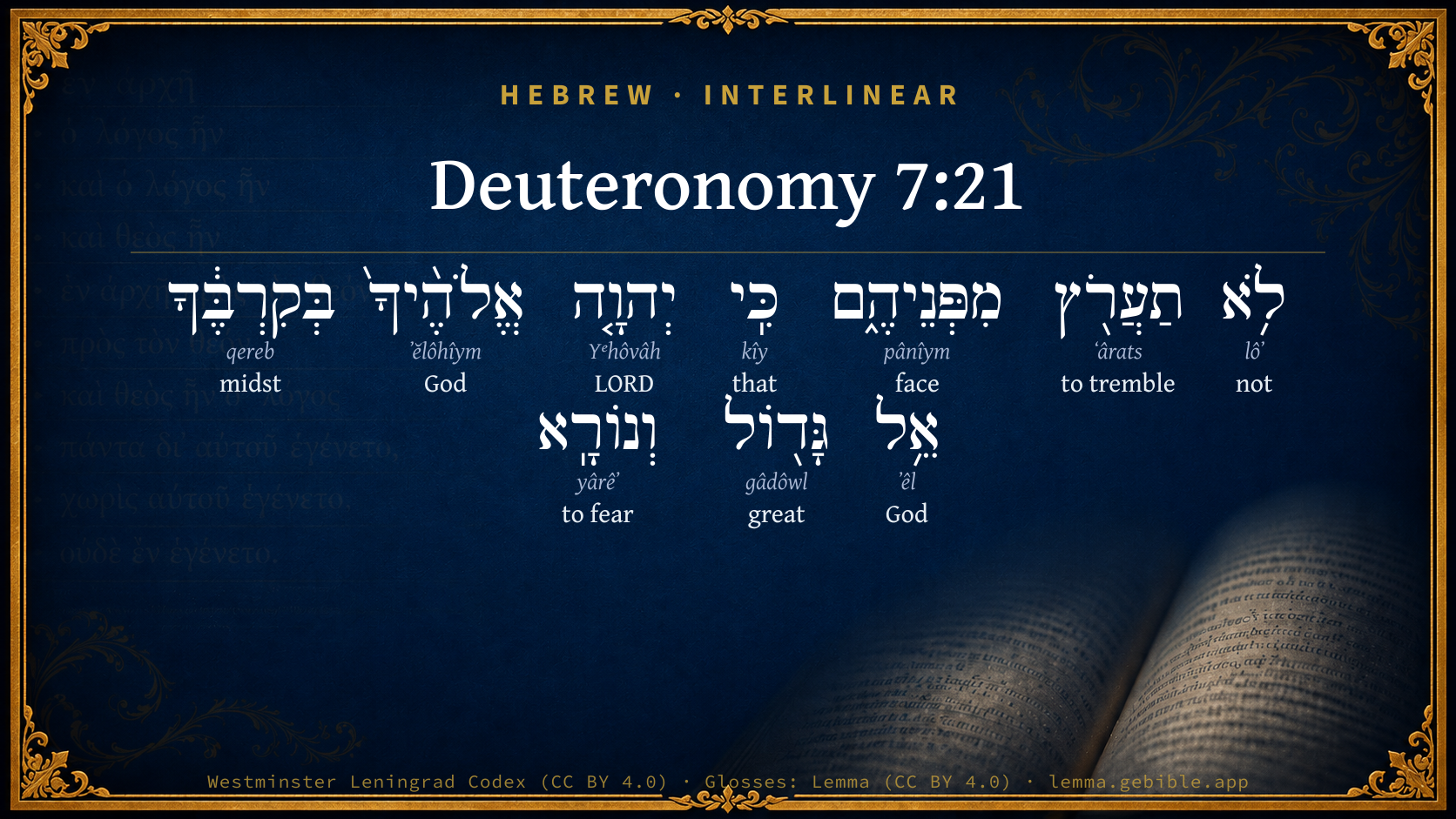
Deuteronomy 7:21

Hebrew (Westminster Leningrad Codex) Deuteronomy 7:21 appears in the Hebrew Old Testament. The text above is from the Westminster Leningrad Codex. Each word links to its Strong’s number, a concise gloss, and parsing drawn from the Open Scriptures Hebrew Bible morphology. Click any word for its full Brown-Driver-Briggs (BDB) entry.
Download image
Cite this verse

Deuteronomy 7:21 (World English Bible). Public Domain. Lemma interlinear Bible study tool, https://lemma.gebible.app/v/deuteronomy/7/21.

Show BibTeX & RIS
BibTeX
RIS
English Translation
You shall not be scared of them; for Yahweh your God is in the midst of you, a great and awesome God.
World English Bible · Public Domain
Download a study sheet

One document with this verse’s original text, its word-by-word gloss line, the meaning frame, cross-references with their text, attributed commentary, and full source and license credits — printable, and it pastes into notes with its structure intact.

This verse Autodidact and up

Study sheet (.html) Plain text (.txt)

A passage Seminary Student

Up to 50 verses in one chapter. A passage sheet keeps up to 6 commentary sources and 12 cross-references per verse, in the order this page ranks them, and says so on the sheet whenever that leaves anything out. Ask for a single verse and you get the Autodidact verse sheet above.

Everything on this page stays free to read, with no account — the sheet is a download of what is already on screen, not access to it.

Want to remove ads? Support Godless Engineer
Compare translations 3

The same verse in 3 English versions, stacked beneath the original-language interlinear above. Click any original word for its lexicon entry.

Each is an independent rendering of the whole verse — the interlinear is not word-aligned to these translations.

Highlighted words mark where these versions differ — a whole-verse word diff, not a word-by-word alignment.

  • World English Bible Public Domain
    You shall not be scared of them; for Yahweh your God is in the midst of you, a great and awesome God.
  • King James Version Public Domain
    Thou shalt not be affrighted at them: for the LORD thy God is among you, a mighty God and terrible.
  • unfoldingWord Literal Text CC BY-SA 4.0
    Do not be frightened from their faces, for Yahweh your God among you, a great and fearsome God.

unfoldingWord Literal Text — © unfoldingWord, licensed CC BY-SA 4.0. Word-aligned USFM3 via Door43 (git.door43.org/unfoldingWord/en_ult).

Versions to compare (up to 4)

3 of 4 selected

Show all 18 translations

Every available English version of this verse, each an independent rendering of the whole verse.

  • World English Bible Public Domain
    You shall not be scared of them; for Yahweh your God is in the midst of you, a great and awesome God.
  • Berean Standard Bible Public Domain
    Do not be terrified by them, for the LORD your God, who is among you, is a great and awesome God.
  • Majority Standard Bible Public Domain
    Do not be terrified by them, for the LORD your God, who is among you, is a great and awesome God.
  • King James Version Public Domain
    Thou shalt not be affrighted at them: for the LORD thy God is among you, a mighty God and terrible.
  • American Standard Version (1901) Public Domain
    Thou shalt not be affrighted at them; for Jehovah thy God is in the midst of thee, a great God and a terrible.
  • Revised Version (1885) Public Domain
    Thou shalt not be affrighted at them: for the LORD thy God is in the midst of thee, a great God and a terrible.
  • Geneva Bible (1599) Public Domain
    Thou shalt not feare them: for the Lord thy God is among you, a God mightie and dreadful.
  • Douay-Rheims (1899) Public Domain
    Thou shalt not fear them, because the Lord thy God is in the midst of thee, a God mighty and terrible:
  • Young's Literal Translation Public Domain
    thou art not terrified by their presence, for Jehovah thy God `is' in thy midst, a God great and fearful.
  • Literal Standard Version CC BY-SA 4.0
    you are not terrified by their presence, for your God YHWH [is] in your midst, a God great and fearful.
  • Unlocked Literal Bible CC BY-SA 4.0
    You will not be frightened at them, for Yahweh your God is among you, a great and fearsome God.
  • unfoldingWord Literal Text CC BY-SA 4.0
    Do not be frightened from their faces, for Yahweh your God among you, a great and fearsome God.
  • Darby Bible Public Domain
    Thou shalt not be afraid of them; for Jehovah thy God is in thy midst, a ùGod great and terrible.
  • World Messianic Bible Public Domain
    You shall not be scared of them; for the LORD your God is among you, a great and awesome God.
  • Webster's Bible Public Domain
    Thou shalt not be affrighted at them: for the LORD thy God is among you, a mighty God and terrible.
  • Free Bible Version CC BY-SA 4.0
    Don't be frightened of these nations, for the Lord your God, who is with you, is a powerful and awesome God.
  • Bible in Basic English Public Domain
    Have no fear of them: for the Lord your God is with you, a great God greatly to be feared.
  • JPS Tanakh (1917) Public Domain
    Thou shalt not be affrighted at them; for the LORD thy God is in the midst of thee, a God great and awful.

Literal Standard Version (2020), Covenant Press — licensed CC BY-SA 4.0. Text via the HelloAO Bible API (eBible.org). Unlocked Literal Bible (unfoldingWord) — licensed CC BY-SA 4.0. Text via the HelloAO Bible API (eBible.org). unfoldingWord Literal Text — © unfoldingWord, licensed CC BY-SA 4.0. Word-aligned USFM3 via Door43 (git.door43.org/unfoldingWord/en_ult). Free Bible Version, Dr. Jonathan Gallagher — licensed CC BY-SA 4.0. Text via the HelloAO Bible API (eBible.org).

Word by word

More ways to search: Search by grammar → Find every occurrence → Compare this word →

Practice this passage: Drill this verse → Learn its vocabulary →

תַעֲרֹ֖ץ
ʻârats
H6206
“to tremble”
Verb, Qal, Imperfect, 2nd Person, Masculine, Singular
Part of Speech
Verb
Stem
Qal
Form
Imperfect
Person
2nd Person
Gender
Masculine
Number
Singular
Full BDB Definition

Origin: a primitive root

TWOT: 1702

to tremble, dread, fear, oppress, prevail, break, be terrified, cause to tremble - (Qal) - to cause to tremble, terrify - to tremble, feel dread - (Niphal) to be awesome, be terrible - (Hiphil) - to regard or treat with awe, regard or treat as awful - to inspire with awe, terrify
  1. לֹ֥א lôʼ H3808 “not” Particle, Negative
  2. מִפְּנֵיהֶ֑ם pânîym H6440 “from · face(s) · their” Preposition + Noun, Common, Both, Plural, Construct + Suffix, Personal, 3rd Person, Masculine, Plural
  3. כִּֽי kîy H3588 “that” Conjunction
  4. יְהוָ֤ה Yᵉhôvâh H3068 “LORD” Noun, Proper
  5. אֱלֹהֶ֨יךָ֙ ʼĕlôhîym H430 “God(s) · your” Noun, Common, Masculine, Plural, Construct + Suffix, Personal, 2nd Person, Masculine, Singular
  6. בְּקִרְבֶּ֔ךָ qereb H7130 “in/at · midst · your” Preposition + Noun, Common, Masculine, Singular, Construct + Suffix, Personal, 2nd Person, Masculine, Singular
  7. אֵ֥ל ʼêl H410 “God” Noun, Common, Masculine, Singular, Absolute
  8. גָּד֖וֹל gâdôwl H1419 “great” Adjective, Adjective, Masculine, Singular, Absolute
  9. וְנוֹרָֽא yârêʼ H3372 “and · fearing” Conjunction + Verb, Niphal, Participle Active, Masculine, Singular, Absolute

About this verse

These counts appear in no published source. They are computed here, from the morphology-tagged text and Lemma’s own curated glosses. What Lemma adds →

10
words
10
distinct lemmas
Pentateuch
section

Notable vocabulary

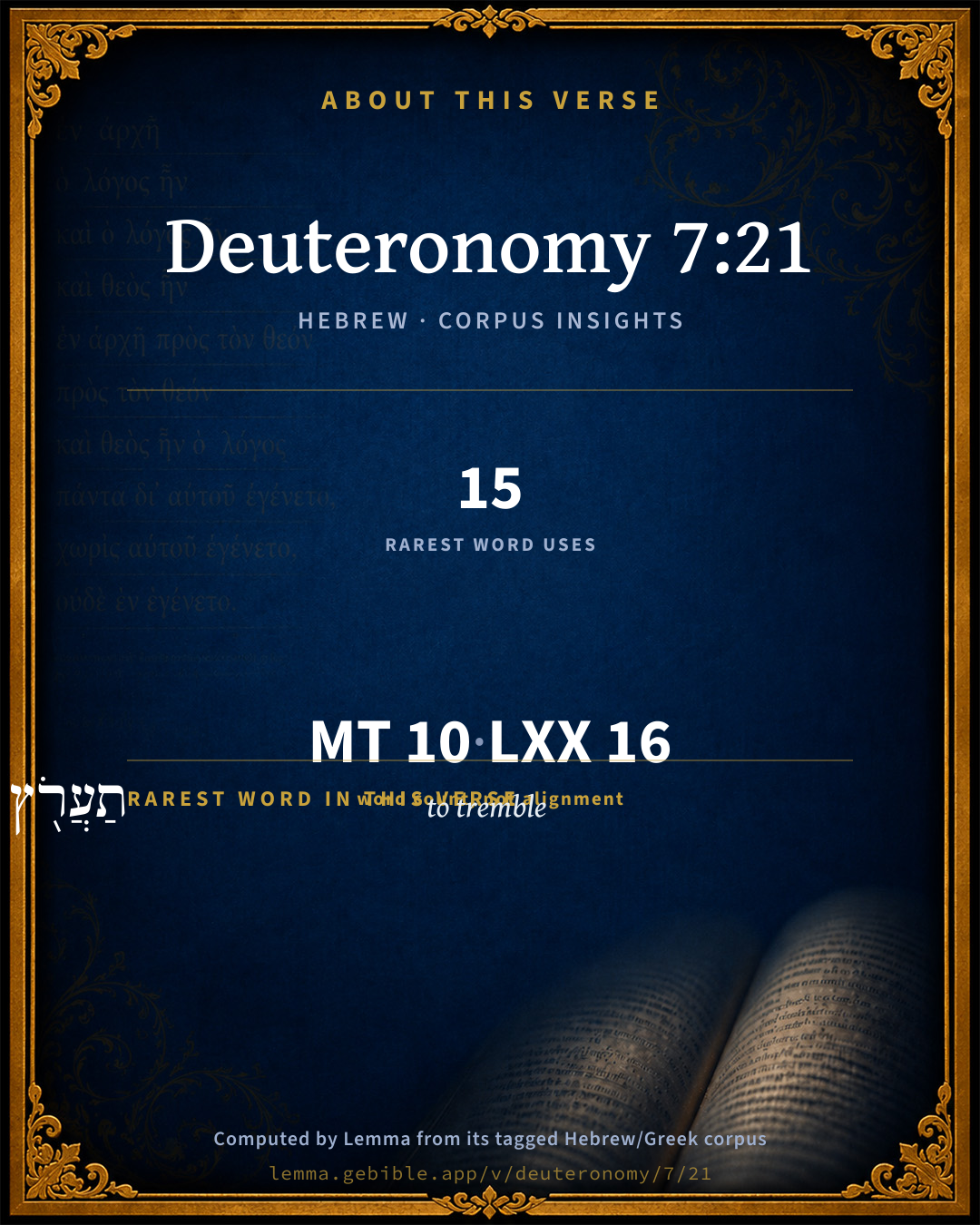
The rarest word here is תַעֲרֹ֖ץ to tremble H6206 — appearing just 15 times in the whole Hebrew Bible.

Shared distinctive vocabulary

תַעֲרֹ֖ץ to tremble H6206 occurs in 15 verses of the Hebrew Bible. Also found in:

Grammatical profile

  • 2 verbs
  • 5 nouns
  • 1 adjective
  • 1 conjunction
  • 1 particle

Verb forms

  • תַעֲרֹ֖ץ Qal · Imperfect
  • וְנוֹרָֽא Niphal · Participle Active

Hebrew & Septuagint length

In English translation the verse runs 22 words from the Hebrew and 23 from the Septuagint (LXX English) — closely comparable.

A rough comparison of the two English renderings, which tokenize alike — not a word-level alignment.

Word counts can differ between the Hebrew and the Greek without any difference in meaning — e.g. the Hebrew direct-object marker אֵת has no separate Greek word, and Greek often adds the article ὁ.

In the original languages it is 10 Hebrew tokens and 16 Greek tokens — but the two are counted differently (Hebrew bundles its prefixes and suffixes into one token; the Greek is in lemma form), so that isn’t a like-for-like length.

Cross-references

21

Topical passages linked to Deuteronomy 7:21 in the Treasury of Scripture Knowledge — connected by theme and wording, ordered by reader-vote popularity; previews shown in the World English Bible.

  • Deuteronomy 10:17 For Yahweh your God, he is God of gods, and Lord of lords, the great God, the mighty, and the awesome, who doesn't regard persons, nor takes reward.
  • Joshua 3:10 Joshua said, Hereby you shall know that the living God is among you, and that he will without fail drive out from before you the Canaanite, and the Hittite, and the Hivite, and the Perizzite, and the Girgashite, and the Amorite, and the Jebusite.
  • Nehemiah 1:5 and said, I beg you, Yahweh, the God of heaven, the great and awesome God, who keeps covenant and loving kindness with those who love him and keep his commandments:
  • Nehemiah 9:32 Now therefore, our God, the great, the mighty, and the awesome God, who keep covenant and loving kindness, don't let all the travail seem little before you, that has come on us, on our kings, on our princes, and on our priests, and on our prophets, and on our fathers, and on all your people, since the time of the kings of Assyria to this day.
  • Nehemiah 4:14 I looked, and rose up, and said to the nobles, and to the rulers, and to the rest of the people, Don't be you afraid of them: remember the Lord, who is great and awesome, and fight for your brothers, your sons, and your daughters, your wives, and your houses.
  • Psalms 46:5 God is in her midst. She shall not be moved. God will help her at dawn.
  • Isaiah 8:9–10 Make an uproar, O you peoples, and be broken in pieces! And give ear, all you of far countries: gird yourselves, and be broken in pieces! Gird yourselves, and be broken in pieces!
  • Numbers 9:20 Sometimes the cloud was a few days on the tabernacle; then according to the commandment of Yahweh they remained encamped, and according to the commandment of Yahweh they traveled.
  • Numbers 14:9 Only don't rebel against Yahweh, neither fear the people of the land; for they are bread for us: their defense is removed from over them, and Yahweh is with us: don't fear them.
  • Numbers 14:14 and they will tell it to the inhabitants of this land. They have heard that you Yahweh are in the midst of this people; for you Yahweh are seen face to face, and your cloud stands over them, and you go before them, in a pillar of cloud by day, and in a pillar of fire by night.
  • Numbers 14:42 Don't go up, for Yahweh isn't among you; that you not be struck down before your enemies.
  • Numbers 16:3 and they assembled themselves together against Moses and against Aaron, and said to them, You take too much on you, seeing all the congregation are holy, everyone of them, and Yahweh is among them: why then lift yourselves up above the assembly of Yahweh?
  • Numbers 23:21 He has not saw iniquity in Jacob; Neither has he seen perverseness in Israel: Yahweh his God is with him, The shout of a king is among them.
  • Deuteronomy 25:8 Then the elders of his city shall call him, and speak to him: and if he stand, and say, I don't want to take her;
  • 1 Samuel 4:8 Woe to us! who shall deliver us out of the hand of these mighty gods? these are the gods that struck the Egyptians with all manner of plagues in the wilderness.
  • 2 Chronicles 32:8 with him is an arm of flesh; but with us is Yahweh our God to help us, and to fight our battles. The people rested themselves on the words of Hezekiah king of Judah.
  • Psalms 46:7 Yahweh of Hosts is with us. The God of Jacob is our refuge. Selah.
  • Psalms 46:11 Yahweh of Hosts is with us. The God of Jacob is our refuge. Selah.
  • Zechariah 2:10–11 Sing and rejoice, daughter of Zion; for, behold, I come, and I will dwell in the midst of you,' says Yahweh.
  • Zechariah 12:2–5 "Behold, I will make Jerusalem a cup of reeling to all the surrounding peoples, and on Judah also will it be in the siege against Jerusalem.
  • 1 Corinthians 14:25 And thus the secrets of his heart are revealed. So he will fall down on his face and worship God, declaring that God is among you indeed.

Cross-references courtesy of OpenBible.info (CC BY 4.0).

Hebrew and Greek witnesses Masoretic Hebrew ↔ Greek Septuagint

The same verse in the two great witnesses to the Old Testament, shown verse-for-verse.

These are two independent witnesses, not word-aligned to each other, and the Septuagint is shown in lemma (dictionary) form.

Hebrew Deuteronomy 7:21 Masoretic · Westminster Leningrad Codex

לֹ֥א תַעֲרֹ֖ץ מִפְּנֵיהֶ֑ם כִּֽי יְהוָ֤ה אֱלֹהֶ֨יךָ֙ בְּקִרְבֶּ֔ךָ אֵ֥ל גָּד֖וֹל וְנוֹרָֽא

You shall not be scared of them; for Yahweh your God is in the midst of you, a great and awesome God.

World English Bible · Public Domain

Greek LXX Deuteronomy 7:21 Septuagint · lemma form

οὐ τρέω ἀπό πρόσωπον αὐτός ὅτι κύριος ὁ θεός σύ ἐν σύ θεός μέγας καί κραταιός

You shall not be wounded before them, because the Lord your God in the midst of you is a great and powerful God.

LXX2012 (modern English Septuagint) · Public Domain

On this verse, Haydock's Catholic Bible Commentary discusses the Septuagint’s reading. Read the note in Commentary ↓

Hebrew: Westminster Leningrad Codex (CC BY 4.0). Greek: Septuagint (public domain); English from LXX2012 (modern English Septuagint) (Public Domain). How the Septuagint differs from the Hebrew →

Targum (Aramaic paraphrase)

2

The Targum is the ancient Jewish Aramaic paraphrase of the Hebrew Scriptures — an interpretive translation, not the Hebrew text itself. Onkelos (literal) and Pseudo-Jonathan (expansive) render the Torah, and Jonathan the Prophets. Coverage is partial: where no permissively-licensed English translation exists for a verse, only the Aramaic is shown. This is verse-level text, not a word-by-word alignment to the Hebrew.

  1. Targum Onkelos Torah (Genesis–Deuteronomy)
    לָא תִתְּבַר מִקֳדָמֵיהוֹן אֲרֵי יְיָ אֱלָהָךְ שְׁכִנְתֵּהּ בֵּינָךְ אֱלָהָא רַבָּא וּדְחִילָא

    (no public-domain English translation for this verse)

    Targum Onkelos — Aramaic: “Onkelos Genesis” (public domain); “Onkelos Exodus” (public domain); “Onkelos Leviticus” (public domain); “Onkelos Numbers” (public domain); “Onkelos Deuteronomy” (public domain). English: “Sefaria Community Translation” (CC0 1.0 (public-domain dedication)); “J.W. Etheridge. The Targums of Onkelos and Jonathan Ben Uzziel on the Pentateuch. London: Longmans, Green, 1862” (public domain). Text via Sefaria.

  2. Targum Pseudo-Jonathan Torah (Genesis–Deuteronomy)
    לָא תִתְבְּרוּן מִן קֳדָמֵיהוֹן אֲרוּם שְׁכִינַת יְיָ אֱלָהָכוֹן בֵּינֵיכוֹן אֱלָהָא רַבָּא וּדְחִילָא

    Therefore be not downbroken before them, for the Shekinah of the Lord your God is among you, the Great and Fearful God.

    Targum Pseudo-Jonathan — Aramaic: “Targum Jonathan on Genesis” (public domain); “Targum Jonathan on Exodus” (public domain); “Targum Jonathan on Leviticus” (public domain); “Targum Jonathan on Numbers” (public domain); “Targum Jonathan on Deuteronomy” (public domain). English: “The Targum of Jonathan ben Uzziel, trans. J. W. Etheridge, London, 1862” (public domain). Text via Sefaria.

Commentary

Notes on Deuteronomy 7:21 from classic Christian and Jewish commentators (each source and its license shown beneath its notes). The classic Christian expositions comment on the surrounding passage and are grouped to its opening verse, so a note may address several verses; the Jewish commentaries on the Tanakh (Rashi and others) are per-verse, so they appear only where the commentator wrote on this verse.

Lemma curates 59 commentaries, every one of them public domain or Creative Commons licensed, each selected and text-cleaned for this edition rather than reprinted as found. About our sources →

Trapp's Complete Commentary

John Trapp

Deu 7:21 Thou shalt not be affrighted at them: for the LORD thy God [is] among you, a mighty God and terrible.

Ver. 21. For the Lord thy God is amongst you.] And how many do you reckon him for? as Antigonus said once to his soldiers, when they feared their enemies as more in number.

John Trapp, A Commentary or Exposition upon All the Books of the Old and New Testament (1647–1656) — public domain. Text from a community e-Sword module.

The Biblical Illustrator

Joseph S. Exell

Deu_7:21

Thou shalt not be affrighted at them: for the Lord thy God is among you, a mighty God and terrible.

Courage and humanity

I. The complaint has been made often that the qualities which Christians are especially encouraged to cultivate are not manliness and courage; that, so far as the Christian ideal is set continually before the mind of a nation or a man, that mind is likely to become submissive, not energetic. I believe that the courage, which is only another way of expressing the heart, of a nation is liable to a continual weakening and decay; that left to itself it will certainly wither; that some religions may hasten its death; but that by doing so such religion will prove that it does not come from God, that it is not His religion, not His instrument for reforming and regenerating the world.

II. A return to the old faith that courage and humanity are not enemies, but inseparable companions, has certainly commenced among us. The misfortune is that Christianity is supposed to be not identical with humanity, but a substitution for it. And this opinion is closely connected with another: that courage is a heathen, or perhaps the heathen, virtue, and that we have cherished it by giving our children a semi-heathen education. Consider this opinion under different aspects.

III. By a heathen we mean one who is not a Jew. That is the simplest, most accurate use of the name. Taking it in this sense, our text is decisive that a high estimate of courage was not confined to heathens; that if to form such an estimate is ungodly, the chosen people were as ungodly as any. The Bible tells us that idolatry is the great destroyer of courage, reverence for the true God and an abiding sense of His presence and protection the upholder of it. Now is this doctrine compatible with the fact that the most illustrious of the heathen nations were singularly brave nations, and that our forefathers sought to kindle English courage at their fires? It is incompatible if we regard a heathen merely as an idolater. It is perfectly compatible if we trace through the history of the great nations that worshipped idols a continual witness against it. Their belief in courage, as a quality which raised them above the animals, was the greatest of all the protests which the conscience of heathens was bearing against idolatry, against the worship of visible things, which is directly connected with our animal instincts, which is always lowering the human being to the level of that which he should rule.

IV. The courage of the Hebrew was derived from his trust in the Being who had chosen him to do his work in the world, who would accomplish that work, let what powers would unite to defeat it. Christianity is not a denial of Judaism or a denial of heathenism, a tertium quid which excludes all that is strongest and most vital in both, but the harmony and concentration of both, the discovery of Him in whom the meaning of both is realised and raised to its highest power; but out of the union and reconciliation of apparent opposites in the faith of a Father and a Son, of a Spirit proceeding from both, to quicken men and make them the voluntary, cheerful servants, because the sons, of God, there must come forth a courage diviner than the Hebrew, more human than the Greek, more pledged to a continual battle with disorder than the Roman. (F. D. Maurice, M. A.)

Moses address to the people

The manner in which the possession of Canaan is invariably spoken of is worthy of notice. Moses never supposes it impossible that they should reach Canaan; the style of his expression is uniformly that of certainty; he does not say, If the Lord, but when. This confidence did not rest on human grounds, for their enemies were in themselves formidable, but on the Divine promise. Those who have the Lords promise are safe, and they who trust in it are happy. But another fact is, that the Lord condescends to the state of His people; He knoweth their frame, and remembereth they are dust that they are prone to fear. True, there is no cause for fear, but their infirmity may lead them to do so. Hence He anticipates those fears, provides a remedy, and suggests every consideration calculated to encourage them.

I. The fears which they were in danger of indulging.

1. The superior strength of their enemies.

2. The consequent difficulty of dispossessing them. A few, comparatively, against many; the weak against the strong. How can I dispossess them? Is not the case very similar now? The Christian cannot be blind to the fact that his enemies are greater and mightier than he; the hosts of hell are marshalled against him. Legion is their name, implying unity, order, zeal, and perseverance. The enemies are mighty, and have overcome their thousands. There are few who have not been tempted to consider the contest hopeless, and to say, Surely I shall one day perish. Now if there be one here saying this in his heart, let him attend--

II. To the encouragements provided against those fears.

1. A recollection of Gods past dealings. Thou shalt remember well what the Lord thy God did unto Pharaoh, and unto all Egypt. The difficulties there were as great as they could be;--Pharaoh had chariots and horsemen; the Israelites were despised slaves; he had power, and was determined to use it in retaining them; yet the Lord brought them out, and therefore they need not fear now.

2. They were instructed as to the Lords future methods. So shall the Lord do unto all the people of whom thou art afraid: He had ten thousand ways of weakening the power of the enemy; the whole kingdom of nature was at His command; He could send the hornet among them; even the insect tribe shall be made subservient to the accomplishment of Gods design towards them. Joshua records the fulfilment of this promise (Deu_24:12). But this conquest was to be gradual. The Lord thy God will put out those nations by little and little. Immediate and entire victory would have been attended with undesirable consequences; God therefore gave them as much as in their circumstances was good for them.

3. Assurance was given of final victory. And are there not equal encouragements now, to everyone anxious to attain the heavenly Canaan? There is, however, this happy difference in the two cases: that when once the Christian has passed over the Jordan of death, every difficulty will be over, every enemy conquered, he will have the land in possession.

In conclusion, I would say--

1. Let no one expect the victor, who fights in his own strength.

2. Let no one despair of victory who fights in the Lords strength. (George Breay, B. A.)

Christian warfare

I. The enemies of Gods people. We know that the inhabitants of Canaan were emphatically idolaters. This was their special characteristic. Now it is idolatry, in some shape or other, that draws men away from the service of God. Some make pleasure their idol; some make wealth their idol. But their enemies are many in number. There is a special danger in the present day arising from those false doctrines which have arisen in the household of faith and caused hostile parties in the Church. In connection with this I may mention a contrary error--latitudinarianism. Again, the world is very dangerous; the example of those who live in it is most seductive. Again, we meet with those who are men of learning and great talent, and we are exposed to danger even from them. We hear them maintaining opinions which are not scriptural, but we think it is scarcely possible for those who are so learned to be wrong; we are thus left to ask in perplexity, Who is in the right? We forget that men must become fools that they may be wise as respects spiritual knowledge. But there are enemies within. And here I must not omit to place in the forefront self, in all its varied forms (2Ti_3:1-5). Then, again, we have to contend against the whole army of lusts--the lust of the flesh, the lust of the eyes, and the pride of life. All these are of the world, and all these lust against the Spirit, so that we cannot do the things that we would.

II. Now let us inquire what are the weapons with which we must fight? Scripture teaches us (2Co_10:4) that the weapons of our warfare are not carnal. Amongst our defensive weapons I may mention, as the first and chiefest, prayer. With this we must join faith in the promises. And, also, we must remember that throughout our whole life we shall have need of active watchfulness. There are also offensive weapons which we are bound to use. The first of these which I will mention is consistency. Outward consistency of character deters many from attempting their proposed assaults. Nor must we forget the Word of God. Here, indeed, is our great weapon; and so powerful is it, that it is the great desire of Satan to keep it out of our reach.

III. But I own there are great difficulties in the way. The first to which I will allude is that which arises from our peculiar position in the world. We must be in the world, and the difficulty at the same time is to take care that we are not of the world. To have a wise discerning judgment; to distinguish between the fulfilment of our duty in that station of life in which God has placed us, and the yielding to the secret subtle snares of Satan, is often a work of great difficulty for the Christian. Again, the Christians difficulties and afflictions are not all at once removed. Like the enemies of the Jews they are put down, as it were, little by little. It is a gradual and a progressive work. But assuredly it does progress towards final victory. But numerous as are our enemies, great as are our difficulties, blessed be God, we have--

IV. Our encouragements also. And first among these we know we shall have the victory. The promise of victory has been given, and it is as sure as if it were accomplished. We know that we are on the conquering side. The numbers of our enemies, then, need not terrify us. Greater is He that is for us than all they that are against us. The past mercies we have received are all pledges of future mercies. If we had but received that one pledge of Gods love which He afforded us in the gift of His Son for us, this would of itself be sufficient to encourage the assurance of hope. For (Rom_8:32) we have nothing to fear from present weakness. The Lord has laid help upon One that is mighty to save. Though our gracious Saviour is not Himself personally present He has told us the reason (Joh_16:7). Still He is spiritually present with us. His Spirit still abides with His Church--and therefore with us, if we be indeed members of that Church--comforting us, assisting us, strengthening us, and ensuring us victory at the last. Furthermore, the Lord is on our side. The Lord thy God will do this (H. M. Villiers, M. A.)

The Almighty Helper

This description of God is a terror to sinners, but an encouragement to Christians. His mighty presence is--

1. Unmerited. The aid we get from earthly friends is often a reciprocity of kindness--a discharge of obligation. But our goodness extends not to God. We have done nothing to deserve help.

2. Unexpected. In most extreme danger and when most unlikely, comes deliverance. Mans extremity is Gods opportunity. The Mace of fear and sorrow becomes one of joy and triumph.

3. Singular. Gods methods are peculiar to Himself. Events Which appear to combine to work our ruin bring our salvation. In the deliverance from Egypt and the conquest of Canaan God was terrible to His enemies.

4. Timely. We think He has forgotten or forsaken us if He appears not when we wish; but He knows better than we do when it is time for Him to work. Too late can never he said of His mercy. A very present help in trouble.

5. All-sufficient. Earthly friends fail. God is always among us, a mighty God and terrible. He conquers most formidable foes, rescues from the greatest dangers. (J. Wolfendale.)

The Biblical Illustrator, edited by Joseph S. Exell (c. 1880s–1900s) — public domain. Text from a community e-Sword module.

Tyndale Open Study Notes

Tyndale Open Resources

7:21 awesome (literally one to be feared): This fear is not the terror induced by a bully who strikes without reason or plan, but the reverential fear of a loving God whose nature is so majestic that it inspires a kind of dread.

Tyndale Open Study Notes — © Tyndale Open Resources, licensed CC BY-SA 4.0. Text via the HelloAO Bible API.

The Cambridge Bible for Schools and Colleges

gen. ed. J. J. S. Perowne

21. Thou shalt not be affrighted] This, combined with the verb be afraid (Deu_7:18), is found in Pl. passages.

in the midst of thee] Deu_6:15.

great God and … terrible] Cp. Deu_10:17, Deu_28:58, the same epithets of the wilderness Deu_1:19, Deu_8:15, and of Jehovah’s deeds Deu_10:21. Terrible, in E, Gen_28:17 of the presence of God; nowhere else before D, for Exo_34:10 is editorial, but very frequent in post-deuteronomic writings.

The Cambridge Bible for Schools and Colleges (gen. ed. J. J. S. Perowne; Cambridge University Press, 1878–1918) — public domain. Text from a community e-Sword module.

John Gill's Exposition

Thou shall not be affrighted at them,.... At their numbers, nor at their gigantic stature:

for the Lord thy God is among you: in the tabernacle, in the holy of holies, which was in the midst of them, and besides would give proof of his powerful presence among them, in protecting them, and destroying their enemies:

a mighty God and terrible; mighty to save his people, and terrible to others.

John Gill's Exposition of the Whole Bible (1746–1763) — public domain (CC PDM 1.0). Text via the HelloAO Bible API.

Haydock's Catholic Bible Commentary

Fear. Septuagint, "be wounded." In the war with the Madianites, not one was killed, (Numbers xxxi. 49,) as Josephus ([Antiquities?] iii. 2) informs us, was also the case when king Amalec and his people attacked the Hebrews, Exodus xvii. 13. The people seem to have expected such a miraculous interference of Providence in their favour; and hence, when 36 were slain at the siege of Hai, all were greatly dejected, Josue vii. 5. (Haydock)

George Leo Haydock (1774–1849), Haydock's Catholic Family Bible and Commentary, 1859 edition — public domain. Excludes Psalms (Douay-Rheims chapter numbering differs from Protestant) and Deuterocanonical books (Catholic canon only).

Lesson kit

Teaching starters — assembled from the data on this page, not authored interpretation. Every prompt links to the verse data it draws on. Edit before teaching.

Deuteronomy, in the Pentateuch, opens this verse with 10 words (10 distinct Hebrew lemmas). Its most distinctive word is ʻârats (“to tremble”). A historical commentator’s framing appears above. Read the whole chapter for the surrounding context.

Discussion questions

  1. How does “to tremble” (ʻârats) shape what this verse is saying?
  2. How does Deuteronomy 1:29, which shares the word «to tremble», read alongside this verse?
  3. The translations on this page render this verse differently — a whole-verse word diff, not a word-by-word alignment. What might account for the different wordings?
  4. «תַעֲרֹ֖ץ» is a Qal Imperfect verb. How does that grammatical form shape the action described?
  5. Compare how Trapp's Complete Commentary and The Biblical Illustrator read this verse. Where do they agree or differ?

Things to notice

Reading settings

Reading text

Shown beneath each verse's original-language words.

Old Testament
Old Testament edition

Read the OT as the Masoretic Hebrew (MT) or the Greek Septuagint (LXX).

English shown for the Greek Septuagint (in the Hebrew ↔ Greek comparison).

Comparing translations? Open the Compare panel on any verse page to stack up to four side by side.