
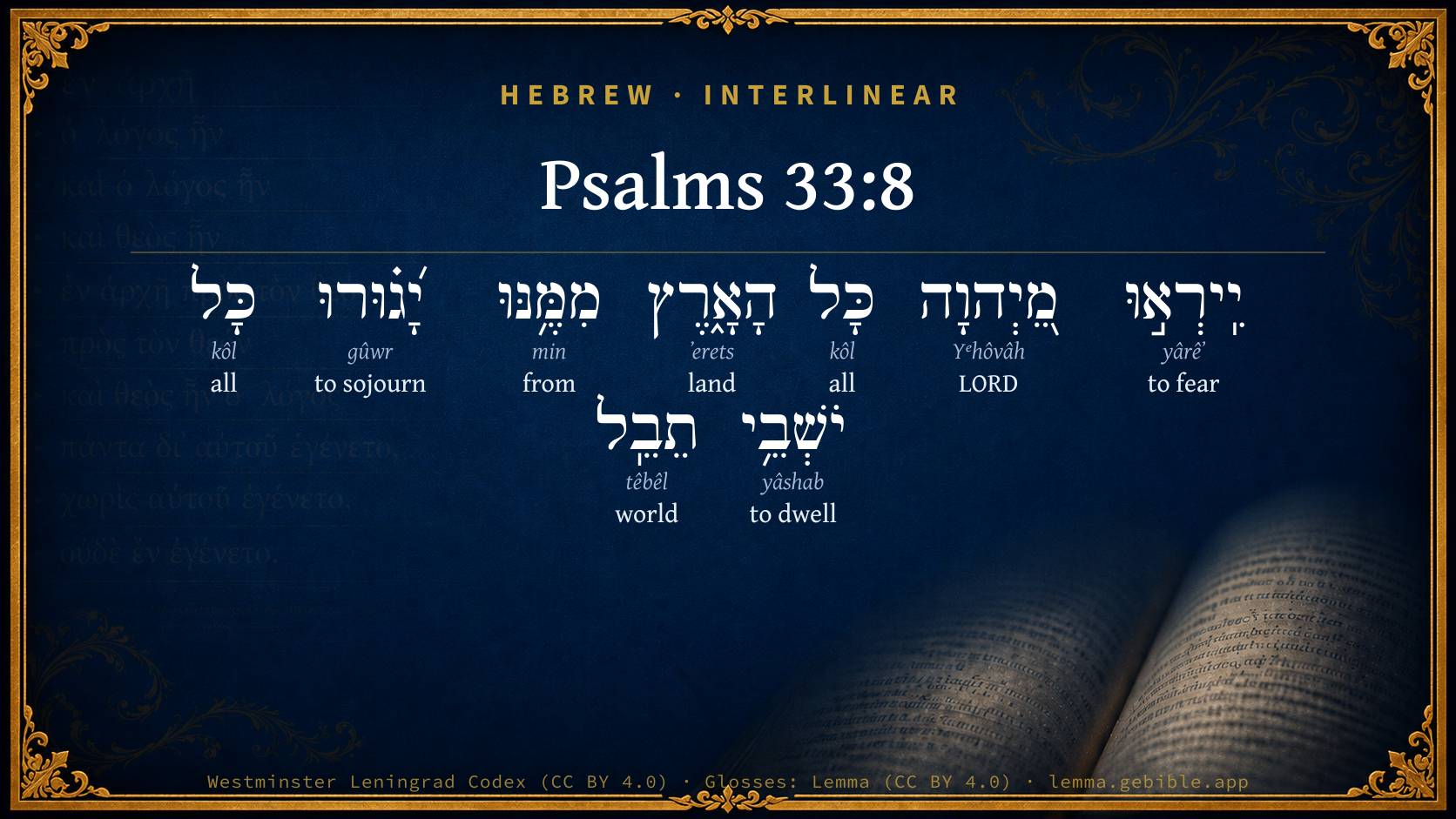
Psalms 33:8

Hebrew (Westminster Leningrad Codex) Psalms 33:8 appears in the Hebrew Old Testament. The text above is from the Westminster Leningrad Codex. Each word links to its Strong’s number, a concise gloss, and parsing drawn from the Open Scriptures Hebrew Bible morphology. Click any word for its full Brown-Driver-Briggs (BDB) entry.
Download image
Cite this verse

Psalms 33:8 (World English Bible). Public Domain. Lemma interlinear Bible study tool, https://lemma.gebible.app/v/psalms/33/8.

Show BibTeX & RIS
BibTeX
RIS
English Translation
Let all the earth fear Yahweh. Let all the inhabitants of the world stand in awe of him.
World English Bible · Public Domain
Download a study sheet

One document with this verse’s original text, its word-by-word gloss line, the meaning frame, cross-references with their text, attributed commentary, and full source and license credits — printable, and it pastes into notes with its structure intact.

This verse Autodidact and up

Study sheet (.html) Plain text (.txt)

A passage Seminary Student

Up to 50 verses in one chapter. A passage sheet keeps up to 6 commentary sources and 12 cross-references per verse, in the order this page ranks them, and says so on the sheet whenever that leaves anything out. Ask for a single verse and you get the Autodidact verse sheet above.

Everything on this page stays free to read, with no account — the sheet is a download of what is already on screen, not access to it.

Want to remove ads? Support Godless Engineer
Compare translations 3

The same verse in 3 English versions, stacked beneath the original-language interlinear above. Click any original word for its lexicon entry.

Each is an independent rendering of the whole verse — the interlinear is not word-aligned to these translations.

Highlighted words mark where these versions differ — a whole-verse word diff, not a word-by-word alignment.

  • World English Bible Public Domain
    Let all the earth fear Yahweh. Let all the inhabitants of the world stand in awe of him.
  • King James Version Public Domain
    Let all the earth fear the LORD: let all the inhabitants of the world stand in awe of him.
  • unfoldingWord Literal Text CC BY-SA 4.0
    let all of the earth fear Yahweh; let all of the dwellers of the world be in dread of him.

unfoldingWord Literal Text — © unfoldingWord, licensed CC BY-SA 4.0. Word-aligned USFM3 via Door43 (git.door43.org/unfoldingWord/en_ult).

Versions to compare (up to 4)

3 of 4 selected

Show all 18 translations

Every available English version of this verse, each an independent rendering of the whole verse.

  • World English Bible Public Domain
    Let all the earth fear Yahweh. Let all the inhabitants of the world stand in awe of him.
  • Berean Standard Bible Public Domain
    Let all the earth fear the LORD; let all the people of the world revere Him.
  • Majority Standard Bible Public Domain
    Let all the earth fear the LORD; let all the people of the world revere Him.
  • King James Version Public Domain
    Let all the earth fear the LORD: let all the inhabitants of the world stand in awe of him.
  • American Standard Version (1901) Public Domain
    Let all the earth fear Jehovah: Let all the inhabitants of the world stand in awe of him.
  • Revised Version (1885) Public Domain
    Let all the earth fear the LORD: let all the inhabitants of the world stand in awe of him.
  • Geneva Bible (1599) Public Domain
    Let all the earth feare the Lord: let al them that dwell in the world, feare him.
  • Douay-Rheims (1899) Public Domain
    Let all the earth fear the Lord, and let all the inhabitants of the world be in awe of him.
  • Young's Literal Translation Public Domain
    Afraid of Jehovah are all the earth, Of Him are all the inhabitants of the world afraid.
  • Literal Standard Version CC BY-SA 4.0
    All the earth is afraid of YHWH, || All the inhabitants of the world are afraid of Him.
  • Unlocked Literal Bible CC BY-SA 4.0
    Let the whole earth fear Yahweh; let all the inhabitants of the world stand in awe of him.
  • unfoldingWord Literal Text CC BY-SA 4.0
    let all of the earth fear Yahweh; let all of the dwellers of the world be in dread of him.
  • Darby Bible Public Domain
    Let all the earth fear Jehovah; let all the inhabitants of the world stand in awe of him.
  • World Messianic Bible Public Domain
    Let all the earth fear the LORD. Let all the inhabitants of the world stand in awe of him.
  • Webster's Bible Public Domain
    Let all the earth fear the LORD: let all the inhabitants of the world stand in awe of him.
  • Free Bible Version CC BY-SA 4.0
    Let all the earth show reverence to the Lord; let all the world's inhabitants be in awe of him.
  • Bible in Basic English Public Domain
    Let the earth be full of the fear of the Lord; let all the people of the world be in holy fear of him.
  • JPS Tanakh (1917) Public Domain
    Let all the earth fear the LORD; let all the inhabitants of the world stand in awe of Him.

Literal Standard Version (2020), Covenant Press — licensed CC BY-SA 4.0. Text via the HelloAO Bible API (eBible.org). Unlocked Literal Bible (unfoldingWord) — licensed CC BY-SA 4.0. Text via the HelloAO Bible API (eBible.org). unfoldingWord Literal Text — © unfoldingWord, licensed CC BY-SA 4.0. Word-aligned USFM3 via Door43 (git.door43.org/unfoldingWord/en_ult). Free Bible Version, Dr. Jonathan Gallagher — licensed CC BY-SA 4.0. Text via the HelloAO Bible API (eBible.org).

Word by word

More ways to search: Search by grammar → Find every occurrence → Compare this word →

Practice this passage: Drill this verse → Learn its vocabulary →

About this verse

These counts appear in no published source. They are computed here, from the morphology-tagged text and Lemma’s own curated glosses. What Lemma adds →

9
words
8
distinct lemmas
Wisdom
section

Shared distinctive vocabulary

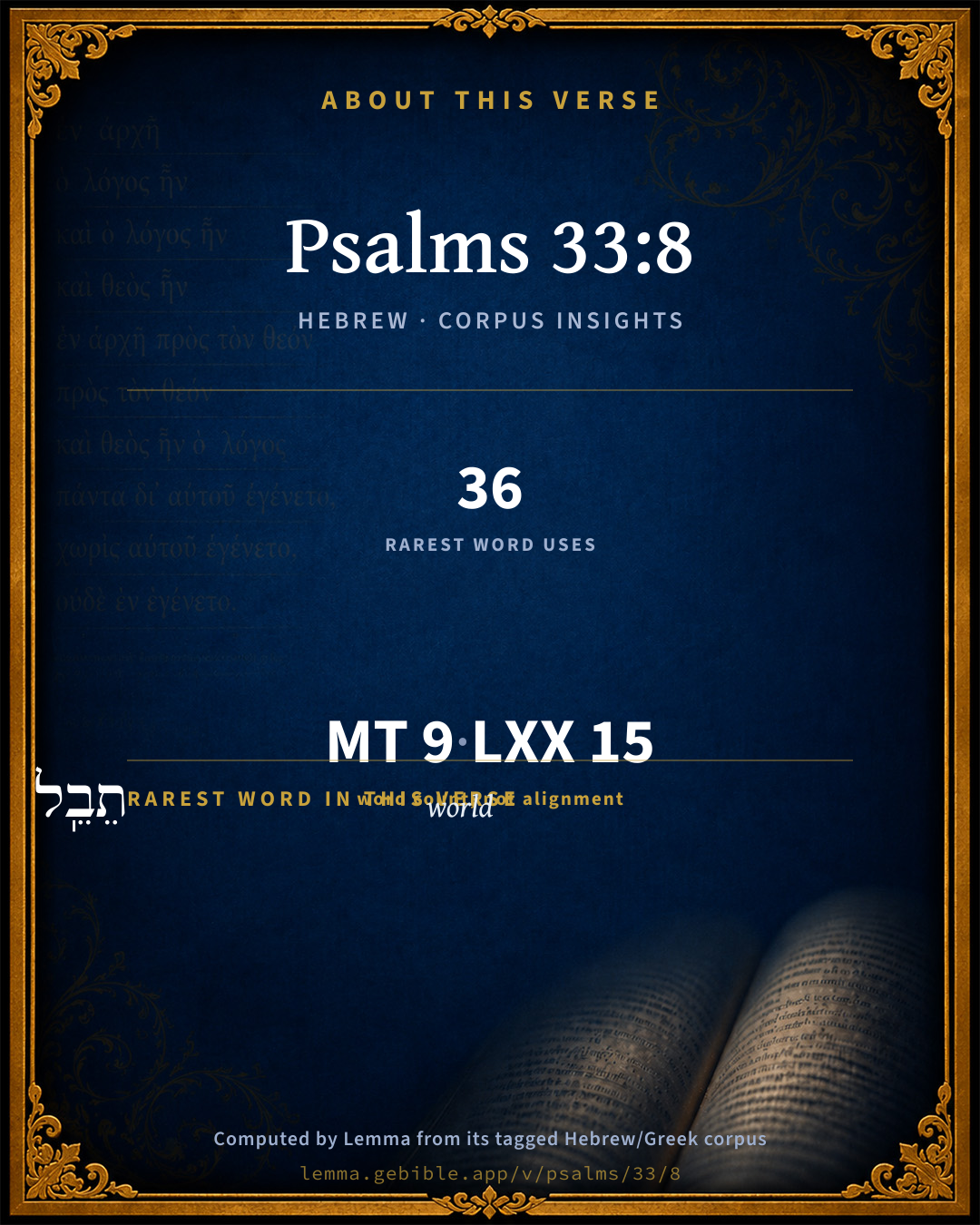
תֵבֵֽל world H8398 occurs in 36 verses of the Hebrew Bible. Also found in:

Grammatical profile

  • 3 verbs
  • 5 nouns
  • 1 preposition

Verb forms

  • יִֽירְא֣וּ Qal · Imperfect
  • יָ֝ג֗וּרוּ Qal · Imperfect
  • יֹשְׁבֵ֥י Qal · Participle Active

Repetition

A word recurs within this verse — often emphatic in Hebrew:

Hebrew & Septuagint length

In English translation the verse runs 18 words from the Hebrew and 20 from the Septuagint (LXX English) — closely comparable.

A rough comparison of the two English renderings, which tokenize alike — not a word-level alignment.

Word counts can differ between the Hebrew and the Greek without any difference in meaning — e.g. the Hebrew direct-object marker אֵת has no separate Greek word, and Greek often adds the article ὁ.

In the original languages it is 9 Hebrew tokens and 15 Greek tokens — but the two are counted differently (Hebrew bundles its prefixes and suffixes into one token; the Greek is in lemma form), so that isn’t a like-for-like length.

Cross-references

9

Topical passages linked to Psalms 33:8 in the Treasury of Scripture Knowledge — connected by theme and wording, ordered by reader-vote popularity; previews shown in the World English Bible.

  • Revelation 14:6–7 I saw an angel flying in mid heaven, having an eternal Gospel to proclaim to those who dwell on the earth, and to every nation, tribe, language, and people.
  • Psalms 96:9–10 Worship Yahweh in holy array. Tremble before him, all the earth.
  • Revelation 15:4 Who wouldn't fear you, Lord, And glorify your name? For you only are holy. For all the nations will come and worship before you. For your righteous acts have been revealed."
  • Psalms 22:27 All the ends of the earth shall remember and turn to Yahweh. All the relatives of the nations shall worship before you.
  • Psalms 67:7 God will bless us. All the ends of the earth shall fear him.
  • Psalms 76:7 You, even you, are to be feared. Who can stand in your sight when you are angry?
  • Jeremiah 10:7–12 Who should not fear you, King of the nations? for to you does it appertain; because among all the wise men of the nations, and in all their royal estate, there is none like you.
  • Daniel 6:25–26 Then king Darius wrote to all the peoples, nations, and languages, who dwell in all the earth: Peace be multiplied to you.

Cross-references courtesy of OpenBible.info (CC BY 4.0).

Hebrew and Greek witnesses Masoretic Hebrew ↔ Greek Septuagint

The same verse in the two great witnesses to the Old Testament, shown verse-for-verse.

You’re reading Greek Psalm 32 (Hebrew Psalm 33). The Septuagint counts the superscription, so verse numbers can differ from the Hebrew — chapter-level alignment, not verse-by-verse. Numbering follows Rahlfs.

These are two independent witnesses, not word-aligned to each other, and the Septuagint is shown in lemma (dictionary) form.

Hebrew Psalms 33:8 Masoretic · Westminster Leningrad Codex

יִֽירְא֣וּ מֵ֭יְהוָה כָּל הָאָ֑רֶץ מִמֶּ֥נּוּ יָ֝ג֗וּרוּ כָּל יֹשְׁבֵ֥י תֵבֵֽל

Let all the earth fear Yahweh. Let all the inhabitants of the world stand in awe of him.

World English Bible · Public Domain

Greek LXX Greek Psalm 32:8 Septuagint · lemma form

φοβέω ὁ κύριος πᾶς ὁ γῆ ἀπό αὐτός δέ σαλεύω πᾶς ὁ καταοἰκέω ὁ οἰκέω

Let all the earth fear the Lord; and let all that dwell in the world be moved because of him.

LXX2012 (modern English Septuagint) · Public Domain

Hebrew: Westminster Leningrad Codex (CC BY 4.0). Greek: Septuagint (public domain); English from LXX2012 (modern English Septuagint) (Public Domain). How the Septuagint differs from the Hebrew →

Commentary

Notes on Psalms 33:8 from classic Christian and Jewish commentators (each source and its license shown beneath its notes). The classic Christian expositions comment on the surrounding passage and are grouped to its opening verse, so a note may address several verses; the Jewish commentaries on the Tanakh (Rashi and others) are per-verse, so they appear only where the commentator wrote on this verse.

Lemma curates 59 commentaries, every one of them public domain or Creative Commons licensed, each selected and text-cleaned for this edition rather than reprinted as found. About our sources →

Trapp's Complete Commentary

John Trapp

Psa 33:8 Let all the earth fear the LORD: let all the inhabitants of the world stand in awe of him.

Ver. 8. Let all the earth fear the Lord] viz. For these stupendous works of his, sufficient to strike an awe into all creatures of the Divine majesty, Jer 5:22. "Tremble, thou earth, at the presence of the Lord, at the presence of the God of Jacob," Psa 114:7.

John Trapp, A Commentary or Exposition upon All the Books of the Old and New Testament (1647–1656) — public domain. Text from a community e-Sword module.

The Biblical Illustrator

Joseph S. Exell

Psa_33:8

Let all the earth fear the Lord.

The nature and influence of the fear of God

I. what is the proper awe and fear which is due from man to God? Distinguish between a servile or superstitious, and a filial or religious fear. The former we are to avoid as a dishonour to God; the latter we are obliged to as an indispensable duty, the true spring and motive of our Christian obedience.

II. some considerations which ought to possess our souls with this affection towards the deity. Can we reflect on the infinite knowledge and omnipresence of God, and not stand in awe of that Being from whom even the most secret thoughts and intentions of the heart are not concealed? Or, can we remember that He is infinitely just, without a religious concern for the event of that day, when we must appear before His impartial tribunal? But the attribute which especially demands this affection from us is His power. None can resist or interrupt the execution of His will; He has power to save, and power to destroy; nor is He accountable to any for His dominion over us. But these arguments arising from the perfections of the Deity will yet more effectually possess us with this reverence, if at the same time we reflect with a just humility on ourselves. That we are indigent, defenceless beings; the dependants of His providence; so far as we know, the lowest of all intelligent beings, whose strength is weakness, and whose wisdom is folly. And, what is yet a more mortifying consideration, we have provoked this Almighty Power by our sins; have affronted His goodness, despised His counsel, and rebelled against His authority.

III. the influence this affection will have on the conduct of our lives. In general, the effect of this fear will be a sincere, universal obedience to the commands of God. The awe of His majesty will keep us from presumption, and the promises of His mercy from despair: for, as is His majesty, so is His mercy. If this principle were thoroughly fixed in the minds of men, we should be ashamed of hypocrisy, and tremble at profaneness; neither hope our treachery could escape the notice, nor our blasphemies the vengeance of God. This affection will give warmth to our zeal, and spirit to our devotion; will animate our faith, enliven our hope, and extend our charity; will deter us from sin, and encourage us in our duty. (J. Rogers, D. D.)

The Biblical Illustrator, edited by Joseph S. Exell (c. 1880s–1900s) — public domain. Text from a community e-Sword module.

Joseph Benson's Commentary

Psa 33:8-9. Let the earth fear the Lord — All the people of the earth, as the next clause expounds this; not only Jews, but also Gentiles, who equally enjoy the benefit of this great and glorious work of God. For he spake, and it was done — The work mentioned Psa 33:6-7. He commanded, and it stood fast — Hebrew יעמד, jagnamad, it stood forth, as a servant at his master’s command, prepared to do his will, and to execute his pleasure.

Joseph Benson's Commentary on the Old and New Testaments (1811–1818) — public domain. Text from a community e-Sword module.

J. A. Alexander on Psalms

Joseph Addison Alexander

8. (Psa 33:8) Let them be afraid of Jehovah—all the earth; let them stand in awe of him—all the dwellers in the world. The position of the verbs at the beginning of the clauses adds greatly to the strength of the expression. The parallelism is exact, the terms being nearly synonymous. That the earth of the first clause means its rational inhabitants, is implied in the plural verb, and expressed in the parallel clause. For the precise sense of the word translated world, see above, on Psa 24:1. The remoter inference suggested is, that this omnipotent creator and preserver of the universe is able to protect his people, and entitled to their confidence.

Joseph Addison Alexander, The Psalms Translated and Explained (1850) — public domain. Text from a community e-Sword module.

Tyndale Open Study Notes

Tyndale Open Resources

33:8-11 Fear of the Lord begins with awe for God and for his powerful word. His word created everything and continues to order and sustain creation. He frustrates the plans of people who oppose his will.

33:8 The power of the Lord extends to all the nations (see 2; 96:1-3).

Tyndale Open Study Notes — © Tyndale Open Resources, licensed CC BY-SA 4.0. Text via the HelloAO Bible API.

Adam Clarke's Commentary

Verse 8. Let all the earth fear the Lord] He who has thus bound, can unloose; he who has created, can destroy. He has promised life and prosperity only to the godly; let the ungodly stand in awe of him.

Adam Clarke's Commentary on the Bible (1810–1826) — public domain. Text from a community e-Sword/MySword module.

John Calvin's Commentaries

8. Let all the earth fear Jehovah. The Psalmist concludes that there is just reason why the whole world should reverently submit itself to the government of God, who gave it being, and who also preserves it. To fear Jehovah, and to stand in awe of him, just means to do honor to, and to reverence his mighty power. It is a mark of great insensibility not to bow at God’s presence, from whom we have our being, and upon whom our condition depends. The prophet alludes to both these things, affirming that the world appeared as soon as God spake, and that it is upheld in being by his commandment; for it would not have been enough for the world to have been created in a moment, if it had not been supported in existence by the power of God. He did not employ a great array of means in creating the world, but to prove the inconceivable power of his word, he ordered that so soon as he should as it were pronounce the word, the thing should be done. “Il a commande que si tost qu’il auroit comme prononce le mot, la chose aussi se trouvast faire.” — Fr.

John Calvin's Commentaries (1540-1563) — public domain. Text from the Calvin Translation Society English edition (1840s-50s) via the Christian Classics Ethereal Library (ccel.org). Calvin's coverage is partial (roughly two-thirds of the Bible); uncommented books and verses are honest gaps, never fabricated. The 19th-century editor's footnotes and remarks are omitted so the notes are faithfully Calvin's own voice.

The Cambridge Bible for Schools and Colleges

gen. ed. J. J. S. Perowne

8, 9. With what awe should man regard such an Almighty Creator! Cp. the argument of Amos, Amo_4:13; Amo_5:8; Amo_9:6. Emphasis is laid on the wonder of the method of creation, by the simple divine fiat.

The Cambridge Bible for Schools and Colleges (gen. ed. J. J. S. Perowne; Cambridge University Press, 1878–1918) — public domain. Text from a community e-Sword module.

John Gill's Exposition

Let all the earth fear the Lord,.... That is, all the men that dwell upon the face of the earth. As it follows,

let all the inhabitants of the world stand in awe of him; which fear and awe design a reverence of the divine Majesty, whose divine perfections are so manifest in the works of creation; and a carefulness not to offend him, into whose hands it must be a fearful thing to fall; and the whole worship of him, which is often in Scripture expressed by the fear of him: and this is to be understood either as what is the duty of all men; for to "fear God, and keep his commandments, is the whole duty of man", Ecc 12:13; and which is incumbent on all men, in consideration of his being the Creator of them; and the obligation to it is yet more increased through his providential care of them and goodness to them; and still more should be found in them, seeing he will be the Judge of them, and has a despotic and uncontrollable power over them; and what is it that he cannot do, who has done all this before related? though none can fear him aright but such who have the grace of fear put into their hearts by the Spirit of God: or else this may be prophetically said, as what will be in the latter day, when not only the Jews shall fear the Lord and his goodness, Hos 3:5, but when the fulness of the Gentiles being brought into the church, it shall fear and be enlarged; yea, all nations shall fear the Lord and glorify his name, and come and worship before him, Isa 60:5.

John Gill's Exposition of the Whole Bible (1746–1763) — public domain (CC PDM 1.0). Text via the HelloAO Bible API.

Albert Barnes' Notes on the Bible

Let all the earth - All the inhabitants of the earth.

Fear the Lord - Worship and adore a Being of so great power. See the notes at Psa 5:7.

Let all the inhabitants of the world - The power displayed in the works of creation appeals to all alike.

Stand in awe of him - Reverence or adore him. The expression is equivalent to “worship,” fear or reverence entering essentially into the idea of worship.

Albert Barnes' Notes on the Bible (1834–1885) — public domain. Text from a community e-Sword/MySword module.

Matthew Poole's English Annotations

All the earth; all the people of the earth, as the next clause expounds this; not only Jews, but Gentiles, who equally enjoy the benefit of this great and glorious work of God.

Matthew Poole's English Annotations on the Holy Bible (1683–1685) — public domain. Text from a community e-Sword/MySword module.

The Treasury of David

Charles H. Spurgeon

Ver. 8. Let all the earth fear the Lord. Not only Jews, but Gentiles. The psalmist was not a man blinded by national prejudice, he did not desire to restrict the worship of Jehovah to the seed of Abraham. He looks for homage even to far off nations. If they are not well enough instructed to be able to praise, at least let them fear. There is an inferior kind of worship in the trembling which involuntarily admits the boundless power of the thundering God. A defiant blasphemer is out of place in a world covered with tokens of the divine power and Godhead: the whole earth cannot afford a spot congenial for the erection of a synagogue of Atheism, nor a man in whom it is becoming to profane the name of God. Let all the inhabitants of the world stand in awe of him. Let them forsake their idols, and reverently regard the only living God. What is here placed as a wish may also be read as a prophecy: the adoration of God will yet be universal.

Ver. 8. Let all the earth. For who can doubt that God can do as he wills upon earth, since he so tamed the unconquerable nature of the sea? Hugo Grotius, 1583-1645.

Ver. 8. Let all the earth fear the Lord, etc. Let them not fear another instead of him. Doth a wild beast rage? Fear God. Doth a serpent lie in wait? Fear God. Doth man hate thee? Fear God. Doth the devil fight against thee? Fear God. For the whole creation is under him whom thou art commanded to fear. Augustine.

Ver. 8. Reasons for universal worship, obstacles to it, future prospects of it, our duty in relation to it.

Ver. 8. (last clause). Awe--the soul of worship.

Psalms 33:9*

Charles H. Spurgeon's The Treasury of David (1869–1885) — public domain. Psalms only. Text from a community e-Sword/MySword module.

The Pulpit Commentary

Vers. 8-11. From the exhortation in ver. 1, addressed to the righteous, to praise the Lord, the psalmist passes now to a second exhortation, addressed to all mankind, to fear the Lord. And as before in vers. 4-7, so now in vers. 9-11, he assigns reasons. God is to be feared

(1) on account of the power which he showed in creation (ver. 9);

(2) on account of his ability to baffle all human counsels that are opposed to him (ver. 10); and

(3) on account of the unchangeableness and perpetuity of his own counsels, which nothing can alter (ver. 11). Let all the earth fear the Lord. The righteous alone have a right to "praise" God (see ver. 1), but "all the earthi.e. all mankind may be called upon to "fear" him. He is an object of awe and true "godly fear" to godly men; to the ungodly he is an object of terror and servile fear. Let all the inhabitants of the world stand in awe of him. Here again, as so often, the second hemistich merely echoes the first.

The Pulpit Commentary (1880–1919), ed. H.D.M. Spence-Jones & Joseph S. Exell — public domain. Text from a community e-Sword module.

Scofield Reference Notes

C. I. Scofield

fear

(See Scofield "Psa 19:9")

The Scofield Reference Bible (1917 edition), notes by C. I. Scofield — public domain. Text from a community e-Sword module.

Lesson kit

Teaching starters — assembled from the data on this page, not authored interpretation. Every prompt links to the verse data it draws on. Edit before teaching.

Psalms, in the Wisdom, opens this verse with 9 words (8 distinct Hebrew lemmas). Its most distinctive word is têbêl (“world”). A historical commentator’s framing appears above. Read the whole chapter for the surrounding context.

Discussion questions

  1. What does “world” (têbêl) contribute to the verse as a whole?
  2. 1 Samuel 2:8 shares the word «world» with this verse. How do the two illuminate each other?
  3. “all” occurs 2× in this one verse. What is the effect of the repetition?
  4. These translations render this verse differently. What is at stake in choosing one wording over another?
  5. The verb «יִֽירְא֣וּ» is Qal Imperfect. How does its form color the action?
  6. Reading how Trapp's Complete Commentary and The Biblical Illustrator read this verse, where do the two commentators agree and where do they part?

Things to notice

Reading settings

Reading text

Shown beneath each verse's original-language words.

Old Testament
Old Testament edition

Read the OT as the Masoretic Hebrew (MT) or the Greek Septuagint (LXX).

English shown for the Greek Septuagint (in the Hebrew ↔ Greek comparison).

Comparing translations? Open the Compare panel on any verse page to stack up to four side by side.