Joshua 4:14

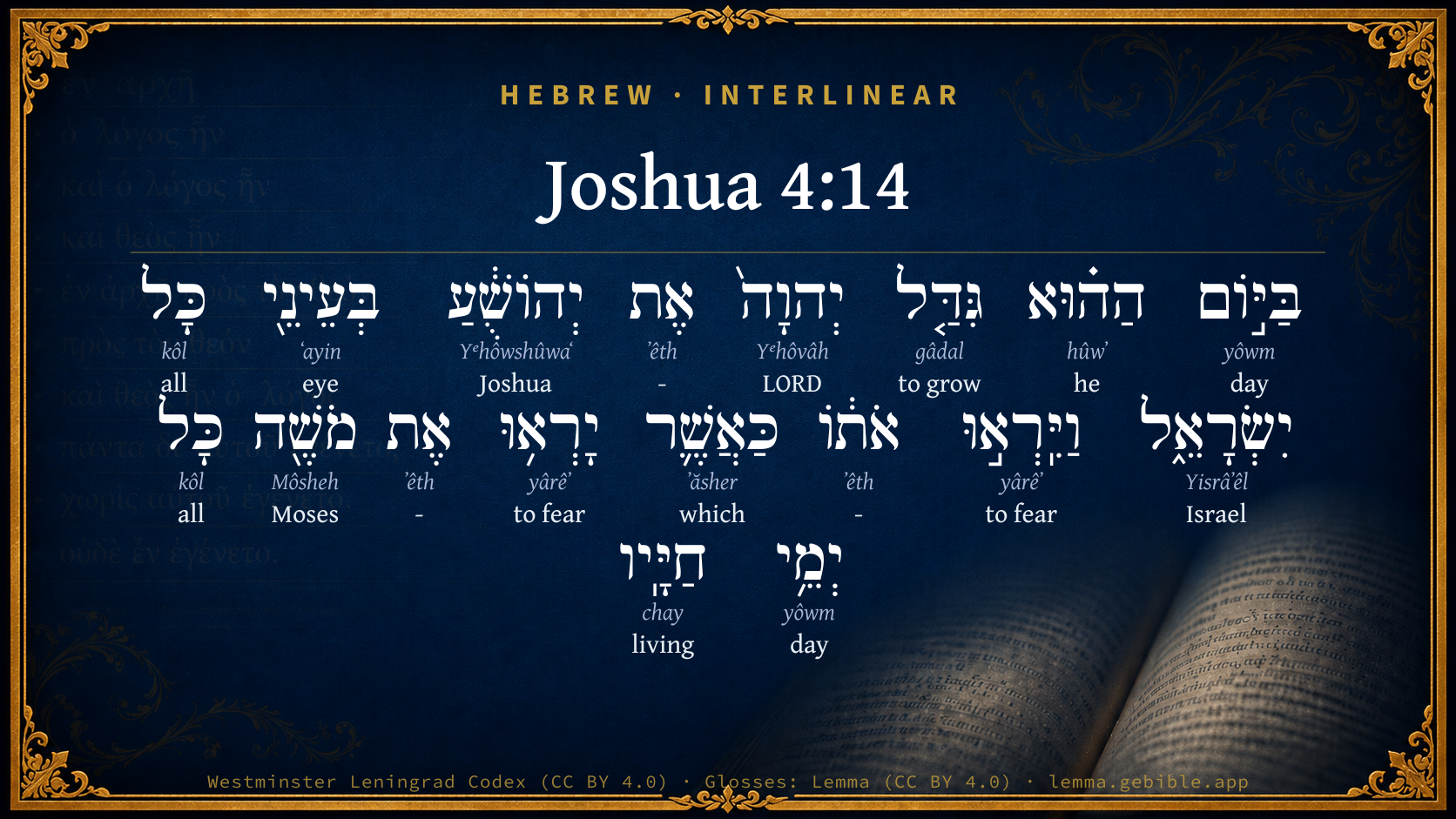
Hebrew (Westminster Leningrad Codex) Joshua 4:14 appears in the Hebrew Old Testament. The text above is from the Westminster Leningrad Codex. Each word links to its Strong’s number, a concise gloss, and parsing drawn from the Open Scriptures Hebrew Bible morphology. Click any word for its full Brown-Driver-Briggs (BDB) entry.
Download image
Cite this verse

Joshua 4:14 (World English Bible). Public Domain. Lemma interlinear Bible study tool, https://lemma.gebible.app/v/joshua/4/14.

Show BibTeX & RIS
BibTeX
RIS
English Translation
On that day Yahweh magnified Joshua in the sight of all Israel; and they feared him, as they feared Moses, all the days of his life.
World English Bible · Public Domain
Download a study sheet

One document with this verse’s original text, its word-by-word gloss line, the meaning frame, cross-references with their text, attributed commentary, and full source and license credits — printable, and it pastes into notes with its structure intact.

This verse Autodidact and up

Study sheet (.html) Plain text (.txt)

A passage Seminary Student

Up to 50 verses in one chapter. A passage sheet keeps up to 6 commentary sources and 12 cross-references per verse, in the order this page ranks them, and says so on the sheet whenever that leaves anything out. Ask for a single verse and you get the Autodidact verse sheet above.

Everything on this page stays free to read, with no account — the sheet is a download of what is already on screen, not access to it.

Want to remove ads? Support Godless Engineer
Compare translations 3

The same verse in 3 English versions, stacked beneath the original-language interlinear above. Click any original word for its lexicon entry.

Each is an independent rendering of the whole verse — the interlinear is not word-aligned to these translations.

Highlighted words mark where these versions differ — a whole-verse word diff, not a word-by-word alignment.

  • World English Bible Public Domain
    On that day Yahweh magnified Joshua in the sight of all Israel; and they feared him, as they feared Moses, all the days of his life.
  • King James Version Public Domain
    On that day the LORD magnified Joshua in the sight of all Israel; and they feared him, as they feared Moses, all the days of his life.
  • unfoldingWord Literal Text CC BY-SA 4.0
    On that day Yahweh made Joshua great in the eyes of all of Israel, and they feared him just as they had feared Moses all of the days of his life.

unfoldingWord Literal Text — © unfoldingWord, licensed CC BY-SA 4.0. Word-aligned USFM3 via Door43 (git.door43.org/unfoldingWord/en_ult).

Versions to compare (up to 4)

3 of 4 selected

Show all 18 translations

Every available English version of this verse, each an independent rendering of the whole verse.

  • World English Bible Public Domain
    On that day Yahweh magnified Joshua in the sight of all Israel; and they feared him, as they feared Moses, all the days of his life.
  • Berean Standard Bible Public Domain
    On that day the LORD exalted Joshua in the sight of all Israel, and they revered him all the days of his life, just as they had revered Moses.
  • Majority Standard Bible Public Domain
    On that day the LORD exalted Joshua in the sight of all Israel, and they revered him all the days of his life, just as they had revered Moses.
  • King James Version Public Domain
    On that day the LORD magnified Joshua in the sight of all Israel; and they feared him, as they feared Moses, all the days of his life.
  • American Standard Version (1901) Public Domain
    On that day Jehovah magnified Joshua in the sight of all Israel; and they feared him, as they feared Moses, all the days of his life.
  • Revised Version (1885) Public Domain
    On that day the LORD magnified Joshua in the sight of all Israel; and they feared him, as they feared Moses, all the days of his life.
  • Geneva Bible (1599) Public Domain
    That day the Lord magnified Ioshua in the sight of all Israel, and they feared him, as they feared Moses all dayes of his life.
  • Douay-Rheims (1899) Public Domain
    In that day the Lord magnified Josue in the sight of all Israel, that they should fear him, as they had feared Moses, while he lived.
  • Young's Literal Translation Public Domain
    On that day hath Jehovah made Joshua great in the eyes of all Israel, and they reverence him, as they reverenced Moses, all days of his life.
  • Literal Standard Version CC BY-SA 4.0
    On that day YHWH has made Joshua great in the eyes of all Israel, and they fear him, as they feared Moses, all [the] days of his life.
  • Unlocked Literal Bible CC BY-SA 4.0
    On that day Yahweh made Joshua great in the eyes of all Israel. They honored him—just as they honored Moses— all his days.
  • unfoldingWord Literal Text CC BY-SA 4.0
    On that day Yahweh made Joshua great in the eyes of all of Israel, and they feared him just as they had feared Moses all of the days of his life.
  • Darby Bible Public Domain
    On that day Jehovah magnified Joshua in the sight of all Israel; and they feared him, as they had feared Moses, all the days of his life.
  • World Messianic Bible Public Domain
    On that day, the LORD magnified Joshua in the sight of all Israel; and they feared him, as they feared Moses, all the days of his life.
  • Webster's Bible Public Domain
    On that day the LORD magnified Joshua in the sight of all Israel, and they feared him, as they feared Moses, all the days of his life.
  • Free Bible Version CC BY-SA 4.0
    On that day the Lord confirmed Joshua as a great leader in the sight of all the Israelites, and they were in awe of him just as they had been in awe of Moses.
  • Bible in Basic English Public Domain
    That day the Lord made Joshua great in the eyes of all Israel; and all the days of his life they went in fear of him, as they had gone in fear of Moses.
  • JPS Tanakh (1917) Public Domain
    On that day the LORD magnified Joshua in the sight of all Israel; and they feared him, as they feared Moses, all the days of his life.

Literal Standard Version (2020), Covenant Press — licensed CC BY-SA 4.0. Text via the HelloAO Bible API (eBible.org). Unlocked Literal Bible (unfoldingWord) — licensed CC BY-SA 4.0. Text via the HelloAO Bible API (eBible.org). unfoldingWord Literal Text — © unfoldingWord, licensed CC BY-SA 4.0. Word-aligned USFM3 via Door43 (git.door43.org/unfoldingWord/en_ult). Free Bible Version, Dr. Jonathan Gallagher — licensed CC BY-SA 4.0. Text via the HelloAO Bible API (eBible.org).

Word by word

More ways to search: Search by grammar → Find every occurrence → Compare this word →

Practice this passage: Drill this verse → Learn its vocabulary →

גִּדַּ֤ל
gâdal
H1431
“to grow”
Verb, Piel, Perfect, 3rd Person, Masculine, Singular
Part of Speech
Verb
Stem
Piel
Form
Perfect
Person
3rd Person
Gender
Masculine
Number
Singular
Full BDB Definition

Origin: a primitive root

TWOT: 315

to grow, become great or important, promote, make powerful, praise, magnify, do great things - (Qal) - to grow up - to become great - to be magnified - (Piel) - to cause to grow - to make great, powerful - to magnify - (Pual) to be brought up - (Hiphil) - to make great - to magnify - to do great things - (Hithpael) to magnify oneself
  1. בַּיּ֣וֹם yôwm H3117 “in/at the · day” Preposition, Determined + Noun, Common, Masculine, Singular, Absolute
  2. הַה֗וּא hûwʼ H1931 “the · he” Particle, Definite Article + Pronoun, Personal, 3rd Person, Masculine, Singular
  3. יְהוָה֙ Yᵉhôvâh H3068 “LORD” Noun, Proper
  4. אֶת ʼêth H853 “-” Particle, Direct Object
  5. יְהוֹשֻׁ֔עַ Yᵉhôwshûwaʻ H3091 “Joshua” Noun, Proper
  6. בְּעֵינֵ֖י ʻayin H5869 “in/at · eyes of” Preposition + Noun, Common, Both, Dual, Construct
  7. כָּל kôl H3605 “all of” Noun, Common, Masculine, Singular, Construct
  8. יִשְׂרָאֵ֑ל Yisrâʼêl H3478 “Israel” Noun, Proper
  9. וַיִּֽרְא֣וּ yârêʼ H3372 “and · to fear” Conjunction + Verb, Qal, Sequential Imperfect, 3rd Person, Masculine, Plural
  10. אֹת֔וֹ ʼêth H853 “- · him” Particle, Direct Object + Suffix, Personal, 3rd Person, Masculine, Singular
  11. כַּאֲשֶׁ֛ר ʼăsher H834 “like/as · which” Preposition + Particle, Relative
  12. יָרְא֥וּ yârêʼ H3372 “to fear” Verb, Qal, Perfect, 3rd Person, Common, Plural
  13. אֶת ʼêth H853 “-” Particle, Direct Object
  14. מֹשֶׁ֖ה Môsheh H4872 “Moses” Noun, Proper
  15. כָּל kôl H3605 “all of” Noun, Common, Masculine, Singular, Construct
  16. יְמֵ֥י yôwm H3117 “days of” Noun, Common, Masculine, Plural, Construct
  17. חַיָּֽיו chay H2416 “living things · his” Noun, Common, Masculine, Plural, Construct + Suffix, Personal, 3rd Person, Masculine, Singular

About this verse

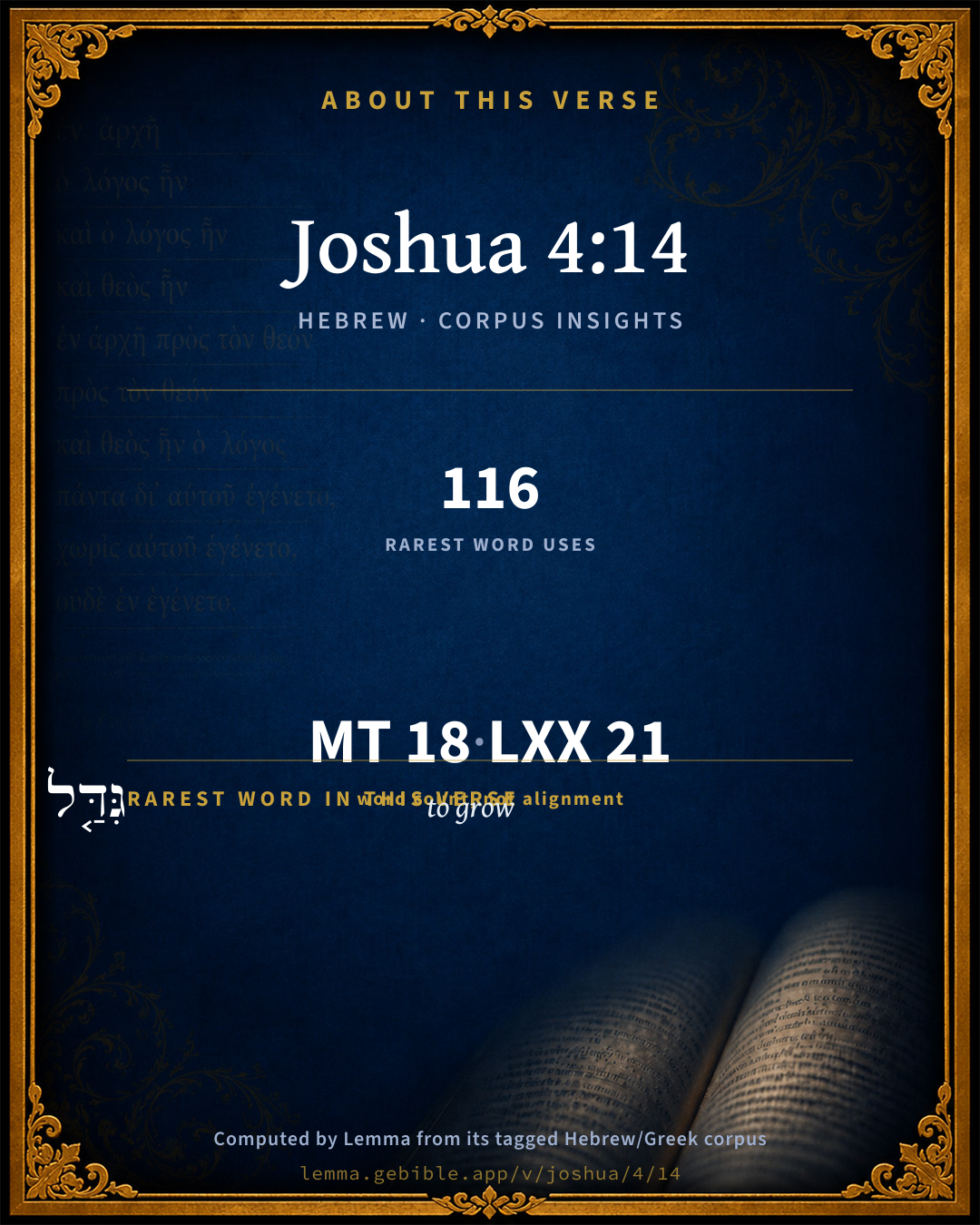
These counts appear in no published source. They are computed here, from the morphology-tagged text and Lemma’s own curated glosses. What Lemma adds →

18
words
13
distinct lemmas
Historical
section

Grammatical profile

  • 3 verbs
  • 10 nouns
  • 1 pronoun
  • 4 particles

Verb forms

  • גִּדַּ֤ל Piel · Perfect
  • וַיִּֽרְא֣וּ Qal · Sequential Imperfect
  • יָרְא֥וּ Qal · Perfect

Repetition

Words recur within this verse — often emphatic in Hebrew:

  • בַּיּ֣וֹם day H3117 ×2
  • כָּל all H3605 ×2
  • וַיִּֽרְא֣וּ to fear H3372 ×2

Hebrew & Septuagint length

In English translation the verse runs 26 words from the Hebrew and 26 from the Septuagint (LXX English) — the same length.

A rough comparison of the two English renderings, which tokenize alike — not a word-level alignment.

Word counts can differ between the Hebrew and the Greek without any difference in meaning — e.g. the Hebrew direct-object marker אֵת has no separate Greek word, and Greek often adds the article ὁ.

In the original languages it is 18 Hebrew tokens and 21 Greek tokens — but the two are counted differently (Hebrew bundles its prefixes and suffixes into one token; the Greek is in lemma form), so that isn’t a like-for-like length.

Cross-references

9

Topical passages linked to Joshua 4:14 in the Treasury of Scripture Knowledge — connected by theme and wording, ordered by reader-vote popularity; previews shown in the World English Bible.

  • Joshua 3:7 Yahweh said to Joshua, This day will I begin to magnify you in the sight of all Israel, that they may know that, as I was with Moses, so I will be with you.
  • 2 Chronicles 30:12 Also on Judah came the hand of God to give them one heart, to do the commandment of the king and of the princes by the word of Yahweh.
  • 1 Kings 3:28 All Israel heard of the judgment which the king had judged; and they feared the king: for they saw that the wisdom of God was in him, to do justice.
  • Joshua 1:16–18 They answered Joshua, saying, All that you have commanded us we will do, and wherever you send us we will go.
  • Romans 13:4 for he is a servant of God to you for good. But if you do that which is evil, be afraid, for he doesn't bear the sword in vain; for he is a minister of God, an avenger for wrath to him who does evil.
  • Exodus 14:31 Israel saw the great work which Yahweh did to the Egyptians, and the people feared Yahweh; and they believed in Yahweh, and in his servant Moses.
  • 1 Samuel 12:18 So Samuel called to Yahweh; and Yahweh sent thunder and rain that day: and all the people greatly feared Yahweh and Samuel.
  • Proverbs 24:21 My son, fear Yahweh and the king. Don't join those who are rebellious:

Cross-references courtesy of OpenBible.info (CC BY 4.0).

Hebrew and Greek witnesses Masoretic Hebrew ↔ Greek Septuagint

The same verse in the two great witnesses to the Old Testament, shown verse-for-verse.

These are two independent witnesses, not word-aligned to each other, and the Septuagint is shown in lemma (dictionary) form.

Hebrew Joshua 4:14 Masoretic · Westminster Leningrad Codex

בַּיּ֣וֹם הַה֗וּא גִּדַּ֤ל יְהוָה֙ אֶת יְהוֹשֻׁ֔עַ בְּעֵינֵ֖י כָּל יִשְׂרָאֵ֑ל וַיִּֽרְא֣וּ אֹת֔וֹ כַּאֲשֶׁ֛ר יָרְא֥וּ אֶת מֹשֶׁ֖ה כָּל יְמֵ֥י חַיָּֽיו

On that day Yahweh magnified Joshua in the sight of all Israel; and they feared him, as they feared Moses, all the days of his life.

World English Bible · Public Domain

Greek LXX Joshua 4:14 Septuagint · lemma form

ἐν ἐκεῖνος ὁ ἡμέρα αὐξάνω κύριος ὁ ἰησοῦς ἐναντίον πᾶς ὁ γένος ἰσραήλ καί φοβέω αὐτός ὥσπερ μωυσῆς ὅσος χρόνος ζάω

In that day the Lord magnified Joshua before all the people of Israel; and they feared him, as they did Moses, as long as he lived.

LXX2012 (modern English Septuagint) · Public Domain

Hebrew: Westminster Leningrad Codex (CC BY 4.0). Greek: Septuagint (public domain); English from LXX2012 (modern English Septuagint) (Public Domain). How the Septuagint differs from the Hebrew →

Targum (Aramaic paraphrase)

1

The Targum is the ancient Jewish Aramaic paraphrase of the Hebrew Scriptures — an interpretive translation, not the Hebrew text itself. Onkelos (literal) and Pseudo-Jonathan (expansive) render the Torah, and Jonathan the Prophets. Coverage is partial: where no permissively-licensed English translation exists for a verse, only the Aramaic is shown. This is verse-level text, not a word-by-word alignment to the Hebrew.

  1. Targum Jonathan Prophets (Joshua–Malachi)
    בְּיוֹמָא הַהוּא רַבֵּי יְיָ יַת יְהוֹשֻׁעַ בְּעֵינֵי כָּל יִשְׂרָאֵל וּדְחִילוּ מִנֵיהּ כְּמָא דַהֲווֹ דָחֲלִין מִן מֹשֶׁה כָּל יוֹמֵי חַיוֹהִי:

    (no public-domain English translation for this verse)

    Targum Jonathan — Aramaic: “Mikraot Gedolot” (public domain). English: “Sefaria Community Translation” (CC0 1.0 (public-domain dedication)); “London "Chaldee Paraphrase," 1871” (public domain). Text via Sefaria.

Commentary

Notes on Joshua 4:14 from classic Christian and Jewish commentators (each source and its license shown beneath its notes). The classic Christian expositions comment on the surrounding passage and are grouped to its opening verse, so a note may address several verses; the Jewish commentaries on the Tanakh (Rashi and others) are per-verse, so they appear only where the commentator wrote on this verse.

Lemma curates 59 commentaries, every one of them public domain or Creative Commons licensed, each selected and text-cleaned for this edition rather than reprinted as found. About our sources →

Jamieson, Fausset & Brown

Robert Jamieson, A. R. Fausset & David Brown

GOD MAGNIFIES JOSHUA. (Jos 4:14-24)

On that day the Lord magnified Joshua in the sight of all Israel--It appeared clear from the chief part he acted, that he was the divinely appointed leader; for even the priests did not enter the river or quit their position, except at his command; and thenceforward his authority was as firmly established as that of his predecessor.

Jamieson, Fausset & Brown — Commentary Critical and Explanatory on the Whole Bible (1871) — public domain (CC PDM 1.0). Text via the HelloAO Bible API.

Trapp's Complete Commentary

John Trapp

Jos 4:14 On that day the LORD magnified Joshua in the sight of all Israel; and they feared him, as they feared Moses, all the days of his life.

Ver. 14. The Lord magnified Joshua.] See Jos 3:7.

John Trapp, A Commentary or Exposition upon All the Books of the Old and New Testament (1647–1656) — public domain. Text from a community e-Sword module.

Joseph Benson's Commentary

Jos 4:14. On that day the Lord magnified Joshua — Both by the fellowship he admitted him to with himself, speaking to him on all occasions, and being ready to be consulted by him, and by the miracle which had just given happy success to that general’s first enterprise, and which had acquired to him the same confidence and respect from the Israelites which Moses had before acquired from the miraculous passage of the Red sea: thus did the Lord, in a glorious manner, accomplish the promises made to Joshua in the foregoing chapter, Jos 4:7.

Joseph Benson's Commentary on the Old and New Testaments (1811–1818) — public domain. Text from a community e-Sword module.

Tyndale Open Study Notes

Tyndale Open Resources

4:14 Now that God had brought the Israelites safely across the Jordan River, Israel recognized God’s presence with Joshua as a great leader and revered him as much as they had revered Moses. Their confidence in Joshua would be crucial in the years ahead.

Tyndale Open Study Notes — © Tyndale Open Resources, licensed CC BY-SA 4.0. Text via the HelloAO Bible API.

Geneva Bible (1599)

Geneva Bible translators

Or, reverenced him.

Geneva Bible (1599) marginal notes — public domain. Text via Bolls.life.

Adam Clarke's Commentary

Verse 14. The Lord magnified Joshua] See Clarke on Jos 3:7.

Adam Clarke's Commentary on the Bible (1810–1826) — public domain. Text from a community e-Sword/MySword module.

John Calvin's Commentaries

14. On that day the Lord magnified, etc It was not indeed the principal end of the miracle to proclaim Joshua’s pre-eminence in power and authority, but as it greatly concerned the public interest, that the government of Joshua should be firmly established, it is justly set down as an additional instance of the divine favor, that he was, so to speak, adorned with sacred insignia to render him venerable in the eyes of the people, and prevent any one from presuming to despise him. For a promiscuous multitude, not ruled by a head, breaks up and falls away of its own accord. The Lord, therefore, to provide for the safety of his people, distinguished Joshua by a special mark declaratory of his vocation.

From this passage we may learn that God specially recommends to us all those through whose hands he displays his excellent working, and requires us to give them due honor and reverence. When it is said that the people feared Joshua as they had feared Moses, should any one object that the statement is refuted by the many sedition’s and tumults which they stirred up against him, not only wantonly but furiously, it is easy to answer, that it does not apply to the whole period from their departure out of Egypt, but only refers to that when subdued by plagues and softened down, they began to be duly obedient to Moses. For what is now described is a tranquil government, as if they had laid aside their ancient perverseness, more especially when the turbulent parents were dead and a better race had succeeded. Accordingly, we do not read that there was any difficulty in ruling and turning them. I now only briefly advert to what I have already explained. For when Joshua at the outset exhorted them to obedience, they said that they would be obedient as they had been to Moses.

John Calvin's Commentaries (1540-1563) — public domain. Text from the Calvin Translation Society English edition (1840s-50s) via the Christian Classics Ethereal Library (ccel.org). Calvin's coverage is partial (roughly two-thirds of the Bible); uncommented books and verses are honest gaps, never fabricated. The 19th-century editor's footnotes and remarks are omitted so the notes are faithfully Calvin's own voice.

Ellicott's Commentary for English Readers

(14) All the days of his life.—This ends the section, as appears by comparison with Jos_3:7. Observe that Joshua’s position, as equal to Moses in the respect of the people, dates from the passage of Jordan, a fact not to be forgotten in considering his Antitype.

A Bible Commentary for English Readers, edited by Charles John Ellicott (1878–1897) — public domain. Text from a community e-Sword module.

John Gill's Exposition

On that day the Lord magnified Joshua in the sight of Israel,.... Made him great and honourable in their esteem, by doing what he foretold would be done, dividing the waters of Jordan, drying up the river to make a passage for them through it, as on dry land:

and they feared him, as they feared Moses, all the days of his life; had a reverend esteem of him, and affection for him, and yielded obedience to him all his days; see Exo 14:31.

John Gill's Exposition of the Whole Bible (1746–1763) — public domain (CC PDM 1.0). Text via the HelloAO Bible API.

Haydock's Catholic Bible Commentary

In, &c. Josue recapitulates how this miracle established his authority, and how he was ordered to command the priests to come up from the midst of the Jordan, after the people had all got to the other side, and the stones were fixed, to denote where the ark had stood, like a wall, to hinder the waters from rushing down. (Haydock)

George Leo Haydock (1774–1849), Haydock's Catholic Family Bible and Commentary, 1859 edition — public domain. Excludes Psalms (Douay-Rheims chapter numbering differs from Protestant) and Deuterocanonical books (Catholic canon only).

Whedon's Commentary on the Bible

Daniel D. Whedon

14. The Lord magnified Joshua — This is the fulfilment of the promise in Jos_3:7. See the note.

And they feared him, as they feared Moses — “This was not, indeed, the chief design of the miracle, to exalt the power and authority of Joshua. But as it was of the greatest importance to the people generally that the government of Joshua should be firmly established, it is very properly mentioned as the crowning advantage resulting from it, that he was, as it were, invested with sacred insignia, which produced such veneration among the people that no one dared to despise him.” — Calvin.

All the days of his life — Joshua’s life.

Daniel D. Whedon (gen. ed.), Commentary on the Old and New Testaments (1874–1909) — public domain. Text from a community e-Sword module.

The Pulpit Commentary

On that day the Lord magnified Joshua. This was not, as Calvin remarks, the chief aim of the miracle. But it was, nevertheless, one important result of it. Joshua was the appointed leader of the Israelites, and he was under God"s special protection and guidance. But however much God may overrule our human nature to His own purposes, He never abrogates the laws of its working. Confidence in a leader, from a human point of view, is one of the most essential requisites for success in war. Therefore in the crossing of the Jordan we find Joshua directing all the operations, though the direction of affairs might have been put into other hands, that of Eleazar the high priest, for instance. But this was the public attestation of the secret intimation God had given Joshua: (Jos_1:5) "As I was with Moses, so will I be with thee: I will not fail thee nor forsake thee." From this point onward we see no signs of hesitation on the part of the Israelites; nothing but the most unwavering confidence in the Divine mission, as well as in the extraordinary natural gifts, of their leader.

Grace for beginners.

In one sense Joshua is not a beginner. For forty years he has been at work for God. As spy, as general, as servant of Moses, during all these years he has wrought in the work, and with the help of God. Yet though eighty-five years of age, this crossing Jordan is his first act of leadership. In the sovereignty of Israel he is a beginner, with a beginner"s fears, difficulties, burdens. And here we see a beautiful illustration of the fact that with a beginner"s cares comes a beginner"s grace as well. A marvellous miracle stamps him as the leader sent by God. The "divinity that doth hedge a king" in an unusual degree invests him. And in his first enterprise he has such help as makes him secure of the future allegiance of all the people. Many are, and more ought to be, beginners in God"s ways. Consider the testimony of this incident as it affects them, and first observe

I BEGINNERS NEED SPECIAL GRACE AND HELP. Evidently Joshua did. If Moses shrank, how much more might he, from this perilous enterprise, when the efforts of the people, after settlement, had no such stimulus as had been supplied by the oppression of their masters; when he was uncommended by the signs he carried of his Divine commission; when probably Eleazar would have been glad to have been chief ruler; when almost inevitably there would be critics who would oppose his plans and dispute the wisdom of his orders He had double work to do to cross Jordan, and justify his own appointment. Nay, treble work to do for his power of helping Israel in the future depended largely on what he would now do. Sufficient unto that day was its own troubles; but it had to carry the justification of the past and the assurance of the future with it. Even so all beginners find their work especially arduous. "It is the first step that costs;" the first step of the prodigal returning to his father; the leaving the nets to follow Christ; the first act of service to men. We are unaccustomed; and that force of habit which stands us in such good stead when we have had experience of well doing now operates the other way. All obstacles are enlarged by nervous apprehensions. In subsequent acts we may have society the first act of right is apt to be profoundly solitary. Do not be staggered at the difficulties of beginning well. All beginners have had the same experience to contend with. But observe secondly

II BEGINNERS HAVE SPECIAL GRACE TO MEET THEIR SPECIAL DIFFICULTIES. As with Paul"s "thorn," pity to remove which was asked, grace to endure which was granted; so here God does not take away the difficulty, but gives grace to surmount it. Over and above the usual grace He gives to all His saints, there is special grace given to them. Has Moses a task imposed on him specially arduous? Not one difficulty is removed, but miraculous signs invest him with a sacred inviolable dignity, and plagues of terrific power sanction his demands. Is David indicated as future king by the whispered call of God? In the challenge of Goliath and the pouring of a "patriotic tide through his undaunted heart the suggested daring, and the power to achieve what he dares to undertake the beginning of his kingly service is made possible. Does it come to Daniel as a duty to keep himself pure from defiling meats? The beginning of his devotion is helped by a physical grace that keeps him strong and well. The beginning of Peter"s consecration is helped by the miraculous draught of fishes. The beginning of the service of the seventy, by the miraculous powers so freely imparted to them. And so always there is special grace for those beginning. There is some fulness of gracious influence clearness of light some strengthening companionship of man some closer presence of God invigorating hopes the energy which comes from the sacred calm of penitence some clearing of the way before us some moving of the pillar of fire and cloud, or of the Ark of God. And whenever any enterprise of Christian love is undertaken, there is always some help of a special kind. Enlargement of spirit some power of prayer, or patience some great strength of humility or steadfastness. As here, so always, special grace attends the beginnings of all great courses. And this is no light thing, for in all the forms of Christian life and service, "Well begun is half done." And the grace then given not merely makes the beginning possible, but all the subsequent career. "They feared Joshua as they feared Moses, all the days of his life." Always, the beginner gets special grace for the beginning of his work, and sufficient to exert an influence on all that follows after. If such is the case, consider lastly

III WHAT LESSONS ARE INVOLVED IN IT. There is this lesson first and foremost

1. Shrink not from beginning the Christian life. It is difficult nay, to naked human strength impossible. The beginning the Jordan passage will try you. But beginners" difficulties are more than matched by beginners" grace. You may not feel this grace: it may be "latent" grace, and not "sensible" grace; but it will be there, omnipotent enough to carry you over every hindrance.

2. Shrink not from undertaking any duty of service with which God charges you. Do not be evilly modest, folding your pound in some napkin of seeming humility. If it be the path of duty, let no obstacles deter; they will only prove the occasion for grander help from God than you ever dare to hope.

3. Have you just begun discipleship or service, and are you overwhelmed with difficulty? "In your patience possess your soul," for even as a mother gives her finger to the little child just beginning to walk, so to us, who are but children of a larger growth, God lends His finger when we are beginning some great life task. G.

The Pulpit Commentary (1880–1919), ed. H.D.M. Spence-Jones & Joseph S. Exell — public domain. Text from a community e-Sword module.

Lesson kit

Teaching starters — assembled from the data on this page, not authored interpretation. Every prompt links to the verse data it draws on. Edit before teaching.

Joshua, in the Historical, opens this verse with 18 words (13 distinct Hebrew lemmas). Its most distinctive word is gâdal (“to grow”). A historical commentator’s framing appears above. Read the whole chapter for the surrounding context.

Discussion questions

  1. What does “to grow” (gâdal) contribute to the verse as a whole?
  2. How does Joshua 3:7, which shares this passage’s theme, read alongside this verse?
  3. What does the repetition of “day” (2× in this one verse) do in this verse?
  4. These translations render this verse differently; the difference is in the English rendering, not the original. What questions does that raise?
  5. «גִּדַּ֤ל» is a Piel Perfect verb. How does that grammatical form shape the action described?
  6. Compare how Jamieson, Fausset & Brown and Trapp's Complete Commentary read this verse. Where do they agree or differ?

Things to notice

Reading settings

Reading text

Shown beneath each verse's original-language words.

Old Testament
Old Testament edition

Read the OT as the Masoretic Hebrew (MT) or the Greek Septuagint (LXX).

English shown for the Greek Septuagint (in the Hebrew ↔ Greek comparison).

Comparing translations? Open the Compare panel on any verse page to stack up to four side by side.