Nehemiah 6:9

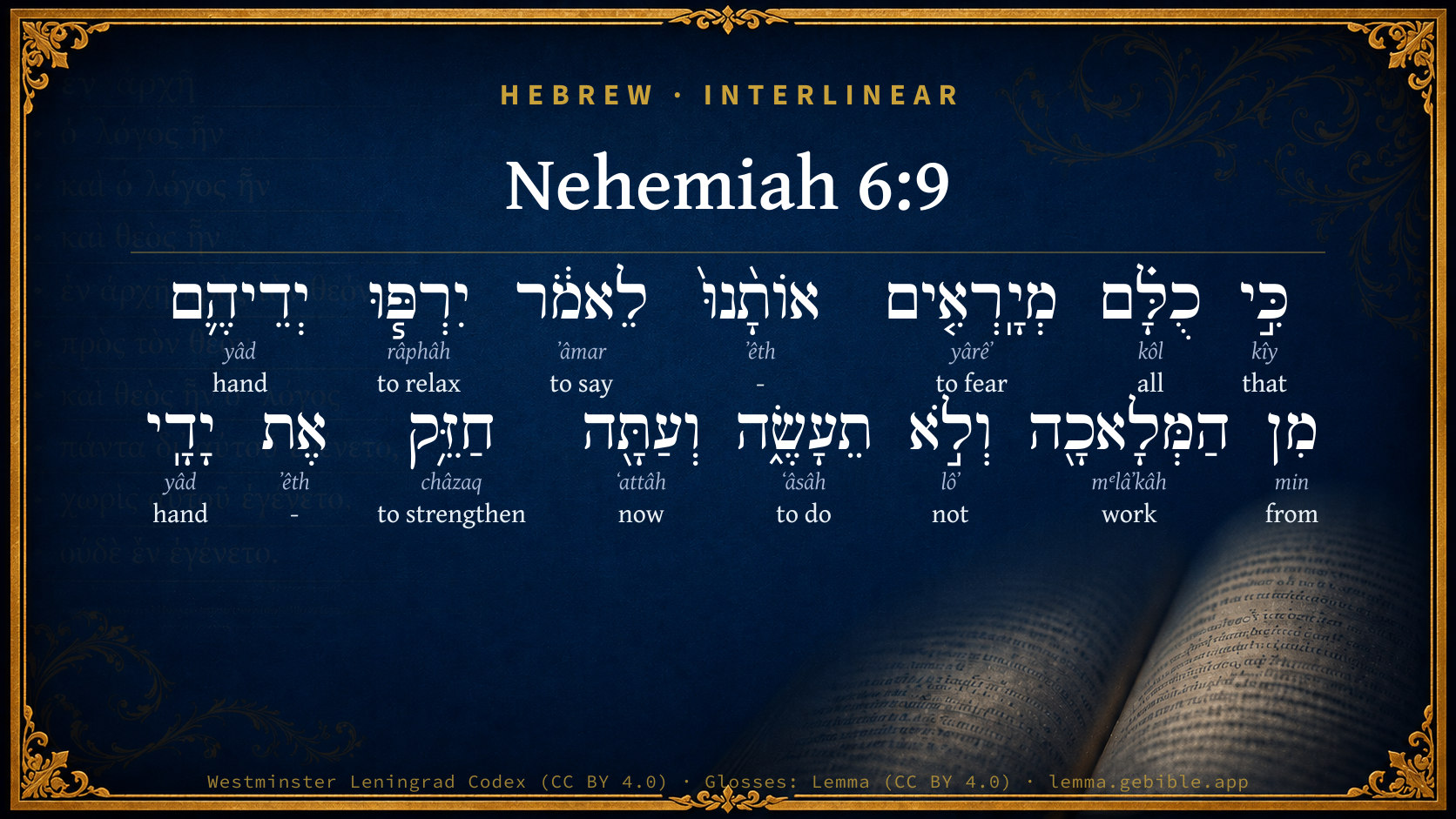
Hebrew (Westminster Leningrad Codex) Nehemiah 6:9 appears in the Hebrew Old Testament. The text above is from the Westminster Leningrad Codex. Each word links to its Strong’s number, a concise gloss, and parsing drawn from the Open Scriptures Hebrew Bible morphology. Click any word for its full Brown-Driver-Briggs (BDB) entry.
Download image
Cite this verse

Nehemiah 6:9 (World English Bible). Public Domain. Lemma interlinear Bible study tool, https://lemma.gebible.app/v/nehemiah/6/9.

Show BibTeX & RIS
BibTeX
RIS
English Translation
For they all would have made us afraid, saying, Their hands shall be weakened from the work, that it not be done. But now, [God], strengthen you my hands.
World English Bible · Public Domain
Download a study sheet

One document with this verse’s original text, its word-by-word gloss line, the meaning frame, cross-references with their text, attributed commentary, and full source and license credits — printable, and it pastes into notes with its structure intact.

This verse Autodidact and up

Study sheet (.html) Plain text (.txt)

A passage Seminary Student

Up to 50 verses in one chapter. A passage sheet keeps up to 6 commentary sources and 12 cross-references per verse, in the order this page ranks them, and says so on the sheet whenever that leaves anything out. Ask for a single verse and you get the Autodidact verse sheet above.

Everything on this page stays free to read, with no account — the sheet is a download of what is already on screen, not access to it.

Want to remove ads? Support Godless Engineer
Compare translations 3

The same verse in 3 English versions, stacked beneath the original-language interlinear above. Click any original word for its lexicon entry.

Each is an independent rendering of the whole verse — the interlinear is not word-aligned to these translations.

Highlighted words mark where these versions differ — a whole-verse word diff, not a word-by-word alignment.

  • World English Bible Public Domain
    For they all would have made us afraid, saying, Their hands shall be weakened from the work, that it not be done. But now, [God], strengthen you my hands.
  • King James Version Public Domain
    For they all made us afraid, saying, Their hands shall be weakened from the work, that it be not done. Now therefore, O God, strengthen my hands.
  • unfoldingWord Literal Text CC BY-SA 4.0
    For all of them were frightening us, saying, “Their hands will drop from the work, and it will not be done.” So now, strengthen my hands.

unfoldingWord Literal Text — © unfoldingWord, licensed CC BY-SA 4.0. Word-aligned USFM3 via Door43 (git.door43.org/unfoldingWord/en_ult).

Versions to compare (up to 4)

3 of 4 selected

Show all 18 translations

Every available English version of this verse, each an independent rendering of the whole verse.

  • World English Bible Public Domain
    For they all would have made us afraid, saying, Their hands shall be weakened from the work, that it not be done. But now, [God], strengthen you my hands.
  • Berean Standard Bible Public Domain
    For they were all trying to frighten us, saying, “Their hands will be weakened in the work, and it will never be finished.” But now, my God, strengthen my hands.
  • Majority Standard Bible Public Domain
    For they were all trying to frighten us, saying, “Their hands will be weakened in the work, and it will never be finished.” But now, my God, strengthen my hands.
  • King James Version Public Domain
    For they all made us afraid, saying, Their hands shall be weakened from the work, that it be not done. Now therefore, O God, strengthen my hands.
  • American Standard Version (1901) Public Domain
    For they all would have made us afraid, saying, Their hands shall be weakened from the work, that it be not done. But now, `O God', strengthen thou my hands.
  • Revised Version (1885) Public Domain
    For they all would have made us afraid, saying, Their hands shall be weakened from the work, that it be not done. But now, O God, strengthen thou my hands.
  • Geneva Bible (1599) Public Domain
    For all they afrayed vs, saying, Their handes shalbe weakened from the worke, and it shall not be done: nowe therefore incourage thou me.
  • Douay-Rheims (1899) Public Domain
    For all these men thought to frighten us, thinking that our hands would cease from the work, and that we would leave off. Wherefore I strengthened my hands the more:
  • Young's Literal Translation Public Domain
    for all of them are making us afraid, saying, `Their hands are too feeble for the work, and it is not done;' and now, strengthen Thou my hands.
  • Literal Standard Version CC BY-SA 4.0
    for all of them are making us afraid, saying, “Their hands are too feeble for the work, and it is not done”; and now, strengthen my hands.
  • Unlocked Literal Bible CC BY-SA 4.0
    For they all wanted to make us afraid, thinking, “They will drop their hands from doing the work, and it will not be done.” But now, God, please strengthen my hands.
  • unfoldingWord Literal Text CC BY-SA 4.0
    For all of them were frightening us, saying, “Their hands will drop from the work, and it will not be done.” So now, strengthen my hands.
  • Darby Bible Public Domain
    For they all would have made us afraid, saying, Their hands shall be slackened from the work, that it be not carried out. -- Now therefore strengthen my hands!
  • World Messianic Bible Public Domain
    For they all would have made us afraid, saying, “Their hands will be weakened from the work, that it not be done.” But now, strengthen my hands.
  • Webster's Bible Public Domain
    For they all made us afraid, saying, Their hands shall be weakened from the work, that it may not be done. Now therefore, O God, strengthen my hands.
  • Free Bible Version CC BY-SA 4.0
    They were all just trying to scare us, telling themselves, “They won't have the strength to work so it won't ever get finished.” But I prayed, now make me strong!
  • Bible in Basic English Public Domain
    For they were hoping to put fear in us, saying, Their hands will become feeble and give up the work so that it may not get done. But now, O God, make my hands strong.
  • JPS Tanakh (1917) Public Domain
    For they all would have us afraid, saying: 'Their hands shall be weakened from the work, that it be not done.' But now, strengthen Thou my hands.

Literal Standard Version (2020), Covenant Press — licensed CC BY-SA 4.0. Text via the HelloAO Bible API (eBible.org). Unlocked Literal Bible (unfoldingWord) — licensed CC BY-SA 4.0. Text via the HelloAO Bible API (eBible.org). unfoldingWord Literal Text — © unfoldingWord, licensed CC BY-SA 4.0. Word-aligned USFM3 via Door43 (git.door43.org/unfoldingWord/en_ult). Free Bible Version, Dr. Jonathan Gallagher — licensed CC BY-SA 4.0. Text via the HelloAO Bible API (eBible.org).

Word by word

More ways to search: Search by grammar → Find every occurrence → Compare this word →

Practice this passage: Drill this verse → Learn its vocabulary →

יִרְפּ֧וּ
râphâh
H7503
“to relax”
Verb, Qal, Imperfect, 3rd Person, Masculine, Plural
Part of Speech
Verb
Stem
Qal
Form
Imperfect
Person
3rd Person
Gender
Masculine
Number
Plural
Full BDB Definition

Origin: a primitive root

TWOT: 2198

to sink, relax, sink down, let drop, be disheartened - (Qal) - to sink down - to sink, drop - to sink, relax, abate - to relax, withdraw - (Niphal) idle (participle) - (Piel) to let drop - (Hiphil) - to let drop, abandon, relax, refrain, forsake - to let go - to refrain, let alone - to be quiet - (Hithpael) to show oneself slack
  1. כִּ֣י kîy H3588 “that” Conjunction
  2. כֻלָּ֗ם kôl H3605 “all · their” Noun, Common, Masculine, Singular, Construct + Suffix, Personal, 3rd Person, Masculine, Plural
  3. מְיָֽרְאִ֤ים yârêʼ H3372 “fearing” Verb, Piel, Participle Active, Masculine, Plural, Absolute
  4. אוֹתָ֨נוּ֙ ʼêth H853 “- · us” Particle, Direct Object + Suffix, Personal, 1st Person, Common, Plural
  5. לֵאמֹ֔ר ʼâmar H559 “to say” Preposition + Verb, Qal, Infinitive Construct
  6. יְדֵיהֶ֛ם yâd H3027 “hands · their” Noun, Common, Both, Dual, Construct + Suffix, Personal, 3rd Person, Masculine, Plural
  7. מִן min H4480 “from” Preposition
  8. הַמְּלָאכָ֖ה mᵉlâʼkâh H4399 “the · work” Particle, Definite Article + Noun, Common, Feminine, Singular, Absolute
  9. וְלֹ֣א lôʼ H3808 “and · not” Conjunction + Particle, Negative
  10. תֵעָשֶׂ֑ה ʻâsâh H6213 “to do” Verb, Niphal, Imperfect, 3rd Person, Feminine, Singular
  11. וְעַתָּ֖ה ʻattâh H6258 “and · now” Conjunction + Adverb
  12. חַזֵּ֥ק châzaq H2388 “strengthen” Verb, Piel, Imperative, 2nd Person, Masculine, Singular
  13. אֶת ʼêth H853 “-” Particle, Direct Object
  14. יָדָֽי yâd H3027 “hands · my” Noun, Common, Both, Dual, Construct + Suffix, Personal, 1st Person, Common, Singular

About this verse

These counts appear in no published source. They are computed here, from the morphology-tagged text and Lemma’s own curated glosses. What Lemma adds →

15
words
13
distinct lemmas
Historical
section

Shared distinctive vocabulary

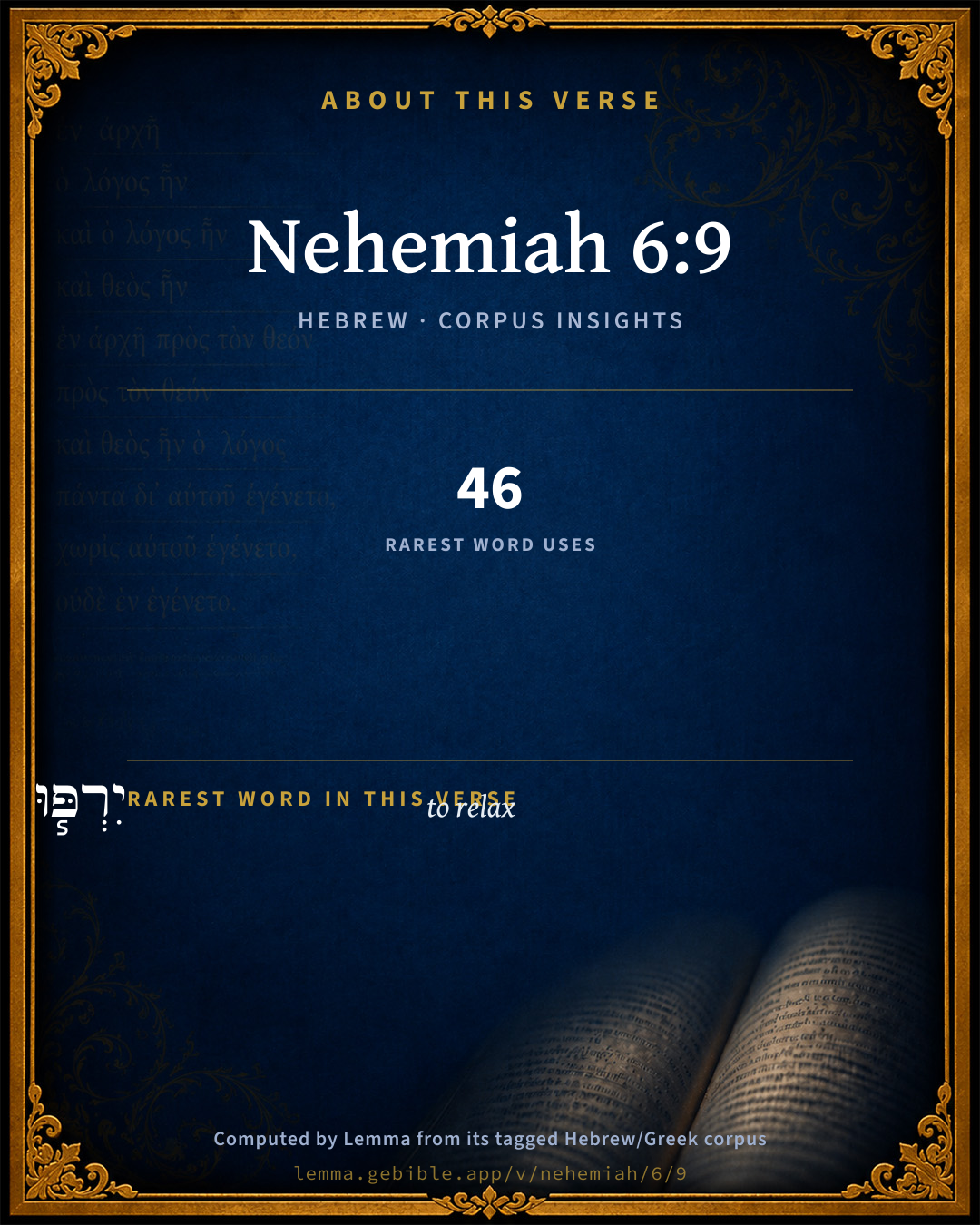
יִרְפּ֧וּ to relax H7503 occurs in 45 verses of the Hebrew Bible. Also found in:

Grammatical profile

  • 5 verbs
  • 4 nouns
  • 1 preposition
  • 1 conjunction
  • 1 adverb
  • 3 particles

Verb forms

  • מְיָֽרְאִ֤ים Piel · Participle Active
  • לֵאמֹ֔ר Qal · Infinitive Construct
  • יִרְפּ֧וּ Qal · Imperfect
  • תֵעָשֶׂ֑ה Niphal · Imperfect
  • חַזֵּ֥ק Piel · Imperative

Repetition

A word recurs within this verse — often emphatic in Hebrew:

  • יְדֵיהֶ֛ם hand H3027 ×2

Cross-references

20

Topical passages linked to Nehemiah 6:9 in the Treasury of Scripture Knowledge — connected by theme and wording, ordered by reader-vote popularity; previews shown in the World English Bible.

  • Psalms 138:3 In the day that I called, you answered me. You encouraged me with strength in my soul.
  • 1 Samuel 30:6 David was greatly distressed; for the people spoke of stoning him, because the soul of all the people was grieved, every man for his sons and for his daughters: but David strengthened himself in Yahweh his God.
  • Nehemiah 4:10–14 Judah said, The strength of the bearers of burdens is decayed, and there is much rubbish; so that we are not able to build the wall.
  • Isaiah 41:10 Don't you be afraid, for I am with you; don't be dismayed, for I am your God; I will strengthen you; yes, I will help you; yes, I will uphold you with the right hand of my righteousness.
  • 2 Corinthians 12:9 He has said to me, "My grace is sufficient for you, for my power is made perfect in weakness." Most gladly therefore I will rather glory in my weaknesses, that the power of Christ may rest on me.
  • Ephesians 3:16 that he would grant you, according to the riches of his glory, that you may be strengthened with power through his Spirit in the inward man;
  • Ephesians 6:10 Finally, be strong in the Lord, and in the strength of his might.
  • Philippians 4:13 I can do all things through Christ, who strengthens me.
  • Hebrews 12:12 Therefore, lift up the hands that hang down and the feeble knees,
  • 1 Peter 5:10 But may the God of all grace, who called you to his eternal glory by Christ Jesus, after you have suffered a little while, perfect, establish, strengthen, and settle you.
  • 2 Chronicles 15:7 But be you strong, and don't let your hands be slack; for your work shall be rewarded.
  • Isaiah 35:3–4 Strengthen you the weak hands, and confirm the feeble knees.
  • Jeremiah 38:4 Then the princes said to the king, Let this man, we pray you, be put to death; because he weakens the hands of the men of war who remain in this city, and the hands of all the people, in speaking such words to them: for this man doesn't seek the welfare of this people, but the hurt.
  • Ezra 4:1–24 Now when the adversaries of Judah and Benjamin heard that the children of the captivity were building a temple to Yahweh, the God of Israel;
  • Nehemiah 6:14 Remember, my God, Tobiah and Sanballat according to these their works, and also the prophetess Noadiah, and the rest of the prophets, that would have put me in fear.
  • Psalms 56:3 When I am afraid, I will put my trust in you.
  • Psalms 71:1 In you, Yahweh, I take refuge. Never let me be disappointed.
  • 2 Chronicles 32:18 They cried with a loud voice in the Jews' language to the people of Jerusalem who were on the wall, to frighten them, and to trouble them; that they might take the city.
  • Psalms 68:35 You are awesome, God, in your sanctuaries. The God of Israel gives strength and power to his people. Praise be to God!
  • Zechariah 10:12 I will strengthen them in Yahweh; And they will walk up and down in his name," says Yahweh.

Cross-references courtesy of OpenBible.info (CC BY 4.0).

Hebrew and Greek witnesses Masoretic Hebrew ↔ Greek Septuagint

The same verse in the two great witnesses to the Old Testament, shown verse-for-verse.

These are two independent witnesses, not word-aligned to each other, and the Septuagint is shown in lemma (dictionary) form.

Hebrew Nehemiah 6:9 Masoretic · Westminster Leningrad Codex

כִּ֣י כֻלָּ֗ם מְיָֽרְאִ֤ים אוֹתָ֨נוּ֙ לֵאמֹ֔ר יִרְפּ֧וּ יְדֵיהֶ֛ם מִן הַמְּלָאכָ֖ה וְלֹ֣א תֵעָשֶׂ֑ה וְעַתָּ֖ה חַזֵּ֥ק אֶת יָדָֽי

For they all would have made us afraid, saying, Their hands shall be weakened from the work, that it not be done. But now, [God], strengthen you my hands.

World English Bible · Public Domain

Greek LXX Structure differs

The Septuagint has no separate book of Nehemiah. Its Greek text is the second half of Esdras B (2 Esdras), chapters 11–23; Ezra is the first half (1–10).

A verse-for-verse comparison isn’t shown here because the chapters and verses don’t line up. Switch to the LXX edition with the MT / LXX toggle above to read the Greek directly.

On this verse, The Cambridge Bible for Schools and Colleges discusses the Septuagint’s reading. Read the note in Commentary ↓

Hebrew: Westminster Leningrad Codex (CC BY 4.0). Greek: Septuagint (public domain); English from a public-domain English Septuagint. How the Septuagint differs from the Hebrew →

Commentary

Notes on Nehemiah 6:9 from classic Christian and Jewish commentators (each source and its license shown beneath its notes). The classic Christian expositions comment on the surrounding passage and are grouped to its opening verse, so a note may address several verses; the Jewish commentaries on the Tanakh (Rashi and others) are per-verse, so they appear only where the commentator wrote on this verse.

Lemma curates 59 commentaries, every one of them public domain or Creative Commons licensed, each selected and text-cleaned for this edition rather than reprinted as found. About our sources →

Trapp's Complete Commentary

John Trapp

Neh 6:9 For they all made us afraid, saying, Their hands shall be weakened from the work, that it be not done. Now therefore, [O God], strengthen my hands.

Ver. 9. For they all made us afraid] This they aimed at; but could not attain unto; for faith quelleth and killeth distrustful fear, Psa 46:1-2. Audacia est pro muro, saith Sallust. Let the wicked flee when none pursueth, but the righteous will be bold as as lion, Pro 28:1.

Saying, Their hands shall be weakened from the work] So measuring them by themselves, as if they would have been soon scared and discouraged. But they knew not the Aes triplex, the power of the Spirit, that spirit of power (opposed to the spirit of fear), of love, and of a sound mind, 2Ti 1:7. They knew not the privy armour of proof that these good Jews had about their hearts.

Now therefore, O God, strengthen my hands] He acknowledgeth himself to be in the condition of a poor garrison soldier, that hath no help or supplies but from the Captain of his salvation which, therefore, he thus humbly calleth in and craveth. Of ejaculations, see Neh 2:4. This here is despatched in four words.

John Trapp, A Commentary or Exposition upon All the Books of the Old and New Testament (1647–1656) — public domain. Text from a community e-Sword module.

The Biblical Illustrator

Joseph S. Exell

Neh_6:9

Now therefore, O God, strengthen my hands.

Gods various ways of strengthening His peoples hands

He sometimes does it by infusing into them an extraordinary measure of wisdom and knowledge. Joseph and Daniel appear to have been thus enriched, the faculty of interpreting dreams being conferred upon them, at a momentous juncture, to qualify them for a great and special work; our Lord promised His disciples that, in the critical moment, though not before, they should be supplied with the mouth of wisdom, that might answer all their adversaries. Sometimes the hands of such believers are strengthened by a strange alteration in the feelings of powerful foes towards them, or by an unexpected accession of friends from quarters where, perhaps, they have expected the least. When a mans ways please the Lord, He maketh even His enemies to be at peace with him. Laban shall be arrested in a dream by night, with the stern command, See that thou speak not to Jacob good or bad; the gaolers heart shall be softened, that he bring forth Paul and Silas out of their dungeon, and wash their stripes, and set meat before them; and the Pharisees, those determined foes of the gospel, moved by their hatred of the Sadducees, take the part of the preacher of the resurrection. God may add to our strength by confounding and debilitating our enemies; as He acted by David, when on his behalf He turned the counsel of Ahithophel into foolishness; when He struck the inhabitants of Sodom with blindness; when He poured terror on the Syrian army that invaded Judea; and when the host of the Midianites fled in dismay before the lamps and pitchers of Gideon, and not a sword was drawn. And now that miracles are not wrought, we must still recognise in thousands of instances the overruling providence of God, working under the cover of natural causes to strengthen His peoples hands. (J. N. Pearson, M. A.)

The Biblical Illustrator, edited by Joseph S. Exell (c. 1880s–1900s) — public domain. Text from a community e-Sword module.

Joseph Benson's Commentary

Neh 6:9. For they all made us afraid — That is, they endeavoured to do so, and actually did terrify some persons. Now, therefore, O God, strengthen my hands — It is a great relief to good people, that in all their straits and difficulties they can have recourse to God, and by faith and prayer derive from him grace to silence their fears and strengthen their hands, while their enemies are endeavouring to fill them with fears and to weaken their hands. And this prayer of Nehemiah is particularly suitable when we are entering on any particular services or conflicts in our Christian warfare, and especially need to have our hands strengthened.

Joseph Benson's Commentary on the Old and New Testaments (1811–1818) — public domain. Text from a community e-Sword module.

Geneva Bible (1599)

Geneva Bible translators

Hebrew, strengthen thou mine hand.

Geneva Bible (1599) marginal notes — public domain. Text via Bolls.life.

Ellicott's Commentary for English Readers

(9) Now therefore, O God, strengthen my hands.—The answer sent was that the thing was not true, and that the report itself did not exist. The reflection in Nehemiah’s journal was that they sought to make him afraid. Quoting this, he adds the prayer that he recorded when he wrote it. It is one of those sudden, interjectional petitions which abound in the narrative, and is all the more remarkable from the absence of the words “O God,” which are here inserted.

A Bible Commentary for English Readers, edited by Charles John Ellicott (1878–1897) — public domain. Text from a community e-Sword module.

The Cambridge Bible for Schools and Colleges

gen. ed. J. J. S. Perowne

9. For they all made us afraid] R.V. For they all would have made us afraid. The participle in the original does not convey more than that the attempt was made. It does not assert, as the A.V. rendering, that the attempt succeeded. By ‘they all’ Nehemiah refers to the enemies mentioned in Neh_6:1. The present verse is his comment upon the whole episode.

saying] i.e. amongst themselves and in their own minds.

Their hands shall be weakened] For this expression cf. Job_4:3; Isa_35:3; Jer_38:4; 2Ch_15:7. Cf. ‘fearful hearts and faint hands’ (Sir_2:12); ‘hands that hang down’ (Heb_12:12).

Now therefore, O God, strengthen, &c.] R.V. But now, O God, strengthen. Marg. ‘Or, I will strengthen my hands’. The adversative ‘but’ is required, since the clause is Nehemiah’s reply to his enemies’ machinations, which are summarized in the previous sentence. The construction in the Hebrew creates a difficulty in the translation. The words ‘O God’ are not in the original: the verb ‘strengthen’ may either be the imperative or the infinitive.

(i) The A.V. and R.V. and the majority of commentators accept the view that the verb is in the imperative, and regard the words as a prayerful soliloquy with which Nehemiah closes his description of this scene. To this rendering it is an objection (1) that the name of the Deity must be supplied in order to make the words intelligible; (2) that even for an interjectional prayer the language is abrupt; (3) that the substance as well as the form of the sentence differs from the interjectional prayers in Neh_5:19, Neh_6:14.

(ii) If the verb be in the infin., the words express Nehemiah’s resolution in the face of his difficulties, ‘I will strengthen my hands.’ There would be no difficulty presented by such a construction if either the infinitive had been preceded by a verb in a finite form, or the subject of the verb had been expressed. But as both those conditions are lacking, the infinitival construction is certainly extremely harsh and unusual. It is strange to find ‘a note added, in the form of a soliloquy, to a description of events which had happened at least 12 years before the final publication of these memoirs.’

Somewhat in favour of the latter view is the evidence of the Gr. and Latin versions, which give, ‘And I strengthened my hands.’ LXX. καὶ νῦν ἐκραταίωσα τὰς χεῖράς μου. Vulg. ‘quam ob causam magis confortavi manus meas,’ and ‘But I will strengthen my hands,’ Syr. and Arab. It may be contended that the Versions have merely aimed at giving the most probable sense, without facing the grammatical difficulty; and that, if so, their evidence is of little value. On the other hand their unanimity possibly indicates a difference of text at any early time. So far as they only record a traditional interpretation, they are opposed to the view that the words are a prayer. On the whole the rendering of the R.V. margin seems preferable. It is a harsh construction, but with a simple meaning. The explanation of a prayer escapes the difficulty of construction, but creates a greater objection in the ellipse of the Sacred Name. Among the older explanations of this clause there is the very strange one which suggested that Nehemiah’s words are addressed to Sanballat, whom he invites to strengthen his hands instead of weakening them in the task of completing the walls. For the phrase ‘strengthen my hands,’ cf. 1Sa_23:16, ‘strengthened his hands in God.’

The Cambridge Bible for Schools and Colleges (gen. ed. J. J. S. Perowne; Cambridge University Press, 1878–1918) — public domain. Text from a community e-Sword module.

John Gill's Exposition

For they all made us afraid,.... Or you all, as Aben Ezra interprets it; or all the Heathen nations, as Jarchi; this was the design of all those scandalous reports, to intimidate them, and with this they pleased themselves, as follows:

their hands shall be weakened from the work, that it be not done; this they hoped would be the effect of those reports sent to them:

now, therefore, O God, strengthen my hands; and let them not have what they will, and hope for; according to Aben Ezra, these words are directed to Sanballat, that if he was a friend, as he pretended, that instead of weakening, he would strengthen his hands by a sincere reconciliation; so Vatablus; but they are an address to God, such short ejaculations being usual with Nehemiah.

John Gill's Exposition of the Whole Bible (1746–1763) — public domain (CC PDM 1.0). Text via the HelloAO Bible API.

Haydock's Catholic Bible Commentary

I. Hebrew, "Now, O Lord, strengthen my hands; (Junius, &c.) or, "now strengthening my hands, (Calmet) I went," &c. Septuagint, &c., agree with the Vulgate. (Haydock)

George Leo Haydock (1774–1849), Haydock's Catholic Family Bible and Commentary, 1859 edition — public domain. Excludes Psalms (Douay-Rheims chapter numbering differs from Protestant) and Deuterocanonical books (Catholic canon only).

Matthew Poole's English Annotations

They all made us afraid, i.e. they endeavoured to do so, and actually did terrify some persons.

Matthew Poole's English Annotations on the Holy Bible (1683–1685) — public domain. Text from a community e-Sword/MySword module.

Whedon's Commentary on the Bible

Daniel D. Whedon

9. Made us afraid — Kept us in continual anxiety and alarm, and apprehensive of some hostile movement against us.

Daniel D. Whedon (gen. ed.), Commentary on the Old and New Testaments (1874–1909) — public domain. Text from a community e-Sword module.

The Pulpit Commentary

They all made us afraid. Rather, sought to affright us." Their attempts did not succeed. Now therefore, O God, strengthen my hands. "O God" is not in the original; whence some critics do not see in the words used a prayer, but only a statement I now strengthened my hands" (so the Septuagint, Vulgate, Syriac, and Arabic versions). This meaning, however, cannot be obtained from the present text.

Prayer for strength.

"Now therefore, O God, strengthen my hands." Another instance of Nehemiah"s prayerfulness. In every difficulty he calls upon God, and not in vain. Thus he obtains strength, and teaches us where to seek it, with assurance of finding it. The manner in which the prayer is recorded is noticeable. He does not say, Then I offered this prayer, etc., but abruptly writes down the.prayer itself. It seems as if, while recording the events of those times, he lived them m imagination and feeling over again; and so, experiencing the old anxiety, he half unconsciously prayed and wrote the old prayer as a present supplication to God.

I WHAT WILL INCITE THE CHRISTIAN TO SUCH A PRAYER.

1. A great and good undertaking. Such as God approves.

2. Dependence of others engaged in the enterprise on our lead and spirit. Influence which our weakness would have on them.

3. Great difficulties in the work.

4. Great opposition to it.

5. Feebleness of fellow workers. In numbers, ability, zeal, courage. Fear of their defection.

6. Depression of spirit arising from these or other causes.

7. Strong desire to accomplish the work notwithstanding.

II How THE PRAYER MAY BE ANSWERED.

1. By the gift of internal strength. (see Eph_3:16) This may be given direct from heaven, or through the medium of encouragement from men. (see Neh_2:18)

2. By affording better external assistance. More and better helpers, or more favourable circumstances. Finally, some have good reason to offer this prayer with special emphasis on its last two words. They are strong in the head, and have strong emotions, but are weak in the hands for giving or doing. Unhappily, those who most need thus to pray are least disposed to do so.

The Pulpit Commentary (1880–1919), ed. H.D.M. Spence-Jones & Joseph S. Exell — public domain. Text from a community e-Sword module.

John Wesley's Explanatory Notes

Strengthen my hands - A good prayer, when we are entering on any particular services or conflicts in our Christian warfare.

John Wesley, Explanatory Notes Upon the Whole Bible (1754–1765) — public domain. Text via the GEBible commentary corpus.

Rashi

Rabbi Shlomo Yitzchaki (Rashi)

For they all for all the nations.

fear us Heb. מְיָרְאִים. They fear us, and so they say, “Let their hands be slackened, etc.”

and now, strengthen my hands to help me with the building of the wall.

Rashi on the Tanakh — English translations: “The Judaica Press complete Tanach with Rashi, translated by A. J. Rosenberg” (CC BY 4.0); “Pentateuch with Rashi's commentary by M. Rosenbaum and A.M. Silbermann, 1929-1934” (public domain); “The Metsudah Tanach series, Lakewood, N.J” (CC BY 4.0); and “The Book of Joshua, Metsudah Publications, 1997” (CC BY 4.0). Text via Sefaria.

Lesson kit

Teaching starters — assembled from the data on this page, not authored interpretation. Every prompt links to the verse data it draws on. Edit before teaching.

Nehemiah, in the Historical, opens this verse with 15 words (13 distinct Hebrew lemmas). Its most distinctive word is râphâh (“to relax”). A historical commentator’s framing appears above. Read the whole chapter for the surrounding context.

Discussion questions

  1. What does “to relax” (râphâh) contribute to the verse as a whole?
  2. Exodus 4:26 shares the word «to relax» with this verse. How do the two illuminate each other?
  3. “hand” occurs 2× in this one verse. What is the effect of the repetition?
  4. These translations render this verse differently; the difference is in the English rendering, not the original. What questions does that raise?
  5. The verb «מְיָֽרְאִ֤ים» is Piel Participle Active. How does its form color the action?
  6. Reading how Trapp's Complete Commentary and The Biblical Illustrator read this verse, where do the two commentators agree and where do they part?

Things to notice

Reading settings

Reading text

Shown beneath each verse's original-language words.

Old Testament
Old Testament edition

Read the OT as the Masoretic Hebrew (MT) or the Greek Septuagint (LXX).

English shown for the Greek Septuagint (in the Hebrew ↔ Greek comparison).

Comparing translations? Open the Compare panel on any verse page to stack up to four side by side.