2 Samuel 1:14

Hebrew (Westminster Leningrad Codex) 2 Samuel 1:14 appears in the Hebrew Old Testament. The text above is from the Westminster Leningrad Codex. Each word links to its Strong’s number, a concise gloss, and parsing drawn from the Open Scriptures Hebrew Bible morphology. Click any word for its full Brown-Driver-Briggs (BDB) entry.
Download image
Cite this verse

2 Samuel 1:14 (World English Bible). Public Domain. Lemma interlinear Bible study tool, https://lemma.gebible.app/v/2-samuel/1/14.

Show BibTeX & RIS
BibTeX
RIS
English Translation
David said to him, How were you not afraid to put forth your hand to destroy Yahweh's anointed?
World English Bible · Public Domain
Download a study sheet

One document with this verse’s original text, its word-by-word gloss line, the meaning frame, cross-references with their text, attributed commentary, and full source and license credits — printable, and it pastes into notes with its structure intact.

This verse Autodidact and up

Study sheet (.html) Plain text (.txt)

A passage Seminary Student

Up to 50 verses in one chapter. A passage sheet keeps up to 6 commentary sources and 12 cross-references per verse, in the order this page ranks them, and says so on the sheet whenever that leaves anything out. Ask for a single verse and you get the Autodidact verse sheet above.

Everything on this page stays free to read, with no account — the sheet is a download of what is already on screen, not access to it.

Want to remove ads? Support Godless Engineer
Compare translations 3

The same verse in 3 English versions, stacked beneath the original-language interlinear above. Click any original word for its lexicon entry.

Each is an independent rendering of the whole verse — the interlinear is not word-aligned to these translations.

Highlighted words mark where these versions differ — a whole-verse word diff, not a word-by-word alignment.

  • World English Bible Public Domain
    David said to him, How were you not afraid to put forth your hand to destroy Yahweh's anointed?
  • King James Version Public Domain
    And David said unto him, How wast thou not afraid to stretch forth thine hand to destroy the LORD's anointed?
  • unfoldingWord Literal Text CC BY-SA 4.0
    And David said to him, “How did you not fear to stretch out your hand to destroy the anointed of Yahweh?”

unfoldingWord Literal Text — © unfoldingWord, licensed CC BY-SA 4.0. Word-aligned USFM3 via Door43 (git.door43.org/unfoldingWord/en_ult).

Versions to compare (up to 4)

3 of 4 selected

Show all 18 translations

Every available English version of this verse, each an independent rendering of the whole verse.

  • World English Bible Public Domain
    David said to him, How were you not afraid to put forth your hand to destroy Yahweh's anointed?
  • Berean Standard Bible Public Domain
    So David asked him, “Why were you not afraid to lift your hand to destroy the LORD’s anointed?”
  • Majority Standard Bible Public Domain
    So David asked him, “Why were you not afraid to lift your hand to destroy the LORD’s anointed?”
  • King James Version Public Domain
    And David said unto him, How wast thou not afraid to stretch forth thine hand to destroy the LORD's anointed?
  • American Standard Version (1901) Public Domain
    And David said unto him, How wast thou not afraid to put forth thy hand to destroy Jehovah's anointed?
  • Revised Version (1885) Public Domain
    And David said unto him, How wast thou not afraid to put forth thine hand to destroy the LORD’S anointed?
  • Geneva Bible (1599) Public Domain
    And Dauid said vnto him, How wast thou not afrayd, to put forth thine hand to destroy the Anoynted of the Lord?
  • Douay-Rheims (1899) Public Domain
    David said to him: Why didst thou not fear to put out thy hand to kill the Lord's anointed?
  • Young's Literal Translation Public Domain
    And David saith unto him, `How wast thou not afraid to put forth thy hand to destroy the anointed of Jehovah?'
  • Literal Standard Version CC BY-SA 4.0
    And David says to him, “How were you not afraid to put forth your hand to destroy the anointed of YHWH?”
  • Unlocked Literal Bible CC BY-SA 4.0
    David said to him, “Why were you not afraid to kill Yahweh's anointed king with your own hand?”
  • unfoldingWord Literal Text CC BY-SA 4.0
    And David said to him, “How did you not fear to stretch out your hand to destroy the anointed of Yahweh?”
  • Darby Bible Public Domain
    And David said to him, How wast thou not afraid to stretch forth thy hand to destroy Jehovah's anointed?
  • World Messianic Bible Public Domain
    David said to him, “Why were you not afraid to stretch out your hand to destroy the LORD’s anointed?”
  • Webster's Bible Public Domain
    And David said to him, How wast thou not afraid to stretch forth thy hand to destroy the LORD'S anointed?
  • Free Bible Version CC BY-SA 4.0
    “Why weren't you worried about killing the Lord's anointed one?” David asked.
  • Bible in Basic English Public Domain
    And David said to him, Had you no fear of stretching out your hand to put to death the one marked with the holy oil?
  • JPS Tanakh (1917) Public Domain
    And David said unto him: 'How wast thou not afraid to put forth thy hand to destroy the LORD'S anointed?'

Literal Standard Version (2020), Covenant Press — licensed CC BY-SA 4.0. Text via the HelloAO Bible API (eBible.org). Unlocked Literal Bible (unfoldingWord) — licensed CC BY-SA 4.0. Text via the HelloAO Bible API (eBible.org). unfoldingWord Literal Text — © unfoldingWord, licensed CC BY-SA 4.0. Word-aligned USFM3 via Door43 (git.door43.org/unfoldingWord/en_ult). Free Bible Version, Dr. Jonathan Gallagher — licensed CC BY-SA 4.0. Text via the HelloAO Bible API (eBible.org).

Word by word

More ways to search: Search by grammar → Find every occurrence → Compare this word →

Practice this passage: Drill this verse → Learn its vocabulary →

מְשִׁ֥יחַ
mâshîyach
H4899
“anointed one of”
Noun, Common, Masculine, Singular, Construct
Part of Speech
Noun
Type
Common
Gender
Masculine
Number
Singular
State
Construct
Full BDB Definition

Origin: from H4886

TWOT: 1255c

anointed, anointed one - of the Messiah, Messianic prince - of the king of Israel - of the high priest of Israel - of Cyrus - of the patriarchs as anointed kings
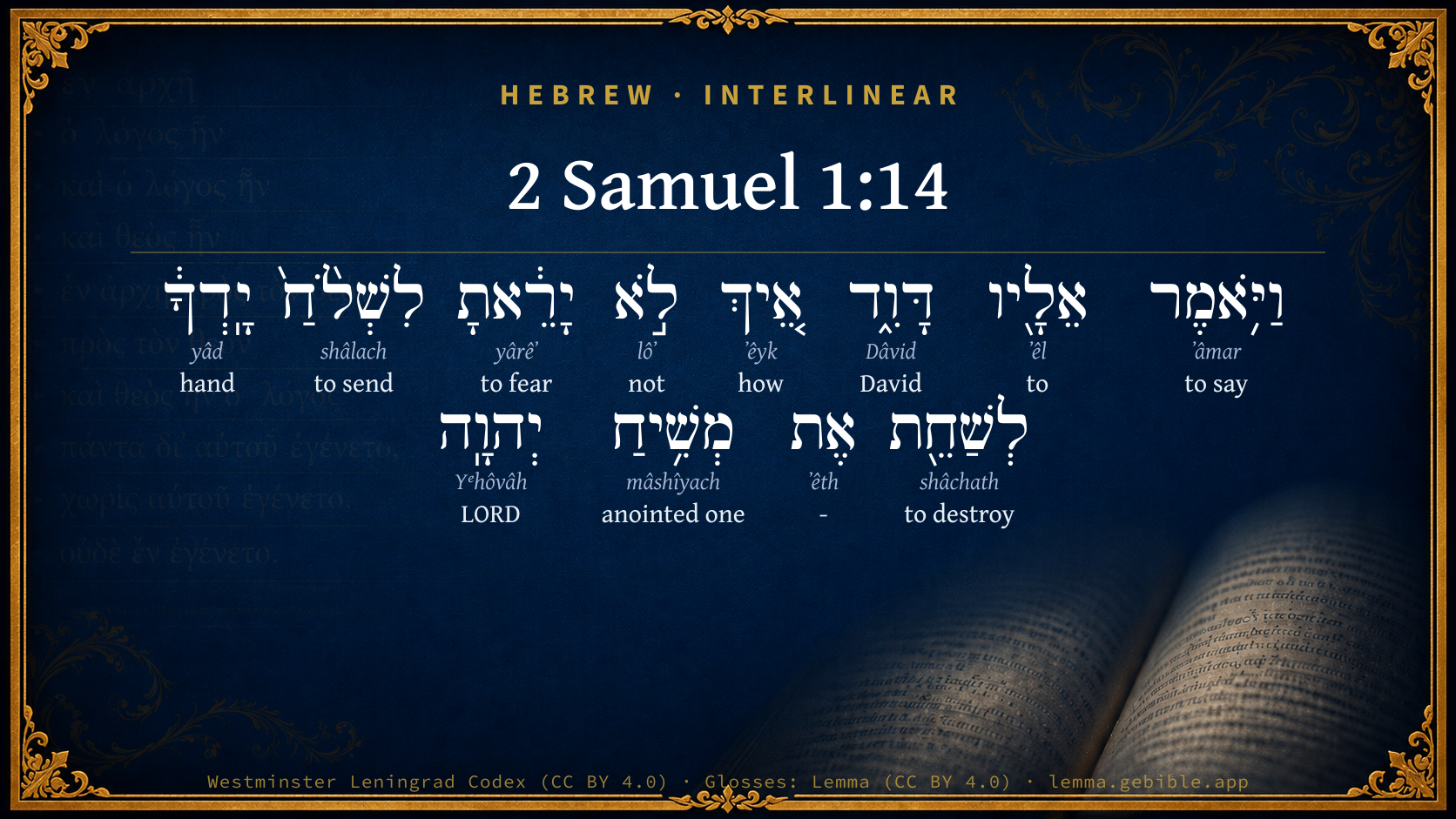
  1. וַיֹּ֥אמֶר ʼâmar H559 “and · to say” Conjunction + Verb, Qal, Sequential Imperfect, 3rd Person, Masculine, Singular
  2. אֵלָ֖יו ʼêl H413 “to · him” Preposition + Suffix, Personal, 3rd Person, Masculine, Singular
  3. דָּוִ֑ד Dâvid H1732 “David” Noun, Proper
  4. אֵ֚יךְ ʼêyk H349 “how” Particle, Interrogative
  5. לֹ֣א lôʼ H3808 “not” Particle, Negative
  6. יָרֵ֔אתָ yârêʼ H3372 “to fear” Verb, Qal, Perfect, 2nd Person, Masculine, Singular
  7. לִשְׁלֹ֨חַ֙ shâlach H7971 “to send” Preposition + Verb, Qal, Infinitive Construct
  8. יָֽדְךָ֔ yâd H3027 “hand · your” Noun, Common, Both, Singular, Construct + Suffix, Personal, 2nd Person, Masculine, Singular
  9. לְשַׁחֵ֖ת shâchath H7843 “to destroy” Preposition + Verb, Piel, Infinitive Construct
  10. אֶת ʼêth H853 “-” Particle, Direct Object
  11. יְהוָֽה Yᵉhôvâh H3068 “LORD” Noun, Proper

About this verse

These counts appear in no published source. They are computed here, from the morphology-tagged text and Lemma’s own curated glosses. What Lemma adds →

12
words
12
distinct lemmas
Historical
section

Shared distinctive vocabulary

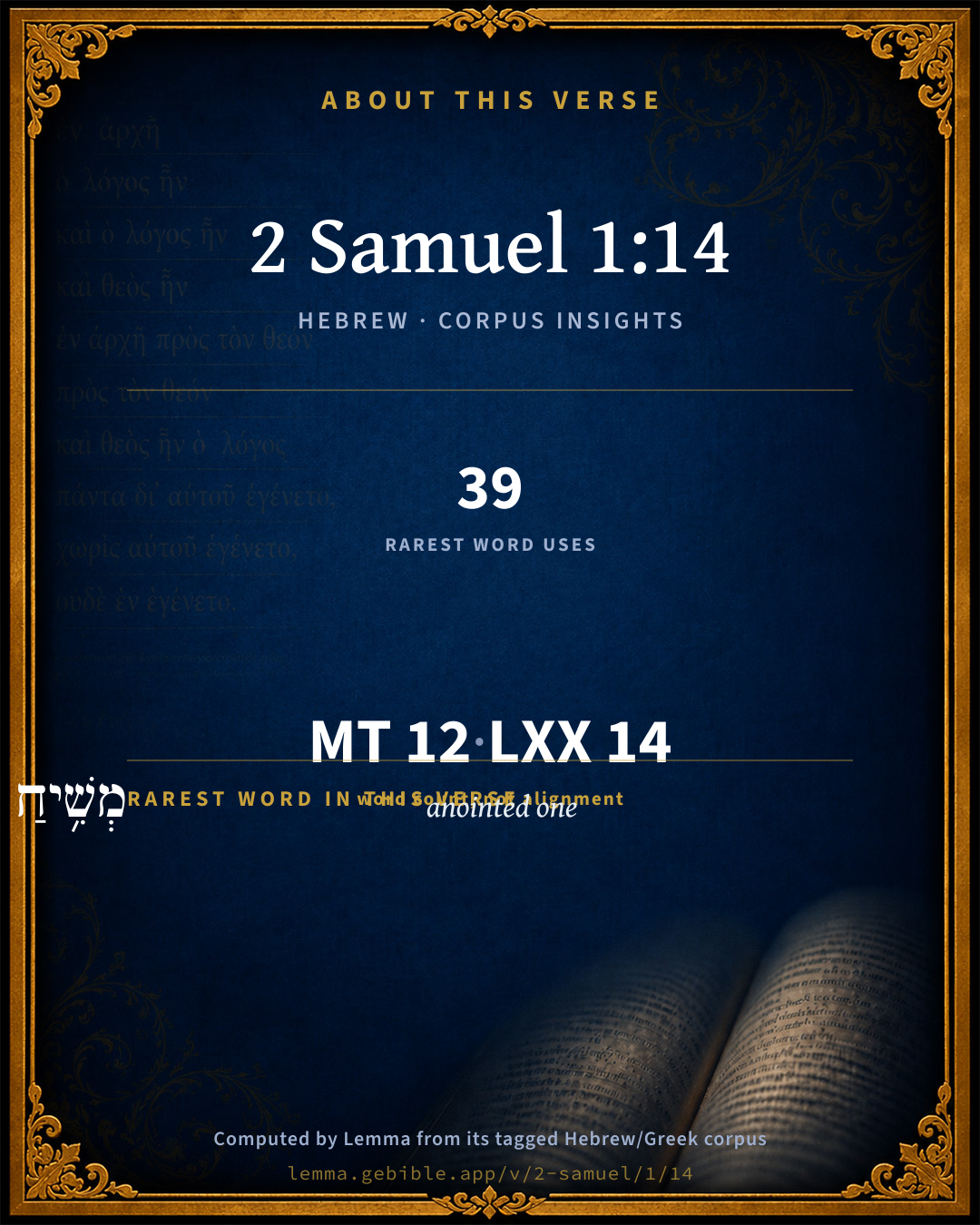
מְשִׁ֥יחַ anointed one H4899 occurs in 38 verses of the Hebrew Bible. Also found in:

Grammatical profile

  • 4 verbs
  • 4 nouns
  • 1 preposition
  • 3 particles

Verb forms

  • וַיֹּ֥אמֶר Qal · Sequential Imperfect
  • יָרֵ֔אתָ Qal · Perfect
  • לִשְׁלֹ֨חַ֙ Qal · Infinitive Construct
  • לְשַׁחֵ֖ת Piel · Infinitive Construct

Hebrew & Septuagint length

In English translation the verse runs 18 words from the Hebrew and 23 from the Septuagint (LXX English) — closely comparable.

A rough comparison of the two English renderings, which tokenize alike — not a word-level alignment.

Word counts can differ between the Hebrew and the Greek without any difference in meaning — e.g. the Hebrew direct-object marker אֵת has no separate Greek word, and Greek often adds the article ὁ.

In the original languages it is 12 Hebrew tokens and 14 Greek tokens — but the two are counted differently (Hebrew bundles its prefixes and suffixes into one token; the Greek is in lemma form), so that isn’t a like-for-like length.

Cross-references

6

Topical passages linked to 2 Samuel 1:14 in the Treasury of Scripture Knowledge — connected by theme and wording, ordered by reader-vote popularity; previews shown in the World English Bible.

  • 1 Samuel 26:9 David said to Abishai, Don't destroy him; for who can put forth his hand against Yahweh's anointed, and be guiltless?
  • Numbers 12:8 with him will I speak mouth to mouth, even manifestly, and not in dark speeches; and the form of Yahweh shall he see: why then were you not afraid to speak against my servant, against Moses?
  • 1 Samuel 24:6 He said to his men, Yahweh forbid that I should do this thing to my lord, Yahweh's anointed, to put forth my hand against him, seeing he is Yahweh's anointed.
  • 1 Samuel 31:4 Then said Saul to his armor bearer, Draw your sword, and thrust me through therewith, lest these uncircumcised come and thrust me through, and abuse me. But his armor bearer would not; for he was sore afraid. Therefore Saul took his sword, and fell on it.
  • Psalms 105:15 "Don't touch my anointed ones! Do my prophets no harm!"
  • 2 Peter 2:10 but chiefly those who walk after the flesh in the lust of defilement, and despise authority. Daring, self-willed, they are not afraid to speak evil of dignitaries;

Cross-references courtesy of OpenBible.info (CC BY 4.0).

Hebrew and Greek witnesses Masoretic Hebrew ↔ Greek Septuagint

The same verse in the two great witnesses to the Old Testament, shown verse-for-verse.

These are two independent witnesses, not word-aligned to each other, and the Septuagint is shown in lemma (dictionary) form.

Hebrew 2 Samuel 1:14 Masoretic · Westminster Leningrad Codex

וַיֹּ֥אמֶר אֵלָ֖יו דָּוִ֑ד אֵ֚יךְ לֹ֣א יָרֵ֔אתָ לִשְׁלֹ֨חַ֙ יָֽדְךָ֔ לְשַׁחֵ֖ת אֶת מְשִׁ֥יחַ יְהוָֽה

David said to him, How were you not afraid to put forth your hand to destroy Yahweh's anointed?

World English Bible · Public Domain

Greek LXX 2 Samuel 1:14 Septuagint · lemma form

καί εἶπον αὐτός δαυίδ πῶς οὐ φοβέω ἐπιφέρω χείρ σύ διαφθείρω ὁ χριστός κύριος

And David said to him, How was it you were not afraid to lift your hand to destroy the anointed of the Lord?

LXX2012 (modern English Septuagint) · Public Domain

Hebrew: Westminster Leningrad Codex (CC BY 4.0). Greek: Septuagint (public domain); English from LXX2012 (modern English Septuagint) (Public Domain). How the Septuagint differs from the Hebrew →

Targum (Aramaic paraphrase)

1

The Targum is the ancient Jewish Aramaic paraphrase of the Hebrew Scriptures — an interpretive translation, not the Hebrew text itself. Onkelos (literal) and Pseudo-Jonathan (expansive) render the Torah, and Jonathan the Prophets. Coverage is partial: where no permissively-licensed English translation exists for a verse, only the Aramaic is shown. This is verse-level text, not a word-by-word alignment to the Hebrew.

  1. Targum Jonathan Prophets (Joshua–Malachi)
    וַאֲמַר לֵיהּ דָוִד אֵיכְדֵין לָא דְחַלְתָּא לְאוֹשָׁטָא יְדָךְ לְחַבָּלָא יַת מְשִׁיחָא דַיָי:

    (no public-domain English translation for this verse)

    Targum Jonathan — Aramaic: “Mikraot Gedolot” (public domain). English: “Sefaria Community Translation” (CC0 1.0 (public-domain dedication)); “London "Chaldee Paraphrase," 1871” (public domain). Text via Sefaria.

Commentary

Notes on 2 Samuel 1:14 from classic Christian and Jewish commentators (each source and its license shown beneath its notes). The classic Christian expositions comment on the surrounding passage and are grouped to its opening verse, so a note may address several verses; the Jewish commentaries on the Tanakh (Rashi and others) are per-verse, so they appear only where the commentator wrote on this verse.

Lemma curates 59 commentaries, every one of them public domain or Creative Commons licensed, each selected and text-cleaned for this edition rather than reprinted as found. About our sources →

Trapp's Complete Commentary

John Trapp

2Sa 1:14 And David said unto him, How wast thou not afraid to stretch forth thine hand to destroy the LORD’S anointed?

Ver. 14. How wast thou not afraid to stretch forth thine hand, &c.] William Parry was for burglary condenmed to die: and yet saved by Queen Elizabeth’s pardon. {a} But he, ungrateful man, sought to requite her by vowing her death, A.D. 1584; but ever he was daunted, though he had opportunity, when he beheld the glory of her presence and majesty in her face.

{a} Speed.

John Trapp, A Commentary or Exposition upon All the Books of the Old and New Testament (1647–1656) — public domain. Text from a community e-Sword module.

Ellicott's Commentary for English Readers

(14) How wast thou not afraid?—David now turns to the Amalekite. It does not matter whether he fully believed his story or not, the man must be judged by his own account of himself. (See 2Sa_1:16.) Regicide was not in David’s eyes merely a political crime; he had showed on more than one occasion of great temptation (1Sa_24:6; 1Sa_26:9; 1Sa_26:11; 1Sa_26:16) that he considered taking the life of “the Lord’s anointed” as a religious offence of the greatest magnitude. It was an especially grievous thing for a foreigner and an Amalekite thus to smite him whom God had appointed as the monarch of Israel.

A Bible Commentary for English Readers, edited by Charles John Ellicott (1878–1897) — public domain. Text from a community e-Sword module.

The Cambridge Bible for Schools and Colleges

gen. ed. J. J. S. Perowne

14. the Lord’s anointed] The person of the king, consecrated to the service of Jehovah by anointing, was inviolable. Compare David’s reiterated expressions on this point in 1Sa_24:6; 1Sa_26:9; 1Sa_26:11; 1Sa_26:16; and the armourbearer’s reverence in 1Sa_31:4.

The Cambridge Bible for Schools and Colleges (gen. ed. J. J. S. Perowne; Cambridge University Press, 1878–1918) — public domain. Text from a community e-Sword module.

John Gill's Exposition

And David said unto him, how, wast thou not afraid to stretch forth thine hand,.... By which it should seem that he did more than stand upon him, and press his body, that the spear might pierce through him, but that he drew his sword, and slew him; so David understood him, and is the sense of the phrase in Sa1 17:51,

to destroy the Lord's anointed? a reason why David did not destroy him, when it was in the power of his hands, and which he made use of to dissuade others from it; and here charges it not only as a criminal, but a daring action in this young man, at which he expresses his admiration how he could do it; hereby representing it as a very shocking and detestable action; see Sa1 24:6.

John Gill's Exposition of the Whole Bible (1746–1763) — public domain (CC PDM 1.0). Text via the HelloAO Bible API.

Matthew Poole's English Annotations

Why didst not thou refuse to kill him, as his armour-bearer had done? For notwithstanding his great danger, something might have fallen out through God’s all-disposing providence, whereby his life might have been preserved.

Matthew Poole's English Annotations on the Holy Bible (1683–1685) — public domain. Text from a community e-Sword/MySword module.

The Pulpit Commentary

A weighty question.

David could consistently ask this question, for he had throughout acted with devout regard to the Divine anointing which Saul. had received. When the opportunity was afforded him of slaying Saul, and he was urged to do so, he again and again steadily refused, notwithstanding all the provocation he received, and although he knew that Saul would have no scruple in putting him to death. Yet the person to whom this question was addressed could, perhaps, hardly appreciate its significance. Supposing his narrative truthful, he may have been actuated by compassion in what he did; and he hoped for reward from David, in whom he saw the coming king of Israel. But, however this may be, the question may be used as applicable to those who assail with deadly intention him who is pre-eminently the anointed (the Christ) of God. First, to those who actually slew him, or took part in his death; and then to all who become sharers in their guilt by endeavouring to destroy his authority and sway amongst men.

I WHO MAY BE THUS ADDRESSED.

1. Those who assail the gospel of Christ.

2. Those who endeavour to destroy his work in the souls of men.. Such as resolutely resist and suppress the thoughts and emotions he produces in themselves, resisting his Spirit. Such also as set themselves to prevent or destroy his influence over others; endeavouring to undermine their faith, to corrupt their morals, to entice them from the paths of piety and goodness. (Mat_18:6, Mat_18:7)

3. Those who persecute his people. "Saul, Saul, why persecutest thou me?

II WHY THEY ARE NOT AFRAID.

1. Ignorance, in some, of what they are doing. As seems to have been the case with this Amalekite. This palliation of guilt is admitted in the case of those who put our Lord to death (Act_3:17; 1Co_2:8) And he told his disciples that their persecutors even unto death would think they were "doing God service". (Joh_16:2) But ignorance itself may be guiltiness, though not so great as sinning against the light, knowing it to be light and hating it on that account.

2. Disbelief as to the truth of Christianity, as to God himself, or even as to the reality and worth of godliness and goodness.

3. Moral insensibility. Which may spring from disbelief, or from habits of godlessness and wickedness, or of mere worldliness.

4. Expectation of impunity. Because of the seeming weakness of him whom they assail, (Mat_27:42, Mat_27:43) or his delay in punishing, (Ecc_8:11) or from false notions of the goodness of God. All these reasons cannot exist in the same person; but some in one, some in another.

III WHY THEY OUGHT TO BE AFRAID.

1. Because Jesus is the Lord"s Anointed the Christ of God. He comes to men with Divine authority, appointed to be their King and Saviour. There is sufficient proof of this. "This is my beloved Son" was not only uttered from heaven; it appears in the whole character, teaching, miracles, in the life, death, and resurrection of Jesus Christ; in the correspondence of prophecy and history; in the testimony of the apostles and the miracles which attested their mission; in the birth, growth, and perpetuation of the Church; in the mighty beneficial influence of Christianity in the world; in its effects on individual character and happiness, on family life and national life. It is echoed in the hearts and consciences of men; in the happy consciousness of every Christian. It is fashionable now to apologize for unbelief, and treat sceptics very tenderly, as if their love of truth made them sceptics. But compare the sayings of our Lord, "He that is of the truth heareth my voice," and "If any man willeth to do his will, he shall know of the teaching, whether it be of God." If, then, Jesus be God"s Anointed, to fight against him is to fight against God, which is both impious and perilous.

2. Because of the penalties incurred by opposition to Christ. The injury they do to themselves now, the judgment which will come upon them hereafter. Him whom they assail they will one day see coming in the clouds of heaven, to take vengeance on his foes. "Those mine enemies ... bring hither and slay them before me.

3. Because of the injury they do to others. Men with any regard to the welfare of others may well be asked to pause before they endeavour to rob them of their faith, and all that springs out of it, in sound moral principles, right character, happiness, comfort under the troubles and burdens of life, and hope in death; especially as avowedly they have no adequate substitute to offer. They ought to be afraid of taking a course which, if successful, would deprive the lowly and the poor of their chief consolation, leave unrestrained by any sufficient check the passions of men, and so demoralize and disorganize society.

IV THE EXPOSTULATIONS. WHICH SHOULD BE ADDRESSED TO THEM. "How is it that thou art not afraid," etc.? Christian speakers and writers sometimes oppose those who are opposing Christ in a style suitable to the discussion of some abstract question. The conflict is conducted as if it were one of mere opinion. But surely those to whom Christ is dear ought to make it felt that they regard the question of his position and claims as one of life and death one in which all that is most valued by them for the sake of themselves, their families, and society at large is involved. And it is due to the foes of Christ themselves that this should be done. Their consciences should be addressed as well as their reasoning faculty. Remonstrance should be employed, and warning, as well as argument. Only let the warmth shown be that of love and intense desire for the salvation of men.

Finally, let the Christian rejoice that all opposition to "the Lord"s Anointed" is, and must be, vain. It cannot injure him; it cannot seriously or permanently injure his cause. It can only recoil on those who engage in it (see Psalm 2.; G.W. (Luk_20:17, Luk_20:18)

The Pulpit Commentary (1880–1919), ed. H.D.M. Spence-Jones & Joseph S. Exell — public domain. Text from a community e-Sword module.

unfoldingWord translationNotes

Door43 World Missions Community

Why were you not afraid to kill Yahweh's anointed ... hand?

This rhetorical question is used to rebuke the man. It can be translated as a statement. AT: "You should have feared Yahweh and not killed his anointed ... hand!" (See: Rhetorical Question)

Yahweh's anointed king

This refers to Saul.

with your own hand

This phrase refers to doing something yourself. AT: "yourself" or "personally" (See: Metonymy)

struck him down

This idiom means "killed him." (See: Idiom)

Your blood is on your head

Here "blood" is a metonym that implies "shed blood" and is associated with death. Here "your head" is a synecdoche referring to the man and means that he is responsible. AT: "You are responsible for your own death" or "You have caused your own death" (See: Metonymy and Synecdoche)

your own mouth has testified against you

Here "your own mouth" refers to the man himself. AT: "you have testified against yourself" (See: Synecdoche)

translationWords

fear

Yahweh

anoint

king

call

Amalek

die

blood

head

testimony

unfoldingWord translationNotes — © Distant Shores Media and the Door43 World Missions Community, licensed CC BY-SA 4.0. Source: git.door43.org/Door43/en_tn.

Lesson kit

Teaching starters — assembled from the data on this page, not authored interpretation. Every prompt links to the verse data it draws on. Edit before teaching.

2 Samuel, in the Historical, opens this verse with 12 words (12 distinct Hebrew lemmas). Its most distinctive word is mâshîyach (“anointed one”). A historical commentator’s framing appears above. Read the whole chapter for the surrounding context.

Discussion questions

  1. What does “anointed one” (mâshîyach) contribute to the verse as a whole?
  2. How does Leviticus 4:3, which shares the word «anointed one», read alongside this verse?
  3. These translations render this verse differently; the difference is in the English rendering, not the original. What questions does that raise?
  4. «וַיֹּ֥אמֶר» is a Qal Sequential Imperfect verb. How does that grammatical form shape the action described?
  5. Compare how Trapp's Complete Commentary and Ellicott's Commentary for English Readers read this verse. Where do they agree or differ?

Things to notice

Reading settings

Reading text

Shown beneath each verse's original-language words.

Old Testament
Old Testament edition

Read the OT as the Masoretic Hebrew (MT) or the Greek Septuagint (LXX).

English shown for the Greek Septuagint (in the Hebrew ↔ Greek comparison).

Comparing translations? Open the Compare panel on any verse page to stack up to four side by side.