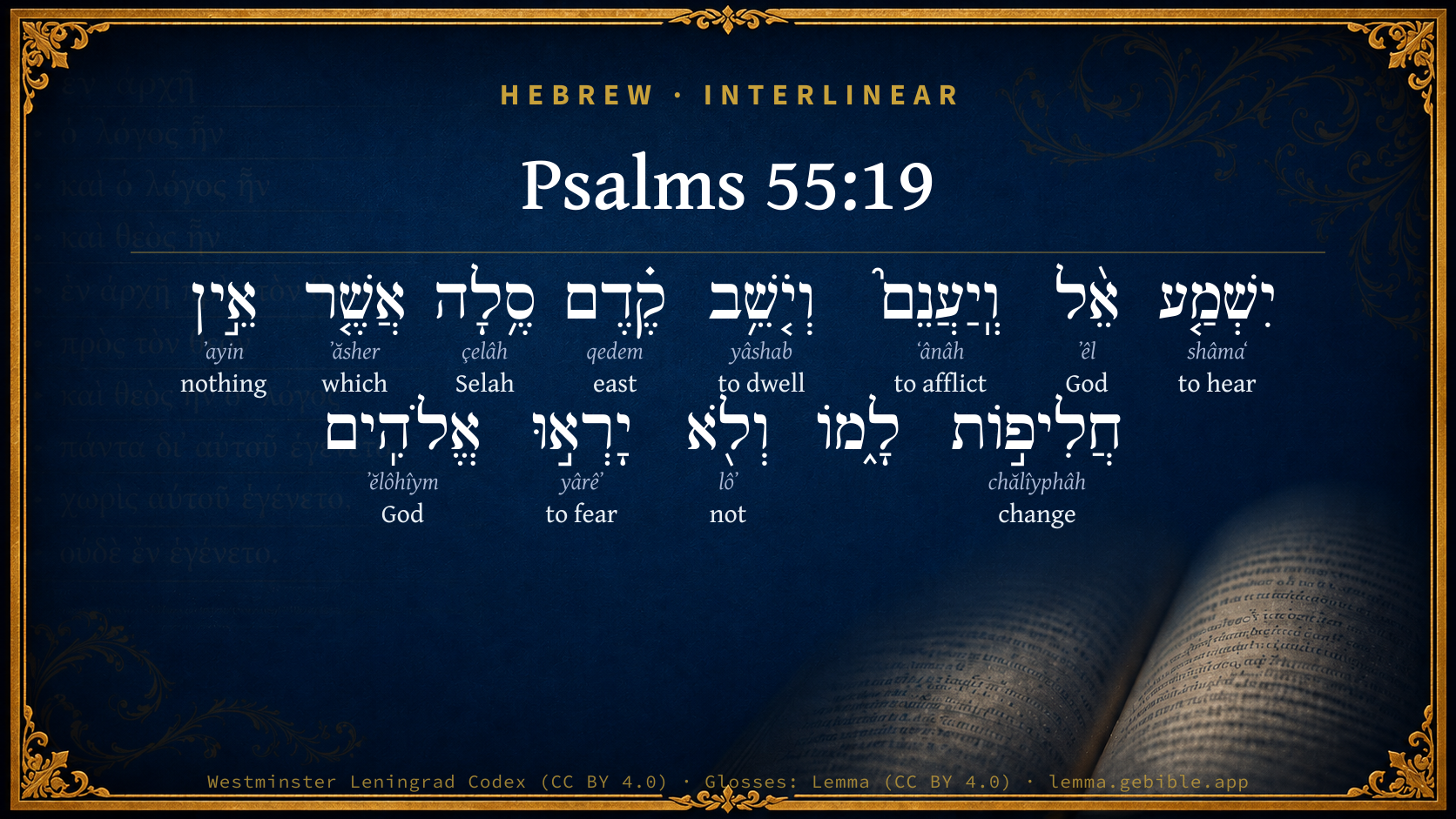
Psalms 55:19

Hebrew (Westminster Leningrad Codex) Psalms 55:19 appears in the Hebrew Old Testament. The text above is from the Westminster Leningrad Codex. Each word links to its Strong’s number, a concise gloss, and parsing drawn from the Open Scriptures Hebrew Bible morphology. Click any word for its full Brown-Driver-Briggs (BDB) entry.
Download image
Cite this verse

Psalms 55:19 (World English Bible). Public Domain. Lemma interlinear Bible study tool, https://lemma.gebible.app/v/psalms/55/19.

Show BibTeX & RIS
BibTeX
RIS
English Translation
God, who is enthroned forever, Will hear, and answer them. Selah. They never change, Who don't fear God.
World English Bible · Public Domain
Download a study sheet

One document with this verse’s original text, its word-by-word gloss line, the meaning frame, cross-references with their text, attributed commentary, and full source and license credits — printable, and it pastes into notes with its structure intact.

This verse Autodidact and up

Study sheet (.html) Plain text (.txt)

A passage Seminary Student

Up to 50 verses in one chapter. A passage sheet keeps up to 6 commentary sources and 12 cross-references per verse, in the order this page ranks them, and says so on the sheet whenever that leaves anything out. Ask for a single verse and you get the Autodidact verse sheet above.

Everything on this page stays free to read, with no account — the sheet is a download of what is already on screen, not access to it.

Want to remove ads? Support Godless Engineer
Compare translations 3

The same verse in 3 English versions, stacked beneath the original-language interlinear above. Click any original word for its lexicon entry.

Each is an independent rendering of the whole verse — the interlinear is not word-aligned to these translations.

Highlighted words mark where these versions differ — a whole-verse word diff, not a word-by-word alignment.

  • World English Bible Public Domain
    God, who is enthroned forever, Will hear, and answer them. Selah. They never change, Who don't fear God.
  • King James Version Public Domain
    God shall hear, and afflict them, even he that abideth of old. Selah. Because they have no changes, therefore they fear not God.
  • unfoldingWord Literal Text CC BY-SA 4.0
    God will hear and answer them, even the one sitting antiquity, Selah to whom no changes, so they do not fear God.

unfoldingWord Literal Text — © unfoldingWord, licensed CC BY-SA 4.0. Word-aligned USFM3 via Door43 (git.door43.org/unfoldingWord/en_ult).

Versions to compare (up to 4)

3 of 4 selected

Show all 18 translations

Every available English version of this verse, each an independent rendering of the whole verse.

  • World English Bible Public Domain
    God, who is enthroned forever, Will hear, and answer them. Selah. They never change, Who don't fear God.
  • Berean Standard Bible Public Domain
    God will hear and humiliate them—the One enthroned for the ages—Selah because they do not change and they have no fear of God.
  • Majority Standard Bible Public Domain
    God will hear and humiliate them—the One enthroned for the ages—Selah because they do not change and they have no fear of God.
  • King James Version Public Domain
    God shall hear, and afflict them, even he that abideth of old. Selah. Because they have no changes, therefore they fear not God.
  • American Standard Version (1901) Public Domain
    God will hear, and answer them, Even he that abideth of old, Selah `The men' who have no changes, And who fear not God.
  • Revised Version (1885) Public Domain
    God shall hear, and answer them, even he that abideth of old, Selah the men who have no changes, and who fear not God.
  • Geneva Bible (1599) Public Domain
    God shall heare and afflict them, euen hee that reigneth of olde, Selah. because they haue no changes, therefore they feare not God.
  • Douay-Rheims (1899) Public Domain
    But I have cried to God: and the Lord will save me.
  • Young's Literal Translation Public Domain
    God doth hear and afflict them, And He sitteth of old. Selah. Because they have no changes, and fear not God,
  • Literal Standard Version CC BY-SA 4.0
    God hears and afflicts them, || And He sits of old. Selah. Because they have no changes, and do not fear God,
  • Unlocked Literal Bible CC BY-SA 4.0
    God, the one who rules from eternity, will hear them and humiliate them. Selah They never change, and they do not fear God.
  • unfoldingWord Literal Text CC BY-SA 4.0
    God will hear and answer them, even the one sitting antiquity, Selah to whom no changes, so they do not fear God.
  • Darby Bible Public Domain
    ùGod will hear, and afflict them: he that is seated of old, (Selah)... because there is no change in them, and they fear not God.
  • World Messianic Bible Public Domain
    God, who is enthroned forever, will hear and answer them. Selah. They never change and don’t fear God.
  • Webster's Bible Public Domain
    \\55:18\\He hath delivered my soul in peace from the battle that was against me: for there were many with me.
  • Free Bible Version CC BY-SA 4.0
    God who has ruled from the beginning will hear me and answer them. Selah. For they refuse to change and don't respect God.
  • Bible in Basic English Public Domain
    God will give thought to me; he who from early times is strong will send pain and trouble on them. (Selah.) Because they are unchanged, they have no fear of God.
  • JPS Tanakh (1917) Public Domain
    (55-20) God shall hear, and humble them, even He that is enthroned of old, Selah, such as have no changes, and fear not God.

Literal Standard Version (2020), Covenant Press — licensed CC BY-SA 4.0. Text via the HelloAO Bible API (eBible.org). Unlocked Literal Bible (unfoldingWord) — licensed CC BY-SA 4.0. Text via the HelloAO Bible API (eBible.org). unfoldingWord Literal Text — © unfoldingWord, licensed CC BY-SA 4.0. Word-aligned USFM3 via Door43 (git.door43.org/unfoldingWord/en_ult). Free Bible Version, Dr. Jonathan Gallagher — licensed CC BY-SA 4.0. Text via the HelloAO Bible API (eBible.org).

Word by word

More ways to search: Search by grammar → Find every occurrence → Compare this word →

Practice this passage: Drill this verse → Learn its vocabulary →

חֲלִיפ֣וֹת
chălîyphâh
H2487
“changes”
Noun, Common, Feminine, Plural, Absolute
Part of Speech
Noun
Type
Common
Gender
Feminine
Number
Plural
State
Absolute
Full BDB Definition

Origin: from H2498

TWOT: 666c

a change, change (of garments), replacement - change (of raiment) - relays - relief (from death) - changing, varying (course of life)
  1. יִשְׁמַ֤ע shâmaʻ H8085 “to hear” Verb, Qal, Imperfect, 3rd Person, Masculine, Singular
  2. אֵ֨ל ʼêl H410 “God” Noun, Common, Masculine, Singular, Absolute
  3. וְֽיַעֲנֵם֮ ʻânâh H6031 “and · to afflict · them” Conjunction + Verb, Qal, Imperfect, 3rd Person, Masculine, Singular + Suffix, Personal, 3rd Person, Masculine, Plural
  4. וְיֹ֤שֵׁ֥ב yâshab H3427 “and · dwelling” Conjunction + Verb, Qal, Participle Active, Masculine, Singular, Absolute
  5. קֶ֗דֶם qedem H6924 “east” Noun, Common, Masculine, Singular, Absolute
  6. סֶ֥לָה çelâh H5542 “Selah” Particle, Interjection
  7. אֲשֶׁ֤ר ʼăsher H834 “which” Particle, Relative
  8. אֵ֣ין ʼayin H369 “nothing” Particle, Negative
  9. וְלֹ֖א lôʼ H3808 “and · not” Conjunction + Particle, Negative
  10. יָרְא֣וּ yârêʼ H3372 “to fear” Verb, Qal, Perfect, 3rd Person, Common, Plural
  11. אֱלֹהִֽים ʼĕlôhîym H430 “God(s)” Noun, Common, Masculine, Plural, Absolute

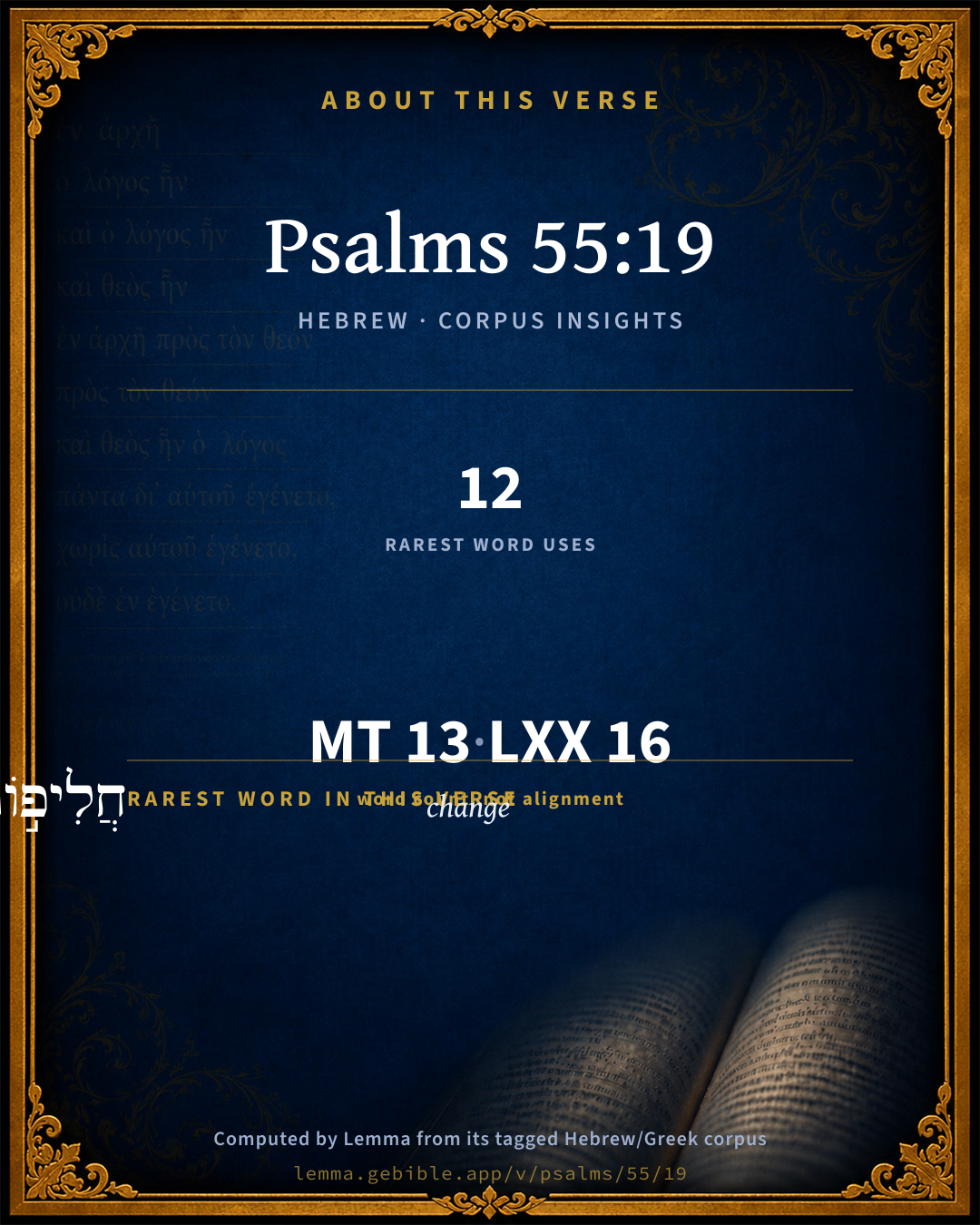
About this verse

These counts appear in no published source. They are computed here, from the morphology-tagged text and Lemma’s own curated glosses. What Lemma adds →

13
words
12
distinct lemmas
Wisdom
section

Notable vocabulary

The rarest word here is חֲלִיפ֣וֹת change H2487 — appearing just 12 times in the whole Hebrew Bible.

Shared distinctive vocabulary

חֲלִיפ֣וֹת change H2487 occurs in 11 verses of the Hebrew Bible. Also found in:

Grammatical profile

  • 4 verbs
  • 4 nouns
  • 1 preposition
  • 4 particles

Verb forms

  • יִשְׁמַ֤ע Qal · Imperfect
  • וְֽיַעֲנֵם֮ Qal · Imperfect
  • וְיֹ֤שֵׁ֥ב Qal · Participle Active
  • יָרְא֣וּ Qal · Perfect

Hebrew & Septuagint length

In English translation the verse runs 18 words from the Hebrew and 27 from the Septuagint (LXX English) — closely comparable.

A rough comparison of the two English renderings, which tokenize alike — not a word-level alignment.

Word counts can differ between the Hebrew and the Greek without any difference in meaning — e.g. the Hebrew direct-object marker אֵת has no separate Greek word, and Greek often adds the article ὁ.

In the original languages it is 13 Hebrew tokens and 16 Greek tokens — but the two are counted differently (Hebrew bundles its prefixes and suffixes into one token; the Greek is in lemma form), so that isn’t a like-for-like length.

Cross-references

15

Topical passages linked to Psalms 55:19 in the Treasury of Scripture Knowledge — connected by theme and wording, ordered by reader-vote popularity; previews shown in the World English Bible.

  • Deuteronomy 33:27 The eternal God is [your] dwelling-place, Underneath are the everlasting arms. He thrust out the enemy from before you, Said, Destroy.
  • Zephaniah 1:12 It will happen at that time, that I will search Jerusalem with lamps, and I will punish the men who are settled on their dregs, who say in their heart, "Yahweh will not do good, neither will he do evil."
  • Ecclesiastes 8:11 Because sentence against an evil work is not executed speedily, therefore the heart of the sons of men is fully set in them to do evil.
  • Jeremiah 48:11 Moab has been at ease from his youth, and he has settled on his lees, and has not been emptied from vessel to vessel, neither has he gone into captivity: therefore his taste remains in him, and his scent is not changed.
  • Micah 5:2 But you, Bethlehem Ephrathah, Being small among the clans of Judah, Out of you one will come forth to me that is to be ruler in Israel; Whose goings forth are from of old, from everlasting.
  • Colossians 1:17 He is before all things, and in him all things are held together.
  • Revelation 6:10–11 They cried with a loud voice, saying, "How long, Master, the holy and true, until you judge and avenge our blood on those who dwell on the earth?"
  • Psalms 65:5 By awesome deeds of righteousness, you answer us, God of our salvation. You who are the hope of all the ends of the earth, Of those who are far away on the sea;
  • Psalms 73:5–6 They are free from burdens of men, Neither are they plagued like other men.
  • Psalms 78:59 When God heard this, he was angry, And greatly abhorred Israel;
  • Psalms 143:12 In your loving kindness, cut off my enemies, And destroy all those who afflict my soul, For I am your servant.
  • Proverbs 1:32 For the backsliding of the simple will kill them. The careless ease of fools will destroy them.
  • Isaiah 36:20 Who are they among all the gods of these countries, that have delivered their country out of my hand, that Yahweh should deliver Jerusalem out of my hand?
  • 1 Thessalonians 2:15–16 who killed both the Lord Jesus and their own prophets, and drove us out, and didn't please God, and are contrary to all men;
  • Psalms 90:1–2 Lord, you have been our dwelling place for all generations.

Cross-references courtesy of OpenBible.info (CC BY 4.0).

Hebrew and Greek witnesses Masoretic Hebrew ↔ Greek Septuagint

The same verse in the two great witnesses to the Old Testament, shown verse-for-verse.

You’re reading Greek Psalm 54 (Hebrew Psalm 55). The Septuagint counts the superscription, so verse numbers can differ from the Hebrew — chapter-level alignment, not verse-by-verse. Numbering follows Rahlfs.

These are two independent witnesses, not word-aligned to each other, and the Septuagint is shown in lemma (dictionary) form.

Hebrew Psalms 55:19 Masoretic · Westminster Leningrad Codex

יִשְׁמַ֤ע אֵ֨ל וְֽיַעֲנֵם֮ וְיֹ֤שֵׁ֥ב קֶ֗דֶם סֶ֥לָה אֲשֶׁ֤ר אֵ֣ין חֲלִיפ֣וֹת לָ֑מוֹ וְלֹ֖א יָרְא֣וּ אֱלֹהִֽים

God, who is enthroned forever, Will hear, and answer them. Selah. They never change, Who don't fear God.

World English Bible · Public Domain

Greek LXX Greek Psalm 54:19 Septuagint · lemma form

λυτρόω ἐν εἰρήνη ὁ ψυχή ἐγώ ἀπό ὁ ἐγγίζω ἐγώ ὅτι ἐν πολύς εἰμί σύν ἐγώ

God shall hear, and bring them low, even he that has existed from eternity. Pause. For they suffer no reverse, and therefore they have not feared God.

LXX2012 (modern English Septuagint) · Public Domain

On this verse, Ellicott's Commentary for English Readers discusses the Septuagint’s reading. Read the note in Commentary ↓

Hebrew: Westminster Leningrad Codex (CC BY 4.0). Greek: Septuagint (public domain); English from LXX2012 (modern English Septuagint) (Public Domain). How the Septuagint differs from the Hebrew →

Commentary

Notes on Psalms 55:19 from classic Christian and Jewish commentators (each source and its license shown beneath its notes). The classic Christian expositions comment on the surrounding passage and are grouped to its opening verse, so a note may address several verses; the Jewish commentaries on the Tanakh (Rashi and others) are per-verse, so they appear only where the commentator wrote on this verse.

Lemma curates 59 commentaries, every one of them public domain or Creative Commons licensed, each selected and text-cleaned for this edition rather than reprinted as found. About our sources →

Trapp's Complete Commentary

John Trapp

Psa 55:19 God shall hear, and afflict them, even he that abideth of old. Selah. Because they have no changes, therefore they fear not God.

Ver. 19. God shall hear] sc. My prayers which are on the file before him, and as solicitors with him. Mittamus preces et lachrymas, cordis legatos, saith Cyprian. Up go prayers, down come deliverances.

And afflict them] Ludit ambiguitate verbi. The same word signifieth to afflict and to answer, q.d. he shall answer me, but afflict them; answer them with blows, with bitter answers.

Even he that abideth of old] And is therefore no changeling; the Eternity of Israel cannot lie, nor repent; "for he is not a man, that he should repent," 1Sa 15:29; neither can mine enemies hide themselves from him in any starting holes. Sedet Deus ad iudicandum, et surgit ad puniendure (Aug.).

Selah] Id est, modo honorabili, saith R. Gaon. Or, So be it, O Lord. It is set in the middle of the verse, as respecting both parts of it.

Because they have no changes, therefore they fear not God] Changed they are not by repentance (which is such a change of the heart, as bringeth forth a reformed life), but continue obstinate and obdurate; neither have they any alterations in their outward estate; they are not poured from vessel to vessel, have a constant prosperity (such as Demetrius called mare mortuum, a dead sea), and do therefore settle upon their lees, cast away all care of God and his service.

John Trapp, A Commentary or Exposition upon All the Books of the Old and New Testament (1647–1656) — public domain. Text from a community e-Sword module.

The Biblical Illustrator

Joseph S. Exell

Psa_55:19

Because they have no changes, therefore they fear not God.

No changes

Who can they be--where can they live, of whom it can be said that they have not changes! Can they be inhabitants of this world of which, if one thing can be said of it with greater certainty than another, it is that it is a scene of perpetual change! Change and decay in all around I see. No changes! We must not take the expression in a hard and narrow literal sense, or it would be true of no man. Many changes Come alike to all, and one at the end of life of which Job speaks when he says, All the days of my appointed time will I wait until my change come. The changes of which the psalmist speaks must mean changes that disturb, changes that unhinge all plans end arrangements, changes which frustrate hopes. These are the changes which some men have not, and because they have them not they fear not God. Our subject, therefore, is--the perils of an undisturbed life.

I. How is this? Freedom from change was never intended to work such sad result, but quite the reverse. It is due not to absence of change, but to the mans own perverse and perverting heart. He turns the sweet into the bitter, the healthy into the poisonous. It is mans eye which is evil, because God is good. The fact that a mans life has not been wrecked by storms or rent by great upheaving sorrows should appeal to the mans gratitude. He should say, What shall I render to the Lord for all His benefits towards me? I will take the cup of salvation, and will call upon the name of the Lord. But it is melancholy to see what a strange power the heart has to turn good into evil. It is like some plants which can elaborate and secrete out of bright sunshine and pure air and water the very elements of death. Such are the men who have no changes, and therefore--mark the word--therefore they fear not God. They have no changes. They devise their plans, and they all succeed. Whatever they touch turns into gold, All the vessels they launch on the great sea of life have prosperous voyages, and return heavily laden with a rich cargo. Their neighbours have losses and misfortunes, but they, never. Now, this wonderful exemption from sudden and sharp vicissitudes tends to engender self-confidence. They are prone to imagine that their better fortune is due to better management. And no doubt not a little may be said in favour of their view of the case. For business, like every other thing, has its own laws, the observance of which will for the most part conduce to prosperity. But such prosperity has a melancholy tendency to produce forgetfulness of God. And when it has gone on for years in an unbroken stream, and a stream swelling and deepening with the years, then is this tendency seen, and this sore temptation felt in their most horrible forms. Because they have no change, therefore, etc. And the like may be said of unbroken, uninterrupted health. But others besides have frequently no changes. The circle of their social life seems wonderfully free from infraction, and that for a long period. It seems as if the ordinary calamities of life could not reach them. There has been no darkening of the windows, there has been no grave to purchase, there has been no hearse at the door. The deepest fountains of sorrow have been unopened, there has been no yearning, unavailing as it is keen, for the touch of a vanished hand, and the sound of a voice that is still. And what is the result, what at least is too often the result? Therefore they fear not God. His blessings have been so constant and so great that they do not fear Him. They think that to-morrow will be as to-day, and still more abundant. The absence of change produces hardness of nature. As one of the greatest blessings is tenderness of heart, so one of the greatest perils in life is that the heart should become hardened. A healthy heart is one which is open to all Divine influences and to all just human appeals. A man becomes practically useless as his heart loses power of sympathy. Hence is change so needful for us would we succour the sorrow of others. But a man cannot do this if he has never known sorrow of his own, if he be one who has no changes. Ah! if the world were made up of no other class of men than these, life would be a fearful thing. It is well that there are some hearts that cannot be thus steeled, hearts that can feel for others, and that can feel for others because frequently they have themselves known sorrow and trouble. No heart has had a thorough education which has not passed through the school of grief. Until it has sat in this class it is crude and narrow and hard. The tendency of continued prosperity, or exemption from calamity, is to create in the mind a sense of claim upon God, and a sense of wrong when the interruption comes. When the usual blessing does not make its appearance at the usual time, the man looks up under a sense of wrong, and upbraids the Providence which seems to have forgotten him. Why has it forgotten him? Why should he be deprived of his usual mercies? And instead of reckoning up all the years during which his table has been spread and his cup has run over, and bursting forth in a song of thanksgiving for all he has received, he complains of God for the removal, or even the diminution, of his comforts. The absence of change produces neglect of eternity. Nothing is more certain than this, and nothing is more natural. When men are settled in any condition which yields them satisfaction they long to remain in it. To live for the present life is as natural as to live in it; and it is the main temptation we have all to overcome to set our affection on things which are on the earth. It is wonderful how men get reconciled by habit even to a state which is by no means the happiest; but when it is one of comfort they have no desire to see it altered or disturbed. Soul, take thine ease, is a very common feeling among those whose circumstances are on the whole fairly pleasant. They get settled in their lives. They have their portion in this life; and they do not think of another life, nor care to think of it. How many will have to thank God for ever for the blow which swept away in a night the wealth in which they trusted. It was then that for the first time they understood the meaning of the words, Lay not up for yourselves treasures upon earth, where moth and rust corrupt, and where thieves break through and steal. How many, too, who have forgotten God in the days of their vigour, have found Him on their beds when the strength has gone from them like water from the summer brook. And some have needed a still greater change. But even these changes may fail. Some have borne them all, and still fear not God. Happy the man that has learnt to place his hope in God. (Enoch Mellor, D. D.)

The discipline of change

The natural heart of man longs for peace, and looks to repose as fit and proper. We feel ourselves in the midst of ceaseless change and decay, and are always seeking a centre of rest. We would hasten our escape from the windy storm and tempest. Yet, with all our longing for peace, we are played on by forces that make for change and unrest, swirled by the ceaseless flux and flow of the tide. Life is like the swift ships, says Job, like ships driven out in the darkness, tossed on the storm, battling on to a quiet harbour. It is like vapour of the hills, says St. James, like the fragile mist that can be withered by sun or torn by wind. There is no real rest in the world for body, or mind, or heart, of soul. This condition of unstable equilibrium is, of course, most evident in connection with outward things in our life, the trappings and the circumstances. But the same transiency is seen in inward things also. Even love suffers loss, as the objects of love pass off at the dread call of night. Even faith cannot remain fixed, but has new problems which demand new efforts at adjustment. We must admit also, if we are honest with ourselves, that we need the stimulus of constant change if life is to attain its best results. We settle down in slothful ease and sluggish indifference, with eyes blinded and hearts made fat by the prosperity that knows no fear. Changelessness would only lull the senses and the faculties to sleep. We are only kept alert by the unstable tenure with which we hold life and all it contains. If we knew we would only meet the expected and always at the expected turn or road, there could be no expectation at all, no wonder, no apprehension, no fear, no hope, no faith. Experience could bring no education, and all our powers would be atrophied. Most of all is this true in the moral sphere. It is in no lotus isle that men are bred. In the stress and strain of life character is formed. Through doubt and uncertainty and sore trial of faith is faith alone made perfect. As a matter of fact, degeneracy has always set in with both nations and men when prosperity has been unchecked and the sunshine of favour has been unalloyed. It is through the conquest of nature, and through the conquest of enemies, and through self-conquest that the conquering peoples have been built. The lesson is painted on a large canvas in universal history; and it is repeated to us in miniature in individual experience. Men live only by custom and convention when they are withdrawn from this discipline of change; and to live only by custom is to be drugged by an opiate. Everything that makes men great partakes of the discipline. There is no music in a monotone; there is no are in one universal drab colour. Thought is born of mystery. Science is the daughter of wonder, and wonder is the fruit of all the changes and movements of the world. Religion even has her secure empire in the hearts of men through the needs of mens hearts, the need for which they crave of a changeless centre in the midst of change. Every deep crisis of life, with its thrill of joy or its spasm of sorrow, with its message, of loss or of gain, is part of Gods higher education. The discipline of change is meant to drive us out beyond the changing hour to the thought of eternity, out from the restless things of sense to find rest in God. He is the same yesterday, to-day, and to-morrow, the same in nature, in character, in love, even as Jesus revealed Him, the eternal Father who yearns over His children in deathless love. Because they have no changes, therefore they fear not God. If that is failure, even though it means continual peace and prosperity, what shall we say of the failure of those who know the desolation and terror of change and yet have not learned; who still cling to the things of sense that have failed them before; who have suffered all the strokes of fortune, all the pangs Of heart, all the shocks that paralyze the soul, and yet have never submitted, never trusted, never feared, never loved God? What failure is like that of those who have been chastened and yet never softened, who have gone through the fire without learning the lesson, who have tasted the sorrow without the sympathy, who have borne the cross without the love? (Hugh Black, M. A.)

Afflictions

There are some who have no changes of fortune from prosperity to adversity. Therefore, says the psalmist, they fear not God.

I. Different kinds.

1. Disappointments.

2. Financial ruin.

3. Sickness.

II. Uses.

1. Corrective. Before I was afflicted I went astray.

2. Instructive. Prosperity is apt to intoxicate the imagination; affliction teaches humility and dependence upon God.

3. Sanctifying. They purify the heart, bring God nearer to the soul, and make the promises more precious.

III. Improvement.

1. Continued prosperity is not always best for man. If prosperity hardens the heart and keeps God out, then is affliction a blessing.

2. Under severe affliction grace is needed to keep the soul from despair.

3. If we are without affliction, are we sure that we do not spirtually need their discipline? (L. O. Thompson.)

Lifes vicissitudes

You pick up two stones lying near the seashore and only a few yards apart. They not only belong to the same geological formation, but have been splintered from the same rock. One is rugged, made up of sharp, uneven angles, and irregular, broken surfaces. The other is smooth, rounded into an almost perfect sphere, has every delicate vein showing, and is polished as on a lapidarys wheel. What is the secret of this contrast? The one had fallen from the cliff and had been stranded above high-water mark. It had lain for centuries just where it dropped. It had undergone no changes and upheavals. The other had fallen within reach of the waves, and every ebbing and flowing tide had lashed it to and fro for year upon year. It had never been left still for long, but had been tossed, jostled, ground, and polished against the pebbly beach till it took that form of comeliness and beauty. So it is with many lives. The lives of some seem to have fallen to them in pleasant places. Life has brought few changes. And the Holy Book says of such, Because they have no changes, therefore they fear not God. Other lives are Still from one sorrow to another thrown. They sometimes say, All Thy waves and Thy billows are gone over me. But what spiritual beauty they have won from their tribulations!

The Biblical Illustrator, edited by Joseph S. Exell (c. 1880s–1900s) — public domain. Text from a community e-Sword module.

Joseph Benson's Commentary

Psa 55:19. God shall hear — My prayer against them, mentioned Psa 55:15, or their reproaches, Psa 55:12, their deceitful and treacherous speeches, Psa 55:21. He had said, God would hear his voice, Psa 55:17, now he adds that God will hear his enemies’ voice also, of which he spake, Psa 55:3. And afflict them — Or, testify against them; or, give an answer to them, as יענם, jagnaneem, may be properly rendered; not in words, but in deeds, and by dreadful punishments, as this word signifies Eze 14:4, which seems best to agree with the word next foregoing, God will hear and answer them. Even he that abideth of old — Hebrew, וישׁב קדם, vejosheb kedem, he that inhabiteth antiquity, or eternity: who is eternal, and, therefore, unchangeable and almighty; who sits judge from the beginning of time, and hath always presided in the affairs of the children of men, and consequently, as he ever was, so he still is and ever will be, ready to defend his people, and to destroy their enemies; and none can prevent or hinder him in either of these designs. Chandler, after Cocceius, translates the clause, Even he who reigns from everlasting: and observes, “The introducing God, as reigning of old, and holding the government of the world from before all ages, has great propriety, and was one of the principal considerations which established David’s hope in God, that he would deliver him from this unnatural rebellion.” Mortal men, though ever so high and strong, will easily be crushed by an eternal God, and are a very unequal match for him. Because they have no changes — No afflictions, no crosses, nor disappointments, no interruption to the constant course of their prosperity, no trouble and distress to empty them from vessel to vessel; therefore they fear not God — Their prosperous success makes them go on securely and obstinately in their wicked courses, without any regard to God, or dread of his judgments; there being nothing which more hardens men’s hearts, or makes them more presumptuous and incorrigible, than uninterrupted prosperity. See Psa 30:6; Pro 1:32; Jer 22:21.

Joseph Benson's Commentary on the Old and New Testaments (1811–1818) — public domain. Text from a community e-Sword module.

J. A. Alexander on Psalms

Joseph Addison Alexander

20. (Psa 55:19). God will hear and answer them, and (He) inhabiting antiquity (will hear and answer those) to whom there are no changes, and (who) fear not God. As he has heard me in mercy, so will he hear them in wrath. As he has answered my prayer in the way described above, Psa 55:18, so will he answer them in the way described below, Psa 55:23. In this case, what is heard and answered is not prayer, but the voice of the enemy, Psa 55:3, and his malignant slanders, Psa 55:12. Inhabiting antiquity, or as the English Bible phrases it, he that abideth of old. The first Hebrew verb, however, could not fail to suggest its primary meaning, which is to sit, and more especially to sit enthroned, as a sovereign and a judge. See above, on Psa 9:4; Psa 9:14. The phrase may therefore be said to represent God as having been a king and a judge from the remotest antiquity. The last clause is by some supposed to mean, that the persons here referred to undergo no moral change, but still persist in their refusal to fear God; by others, that they undergo no outward changes, no vicissitudes of fortune, and for that reason will not fear him. But as the word translated changes is repeatedly employed by Job in a military sense, to signify either an alternate service, as, for instance, in relieving guard, or a succession in the service, as when one corps is disbanded and another takes its place, some of the best interpreters suppose this clause to mean that those enlisted in this evil warfare have no such reliefs or discharges to expect, but must continue in the unremitting service of sin, and as a necessary consequence cannot fear God. The grammatical structure of the whole verse is peculiar, and can be made intelligible only by supplying the ellipsis.

Joseph Addison Alexander, The Psalms Translated and Explained (1850) — public domain. Text from a community e-Sword module.

Tyndale Open Study Notes

Tyndale Open Resources

55:19-21 God is good and faithful, but the psalmist’s enemies and so-called friend are deceitful and wicked.

Tyndale Open Study Notes — © Tyndale Open Resources, licensed CC BY-SA 4.0. Text via the HelloAO Bible API.

Geneva Bible (1599)

Geneva Bible translators

But their prosperous estate still continueth.

Geneva Bible (1599) marginal notes — public domain. Text via Bolls.life.

Jamieson, Fausset & Brown

Robert Jamieson, A. R. Fausset & David Brown

God hears the wicked in wrath.

abideth--or, "sitteth."

of old--enthroned as a sovereign.

Because . . . no changes--Prosperity hardens them (Psa 73:5).

Jamieson, Fausset & Brown — Commentary Critical and Explanatory on the Whole Bible (1871) — public domain (CC PDM 1.0). Text via the HelloAO Bible API.

Adam Clarke's Commentary

Verse 19. Because they have no changes] At first Absalom, Ahithophel, and their party, carried all before them. There seemed to be a very general defection of the people; and as in their first attempts they suffered no reverses, therefore they feared not God. Most of those who have few or no afflictions and trials in life, have but little religion. They become sufficient to themselves, and call not upon God.

Adam Clarke's Commentary on the Bible (1810–1826) — public domain. Text from a community e-Sword/MySword module.

John Calvin's Commentaries

19 God shall hear, and afflict them As the verb ענה, anah, which I have rendered afflict, signifies, occasionally, to testify, some understand David to say that God would rise up as a witness against them. The syntax of the language will scarcely, however, admit of this, as, in Hebrew, the letter ב, beth, is generally subjoined in such a case. There seems no doubt that the word signifies here to addict or punish, although this is rather its signification implicitly and by a species of irony; for, most commonly, ענה, anah, means to answer. Having said that God would hear him, he adds that he would answer him, in the way of avenging his cause, in the punishment of his enemies. The epithet, or descriptive title, which he applies to God, is one calculated to comfort the pious mind in times of trouble and confusion. Much of that impatience into which we are hurried arises from not elevating our thoughts to the eternity of God. Can anything be more unreasonable than that poor mortals, who pass away like a shadow, should measure God by their feeble apprehensions, which is to cast him down from his eternal throne, and subject him to the fluctuations of a changing world? As חלף, chalaph, may signify to cut off as well as to change, some have supposed that David here complains of the destruction of the wicked having been too long deferred; but this is not a probable interpretation. The term has been more properly rendered changes But even those who have adopted this rendering have varied in the sense of the passage. Some understand it to mean that no change to the better was to be expected in their character; that they were so bent upon evil as to be inflexible to repentance; so entirely under the influence of a cruel disposition, as never once to incline to humanity or mercy. Others, with more reason, consider that he refers, in the language of complaint, to the uninterrupted flow of their prosperity, which was such that they seemed exempt from the common vicissitudes of life. He represents them as being corrupted by this indulgence, and casting off from their minds every principle of fear, as if they were privileged with immunity from mortal ills. The copulative particle will thus carry the force of a consequence — they have no changes, and therefore they fear not God It is an undeniable truth, that the longer the wicked are left in the enjoyment of their pleasures, they are only hardened the more in their evil courses; and that where pride has the ascendancy in the heart, the effect of the Divine indulgence is to make us forget that we are men. In the connection between the two parts of the verse there is an implied censure of the infatuation of those who are led by their exemption from adversity to conclude that. they are a species of demigods; for, how insignificant is the course of human life when compared with the eternity of God? We have need to be upon our guard when under prosperity, lest we fall into the secure spirit which the Psalmist here alludes to, and even carry our exultation to the extent of a defiance of the Almighty.

John Calvin's Commentaries (1540-1563) — public domain. Text from the Calvin Translation Society English edition (1840s-50s) via the Christian Classics Ethereal Library (ccel.org). Calvin's coverage is partial (roughly two-thirds of the Bible); uncommented books and verses are honest gaps, never fabricated. The 19th-century editor's footnotes and remarks are omitted so the notes are faithfully Calvin's own voice.

Ellicott's Commentary for English Readers

(19) God shall hear.—Render this verse,

God shall hear and afflict them,

He abideth of old;

One in whom are no changes,

And yet they fear not God.

(Comp. Jas_1:17, “with whom is no variableness, neither shadow of turning.”) As the text stands, for afflict we should have answer; but the LXX. and Vulg. have the true reading. The Selah must be removed as plainly out of place. The plural pronoun is used poetically for the singular. The word changes, chalîpôth, is used of troops relieving guard (Job_14:14), of servants taking their turn of work, of a change of clothing, &c. Here generally variableness. The rendering of the Authorised Version does not suit the context. The reason of the assertion that, in spite of his in variableness, the wicked do not fear God, appears in the next verse. Instead of respecting those in covenant with one who does not change, they have not feared to attack and oppress them.

A Bible Commentary for English Readers, edited by Charles John Ellicott (1878–1897) — public domain. Text from a community e-Sword module.

The Cambridge Bible for Schools and Colleges

gen. ed. J. J. S. Perowne

19. The judgement of his enemies.

God shall hear, and afflict them] Or, humble them. This, which is the rendering of the Ancient Versions, is probably right. But it requires a change of the vocalisation. The text as it stands must be rendered with R.V., God shall hear, and answer them, meaning apparently, that God will hear their raging and answer them with judgement. But this is an unnatural form of expression. The object to the verbs ‘hear’ and ‘answer’ could hardly be other than the Psalmist or his prayer.

even he that abideth of old] Render, He that sitteth enthroned eternally, as Judge of the world. (Cp. “Thou most worthy Judge Eternal.”) Cp. Deu_33:27; Psa_9:7-8; Psa_29:10; Psa_74:12; Hab_1:12.

Because they have no changes] This is best taken as a relative clause, dependent on the preceding sentence. Render with R.V. (placing a comma only after of old),

(The men) who have no changes,

And who fear not God.

‘Changes’ will mean vicissitudes of fortune. God will humble these men, who, because their prosperity is unbroken, fear Him not. Cp. Psa_10:4-6; Psa_73:4 ff. The truth is a general one, but the Psalmist is thinking particularly of his own enemies. The P.B.V., for they will not turn, nor fear God, takes changes in the sense of change of mind, repentance, an interpretation adopted by some critics, but not justified by usage. The text is not free from difficulty, but the explanation given above is sufficiently probable to make it unnecessary to assume a further corruption or displacement of the text.

Selah in the middle of a sentence is quite inexplicable, and must be misplaced, as it seems to be in Psa_55:7.

The Cambridge Bible for Schools and Colleges (gen. ed. J. J. S. Perowne; Cambridge University Press, 1878–1918) — public domain. Text from a community e-Sword module.

John Gill's Exposition

He hath put forth his hands,.... The psalmist returns and describes, in this verse Psa 55:3, the cruelty, perfidy, and hypocrisy of his false friend; who had stretched forth his hands

against such as be at peace with him, or he pretended to be at peace with. So Ahithophel put forth his hands against David, by whom he had been admitted into his privy council, and there had taken sweet counsel together, by entering into a conspiracy and rebellion against him, and by forming a scheme to smite the king only, Sa2 17:1; and Judas, though he did not lay hands on Christ himself, yet he gave his enemies a sign by which they might know him, and seize him, and hold him fast, as they did; and him Christ calls the man of his peace, Psa 41:9; they being at peace when he lifted up his heel against him;

he hath broken his covenant; of friendship that was made between them; he proved false and treacherous, broke through his engagements, and violated his faith.

John Gill's Exposition of the Whole Bible (1746–1763) — public domain (CC PDM 1.0). Text via the HelloAO Bible API.

Albert Barnes' Notes on the Bible

God shall hear and afflict them - That is, God will hear my prayer, and will afflict them, or bring upon them deserved judgments. As this looks to the future, it would seem to show that when in the previous verse he uses the past tense, and says that God “had” redeemed him, the language there, as suggested above, is that of strong confidence, implying that he had such certain assurance that the thing would be, that he speaks of it as if it were already done. Here he expresses the same confidence in another form - his firm belief that God “would” hear his prayer, and would bring upon his enemies deserved punishment.

Even he that abideth of old - The eternal God; he who is from everlasting. Literally, “He inhabits antiquity;” that is, he sits enthroned in the most distant past; he is eternal and unchanging. The same God who has heard prayer, will hear it now; he who has always shown himself a just God and an avenger, will show himself the same now. The fact that God is from everlasting, and is unchanging, is the only foundation for our security at any time, and the only ground of success in our plans. To a Being who is always the same we may confidently appeal, for we know what he will do. But who could have confidence in a changeable God? Who would know what to expect? Who can make any “calculation” on mere chance?

Because they have no changes ... - Margin, “With whom there be no changes, yet they fear not God.” Literally, “To whom there are no changes, and they fear not God.” Prof. Alexander supposes this to mean that God will “hear” the reproaches and blasphemies of those who have no changes, and who, therefore, have no fear of God. The meaning of the original is not exactly expressed in our common version. According to that version, the idea would seem to be that the fact that they meet with no changes or reverses in life, or that they are favored with uniform prosperity, is a “reason” why they do not fear or worship God. This may be true in fact (compare the notes at Job 21:9-14), but it is not the idea here. The meaning is, that the God who is unchanging - who is always true and just - will “afflict,” that is, will bring punishisment on those who heretofore have had no changes; who have experienced no adversities; who are confident of success because they have always been prosperous, and who have no fear of God. Their continual success and prosperity “may” be a reason - as it often is - why they do “not” feel their need of religion, and do “not” seek and serve God; but the precise truth taught here is, that the fact of continued prosperity is no argument for impunity and safety in a course of wrong doing. God is unchangeable in fact, as they seem to be; and an unchangeable God will not suffer the wicked always to prosper. To constitute safety there must be a better ground of assurance than the mere fact that we have been uniformly prospered, and have experienced no reverses hitherto.

They fear not God - They do not regard him. They do not dread his interposition as a just God. How many such there are upon the earth, who argue secretly that because they have always been favored with success, therefore they are safe; who, in the midst of abundant prosperity - of unchanging “good fortune,” as they would term it - worship no God, feel no need of religion, and are regardless of the changes of life which may soon occur, and even of that one great change which death must soon produce!

Albert Barnes' Notes on the Bible (1834–1885) — public domain. Text from a community e-Sword/MySword module.

Matthew Poole's English Annotations

God shall hear; either,

1. My prayers against them, mentioned Psa 55:15. Or,

2. Their reproaches, Psa 55:12; their deceitful and treacherous speeches, Psa 55:21. He said God would hear his voice, Psa 55:17; now he adds that God will hear his enemies’ voice also, of which he spake Psa 55:3.

Afflict them; or, testify against them, or give an answer to them; not in words, but really, and by dreadful punishments, as this word signifies, Eze 14:4; which seems best to agree with the next foregoing word, God will hear and answer them. He that abideth of old, Heb. he that inhabiteth antiquity or eternity; who is eternal, and therefore unchangeable and almighty; and consequently, as he ever was, so he still is and will be, ready to defend his people, and to destroy their enemies; and none can prevent nor hinder-him in either of those designs.

No changes; either,

1. For the better; because they do not repent nor turn from their sins. But then the next clause must be rendered, as it is in the Hebrew, and not fear God. Or rather,

2. For the worse; for of such destructive changes this word, when applied to persons. is generally used in Scripture, as Job 10:17; Job 14:14, &c., because they meet with no crosses nor disappointments, and hitherto all their counsels succeed well, and the people flow in to them unanimously; as it was in the beginning and progress of Absalom’s rebellion.

They fear not God; their prosperous success makes them go on securely and obstinately in their wicked courses, without any regard to God, or dread of his judgments; there being nothing which more hardens men’s hearts, and makes them presumptuous and incorrigible, than uninterrupted prosperity. See Psa 30:6; Pro 1:32; Jer 22:21.

Matthew Poole's English Annotations on the Holy Bible (1683–1685) — public domain. Text from a community e-Sword/MySword module.

The Treasury of David

Charles H. Spurgeon

Ver. 19. God shall hear, and afflict them. They make a noise as well as I, and God will hear them. The voice of slander, malice, and pride, is not alone heard by those whom it grieves, it reaches to heaven, it penetrates the divine ear, it demands vengeance, and shall have it. God hears and delivers his people, he hears and destroys the wicked. Their cruel jests, their base falsehoods, their cowardly insults, their daring blasphemies are heard, and shall be repaid to them by the eternal judge.

Even he that abideth of old. He sits in eternity, enthroned judge for evermore; all the prayers of saints and profanities of sinners are before his judgment seat, and he will see that justice is done.

Selah. The singer pauses, overwhelmed with awe in the presence of the everlasting God.

Because they have no changes, therefore they fear not God. His own reverential feeling causes him to remember the daring godlessness of the wicked; he feels that his trials have driven him to his God, and he declares that their uninterrupted prosperity was the cause of their living in such neglect of the Most High. It is a very manifest fact that long continued ease and pleasure are sure to produce the worst influences upon graceless men: though troubles do not convert them, yet the absence of them makes their corrupt nature more readily develop itself. Stagnant water becomes putrid. Summer heat breeds noxious insects. He who is without trouble is often without God. It is a forcible proof of human depravity that man turns the mercy of God into nutriment for sin: the Lord save us from this.

Ver. 19. Even he that abideth of old. The deeds by which God had already showed himself from of old as the righteous King and Judge, the judgments, for example, upon the wicked in the land of Shinar (Ps 55:9), the company of Korah (Ps 55:9, 18), the cities of the plain (Ps 55:15), pledge his still ready interposition. He who had already so long held the throne, must now also show himself as King and Judge; he cannot now, at so late a period, be another. E. W. Hengstenberg, 1845.

Ver. 19. Because they have no changes, therefore they fear not God. That is, there is no new thing among them, no extraordinary providential turns, no judiciary changes, their prosperity keeps a settled course, and because they find all things going on in the old course of providence, therefore they go on in their old course of sinfulness, they fear not God; intimating, that as such changes always should, so usually they do, awaken fear; and that, if the Lord would but change, and toss, and tumble them about, by various troublesome dispensations, surely they would fear him. Joseph Caryl.

Ver. 19. Because they have no changes, etc. Or, with whom also there be no changes, yet they fear not God. If changes be referred to their temporal estates and welfare, as Job 10:17 (it is the same word there as here, twkylx), "changes and war are against me:" then, according to the first translation, because etc., a reason is given of their perseverance in wickedness, and contempt of God; to wit, their constant and uninterrupted worldly prosperity. Or, according to the second, With whom there are no changes, yet, etc.; it is a great aggravation of their impenitency, that notwithstanding so much goodness vouchsafed unto them, they should continue so unthankful as to requite so ill, or so stupid and insensible as not to acknowledge the author. But if changes be referred, as by many, to the soul, then the meaning is--that through long use and continuance of sinning, they are, through God's just judgment, become altogether obdurate and inflexible; and therefore, no wonder if nothing work upon them to their conversion. "Can the Ethiopian change his skin?" etc. Jer 13:23. But this changes might also have another meaning. The Grecians used to say, streptai esylwn, that the minds or hearts of good men are changeable; their meaning is, that good men are merciful. Quos quisque est major, magis est placabilis ira: et faciles motus mens generosa capit, as the Latin proverb expresses it. He may therefore say, that they show by their cruel unmercifulness, that they have no fear or sense of God at all; else they would fear him, of whose mercy themselves stood in so much need, and consider that they whom they so fiercely persecute are his creatures as well as they. Westminster Assembly's Annotations.

Ver. 19. They have no changes, etc. Who are they who have no changes? Apparently those whom God is said to humble or chastise. And what is the meaning of the word, changes as here used? Many understand it of a moral change; "who are without change of heart or reformation." But the word never occurs in this sense. It means, properly, "a change" in the sense of succession; as of garments, of troops relieving guard, servants leaving work, and the like. Hence it would rather mean in a moral sense: "They who have no cessation in their course (by being relieved guard, for instance), who always continue, and persevere in their evil life." Calvin and others understand it of change of fortune, i.e., "who are always prosperous; "but this again is not supported by usage. J. J. Stewart Perowne.

Ver. 19. They fear not God. The fear required here, is to fear him as God, and as God presented in this name, Elohim; which though it be a name primarily rooted in power and strength (for El is Deus fortis, The powerful God; and as there is no love without fear, so there is no fear without power), yet properly it signifies his judgment, and order, and providence, and dispensations and government of his creatures. It is that name which goes through all God's whole work of the creation, and disposition of all creatures in the first of Genesis: in all that he is called by no other name than this, the name God; not by Jehovah, to present an infinite majesty; nor by Adonai, to present an absolute power; nor by Tzebaoth, to present a force, or conquest; but only the name of God, his name of government. All ends in this; to fear God is to adhere to him, in his way, as he hath dispensed and notified himself to us; , that is, as God is manifested in Christ, in the Scriptures, and applied to us out of those Scriptures, by the church: not to rest in nature without God, nor in God without Christ. John Donne, 1573-1631.

Ver. 19. The eternal government of God a threat to the ungodly.

Ver. 19. (second part). Prosperity creating atheism. This involves--

1. Ingratitude--they ought to be the more devout.

2. Impudence--they think themselves as God.

3. Forgetfulness--they forget that changes will come.

4. Ignorance--they know not that unbroken prosperity is often for awhile the portion of the accursed.

5. Insanity--for there is no reason in their conduct.

6. Rottenness--preparing them to be cast away for ever.

Psalms 55:20*

Charles H. Spurgeon's The Treasury of David (1869–1885) — public domain. Psalms only. Text from a community e-Sword/MySword module.

Whedon's Commentary on the Bible

Daniel D. Whedon

19. God shall hear, and afflict them—He “shall hear” me and afflict them. Or, as Hengstenberg: “God will hear the tumult of the enemies and answer them judicially.”

He that abideth of old—Or, is enthroned from eternity, taking קדם, (kedem,) to denote time. But the word often denotes east, and Furst renders “even he who is enthroned, or rideth along, upon the east wind,” (the Simoon,) and this accords with the warning tone of the psalm, for when God goeth forth to judgment he is represented as sitting enthroned upon the cherubim, or riding upon the tempest. See on Psa_46:8; Psa_80:1; Psa_18:10; Psa_104:3.

Because they have no changes— Because they, the wicked, are not forcibly arrested and turned aside from their wicked course by the divine judgments, therefore they fear not God. Compare Ecc_8:11

Daniel D. Whedon (gen. ed.), Commentary on the Old and New Testaments (1874–1909) — public domain. Text from a community e-Sword module.

The Pulpit Commentary

God shall hear, and afflict them; i.e. "God will hear my prayers, and will afflict my adversaries;" or, perhaps, "God will hear me and answer me." But this requires a change in the reading. Even he that abideth of old; or, "he that is enthroned of old;" he, i.e. , that sitteth, and has always sat, on his eternal throne in the heavens. Selah. The "selah" here marks probably a pause for adoration of the great and eternal King enthroned in all his glory. Because they have no changes; rather, the men who have no changes exegetical of "them" in the first clause of the verse. The wicked "have no changes," i.e. no great reverses of fortune, until their end comes. (see Job_21:7-15) Therefore they fear not God; rather, and who do not fear God.

The Pulpit Commentary (1880–1919), ed. H.D.M. Spence-Jones & Joseph S. Exell — public domain. Text from a community e-Sword module.

John Wesley's Explanatory Notes

Hear - My prayers. Eternity - Who is eternal, and therefore unchangeable, and almighty. Because - They meet with no crosses nor disappointments. Therefore - Their success makes them go on securely, without any regard to God, or dread of his judgments.

John Wesley, Explanatory Notes Upon the Whole Bible (1754–1765) — public domain. Text via the GEBible commentary corpus.

unfoldingWord translationNotes

Door43 World Missions Community

will hear them

"will hear my enemies" or "will hear what my enemies say." Some versions say "will hear me."

humiliate them

How God will humiliate them can be stated clearly. AT: "will defeat and humiliate them" (See: Assumed Knowledge and Implicit Information)

translationWords

eternity

humiliate

selah

fear

unfoldingWord translationNotes — © Distant Shores Media and the Door43 World Missions Community, licensed CC BY-SA 4.0. Source: git.door43.org/Door43/en_tn.

Rashi

Rabbi Shlomo Yitzchaki (Rashi)

from the battle that came upon me from the war that came upon me.

because of the many [people who] were with me For He did this because of the many people who came to my aid to pray on my behalf, as it is stated (I Sam. 18:16): “And all Israel and Judah loved David.”

Rashi on the Tanakh — English translations: “The Judaica Press complete Tanach with Rashi, translated by A. J. Rosenberg” (CC BY 4.0); “Pentateuch with Rashi's commentary by M. Rosenbaum and A.M. Silbermann, 1929-1934” (public domain); “The Metsudah Tanach series, Lakewood, N.J” (CC BY 4.0); and “The Book of Joshua, Metsudah Publications, 1997” (CC BY 4.0). Text via Sefaria.

Lesson kit

Teaching starters — assembled from the data on this page, not authored interpretation. Every prompt links to the verse data it draws on. Edit before teaching.

Psalms, in the Wisdom, opens this verse with 13 words (12 distinct Hebrew lemmas). Its most distinctive word is chălîyphâh (“change”). A historical commentator’s framing appears above. Read the whole chapter for the surrounding context.

Discussion questions

  1. How does “change” (chălîyphâh) shape what this verse is saying?
  2. Genesis 45:22 shares the word «change» with this verse. How do the two illuminate each other?
  3. These translations render this verse differently; the difference is in the English rendering, not the original. What questions does that raise?
  4. The verb «יִשְׁמַ֤ע» is Qal Imperfect. How does its form color the action?
  5. Reading how Trapp's Complete Commentary and The Biblical Illustrator read this verse, where do the two commentators agree and where do they part?

Things to notice

Reading settings

Reading text

Shown beneath each verse's original-language words.

Old Testament
Old Testament edition

Read the OT as the Masoretic Hebrew (MT) or the Greek Septuagint (LXX).

English shown for the Greek Septuagint (in the Hebrew ↔ Greek comparison).

Comparing translations? Open the Compare panel on any verse page to stack up to four side by side.