1 Samuel 12:24

Hebrew (Westminster Leningrad Codex) 1 Samuel 12:24 appears in the Hebrew Old Testament. The text above is from the Westminster Leningrad Codex. Each word links to its Strong’s number, a concise gloss, and parsing drawn from the Open Scriptures Hebrew Bible morphology. Click any word for its full Brown-Driver-Briggs (BDB) entry.
Download image
Cite this verse

1 Samuel 12:24 (World English Bible). Public Domain. Lemma interlinear Bible study tool, https://lemma.gebible.app/v/1-samuel/12/24.

Show BibTeX & RIS
BibTeX
RIS
English Translation
Only fear Yahweh, and serve him in truth with all your heart; for consider how great things he has done for you.
World English Bible · Public Domain
Download a study sheet

One document with this verse’s original text, its word-by-word gloss line, the meaning frame, cross-references with their text, attributed commentary, and full source and license credits — printable, and it pastes into notes with its structure intact.

This verse Autodidact and up

Study sheet (.html) Plain text (.txt)

A passage Seminary Student

Up to 50 verses in one chapter. A passage sheet keeps up to 6 commentary sources and 12 cross-references per verse, in the order this page ranks them, and says so on the sheet whenever that leaves anything out. Ask for a single verse and you get the Autodidact verse sheet above.

Everything on this page stays free to read, with no account — the sheet is a download of what is already on screen, not access to it.

Want to remove ads? Support Godless Engineer
Compare translations 3

The same verse in 3 English versions, stacked beneath the original-language interlinear above. Click any original word for its lexicon entry.

Each is an independent rendering of the whole verse — the interlinear is not word-aligned to these translations.

Highlighted words mark where these versions differ — a whole-verse word diff, not a word-by-word alignment.

  • World English Bible Public Domain
    Only fear Yahweh, and serve him in truth with all your heart; for consider how great things he has done for you.
  • King James Version Public Domain
    Only fear the LORD, and serve him in truth with all your heart: for consider how great things he hath done for you.
  • unfoldingWord Literal Text CC BY-SA 4.0
    But fear Yahweh and serve him in faithfulness with all of your heart. For see what he has made great with you!

unfoldingWord Literal Text — © unfoldingWord, licensed CC BY-SA 4.0. Word-aligned USFM3 via Door43 (git.door43.org/unfoldingWord/en_ult).

Versions to compare (up to 4)

3 of 4 selected

Show all 18 translations

Every available English version of this verse, each an independent rendering of the whole verse.

  • World English Bible Public Domain
    Only fear Yahweh, and serve him in truth with all your heart; for consider how great things he has done for you.
  • Berean Standard Bible Public Domain
    Above all, fear the LORD and serve Him faithfully with all your heart; consider what great things He has done for you.
  • Majority Standard Bible Public Domain
    Above all, fear the LORD and serve Him faithfully with all your heart; consider what great things He has done for you.
  • King James Version Public Domain
    Only fear the LORD, and serve him in truth with all your heart: for consider how great things he hath done for you.
  • American Standard Version (1901) Public Domain
    Only fear Jehovah, and serve him in truth with all your heart; for consider how great things he hath done for you.
  • Revised Version (1885) Public Domain
    Only fear the LORD, and serve him in truth with all your heart: for consider how great things he hath done for you.
  • Geneva Bible (1599) Public Domain
    Therefore feare you the Lord, and serue him in the trueth with all your hearts, and consider howe great things he hath done for you.
  • Douay-Rheims (1899) Public Domain
    Therefore fear the Lord, and serve him in truth and with your whole heart, for you have seen the great works which he hath done among you.
  • Young's Literal Translation Public Domain
    only, fear ye Jehovah, and ye have served Him in truth with all your heart, for see that which He hath made great with you;
  • Literal Standard Version CC BY-SA 4.0
    only, fear YHWH, and you have served Him in truth with all your heart, for see that which He has made great with you;
  • Unlocked Literal Bible CC BY-SA 4.0
    Only fear Yahweh and serve him in truth with all your heart. Consider the great things he has done for you.
  • unfoldingWord Literal Text CC BY-SA 4.0
    But fear Yahweh and serve him in faithfulness with all of your heart. For see what he has made great with you!
  • Darby Bible Public Domain
    Only, fear Jehovah, and serve him in truth, with all your heart; for see how great things he has done for you.
  • World Messianic Bible Public Domain
    Only fear the LORD, and serve him in truth with all your heart; for consider what great things he has done for you.
  • Webster's Bible Public Domain
    Only fear the LORD, and serve him in truth with all your heart: for consider how great things he hath done for you.
  • Free Bible Version CC BY-SA 4.0
    Make sure you honor God and worship him faithfully, with complete dedication. Think of all the tremendous things he has done for you.
  • Bible in Basic English Public Domain
    Only go in the fear of the Lord, and be his true servants with all your heart, keeping in mind what great things he has done for you.
  • JPS Tanakh (1917) Public Domain
    Only fear the LORD, and serve Him in truth with all your heart; for consider how great things He hath done for you.

Literal Standard Version (2020), Covenant Press — licensed CC BY-SA 4.0. Text via the HelloAO Bible API (eBible.org). Unlocked Literal Bible (unfoldingWord) — licensed CC BY-SA 4.0. Text via the HelloAO Bible API (eBible.org). unfoldingWord Literal Text — © unfoldingWord, licensed CC BY-SA 4.0. Word-aligned USFM3 via Door43 (git.door43.org/unfoldingWord/en_ult). Free Bible Version, Dr. Jonathan Gallagher — licensed CC BY-SA 4.0. Text via the HelloAO Bible API (eBible.org).

Word by word

More ways to search: Search by grammar → Find every occurrence → Compare this word →

Practice this passage: Drill this verse → Learn its vocabulary →

הִגְדִּ֖ל
gâdal
H1431
“to grow”
Verb, Hiphil, Perfect, 3rd Person, Masculine, Singular
Part of Speech
Verb
Stem
Hiphil
Form
Perfect
Person
3rd Person
Gender
Masculine
Number
Singular
Full BDB Definition

Origin: a primitive root

TWOT: 315

to grow, become great or important, promote, make powerful, praise, magnify, do great things - (Qal) - to grow up - to become great - to be magnified - (Piel) - to cause to grow - to make great, powerful - to magnify - (Pual) to be brought up - (Hiphil) - to make great - to magnify - to do great things - (Hithpael) to magnify oneself
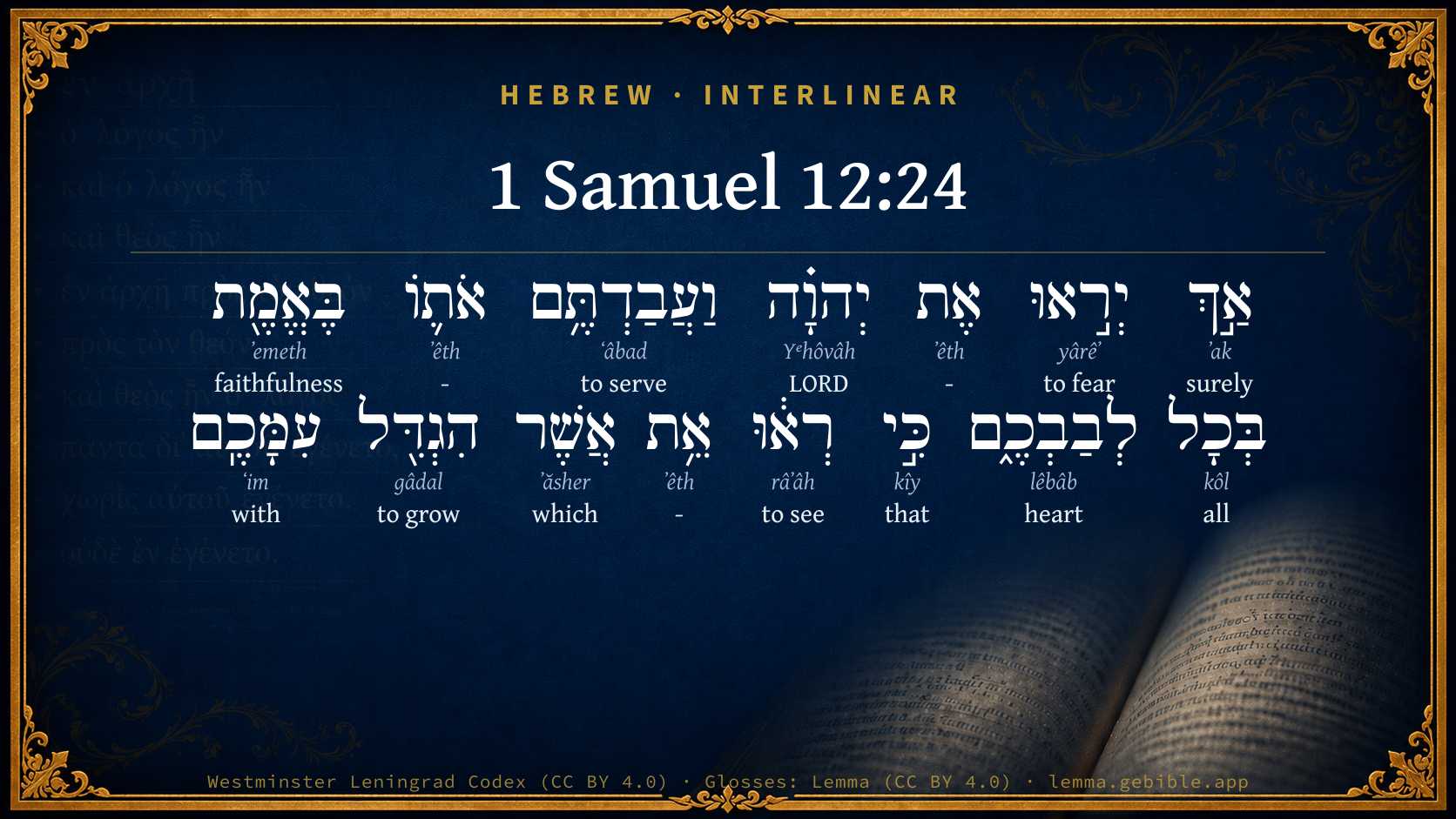
  1. אַ֣ךְ ʼak H389 “surely” Particle, Accusative
  2. יְר֣אוּ yârêʼ H3372 “fear” Verb, Qal, Imperative, 2nd Person, Masculine, Plural
  3. אֶת ʼêth H853 “-” Particle, Direct Object
  4. יְהוָ֗ה Yᵉhôvâh H3068 “LORD” Noun, Proper
  5. וַעֲבַדְתֶּ֥ם ʻâbad H5647 “and · to serve” Conjunction + Verb, Qal, Sequential Perfect, 2nd Person, Masculine, Plural
  6. אֹת֛וֹ ʼêth H853 “- · him” Particle, Direct Object + Suffix, Personal, 3rd Person, Masculine, Singular
  7. בֶּאֱמֶ֖ת ʼemeth H571 “in/at · faithfulness” Preposition + Noun, Common, Feminine, Singular, Absolute
  8. בְּכָל kôl H3605 “in/at · all of” Preposition + Noun, Common, Masculine, Singular, Construct
  9. לְבַבְכֶ֑ם lêbâb H3824 “heart · your” Noun, Common, Masculine, Singular, Construct + Suffix, Personal, 2nd Person, Masculine, Plural
  10. כִּ֣י kîy H3588 “that” Conjunction
  11. רְא֔וּ râʼâh H7200 “see” Verb, Qal, Imperative, 2nd Person, Masculine, Plural
  12. אֵ֥ת ʼêth H853 “-” Particle, Direct Object
  13. אֲשֶׁר ʼăsher H834 “which” Particle, Relative
  14. עִמָּכֶֽם ʻim H5973 “with · you” Preposition + Suffix, Personal, 2nd Person, Masculine, Plural

About this verse

These counts appear in no published source. They are computed here, from the morphology-tagged text and Lemma’s own curated glosses. What Lemma adds →

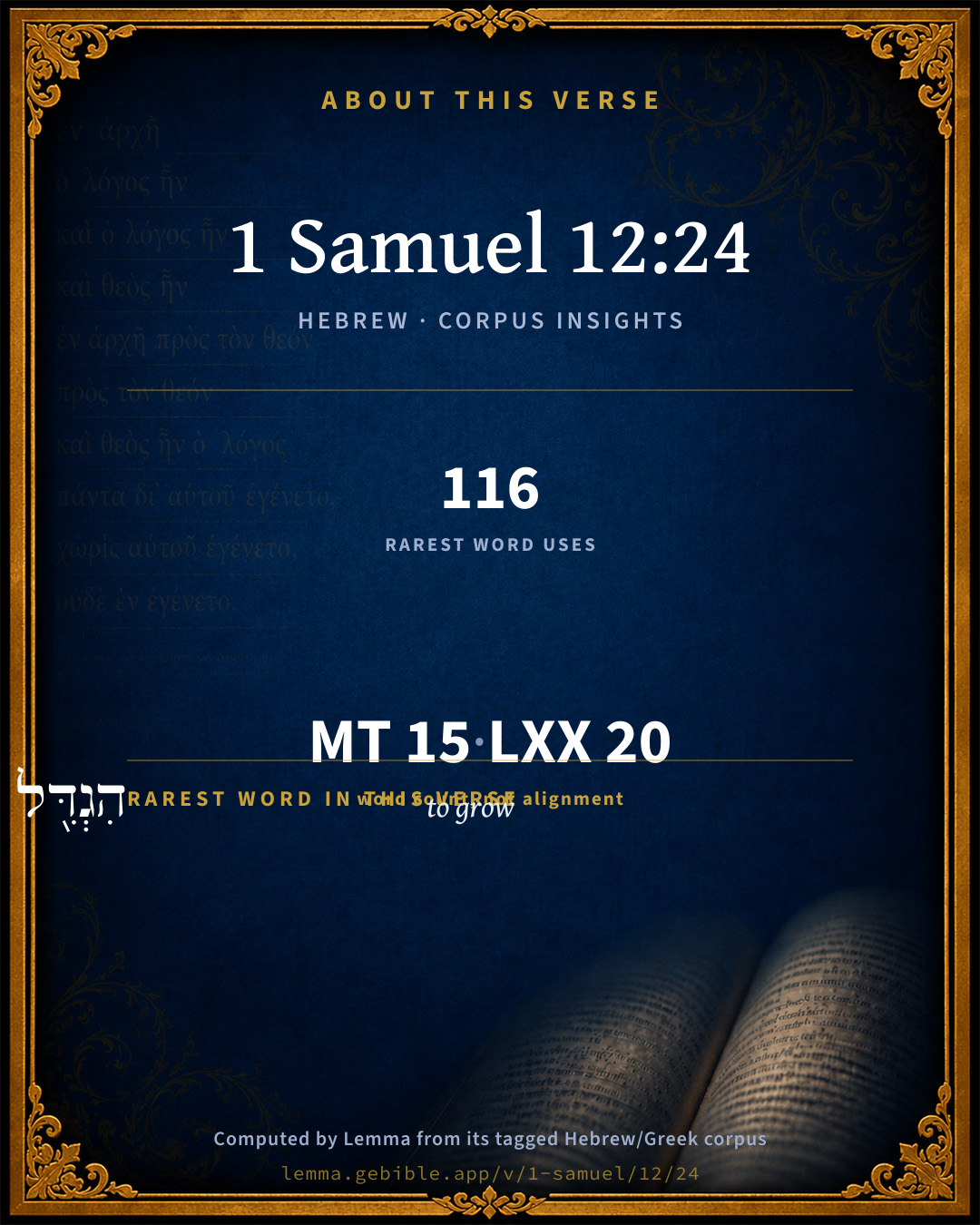
15
words
13
distinct lemmas
Historical
section

Grammatical profile

  • 4 verbs
  • 4 nouns
  • 1 preposition
  • 1 conjunction
  • 5 particles

Verb forms

  • יְר֣אוּ Qal · Imperative
  • וַעֲבַדְתֶּ֥ם Qal · Sequential Perfect
  • רְא֔וּ Qal · Imperative
  • הִגְדִּ֖ל Hiphil · Perfect

Hebrew & Septuagint length

In English translation the verse runs 22 words from the Hebrew and 25 from the Septuagint (LXX English) — closely comparable.

A rough comparison of the two English renderings, which tokenize alike — not a word-level alignment.

Word counts can differ between the Hebrew and the Greek without any difference in meaning — e.g. the Hebrew direct-object marker אֵת has no separate Greek word, and Greek often adds the article ὁ.

In the original languages it is 15 Hebrew tokens and 20 Greek tokens — but the two are counted differently (Hebrew bundles its prefixes and suffixes into one token; the Greek is in lemma form), so that isn’t a like-for-like length.

Cross-references

13

Topical passages linked to 1 Samuel 12:24 in the Treasury of Scripture Knowledge — connected by theme and wording, ordered by reader-vote popularity; previews shown in the World English Bible.

  • Deuteronomy 10:21 He is your praise, and he is your God, who has done for you these great and awesome things, which your eyes have seen.
  • Proverbs 1:7 The fear of Yahweh is the beginning of knowledge; But the foolish despise wisdom and instruction.
  • Psalms 126:2–3 Then our mouth was filled with laughter, And our tongue with singing. Then they said among the nations, "Yahweh has done great things for them."
  • Isaiah 5:12 The harp, lyre, tambourine, and flute, with wine, are at their feasts; But they don't regard the work of Yahweh, Neither have they considered the operation of his hands.
  • Hebrews 12:29 for our God is a consuming fire.
  • Psalms 111:10 The fear of Yahweh is the beginning of wisdom. All those who do his work have a good understanding. His praise endures forever!
  • Ecclesiastes 12:13 This is the end of the matter. All has been heard. Fear God, and keep his commandments; for this is the whole duty of man.
  • Exodus 12:13 The blood shall be to you for a token on the houses where you are: and when I see the blood, I will pass over you, and there shall no plague be on you to destroy you, when I strike the land of Egypt.
  • Psalms 119:80 Let my heart be blameless toward your decrees, That I may not be disappointed.
  • Job 28:28 To man he said, 'Behold, the fear of the Lord, that is wisdom. To depart from evil is understanding.'"
  • Romans 12:1 Therefore I urge you, brothers, by the mercies of God, to present your bodies a living sacrifice, holy, acceptable to God, which is your spiritual service.
  • John 1:47 Jesus saw Nathanael coming to him, and said about him, "Behold, an Israelite indeed, in whom is no deceit!"
  • Ezra 9:13–14 After all that is come on us for our evil deeds, and for our great guilt, seeing that you our God have punished us less than our iniquities deserve, and have given us such a remnant,

Cross-references courtesy of OpenBible.info (CC BY 4.0).

Hebrew and Greek witnesses Masoretic Hebrew ↔ Greek Septuagint

The same verse in the two great witnesses to the Old Testament, shown verse-for-verse.

These are two independent witnesses, not word-aligned to each other, and the Septuagint is shown in lemma (dictionary) form.

Hebrew 1 Samuel 12:24 Masoretic · Westminster Leningrad Codex

אַ֣ךְ יְר֣אוּ אֶת יְהוָ֗ה וַעֲבַדְתֶּ֥ם אֹת֛וֹ בֶּאֱמֶ֖ת בְּכָל לְבַבְכֶ֑ם כִּ֣י רְא֔וּ אֵ֥ת אֲשֶׁר הִגְדִּ֖ל עִמָּכֶֽם

Only fear Yahweh, and serve him in truth with all your heart; for consider how great things he has done for you.

World English Bible · Public Domain

Greek LXX 1 Samuel 12:24 Septuagint · lemma form

πλήν φοβέω ὁ κύριος καί δουλεύω αὐτός ἐν ἀλήθεια καί ἐν ὅλος καρδία σύ ὅτι ὁράω ὅς μεγαλύνω μετά σύ

Only fear the Lord, and serve him in truth and with all your heart, for you⌃ see what great things he has wrought with you.

LXX2012 (modern English Septuagint) · Public Domain

Hebrew: Westminster Leningrad Codex (CC BY 4.0). Greek: Septuagint (public domain); English from LXX2012 (modern English Septuagint) (Public Domain). How the Septuagint differs from the Hebrew →

Targum (Aramaic paraphrase)

1

The Targum is the ancient Jewish Aramaic paraphrase of the Hebrew Scriptures — an interpretive translation, not the Hebrew text itself. Onkelos (literal) and Pseudo-Jonathan (expansive) render the Torah, and Jonathan the Prophets. Coverage is partial: where no permissively-licensed English translation exists for a verse, only the Aramaic is shown. This is verse-level text, not a word-by-word alignment to the Hebrew.

  1. Targum Jonathan Prophets (Joshua–Malachi)
    בְּרַם דְחִילוּ מִן קֳדָם יְיָ וְתִפְלְחוּן קֳדָמוֹהִי בִּקְשׁוֹט בְּכָל לִבְּכוֹן אֲרֵי חֲזוֹ יַת דְאַסְגֵי לְמֶעְבַּד עִמְכוֹן:

    (no public-domain English translation for this verse)

    Targum Jonathan — Aramaic: “Mikraot Gedolot” (public domain). English: “Sefaria Community Translation” (CC0 1.0 (public-domain dedication)); “London "Chaldee Paraphrase," 1871” (public domain). Text via Sefaria.

Commentary

Notes on 1 Samuel 12:24 from classic Christian and Jewish commentators (each source and its license shown beneath its notes). The classic Christian expositions comment on the surrounding passage and are grouped to its opening verse, so a note may address several verses; the Jewish commentaries on the Tanakh (Rashi and others) are per-verse, so they appear only where the commentator wrote on this verse.

Lemma curates 59 commentaries, every one of them public domain or Creative Commons licensed, each selected and text-cleaned for this edition rather than reprinted as found. About our sources →

Trapp's Complete Commentary

John Trapp

1Sa 12:24 Only fear the LORD, and serve him in truth with all your heart: for consider how great [things] he hath done for you.

Ver. 24. Only fear the Lord.] Else my praying for you shall profit you nothing: my preaching also will be lost labour.

And serve him in truth.] Without dissimulation

With all your heart.] Without diminution.

For consider how great things, &c.] Mercy calleth for duty: deliverance commandeth obedience.

John Trapp, A Commentary or Exposition upon All the Books of the Old and New Testament (1647–1656) — public domain. Text from a community e-Sword module.

The Biblical Illustrator

Joseph S. Exell

1Sa_12:24

Only fear the Lord and serve Him in truth with all your heart.

The religious capability of man

I. That man can reverence God. Only fear the Lord Reverence implies:--

1. A sense of Divine greatness. For none can reverence the contemptible or the small

2. A sense of Divine excellance. For none can reverence the morally unworthy.

II. That man can serve God. Serve Him in truth with all your heart. There is a sense in which all things serve God.

1. Some serve Him without their will. All the masses of matter, organised and inorganised, serve Him.

2. Some serve Him with their will. All rational existences do this, and moving thus they serve Him.

3. Some serve Him against their will. All fiends human and angelic do this

III. That man can consider God. Consider how great things He hath done for you. Man can reflect on God, both on what He is in Himself and on what He does. What other creatures on this earth can do this? The eagle that pierces the clouds with a power of vision keener, and a range wider than ours, returns from its lofty flight to its lonely eyrie without one thought of God, (Homilist.)

Filial fear of God

Our feeling must be the reverence of a son, not the abject terror of a slave. For surely if this terror were merely that servile dread which represents God as an implacable inexorable Being, the soul under such an impression would sit down inactive, overwhelmed with a horrible despair, and never engage in a fruitless attempt to appease a Power whom no prayers could interest, no repentance reconcile.

1. It is clear that the fear of an awakened sinner who sues successfully for pardon differs vastly from that servile dread which would flee from God as an unfriendly Being delighting in the misery of His creatures. I know also that it differs greatly from that composed reverence with which the soul in a condition of confirmed pardon and reconciliation looks upon God. It is--if we may use the expression--an initial fear of God, it is the beginning of wisdom, it is the broken and contrite heart, looking with self-abasement yet with humble trust upon its omniscient Judge; and in proportion as we teal ourselves reconciled to Him in the face of Jesus Christ, the feeling will gradually ripen into that filial reverence accompanied by love which is the proper attitude of the justified soul towards its Maker. It is only, as I conceive, upon the principles which I have enunciated that you can reconcile passages of Gods Word which would otherwise appear contradictory. St. John tells us that perfect love casteth out fear, and that he who feareth is not made perfect in love, while other passages, such as our text and many like it, represent the Fear of God--coupled with obedience--as the whole duty of man; but all becomes plain when we understand the term as commencing with the initial fear which attends the imperfect conversion of the sinner, and leading on to that filial reverence which is the strength and ornament of the soul as that conversion progresses to its perfection.

2. I must go on to show the connection of the former clause of my text with the latter. How are we to bridge over the interval, as it were, between fearing God and serving Him in truth with all our heart? I presume in this way. We can imagine no motives for obedience either to an earthly or a heavenly father except either the value and certainty of the rewards proposed, coupled with a conviction of the ability and willingness of our father to confer them, or the apprehension of just and severe punishment for disobedience. Now, neither of these, exclusive of the other, is the true principle of our obedience to God. For if our obedience of the Divine law were founded merely on our belief of Gods desire for our happiness then as soon as the rough wind of calamity swept over us, we should cease to regard Him as the God whom we had hitherto worshipped. On the other hand, if our service arose from our dread of the vengeance of God and nothing more, it would be deficient in that entire trust in His goodness, and free choice of His service which alone can make us acceptable in His sight. He is at once the Governor of the World, and Our Father which is in heaven. Therefore, ere we can serve God in truth with all our heart our bosoms must be transfused with that fear of God which is made perfect in love. For if you regard it attentively you will observe that this principle of reverential love is most marvellously adapted to every state and condition in life, and to the due discharge of our duty at all times and under all circumstances. In a word, the fear of God rightly understood and rightly acted upon will give warmth to our zeal, spirit to our devotion, animation to our faith, life be our hope, and extension to our charity. It will deter us from sin; it will cheer and encourage us in the path of duty--that path which leads us unto everlasting life. I have thus given what may be regarded as a Christian interpretation of the fear of God, end shown you how it is the germ which blossoms unto the perfect love and service of our heavenly Father--a service which is both real and engages the affections of the whole heart.

3. Gods claim to this Fear which I have described That claim is founded on every one of the Divine imperfections. Can we think of His omniscience and omnipresence and justice without casting our meditations forward to that great day when we must all appear before His impartial tribunal? Goodness, holiness, mercy when exhibited by our fellow men win our hearts and charm us into admiration, but how puny are even their highest development on earth compared with the display of them in the character of God! The crowning proof of Gods mercy we have reserved to the last--I mean His wondrous love and pity as displayed in the Redemption of the World by the death and passion of Christ. In Creation and Providence there is never conveyed to the mind any impression of effort or sacrifice on the part of the Supreme Being. The beauty and bounty which, through the long cycle of the ages. God has been scattering over this earth, have not detracted from His boundless wealth. But of Jesus, His well-beloved Son, He possessed no equivalent, no counterpart. Of this Possession only Himself could be the Parallel. And yet He Who alone knew its worth yielded it up for us. Behold, then, the power and mercy of Jehovah! Beware how you affront His Majesty by want of reverence, or dishonour His goodness by servile dread. It may not be our lot while upon earth to realise the Majesty and Beauty of His attributes. But a day will surely come, which the rapid years are hurrying on, when we shall behold Him no longer armed as our Judge, but displaying Himself as reconciled to us and at one with us through Christ. (J. Hunt, M. A.)

The simplicity of life

The great scientist is he who discovers some wide-reaching law of nature which explains a thousand facts otherwise disconnected and inexplicable; the great historian is he who seizes some deep social law which determines the development of nations through long periods. Men of lesser genius seek to understand things superficially, and to correct them one by one, but the masters get to the root principle, the dominant law, the prevailing tendency. Now, in our text Samuel has got to the deep and final law of human life--Only fear the Lord. Strange, complicated, contradictory, baffling as life seems, there is one simple principle, one sovereign passion, one master truth, that will solve for us every problem, subdue every opposition, and guide us safely through every difficulty.

I. Let us consider the text in relation to national life. The kingdom of Israel was at this time in the throes of a great political change. They stood on the threshold of a new epoch. They were alarmed at the change they had made in their form of government; they were ashamed of the unbelief which had prompted the change; they were full of misgiving as to the consequences of this great political revolution Then Samuel speaks: Ye have done all this wickedness, yet turn not aside from following the Lord, and all shall still be right. Did not our Lord teach us most clearly the selfsame truth, that everything in human life depends upon the religious idea--that the knowledge and service of God constitute the one grand question which decides all other questions? There can be no doubt but that we live on the eve of vast changes alike in Church and State. And not only do these signs of the times, with fear of change, perplex monarchs, but they trouble many besides. Listen to your great prophet Carlyle, to your great critic Ruskin, to your great poet Tennyson. These and many more are full of misgiving as they ponder the signs of the times. Is not our text to us a very precious direction and encouragement? In all this confusion and conflict true religious faith and feeling shall preserve us, and bring us through in safety. It will prove our sheet anchor in the storm, our guiding star in the hour of darkness, our spring of strength and hope always. Everything depends upon the religious faith and life of our nation. Let this be true and deep, and all shall be well. But it must be true and deep. In truth with all your heart. A national profession of Christianity will not says us, a barren orthodoxy will not save us, but if the heart of the nation be sound God will not desert us. For consider how great things He hath done for you. We have had perils before, and they were averted. The religious sentiment revived in the Puritan saved us from the terrible despotism which the Stuarts sought to fasten upon up. The religious sentiment revived in Wesley and Whitefield saved us from atheism and its horrors when Voltaire with a light heart led the French nation into a sea of blood. The religious question comes before all others, it is the deepest question of all, it decides all others. Let us be full of faith and spirituality; let us honour God and the higher law; let us be true to prayer, to worship, to Gods Holy Word; let us do our duty in the fear of God; and God will untie our knots, solve our problems, protect our liberties end glory, and lead us into a larger and richer inheritance.

II. Let us consider the text in relation to personal life. To the individual life often appears chaotic, confusing, and we are sometimes tempted to give it up in despair. In all perplexities touching belief the best philosophy is the philosophy of the text. Proceed in practical life to perform the duty that presents itself in the fear of God, live from day to day keeping close to conscience, and the Spirit shall teach you the true thing and the right way. When Frederic Douglass was a slave, escaping from the Southern States, it was strictly necessary for him to travel by night, and his grand guide was the North Star. He knew nothing of the country through which be was passing, it was all silence and darkness and mystery, but keeping his eye on the Star of the North, it guided him to liberty. So you may mentally be traversing a land of mystery, a land of darkness and of the shadow of death, but you have a precious beacon. Only fear the Lord, and serve Him in truth, follow that star, and the Dayspring shall arise upon you. Does anyone object that such mottoes as these are vague generalities, out of which we can get little good? Only fear the Lord. Only let your manner of life be worthy of the Gospel. Does anyone cavil at these sayings as if they were not definite and illuminative? When someone objected that the clauses in the American Declaration of Independence, such as, All men are equal, and so forth, were but glittering generalities, Emerson replied that they had proved blazing ubiquities, they had poured the light of salvation on the nations path at great moments. So with these sayings, they have a very definite and immense significance, they are blazing ubiquities, and they will throw a precious light on all the questions and interests and duties of life, as the pillar of fire lit up every stick and stone of the wilderness. In hours of deepest darkness and confusion be loyal to the text--only that, and nothing more. I remember once hearing a devout engine driver relate his religious experience. He said, The other night when I was on duty there was a dense fog; we could not see a yard before us, but I knew that the permanent way was under us, and every now and then we caught a glimpse of some signal or other, and in time came safely to the journeys end; so, he said, I know if I am true to the great commandments and promises God will guide and bring me through (W. L. Watkinson.)

Samuels address to Israel

I. The duties urged. Fear the Lord, and serve Him, etc.

1. To fear the Lord. This is an indispensable part of true godliness. Setting Him ever before us. (Job_28:28; Psa_19:9; Pro_23:17; Rev_14:7.)

2. To serve God. In the way that He appoints. With the voluntary devotedness of the heart and life, With constancy and perseverance.

3. It must be in truth with all our hearts. Notice:--

II. The powerful motive supplied. For consider what great things the Lord hath done for you. This is seen:

1. In the temporal provisions of His bounty.

2. In providential interpositions.

3. In the exercises of His mercy.

4. In the supplies of His grace.

5. In the promises of glory.

Learn:--

1. The practical nature of true religion. It includes both the fear and service of God.

2. How great are our obligations thus to fear and serve God.

3. Abused mercies will bring a fearful weight of judgment upon us (J. Burns.)

Gratitude a motive for Divine service

To all such seers as Samuel, all history has a moral; indeed, all history is an argument. Thus he deals with the history of Israel, as an argument for their serving God. We notice here:--

I. The service characterised. It is to be marked:

1. By reality. Serve Him in truth. This distinguishes it from all mere external service, as well as from all hypocrisy. Be real, is the foundation stone as well as the top stone. It is to be marked:

2. By heartiness. With all your heart. There is to be vitality as well as sincerity, enthusiasm as well as thoroughness.

II. The motive enforced. There are two other motives for serving God besides this one.

1. The supreme one is adoration of God. Were there no rewards or punishments, no heaven or hell, He commands our service by what He is The Infinite Beauty claims our homage, the Infinite Righteousness our obedience.

2. Another and proper, though inferior, motive is regard to reward. Christ uses it in many of His parables. Moses had respect to the recompense, etc. Jesus, for the joy that was set before Him, etc.

3. But the motive pleaded here is gratitude for what God has done. Great things. These are words which Moses and David as well as Samuel use in speaking of Gods dealings. We may note the parallel between Gods dealings with the Jews and His dealings with us--Redemption, Protection, Discipline. But the parallel fails; He has given us Christ; the demand on our gratitude is transcendent, the claim for our service unparalleled. (U. R. Thomas.)

Consider how great things He hath done for you.

Thanksgiving Sermon, 1817

In applying these words to ourselves let us:

I. Briefly review some of those great things which God hath done for us. These are recorded in the annals of our country, in almost every page of which we meet with instances of Divine interposition and guardianship, which must compel him who loves his country or his God, to lift up his grateful and adoring heart to Him who ruleth over all. Still there is preserved that form of government in which we so deservedly rejoice. Still there is preserved unto us the inestimable privilege of worshipping God according, to the dictates of our own consciences. It is another mercy which peculiarly calls for our praise that the triumphs of the Gospel during the last year have in our country been extensive. In passing from our country in general, to the city which we inhabit, we still see that God hath done great things for us. To whom have we been indebted for the almost unprecedented healthfulness of our city, but to that God who sends sickness or preserves life at His pleasure? What great things has God done for us as individuals? Here your own meditations must supply what we can only intimate. But I forbear: Thy mercies, Lord, are innumerable; and to reckon them up in order before Thee is as difficult as to count the stars in the heavens, or the sand which is on the seashore.

II. Shall our hearts be unaffected by this kindness of our God? Ingratitude, with respect to men, is ever considered by you as the evidence of a most abandoned character, as the unfailing mark of a total dereliction of every noble emotion; and yet how many of us, occupied by the cares of the world, engaged in the pursuit of a thousand frivolous objects, never feelingly remember the goodness of the Lord. The exercise of gratitude for the Divine mercies is certainly the most elevated of all the occupations of the believer; for it leads us, thus to speak, even to heaven, and attaches us immediately to God; it places in our heart the greatest object that can engage it, in our mouth the greatest name which can fill it; it unites us to God in a manner the most tender and disinterested by emotions of love, by emotions which have for their end the glory even of God. But how shall this gratitude be expressed? Is it sufficient for us coldly to bless God with our lips; unconcernedly to enter into His holy temple, and unite with His people in declaring our thankfulness? No, this alone will not satisfy Him who searcheth the heart; who trifles not with us, and will not permit us to trifle with Him. We must fear the Lord, and serve Him in truth, with all our heart. This filial fear must necessarily impel us to serve the Lord in truth, with all our heart. It will not rest satisfied with the most splendid outward performances: since God is a Spirit, the believer will pay his thanks in spirit and in truth. If these be the sentiments of his soul, if this be the conduct of his life, his tongue cannot be silent. Gratitude, which loosed the tongue of Zechariah at the birth of John the Baptist, will loose his also, and cause him to glorify God with a loud voice.

III. Such a mode of expressing our gratitude by devoting our lives to the service of God is right and good. It is the right way enjoined upon us by the nature of things; as well as by the authority of God.

1. It is a way which is profitable, and will secure for us new favours God wastes not His blessings: the streams of His goodness will not always flow upon a barren and unfertile soil: He will at last turn them to those places that will be rendered by them luxuriant and productive.

2. This way is pleasant and good. Yes, act thus, and every situation in life will be to you full of blessedness. Prosperity will not be to you as to the ungrateful, a snare for your virtue; it will never for you be turned into a curse; you will preserve in the midst of your enjoyments a heart humble, docile, detached from the vanities of the world. (H. Kollock, D. D.)

Benefits of remembrance

God gives us remembrance in order that we may make great and blessed use of it. Often in our hearts may shine an afterglow of uncoruscating light from a sun that has set, more lustrous, more calm, more mellow, than when its hot fervours were falling on our heads--a pensive, clear, and still Indian summer of memory after the sultry autumn has gone. (A. Maclaren, D. D.)

National mercies

These words conclude the sum of the whole chapter, wherein Samuel had made a long narration of Gods dealing with His people, and theirs with Him. In the words are:

1. An exhortation to fear and serve the Lord.

2. The reasons of it. Consider how great things he hath done for you. But if ye do wickedly ye shall perish both you and your King. This duty meets us everywhere in Scripture, and therefore I will stand no longer in explaining it, but come to the reasons that enforce it.

I. The first is to consider how great things they had seen God doing for them, and therein see what a tie and bond the Lord hath upon them to obey Him. Consider what spiritual mercies He hath vouchsafed you, when of old ye were no people, but an Amorite was your father, an Hittite your mother. If you cast your eyes back to temporal favours, consider how He went clown with your fathers into Egypt, and what wonders he wrought for them in that land. If you cast your eye upon present things, consider how you have rebelled and cast the government of Jehovah from off your necks; and yet He forbeareth you, not plaguing you according to your demerits, but hath condescended to yield you a king.

1. Israel must consider the works of God in the greatness of them, their multitude, variety, freeness, and sweetness; in their own unworthiness of them, and their misery without them. All these will make them swell in our eyes to a wonderful magnitude. And that many cords bind faster then one, unto love and duty: And in many great mercies such a flame of affection shineth out upon the Church as much water cannot quench; and this sense of Gods love enlargeth our affections with zeal and fervency, to love Him again.

2. Israel must consider who hath wrought these great works; and that is the Lord. Consider what the Lord hath done for us. Israel shall sat an higher price on the mercies, because they are the Lords; as you know it doubles the favour, to be from a friend, a father, or a dear hand. The gift is but the shell; the grace of the giver the kernel. All waters issue from the sea by secret channels, but run openly back again to it. So all the streams of mercy must, in the right use of them, return to the boundless sea whence they first flow unto us.

3. Israel must consider for whom God hath dons all these great works, namely for Israel. The greatest works of His mercy are but His love tokens to Israel, In all which not the greatest mercy itself, but the application of it to ourselves, whets up and sets an edge upon thankfulness. And thus in this place it serves Samuels purpose to bring home the mercies close to Israel.

4. Israel must consider for what the Lord hath wrought all these great things for them: And this, three ways.

(1) In respect of the mercies themselves, to remember and keep them in mind. As men of trading have their days book for their receipts of every day, so should we make a day book of our receipts, and by occasion of one (while we turn leaves) look often upon others, which we look not for.

(2) In respect of God, to think of some return. One good turn requires another, we say; and among men we are careful to answer kindness with kindness. So saith David, What shall I return or render to the Lord for all his benefits? (Psa_116:1-19; Psa_12:1-8.) I have nothing to give Him but His own; I have nothing worth giving Him, or worth the taking. But know, He desires nothing beyond that thou art able to give, and he accepts according to that we have. For free favours, he expecteth but free thanks, free duties, fast affections. He hath given us the choicest and best things we have, and we in way of thankfulness must return and offer the best things we have unto Him (Lev_2:1), the cakes for the meat offering must be made of the finest flour. We must offer the best of our time, our youth, our strength; the best of the day, the morning for His service; the best part of ourselves, our hearts, which will bring our whole selves.

(3) In respect of others, to provoke them to praise God with us, as the cock clapping himself rouseth himself, and by crowing provoketh others (Psa_34:8.) Say as the lepers, Come, this is a day of good tidings, we do not well to be silent.

II. And now, having done with Israel, let us see what great things God hath done for us, and whether they be not as worthy our consideration. What? As great things for us? We never were in Egypt, nor in the bottom of the sea, nor in the wilderness fed with manna, etc.

1. Let me a little untie a bundle of spiritual mercies wrapt up together. And was the covenant of grace more peculiar, more sure, half so clear to Israel, as to us? What oracles had they, which we want? Had they the law written, and have not we? And to the prophets, the whole Gospel added, the evangelists, Apostles, pastors, and teachers? Had they the true worship of God in shadows, and have not we in substances? Had they the promises in hope, and have not we them in mind? Had they Moses, faithful as a servant in the house, leading them through the wilderness, and Joshua to save them, and lead them into Canaan? And have not we one faithful in the house as the Son, and our great Joshua, a great Saviour, to lead us into the celestial Canaan? Had they the Lord nearer unto them than any nation, walking among them in the Ark, in the pillar of the cloud and fire, and the like? And is our God farther from us? Nay, is He not nearer unto us, even our Immanuel. Had they plenty of manna, purity of worship, and extraordinary protection, and are we inferior to them, or any age before us, in the liberties of the Gospel, and happy days of grace?

2. Next, are we behind them in temporals? Hath not God brought our vine out of Egypt, where it grew not well, with signs and wonders, and a strong hand, when we were in Egyptian darkness and the Babylonish captivity. How did His strong arm pull us out of popery, and make the happy restoring of the Gospel the new and glorious birthday of our country? Did the Lord give them a good land, flowing with milk and honey? And hath He not seated us in a land far exceeding that in commodity, as in quantity, four times as big, every way as fruitful. As he gave them saviours and deliverers, so have we had our Moseses, our Joshuas, our Kings in a settled government, who led us forward in the Gospel, where the former left us. As the Lord gave Israel extraordinary victories and deliverances, which struck dread into all the nations about them, so hath He done for us, who have been made the head of nations, and not the tail, honoured and feared abroad, as well as happy at home. The conclusion of all is in verse 14. Now therefore fear the Lord, and serve Him in uprightness. The sins of kingdoms are the destroyers of kings and kingdoms. Sin makes havoc of all, confounds all, and brings derision to all estates; makes the tail the head, changes the fine gold, and makes it dim like to earthen pitchers. It gives up the strong staff and beautiful rod to be broken (Jer_48:17). (T. Taylor, D. D.)

The Biblical Illustrator, edited by Joseph S. Exell (c. 1880s–1900s) — public domain. Text from a community e-Sword module.

Joseph Benson's Commentary

1Sa 12:24. Only fear the Lord, and serve him with truth, &c. — Otherwise neither my prayers nor counsels will stand you in any stead. Thus we see that amidst all the changes of the Hebrew state, their prophets steadily inculcated one and the same great principle, namely, that of fearing and serving the one true and living God, in spirit and in truth. Whether Moses or Joshua, the elders, or judges, or kings, were their governors, this great point was kept in view, and pursued still. And this indeed was the end of the Divine Providence in selecting this people: to preserve and spread among mankind the knowledge and worship of the true God, and obedience to his will, was the great point in view, in the divine counsels, in all that was done to and for the Israelites. And this great purpose, notwithstanding all their revolts and rebellions, was still carried on, at least in a measure, and accomplished.

Joseph Benson's Commentary on the Old and New Testaments (1811–1818) — public domain. Text from a community e-Sword module.

Keil & Delitzsch

C. F. Keil & F. Delitzsch

Lastly, he repeats once more his admonition, that they would continue stedfast in the fear of God, threatening at the same time the destruction of both king and people if they should do wrong (on Sa1 12:24, see Sa1 7:3 and Jos 24:14, where the form יראוּ is also found). "For see what great things He has done for you" (shown to you), not by causing it to thunder and rain at Samuel's prayer, but by giving them a king. עם הגדּיל, as in Gen 19:19.

Keil & Delitzsch — Biblical Commentary on the Old Testament (1861–1891) — public domain (CC PDM 1.0). Text via the HelloAO Bible API. (Old Testament only.)

Geneva Bible (1599)

Geneva Bible translators

Unfeignedly, and without hypocrisy.

Geneva Bible (1599) marginal notes — public domain. Text via Bolls.life.

Adam Clarke's Commentary

Verse 24. Only fear the Lord] Know, respect, and reverence him.

Serve him] Consider him your Lord and Master; consider yourselves his servants.

In truth] Be ever honest, ever sincere; with all your heart - have every affection engaged in the work of obedience; act not merely from a principle of duty, but also from a pious, affectionate sense of obligation. Act towards your God as an affectionate child should act towards a tender and loving parent.

Consider how great things] Review the history of your fathers, review your own life; see what interpositions of power, mercy, goodness, and truth, God has displayed in your behalf! Has he not daily loaded you with his benefits?

Adam Clarke's Commentary on the Bible (1810–1826) — public domain. Text from a community e-Sword/MySword module.

The Cambridge Bible for Schools and Colleges

gen. ed. J. J. S. Perowne

24. how great things he hath done for you] Lit. with you. The reference can scarcely be limited to the recent storm as a display of God’s greatness, but includes all his gracious dealings with His people. Samuel concludes his speech as he began it (1Sa_12:6-7), with an appeal to these as the motive for loyal obedience.

The Cambridge Bible for Schools and Colleges (gen. ed. J. J. S. Perowne; Cambridge University Press, 1878–1918) — public domain. Text from a community e-Sword module.

John Gill's Exposition

Only fear the Lord, and serve him in truth with all your heart,.... Fear him not with a servile fear, which is before dehorted from, but with a filial fear, a reverential affection for God; and includes the whole of religious worship, internal and external; explained further by serving him according to the truth of his word, and in a cordial, sincere, and affectionate manner; and if this was wanting in them, he suggests that his prayers and instructions would be of little avail, and not to be depended on:

for consider how great things he hath done for you; in bringing them out of Egypt: settling them in the land of Canaan; giving them his laws, statutes, commands, and ordinances; sending prophets unto them, and raising up judges for them, and bestowing all good things on them, in nature, providence, and grace; though some restrain this to the great thing he had done that day, to convince them of their sin, and by which they were returned to the Lord, namely, the violent storm of thunder; which wonderful instance of the power of God, and token of his displeasure against them, they were to lay up in their minds, and not forget, that it might be a means of preserving them from sin for the future.

John Gill's Exposition of the Whole Bible (1746–1763) — public domain (CC PDM 1.0). Text via the HelloAO Bible API.

Matthew Poole's English Annotations

Fear the Lord, and serve him; otherwise neither my prayer nor counsels will stand you in any stead.

He hath done for you, or, among you, both at this time and formerly.

Matthew Poole's English Annotations on the Holy Bible (1683–1685) — public domain. Text from a community e-Sword/MySword module.

The Pulpit Commentary

For consider, etc. Samuel concludes his address by appealing to the mighty deeds wrought in old time by Jehovah for his people; literally, it is, "For consider how grandly he hath wrought with you.

Ver. 24. (GILGAL.)

The good and right way.

fear the Lord," etc. Samuel assured the people that (as a priest) he would continue to pray for them, and (as a prophet) to show them the way of happiness and righteousness. (Act_7:4) Of this way the text may be taken as a further explanation, and gives

I ITS DESCRIPTION.

1. Filial reverence. Fear not (be not terrified vers. 17, 18, 20); but fear (with a lowly, affectionate, trustful reverence.), implying a knowledge of his character and saving purposes, in so far as he has revealed them to men; in our case, of him who is "the Way, the Truth, and the Life.

2. Practical obedience. "And serve him." Recognise yourselves as servants, his servants, and act accordingly. "Fear God, and keep his commandments" (the practical expression of the principle): "for this is the whole of man". (Ecc_12:13) The two may not be disjoined (Jos_24:14; Psa_2:11) "The life of service is work; the work of a Christian is obedience to the law of God" (Hall).

3. Thorough sincerity and whole heartedness. "In truth, with all your heart." Do not suppose that it is sufficient to render an outward and formal service; or a partial service, in which the love of idols may be united with the love of God. "Serve him only". (1Sa_7:3) "God will put up with many things in the human heart; but there is one thing he will not put up with in it a second place. He who offers God a second place offers him no place; and he who makes religion his first object makes it his whole object" (Ruskin).

II ITS NECESSITY. "Only." You must walk in it, whatever else you do; for it is only by doing so that you can

1. Avoid walking in the evil and wrong way. The "vision of life" which the great Teacher saw and described contained only two ways, the broad and the narrow, and there is no other.

2. Escape the destructive consequences of that way. You have already entered on a perilous course, only (in order that you may escape the end to which it naturally conducts), "fear the Lord," etc. "If ye still do wickedly, ye shall be consumed, both you and your king" (ver. 25). "The way of transgressors is hard." "it leadeth to destruction.

3. Receive, and continue to receive, the blessings that have been promised. "The Lord will not forsake his people," only (in order that you may enjoy his favour), "fear," etc. "I will pray for you, and teach you," only (in order that you may be really benefited thereby), "fear," etc. (Jer_6:16; Isa_1:19)

III ITS INCENTIVE. "For consider how great things he hath done for you." The motive here is not fear of punishment, nor hope of reward, nor even the sense of right, but gratitude and love.

1. What benefits; so great, so numerous, so long continued temporal and spiritual (vers. 6-11).

2. Toward you, in comparison with others (ver. 22).

3. He hath wrought. He, and no other; freely and graciously. "Free love is that which has never been deserved, which has never been desired, and which never can be requited." "We have known and believed the love that God hath to us. God is love". (1Jn_4:17) But in order that his love may be perceived and its influence felt, in awakening love, we must consider, fix attention upon it, especially as manifested in "his unspeakable. (1Jn_4:10) Our responsibility in regard to "salvation" depends directly on the power we possess of directing attention to Divine truth, and considering it with a real and earnest desire to know it, and live according to it; and by this means, as ice is melted by the sunbeams, so the heart is softened, renewed, and sanctified by the Spirit of truth. "O that they would consider! D.

The Pulpit Commentary (1880–1919), ed. H.D.M. Spence-Jones & Joseph S. Exell — public domain. Text from a community e-Sword module.

John Wesley's Explanatory Notes

Only, &c. - Otherwise neither my prayer nor counsels will stand you in any stead.

John Wesley, Explanatory Notes Upon the Whole Bible (1754–1765) — public domain. Text via the GEBible commentary corpus.

Scofield Reference Notes

C. I. Scofield

fear

(See Scofield "Psa 19:9").

The Scofield Reference Bible (1917 edition), notes by C. I. Scofield — public domain. Text from a community e-Sword module.

unfoldingWord translationNotes

Door43 World Missions Community

translationWords

fear

servant

true

heart

evil

unfoldingWord translationNotes — © Distant Shores Media and the Door43 World Missions Community, licensed CC BY-SA 4.0. Source: git.door43.org/Door43/en_tn.

Lesson kit

Teaching starters — assembled from the data on this page, not authored interpretation. Every prompt links to the verse data it draws on. Edit before teaching.

1 Samuel, in the Historical, opens this verse with 15 words (13 distinct Hebrew lemmas). Its most distinctive word is gâdal (“to grow”). A historical commentator’s framing appears above. Read the whole chapter for the surrounding context.

Discussion questions

  1. How does “to grow” (gâdal) shape what this verse is saying?
  2. How does Deuteronomy 10:21, which shares this passage’s theme, read alongside this verse?
  3. These translations render this verse differently; the difference is in the English rendering, not the original. What questions does that raise?
  4. «יְר֣אוּ» is a Qal Imperative verb. How does that grammatical form shape the action described?
  5. Compare how Trapp's Complete Commentary and The Biblical Illustrator read this verse. Where do they agree or differ?

Things to notice

Reading settings

Reading text

Shown beneath each verse's original-language words.

Old Testament
Old Testament edition

Read the OT as the Masoretic Hebrew (MT) or the Greek Septuagint (LXX).

English shown for the Greek Septuagint (in the Hebrew ↔ Greek comparison).

Comparing translations? Open the Compare panel on any verse page to stack up to four side by side.