
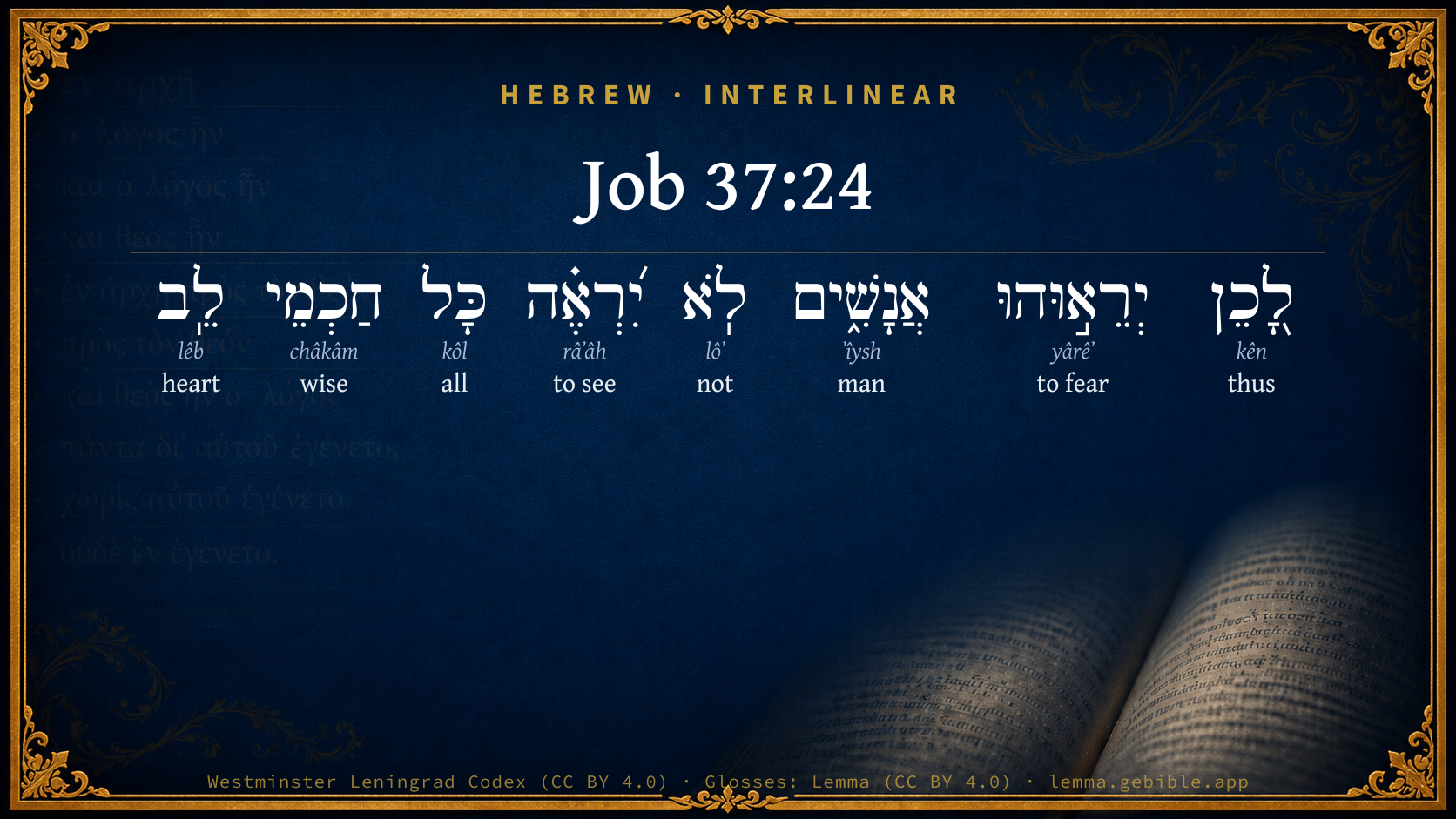
Job 37:24

Hebrew (Westminster Leningrad Codex) Job 37:24 appears in the Hebrew Old Testament. The text above is from the Westminster Leningrad Codex. Each word links to its Strong’s number, a concise gloss, and parsing drawn from the Open Scriptures Hebrew Bible morphology. Click any word for its full Brown-Driver-Briggs (BDB) entry.
Download image
Cite this verse

Job 37:24 (World English Bible). Public Domain. Lemma interlinear Bible study tool, https://lemma.gebible.app/v/job/37/24.

Show BibTeX & RIS
BibTeX
RIS
English Translation
Therefore men revere him. He doesn't regard any who are wise of heart."
World English Bible · Public Domain
Download a study sheet

One document with this verse’s original text, its word-by-word gloss line, the meaning frame, cross-references with their text, attributed commentary, and full source and license credits — printable, and it pastes into notes with its structure intact.

This verse Autodidact and up

Study sheet (.html) Plain text (.txt)

A passage Seminary Student

Up to 50 verses in one chapter. A passage sheet keeps up to 6 commentary sources and 12 cross-references per verse, in the order this page ranks them, and says so on the sheet whenever that leaves anything out. Ask for a single verse and you get the Autodidact verse sheet above.

Everything on this page stays free to read, with no account — the sheet is a download of what is already on screen, not access to it.

Want to remove ads? Support Godless Engineer
Compare translations 3

The same verse in 3 English versions, stacked beneath the original-language interlinear above. Click any original word for its lexicon entry.

Each is an independent rendering of the whole verse — the interlinear is not word-aligned to these translations.

Highlighted words mark where these versions differ — a whole-verse word diff, not a word-by-word alignment.

  • World English Bible Public Domain
    Therefore men revere him. He doesn't regard any who are wise of heart."
  • King James Version Public Domain
    Men do therefore fear him: he respecteth not any that are wise of heart.
  • unfoldingWord Literal Text CC BY-SA 4.0
    Therefore, fear him, men. He does not regard any of the wise of heart.”

unfoldingWord Literal Text — © unfoldingWord, licensed CC BY-SA 4.0. Word-aligned USFM3 via Door43 (git.door43.org/unfoldingWord/en_ult).

Versions to compare (up to 4)

3 of 4 selected

Show all 18 translations

Every available English version of this verse, each an independent rendering of the whole verse.

  • World English Bible Public Domain
    Therefore men revere him. He doesn't regard any who are wise of heart."
  • Berean Standard Bible Public Domain
    Therefore, men fear Him, for He is not partial to the wise in heart.”
  • Majority Standard Bible Public Domain
    Therefore, men fear Him, for He is not partial to the wise in heart.”
  • King James Version Public Domain
    Men do therefore fear him: he respecteth not any that are wise of heart.
  • American Standard Version (1901) Public Domain
    Men do therefore fear him: He regardeth not any that are wise of heart.
  • Revised Version (1885) Public Domain
    Men do therefore fear him: he regardeth not any that are wise of heart.
  • Geneva Bible (1599) Public Domain
    Let men therefore feare him: for he will not regarde any that are wise in their owne conceit.
  • Douay-Rheims (1899) Public Domain
    Therefore men shall fear him, and all that seem to themselves to be wise, shall not dare to behold him.
  • Young's Literal Translation Public Domain
    Therefore do men fear Him, He seeth not any of the wise of heart.
  • Literal Standard Version CC BY-SA 4.0
    Therefore men fear Him, || He does not see any of the wise of heart.”
  • Unlocked Literal Bible CC BY-SA 4.0
    Therefore, people fear him. He does not pay any attention to those who are wise in their own minds.”
  • unfoldingWord Literal Text CC BY-SA 4.0
    Therefore, fear him, men. He does not regard any of the wise of heart.”
  • Darby Bible Public Domain
    Men do therefore fear him: he respecteth not any that are wise of heart.
  • World Messianic Bible Public Domain
    Therefore men revere him. He doesn’t regard any who are wise of heart.”
  • Webster's Bible Public Domain
    Men therefore fear him: he respecteth not any that are wise of heart.
  • Free Bible Version CC BY-SA 4.0
    He does not act like a tyrant—no wonder people are in awe of him, though he does not value those who think they're wise.”
  • Bible in Basic English Public Domain
    For this cause men go in fear of him; he has no respect for any who are wise in heart.
  • JPS Tanakh (1917) Public Domain
    Men do therefore fear Him; He regardeth not any that are wise of heart.

Literal Standard Version (2020), Covenant Press — licensed CC BY-SA 4.0. Text via the HelloAO Bible API (eBible.org). Unlocked Literal Bible (unfoldingWord) — licensed CC BY-SA 4.0. Text via the HelloAO Bible API (eBible.org). unfoldingWord Literal Text — © unfoldingWord, licensed CC BY-SA 4.0. Word-aligned USFM3 via Door43 (git.door43.org/unfoldingWord/en_ult). Free Bible Version, Dr. Jonathan Gallagher — licensed CC BY-SA 4.0. Text via the HelloAO Bible API (eBible.org).

Word by word

More ways to search: Search by grammar → Find every occurrence → Compare this word →

Practice this passage: Drill this verse → Learn its vocabulary →

About this verse

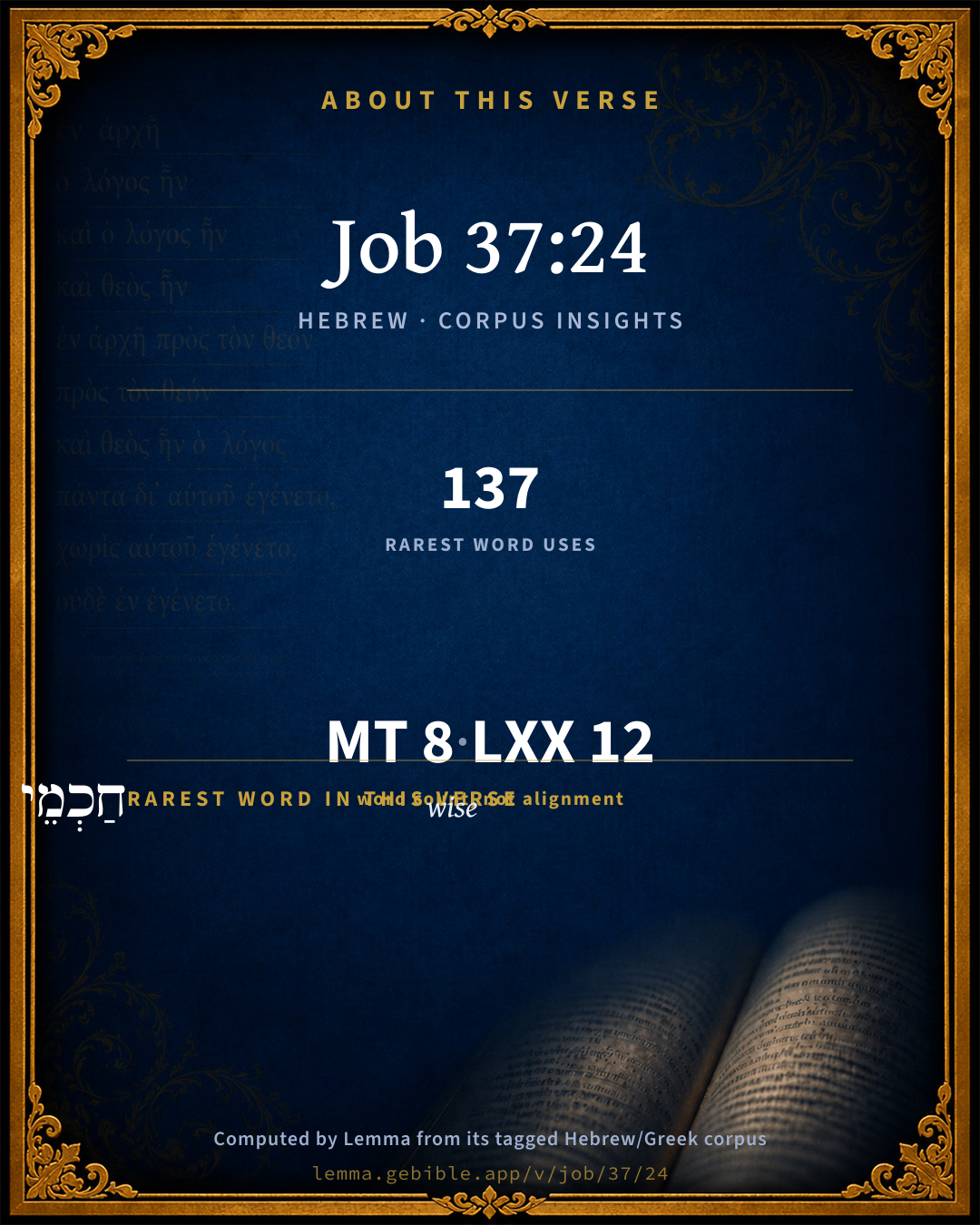
These counts appear in no published source. They are computed here, from the morphology-tagged text and Lemma’s own curated glosses. What Lemma adds →

8
words
8
distinct lemmas
Wisdom
section

Grammatical profile

  • 2 verbs
  • 3 nouns
  • 1 adjective
  • 1 adverb
  • 1 particle

Verb forms

  • יְרֵא֣וּהוּ Qal · Perfect
  • יִ֝רְאֶ֗ה Qal · Imperfect

Hebrew & Septuagint length

In English translation the verse runs 13 words from the Hebrew and 14 from the Septuagint (LXX English) — closely comparable.

A rough comparison of the two English renderings, which tokenize alike — not a word-level alignment.

Word counts can differ between the Hebrew and the Greek without any difference in meaning — e.g. the Hebrew direct-object marker אֵת has no separate Greek word, and Greek often adds the article ὁ.

In the original languages it is 8 Hebrew tokens and 12 Greek tokens — but the two are counted differently (Hebrew bundles its prefixes and suffixes into one token; the Greek is in lemma form), so that isn’t a like-for-like length.

Cross-references

15

Topical passages linked to Job 37:24 in the Treasury of Scripture Knowledge — connected by theme and wording, ordered by reader-vote popularity; previews shown in the World English Bible.

  • Matthew 10:28 Don't be afraid of those who kill the body, but are not able to kill the soul. Rather, fear him who is able to destroy both soul and body in Gehenna.
  • 1 Corinthians 1:26 For you see your calling, brothers, that not many are wise according to the flesh, not many mighty, and not many noble;
  • Job 5:13 He takes the wise in their own craftiness; The counsel of the cunning is carried headlong.
  • Psalms 130:4 But there is forgiveness with you, Therefore you are feared.
  • Isaiah 5:21 Woe to those who are wise in their own eyes, And prudent in their own sight!
  • Matthew 11:25–26 At that time, Jesus answered, "I thank you, Father, Lord of heaven and earth, that you hid these things from the wise and understanding, and revealed them to infants.
  • Romans 2:4 Or do you despise the riches of his goodness, forbearance, and patience, not knowing that the goodness of God leads you to repentance?
  • Ecclesiastes 9:11 I returned, and saw under the sun, that the race is not to the swift, nor the battle to the strong, neither yet bread to the wise, nor yet riches to men of understanding, nor yet favor to men of skill; but time and chance happen to them all.
  • Jeremiah 32:39 and I will give them one heart and one way, that they may fear me forever, for the good of them, and of their children after them:
  • Jeremiah 33:9 [This city] shall be to me for a name of joy, for a praise and for a glory, before all the nations of the earth, which shall hear all the good that I do to them, and shall fear and tremble for all the good and for all the peace that I procure to it.
  • Hosea 3:5 Afterward the children of Israel shall return, and seek Yahweh their God, and David their king, and shall come with trembling to Yahweh and to his blessings in the last days.
  • Luke 10:21 In that same hour Jesus rejoiced in the Holy Spirit, and said, "I thank you, O Father, Lord of heaven and earth, that you have hidden these things from the wise and understanding, and revealed them to little children. Yes, Father, for so it was well-pleasing in your sight."
  • Luke 12:4–5 "I tell you, my friends, don't be afraid of those who kill the body, and after that have no more that they can do.
  • Romans 11:20–22 True; by their unbelief they were broken off, and you stand by your faith. Don't be conceited, but fear;
  • 1 Corinthians 3:19 For the wisdom of this world is foolishness with God. For it is written, "He has taken the wise in their craftiness."

Cross-references courtesy of OpenBible.info (CC BY 4.0).

Hebrew and Greek witnesses Masoretic Hebrew ↔ Greek Septuagint

The same verse in the two great witnesses to the Old Testament, shown verse-for-verse.

These are two independent witnesses, not word-aligned to each other, and the Septuagint is shown in lemma (dictionary) form.

Hebrew Job 37:24 Masoretic · Westminster Leningrad Codex

לָ֭כֵן יְרֵא֣וּהוּ אֲנָשִׁ֑ים לֹֽא יִ֝רְאֶ֗ה כָּל חַכְמֵי לֵֽב

Therefore men revere him. He doesn't regard any who are wise of heart."

World English Bible · Public Domain

Greek LXX Job 37:24 Septuagint · lemma form

διό φοβέω αὐτός ὁ ἄνθρωπος φοβέω δέ αὐτός καί ὁ σοφός καρδία

Therefore men shall fear him; and the wise also in heart shall fear him.

LXX2012 (modern English Septuagint) · Public Domain

Hebrew: Westminster Leningrad Codex (CC BY 4.0). Greek: Septuagint (public domain); English from LXX2012 (modern English Septuagint) (Public Domain). How the Septuagint differs from the Hebrew →

Commentary

Notes on Job 37:24 from classic Christian and Jewish commentators (each source and its license shown beneath its notes). The classic Christian expositions comment on the surrounding passage and are grouped to its opening verse, so a note may address several verses; the Jewish commentaries on the Tanakh (Rashi and others) are per-verse, so they appear only where the commentator wrote on this verse.

Lemma curates 59 commentaries, every one of them public domain or Creative Commons licensed, each selected and text-cleaned for this edition rather than reprinted as found. About our sources →

Trapp's Complete Commentary

John Trapp

Job 37:24 Men do therefore fear him: he respecteth not any [that are] wise of heart.

Ver. 24. Men do therefore fear him] They do, or should do, for his excellent greatness and goodness, Psa 130:4 Mat 10:28. But in case they do not,

He respecteth not any that are wise of heart] That out of a conceit of their own wisdom stand it out against him, and think to reason it out with him, as thou hast done. Or, But he seeth not all wise in heart; he findeth not all wise, whom he beholdeth here upon earth. Stultorum plena sunt omnia, and thou also hast dealt very foolishly, as God hath seen, and wilt shortly show thee better than I can do.

John Trapp, A Commentary or Exposition upon All the Books of the Old and New Testament (1647–1656) — public domain. Text from a community e-Sword module.

Jamieson, Fausset & Brown

Robert Jamieson, A. R. Fausset & David Brown

do--rather, "ought."

wise--in their own conceits.

Next: Job Chapter 38

Jamieson, Fausset & Brown — Commentary Critical and Explanatory on the Whole Bible (1871) — public domain (CC PDM 1.0). Text via the HelloAO Bible API.

Adam Clarke's Commentary

Verse 24. Men do therefore] Therefore men, אנשים anashim, wretched, miserable, ignorant, sinful men, should fear him.

He respecteth not any] No man is valuable in his sight on account of his wisdom; for what is his wisdom when compared with that of the Omniscient? Whatever good is in man, God alone is the author of it. Let him, therefore, that glorieth, glory in the Lord.

THUS ends the speech of Elihu; a speech of a widely different description, on the whole, from that of the three friends of Job who had spoken so largely before him. In the speeches of Eliphaz, Zophar, and Bildad, there is little besides a tissue of borrowed wise sayings, and ancient proverbs and maxims, relative to the nature of God, and his moral government of the world. In the speech of Elihu every thing appears to be original; he speaks from a deep and comprehensive mind, that had profoundly studied the subjects on which he discoursed. His descriptions of the Divine attributes, and of the wonderful works of God, are correct, splendid, impressive, and inimitable. Elihu, having now come nearly to a close, and knowing that the Almighty would appear and speak for himself, judiciously prepares for and announces his coming by the thunder and lightning of which he has given so terrific and majestic a description in this and the preceding chapter. The evidences of the Divine presence throng on his eyes and mind; the incomprehensible glory and excellency of God confound all his powers of reasoning and description; he cannot arrange his words by reason of darkness; and he concludes with stating, that to poor weak man God must for ever be incomprehensible, and to him a subject of deep religious fear and reverence. Just then the terrible majesty of the Lord appears! Elihu is silent! The rushing mighty wind, for which the description of the thunder and lightning had prepared poor, confounded, astonished Job, proclaims the presence of Jehovah: and out of this whirlwind God answers for and proclaims himself! Reader, canst thou not conceive something of what these men felt? Art thou not astonished, perplexed, confounded, in reading over these descriptions of the thunder of God's power? Prepare, then, to hear the voice of God himself out of this whirlwind.

Adam Clarke's Commentary on the Bible (1810–1826) — public domain. Text from a community e-Sword/MySword module.

Ellicott's Commentary for English Readers

(24) Men do therefore fear him.—Or, “Therefore men may fear Him; but as for the wise in heart, no one even of them shall see Him.” This may be, and probably is, the meaning, though the literal rendering is that of the Authorised Version, which, however, involves a somewhat doubtful sentiment in itself, for God, we may believe, does regard or respect those who are truly wise. In the original there is a very manifest play on the words, which it is impossible to preserve, between yĕre’u and yireh—men shall fear, but none shall see.

A Bible Commentary for English Readers, edited by Charles John Ellicott (1878–1897) — public domain. Text from a community e-Sword module.

The Cambridge Bible for Schools and Colleges

gen. ed. J. J. S. Perowne

24. wise of heart] That is, wise in their own thoughts. God has respect unto the humble—a final exhortation to Job to abstain from presumptuous complaints of God, and to unite with mankind everywhere in fearing Him.

The Cambridge Bible for Schools and Colleges (gen. ed. J. J. S. Perowne; Cambridge University Press, 1878–1918) — public domain. Text from a community e-Sword module.

John Gill's Exposition

Men do therefore fear him,.... Or should, because of his greatness in power, judgment, and justice; and because of his goodness, in not afflicting for his pleasure's sake, but for the profit of men; and therefore they should reverence and adore him, submit to his will, patiently bear afflictions, serve him internally and externally, with reverence and godly fear;

he respecteth not any that are wise of heart; that are wise in a natural sense: these are not always regarded by God, or are his favourites; neither temporal blessings, nor special grace, or the knowledge of spiritual things, are always given to the wise and prudent, Ecc 9:11. Or that are wise in their own conceit; there is a woe to such; and there is more hope of a fool than of him, Isa 5:21. Or he is not "afraid" of them (c), as some choose to render the word; he fears not to reprove them and correct them for their faults, or the schemes they form to counterwork him; for he can take them in their craftiness, and carry their counsel headlong. Or "every wise in heart shall not see him" (d): the world by wisdom knows him not; nor can any look into his heart, his thoughts, purposes, and designs, and into the causes and reasons of his actions; nor have those that are truly wise perfect vision and knowledge of him now, Co1 13:9.

(c) "non timebit", Osiander. (d) "Non videbit eum omuis sapiens corde"; so some in Drusius.

Next: Job Chapter 38

John Gill's Exposition of the Whole Bible (1746–1763) — public domain (CC PDM 1.0). Text via the HelloAO Bible API.

Albert Barnes' Notes on the Bible

Men do therefore fear him - There is reason why they should fear him, or why they should treat him with reverence.

He respecteth not any that are wise of heart - He pursues his own plans, and forms and executes his own counsels. He is not dependent upon the suggestions of people, and does not listen to their advice. In his schemes he is original and independent, and people should therefore regard him with profound veneration. This is the sum of all that Elihu had to say - that God was original and independent; that he did not ask counsel of people in his dealings; that he was great, and glorious, and inscrutable in his plans; and that people therefore should bow before him with profound submission and adoration. It was to be presumed that he was wise and good in all that he did, and to this independent and almighty Sovereign man ought to submit his understanding and his heart. Having illustrated and enforced this sentiment, Elihu, overwhelmed with the awful symbols of the approaching Deity, is silent, and God is introduced to close the controversy.

Albert Barnes' Notes on the Bible (1834–1885) — public domain. Text from a community e-Sword/MySword module.

Haydock's Catholic Bible Commentary

Fear him, and receive with respect whatever he shall appoint. (Haydock) --- And all. Hebrew, "he fears not any that are wise of heart." He knows that the most intelligent (Calmet) must confess their ignorance, when they attempt to examine his divine nature. Simonides being desired by Hiero to express his sentiments on this subject, always requested more time to consider of it. Quia, inquit, res videtur mihi tanto obscurior, quanto diutius eam considero. (Cicero, Nat. i. 60. Selectæ e Prof. i. 3.) --- "With thee (says St. Augustine, Confessions i. 6.) stand the causes of all instable things," &c. (Haydock) --- Those who are really wise, will therefore adore God’s judgments in silence, while the presumptuous will be forced to yield. This is the excellent conclusion of all that had been said. (Pineda) --- The sentence is beautiful, but ill-applied (Haydock) to Job. (Philip) See Proverbs iii. 7. (Haydock) --- He convinced the other three with sound arguments, "and this last and most arrogant disputant with silence." (Worthington)

George Leo Haydock (1774–1849), Haydock's Catholic Family Bible and Commentary, 1859 edition — public domain. Excludes Psalms (Douay-Rheims chapter numbering differs from Protestant) and Deuterocanonical books (Catholic canon only).

Matthew Poole's English Annotations

Men do therefore fear him; for this cause, to wit, because of God’s infinite and excellent perfections, and especially those mentioned in the foregoing verse, men do or should (for the future tense is oft used potentially, as Hebricians know) fear or reverence him, and humbly submit to him, and not presume to quarrel or dispute with him, as thou, O Job, hast done.

He respecteth not, Heb. he doth not, or will not behold, to wit, with respect or approbation; he beholdeth them afar off with scorn and contempt.

Any that are wise of heart, i. e. such as are wise in their own eyes, that lean to their own understandings, and despise all other men in comparison of themselves, and scorn all their counsels; that are so puffed up with the opinion of their own wisdom, that they dare contend with their Maker, and presume to censure his counsels and actions; which he hereby intimates to be Job’s fault, and to be the true reason why God did not respect nor regard him, nor his prayers and tears, as Job complained. And so this is also a tacit advice and exhortation to Job to be humble and little ill his own eyes, if ever he expected or desired any favour from God.

Matthew Poole's English Annotations on the Holy Bible (1683–1685) — public domain. Text from a community e-Sword/MySword module.

Whedon's Commentary on the Bible

Daniel D. Whedon

24. He respecteth not — He regardeth not, (or, as nothing — Schultens,) any of the wise of heart. “who seem to themselves to be wise.” (Vulgate.) The self-conceited wisdom of men is beneath the contempt of God. Even “the foolishness of God is wiser than men.” 1Co_1:25-29. The dispute, so long protracted, ends in the nothingness of man. Human wisdom, that flaunted high pretensions, trails in the dust. The murmuring and rebellious sufferer, who but a little before defied man and questioned God, is now abashed into silence, and by his silence acknowledges the justice of Elihu’s reasoning and rebuke, (comp. Job_6:24,) so that now naught remains but the divine disclosure, which Job has every reason to apprehend.

Daniel D. Whedon (gen. ed.), Commentary on the Old and New Testaments (1874–1909) — public domain. Text from a community e-Sword module.

The Pulpit Commentary

Men do therefore fear him; or, let men therefore fear him. Let them see in his unsearchableness, his almighty power, his absolute moral perfection, and his superiority to all human questioning, ample grounds for the profoundest reverence and fear. And let them remember that he respecteth not any that are wise of heart. However "wise of heart" men may be, God does not "respect" them, at any rate to the extent of submitting his conduct to their judgment, and answering their questionings (see ver. 20).

The Pulpit Commentary (1880–1919), ed. H.D.M. Spence-Jones & Joseph S. Exell — public domain. Text from a community e-Sword module.

John Wesley's Explanatory Notes

Fear - Fear or reverence him, and humbly submit to him, and not presume to quarrel or dispute with him. Wise of heart - Wise in their own eyes.

John Wesley, Explanatory Notes Upon the Whole Bible (1754–1765) — public domain. Text via the GEBible commentary corpus.

Rashi

Rabbi Shlomo Yitzchaki (Rashi)

Therefore, men fear Him to debate with Him. (because) He does not look upon any wise of heart who want to deal wisely with Him, because their wisdom is as nothing in His eyes. Our Sages (Rosh Hashanah 17a) explained this as referring to Job. Elihu says to him, “Because you would impose excessive fear upon your generation, you did not merit having wise-hearted sons remain alive to you.”

Rashi on the Tanakh — English translations: “The Judaica Press complete Tanach with Rashi, translated by A. J. Rosenberg” (CC BY 4.0); “Pentateuch with Rashi's commentary by M. Rosenbaum and A.M. Silbermann, 1929-1934” (public domain); “The Metsudah Tanach series, Lakewood, N.J” (CC BY 4.0); and “The Book of Joshua, Metsudah Publications, 1997” (CC BY 4.0). Text via Sefaria.

Lesson kit

Teaching starters — assembled from the data on this page, not authored interpretation. Every prompt links to the verse data it draws on. Edit before teaching.

Job, in the Wisdom, opens this verse with 8 words (8 distinct Hebrew lemmas). Its most distinctive word is châkâm (“wise”). A historical commentator’s framing appears above. Read the whole chapter for the surrounding context.

Discussion questions

  1. How does “wise” (châkâm) shape what this verse is saying?
  2. How does Matthew 10:28, which shares this passage’s theme, read alongside this verse?
  3. The translations on this page render this verse differently — a whole-verse word diff, not a word-by-word alignment. What might account for the different wordings?
  4. «יְרֵא֣וּהוּ» is a Qal Perfect verb. How does that grammatical form shape the action described?
  5. Compare how Trapp's Complete Commentary and Jamieson, Fausset & Brown read this verse. Where do they agree or differ?

Things to notice

Reading settings

Reading text

Shown beneath each verse's original-language words.

Old Testament
Old Testament edition

Read the OT as the Masoretic Hebrew (MT) or the Greek Septuagint (LXX).

English shown for the Greek Septuagint (in the Hebrew ↔ Greek comparison).

Comparing translations? Open the Compare panel on any verse page to stack up to four side by side.