
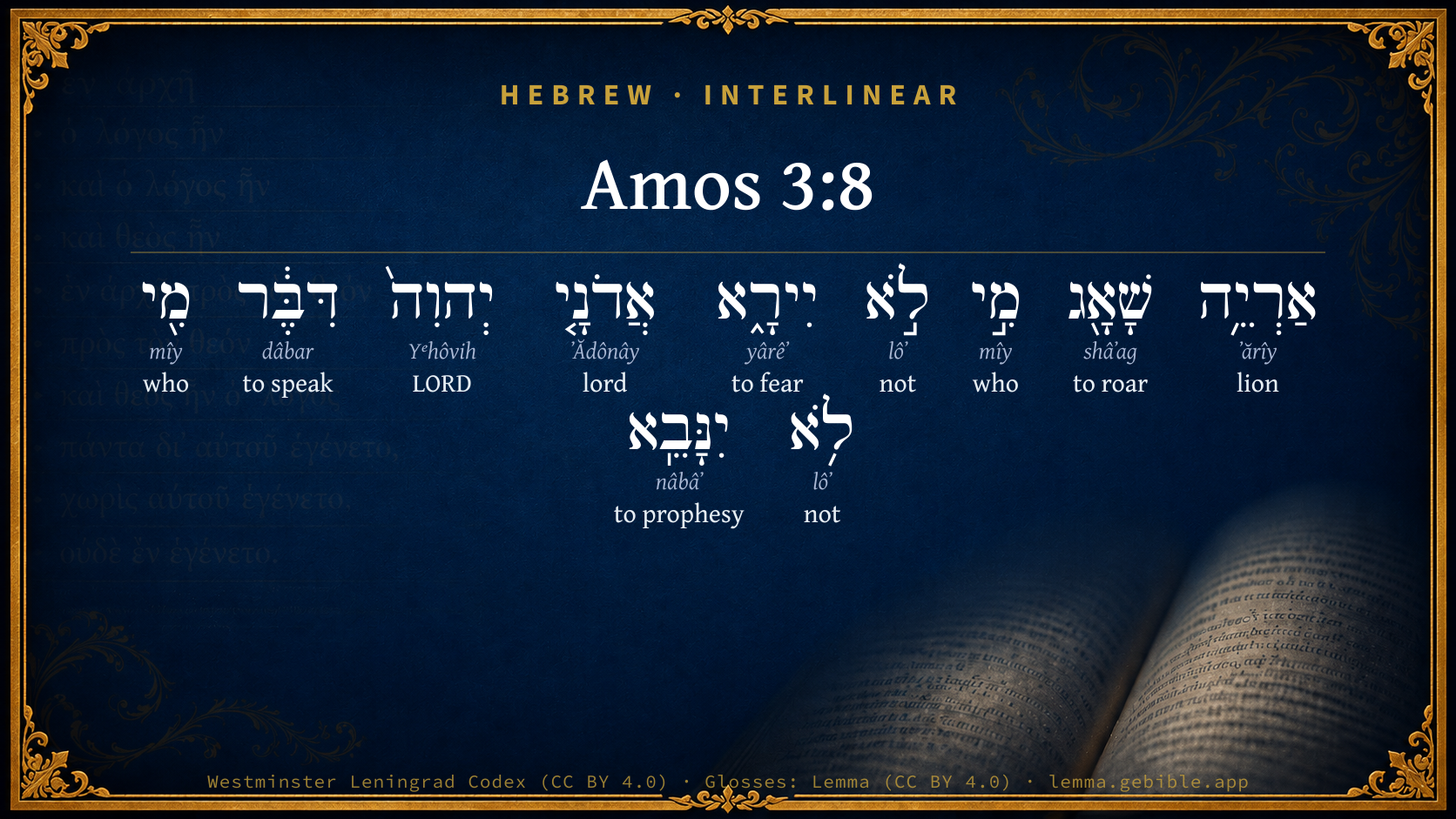
Amos 3:8

Hebrew (Westminster Leningrad Codex) Amos 3:8 appears in the Hebrew Old Testament. The text above is from the Westminster Leningrad Codex. Each word links to its Strong’s number, a concise gloss, and parsing drawn from the Open Scriptures Hebrew Bible morphology. Click any word for its full Brown-Driver-Briggs (BDB) entry.
Download image
Cite this verse

Amos 3:8 (World English Bible). Public Domain. Lemma interlinear Bible study tool, https://lemma.gebible.app/v/amos/3/8.

Show BibTeX & RIS
BibTeX
RIS
English Translation
The lion has roared. Who will not fear? The Lord Yahweh has spoken. Who can but prophesy?
World English Bible · Public Domain
Download a study sheet

One document with this verse’s original text, its word-by-word gloss line, the meaning frame, cross-references with their text, attributed commentary, and full source and license credits — printable, and it pastes into notes with its structure intact.

This verse Autodidact and up

Study sheet (.html) Plain text (.txt)

A passage Seminary Student

Up to 50 verses in one chapter. A passage sheet keeps up to 6 commentary sources and 12 cross-references per verse, in the order this page ranks them, and says so on the sheet whenever that leaves anything out. Ask for a single verse and you get the Autodidact verse sheet above.

Everything on this page stays free to read, with no account — the sheet is a download of what is already on screen, not access to it.

Want to remove ads? Support Godless Engineer
Compare translations 3

The same verse in 3 English versions, stacked beneath the original-language interlinear above. Click any original word for its lexicon entry.

Each is an independent rendering of the whole verse — the interlinear is not word-aligned to these translations.

Highlighted words mark where these versions differ — a whole-verse word diff, not a word-by-word alignment.

  • World English Bible Public Domain
    The lion has roared. Who will not fear? The Lord Yahweh has spoken. Who can but prophesy?
  • King James Version Public Domain
    The lion hath roared, who will not fear? the Lord GOD hath spoken, who can but prophesy?
  • unfoldingWord Literal Text CC BY-SA 4.0
    The lion has roared; who will not fear? The Lord Yahweh has spoken; who will not prophesy?

unfoldingWord Literal Text — © unfoldingWord, licensed CC BY-SA 4.0. Word-aligned USFM3 via Door43 (git.door43.org/unfoldingWord/en_ult).

Versions to compare (up to 4)

3 of 4 selected

Show all 18 translations

Every available English version of this verse, each an independent rendering of the whole verse.

  • World English Bible Public Domain
    The lion has roared. Who will not fear? The Lord Yahweh has spoken. Who can but prophesy?
  • Berean Standard Bible Public Domain
    The lion has roared—who will not fear? The Lord GOD has spoken—who will not prophesy?
  • Majority Standard Bible Public Domain
    The lion has roared—who will not fear? The Lord GOD has spoken—who will not prophesy?
  • King James Version Public Domain
    The lion hath roared, who will not fear? the Lord GOD hath spoken, who can but prophesy?
  • American Standard Version (1901) Public Domain
    The lion hath roared; who will not fear? The Lord Jehovah hath spoken; who can but prophesy?
  • Revised Version (1885) Public Domain
    The lion hath roared, who will not fear? the Lord GOD hath spoken, who can but prophesy?
  • Geneva Bible (1599) Public Domain
    The lyon hath roared: who will not bee afraide? the Lord God hath spoken: who can but prophecie?
  • Douay-Rheims (1899) Public Domain
    The lion shall roar, who will not fear? The Lord God hath spoken, who shall not prophesy?
  • Young's Literal Translation Public Domain
    A lion hath roared -- who doth not fear? The Lord Jehovah hath spoken -- who doth not prophesy?
  • Literal Standard Version CC BY-SA 4.0
    A lion has roared—who does not fear? Lord YHWH has spoken—who does not prophesy?
  • Unlocked Literal Bible CC BY-SA 4.0
    The lion has roared; who will not fear? The Lord Yahweh has spoken; who will not prophesy?
  • unfoldingWord Literal Text CC BY-SA 4.0
    The lion has roared; who will not fear? The Lord Yahweh has spoken; who will not prophesy?
  • Darby Bible Public Domain
    The lion hath roared, -- who will not fear? The Lord Jehovah hath spoken, -- who can but prophesy?
  • World Messianic Bible Public Domain
    The lion has roared. Who will not fear? The Lord GOD has spoken. Who can but prophesy?
  • Webster's Bible Public Domain
    The lion hath roared, who will not fear? the Lord GOD hath spoken, who can but prophesy?
  • Free Bible Version CC BY-SA 4.0
    The lion has roared—so who isn't scared? The Lord God has spoken—so who can refuse to speak for him?
  • Bible in Basic English Public Domain
    The cry of the lion is sounding; who will not have fear? The Lord God has said the word; is it possible for the prophet to keep quiet?
  • JPS Tanakh (1917) Public Domain
    The lion hath roared, who will not fear? The Lord GOD hath spoken, who can but prophesy?

Literal Standard Version (2020), Covenant Press — licensed CC BY-SA 4.0. Text via the HelloAO Bible API (eBible.org). Unlocked Literal Bible (unfoldingWord) — licensed CC BY-SA 4.0. Text via the HelloAO Bible API (eBible.org). unfoldingWord Literal Text — © unfoldingWord, licensed CC BY-SA 4.0. Word-aligned USFM3 via Door43 (git.door43.org/unfoldingWord/en_ult). Free Bible Version, Dr. Jonathan Gallagher — licensed CC BY-SA 4.0. Text via the HelloAO Bible API (eBible.org).

Word by word

More ways to search: Search by grammar → Find every occurrence → Compare this word →

Practice this passage: Drill this verse → Learn its vocabulary →

About this verse

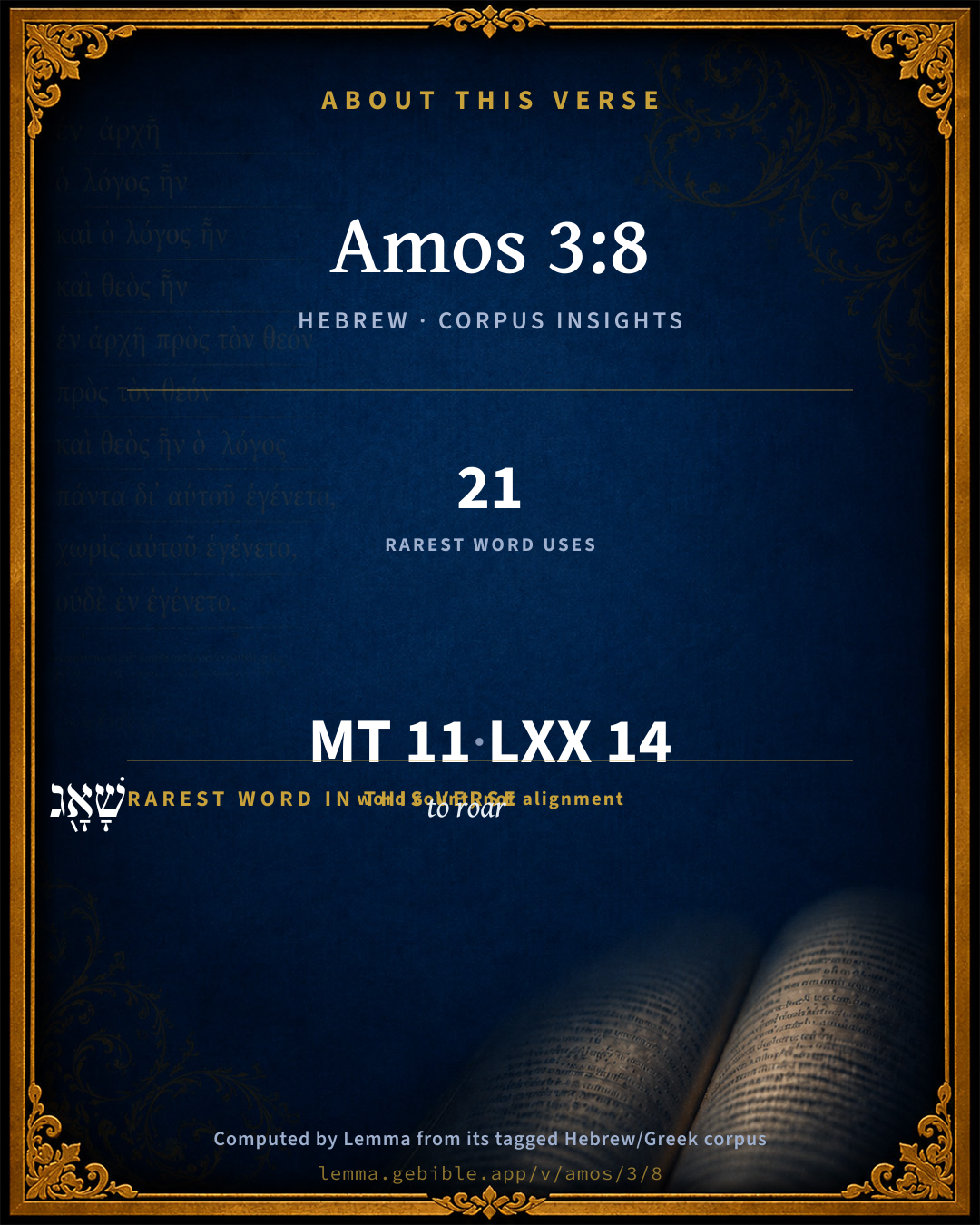
These counts appear in no published source. They are computed here, from the morphology-tagged text and Lemma’s own curated glosses. What Lemma adds →

11
words
9
distinct lemmas
Prophets
section

Notable vocabulary

The rarest word here is שָׁאָ֖ג to roar H7580 — appearing just 21 times in the whole Hebrew Bible.

Shared distinctive vocabulary

שָׁאָ֖ג to roar H7580 occurs in 17 verses of the Hebrew Bible. Also found in:

Grammatical profile

  • 4 verbs
  • 3 nouns
  • 4 particles

Verb forms

  • שָׁאָ֖ג Qal · Perfect
  • יִירָ֑א Qal · Imperfect
  • דִּבֶּ֔ר Piel · Perfect
  • יִנָּבֵֽא Niphal · Imperfect

Repetition

Words recur within this verse — often emphatic in Hebrew:

Hebrew & Septuagint length

In English translation the verse runs 17 words from the Hebrew and 20 from the Septuagint (LXX English) — closely comparable.

A rough comparison of the two English renderings, which tokenize alike — not a word-level alignment.

Word counts can differ between the Hebrew and the Greek without any difference in meaning — e.g. the Hebrew direct-object marker אֵת has no separate Greek word, and Greek often adds the article ὁ.

In the original languages it is 11 Hebrew tokens and 14 Greek tokens — but the two are counted differently (Hebrew bundles its prefixes and suffixes into one token; the Greek is in lemma form), so that isn’t a like-for-like length.

Cross-references

13

Topical passages linked to Amos 3:8 in the Treasury of Scripture Knowledge — connected by theme and wording, ordered by reader-vote popularity; previews shown in the World English Bible.

  • Jeremiah 20:9 If I say, I will not make mention of him, nor speak any more in his name, then there is in my heart as it were a burning fire shut up in my bones, and I am weary with forbearing, and I can't [contain].
  • Amos 3:4 Will a lion roar in the thicket, When he has no prey? Does a young lion cry out of his den, If he has caught nothing?
  • Acts 4:20 for we can't help telling the things which we saw and heard."
  • Amos 1:2 He said: "Yahweh will roar from Zion, And utter his voice from Jerusalem; And the pastures of the shepherds will mourn, And the top of Carmel will wither."
  • Amos 2:12 "But you gave the Nazirites wine to drink, And commanded the prophets, saying, 'Don't prophesy!'
  • Amos 7:12–17 Amaziah also said to Amos, "You seer, go, flee away into the land of Judah, and there eat bread, and prophesy there:
  • 1 Corinthians 9:16 For if I preach the Gospel, I have nothing to boast about; for necessity is laid on me; but woe is to me, if I don't preach the Gospel.
  • Revelation 5:5 One of the elders said to me, "Don't weep. Behold, the Lion who is of the tribe of Judah, the Root of David, has overcome; he who opens the book and its seven seals."
  • Job 32:18–19 For I am full of words. The spirit within me constrains me.
  • Jonah 1:1–3 Now the word of Yahweh came to Jonah the son of Amittai, saying,
  • Jonah 3:1–3 The word of Yahweh came to Jonah the second time, saying,
  • Acts 5:20 "Go stand and speak in the temple to the people all the words of this life."
  • Acts 5:29 But Peter and the apostles answered, "We must obey God rather than men.

Cross-references courtesy of OpenBible.info (CC BY 4.0).

Hebrew and Greek witnesses Masoretic Hebrew ↔ Greek Septuagint

The same verse in the two great witnesses to the Old Testament, shown verse-for-verse.

These are two independent witnesses, not word-aligned to each other, and the Septuagint is shown in lemma (dictionary) form.

Hebrew Amos 3:8 Masoretic · Westminster Leningrad Codex

אַרְיֵ֥ה שָׁאָ֖ג מִ֣י לֹ֣א יִירָ֑א אֲדֹנָ֤י יְהוִה֙ דִּבֶּ֔ר מִ֖י לֹ֥א יִנָּבֵֽא

The lion has roared. Who will not fear? The Lord Yahweh has spoken. Who can but prophesy?

World English Bible · Public Domain

Greek LXX Amos 3:8 Septuagint · lemma form

λέων ἐρεύγομαι καί τίς οὐ φοβέω κύριος ὁ θεός λαλέω καί τίς οὐ προφητεύω

A lion shall roar, and who will not be alarmed? the Lord God has spoken, and who will not prophesy?

LXX2012 (modern English Septuagint) · Public Domain

Hebrew: Westminster Leningrad Codex (CC BY 4.0). Greek: Septuagint (public domain); English from LXX2012 (modern English Septuagint) (Public Domain). How the Septuagint differs from the Hebrew →

Targum (Aramaic paraphrase)

1

The Targum is the ancient Jewish Aramaic paraphrase of the Hebrew Scriptures — an interpretive translation, not the Hebrew text itself. Onkelos (literal) and Pseudo-Jonathan (expansive) render the Torah, and Jonathan the Prophets. Coverage is partial: where no permissively-licensed English translation exists for a verse, only the Aramaic is shown. This is verse-level text, not a word-by-word alignment to the Hebrew.

  1. Targum Jonathan Prophets (Joshua–Malachi)
    אַרְיֵה נָהֵים מַן לָא יִדְחַל יְיָ אֱלֹהִים מַלֵיל מַן לָא יְקַבֵּיל נְבוּאֲתָא:

    (no public-domain English translation for this verse)

    Targum Jonathan — Aramaic: “Mikraot Gedolot” (public domain). English: “Sefaria Community Translation” (CC0 1.0 (public-domain dedication)); “London "Chaldee Paraphrase," 1871” (public domain). Text via Sefaria.

Commentary

Notes on Amos 3:8 from classic Christian and Jewish commentators (each source and its license shown beneath its notes). The classic Christian expositions comment on the surrounding passage and are grouped to its opening verse, so a note may address several verses; the Jewish commentaries on the Tanakh (Rashi and others) are per-verse, so they appear only where the commentator wrote on this verse.

Lemma curates 59 commentaries, every one of them public domain or Creative Commons licensed, each selected and text-cleaned for this edition rather than reprinted as found. About our sources →

Trapp's Complete Commentary

John Trapp

Amo 3:8 The lion hath roared, who will not fear? the Lord GOD hath spoken, who can but prophesy?

Ver. 8. The lion hath roared, who will not fear? the Lord God hath spoken, who can but prophesy?] Who that knoweth the terror of the Lord can dare to do otherwise, when he commandeth it? Shall men fear fire, water, bears, lions, &c., and not the great and terrible God? If he roar upon his servants and say, as to Jeremiah he once did, "Thou therefore, gird up the loins of thy mind, and arise, and speak unto them all that I command thee: be not dismayed at their faces, lest I confound thee before them," Jer 1:17. We must roar against men’s sins, and be instant, though they roar against us for so doing, and threaten never so much. Micaiah will not budge for a king’s authority when once he had seen the Lord in his majesty; nor Paul for an angel’s, Gal 1:8, the rest of the apostles for the Sanhedrim’s, Act 4:19; Act 5:25. When the emperor threatened Basil with imprisonment, banishment, death, he answered: Let him threaten boys with such spectres; I am resolved: neither menaces nor flatteries shall silence me, or draw me to betray a good cause or conscience. If I deal not plainly and faithfully with your souls, said Bernard, vobis erit damnosum, mihi periculosum. Timeo itaque damnum vestrum, timeo damnationem meam si tacuero: i.e. it will be ill for you, and worse for me. The truth is, you would be betrayed, and I should be damned, if I should hold my peace. Let me be accounted proud, pragmatic, anything rather than found guilty of sinful silence when the Lord calleth me to speak, saith Luther. These were men whose hearts were fraught with the reverential fear of God; and therefore found themselves necessitated to be faithful; besides the love of Christ constraineth them, 2Co 5:14, so that they could do no less, they could not but speak, Act 4:19.

John Trapp, A Commentary or Exposition upon All the Books of the Old and New Testament (1647–1656) — public domain. Text from a community e-Sword module.

Tyndale Open Study Notes

Tyndale Open Resources

3:8 God, the lion, has roared from Mount Zion (1:2) and compelled Amos to prophesy (see 7:14-16).

Tyndale Open Study Notes — © Tyndale Open Resources, licensed CC BY-SA 4.0. Text via the HelloAO Bible API.

Geneva Bible (1599)

Geneva Bible translators

Because the people ever murmured against the Prophets, he showeth that God’s Spirit moved them so to speak as they did.

Geneva Bible (1599) marginal notes — public domain. Text via Bolls.life.

Jamieson, Fausset & Brown

Robert Jamieson, A. R. Fausset & David Brown

As when "the lion roars" (compare Amo 1:2; Amo 3:4), none can help but "fear," so when Jehovah communicates His awful message, the prophet cannot but prophesy. Find not fault with me for prophesying; I must obey God. In a wider sense true of all believers (Act 4:20; Act 5:29).

Jamieson, Fausset & Brown — Commentary Critical and Explanatory on the Whole Bible (1871) — public domain (CC PDM 1.0). Text via the HelloAO Bible API.

Adam Clarke's Commentary

Verse 8. The lion hath roared,] God hath sent forth a terrible alarm, Who will not fear? Can any hear such denunciations of Divine wrath and not tremble?

The Lord God hath spoken] And those only who are in communion with him have heard the speech. Who can but prophesy? Who can help proclaiming at large the judgment threatened against the nation?

But I think נבא naba, here, is to be taken in its natural and ideal signification, to pray, supplicate, or deprecate vengeance. The Lord hath spoken of punishment - who can help supplicating his mercy, that his judgments may be averted?

Adam Clarke's Commentary on the Bible (1810–1826) — public domain. Text from a community e-Sword/MySword module.

John Calvin's Commentaries

It now follows, The lion roars who would not fear? The Lord Jehovah speaks, who would not prophesy? In this verse the Prophet reproved the Israelites for their usual contentions with the Prophets when their sins were sharply reprehended. Thus indeed are men wont to do; they consider not that Prophets are sent from above, and that there is a charge committed to them. Hence, when Prophets are severe in their words, the world clamors and wrangles: “What do these men intend? Why do they urge us so much? Why do they not allow us to rest quietly? for they provoke against us the wrath of God.” Whenever then men are roused, they immediately menace God’s Prophets with strife and contention, and regard not threatening as coming from God himself. This vice the Prophet now condemns: The lion roars, he says, who would not fear? God speaks, who would not prophesy? “Ye think that I am your adversary; but ye can gain nothing by quarreling with me: were I silent, the voice of God would of itself be formidable enough. The evil then proceeds not from my mouth, but from God’s command; for I am constrained, willing or unwilling, to obey God: he has chosen me to be a Prophet, and has showed what he intends that I should proclaim. What can I do, he says? I am not at liberty to invent revelations; but I faithfully bring forth to you what has been delivered to me by the Lord. How great then is your madness, that ye contend with me, and consider not that your strife and contention is with God himself?” We now see what the Prophet meant, and also understand, why he adduced the four similitudes, of which we have already spoken. I now proceed with the remaining context.

John Calvin's Commentaries (1540-1563) — public domain. Text from the Calvin Translation Society English edition (1840s-50s) via the Christian Classics Ethereal Library (ccel.org). Calvin's coverage is partial (roughly two-thirds of the Bible); uncommented books and verses are honest gaps, never fabricated. The 19th-century editor's footnotes and remarks are omitted so the notes are faithfully Calvin's own voice.

Ellicott's Commentary for English Readers

(8) Roared.—Comp. the imagery of Amo_1:2, and that of Amo_3:4. The voice of the Lord is so audible, so clearly portending the coming judgment, that universal terror inevitably follows. (Comp. “If these should hold their peace, the stones would cry out.”

A Bible Commentary for English Readers, edited by Charles John Ellicott (1878–1897) — public domain. Text from a community e-Sword module.

John Gill's Exposition

Publish in the palaces at Ashdod, and in the palaces in the land of Egypt,.... This is spoken to the prophets, to publish and declare in all the courts of the Philistines and Egyptians, and among all the princes and great men therein, the sins of the people of Israel, and the punishment God threatened them with; and let them, even these very Heathens, judge whether there was not a just proportion between them, and whether their sins did not deserve such calamities to be brought upon them, the Lord by his prophets had denounced;

and say, assemble yourselves on the mountains of Samaria; the metropolis of the ten tribes, Isa 7:9; and which was built upon a mountain, and several others were about it, and joined to it; where these princes of Ashdod or Azotus in Palestine, and of Egypt, are called to leave their courts, and meet together, to behold the iniquities committed by Israel, and to sit in judgment upon them, and declare their sense of what was just and fitting to be done to such a people:

and behold the great tumults in the midst thereof; the riots of its inhabitants, the noise of the mob committing all manner of outrages and wickedness:

and the oppressed in the midst thereof; the poor, the fatherless, and the widow, injured in their persons and properties, plundered of their substance, or defrauded of it.

John Gill's Exposition of the Whole Bible (1746–1763) — public domain (CC PDM 1.0). Text via the HelloAO Bible API.

Albert Barnes' Notes on the Bible

The Lion hath roared: who will not fear? The Lord God hath spoken: who can but prophesy? - that is, there is cause for you to fear, when the Lord “roareth from Zion;” but if ye fear not, God’s prophets dare not but fear. So Paul saith, “necessity is laid upon me; yea, woe is unto me if I preach not the Gospel! For if I do this thing willingly, I have a reward; but if against my will, a dispensation” of the Gospel “is committed unto me” 1Co 9:16-17; and Peter and John, “whether it be right in the sight of God to hearken unto you more than unto God, judge ye! For we cannot but speak the things which we have seen and heard” Act 4:19-20; Moses was not excused, though slow of speech; nor Isaiah, though of polluted lips; nor Jeremiah, because he was a child; but God said, “Say not, I am child, for thou shalt go to all that I shall send thee, and whatsoever I command thee, thou shalt speak” Jer 1:7. And Ezekiel was bidden, “be not rebellious, like that rebellious house” Eze 2:8. And when Jeremiah would keep silence, he saith, “His Word was in mine heart as a burning fire, shut up in my bones, and I was weary with forbearing and I could not stay” Jer 20:9.

Albert Barnes' Notes on the Bible (1834–1885) — public domain. Text from a community e-Sword/MySword module.

Matthew Poole's English Annotations

The lion hath roared; God hath threatened; and, as a lion roareth when near his prey, so God hath terribly threatened what is near to be done. Amos lived and prophesied in Jeroboam’s time, about A.M. 3150, and these threatened judgments began to come upon Israel when the conspiracies and usurpations of Shallum, Menahem, &c. filled all with blood and confusions, about A.M. 3177.

Who will not fear? what wise man, who that is solicitous for his own good and safety, or that hath any affections for the good of others, will do less than reverence and fear, and prevent by a speedy repentance?

The Lord God hath spoken: this is plainly what was before figuratively set forth, God had spoken to his prophets but dreadful things against Israel. Who can but prophesy? they dare not conceal them, Amos cannot but speak what he had heard, Jer 1:17; Act 4:19; 5:25.

Matthew Poole's English Annotations on the Holy Bible (1683–1685) — public domain. Text from a community e-Sword/MySword module.

The Pulpit Commentary

As the lion"s roar forces every one to fear, so the Divine call of the prophet forces him to speak (Jer_20:9; Eze_2:8; 1Co_9:16, etc.) St. Gregory, moralizing, takes the lion in a spiritual sense: "After the power of his Creator has been made known to him, the strength of his adversary ought not to be concealed from him, in order that he might submit himself the more humbly to his defender, the more accurately he had learned the wickedness of his enemy, and might more ardently seek his Creator, the more terrible he found the enemy to be whom he had to avoid. For it is certain that he who less understands the danger he has escaped, loves his deliverer has; and that he who considers the strength of his adversary to be feeble, regards the solace of his defender as worthless" ("Moral.," 32:14). Of course, this exposition does not regard the context.

The Pulpit Commentary (1880–1919), ed. H.D.M. Spence-Jones & Joseph S. Exell — public domain. Text from a community e-Sword module.

John Wesley's Explanatory Notes

Hath roared - As a lion roareth when near his prey: so God hath terribly threatened what is near to be done. Prophesy - Amos can not but speak what he had heard.

John Wesley, Explanatory Notes Upon the Whole Bible (1754–1765) — public domain. Text via the GEBible commentary corpus.

Rashi

Rabbi Shlomo Yitzchaki (Rashi)

A lion has roared; who will not fear?—So has the Holy One, blessed be He, spoken to the prophets to prophesy. Who will not prophesy?

Rashi on the Tanakh — English translations: “The Judaica Press complete Tanach with Rashi, translated by A. J. Rosenberg” (CC BY 4.0); “Pentateuch with Rashi's commentary by M. Rosenbaum and A.M. Silbermann, 1929-1934” (public domain); “The Metsudah Tanach series, Lakewood, N.J” (CC BY 4.0); and “The Book of Joshua, Metsudah Publications, 1997” (CC BY 4.0). Text via Sefaria.

Lesson kit

Teaching starters — assembled from the data on this page, not authored interpretation. Every prompt links to the verse data it draws on. Edit before teaching.

Amos, in the Prophets, opens this verse with 11 words (9 distinct Hebrew lemmas). Its most distinctive word is shâʼag (“to roar”). A historical commentator’s framing appears above. Read the whole chapter for the surrounding context.

Discussion questions

  1. The word shâʼag carries the sense “to roar.” How does it shape the verse?
  2. How does Judges 14:5, which shares the word «to roar», read alongside this verse?
  3. What does the repetition of “who” (2× in this one verse) do in this verse?
  4. These translations render this verse differently. What is at stake in choosing one wording over another?
  5. «שָׁאָ֖ג» is a Qal Perfect verb. How does that grammatical form shape the action described?
  6. Compare how Trapp's Complete Commentary and Tyndale Open Study Notes read this verse. Where do they agree or differ?

Things to notice

Reading settings

Reading text

Shown beneath each verse's original-language words.

Old Testament
Old Testament edition

Read the OT as the Masoretic Hebrew (MT) or the Greek Septuagint (LXX).

English shown for the Greek Septuagint (in the Hebrew ↔ Greek comparison).

Comparing translations? Open the Compare panel on any verse page to stack up to four side by side.