1 Samuel 23:3

Hebrew (Westminster Leningrad Codex) 1 Samuel 23:3 appears in the Hebrew Old Testament. The text above is from the Westminster Leningrad Codex. Each word links to its Strong’s number, a concise gloss, and parsing drawn from the Open Scriptures Hebrew Bible morphology. Click any word for its full Brown-Driver-Briggs (BDB) entry.
Download image
Cite this verse

1 Samuel 23:3 (World English Bible). Public Domain. Lemma interlinear Bible study tool, https://lemma.gebible.app/v/1-samuel/23/3.

Show BibTeX & RIS
BibTeX
RIS
English Translation
David's men said to him, Behold, we are afraid here in Judah: how much more then if we go to Keilah against the armies of the Philistines?
World English Bible · Public Domain
Download a study sheet

One document with this verse’s original text, its word-by-word gloss line, the meaning frame, cross-references with their text, attributed commentary, and full source and license credits — printable, and it pastes into notes with its structure intact.

This verse Autodidact and up

Study sheet (.html) Plain text (.txt)

A passage Seminary Student

Up to 50 verses in one chapter. A passage sheet keeps up to 6 commentary sources and 12 cross-references per verse, in the order this page ranks them, and says so on the sheet whenever that leaves anything out. Ask for a single verse and you get the Autodidact verse sheet above.

Everything on this page stays free to read, with no account — the sheet is a download of what is already on screen, not access to it.

Want to remove ads? Support Godless Engineer
Compare translations 3

The same verse in 3 English versions, stacked beneath the original-language interlinear above. Click any original word for its lexicon entry.

Each is an independent rendering of the whole verse — the interlinear is not word-aligned to these translations.

Highlighted words mark where these versions differ — a whole-verse word diff, not a word-by-word alignment.

  • World English Bible Public Domain
    David's men said to him, Behold, we are afraid here in Judah: how much more then if we go to Keilah against the armies of the Philistines?
  • King James Version Public Domain
    And David's men said unto him, Behold, we be afraid here in Judah: how much more then if we come to Keilah against the armies of the Philistines?
  • unfoldingWord Literal Text CC BY-SA 4.0
    But the men of David said to him, “Behold, we afraid here in Judah. And much more if we go to Keilah against the arrays of the Philistines!”

unfoldingWord Literal Text — © unfoldingWord, licensed CC BY-SA 4.0. Word-aligned USFM3 via Door43 (git.door43.org/unfoldingWord/en_ult).

Versions to compare (up to 4)

3 of 4 selected

Show all 18 translations

Every available English version of this verse, each an independent rendering of the whole verse.

  • World English Bible Public Domain
    David's men said to him, Behold, we are afraid here in Judah: how much more then if we go to Keilah against the armies of the Philistines?
  • Berean Standard Bible Public Domain
    But David’s men said to him, “Look, we are afraid here in Judah; how much more if we go to Keilah against the armies of the Philistines?”
  • Majority Standard Bible Public Domain
    But David’s men said to him, “Look, we are afraid here in Judah; how much more if we go to Keilah against the armies of the Philistines?”
  • King James Version Public Domain
    And David's men said unto him, Behold, we be afraid here in Judah: how much more then if we come to Keilah against the armies of the Philistines?
  • American Standard Version (1901) Public Domain
    And David's men said unto him, Behold, we are afraid here in Judah: how much more then if we go to Keilah against the armies of the Philistines?
  • Revised Version (1885) Public Domain
    And David’s men said unto him, Behold, we be afraid here in Judah: how much more then if we go to Keilah against the armies of the Philistines?
  • Geneva Bible (1599) Public Domain
    And Dauids men said vnto him, See, we be afrayde here in Iudah, howe much more if we come to Keilah against the hoste of ye Philistims?
  • Douay-Rheims (1899) Public Domain
    And the men that were with David, said to him: Behold we are in fear here in Judea, how much more if we go to Ceila against the hands of the Philistines?
  • Young's Literal Translation Public Domain
    And David's men say unto him, `Lo, we here in Judah are afraid; and how much more when we go to Keilah, unto the ranks of the Philistines?'
  • Literal Standard Version CC BY-SA 4.0
    And David’s men say to him, “Behold, we here in Judah are afraid; and how much more when we go to Keilah, to the ranks of the Philistines?”
  • Unlocked Literal Bible CC BY-SA 4.0
    David's men said to him, “See, we are afraid here in Judah. How much more then if we go to Keilah against the armies of the Philistines?”
  • unfoldingWord Literal Text CC BY-SA 4.0
    But the men of David said to him, “Behold, we afraid here in Judah. And much more if we go to Keilah against the arrays of the Philistines!”
  • Darby Bible Public Domain
    But David's men said to him, Behold, we are afraid here in Judah; how much more then if we go to Keilah against the armies of the Philistines?
  • World Messianic Bible Public Domain
    David’s men said to him, “Behold, we are afraid here in Judah. How much more then if we go to Keilah against the armies of the Philistines?”
  • Webster's Bible Public Domain
    And David's men said to him, Behold, we are afraid here in Judah: how much more then if we come to Keilah against the armies of the Philistines?
  • Free Bible Version CC BY-SA 4.0
    But David's men told him, “Even here in Judah we feel afraid. If we went to Keilah to fight the Philistine armies we'd be absolutely terrified!”
  • Bible in Basic English Public Domain
    And David's men said to him, Even here in Judah we are full of fear: how much more then if we go to Keilah against the armies of the Philistines?
  • JPS Tanakh (1917) Public Domain
    And David's men said unto him: 'Behold, we are afraid here in Judah; how much more then if we go to Keilah against the armies of the Philistines?'

Literal Standard Version (2020), Covenant Press — licensed CC BY-SA 4.0. Text via the HelloAO Bible API (eBible.org). Unlocked Literal Bible (unfoldingWord) — licensed CC BY-SA 4.0. Text via the HelloAO Bible API (eBible.org). unfoldingWord Literal Text — © unfoldingWord, licensed CC BY-SA 4.0. Word-aligned USFM3 via Door43 (git.door43.org/unfoldingWord/en_ult). Free Bible Version, Dr. Jonathan Gallagher — licensed CC BY-SA 4.0. Text via the HelloAO Bible API (eBible.org).

Word by word

More ways to search: Search by grammar → Find every occurrence → Compare this word →

Practice this passage: Drill this verse → Learn its vocabulary →

קְעִלָ֔ה
Qᵉʻîylâh
H7084
“Keilah”
Noun, Proper
Part of Speech
Noun
Type
Proper
Full BDB Definition

Origin: perhaps from H7049 in the sense of inclosing

TWOT: None

Keilah = "fortress" - a city in the lowlands of Judah northwest of Hebron
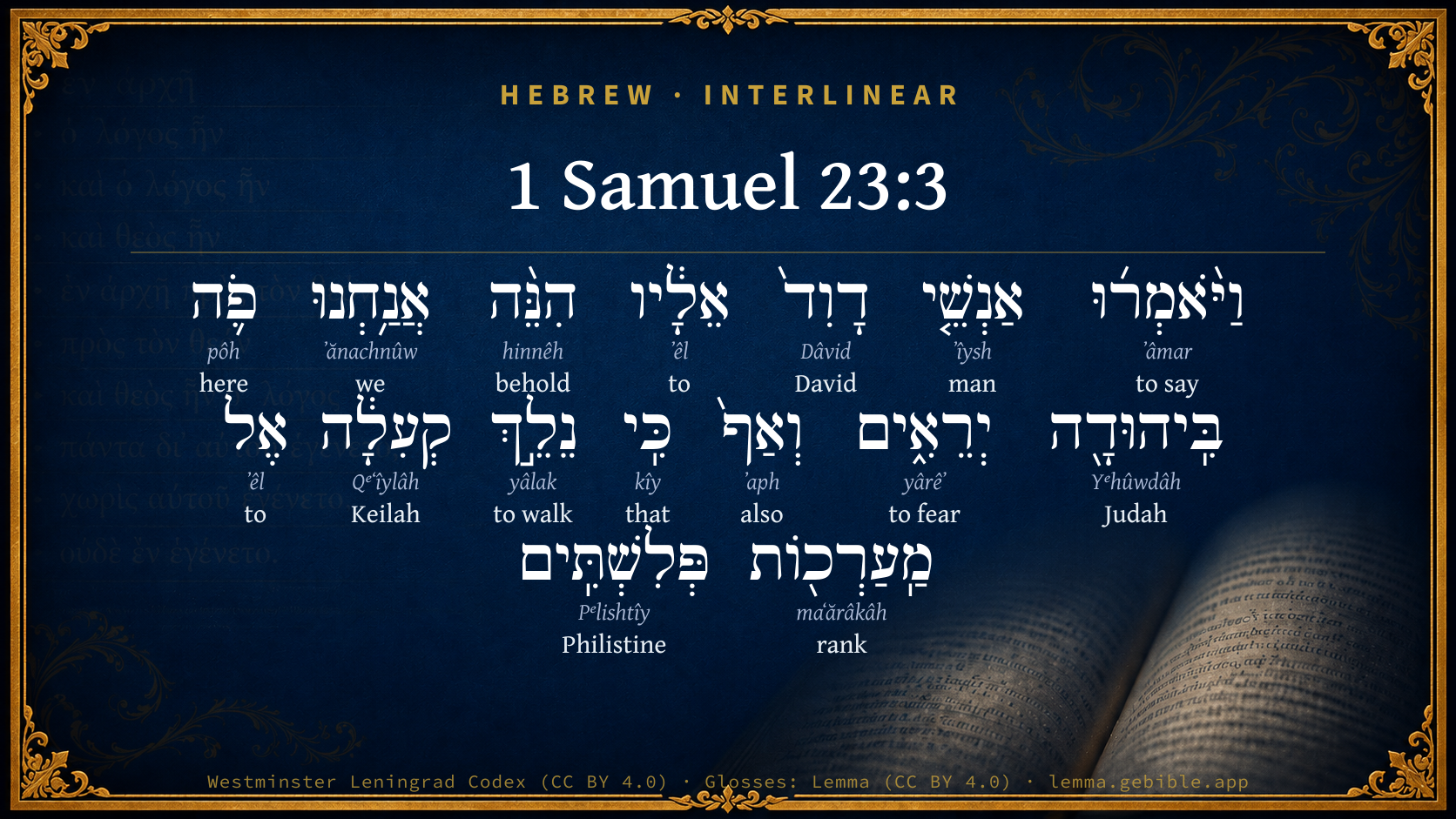
  1. וַיֹּ֨אמְר֜וּ ʼâmar H559 “and · to say” Conjunction + Verb, Qal, Sequential Imperfect, 3rd Person, Masculine, Plural
  2. אַנְשֵׁ֤י ʼîysh H376 “men of” Noun, Common, Masculine, Plural, Construct
  3. דָוִד֙ Dâvid H1732 “David” Noun, Proper
  4. אֵלָ֔יו ʼêl H413 “to · him” Preposition + Suffix, Personal, 3rd Person, Masculine, Singular
  5. הִנֵּ֨ה hinnêh H2009 “behold” Particle, Demonstrative
  6. אֲנַ֥חְנוּ ʼănachnûw H587 “we” Pronoun, Personal, 1st Person, Common, Plural
  7. פֹ֛ה pôh H6311 “here” Adverb
  8. בִּֽיהוּדָ֖ה Yᵉhûwdâh H3063 “in/at · Judah” Preposition + Noun, Proper
  9. יְרֵאִ֑ים yârêʼ H3372 “fearing” Adjective, Adjective, Masculine, Plural, Absolute
  10. וְאַף֙ ʼaph H637 “and · also” Conjunction + Adverb
  11. כִּֽי kîy H3588 “that” Conjunction
  12. נֵלֵ֣ךְ yâlak H3212 “to walk” Verb, Qal, Imperfect, 1st Person, Common, Plural
  13. אֶל ʼêl H413 “to” Preposition
  14. מַֽעַרְכ֖וֹת maʻărâkâh H4634 “ranks of” Noun, Common, Feminine, Plural, Construct
  15. פְּלִשְׁתִּֽים Pᵉlishtîy H6430 “Philistines” Noun, Gentilic, Masculine, Plural, Absolute

About this verse

These counts appear in no published source. They are computed here, from the morphology-tagged text and Lemma’s own curated glosses. What Lemma adds →

16
words
15
distinct lemmas
Historical
section

Notable vocabulary

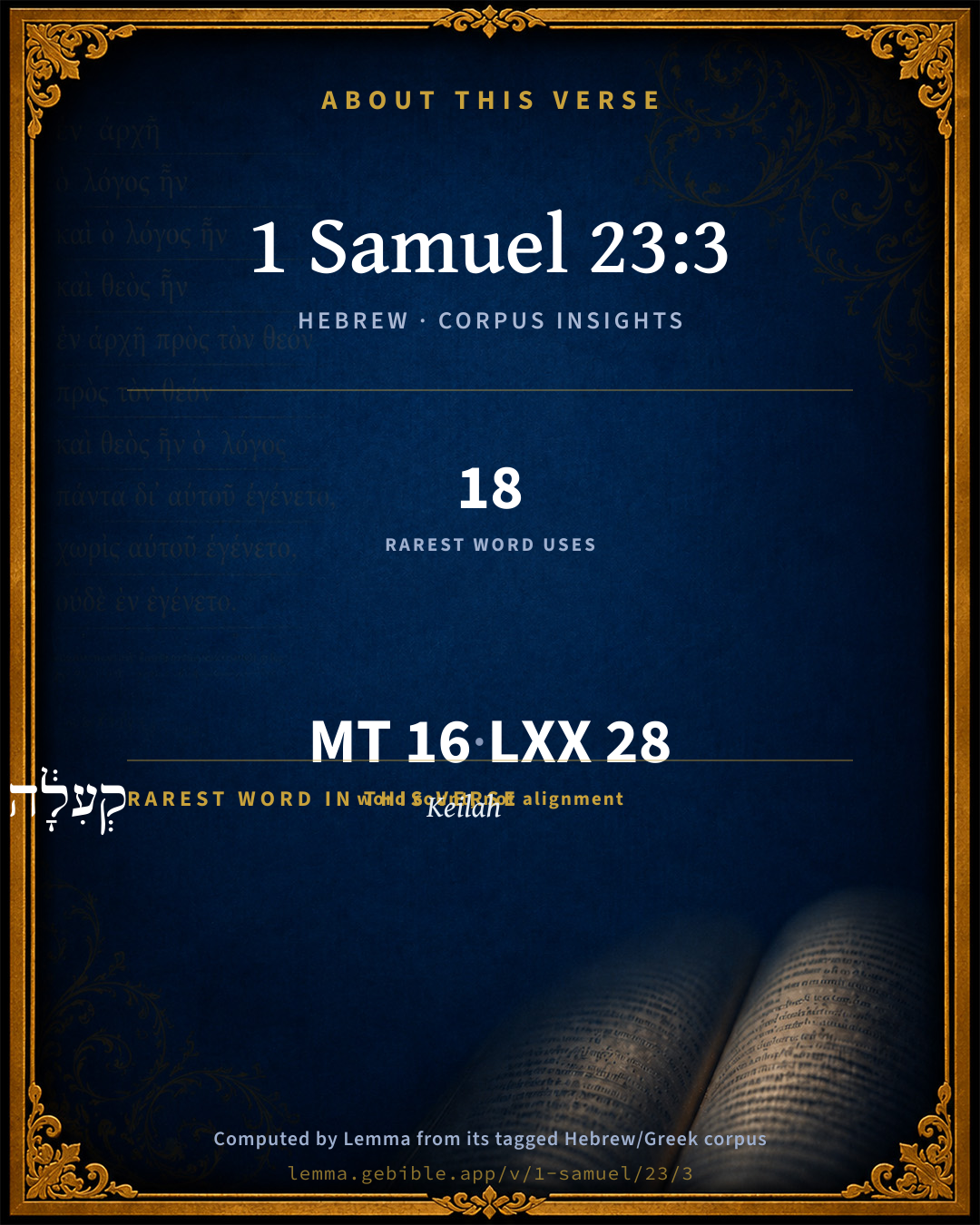
The rarest word here is קְעִלָ֔ה Keilah H7084 — appearing just 18 times in the whole Hebrew Bible.

Shared distinctive vocabulary

קְעִלָ֔ה Keilah H7084 occurs in 16 verses of the Hebrew Bible. Also found in:

Grammatical profile

  • 2 verbs
  • 6 nouns
  • 1 adjective
  • 1 pronoun
  • 2 prepositions
  • 1 conjunction
  • 2 adverbs
  • 1 particle

Verb forms

  • וַיֹּ֨אמְר֜וּ Qal · Sequential Imperfect
  • נֵלֵ֣ךְ Qal · Imperfect

Repetition

A word recurs within this verse — often emphatic in Hebrew:

  • אֵלָ֔יו to H413 ×2

Hebrew & Septuagint length

In English translation the verse runs 27 words from the Hebrew and 34 from the Septuagint (LXX English) — closely comparable.

A rough comparison of the two English renderings, which tokenize alike — not a word-level alignment.

Word counts can differ between the Hebrew and the Greek without any difference in meaning — e.g. the Hebrew direct-object marker אֵת has no separate Greek word, and Greek often adds the article ὁ.

In the original languages it is 16 Hebrew tokens and 28 Greek tokens — but the two are counted differently (Hebrew bundles its prefixes and suffixes into one token; the Greek is in lemma form), so that isn’t a like-for-like length.

Cross-references

5

Topical passages linked to 1 Samuel 23:3 in the Treasury of Scripture Knowledge — connected by theme and wording, ordered by reader-vote popularity; previews shown in the World English Bible.

  • 1 Samuel 23:15 David saw that Saul had come out to seek his life: and David was in the wilderness of Ziph in the wood.
  • 1 Samuel 23:23 See therefore, and take knowledge of all the lurking-places where he hides himself, and come you again to me of a certainty, and I will go with you: and it shall happen, if he be in the land, that I will search him out among all the thousands of Judah.
  • 1 Samuel 23:26 Saul went on this side of the mountain, and David and his men on that side of the mountain: and David made haste to get away for fear of Saul; for Saul and his men compassed David and his men round about to take them.
  • Psalms 11:1 In Yahweh, I take refuge. How can you say to my soul, "Flee as a bird to your mountain!"
  • Jeremiah 12:5 If you have run with the footmen, and they have wearied you, then how can you contend with horses? and though in a land of peace you are secure, yet how will you do in the pride of the Jordan?

Cross-references courtesy of OpenBible.info (CC BY 4.0).

Hebrew and Greek witnesses Masoretic Hebrew ↔ Greek Septuagint

The same verse in the two great witnesses to the Old Testament, shown verse-for-verse.

These are two independent witnesses, not word-aligned to each other, and the Septuagint is shown in lemma (dictionary) form.

Hebrew 1 Samuel 23:3 Masoretic · Westminster Leningrad Codex

וַיֹּ֨אמְר֜וּ אַנְשֵׁ֤י דָוִד֙ אֵלָ֔יו הִנֵּ֨ה אֲנַ֥חְנוּ פֹ֛ה בִּֽיהוּדָ֖ה יְרֵאִ֑ים וְאַף֙ כִּֽי נֵלֵ֣ךְ קְעִלָ֔ה אֶל מַֽעַרְכ֖וֹת פְּלִשְׁתִּֽים

David's men said to him, Behold, we are afraid here in Judah: how much more then if we go to Keilah against the armies of the Philistines?

World English Bible · Public Domain

Greek LXX 1 Samuel 23:3 Septuagint · lemma form

καί εἶπον ὁ ἀνήρ ὁ δαυίδ πρός αὐτός ἰδού ἐγώ ἐνταῦθα ἐν ὁ ἰουδαία φοβέω καί πῶς εἰμί ἐάν πορεύομαι εἰς κεϊλα εἰς ὁ σκῦλον ὁ ἀλλόφυλος εἰςπορεύομαι

And the men of David said to him, Behold, we are afraid here in Judea; and how shall it be if we go to Keila? Shall we go after the spoils of the Philistines?

LXX2012 (modern English Septuagint) · Public Domain

Hebrew: Westminster Leningrad Codex (CC BY 4.0). Greek: Septuagint (public domain); English from LXX2012 (modern English Septuagint) (Public Domain). How the Septuagint differs from the Hebrew →

Targum (Aramaic paraphrase)

1

The Targum is the ancient Jewish Aramaic paraphrase of the Hebrew Scriptures — an interpretive translation, not the Hebrew text itself. Onkelos (literal) and Pseudo-Jonathan (expansive) render the Torah, and Jonathan the Prophets. Coverage is partial: where no permissively-licensed English translation exists for a verse, only the Aramaic is shown. This is verse-level text, not a word-by-word alignment to the Hebrew.

  1. Targum Jonathan Prophets (Joshua–Malachi)
    וַאֲמַרוּ גַבְרֵי דָוִד לֵיהּ הָא כַד אֲנַחְנָא הָכָא בְּאַרְעָא דְבֵית יְהוּדָה אֲנַחְנָא דַחֲלִין וְאַף אֱלָהֵין דְנֵיזִל לִקְעִילָה לְסִדְרֵי פְלִשְׁתָּאֵי:

    (no public-domain English translation for this verse)

    Targum Jonathan — Aramaic: “Mikraot Gedolot” (public domain). English: “Sefaria Community Translation” (CC0 1.0 (public-domain dedication)); “London "Chaldee Paraphrase," 1871” (public domain). Text via Sefaria.

Commentary

Notes on 1 Samuel 23:3 from classic Christian and Jewish commentators (each source and its license shown beneath its notes). The classic Christian expositions comment on the surrounding passage and are grouped to its opening verse, so a note may address several verses; the Jewish commentaries on the Tanakh (Rashi and others) are per-verse, so they appear only where the commentator wrote on this verse.

Lemma curates 59 commentaries, every one of them public domain or Creative Commons licensed, each selected and text-cleaned for this edition rather than reprinted as found. About our sources →

Trapp's Complete Commentary

John Trapp

1Sa 23:3 And David’s men said unto him, Behold, we be afraid here in Judah: how much more then if we come to Keilah against the armies of the Philistines?

Ver. 3. And David’s men said unto him.] See a like discouraging speech of the disciples to our Saviour, {Joh 11:8} and his resolute answer. {1Sa 23:9-10} God may be safely and must be faithfully followed, whithersoever he leads us: neither must we stand casting of perils.

John Trapp, A Commentary or Exposition upon All the Books of the Old and New Testament (1647–1656) — public domain. Text from a community e-Sword module.

Joseph Benson's Commentary

1Sa 23:3-4. David’s men said, Behold, we are afraid here in Judah — “They had more than difficulty enough to defend themselves against Saul where they were; and could it be less than madness to provoke more and greater enemies? Doubtless Saul would send forces to beat off the Philistines, and then they should be pent in between two hostile armies. And yet, notwithstanding all this, David undertook and achieved the adventure; which it was impossible he should, against such fears, and such reasonings of his forces, from any motive other than the assurance of divine protection and aid. Which fully confirms the Scripture account of this matter, that he did not undertake it until he had, for the fuller satisfaction of his associates, again consulted, and was again assured of success by the divine oracle.”

Joseph Benson's Commentary on the Old and New Testaments (1811–1818) — public domain. Text from a community e-Sword module.

Geneva Bible (1599)

Geneva Bible translators

That is, in the midst of Judah, much more when we come to the borders against our enemies.

Geneva Bible (1599) marginal notes — public domain. Text via Bolls.life.

Ellicott's Commentary for English Readers

(3) Here in Judah.—This does not imply that Keilah was out of the territory of Judah, but simply that the district in the neighbourhood round Keilah was at that time under Philistine domination. The open country in times of Philistine supremacy first fell under their control; their strong places, like Keilah, would resist for a much longer period.

A Bible Commentary for English Readers, edited by Charles John Ellicott (1878–1897) — public domain. Text from a community e-Sword module.

The Cambridge Bible for Schools and Colleges

gen. ed. J. J. S. Perowne

3. here in Judah] Keilah belonged to the tribe of Judah (Jos_15:44): so that Judah must here be used in a limited sense of the highlands of Judah.

the armies of the Philistines] David’s men exaggerate the marauding bands of Philistines into a regular army.

The Cambridge Bible for Schools and Colleges (gen. ed. J. J. S. Perowne; Cambridge University Press, 1878–1918) — public domain. Text from a community e-Sword module.

John Gill's Exposition

And David's men said unto him, behold, we be afraid here in Judah,.... Of Saul and his army falling upon them, and crushing them, though they were in the tribe of Judah, where they had many friends, and in the heart of that tribe:

how much more then if we come to Keilah; which, though in the same tribe, yet in the further parts of it, and on the borders of the Philistines: and there engage

against the armies of the Philistines? too numerous and powerful for them, and so by this means be driven out of their place of safety, the forest of Hareth, where they could hide themselves upon occasion; to be exposed not only to the Philistines, before them, on the edge of their country, from whence they could have re-enforcements easily, but to Saul and his army behind them; and so, being between two fires, would be in danger of being cut off.

John Gill's Exposition of the Whole Bible (1746–1763) — public domain (CC PDM 1.0). Text via the HelloAO Bible API.

Haydock's Catholic Bible Commentary

Judea, in the midst of the country, remote from the Philistines; and in a forest, where Saul cannot so easily attack us, as in a city.

George Leo Haydock (1774–1849), Haydock's Catholic Family Bible and Commentary, 1859 edition — public domain. Excludes Psalms (Douay-Rheims chapter numbering differs from Protestant) and Deuterocanonical books (Catholic canon only).

Matthew Poole's English Annotations

Here in Judah, i. e. in this part of Judah, whereas yet we have no army to oppose us; for else Keilah also was in Judah.

If we come to Keilah; when we shall have a potent enemy before us, the Philistines, and, it may be, another behind us, even Saul, who probably will come forth, either to resist the Philistines, or to intercept us.

Matthew Poole's English Annotations on the Holy Bible (1683–1685) — public domain. Text from a community e-Sword/MySword module.

Whedon's Commentary on the Bible

Daniel D. Whedon

3. We be afraid here in Judah — Afraid of Saul’s pursuit and sudden attack. They thought that any engagement against an enemy would expose them to still greater danger.

Daniel D. Whedon (gen. ed.), Commentary on the Old and New Testaments (1874–1909) — public domain. Text from a community e-Sword module.

unfoldingWord translationNotes

Door43 World Missions Community

How much more then if we go to Keilah against the armies of the Philistines?

This rhetorical question can be translated as a statement. AT: "We will be even more fearful if we go to Keilah to fight the armies of the Philistines." (See: Rhetorical Question)

translationWords

fear

Judah

raise

unfoldingWord translationNotes — © Distant Shores Media and the Door43 World Missions Community, licensed CC BY-SA 4.0. Source: git.door43.org/Door43/en_tn.

Lesson kit

Teaching starters — assembled from the data on this page, not authored interpretation. Every prompt links to the verse data it draws on. Edit before teaching.

1 Samuel, in the Historical, opens this verse with 16 words (15 distinct Hebrew lemmas). Its most distinctive word is Qᵉʻîylâh (“Keilah”). A historical commentator’s framing appears above. Read the whole chapter for the surrounding context.

Discussion questions

  1. What does “Keilah” (Qᵉʻîylâh) contribute to the verse as a whole?
  2. Joshua 15:44 shares the word «Keilah» with this verse. How do the two illuminate each other?
  3. “to” occurs 2× in this one verse. What is the effect of the repetition?
  4. The translations on this page render this verse differently — a whole-verse word diff, not a word-by-word alignment. What might account for the different wordings?
  5. The verb «וַיֹּ֨אמְר֜וּ» is Qal Sequential Imperfect. How does its form color the action?
  6. Reading how Trapp's Complete Commentary and Joseph Benson's Commentary read this verse, where do the two commentators agree and where do they part?

Things to notice

Reading settings

Reading text

Shown beneath each verse's original-language words.

Old Testament
Old Testament edition

Read the OT as the Masoretic Hebrew (MT) or the Greek Septuagint (LXX).

English shown for the Greek Septuagint (in the Hebrew ↔ Greek comparison).

Comparing translations? Open the Compare panel on any verse page to stack up to four side by side.