
Nehemiah 9:32

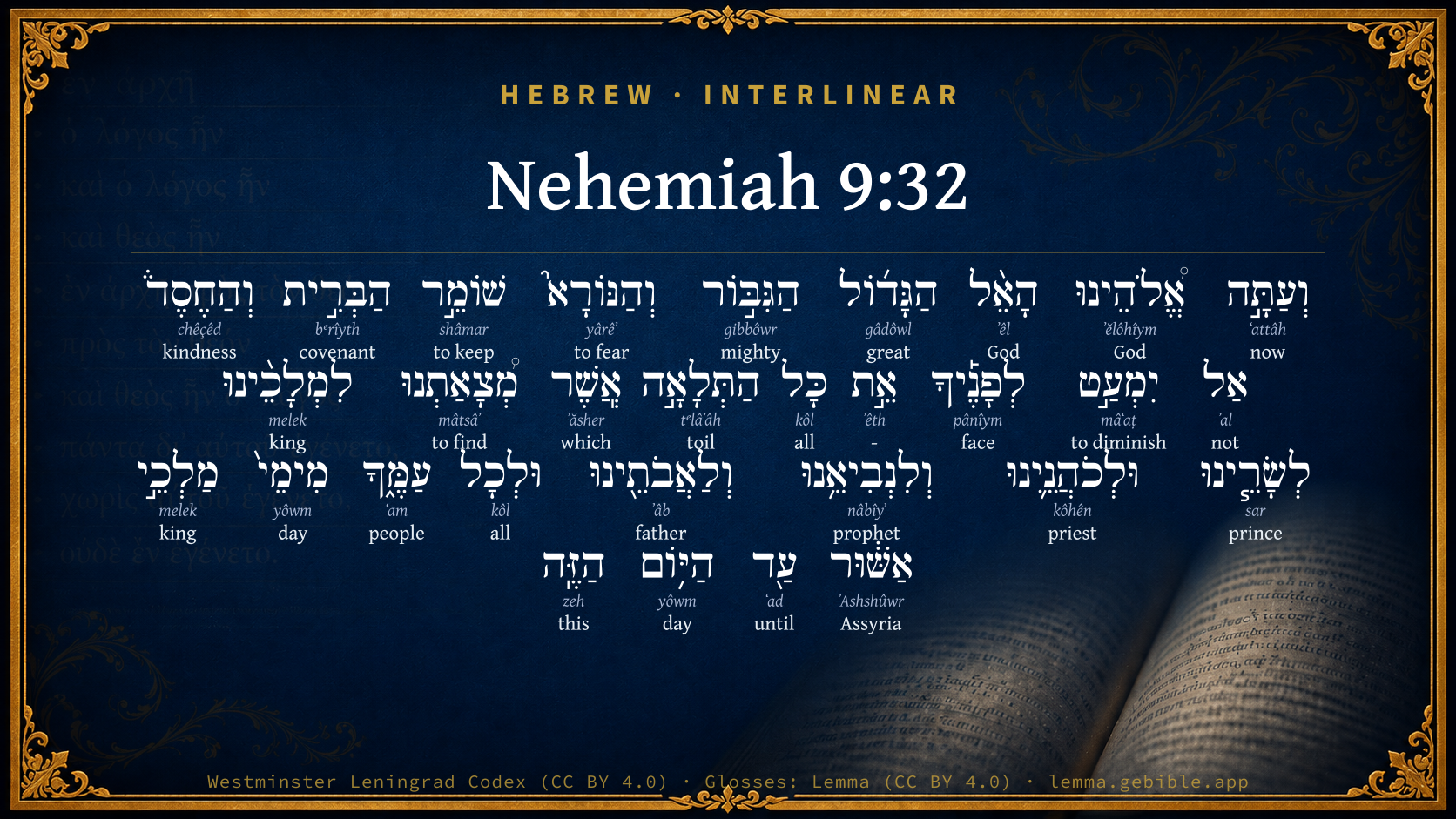
Hebrew (Westminster Leningrad Codex) Nehemiah 9:32 appears in the Hebrew Old Testament. The text above is from the Westminster Leningrad Codex. Each word links to its Strong’s number, a concise gloss, and parsing drawn from the Open Scriptures Hebrew Bible morphology. Click any word for its full Brown-Driver-Briggs (BDB) entry.
Download image
Cite this verse

Nehemiah 9:32 (World English Bible). Public Domain. Lemma interlinear Bible study tool, https://lemma.gebible.app/v/nehemiah/9/32.

Show BibTeX & RIS
BibTeX
RIS
English Translation
Now therefore, our God, the great, the mighty, and the awesome God, who keep covenant and loving kindness, don't let all the travail seem little before you, that has come on us, on our kings, on our princes, and on our priests, and on our prophets, and on our fathers, and on all your people, since the time of the kings of Assyria to this day.
World English Bible · Public Domain
Download a study sheet

One document with this verse’s original text, its word-by-word gloss line, the meaning frame, cross-references with their text, attributed commentary, and full source and license credits — printable, and it pastes into notes with its structure intact.

This verse Autodidact and up

Study sheet (.html) Plain text (.txt)

A passage Seminary Student

Up to 50 verses in one chapter. A passage sheet keeps up to 6 commentary sources and 12 cross-references per verse, in the order this page ranks them, and says so on the sheet whenever that leaves anything out. Ask for a single verse and you get the Autodidact verse sheet above.

Everything on this page stays free to read, with no account — the sheet is a download of what is already on screen, not access to it.

Want to remove ads? Support Godless Engineer
Compare translations 3

The same verse in 3 English versions, stacked beneath the original-language interlinear above. Click any original word for its lexicon entry.

Each is an independent rendering of the whole verse — the interlinear is not word-aligned to these translations.

Highlighted words mark where these versions differ — a whole-verse word diff, not a word-by-word alignment.

  • World English Bible Public Domain
    Now therefore, our God, the great, the mighty, and the awesome God, who keep covenant and loving kindness, don't let all the travail seem little before you, that has come on us, on our kings, on our princes, and on our priests, and on our prophets, and on our fathers, and on all your people, since the time of the kings of Assyria to this day.
  • King James Version Public Domain
    Now therefore, our God, the great, the mighty, and the terrible God, who keepest covenant and mercy, let not all the trouble seem little before thee, that hath come upon us, on our kings, on our princes, and on our priests, and on our prophets, and on our fathers, and on all thy people, since the time of the kings of Assyria unto this day.
  • unfoldingWord Literal Text CC BY-SA 4.0
    So now, our God, the great, mighty, and fearsome God, who keeps the covenant and covenant faithfulness, do not let all the hardship be little before your face, that has found us, our kings, our leaders, and our priests, and our prophets, and our fathers, and all your people from the days of the kings of Assyria until this day.

unfoldingWord Literal Text — © unfoldingWord, licensed CC BY-SA 4.0. Word-aligned USFM3 via Door43 (git.door43.org/unfoldingWord/en_ult).

Versions to compare (up to 4)

3 of 4 selected

Show all 18 translations

Every available English version of this verse, each an independent rendering of the whole verse.

  • World English Bible Public Domain
    Now therefore, our God, the great, the mighty, and the awesome God, who keep covenant and loving kindness, don't let all the travail seem little before you, that has come on us, on our kings, on our princes, and on our priests, and on our prophets, and on our fathers, and on all your people, since the time of the kings of Assyria to this day.
  • Berean Standard Bible Public Domain
    So now, our God, the great and mighty and awesome God who keeps His gracious covenant, do not view lightly all the hardship that has come upon us, and upon our kings and leaders, our priests and prophets, our ancestors and all Your people, from the days of the kings of Assyria until today.
  • Majority Standard Bible Public Domain
    So now, our God, the great and mighty and awesome God who keeps His gracious covenant, do not view lightly all the hardship that has come upon us, and upon our kings and leaders, our priests and prophets, our ancestors and all Your people, from the days of the kings of Assyria until today.
  • King James Version Public Domain
    Now therefore, our God, the great, the mighty, and the terrible God, who keepest covenant and mercy, let not all the trouble seem little before thee, that hath come upon us, on our kings, on our princes, and on our priests, and on our prophets, and on our fathers, and on all thy people, since the time of the kings of Assyria unto this day.
  • American Standard Version (1901) Public Domain
    Now therefore, our God, the great, the mighty, and the terrible God, who keepest covenant and lovingkindness, let not all the travail seem little before thee, that hath come upon us, on our kings, on our princes, and on our priests, and on our prophets, and on our fathers, and on all thy people, since the time of the kings of Assyria unto this day.
  • Revised Version (1885) Public Domain
    Now therefore, our God, the great, the mighty, and the terrible God, who keepest covenant and mercy, let not all the travail seem little before thee, that hath come upon us, on our kings, on our princes, and on our priests, and on our prophets, and on our fathers; and on all thy people, since the time of the kings of Assyria unto this day.
  • Geneva Bible (1599) Public Domain
    Nowe therefore our God, thou great God, mightie and terrible, that keepest couenant and mercie, let not all the affliction that hath come vnto vs, seeme a litle before thee, that is, to our Kings, to our princes, and to our Priests, and to our Prophets, and to our fathers, and to all thy people since the time of the Kings of Asshur vnto this day.
  • Douay-Rheims (1899) Public Domain
    Now therefore our God, great, strong and terrible, who keepest covenant and mercy, turn not away from thy face all the labour which hath come upon us, upon our kings, and our princes, and our priests, and our prophets, and our fathers, and all the people from the days of the king of Assur, until this day.
  • Young's Literal Translation Public Domain
    `And now, O our God -- God, the great, the mighty, and the fearful, keeping the covenant and the kindness -- let not all the travail that hath found us be little before Thee, for our kings, for our heads, and for our priests, and for our prophets, and for our fathers, and for all Thy people, from the days of the kings of Asshur unto this day;
  • Literal Standard Version CC BY-SA 4.0
    And now, O our God—God, the great, the mighty, || And the fearful, || Keeping the covenant and the kindness—Do not let all the travail that has found us be little before You, || For our kings, for our heads, and for our priests, || And for our prophets, and for our fathers, || And for all Your people, || From the days of the kings of Asshur to this day;
  • Unlocked Literal Bible CC BY-SA 4.0
    Now therefore, our God—you great, mighty, and awesome God who keep your covenant and steadfast love—do not let all this hardship seem little to you that has come on us, on our kings, on our princes, and on our priests, and on our prophets, and on our ancestors, and on all your people from the days of the kings of Assyria until today.
  • unfoldingWord Literal Text CC BY-SA 4.0
    So now, our God, the great, mighty, and fearsome God, who keeps the covenant and covenant faithfulness, do not let all the hardship be little before your face, that has found us, our kings, our leaders, and our priests, and our prophets, and our fathers, and all your people from the days of the kings of Assyria until this day.
  • Darby Bible Public Domain
    And now, our God, the great, the mighty, and the terrible ùGod, who keepest covenant and loving-kindness, let not all the trouble seem little before thee, that hath come upon us, on our kings, on our princes, and on our priests, and on our prophets, and on our fathers, and on all thy people, since the days of the kings of Assyria unto this day.
  • World Messianic Bible Public Domain
    Now therefore, our God, the great, the mighty, and the awesome God, who keeps covenant and loving kindness, don’t let all the travail seem little before you that has come on us, on our kings, on our princes, on our priests, on our prophets, on our fathers, and on all your people, since the time of the kings of Assyria to this day.
  • Webster's Bible Public Domain
    Now therefore, our God, the great, the mighty, and the terrible God, who keepest covenant and mercy, let not all the trouble seem little before thee, that hath come upon us, on our kings, on our princes, and on our priests, and on our prophets, and on our fathers, and on all thy people, since the time of the kings of Assyria to this day.
  • Free Bible Version CC BY-SA 4.0
    So now, our God, the great and powerful and awesome God who keeps his agreement of trustworthy love, please don't see as unimportant all the hardships that have happened to us, and to our kings and leaders, our priests and prophets, our forefather and all your people, from the time of the Assyrian kings of Assyria up till now.
  • Bible in Basic English Public Domain
    And now, our God, the great, the strong, the God who is to be feared, who keeps faith and mercy, let not all this trouble seem small to you, which has come on us, and on our kings and our rulers and on our priests and our prophets and our fathers and on all your people from the time of the kings of Assyria till this day.
  • JPS Tanakh (1917) Public Domain
    Now therefore, our God, the great, the mighty, and the awful God, who keepest covenant and mercy, let not all the travail seem little before Thee, that hath come upon us, on our kings, on our princes, and on our priests, and on our prophets, and on our fathers, and on all Thy people, since the time of the kings of Assyria unto this day.

Literal Standard Version (2020), Covenant Press — licensed CC BY-SA 4.0. Text via the HelloAO Bible API (eBible.org). Unlocked Literal Bible (unfoldingWord) — licensed CC BY-SA 4.0. Text via the HelloAO Bible API (eBible.org). unfoldingWord Literal Text — © unfoldingWord, licensed CC BY-SA 4.0. Word-aligned USFM3 via Door43 (git.door43.org/unfoldingWord/en_ult). Free Bible Version, Dr. Jonathan Gallagher — licensed CC BY-SA 4.0. Text via the HelloAO Bible API (eBible.org).

Word by word

More ways to search: Search by grammar → Find every occurrence → Compare this word →

Practice this passage: Drill this verse → Learn its vocabulary →

הַתְּלָאָ֣ה
tᵉlâʼâh
H8513
“the · toil”
Particle, Definite Article + Noun, Common, Feminine, Singular, Absolute
Part of Speech
Particle + Noun
Type
Common
Gender
Feminine
Number
Singular
State
Absolute
Full BDB Definition

Origin: from H3811

TWOT: 1066a

toil, hardship, distress, weariness
  1. וְעַתָּ֣ה ʻattâh H6258 “and · now” Conjunction + Adverb
  2. אֱ֠לֹהֵינוּ ʼĕlôhîym H430 “God(s) · our” Noun, Common, Masculine, Plural, Construct + Suffix, Personal, 1st Person, Common, Plural
  3. הָאֵ֨ל ʼêl H410 “the · God” Particle, Definite Article + Noun, Common, Masculine, Singular, Absolute
  4. הַגָּד֜וֹל gâdôwl H1419 “the · great” Particle, Definite Article + Adjective, Adjective, Masculine, Singular, Absolute
  5. הַגִּבּ֣וֹר gibbôwr H1368 “the · mighty” Particle, Definite Article + Adjective, Adjective, Masculine, Singular, Absolute
  6. וְהַנּוֹרָא֮ yârêʼ H3372 “and · the · fearing” Conjunction + Particle, Definite Article + Verb, Niphal, Participle Active, Masculine, Singular, Absolute
  7. שׁוֹמֵ֣ר shâmar H8104 “keeping” Verb, Qal, Participle Active, Masculine, Singular, Absolute
  8. הַבְּרִ֣ית bᵉrîyth H1285 “the · covenant” Particle, Definite Article + Noun, Common, Feminine, Singular, Absolute
  9. וְהַחֶסֶד֒ chêçêd H2617 “and · the · kindness” Conjunction + Particle, Definite Article + Noun, Common, Masculine, Singular, Absolute
  10. אַל ʼal H408 “not” Particle, Negative
  11. יִמְעַ֣ט mâʻaṭ H4591 “to diminish” Verb, Qal, Jussive, 3rd Person, Masculine, Singular
  12. לְפָנֶ֡יךָ pânîym H6440 “to/for · face(s) · your” Preposition + Noun, Common, Both, Plural, Construct + Suffix, Personal, 2nd Person, Masculine, Singular
  13. אֵ֣ת ʼêth H853 “-” Particle, Direct Object
  14. כָּל kôl H3605 “all of” Noun, Common, Masculine, Singular, Construct
  15. אֲֽשֶׁר ʼăsher H834 “which” Particle, Relative
  16. מְ֠צָאַתְנוּ mâtsâʼ H4672 “to find · us” Verb, Qal, Perfect, 3rd Person, Feminine, Singular + Suffix, Personal, 1st Person, Common, Plural
  17. לִמְלָכֵ֨ינוּ melek H4428 “to/for · kings · our” Preposition + Noun, Common, Masculine, Plural, Construct + Suffix, Personal, 1st Person, Common, Plural
  18. לְשָׂרֵ֧ינוּ sar H8269 “to/for · princes · our” Preposition + Noun, Common, Masculine, Plural, Construct + Suffix, Personal, 1st Person, Common, Plural
  19. וּלְכֹהֲנֵ֛ינוּ kôhên H3548 “and · to/for · priests · our” Conjunction + Preposition + Noun, Common, Masculine, Plural, Construct + Suffix, Personal, 1st Person, Common, Plural
  20. וְלִנְבִיאֵ֥נוּ nâbîyʼ H5030 “and · to/for · prophets · our” Conjunction + Preposition + Noun, Common, Masculine, Plural, Construct + Suffix, Personal, 1st Person, Common, Plural
  21. וְלַאֲבֹתֵ֖ינוּ ʼâb H1 “and · to/for · fathers · our” Conjunction + Preposition + Noun, Common, Masculine, Plural, Construct + Suffix, Personal, 1st Person, Common, Plural
  22. וּלְכָל kôl H3605 “and · to/for · all of” Conjunction + Preposition + Noun, Common, Masculine, Singular, Construct
  23. עַמֶּ֑ךָ ʻam H5971 “people · your” Noun, Common, Masculine, Singular, Construct + Suffix, Personal, 2nd Person, Masculine, Singular
  24. מִימֵי֙ yôwm H3117 “from · days of” Preposition + Noun, Common, Masculine, Plural, Construct
  25. מַלְכֵ֣י melek H4428 “kings of” Noun, Common, Masculine, Plural, Construct
  26. אַשּׁ֔וּר ʼAshshûwr H804 “Assyria” Noun, Proper
  27. עַ֖ד ʻad H5704 “until” Preposition
  28. הַיּ֥וֹם yôwm H3117 “the · day” Particle, Definite Article + Noun, Common, Masculine, Singular, Absolute
  29. הַזֶּֽה zeh H2088 “the · this” Particle, Definite Article + Pronoun, Demonstrative, Masculine, Singular

About this verse

These counts appear in no published source. They are computed here, from the morphology-tagged text and Lemma’s own curated glosses. What Lemma adds →

30
words
27
distinct lemmas
Historical
section

Notable vocabulary

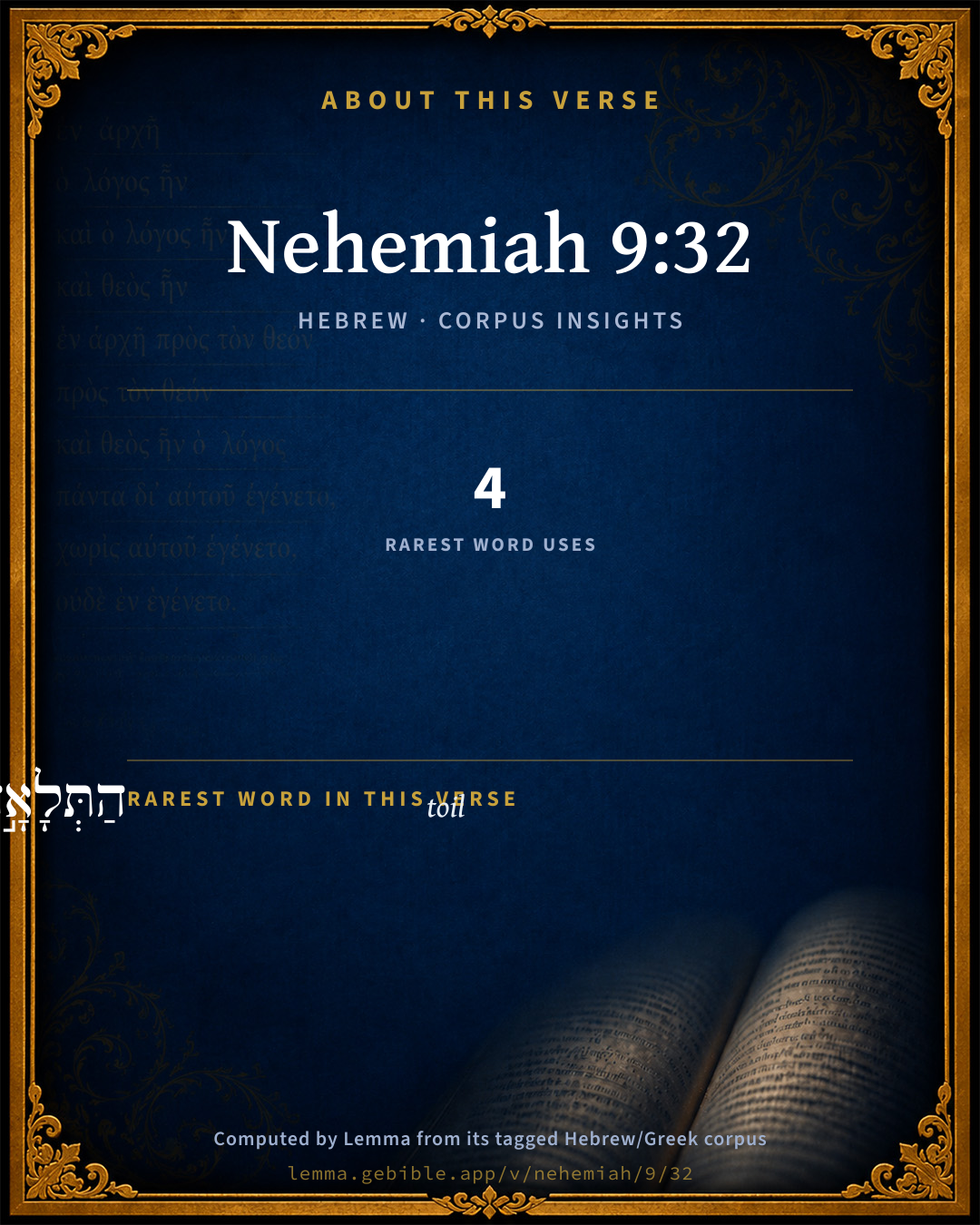
The rarest word here is הַתְּלָאָ֣ה toil H8513 — appearing just 4 times in the whole Hebrew Bible.

Shared distinctive vocabulary

הַתְּלָאָ֣ה toil H8513 occurs in 4 verses of the Hebrew Bible. Also found in:

Grammatical profile

  • 4 verbs
  • 18 nouns
  • 2 adjectives
  • 1 pronoun
  • 1 preposition
  • 1 adverb
  • 3 particles

Verb forms

  • וְהַנּוֹרָא֮ Niphal · Participle Active
  • שׁוֹמֵ֣ר Qal · Participle Active
  • יִמְעַ֣ט Qal · Jussive
  • מְ֠צָאַתְנוּ Qal · Perfect

Repetition

Words recur within this verse — often emphatic in Hebrew:

  • כָּל all H3605 ×2
  • לִמְלָכֵ֨ינוּ king H4428 ×2
  • מִימֵי֙ day H3117 ×2

Cross-references

34

Topical passages linked to Nehemiah 9:32 in the Treasury of Scripture Knowledge — connected by theme and wording, ordered by reader-vote popularity; previews shown in the World English Bible.

  • Deuteronomy 7:9 Know therefore that Yahweh your God, he is God, the faithful God, who keeps covenant and loving kindness with them who love him and keep his commandments to a thousand generations,
  • Nehemiah 1:5 and said, I beg you, Yahweh, the God of heaven, the great and awesome God, who keeps covenant and loving kindness with those who love him and keep his commandments:
  • Daniel 9:4 I prayed to Yahweh my God, and made confession, and said, Oh, Lord, the great and dreadful God, who keeps covenant and loving kindness with those who love him and keep his commandments,
  • Daniel 9:8 Lord, to us belongs confusion of face, to our kings, to our princes, and to our fathers, because we have sinned against you.
  • Micah 7:18–20 Who is a God like you, who pardons iniquity, And passes over the disobedience of the remnant of his heritage? He doesn't retain his anger forever, Because he delights in loving kindness.
  • Psalms 66:3 Tell God, "How awesome are your deeds! Through the greatness of your power, your enemies submit themselves to you.
  • Psalms 66:5 Come, and see God's deeds-- Awesome work on behalf of the children of men.
  • Daniel 9:6 neither have we listened to your servants the prophets, who spoke in your name to our kings, our princes, and our fathers, and to all the people of the land.
  • Leviticus 26:18 "'If you in spite of these things will not listen to me, then I will chastise you seven times more for your sins.
  • Leviticus 26:21 "'If you walk contrary to me, and won't listen to me, then I will bring seven times more plagues on you according to your sins.
  • Leviticus 26:24 then I will also walk contrary to you; and I will strike you, even I, seven times for your sins.
  • Leviticus 26:28 then I will walk contrary to you in wrath; and I also will chastise you seven times for your sins.
  • Deuteronomy 7:21 You shall not be scared of them; for Yahweh your God is in the midst of you, a great and awesome God.
  • 1 Kings 8:23 and he said, Yahweh, the God of Israel, there is no God like you, in heaven above, or on earth beneath; who keep covenant and loving kindness with your servants, who walk before you with all their heart;
  • 2 Kings 15:19 There came against the land Pul the king of Assyria; and Menahem gave Pul one thousand talents of silver, that his hand might be with him to confirm the kingdom in his hand.
  • 2 Kings 15:29 In the days of Pekah king of Israel came Tiglath Pileser king of Assyria, and took Ijon, and Abel Beth Maacah, and Janoah, and Kedesh, and Hazor, and Gilead, and Galilee, all the land of Naphtali; and he carried them captive to Assyria.
  • 2 Kings 17:3 Against him came up Shalmaneser king of Assyria; and Hoshea became his servant, and brought him tribute.
  • 2 Kings 23:29 In his days Pharaoh Necoh king of Egypt went up against the king of Assyria to the river Euphrates: and king Josiah went against him; and [Pharaoh Necoh] killed him at Megiddo, when he had seen him.
  • 2 Kings 23:33–34 Pharaoh Necoh put him in bonds at Riblah in the land of Hamath, that he might not reign in Jerusalem; and put the land to a tribute of one hundred talents of silver, and a talent of gold.
  • 2 Kings 25:7 They killed the sons of Zedekiah before his eyes, and put out the eyes of Zedekiah, and bound him in fetters, and carried him to Babylon.
  • 2 Kings 25:18–21 The captain of the guard took Seraiah the chief priest, and Zephaniah the second priest, and the three keepers of the threshold:
  • 2 Kings 25:25–26 But it happened in the seventh month, that Ishmael the son of Nethaniah, the son of Elishama, of the royal seed came, and ten men with him, and struck Gedaliah, so that he died, and the Jews and the Chaldeans that were with him at Mizpah.
  • 2 Chronicles 36:1–23 Then the people of the land took Jehoahaz the son of Josiah, and made him king in his father's place in Jerusalem.
  • Ezra 9:13 After all that is come on us for our evil deeds, and for our great guilt, seeing that you our God have punished us less than our iniquities deserve, and have given us such a remnant,
  • Psalms 47:2 For Yahweh Most High is awesome. He is a great King over all the earth.
  • Isaiah 7:17–18 Yahweh will bring on you, on your people, and on your father's house, days that have not come, from the day that Ephraim departed from Judah; even the king of Assyria.
  • Isaiah 8:7–8 now therefore, behold, the Lord brings up on them the waters of the River, strong and many, [even] the king of Assyria and all his glory: and it shall come up over all its channels, and go over all its banks;
  • Isaiah 10:5–7 Ho Assyrian, the rod of my anger, the staff in whose hand is my indignation!
  • Isaiah 36:1–22 Now it happened in the fourteenth year of king Hezekiah, that Sennacherib king of Assyria came up against all the fortified cities of Judah, and took them.
  • Jeremiah 8:1–3 At that time, says Yahweh, they shall bring out the bones of the kings of Judah, and the bones of his princes, and the bones of the priests, and the bones of the prophets, and the bones of the inhabitants of Jerusalem, out of their graves;
  • Jeremiah 22:18–19 Therefore thus says Yahweh concerning Jehoiakim the son of Josiah, king of Judah: they shall not lament for him, [saying], Ah my brother! or, Ah sister! They shall not lament for him, [saying] Ah lord! or, Ah his glory!
  • Jeremiah 34:19–22 the princes of Judah, and the princes of Jerusalem, the eunuchs, and the priests, and all the people of the land, who passed between the parts of the calf;
  • Jeremiah 39:1–18 It happened when Jerusalem was taken, (in the ninth year of Zedekiah king of Judah, in the tenth month, came Nebuchadrezzar king of Babylon and all his army against Jerusalem, and besieged it;
  • Jeremiah 52:1–34 Zedekiah was twenty-one years old when he began to reign; and he reigned eleven years in Jerusalem: and his mother's name was Hamutal the daughter of Jeremiah of Libnah.

Cross-references courtesy of OpenBible.info (CC BY 4.0).

Hebrew and Greek witnesses Masoretic Hebrew ↔ Greek Septuagint

The same verse in the two great witnesses to the Old Testament, shown verse-for-verse.

These are two independent witnesses, not word-aligned to each other, and the Septuagint is shown in lemma (dictionary) form.

Hebrew Nehemiah 9:32 Masoretic · Westminster Leningrad Codex

וְעַתָּ֣ה אֱ֠לֹהֵינוּ הָאֵ֨ל הַגָּד֜וֹל הַגִּבּ֣וֹר וְהַנּוֹרָא֮ שׁוֹמֵ֣ר הַבְּרִ֣ית וְהַחֶסֶד֒ אַל יִמְעַ֣ט לְפָנֶ֡יךָ אֵ֣ת כָּל הַתְּלָאָ֣ה אֲֽשֶׁר מְ֠צָאַתְנוּ לִמְלָכֵ֨ינוּ לְשָׂרֵ֧ינוּ וּלְכֹהֲנֵ֛ינוּ וְלִנְבִיאֵ֥נוּ וְלַאֲבֹתֵ֖ינוּ וּלְכָל עַמֶּ֑ךָ מִימֵי֙ מַלְכֵ֣י אַשּׁ֔וּר עַ֖ד הַיּ֥וֹם הַזֶּֽה

Now therefore, our God, the great, the mighty, and the awesome God, who keep covenant and loving kindness, don't let all the travail seem little before you, that has come on us, on our kings, on our princes, and on our priests, and on our prophets, and on our fathers, and on all your people, since the time of the kings of Assyria to this day.

World English Bible · Public Domain

Greek LXX Structure differs

The Septuagint has no separate book of Nehemiah. Its Greek text is the second half of Esdras B (2 Esdras), chapters 11–23; Ezra is the first half (1–10).

A verse-for-verse comparison isn’t shown here because the chapters and verses don’t line up. Switch to the LXX edition with the MT / LXX toggle above to read the Greek directly.

Hebrew: Westminster Leningrad Codex (CC BY 4.0). Greek: Septuagint (public domain); English from a public-domain English Septuagint. How the Septuagint differs from the Hebrew →

Commentary

Notes on Nehemiah 9:32 from classic Christian and Jewish commentators (each source and its license shown beneath its notes). The classic Christian expositions comment on the surrounding passage and are grouped to its opening verse, so a note may address several verses; the Jewish commentaries on the Tanakh (Rashi and others) are per-verse, so they appear only where the commentator wrote on this verse.

Lemma curates 59 commentaries, every one of them public domain or Creative Commons licensed, each selected and text-cleaned for this edition rather than reprinted as found. About our sources →

Trapp's Complete Commentary

John Trapp

Neh 9:32 Now therefore, our God, the great, the mighty, and the terrible God, who keepest covenant and mercy, let not all the trouble seem little before thee, that hath come upon us, on our kings, on our princes, and on our priests, and on our prophets, and on our fathers, and on all thy people, since the time of the kings of Assyria unto this day.

Ver. 32. Now therefore, our God, the great, the mighty] It is a high point of heavenly wisdom, in the beginning of our petitions, to propound God to ourselves under such holy notions and fit expressions, as wherein we may see an answer to our prayers, as here. See Neh 1:5.

Let not all the trouble] Heb. The wearying, the lassitude. Afflictions are not joyous, but grievous to the flesh, which doth soon flag, and even sink under the burden, if not supported by the hand of Heaven.

Seem little before thee] As if we had not yet suffered enough, but, as if we wanted weight, must be made yet heavier by an addition of new afflictions, 1Pe 1:6. God is apt to think a little enough, and spare, Isa 40:1, and to take care that the spirit fail not before him, that his children swoon not in the whipping, Isa 57:16. He knows that every child of affliction hath not the strength to cry out, as Luther did, Feri Domine, feri, Smite on, Lord, smite on, for I am absolved from my sins; or as another did, I thank thee, O Lord, for all mine extremity; and I beseech thee, if thou think it good, to add to it a hundredfold more, &c.

That hath come upon us] As foul weather comes before it is sent for. Heb. Hath found us; for we sought it not, but would gladly have shunned it.

Since the time of the kings of Assyria] Who yet were their most favourable enemies; and are, therefore, compared to a golden head in Nebuchadnezzar’s image; but any servitude is grievous; and among the Greeks, after that they were delivered from the tyranny of the Macedonians and Spartans, the error at the Nemaean games was forced to prononce the word, Liberty, iterumque iterumque, again and again. And how earnest are God’s people here in deprecating another captivity. He heareth them; and for their late seventy years’ captivity, granteth them seven seventies of years (Daniel’s weeks) for the enjoyment of their own country.

John Trapp, A Commentary or Exposition upon All the Books of the Old and New Testament (1647–1656) — public domain. Text from a community e-Sword module.

Joseph Benson's Commentary

Neh 9:32-33. Who keepest covenant and mercy — He adds mercy, because the covenant in itself was not a sufficient ground of hope, because they having so basely broken it, God was discharged from keeping it, and therefore they flee to his free and rich mercy for relief. Howbeit, thou art just in all that is brought upon us — We cannot complain of any of thy dispensations toward us, for the whole series of our history shows that thou art just in all thy ways toward the children of men. It becomes us, when we are under the rebukes of Providence, be they ever so sharp, or ever so long continued, still to justify God, and to own we are punished less than our iniquities deserve.

Joseph Benson's Commentary on the Old and New Testaments (1811–1818) — public domain. Text from a community e-Sword module.

Keil & Delitzsch

C. F. Keil & F. Delitzsch

May then, God, who keepeth covenant and mercy, now also look upon the affliction of His people, though kings, rulers, priests, and people have fully deserved this punishment; for they are now bondmen, and in great affliction, in the land of their fathers. Neh 9:32 "And now, our God, the great, the mighty, and the terrible God, who keepest covenant and mercy, let not all the trouble that hath come upon us, on our kings, our princes our priests, our prophets, and our fathers, and on all Thy people, since the times of the kings of Assyria unto this day, seem little to Thee. Neh 9:33 Thou art just in all that is come upon us; for Thou hast done right, but we have done wickedly. Neh 9:34 And our kings, our princes, our priests, and our fathers have not kept Thy law, nor hearkened to Thy commandments and Thy testimonies, wherewith Thou didst testify against them. Neh 9:35 And they have not served Thee in their kingdom, and in Thy great goodness that Thou gavest them, and in the large and fat land which Thou gavest up to them, and have not turned from their wicked works. Neh 9:36 Behold, we are now bondmen; and the land that Thou gavest unto our fathers to eat the fruit thereof, and the good thereof, behold, we are bondmen in it. Neh 9:37 And it yieldeth much increase unto the kings whom Thou hast set over us because of our sins; and they have dominion over our bodies, and over our cattle at their pleasure, and we are in great distress." The invocation of God, Neh 9:32, like that in Neh 1:5, is similar to Deu 10:17. לפניך ימעט אל stands independently, the following clause being emphasized by את, like e.g., Neh 9:19 : Let not what concerns all our trouble be little before Thee; comp. the similar construction with מעט in Jos 22:17. What seems little is easily disregarded. The prayer is a litotes; and the sense is, Let our affliction be regarded by Thee as great and heavy. The nouns למלכינוּ, etc., are in apposition to the suffix of מצאתנוּ, the object being continued by ל.

Neh 9:33-34

Thou art just: comp. Neh 9:8, Deu 32:4; Ezr 9:15. כּל על, upon all, i.e., concerning all that has befallen us; because their sins deserved punishment, and God is only fulfilling His word upon the sinners. In Neh 9:34, את again serves to emphasize the subject. In the enumeration of the different classes of the people, the prophets are here omitted, because, as God's witnesses, they are not reckoned among these who had transgressed, though involved (Neh 9:32) in the sufferings that have fallen on the nation.

Keil & Delitzsch — Biblical Commentary on the Old Testament (1861–1891) — public domain (CC PDM 1.0). Text via the HelloAO Bible API. (Old Testament only.)

Tyndale Open Study Notes

Tyndale Open Resources

9:32-37 And now: The prayer moves to the current situation, petitioning the great . . . God—who has unfailing love—for continued love and mercy to his people in their present difficult situation (9:32). The leaders recognized God’s justice in punishing them for their sins (9:33-35), and they lamented their enslavement under the Persians (9:36-37).

Tyndale Open Study Notes — © Tyndale Open Resources, licensed CC BY-SA 4.0. Text via the HelloAO Bible API.

Geneva Bible (1599)

Geneva Bible translators

By whom we were led away into captivity, and have been appointed to be slain, as Esther 3:13.

Geneva Bible (1599) marginal notes — public domain. Text via Bolls.life.

Jamieson, Fausset & Brown

Robert Jamieson, A. R. Fausset & David Brown

Now therefore, our God . . . who keepest covenant and mercy--God's fidelity to His covenant is prominently acknowledged, and well it might; for their whole national history bore testimony to it. But as this could afford them little ground of comfort or of hope while they were so painfully conscious of having violated it, they were driven to seek refuge in the riches of divine grace; and hence the peculiar style of invocation here adopted: "Now therefore, our God, the great, the mighty, and the terrible God, who keepest covenant and mercy."

Jamieson, Fausset & Brown — Commentary Critical and Explanatory on the Whole Bible (1871) — public domain (CC PDM 1.0). Text via the HelloAO Bible API.

Adam Clarke's Commentary

Verse 32. On our kings, on our princes] I believe Nehemiah in this place mentions the whole of civil society in its officers as they stand related to each other in dignity: -

1. KINGS, as supreme.

2. PRINCES.

3. PRIESTS.

4. PROPHETS.

5. The FATHERS, heads or chiefs of tribes and families.

6. The COMMON PEOPLE.

Those who disturb this natural order (for it subsists even in Britain) are enemies to the peace of the whole, whatever they may pretend to the contrary.

Adam Clarke's Commentary on the Bible (1810–1826) — public domain. Text from a community e-Sword/MySword module.

Ellicott's Commentary for English Readers

(32) Here begins the prayer proper.

Kings of Assyria.—“The rod of God’s anger” (Isa_10:5). Pul, Tiglath-pileser, Shalmaneser, Sargon, Sennacherib, Esar-haddon, are traced in the sacred record as successive scourges.

A Bible Commentary for English Readers, edited by Charles John Ellicott (1878–1897) — public domain. Text from a community e-Sword module.

The Cambridge Bible for Schools and Colleges

gen. ed. J. J. S. Perowne

32–35. Israel’s sufferings in the past a just punishment from God

32. our God, the great, the mighty, and the terrible God] Cf. note on Neh_1:5. See Deu_10:17, ‘the great God, the mighty and the terrible.’ Dan_9:4.

who keepest covenant and mercy] Cf. Neh_1:5.

trouble] R.V. travail. The Hebrew word (t’lâah) here used is only found in the O. T., Exo_18:8; Num_20:14; Lam_3:5; Mal_1:13 (= ‘weariness’).

seem little before thee] A humble way of entreating for gracious consideration. The construction is like that of Neh_9:19 (see note), ‘As for all the travail, let it not seem little, &c.’

upon us, on our kings, &c.] The nation is here described under a threefold division, (1) the aristocracy, the king and the nobles, (2) the religious castes, the priestly officials and the prophetic schools, (3) the laity generally, the heads of the houses or fathers and the mass of the nation.

since the time of the kings of Assyria] i.e. since the kings of Assyria first made Israel tributary. When this took place is not known. The first recorded instance in Scripture is that of Menahem and Pekah (2Ki_15:19; 2Ki_15:24), who submitted to Pul or Tiglath-Pileser II. (745–727 b.c.). But it is evident from the famous ‘Black obelisk’ that Jehu was among the vassal kings who brought tribute to Shalmaneser II. (842 b.c.). The kings of Babylon, of Egypt and of Persia had exercised the same dominion. Assyria was the typical oppressor; Assyria first carried away Israel into captivity (2Ki_15:19; 2Ki_17:23).

The Cambridge Bible for Schools and Colleges (gen. ed. J. J. S. Perowne; Cambridge University Press, 1878–1918) — public domain. Text from a community e-Sword module.

John Gill's Exposition

Now therefore, our God, the great, the mighty, and the terrible God, who keepest covenant and mercy,.... The same titles Nehemiah gives to the Lord, Neh 1:5 and it may be reasonably thought the whole prayer is his composure, which was delivered by him to the Levites:

let not all the trouble seem little before thee; as if it was not enough; let it be judged sufficient, and no more be added, but mercy shown; Aben Ezra thinks the word "little" is not to be connected with "trouble", but with the nearest antecedent "mercy", and so Gussetius (z); as if the sense was, let not thy mercy be small with thee, but let it be largely extended along with all the trouble, or at the time when trouble of every kind

comes upon us, on our kings, on our princes, and on our priests, and on our prophets, and on our fathers, and on all thy people, since the times of the kings of Assyria unto this day; but this sense is not clear, and makes it have respect to times to come; whereas it relates to time past, and to all the trouble and affliction they had met with from the Assyrian kings, from the time they invaded their land, and carried them captive, until this very time.

(z) Ebr. Comment. p. 937.

John Gill's Exposition of the Whole Bible (1746–1763) — public domain (CC PDM 1.0). Text via the HelloAO Bible API.

Haydock's Catholic Bible Commentary

Labour. Receive it in satisfaction. (Calmet) --- Hebrew, "let not all the trouble seem little before thee;" as if it were not enough to appease thy anger, when borne with proper dispositions and faith. (Haydock) --- Assur. Theglathphalassar, who led some of the tribes into captivity, as Salmanasar did the rest. During this period, the whole nation was involved in misery, (Calmet) from which they had not been liberated even when the author wrote, ver. 36. (Haydock) (1 Paralipomenon v. 26.) (Menochius)

George Leo Haydock (1774–1849), Haydock's Catholic Family Bible and Commentary, 1859 edition — public domain. Excludes Psalms (Douay-Rheims chapter numbering differs from Protestant) and Deuterocanonical books (Catholic canon only).

Matthew Poole's English Annotations

Covenant and mercy, i.e. covenanted mercy, or thy covenant of mercy and peace. Or, he adds mercy, because the covenant in itself was not a sufficient ground of hope, because they having so basely broken it, God was discharged from keeping it, and therefore they fly to God’s free and rich mercy for relief.

Let not all the trouble seem little before thee; do not thou account it small and insufficient for our punishment, and that it is fit to continue and increase it.

Since the time of the kings of Assyria, strictly and properly so called; for from them was the beginning of all the calamities, both of Judah and of Israel, as appears from 2Ki 15:19; 18:13. Or, the kings of Babylon, so called, 2Ch 33:11.

Matthew Poole's English Annotations on the Holy Bible (1683–1685) — public domain. Text from a community e-Sword/MySword module.

Whedon's Commentary on the Bible

Daniel D. Whedon

32. All the trouble… that hath come upon us — Literally, all the distress which has found us; that is, the woes and judgments which had come upon them in consequence of their sins.

Daniel D. Whedon (gen. ed.), Commentary on the Old and New Testaments (1874–1909) — public domain. Text from a community e-Sword module.

The Pulpit Commentary

Our God, the great, the mighty, and the terrible. Compare Neh_1:5, with the comment. Who keepest covenant and mercy. This phrase, which occurs also in Neh_1:5, has apparently been derived from the Psalmist"s words mercy will I keep for him for evermore, and my covenant shall stand fast with him". (Psa_89:28) All the trouble. Literally, "the weariness;" but the word is clearly used here for "suffering" generally. Since the time of the kings of Assyria. The kings of Assyria, in the strictest sense of the word, had been God"s original instrument for punishing his rebellious people. A king not mentioned in Holy Scripture tells us that he defeated Ahab, and forced Jehu to pay him tribute. Another (Pul) took tribute from Menahem. (2Ki_15:19, 2Ki_15:20) A third (Tiglath. Pfieser) carried two tribes and a half into captivity. (ibid. ver. 29; 1Ch_5:26) A fourth (Shalmaneser) laid siege to Samaria, (2Ki_17:5) and a fifth (Sargon) took it. A sixth (Sennacherib) took all the fenced cities of Judah from Hezekiah, and forced him to buy the safety of Jerusalem. (2Ki_18:13-16) A seventh (Esar-haddon) had Manasseh brought as a prisoner to Babylon. (2Ch_33:11) Hence Isaiah calls the Assyrian monarch "the rod of God"s anger". (Isa_10:5)

Vers. 32-38. A sorrowful appeal to the Divine compassion.

The conclusion of the public united confession. It contains

I AN APPROPRIATE INVOCATION. Similar to that of Nehemiah, (Neh_1:5) and which would be felt as suitable after the preceding recital of the Divine proceedings.

II AN APPEAL TO THE DIVINE PITY. In view of

1. The greatness of their past troubles (ver. 32). "Let not all the trouble seem little." "Do not regard it as too little to require notice and relief. Rather see how great it is, and bring it in mercy to an end." Perhaps, however, the meaning is, "Let it be deemed sufficient to answer the design of punishment, and therefore be now terminated". (comp. Isa_40:2)

2. Their present depressed condition (vers. 36-37). A condition of subjection to the Gentiles, of spoliation, and of "great distress.

III AN ACKNOWLEDGMENT OF DIVINE JUSTICE IN THEIR TREATMENT (vers. 33-35).

IV A DECLARATION OF THEIR MAKING A SOLEMN AND FAITHFUL UNITED COVENANT. A fitting conclusion of the day"s proceedings. In conclusion

1. The justice of God in inflicting chastisement should be heartily acknowledged by those who implore its cessation or mitigation.

2. Review of our past lives is adapted to and should excite humiliation, penitence, and resolutions of amendment. Therefore greatly wise to talk with our past hours, And ask them what report they bore to heaven, And how they might have borne more welcome news."

The Pulpit Commentary (1880–1919), ed. H.D.M. Spence-Jones & Joseph S. Exell — public domain. Text from a community e-Sword module.

John Wesley's Explanatory Notes

Mercy - He adds mercy, because the covenant in itself was not a sufficient ground of hope, because they had so basely broken it. God was discharged from keeping it, and therefore they fly to God's free and rich mercy for relief.

John Wesley, Explanatory Notes Upon the Whole Bible (1754–1765) — public domain. Text via the GEBible commentary corpus.

unfoldingWord translationNotes

Door43 World Missions Community

Connecting Statement:

In these verses, the Levites continue to praise Yahweh in the presence of the people of Israel.

do not let all this hardship seem little to you that has come on us ... until today

It is possible to divide this into two sentences. "Do not let all this hardship seem little to you. The hardship has come upon us ... until today"

hardship ... has come on us ... everything that has come on us

The phrase "come on us" speaks of bad things that happen as if they are people who cause harm. AT: "harm ... we have suffered ... everything we have suffered" (See: Personification)

translationWords

God

might

awe

covenant

love

king

prince

priest

prophet

Assyria

just

faithful

evil

law

command

unfoldingWord translationNotes — © Distant Shores Media and the Door43 World Missions Community, licensed CC BY-SA 4.0. Source: git.door43.org/Door43/en_tn.

Lesson kit

Teaching starters — assembled from the data on this page, not authored interpretation. Every prompt links to the verse data it draws on. Edit before teaching.

Nehemiah, in the Historical, opens this verse with 30 words (27 distinct Hebrew lemmas). Its most distinctive word is tᵉlâʼâh (“toil”). A historical commentator’s framing appears above. Read the whole chapter for the surrounding context.

Discussion questions

  1. What does “toil” (tᵉlâʼâh) contribute to the verse as a whole?
  2. How does Exodus 18:8, which shares the word «toil», read alongside this verse?
  3. What does the repetition of “all” (2× in this one verse) do in this verse?
  4. These translations render this verse differently. What is at stake in choosing one wording over another?
  5. «וְהַנּוֹרָא֮» is a Niphal Participle Active verb. How does that grammatical form shape the action described?
  6. Compare how Trapp's Complete Commentary and Joseph Benson's Commentary read this verse. Where do they agree or differ?

Things to notice

Reading settings

Reading text

Shown beneath each verse's original-language words.

Old Testament
Old Testament edition

Read the OT as the Masoretic Hebrew (MT) or the Greek Septuagint (LXX).

English shown for the Greek Septuagint (in the Hebrew ↔ Greek comparison).

Comparing translations? Open the Compare panel on any verse page to stack up to four side by side.