Joshua 4:24

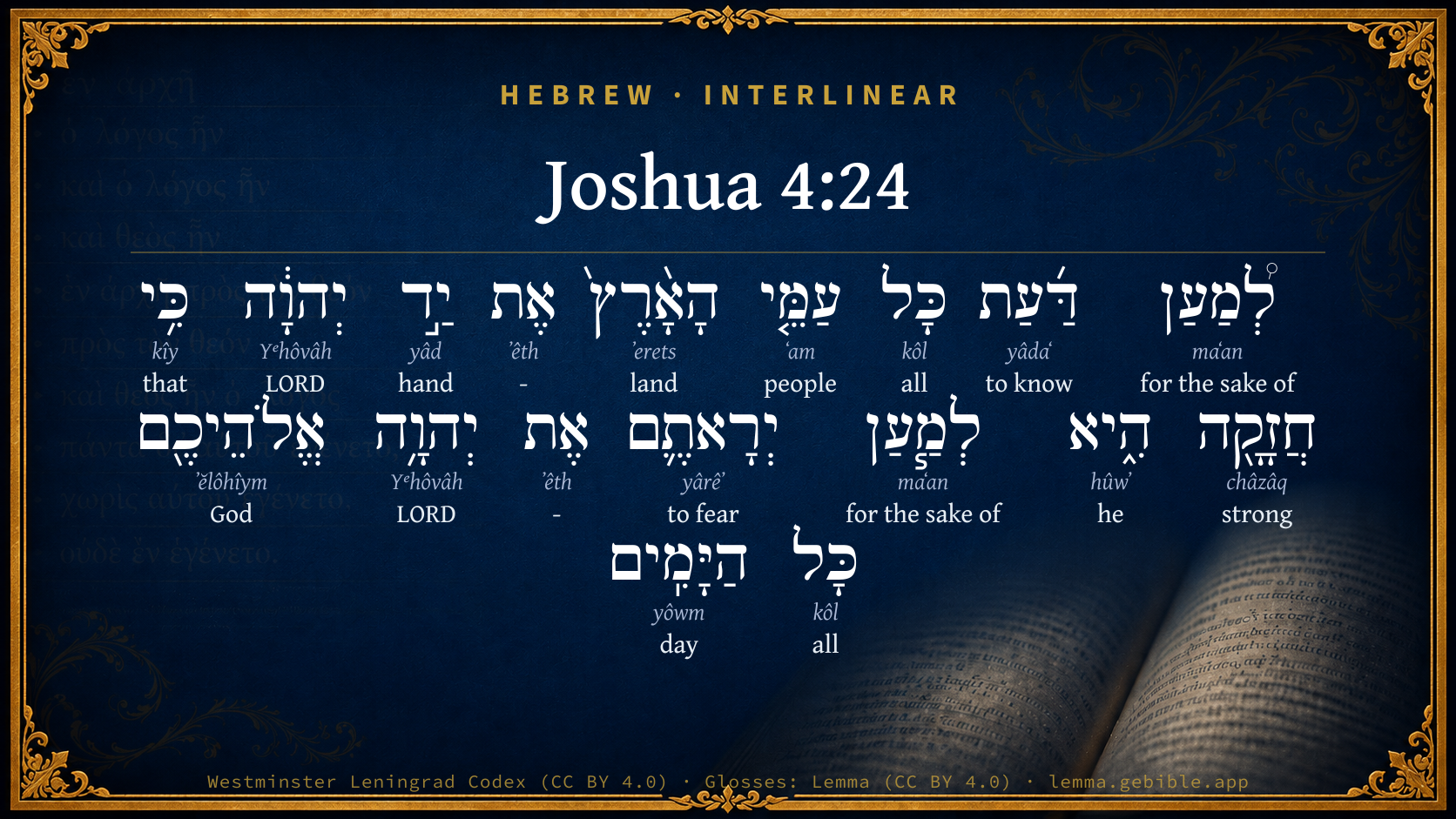
Hebrew (Westminster Leningrad Codex) Joshua 4:24 appears in the Hebrew Old Testament. The text above is from the Westminster Leningrad Codex. Each word links to its Strong’s number, a concise gloss, and parsing drawn from the Open Scriptures Hebrew Bible morphology. Click any word for its full Brown-Driver-Briggs (BDB) entry.
Download image
Cite this verse

Joshua 4:24 (World English Bible). Public Domain. Lemma interlinear Bible study tool, https://lemma.gebible.app/v/joshua/4/24.

Show BibTeX & RIS
BibTeX
RIS
English Translation
that all the peoples of the earth may know the hand of Yahweh, that it is mighty; that you may fear Yahweh your God forever.
World English Bible · Public Domain
Download a study sheet

One document with this verse’s original text, its word-by-word gloss line, the meaning frame, cross-references with their text, attributed commentary, and full source and license credits — printable, and it pastes into notes with its structure intact.

This verse Autodidact and up

Study sheet (.html) Plain text (.txt)

A passage Seminary Student

Up to 50 verses in one chapter. A passage sheet keeps up to 6 commentary sources and 12 cross-references per verse, in the order this page ranks them, and says so on the sheet whenever that leaves anything out. Ask for a single verse and you get the Autodidact verse sheet above.

Everything on this page stays free to read, with no account — the sheet is a download of what is already on screen, not access to it.

Want to remove ads? Support Godless Engineer
Compare translations 3

The same verse in 3 English versions, stacked beneath the original-language interlinear above. Click any original word for its lexicon entry.

Each is an independent rendering of the whole verse — the interlinear is not word-aligned to these translations.

Highlighted words mark where these versions differ — a whole-verse word diff, not a word-by-word alignment.

  • World English Bible Public Domain
    that all the peoples of the earth may know the hand of Yahweh, that it is mighty; that you may fear Yahweh your God forever.
  • King James Version Public Domain
    That all the people of the earth might know the hand of the LORD, that it is mighty: that ye might fear the LORD your God for ever.
  • unfoldingWord Literal Text CC BY-SA 4.0
    so that all of the peoples of the earth may know the hand of Yahweh, that it is mighty, so that you will fear Yahweh your God all of the days.”

unfoldingWord Literal Text — © unfoldingWord, licensed CC BY-SA 4.0. Word-aligned USFM3 via Door43 (git.door43.org/unfoldingWord/en_ult).

Versions to compare (up to 4)

3 of 4 selected

Show all 18 translations

Every available English version of this verse, each an independent rendering of the whole verse.

  • World English Bible Public Domain
    that all the peoples of the earth may know the hand of Yahweh, that it is mighty; that you may fear Yahweh your God forever.
  • Berean Standard Bible Public Domain
    He did this so that all the peoples of the earth may know that the hand of the LORD is mighty, and so that you may always fear the LORD your God.”
  • Majority Standard Bible Public Domain
    He did this so that all the peoples of the earth may know that the hand of the LORD is mighty, and so that you may always fear the LORD your God.”
  • King James Version Public Domain
    That all the people of the earth might know the hand of the LORD, that it is mighty: that ye might fear the LORD your God for ever.
  • American Standard Version (1901) Public Domain
    that all the peoples of the earth may know the hand of Jehovah, that it is mighty; that ye may fear Jehovah your God for ever.
  • Revised Version (1885) Public Domain
    that all the peoples of the earth may know the hand of the LORD, that it is mighty; that they may fear the LORD your God for ever.
  • Geneva Bible (1599) Public Domain
    That all the people of the worlde may know that the hand of the Lord is mightie, that ye might feare the Lord your God continually.
  • Douay-Rheims (1899) Public Domain
    As he had done before in the Red Sea, which he dried up till we passed through:
  • Young's Literal Translation Public Domain
    so that all the people of the land do know the hand of Jehovah that it `is' strong, so that ye have reverenced Jehovah your God all the days.'
  • Literal Standard Version CC BY-SA 4.0
    so that all the people of the land know the hand of YHWH—that it [is] strong, so that you have feared your God YHWH [for] all the days.”
  • Unlocked Literal Bible CC BY-SA 4.0
    so that all the peoples of the earth may know that the hand of Yahweh is mighty, and that you will honor Yahweh your God forever.”
  • unfoldingWord Literal Text CC BY-SA 4.0
    so that all of the peoples of the earth may know the hand of Yahweh, that it is mighty, so that you will fear Yahweh your God all of the days.”
  • Darby Bible Public Domain
    that all peoples of the earth might know the hand of Jehovah, that it is mighty; that ye might fear Jehovah your God continually.
  • World Messianic Bible Public Domain
    that all the peoples of the earth may know that the LORD’s hand is mighty, and that you may fear the LORD your God forever.’”
  • Webster's Bible Public Domain
    That all the people of the earth might know the hand of the LORD that it is mighty: that ye might fear the LORD your God for ever.
  • Free Bible Version CC BY-SA 4.0
    He did this so everyone on earth would know how powerful the Lord is, and so that you might be in awe of the Lord your God forever.”
  • Bible in Basic English Public Domain
    So that all the peoples of the earth may see that the hand of the Lord is strong; and that they may go in fear of the Lord your God for ever.
  • JPS Tanakh (1917) Public Domain
    that all the peoples of the earth may know the hand of the LORD, that it is mighty; that ye may fear the LORD your God for ever.'

Literal Standard Version (2020), Covenant Press — licensed CC BY-SA 4.0. Text via the HelloAO Bible API (eBible.org). Unlocked Literal Bible (unfoldingWord) — licensed CC BY-SA 4.0. Text via the HelloAO Bible API (eBible.org). unfoldingWord Literal Text — © unfoldingWord, licensed CC BY-SA 4.0. Word-aligned USFM3 via Door43 (git.door43.org/unfoldingWord/en_ult). Free Bible Version, Dr. Jonathan Gallagher — licensed CC BY-SA 4.0. Text via the HelloAO Bible API (eBible.org).

Word by word

More ways to search: Search by grammar → Find every occurrence → Compare this word →

Practice this passage: Drill this verse → Learn its vocabulary →

חֲזָקָ֖ה
châzâq
H2389
“strong”
Adjective, Adjective, Feminine, Singular, Absolute
Part of Speech
Adjective
Type
Adjective
Gender
Feminine
Number
Singular
State
Absolute
Full BDB Definition

Origin: from H2388

TWOT: 636a

strong, stout, mighty - strong - severe, sharp, hot - firm, hard - a strong one (substantive)
  1. לְ֠מַעַן maʻan H4616 “for the sake of” Preposition
  2. דַּ֜עַת yâdaʻ H3045 “to know” Verb, Qal, Infinitive Construct
  3. כָּל kôl H3605 “all of” Noun, Common, Masculine, Singular, Construct
  4. עַמֵּ֤י ʻam H5971 “peoples of” Noun, Common, Masculine, Plural, Construct
  5. הָאָ֨רֶץ֙ ʼerets H776 “the · land” Particle, Definite Article + Noun, Common, Both, Singular, Absolute
  6. אֶת ʼêth H853 “-” Particle, Direct Object
  7. יַ֣ד yâd H3027 “hand of” Noun, Common, Both, Singular, Construct
  8. יְהוָ֔ה Yᵉhôvâh H3068 “LORD” Noun, Proper
  9. כִּ֥י kîy H3588 “that” Conjunction
  10. הִ֑יא hûwʼ H1931 “he” Pronoun, Personal, 3rd Person, Feminine, Singular
  11. לְמַ֧עַן maʻan H4616 “for the sake of” Preposition
  12. יְרָאתֶ֛ם yârêʼ H3372 “to fear” Verb, Qal, Perfect, 2nd Person, Masculine, Plural
  13. אֶת ʼêth H853 “-” Particle, Direct Object
  14. יְהוָ֥ה Yᵉhôvâh H3068 “LORD” Noun, Proper
  15. אֱלֹהֵיכֶ֖ם ʼĕlôhîym H430 “God(s) · your” Noun, Common, Masculine, Plural, Construct + Suffix, Personal, 2nd Person, Masculine, Plural
  16. כָּל kôl H3605 “all of” Noun, Common, Masculine, Singular, Construct
  17. הַיָּמִֽים yôwm H3117 “the · days” Particle, Definite Article + Noun, Common, Masculine, Plural, Absolute

About this verse

These counts appear in no published source. They are computed here, from the morphology-tagged text and Lemma’s own curated glosses. What Lemma adds →

18
words
14
distinct lemmas
Historical
section

Shared distinctive vocabulary

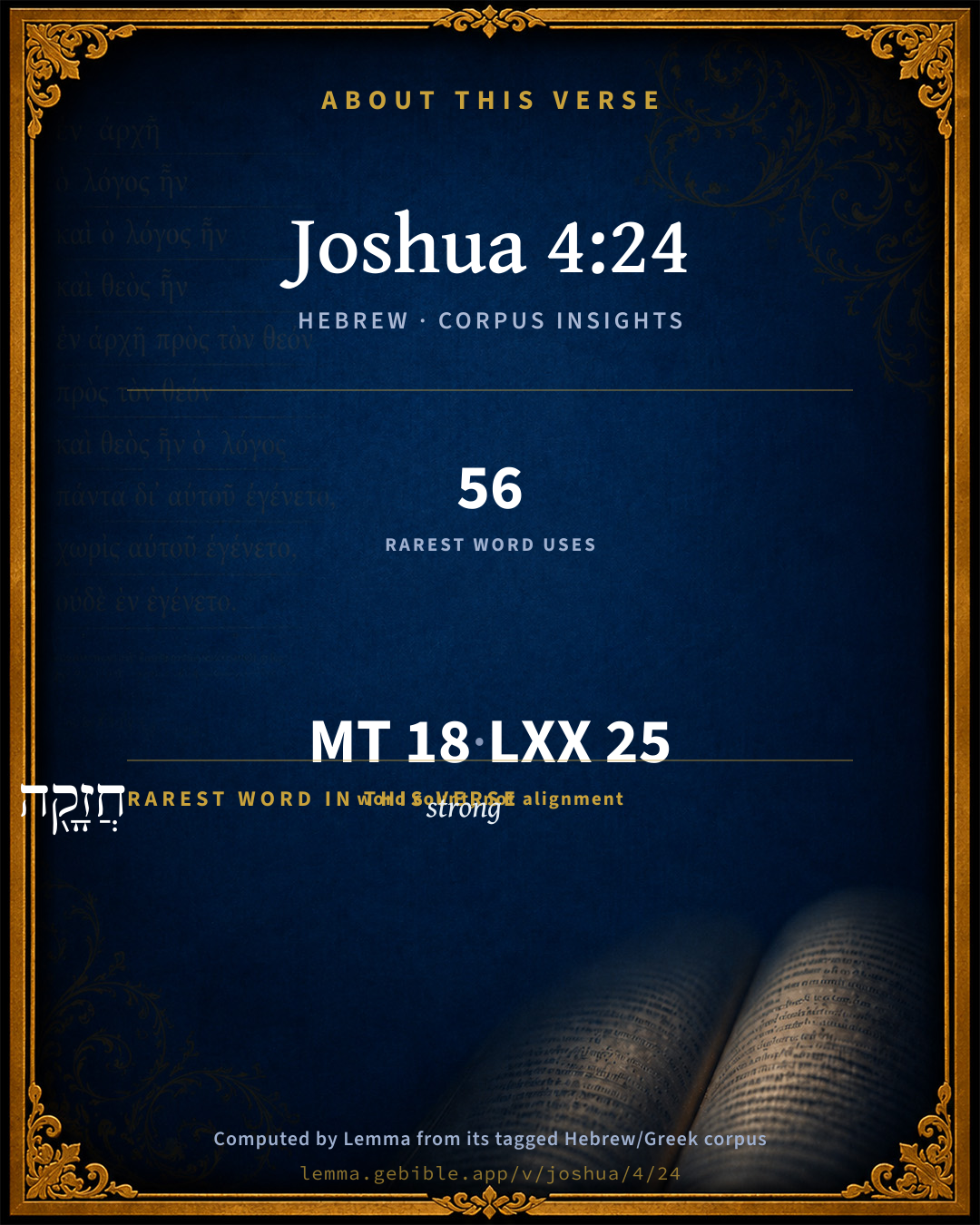
חֲזָקָ֖ה strong H2389 occurs in 54 verses of the Hebrew Bible. Also found in:

Grammatical profile

  • 2 verbs
  • 9 nouns
  • 1 adjective
  • 1 pronoun
  • 2 prepositions
  • 1 conjunction
  • 2 particles

Verb forms

  • דַּ֜עַת Qal · Infinitive Construct
  • יְרָאתֶ֛ם Qal · Perfect

Repetition

Words recur within this verse — often emphatic in Hebrew:

  • לְ֠מַעַן for the sake of H4616 ×2
  • כָּל all H3605 ×2
  • יְהוָ֔ה LORD H3068 ×2

Hebrew & Septuagint length

In English translation the verse runs 25 words from the Hebrew and 29 from the Septuagint (LXX English) — closely comparable.

A rough comparison of the two English renderings, which tokenize alike — not a word-level alignment.

Word counts can differ between the Hebrew and the Greek without any difference in meaning — e.g. the Hebrew direct-object marker אֵת has no separate Greek word, and Greek often adds the article ὁ.

In the original languages it is 18 Hebrew tokens and 25 Greek tokens — but the two are counted differently (Hebrew bundles its prefixes and suffixes into one token; the Greek is in lemma form), so that isn’t a like-for-like length.

Cross-references

20

Topical passages linked to Joshua 4:24 in the Treasury of Scripture Knowledge — connected by theme and wording, ordered by reader-vote popularity; previews shown in the World English Bible.

  • Psalms 106:8 Nevertheless he saved them for his name's sake, That he might make his mighty power known.
  • 1 Kings 8:42–43 (for they shall hear of your great name, and of your mighty hand, and of your outstretched arm); when he shall come and pray toward this house;
  • Psalms 89:13 You have a mighty arm. Your hand is strong, and your right hand is exalted.
  • Exodus 14:31 Israel saw the great work which Yahweh did to the Egyptians, and the people feared Yahweh; and they believed in Yahweh, and in his servant Moses.
  • Exodus 15:16 Terror and dread falls on them. By the greatness of your arm they are as still as a stone; Until your people pass over, Yahweh, Until the people pass over who you have purchased.
  • 2 Kings 19:19 Now therefore, Yahweh our God, save you us, I beg you, out of his hand, that all the kingdoms of the earth may know that you Yahweh are God alone.
  • 1 Chronicles 29:12 Both riches and honor come of you, and you rule over all; and in your hand is power and might; and it is in your hand to make great, and to give strength to all.
  • Deuteronomy 6:2 that you might fear Yahweh your God, to keep all his statutes and his commandments, which I command you, you, and your son, and your son's son, all the days of your life; and that your days may be prolonged.
  • Exodus 9:16 but indeed for this cause I have made you stand: to show you my power, and that my name may be declared throughout all the earth;
  • Exodus 20:20 Moses said to the people, "Don't be afraid, for God has come to test you, and that his fear may be before you, that you won't sin."
  • 1 Samuel 17:46 This day will Yahweh deliver you into my hand; and I will strike you, and take your head from off you; and I will give the dead bodies of the host of the Philistines this day to the birds of the sky, and to the wild animals of the earth; that all the earth may know that there is a God in Israel,
  • 2 Kings 5:15 He returned to the man of God, he and all his company, and came, and stood before him; and he said, See now, I know that there is no God in all the earth, but in Israel: now therefore, please take a present from your servant.
  • Psalms 76:6–8 At your rebuke, God of Jacob, Both chariot and horse are cast into a deep sleep.
  • Psalms 89:7 A very awesome God in the council of the holy ones, To be feared above all those who are around him?
  • Jeremiah 10:6–7 There is none like you, Yahweh; you are great, and your name is great in might.
  • Jeremiah 32:40 and I will make an everlasting covenant with them, that I will not turn away from following them, to do them good; and I will put my fear in their hearts, that they may not depart from me.
  • Daniel 3:26–29 Then Nebuchadnezzar came near to the mouth of the burning fiery furnace: he spoke and said, Shadrach, Meshach, and Abednego, you servants of the Most High God, come forth, and come here. Then Shadrach, Meshach, and Abednego came forth out of the midst of the fire.
  • Daniel 4:34–35 At the end of the days I, Nebuchadnezzar, lifted up my eyes to heaven, and my understanding returned to me, and I blessed the Most High, and I praised and honored him who lives forever; for his dominion is an everlasting dominion, and his kingdom from generation to generation.
  • Daniel 6:26–27 I make a decree, that in all the dominion of my kingdom men tremble and fear before the God of Daniel; for he is the living God, and steadfast forever, His kingdom that which shall not be destroyed; and his dominion shall be even to the end.
  • Deuteronomy 28:10 All the peoples of the earth shall see that you are called by the name of Yahweh; and they shall be afraid of you.

Cross-references courtesy of OpenBible.info (CC BY 4.0).

Hebrew and Greek witnesses Masoretic Hebrew ↔ Greek Septuagint

The same verse in the two great witnesses to the Old Testament, shown verse-for-verse.

These are two independent witnesses, not word-aligned to each other, and the Septuagint is shown in lemma (dictionary) form.

Hebrew Joshua 4:24 Masoretic · Westminster Leningrad Codex

לְ֠מַעַן דַּ֜עַת כָּל עַמֵּ֤י הָאָ֨רֶץ֙ אֶת יַ֣ד יְהוָ֔ה כִּ֥י חֲזָקָ֖ה הִ֑יא לְמַ֧עַן יְרָאתֶ֛ם אֶת יְהוָ֥ה אֱלֹהֵיכֶ֖ם כָּל הַיָּמִֽים

that all the peoples of the earth may know the hand of Yahweh, that it is mighty; that you may fear Yahweh your God forever.

World English Bible · Public Domain

Greek LXX Joshua 4:24 Septuagint · lemma form

ὅπως γιγνώσκω πᾶς ὁ ἔθνος ὁ γῆ ὅτι ὁ δύναμις ὁ κύριος ἰσχυρός εἰμί καί ἵνα σύ σέβω κύριος ὁ θεός σύ ἐν πᾶς χρόνος

That all the nations of the earth might know, that the power of the Lord is mighty, and that you⌃ might worship the Lord our God in every work.

LXX2012 (modern English Septuagint) · Public Domain

On this verse, John Gill's Exposition discusses the Septuagint’s reading. Read the note in Commentary ↓

Hebrew: Westminster Leningrad Codex (CC BY 4.0). Greek: Septuagint (public domain); English from LXX2012 (modern English Septuagint) (Public Domain). How the Septuagint differs from the Hebrew →

Targum (Aramaic paraphrase)

1

The Targum is the ancient Jewish Aramaic paraphrase of the Hebrew Scriptures — an interpretive translation, not the Hebrew text itself. Onkelos (literal) and Pseudo-Jonathan (expansive) render the Torah, and Jonathan the Prophets. Coverage is partial: where no permissively-licensed English translation exists for a verse, only the Aramaic is shown. This is verse-level text, not a word-by-word alignment to the Hebrew.

  1. Targum Jonathan Prophets (Joshua–Malachi)
    בְּדִיל דְיֵדְעוּן כָּל עַמְמֵי אַרְעָא יַת גְבוּרְתָּא דַייָ אֲרֵי תַקִיפָה הִיא בְּדִיל דְתִדְחֲלוּן יַת יְיָ אֱלָהָכוֹן כָּל יוֹמַיָא:

    (no public-domain English translation for this verse)

    Targum Jonathan — Aramaic: “Mikraot Gedolot” (public domain). English: “Sefaria Community Translation” (CC0 1.0 (public-domain dedication)); “London "Chaldee Paraphrase," 1871” (public domain). Text via Sefaria.

Commentary

Notes on Joshua 4:24 from classic Christian and Jewish commentators (each source and its license shown beneath its notes). The classic Christian expositions comment on the surrounding passage and are grouped to its opening verse, so a note may address several verses; the Jewish commentaries on the Tanakh (Rashi and others) are per-verse, so they appear only where the commentator wrote on this verse.

Lemma curates 59 commentaries, every one of them public domain or Creative Commons licensed, each selected and text-cleaned for this edition rather than reprinted as found. About our sources →

Trapp's Complete Commentary

John Trapp

Jos 4:24 That all the people of the earth might know the hand of the LORD, that it [is] mighty: that ye might fear the LORD your God for ever.

Ver. 24. That all the people of the earth might know.] And acknowledge God’s power and providence: for at his own glory he aimeth in all his actions, and at the good of his people.

John Trapp, A Commentary or Exposition upon All the Books of the Old and New Testament (1647–1656) — public domain. Text from a community e-Sword module.

Joseph Benson's Commentary

Jos 4:24. That all the people of the earth might know, &c. — Although this may primarily mean the neighbouring nations, yet there is great reason to think that both this and Exo 9:16, That my name may be declared throughout all the earth, had a prophetic aspect, and looked to distant ages, even to the end of time, and to all the nations on the face of the earth; to whom these wonderful facts should bear witness of the true God, as well as to the surrounding nations. And when we consider how the Holy Scriptures, the record of these facts, have been already carried into almost every nation, what a forcible evidence they bear with them, how entire they still remain after so many thousands of years, and what probability there is, when the Jews are converted, that they will be made more known in every nation and language, we may see great reason to conclude that these miracles were intended to make known the power of the true God to all nations, as well as to the Israelites; and in fact they do equally declare him to us, as they did to them.

Joseph Benson's Commentary on the Old and New Testaments (1811–1818) — public domain. Text from a community e-Sword module.

Tyndale Open Study Notes

Tyndale Open Resources

4:24 In addition to future generations of Israelites, all the nations of the earth were to understand God’s power. At least some individuals in every group respond to the God who cares for them (Rev 7:9-10).

Tyndale Open Study Notes — © Tyndale Open Resources, licensed CC BY-SA 4.0. Text via the HelloAO Bible API.

Geneva Bible (1599)

Geneva Bible translators

God’s benefits serve for a further condemnation to the wicked, and stir up his to reverence him, and obey him.

Geneva Bible (1599) marginal notes — public domain. Text via Bolls.life.

Adam Clarke's Commentary

Verse 24. That all the people of the earth might know] It is very likely that כל עמי הארץ col ammey haarets means simply, all the people of this land - all the Canaanitish nations, to whom, by the miracles wrought in behalf of his people, he intended to show his eternal power and Godhead, the excellence of his protection, and the unavailableness of human might against his omnipotence; and the miracles he wrought for this people, in the sight of the heathen, were well calculated to make these things known.

1. GOD intends that his religion should be maintained and propagated in the earth; therefore he has given a revelation of himself to men, that it may be taught in the world; and he particularly requires that parents should be diligent and fervent in teaching their children the knowledge of his name.

2. This is one great use of the ordinances of the Gospel, and the rites of religion. They are all significators of sacred things, and point out matters of infinite importance beyond themselves.

3. A spirit of inquiry is common to every child: the human heart is ever panting after knowledge; and if not rightly directed when young, will, like that of our first mother, go astray after forbidden science.

4. If we wish our children to be happy we should show them where happiness is to be found. If we wish them to be wise, we should lead them unto God by means of his word and ordinances. It is natural for a child to inquire, "What do you mean by this baptism? - by this sacrament?. - by praying - by singing psalms and hymns?" &c. And what fine opportunities do such questions give pious and intelligent parents to instruct their children in every article of the Christian faith, and in every fact on which these articles are established! Oh why is this neglected, while the command of God is before our eyes, and the importance of the measure so strikingly obvious?

Adam Clarke's Commentary on the Bible (1810–1826) — public domain. Text from a community e-Sword/MySword module.

John Calvin's Commentaries

24. That all people of the earth might know, etc He states that God had put forth that manifestation of his power that it might not only be proclaimed among his own people, but that the form of it might spread far and wide among the nations. For although it pleased him that his praise should dwell in Zion, it pleased him also that his works should so far be made known to strangers that they might be forced to confess that he is the true God, and compelled unwillingly to fear him whom they had willingly contemned, as it is said in the song of Moses, (Deuteronomy 32:31) “Our enemies are judges.” For he means that unbelievers, whether they will or not, have this confession extorted from them by a knowledge of the works of God. But as it did not at all profit them to know how great the might of God was, Joshua distinguishes them from the Israelites, to whom he attributes a special knowledge, namely, that which begets serious fear of God. That the nations may know, he says; but that thou may fear thy God. Therefore while unbelievers extinguish the light by their darkness, let us learn from considering the works of God to advance in his fear. He says all days, because the favor here spoken of was diffused over several generations.

John Calvin's Commentaries (1540-1563) — public domain. Text from the Calvin Translation Society English edition (1840s-50s) via the Christian Classics Ethereal Library (ccel.org). Calvin's coverage is partial (roughly two-thirds of the Bible); uncommented books and verses are honest gaps, never fabricated. The 19th-century editor's footnotes and remarks are omitted so the notes are faithfully Calvin's own voice.

The Cambridge Bible for Schools and Colleges

gen. ed. J. J. S. Perowne

24. that all the people of the earth might know] The miracle made the passage possible and easy for the Elect Nation, but it was intended also to have its effect on the nations around, and impart to them a knowledge of the power of Jehovah, the God of Israel.

that ye might fear] The tribes of Israel were now in the enemy’s country, and they had learnt afresh, as their fathers had done before them at the Red Sea, three important lessons; (i) that the power of Jehovah was unlimited; (ii) that it would be exerted on their behalf so long as they were obedient to His commands; (iii) that their leader was acting under the direct command and guidance of their Invisible Protector. These lessons were of universal application and were to be impressed on generation after generation.

The Cambridge Bible for Schools and Colleges (gen. ed. J. J. S. Perowne; Cambridge University Press, 1878–1918) — public domain. Text from a community e-Sword module.

John Gill's Exposition

That all the people of the earth might know the hand of the Lord, that it is mighty,.... Even almighty, and can do that which is marvellous and surprising, and above the power of nature to effect; things unsearchable and past finding out, which cannot be expressed, or conceived how and by what means they are brought about; this the very Heathens would own and acknowledge when they should see these stones, and be told the meaning of them, or should hear of this amazing event:

that ye might fear the Lord your God for ever; as the above mentioned end was to be answered among the people of the earth by these stones, this among the people of Israel; who upon sight of them would call to mind the power and goodness of God, which would serve to keep an awe of his majesty on their mind, a due reverence of him and his greatness, and engage them to fear, serve, and worship him; who by such acts as these had abundantly showed himself to be the only true and living God, and the covenant God of them his people Israel; the Septuagint version is,"that ye may worship the Lord your God in every work.''

Next: Joshua Chapter 5

John Gill's Exposition of the Whole Bible (1746–1763) — public domain (CC PDM 1.0). Text via the HelloAO Bible API.

Whedon's Commentary on the Bible

Daniel D. Whedon

24. All the people of the earth — We need not limit this expression to mean merely the nations of the land of Canaan, for this amazing miracle was doubtless designed to teach impressive lessons of divine power to the nations of all coming ages.

Daniel D. Whedon (gen. ed.), Commentary on the Old and New Testaments (1874–1909) — public domain. Text from a community e-Sword module.

The Pulpit Commentary

The hand of the Lord, that it is mighty. "Thus the river, though dumb, was the best of heralds, proclaiming with a loud voice that heaven and earth are subject to the Lord God of Israel" (Calvin). That ye might fear. The construction here is unusual. Instead of the imperfect or infinitive with ml we have the perfect. Therefore Ewald, Maurer, and Knobel (who says that the second member of the sentence ought to correspond with the first) have altered the pointing in order to bring this passage into conformity with the supposed necessities of grammar. In so doing they have robbed it of its picturesqueness and its meaning. For the object is clearly to show the lasting nature of the fear, "that ye might recognise now the hand of the Lord, that ye might have a thorough and lasting fear of his name." We may here remark on the necessarily miraculous character of the whole narrative of the crossing the Jordan. It admits of no explaining away. The account must either be accepted or rejected en bloc. First we have the specific declaration of Rahab in Jos_2:10, that Jehovah dried up the Red Sea, and that this proof of the peculiar protection of Israel by the Most High had struck terror into the hearts of the inhabitants of Canaan. Next we have the fact that Jordan had overflowed its banks. The dangerous nature of the crossing, even at ordinary times, has been mentioned already. Lives are frequently lost in the attempt, as recent travellers with one voice declare. At the time when the waters were out such a crossing was practically impossible to a host like the host of Israel. Nor can there be any mistake about its being the period of the overflowing of Jordan, for the time of the crossing is mentioned. It was the time of harvest that is, of the barley harvest. This is confirmed by the fact that the recently cut flax was now lying on the roof of Rahab"s house, and by the fact that the harley and flax ripened together, a coincidence which we have already mentioned in the note on Jos_2:6. The time is yet further defined. It was the "tenth day of the first month." We learn, moreover, from Lev_23:9-15 and Deu_16:6 that this was the time when the firstfruits were offered, from which seven weeks were reckoned to the beginning of wheat harvest. (Exo_34:2) Moreover, the passover was kept immediately afterwards, (Jos_5:10) on "the fourteenth day of the first month." Thus the date of the crossing, which is accurately fixed by a variety of circumstances, is clearly proved to correspond with the time of Jordan"s overflow. We next come to the measures taken to secure the crossing. There is likewise no mistake here. Not one single intimation is given of an endeavour to break in any way the force of the current, or to preserve the Israelites, either men, women, or children, from the imminent risk they ran of death by drowning. Not only are no other expedients resorted to, but no animals seem to have been prepared to transport them over. Nor, again, were any means used to elude the vigilance of the inhabitants of Canaan. Readers of Xenophon"s "Anabasis" will not fail to notice how often the passage of the rivers was a matter of the utmost difficulty to that expedition, and how fiercely attempts at crossing were disputed by the half savage tribes of Asia Minor. How are we to account for the fact that no opposition was offered to Joshua"s passage by the highly civilised nations of Palestine? According to the narrative before us it was effected in the most leisurely and peaceful manner. What other explanation is possible titan that offered in the text, that when the feet of the priests bearing the ark touched the waters, those waters were cut off by supernatural power, and a way was miraculously made for the people of God through the midst of Jordan? The crossing was remarkable enough, we are told, to have been commemorated by a double memorial (vers. 8, 9). If it had taken place through an unusually easy ford there would have been nothing remarkable about it. Therefore it is clear that the whole narrative of the crossing is either absolute fable or strictly and historically accurate. Let us conclude by summing up the several reasons which make the former alternative inadmissible. The first is the precision with which the date is fixed, and the fact that the correctness of this date is confirmed, as we have seen, by a variety of corroborative evidence. The next is the simplicity and artlessness of the narrative, and its appeal to still existing monuments as confirmatory of the facts recorded. The third is that no account of a battle at Jordan is even hinted at by the Hebrew or any other historian, a battle which must infallibly have taken place had the Israelites attempted to enter Palestine in any ordinary manner; for the supposition that the waters of the ford at Jericho were unusually low at this time is quite inadmissible for the reasons given above; nor can it be supposed that the Israelites crossed the river by any other ford without rejecting the whole history of the conquest. The last reason is the touch of detail given in the word trm which seems to mark the transition from the soft adhesive mud of the river to the firmness of the dry land beyond (for the word translated "dry land" in Jos_3:17 only means that it was land and not water Gesenius). Our witness, in fact, can be subjected to the severest cross examination without shaking his testimony. And we are thus compelled to choose between accepting the literal correctness of the narrative as it stands, or crediting the author with a skill in constructing a work of fiction which itself scarcely falls short of the miraculous.

The Pulpit Commentary (1880–1919), ed. H.D.M. Spence-Jones & Joseph S. Exell — public domain. Text from a community e-Sword module.

Lesson kit

Teaching starters — assembled from the data on this page, not authored interpretation. Every prompt links to the verse data it draws on. Edit before teaching.

Joshua, in the Historical, opens this verse with 18 words (14 distinct Hebrew lemmas). Its most distinctive word is châzâq (“strong”). A historical commentator’s framing appears above. Read the whole chapter for the surrounding context.

Discussion questions

  1. The word châzâq carries the sense “strong.” How does it shape the verse?
  2. Exodus 3:19 shares the word «strong» with this verse. How do the two illuminate each other?
  3. “for the sake of” occurs 2× in this one verse. What is the effect of the repetition?
  4. The translations on this page render this verse differently — a whole-verse word diff, not a word-by-word alignment. What might account for the different wordings?
  5. The verb «דַּ֜עַת» is Qal Infinitive Construct. How does its form color the action?
  6. Reading how Trapp's Complete Commentary and Joseph Benson's Commentary read this verse, where do the two commentators agree and where do they part?

Things to notice

Reading settings

Reading text

Shown beneath each verse's original-language words.

Old Testament
Old Testament edition

Read the OT as the Masoretic Hebrew (MT) or the Greek Septuagint (LXX).

English shown for the Greek Septuagint (in the Hebrew ↔ Greek comparison).

Comparing translations? Open the Compare panel on any verse page to stack up to four side by side.