

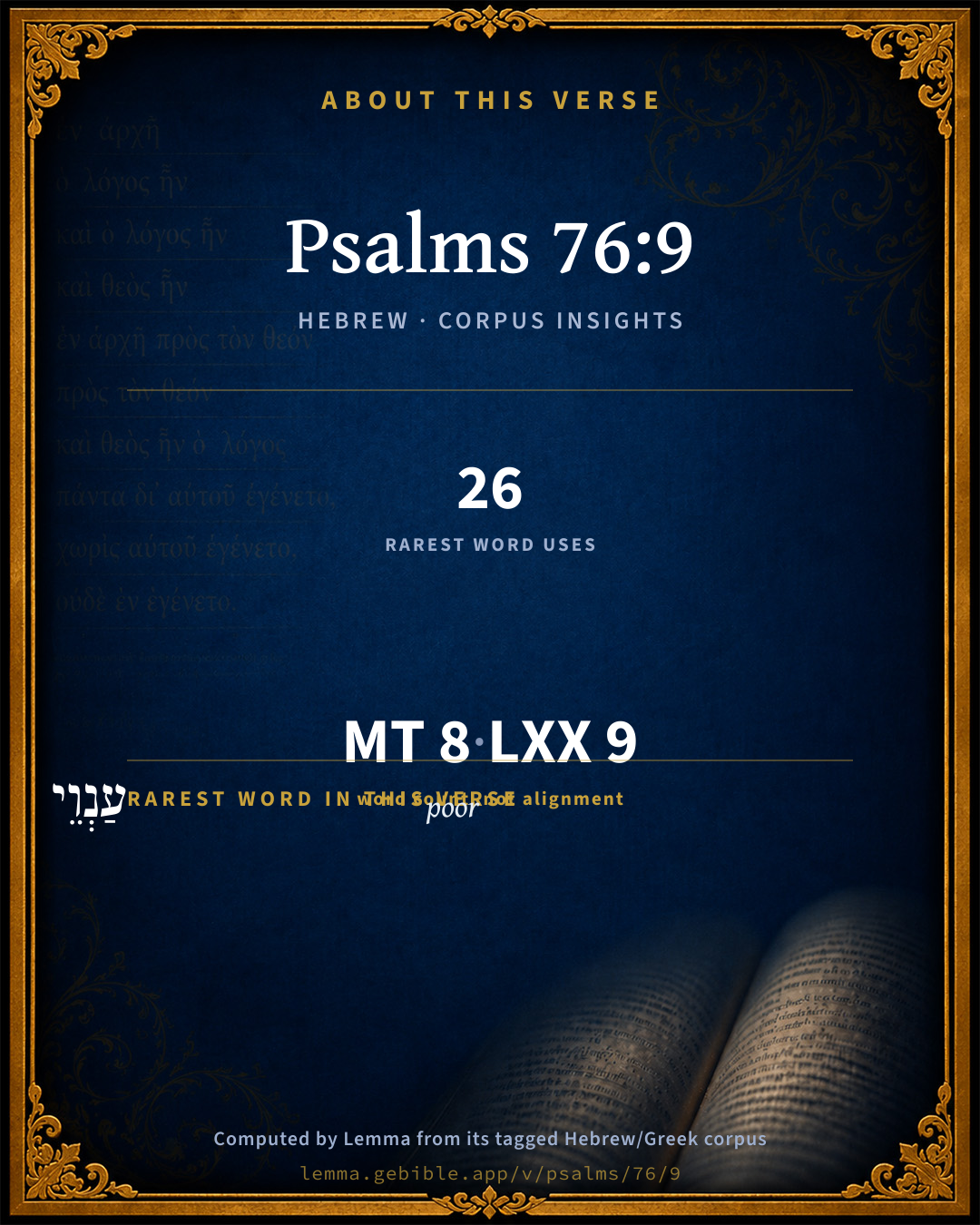
Psalms 76:9

Hebrew (Westminster Leningrad Codex) Psalms 76:9 appears in the Hebrew Old Testament. The text above is from the Westminster Leningrad Codex. Each word links to its Strong’s number, a concise gloss, and parsing drawn from the Open Scriptures Hebrew Bible morphology. Click any word for its full Brown-Driver-Briggs (BDB) entry.
Download image
Cite this verse

Psalms 76:9 (World English Bible). Public Domain. Lemma interlinear Bible study tool, https://lemma.gebible.app/v/psalms/76/9.

Show BibTeX & RIS
BibTeX
RIS
English Translation
When God arose to judgment, To save all the afflicted ones of the earth. Selah.
World English Bible · Public Domain
Download a study sheet

One document with this verse’s original text, its word-by-word gloss line, the meaning frame, cross-references with their text, attributed commentary, and full source and license credits — printable, and it pastes into notes with its structure intact.

This verse Autodidact and up

Study sheet (.html) Plain text (.txt)

A passage Seminary Student

Up to 50 verses in one chapter. A passage sheet keeps up to 6 commentary sources and 12 cross-references per verse, in the order this page ranks them, and says so on the sheet whenever that leaves anything out. Ask for a single verse and you get the Autodidact verse sheet above.

Everything on this page stays free to read, with no account — the sheet is a download of what is already on screen, not access to it.

Want to remove ads? Support Godless Engineer
Compare translations 3

The same verse in 3 English versions, stacked beneath the original-language interlinear above. Click any original word for its lexicon entry.

Each is an independent rendering of the whole verse — the interlinear is not word-aligned to these translations.

Highlighted words mark where these versions differ — a whole-verse word diff, not a word-by-word alignment.

  • World English Bible Public Domain
    When God arose to judgment, To save all the afflicted ones of the earth. Selah.
  • King James Version Public Domain
    When God arose to judgment, to save all the meek of the earth. Selah.
  • unfoldingWord Literal Text CC BY-SA 4.0
    when God arose to judgment, to save all the humble of the earth. Selah ts\*

unfoldingWord Literal Text — © unfoldingWord, licensed CC BY-SA 4.0. Word-aligned USFM3 via Door43 (git.door43.org/unfoldingWord/en_ult).

Versions to compare (up to 4)

3 of 4 selected

Show all 18 translations

Every available English version of this verse, each an independent rendering of the whole verse.

  • World English Bible Public Domain
    When God arose to judgment, To save all the afflicted ones of the earth. Selah.
  • Berean Standard Bible Public Domain
    when God rose up to judge, to save all the lowly of the earth. Selah
  • Majority Standard Bible Public Domain
    when God rose up to judge, to save all the lowly of the earth. Selah
  • King James Version Public Domain
    When God arose to judgment, to save all the meek of the earth. Selah.
  • American Standard Version (1901) Public Domain
    When God arose to judgment, To save all the meek of the earth. Selah
  • Revised Version (1885) Public Domain
    When God arose to judgment, to save all the meek of the earth. Selah
  • Geneva Bible (1599) Public Domain
    When thou, O God, arose to iudgement, to helpe all the meeke of the earth. Selah.
  • Douay-Rheims (1899) Public Domain
    Thou hast caused judgment to be heard from heaven: the earth trembled and was still,
  • Young's Literal Translation Public Domain
    In the rising of God to judgment, To save all the humble of earth. Selah.
  • Literal Standard Version CC BY-SA 4.0
    In the rising of God to judgment, || To save all the humble of earth. Selah.
  • Unlocked Literal Bible CC BY-SA 4.0
    when you, God, arose to execute judgment and to save all the oppressed of the earth. Selah
  • unfoldingWord Literal Text CC BY-SA 4.0
    when God arose to judgment, to save all the humble of the earth. Selah ts\*
  • Darby Bible Public Domain
    When God rose up to judgment, to save all the meek of the earth. Selah.
  • World Messianic Bible Public Domain
    when God arose to judgment, to save all the afflicted ones of the earth. Selah.
  • Webster's Bible Public Domain
    \\76:8\\Thou didst cause judgment to be heard from heaven; the earth feared, and was still,
  • Free Bible Version CC BY-SA 4.0
    when you stood up to judge, to save the oppressed people of the earth. Selah.
  • Bible in Basic English Public Domain
    When God took his place as judge, for the salvation of the poor on the earth. (Selah.)
  • JPS Tanakh (1917) Public Domain
    (76-10) When God arose to judgment, to save all the humble of the earth. Selah

Literal Standard Version (2020), Covenant Press — licensed CC BY-SA 4.0. Text via the HelloAO Bible API (eBible.org). Unlocked Literal Bible (unfoldingWord) — licensed CC BY-SA 4.0. Text via the HelloAO Bible API (eBible.org). unfoldingWord Literal Text — © unfoldingWord, licensed CC BY-SA 4.0. Word-aligned USFM3 via Door43 (git.door43.org/unfoldingWord/en_ult). Free Bible Version, Dr. Jonathan Gallagher — licensed CC BY-SA 4.0. Text via the HelloAO Bible API (eBible.org).

Word by word

More ways to search: Search by grammar → Find every occurrence → Compare this word →

Practice this passage: Drill this verse → Learn its vocabulary →

About this verse

These counts appear in no published source. They are computed here, from the morphology-tagged text and Lemma’s own curated glosses. What Lemma adds →

8
words
8
distinct lemmas
Wisdom
section

Shared distinctive vocabulary

עַנְוֵי poor H6035 occurs in 24 verses of the Hebrew Bible. Also found in:

Grammatical profile

  • 2 verbs
  • 4 nouns
  • 1 adjective
  • 1 particle

Verb forms

  • בְּקוּם Qal · Infinitive Construct
  • לְהוֹשִׁ֖יעַ Hiphil · Infinitive Construct

Hebrew & Septuagint length

In English translation the verse runs 15 words from the Hebrew and 13 from the Septuagint (LXX English) — closely comparable.

A rough comparison of the two English renderings, which tokenize alike — not a word-level alignment.

Word counts can differ between the Hebrew and the Greek without any difference in meaning — e.g. the Hebrew direct-object marker אֵת has no separate Greek word, and Greek often adds the article ὁ.

In the original languages it is 8 Hebrew tokens and 9 Greek tokens — but the two are counted differently (Hebrew bundles its prefixes and suffixes into one token; the Greek is in lemma form), so that isn’t a like-for-like length.

Cross-references

10

Topical passages linked to Psalms 76:9 in the Treasury of Scripture Knowledge — connected by theme and wording, ordered by reader-vote popularity; previews shown in the World English Bible.

  • Zephaniah 2:3 Seek Yahweh, all you humble of the land, who have kept his ordinances. Seek righteousness. Seek humility. It may be that you will be hidden in the day of Yahweh's anger.
  • Matthew 5:5 Blessed are the gentle, For they shall inherit the earth.
  • Psalms 9:7–9 But Yahweh reigns forever. He has prepared his throne for judgment.
  • Isaiah 11:4 but with righteousness shall he judge the poor, and decide with equity for the humble of the earth; and he shall strike the earth with the rod of his mouth; and with the breath of his lips shall he kill the wicked.
  • Psalms 25:9 He will guide the humble in justice. He will teach the humble his way.
  • Psalms 72:4 He will judge the poor of the people. He will save the children of the needy, And will break the oppressor in pieces.
  • Psalms 82:2–5 "How long will you judge unjustly, And show partiality to the wicked?" Selah.
  • Psalms 149:4 For Yahweh takes pleasure in his people. He crowns the humble with salvation.
  • Jeremiah 5:28 They are grew fat, they shine: yes, they overpass in deeds of wickedness; they don't plead the cause, the cause of the fatherless, that they may prosper; and the right of the needy they don't judge.
  • 1 Peter 3:4 but in the hidden person of the heart, in the incorruptible adornment of a gentle and quiet spirit, which is in the sight of God very precious.

Cross-references courtesy of OpenBible.info (CC BY 4.0).

Hebrew and Greek witnesses Masoretic Hebrew ↔ Greek Septuagint

The same verse in the two great witnesses to the Old Testament, shown verse-for-verse.

You’re reading Greek Psalm 75 (Hebrew Psalm 76). The Septuagint counts the superscription, so verse numbers can differ from the Hebrew — chapter-level alignment, not verse-by-verse. Numbering follows Rahlfs.

These are two independent witnesses, not word-aligned to each other, and the Septuagint is shown in lemma (dictionary) form.

Hebrew Psalms 76:9 Masoretic · Westminster Leningrad Codex

בְּקוּם לַמִּשְׁפָּ֥ט אֱלֹהִ֑ים לְהוֹשִׁ֖יעַ כָּל עַנְוֵי אֶ֣רֶץ סֶֽלָה

When God arose to judgment, To save all the afflicted ones of the earth. Selah.

World English Bible · Public Domain

Greek LXX Greek Psalm 75:9 Septuagint · lemma form

ἐκ ὁ οὐρανός ἀκούω κρίσις γῆ φοβέω καί ἡσυχάζω

when God arose to judgment, to save all the meek in heart. Pause.

LXX2012 (modern English Septuagint) · Public Domain

Hebrew: Westminster Leningrad Codex (CC BY 4.0). Greek: Septuagint (public domain); English from LXX2012 (modern English Septuagint) (Public Domain). How the Septuagint differs from the Hebrew →

Commentary

Notes on Psalms 76:9 from classic Christian and Jewish commentators (each source and its license shown beneath its notes). The classic Christian expositions comment on the surrounding passage and are grouped to its opening verse, so a note may address several verses; the Jewish commentaries on the Tanakh (Rashi and others) are per-verse, so they appear only where the commentator wrote on this verse.

Lemma curates 59 commentaries, every one of them public domain or Creative Commons licensed, each selected and text-cleaned for this edition rather than reprinted as found. About our sources →

Trapp's Complete Commentary

John Trapp

Psa 76:9 When God arose to judgment, to save all the meek of the earth. Selah.

Ver. 9. When God arose to judgment] Being stirred up, as it were, by the prayers of his people, as Psa 76:2-3.

To save all the meek of the earth] Who cease not to seek the Lord, to seek righteousness and judgment, Zep 2:3.

John Trapp, A Commentary or Exposition upon All the Books of the Old and New Testament (1647–1656) — public domain. Text from a community e-Sword module.

The Biblical Illustrator

Joseph S. Exell

Psa_76:9-10

But I will declare for over; I will sing praises to the God of Jacob.

A model of devout praise

The praise resolved upon here is worthy of our imitation, inasmuch as it--

I. Loses sight of self in devout admiration of the character and doings of God.

1. He will praise God for His doings.

(1) Undeserved by us. While we were yet sinners, Christ died for us.

(2) Unsought by us. We did not seek God, but He sought us by Jesus Christ.

(3) Freely and heartily given by God out of His own sovereign love. Bless the Lord, O my soul.

2. He will praise God for His faithfulness. With Him there is no variableness, neither shadow of turning.

3. He will praise God for ever. Let not thy praises be transient--a fit of music, and then the instrument hung by the wall till another gaudy day of some remarkable providence makes thee take it down. God comes not guest-wise to His saints house, but to dwell with them. David took this up for a life-work: As long as I live, I will praise Thee.

II. Evinces its reality by resolving to imitate Him. Our praise of the excellences of others is a very hollow affair unless we also cultivate those excellences. We praise God for His unspeakable gift; are we imitating His pure generosity? We praise Jesus Christ for His great self-sacrifice for us; are we denying ourselves in His spirit that others might be benefited? We bless God for the Gospel; are we exemplifying the spirit of the Gospel? A certain Dr. Whitaker, on reading the fifth chapter of Matthew, brake out, saying, Either this is not the Gospel, or we are not of the Gospel. And is it not to be feared that the spirit of the Gospel for which men praise God, and the spirit of their lives, are often widely different? Let-us evince the sincerity of our praise to God by imitating Him in our spirit and life. Let us admire Him, commune with Him, adore Him, until we are transformed into the same image. (W. Jones.)

.

Psa_77:1-20

The Biblical Illustrator, edited by Joseph S. Exell (c. 1880s–1900s) — public domain. Text from a community e-Sword module.

J. A. Alexander on Psalms

Joseph Addison Alexander

10. (Psa 76:9). In God's arising for the judgment, to save all the humble of the earth. This completes the sentence begun in the preceding verse, by assigning the date, and at the same time the cause, of the effect there recorded. The earth was awe-struck and reduced to silence when God arose to judgment, i.e. to act as judge or sovereign arbiter. In the last clause, as in many other places, the judgments of God upon his enemies are represented as occasions of deliverance to his people, here described by one of their characteristic qualities, not merely as the meek in temper, but as the lowly in spirit, the humble in the strong religious sense. See above, on Psa 9:12; Psa 10:12; Psa 10:17; Psa 22:26; Psa 25:9; Psa 34:2; Psa 37:11; Psa 69:32. The last word in the verse has here a kind of double sense, since the promise made directly to the humble of the land, i. e. the spiritual Israel, was really intended to include all the humble of the earth, i.e. all the truly pious, whether Jews or Gentiles.

Joseph Addison Alexander, The Psalms Translated and Explained (1850) — public domain. Text from a community e-Sword module.

Geneva Bible (1599)

Geneva Bible translators

To revenge the wrongs done to thy Church.

Geneva Bible (1599) marginal notes — public domain. Text via Bolls.life.

Adam Clarke's Commentary

Verse 9. The meek of the earth.] The humbled or oppressed people of the land. The poor Jews, now utterly helpless, and calling upon the Lord for succour.

Adam Clarke's Commentary on the Bible (1810–1826) — public domain. Text from a community e-Sword/MySword module.

John Calvin's Commentaries

9. When God arose to judgment. The great object which God had in view in executing this judgment is now declared; which was, that he might furnish a proof of his fatherly love towards all his people. He is, therefore, introduced as speaking, not with his mouth, but with his hand, that he may show to all how precious in his sight is the salvation of all who fear and love him. Under the word arise, there is a reference to the inactivity and indolency ascribed by wicked men to God, an opinion which had led them to take so much liberty to themselves. God is then said to ascend into his judgment-seat, when he plainly indicates that he exercises a special care over his Church. The design of the passage is to show that it is as impossible for God to forsake the afflicted and innocent, as it is impossible for him to deny himself. It is to be observed that he is termed Judge, because he affords succor to the poor who are unrighteously oppressed. The appellation of the meek or humble of the earth is applied to the faithful, who, subdued by afflictions, seek not high things, but, with humble groaning, patiently bear the burden of the cross. The best fruit of afflictions is, when thereby we are brought to purge our minds from all arrogance, and to bend them to meekness and modesty. When such is the effect, we may conclude with certainty that we are under the guardianship and protection of God, and that he is ready to extend his aid and favor towards us.

John Calvin's Commentaries (1540-1563) — public domain. Text from the Calvin Translation Society English edition (1840s-50s) via the Christian Classics Ethereal Library (ccel.org). Calvin's coverage is partial (roughly two-thirds of the Bible); uncommented books and verses are honest gaps, never fabricated. The 19th-century editor's footnotes and remarks are omitted so the notes are faithfully Calvin's own voice.

Ellicott's Commentary for English Readers

(9) Of the earth.—Or, of the land.

A Bible Commentary for English Readers, edited by Charles John Ellicott (1878–1897) — public domain. Text from a community e-Sword module.

John Gill's Exposition

When God arose to judgment,.... He may sometimes seem to be asleep, and to defer judgment, but he will arise and hasten it in his own time, and will take vengeance on all his and his people's enemies, as he did upon the army of the Assyrians, and will upon the antichristian powers, and upon all the wicked, and at the same time will save his own people, as follows:

to save all the meek of the earth; the quiet in the land, who are afflicted in this world, despised by the men of it, are lowly and humble, and mean in their own eyes; these the Lord takes notice of and cares for them, he will beautify them with salvation; these, all of them, even everyone of them, shall be saved in him with an everlasting salvation; this verse is by some connected with the preceding; so Kimchi, "the earth feared, and was still, when God arose to judgment", &c. and by others, as R. Moses and Aben Ezra, with the following.

Selah. See Gill on Psa 3:2.

John Gill's Exposition of the Whole Bible (1746–1763) — public domain (CC PDM 1.0). Text via the HelloAO Bible API.

Albert Barnes' Notes on the Bible

When God arose to judgment - That is, when he came to overthrow and destroy the enemies of his people, as referred to in the former part of the psalm.

To save all the meek of the earth - Of the land - to wit, the land of Judea; or, to save his people when in affliction. The word “meek,” which with us usually means those who are forbearing under injuries, means here the humble, the afflicted, the crushed, the oppressed.

Albert Barnes' Notes on the Bible (1834–1885) — public domain. Text from a community e-Sword/MySword module.

Matthew Poole's English Annotations

When God arose to judgement; when God, who for a season had sat still, began to bestir and show himself against his enemies. Or, after God had risen, &c. Or, because God did arise, &c.

To save all the meek of the earth; to save all the godly persons (who are oft called meek ones, as hath been noted again and again) in Israel, for whose sakes God wrought this great deliverance, which reached to all the people of the land.

Matthew Poole's English Annotations on the Holy Bible (1683–1685) — public domain. Text from a community e-Sword/MySword module.

The Treasury of David

Charles H. Spurgeon

Ver. 9. When God arose to judgment. Men were hushed when he ascended the judgment seat and actively carried out the decrees of justice. When God is still the people are in tumult; when he arises they are still as a stone.

To save all the meek of the earth. The Ruler of men has a special eye towards the poor and despised; he makes it his first point to right all their wrongs. "Blessed are the meek, for they shall inherit the earth." They have little enough of it now, but their avenger is strong and he will surely save them. He who saves his people is the same God who overthrows their enemies; he is as omnipotent to save as to destroy. Glory be unto his name.

Selah. Here pause, and let devout contemplation adore the God of Jacob.

Whole Psalm. No Psalm has a greater right to follow Psalm 75 than this, which is inscribed To the Precentor, with accompaniment of stringed instruments (vid. iv. 1), a Psalm by Asaph, a song. Similar expressions (God of Jacob, Ps 75:10 77:7; saints, wicked of the earth, Ps 75:9 76:10), and the same impress throughout speak in favour of unity of authorship. In other respects too, they form a pair: Psalm 75 prepares the way for the divine deed of judgments as imminent, which Psalm 76 celebrates as having taken place. Franz Delitzsch.

Ver. 9. God arose to judgment. This great judgment was wrought upon the enemies when God rose: it was not done when God sat; for the whole time when he sat his enemies were aloft, stirring their time, raging in murder, oppression, and blood... He bringeth in God here after the manner of earthly judges, after the custom of our judges; for first they sit down, they try, seek out, and advise, and after consideration they resolve, and after resolution they rise up, give forth judgment, and pronounce the sentence; even so the prophet bringeth in God after the same manner; sitting, and after sitting, rising and pronouncing the sentence. Robert Bruce.

Ver. 9. To save all the meek. We see from this passage what care God takes of the afflicted. When he is angry with the ungodly, he is angry with them chiefly because they have oppressed the poor and the innocent. Although he detests all iniquity, yet he is most indignant with that which is committed against the needy and guiltless. So in Psalm 12, "For the oppression of the poor, for the sighing of the needy, now will I arise, saith the Lord." So in this verse, when God arose to judgment, to save all the meek of the earth. Musculus.

Ver. 9. Is not this the day when the Saviour comes to reign? the day when the results of things shall best be seen; the day when every saint with anointed eye shall see that events all tended to the glory of God; the day when they shall sing better far than now.

"Surely the wrath of man praiseth thee.

Thou girdest thyself with the remnant of wrath." Andrew A. Bonar.

Charles H. Spurgeon's The Treasury of David (1869–1885) — public domain. Psalms only. Text from a community e-Sword/MySword module.

The Pulpit Commentary

When God arose to judgment (see the preceding verses). God"s "rising" is an anthropomorphism, drawn from the tact that men "rise up" when they proceed to take vengeance. (comp. Psa_3:7 Psa_7:6 Psa_44:26 Psa_68:1, etc.) To save all the meek of the earth. God"s vengeances on the wicked are, in great measure, for the relief of the righteous. Sennacherib"s discomfiture relieved "the meek of the earth," i.e. not only Israel, but many other downtrodden and oppressed nations. The psalmist"s sympathies are with all the victims of Assyrian ambition.

With God judgment is salvation.

"When God arose to judgment, to save all the meek of the earth." The "meek" are those who, with Hezekiah, held fast their integrity to Jehovah, and yet seemed placed in circumstances of hopeless distress. God"s judgment on Sennacherib was their vindication, deliverance, and uplifting. Compare the destruction of Pharaoh"s host at the Red Sea. God"s judgment on the Egyptians was God"s salvation of his people. It may even be established as the recognized principle of Divine dealings, that judgment and mercy shall always go together. They are like the pillar of cloud, which lay dark against the Egyptians, but shone a bright light forth to guide the wonderful path of delivered Israel. It must not be assumed that in this is seen any favouritism on the part of God; for if it is true that God"s judgments on the nations were blessing for Israel, it is equally true that God"s judgments on Israel were blessings for the nations. What we dwell on here is that, whatever may be the feature of Divine dealing that we specially observe, we may confidently look for signs of that dealing being made a blessing and salvation to somebody. This introduces a very large subject the vicariousness of all forms of human calamity and trouble. "No man dieth unto himself." No suffering ever bears exclusive relation to the sufferer. You never have read its mission when you have found out what it did for him. You have never apprehended God"s infinitely gracious purposes when you have only seen some one thing that he has accomplished. What mistaken views of God the man would take who persisted in seeing only what this awful night judgment was to the Assyrians! It must be seen all round to be truly understood and appreciated.

I GOD WORKS IN WAYS OF JUDGMENT. Illustrate from Bible history, both of nations and of individuals.

II GOD WORKS IN WAYS OF SALVATION. Illustrate in a similar way.

III WHEN WORTHILY APPREHENDED, THESE TWO ARE REALLY ONE, AND GOD"S JUDGMENT IS SALVATION. Lead up to illustrate from the sublime case of the Lord Jesus. "The Lord laid on him the iniquity of us all," and the judgment that fell on him was salvation for us. R.T.

The Pulpit Commentary (1880–1919), ed. H.D.M. Spence-Jones & Joseph S. Exell — public domain. Text from a community e-Sword module.

Rashi

Rabbi Shlomo Yitzchaki (Rashi)

From heaven, You let judgment be heard When Isaiah prophesied concerning the retribution of Sennacherib and it was fulfilled in him, then Eretz Israel, which feared him and his hosts, became calm.

Rashi on the Tanakh — English translations: “The Judaica Press complete Tanach with Rashi, translated by A. J. Rosenberg” (CC BY 4.0); “Pentateuch with Rashi's commentary by M. Rosenbaum and A.M. Silbermann, 1929-1934” (public domain); “The Metsudah Tanach series, Lakewood, N.J” (CC BY 4.0); and “The Book of Joshua, Metsudah Publications, 1997” (CC BY 4.0). Text via Sefaria.

Lesson kit

Teaching starters — assembled from the data on this page, not authored interpretation. Every prompt links to the verse data it draws on. Edit before teaching.

Psalms, in the Wisdom, opens this verse with 8 words (8 distinct Hebrew lemmas). Its most distinctive word is ʻânâv (“poor”). A historical commentator’s framing appears above. Read the whole chapter for the surrounding context.

Discussion questions

  1. The word ʻânâv carries the sense “poor.” How does it shape the verse?
  2. Numbers 12:3 shares the word «poor» with this verse. How do the two illuminate each other?
  3. The translations on this page render this verse differently — a whole-verse word diff, not a word-by-word alignment. What might account for the different wordings?
  4. The verb «בְּקוּם» is Qal Infinitive Construct. How does its form color the action?
  5. Reading how Trapp's Complete Commentary and The Biblical Illustrator read this verse, where do the two commentators agree and where do they part?

Things to notice

Reading settings

Reading text

Shown beneath each verse's original-language words.

Old Testament
Old Testament edition

Read the OT as the Masoretic Hebrew (MT) or the Greek Septuagint (LXX).

English shown for the Greek Septuagint (in the Hebrew ↔ Greek comparison).

Comparing translations? Open the Compare panel on any verse page to stack up to four side by side.