Psalms 45:4

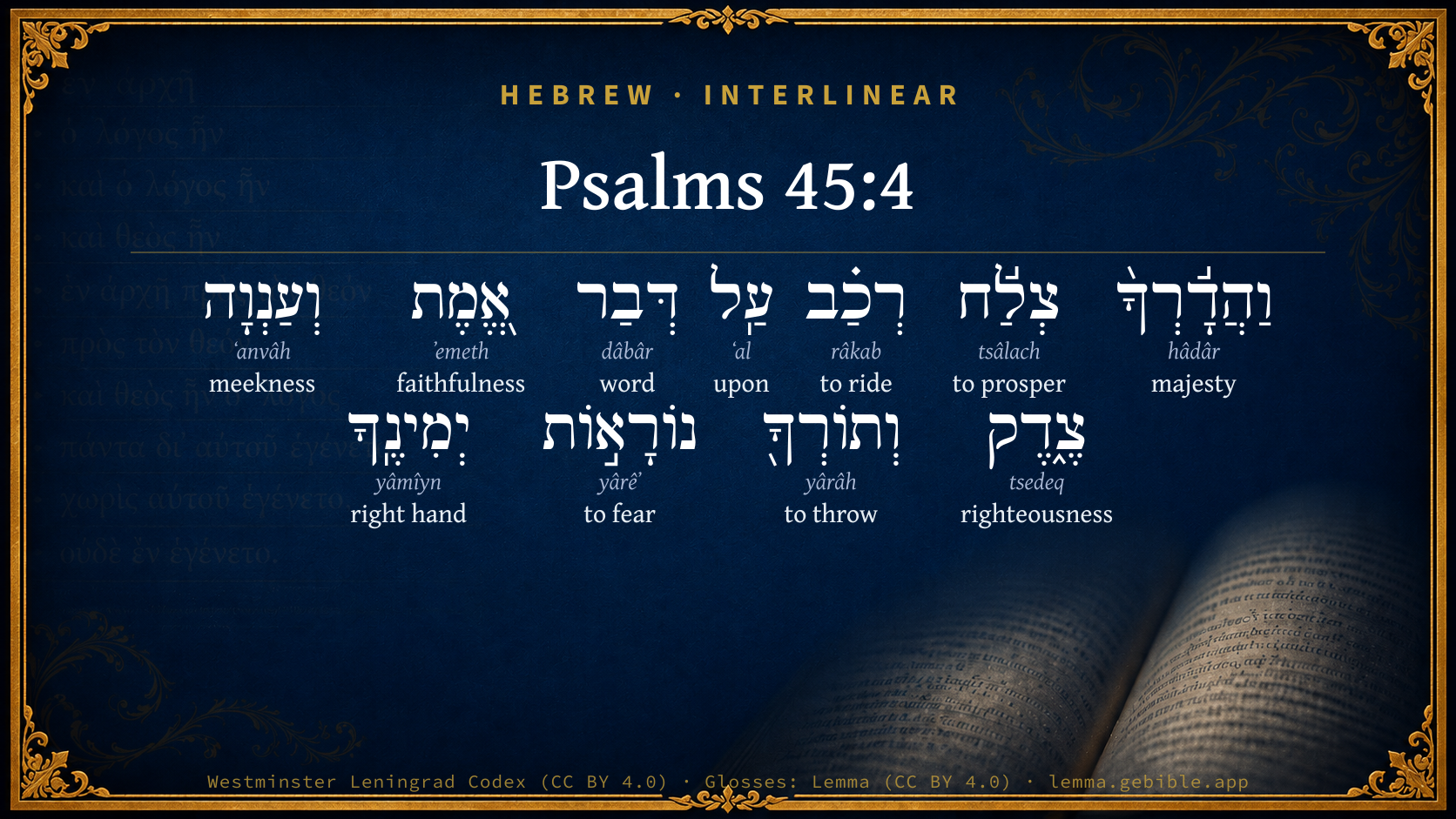
Hebrew (Westminster Leningrad Codex) Psalms 45:4 appears in the Hebrew Old Testament. The text above is from the Westminster Leningrad Codex. Each word links to its Strong’s number, a concise gloss, and parsing drawn from the Open Scriptures Hebrew Bible morphology. Click any word for its full Brown-Driver-Briggs (BDB) entry.
Download image
Cite this verse

Psalms 45:4 (World English Bible). Public Domain. Lemma interlinear Bible study tool, https://lemma.gebible.app/v/psalms/45/4.

Show BibTeX & RIS
BibTeX
RIS
English Translation
In your majesty ride on victoriously on behalf of truth, humility, and righteousness. Let your right hand display awesome deeds.
World English Bible · Public Domain
Download a study sheet

One document with this verse’s original text, its word-by-word gloss line, the meaning frame, cross-references with their text, attributed commentary, and full source and license credits — printable, and it pastes into notes with its structure intact.

This verse Autodidact and up

Study sheet (.html) Plain text (.txt)

A passage Seminary Student

Up to 50 verses in one chapter. A passage sheet keeps up to 6 commentary sources and 12 cross-references per verse, in the order this page ranks them, and says so on the sheet whenever that leaves anything out. Ask for a single verse and you get the Autodidact verse sheet above.

Everything on this page stays free to read, with no account — the sheet is a download of what is already on screen, not access to it.

Want to remove ads? Support Godless Engineer
Compare translations 3

The same verse in 3 English versions, stacked beneath the original-language interlinear above. Click any original word for its lexicon entry.

Each is an independent rendering of the whole verse — the interlinear is not word-aligned to these translations.

Highlighted words mark where these versions differ — a whole-verse word diff, not a word-by-word alignment.

  • World English Bible Public Domain
    In your majesty ride on victoriously on behalf of truth, humility, and righteousness. Let your right hand display awesome deeds.
  • King James Version Public Domain
    And in thy majesty ride prosperously because of truth and meekness and righteousness; and thy right hand shall teach thee terrible things.
  • unfoldingWord Literal Text CC BY-SA 4.0
    And your majesty prosper, ride out for the sake of truth and humility righteousness. May your right hand teach you fearful things.

unfoldingWord Literal Text — © unfoldingWord, licensed CC BY-SA 4.0. Word-aligned USFM3 via Door43 (git.door43.org/unfoldingWord/en_ult).

Versions to compare (up to 4)

3 of 4 selected

Show all 18 translations

Every available English version of this verse, each an independent rendering of the whole verse.

  • World English Bible Public Domain
    In your majesty ride on victoriously on behalf of truth, humility, and righteousness. Let your right hand display awesome deeds.
  • Berean Standard Bible Public Domain
    In your splendor ride forth in victory on behalf of truth and humility and justice; may your right hand show your awesome deeds.
  • Majority Standard Bible Public Domain
    In your splendor ride forth in victory on behalf of truth and humility and justice; may your right hand show your awesome deeds.
  • King James Version Public Domain
    And in thy majesty ride prosperously because of truth and meekness and righteousness; and thy right hand shall teach thee terrible things.
  • American Standard Version (1901) Public Domain
    And in thy majesty ride on prosperously, Because of truth and meekness `and' righteousness: And thy right hand shall teach thee terrible things.
  • Revised Version (1885) Public Domain
    And in thy majesty ride on prosperously, because of truth and meekness and righteousness: and thy right hand shall teach thee terrible things.
  • Geneva Bible (1599) Public Domain
    And prosper with thy glory: ride vpon the worde of trueth and of meekenes and of righteousnes: so thy right hand shall teach thee terrible things.
  • Douay-Rheims (1899) Public Domain
    Gird thy sword upon thy thigh, O thou most mighty.
  • Young's Literal Translation Public Domain
    As to Thy majesty -- prosper! -- ride! Because of truth, and meekness -- righteousness, And Thy right hand showeth Thee fearful things.
  • Literal Standard Version CC BY-SA 4.0
    As for Your majesty—prosper [and] ride! Because of truth, meekness, [and] righteousness, || And Your right hand shows You fearful things.
  • Unlocked Literal Bible CC BY-SA 4.0
    In your majesty ride on triumphantly because of trustworthiness, meekness, and righteousness; your right hand will teach you fearful things.
  • unfoldingWord Literal Text CC BY-SA 4.0
    And your majesty prosper, ride out for the sake of truth and humility righteousness. May your right hand teach you fearful things.
  • Darby Bible Public Domain
    And [in] thy splendour ride prosperously, because of truth and meekness [and] righteousness: and thy right hand shall teach thee terrible things.
  • World Messianic Bible Public Domain
    In your majesty ride on victoriously on behalf of truth, humility, and righteousness. Let your right hand display awesome deeds.
  • Webster's Bible Public Domain
    \\45:3\\Gird thy sword upon thy thigh, O most mighty, with thy glory and thy majesty.
  • Free Bible Version CC BY-SA 4.0
    In your majesty ride out to victory, in the defense of truth, humility, and right, because you are strong and act powerfully.
  • Bible in Basic English Public Domain
    And go nobly on in your power, because you are good and true and without pride; and your right hand will be teaching you things of fear.
  • JPS Tanakh (1917) Public Domain
    (45-5) And in thy majesty prosper, ride on, in behalf of truth and meekness and righteousness; and let thy right hand teach thee tremendous things.

Literal Standard Version (2020), Covenant Press — licensed CC BY-SA 4.0. Text via the HelloAO Bible API (eBible.org). Unlocked Literal Bible (unfoldingWord) — licensed CC BY-SA 4.0. Text via the HelloAO Bible API (eBible.org). unfoldingWord Literal Text — © unfoldingWord, licensed CC BY-SA 4.0. Word-aligned USFM3 via Door43 (git.door43.org/unfoldingWord/en_ult). Free Bible Version, Dr. Jonathan Gallagher — licensed CC BY-SA 4.0. Text via the HelloAO Bible API (eBible.org).

Word by word

More ways to search: Search by grammar → Find every occurrence → Compare this word →

Practice this passage: Drill this verse → Learn its vocabulary →

וְעַנְוָה
ʻanvâh
H6037
“and · meekness”
Conjunction + Noun, Common, Feminine, Singular, Absolute
Part of Speech
Conjunction + Noun
Type
Common
Gender
Feminine
Number
Singular
State
Absolute
Full BDB Definition

Origin: from H6035

TWOT: 1652b

humility, meekness - humility, meekness - condescension
  1. וַהֲדָ֬רְךָ֨ hâdâr H1926 “and · majesty · your” Conjunction + Noun, Common, Masculine, Singular, Construct + Suffix, Personal, 2nd Person, Masculine, Singular
  2. צְלַ֬ח tsâlach H6743 “prosper” Verb, Qal, Imperative, 2nd Person, Masculine, Singular
  3. רְכַ֗ב râkab H7392 “ride” Verb, Qal, Imperative, 2nd Person, Masculine, Singular
  4. עַֽל ʻal H5921 “upon” Preposition
  5. דְּבַר dâbâr H1697 “word of” Noun, Common, Masculine, Singular, Construct
  6. אֱ֭מֶת ʼemeth H571 “faithfulness” Noun, Common, Feminine, Singular, Absolute
  7. צֶ֑דֶק tsedeq H6664 “righteousness” Noun, Common, Masculine, Singular, Absolute
  8. וְתוֹרְךָ֖ yârâh H3384 “and · to throw · you” Conjunction + Verb, Hiphil, Imperfect, 3rd Person, Feminine, Singular + Suffix, Personal, 2nd Person, Masculine, Singular
  9. נוֹרָא֣וֹת yârêʼ H3372 “fearing” Verb, Niphal, Participle Active, Feminine, Plural, Absolute
  10. יְמִינֶֽךָ yâmîyn H3225 “right hand · your” Noun, Common, Feminine, Singular, Construct + Suffix, Personal, 2nd Person, Masculine, Singular

About this verse

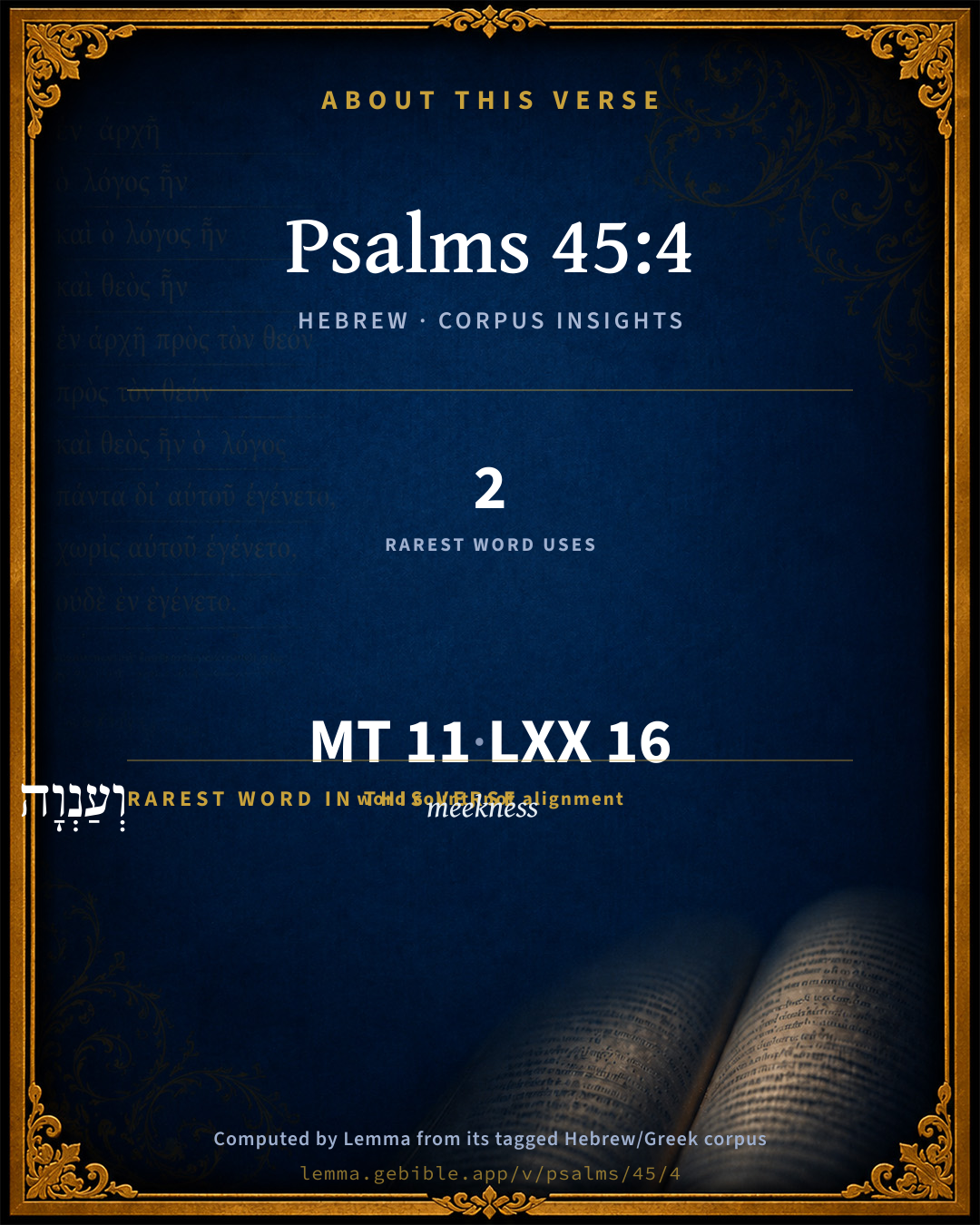
These counts appear in no published source. They are computed here, from the morphology-tagged text and Lemma’s own curated glosses. What Lemma adds →

11
words
11
distinct lemmas
Wisdom
section

Notable vocabulary

The rarest word here is וְעַנְוָה meekness H6037 — appearing just 2 times in the whole Hebrew Bible.

Shared distinctive vocabulary

וְעַנְוָה meekness H6037 occurs in 2 verses of the Hebrew Bible. Also found in:

Grammatical profile

  • 4 verbs
  • 6 nouns
  • 1 preposition

Verb forms

  • צְלַ֬ח Qal · Imperative
  • רְכַ֗ב Qal · Imperative
  • וְתוֹרְךָ֖ Hiphil · Imperfect
  • נוֹרָא֣וֹת Niphal · Participle Active

Hebrew & Septuagint length

In English translation the verse runs 20 words from the Hebrew and 23 from the Septuagint (LXX English) — closely comparable.

A rough comparison of the two English renderings, which tokenize alike — not a word-level alignment.

Word counts can differ between the Hebrew and the Greek without any difference in meaning — e.g. the Hebrew direct-object marker אֵת has no separate Greek word, and Greek often adds the article ὁ.

In the original languages it is 11 Hebrew tokens and 16 Greek tokens — but the two are counted differently (Hebrew bundles its prefixes and suffixes into one token; the Greek is in lemma form), so that isn’t a like-for-like length.

Cross-references

25

Topical passages linked to Psalms 45:4 in the Treasury of Scripture Knowledge — connected by theme and wording, ordered by reader-vote popularity; previews shown in the World English Bible.

  • Psalms 65:5 By awesome deeds of righteousness, you answer us, God of our salvation. You who are the hope of all the ends of the earth, Of those who are far away on the sea;
  • Revelation 6:2 And behold, a white horse, and he who sat on it had a bow. A crown was given to him, and he came forth conquering, and to conquer.
  • Revelation 19:11 I saw the heaven opened, and behold, a white horse, and he who sat on it is called Faithful and True. In righteousness he judges and makes war.
  • Isaiah 59:17–18 He put on righteousness as a breastplate, and a helmet of salvation on his head; and he put on garments of vengeance for clothing, and was clad with zeal as a mantle.
  • Zechariah 9:9 Rejoice greatly, daughter of Zion! Shout, daughter of Jerusalem! Behold, your king comes to you! He is righteous, and having salvation; Lowly, and riding on a donkey, Even on a colt, the foal of a donkey.
  • Matthew 11:29 Take my yoke upon you, and learn from me, for I am gentle and lowly in heart; and you will find rest for your souls.
  • Psalms 2:9 You shall break them with a rod of iron. You shall dash them in pieces like a potter's vessel."
  • Psalms 21:8–9 Your hand will find out all of your enemies. Your right hand will find out those who hate you.
  • Psalms 60:4 You have given a banner to those who fear you, That it may be displayed because of the truth. Selah.
  • Psalms 110:2–3 Yahweh will send forth the rod of your strength out of Zion. Rule in the midst of your enemies.
  • Isaiah 63:1–6 Who is this who comes from Edom, with dyed garments from Bozrah? this who is glorious in his clothing, marching in the greatness of his strength? I who speak in righteousness, mighty to save.
  • Matthew 12:19–20 He will not strive, nor shout; Neither will anyone hear his voice in the streets.
  • Luke 19:27 But bring those enemies of mine who didn't want me to reign over them here, and kill them before me.'"
  • John 1:17 For the law was given through Moses. Grace and truth came through Jesus Christ.
  • John 14:6 Jesus said to him, "I am the way, the truth, and the life. No one comes to the Father, except through me.
  • 2 Corinthians 10:1 Now I Paul, myself, entreat you by the humility and gentleness of Christ; I who in your presence am lowly among you, but being absent am of good courage toward you.
  • 1 Thessalonians 1:5 and that our Gospel came to you not in word only, but also in power, and in the Holy Spirit, and with much assurance. You know what kind of men we showed ourselves to be among you for your sake.
  • 1 Thessalonians 2:13 For this cause we also thank God without ceasing, that, when you received from us the word of the message of God, you accepted it not as the word of men, but, as it is in truth, the word of God, which also works in you who believe.
  • 2 Thessalonians 1:8–9 giving vengeance to those who don't know God, and to those who don't obey the Gospel of our Lord Jesus,
  • 2 Thessalonians 3:1 Finally, brothers, pray for us, that the word of the Lord may spread rapidly and be glorified, even as also with you;
  • Revelation 6:16–17 They told the mountains and the rocks, "Fall on us, and hide us from the face of him who sits on the throne, and from the wrath of the Lamb,
  • Revelation 11:18 The nations were angry, and your wrath came, as did the time for the dead to be judged, and to give your bondservants the prophets, their reward, as well as to the saints, and those who fear your name, to the small and the great; and to destroy those who destroy the earth."
  • Revelation 19:17–21 I saw an angel standing in the sun. He cried with a loud voice, saying to all the birds that fly in the sky, "Come! Be gathered together to the great supper of God,
  • Psalms 110:5–6 The Lord is at your right hand. He will crush kings in the day of his wrath.
  • Revelation 20:15 If anyone was not found written in the book of life, he was cast into the lake of fire.

Cross-references courtesy of OpenBible.info (CC BY 4.0).

Hebrew and Greek witnesses Masoretic Hebrew ↔ Greek Septuagint

The same verse in the two great witnesses to the Old Testament, shown verse-for-verse.

You’re reading Greek Psalm 44 (Hebrew Psalm 45). The Septuagint counts the superscription, so verse numbers can differ from the Hebrew — chapter-level alignment, not verse-by-verse. Numbering follows Rahlfs.

These are two independent witnesses, not word-aligned to each other, and the Septuagint is shown in lemma (dictionary) form.

Hebrew Psalms 45:4 Masoretic · Westminster Leningrad Codex

וַהֲדָ֬רְךָ֨ צְלַ֬ח רְכַ֗ב עַֽל דְּבַר אֱ֭מֶת וְעַנְוָה צֶ֑דֶק וְתוֹרְךָ֖ נוֹרָא֣וֹת יְמִינֶֽךָ

In your majesty ride on victoriously on behalf of truth, humility, and righteousness. Let your right hand display awesome deeds.

World English Bible · Public Domain

Greek LXX Greek Psalm 44:4 Septuagint · lemma form

περιζώννυμι ὁ ῥομφαία σύ ἐπί ὁ μηρός σύ δυνατός ὁ ὡραιότης σύ καί ὁ κάλλος σύ

and bend your bow, and prosper, and reign, because of truth and meekness and righteousness; and your right hand shall guide you wonderfully.

LXX2012 (modern English Septuagint) · Public Domain

On this verse, Adam Clarke's Commentary discusses the Septuagint’s reading. Read the note in Commentary ↓

Hebrew: Westminster Leningrad Codex (CC BY 4.0). Greek: Septuagint (public domain); English from LXX2012 (modern English Septuagint) (Public Domain). How the Septuagint differs from the Hebrew →

Commentary

Notes on Psalms 45:4 from classic Christian and Jewish commentators (each source and its license shown beneath its notes). The classic Christian expositions comment on the surrounding passage and are grouped to its opening verse, so a note may address several verses; the Jewish commentaries on the Tanakh (Rashi and others) are per-verse, so they appear only where the commentator wrote on this verse.

Lemma curates 59 commentaries, every one of them public domain or Creative Commons licensed, each selected and text-cleaned for this edition rather than reprinted as found. About our sources →

Trapp's Complete Commentary

John Trapp

Psa 45:4 And in thy majesty ride prosperously because of truth and meekness [and] righteousness; and thy right hand shall teach thee terrible things.

Ver. 4. And in thy majesty ride prosperously] Heb. Prosper thou, ride thou upon the word of truth, Equita super verbum veritatis, of meekness and of righteousness, q.d. Ride thou in thy triumphant chariot, as it were, drawn by those three glorious graces, truth, meekness, and righteousness; and governed by the word, as by the chariot man. Cui divinissimae allegoriae explicandae pro rei gravitate ac dignitate integro vohmine opus esset, saith Beza, for the explaining of which most divine allegory, according to the worth of it, a whole volume might well be full written. The kings of the earth for the most part have their chariots drawn by other horses, viz. pride, ambition, cruelty, &c., as Sesostris, king of Egypt,

Qui Pharios currus regum cervicibus egit.

And thy right hand shall teach thee terrible things] i.e. Shall enable thee to perform them. Christ, riding on his white horse (his apostles and preachers), went forth conquering and to conquer, Rev 6:2. Solomon was no such swordman as was Jesus Christ.

Aμφοτερος Bασιλευς τ αγαθος, κρατερος τ αιχμητης.

John Trapp, A Commentary or Exposition upon All the Books of the Old and New Testament (1647–1656) — public domain. Text from a community e-Sword module.

The Biblical Illustrator

Joseph S. Exell

Psa_45:4

And in Thy majesty ride prosperously.

The Captain of salvation riding prosperously in the Gospel-chariot and bringing terrible things to pass

I. Open and explain the various designations given to the gospel in the text.

1. It is called the word of truth.

(1) As opposed to error and false doctrine, whereby Satan endeavours to blind and ruin souls.

(2) As opposed to the dispensation of grace which the Church enjoyed under the Mosaic economy (Joh_1:17).

(3) By way of eminency in regard it is the most excellent, sweet and desirable truth (Psa_19:10).

(4) In regard of its effects upon the hearts of those who believe it. The solid belief of the Gospel is not only accompanied with an inward change upon the understanding will and affections, but also with newness of life and conversation.

2. The word of meekness.

(1) In regard of Him whose word it is (Mat_11:29; Zec_9:9).

(2) From the manner in which it was delivered to us by Christ and His apostles.

(3) In respect of its design and the end which through the Divine blessing it reaches among men.

3. The word of righteousness.

(1) On account of its purity and holiness.

(2) Because it contains a revelation of the righteousness of God our Saviour, which is the alone ground of a sinners access to, and acceptance in the sight of an holy and just God; yea, the leading design of the Gospel, in subordination to the glory of its Author, is to proclaim that righteousness to sinners; to set it before them as the sure foundation of all their hope and confidence (Isa_46:12-13).

(3) In respect of its effect. It is by looking into the glass of the Gospel by faith that the good work of likeness and conformity to Christ is begun in regeneration, and is carried on to perfection (2Co_3:18).

II. Some of the terrible things that our Lord Jesus brings to pass by means of the gospel.

1. The unhinging and removing the whole fabric of ceremonial institutions.

2. Our Lord has made terrible work upon the kingdom and interests of Satan by means of the Gospel.

3. The preaching of the Gospel by our Lord and His apostles was followed with terrible consequences to His ancient people, to whom it was first published, because of their unbelief in rejecting the compassionate counsel of God against themselves.

4. Another of the terrible things our Lord Jesus has performed by means of the Gospel is the inroads He has made upon the kingdom and power of Antichrist.

5. Our Lord Jesus performs terrible things upon the hearts and consciences of obstinate sinners by means of a dispensation of the Gospel.

III. Inferences.

1. We may infer that the Gospel is a subject very glorious and excellent.

2. We may infer how much the Gospel ought to be esteemed by all who enjoy it in purity; and the great sin of despising and neglecting it.

3. We may see the great need all who enjoy a dispensation of the Gospel have to exercise a constant dependence upon the power and grace of Christ, in order to their profiting by it.

4. We may see from this subject that our Lord Jesus is not only succeeding in the management of the affairs of His kingdom of grace, but hastening to finish the mystery of God in the Church; He is riding in the Gospel-chariot with great celerity.

5. We may see with what holy diligence it concerns all the hearers of the Gospel, to improve their day of grace and merciful visitation.

6. We may see matter of trial and examination. Try what acquaintance you have with the designations given to the Gospel in the text, in your experience.

7. We may see matter of comfort to believers. It may comfort the heart of every child of God to consider that the Captain of salvation is making way for His second coming and the accomplishment of the promise, which will crown His felicity (Joh_14:2-3).

8. We may see matter of reproof and terror to all the scoffers of the last times.

9. We may infer matter of exhortation.

(1) We exhort all who have experienced the power of Divine grace upon their hearts, and known the joyful sound of the Gospel in truth, to bless a God of infinite love and grace for sending the Gospel to them, and that not only in word, but in the demonstration of the Holy Spirit.

(2) As for you, who, though you are enjoying a dispensation of the Gospel, have never yet experienced the salutary effects of it upon your hearts, we exhort you to consider the great misery of your present condition. (T. Bonnet.)

Because of truth and meekness and righteousness.--

The conquest of the world by meekness

Poetry is the language of the soul; for the soul is the seat of all deeper, purer, diviner feeling. Till the spirit is touched and stirred to her very depth and inmost self there can be no poetry. A man may be set down in the very midst of Natures life and loveliness, amid her fields, and flowers, and streams, and mountains, and even her wildest grandeur, but if he has no communion with the soul of Nature, he can have nothing to say. He may imitate her language, but he has no real voice. Now, the poetry of the Bible is the Bible of poetry. You may find the language of feeling in other books, but this is the book of feeling. It is the utterance of the soul in its deepest moods. It lets you into the very heart of humanity. An inspired apostle has applied a certain portion of this psalm to the Redeemer of man.

I. That the conquest of our world by Christ implies rather its redemption than its subjugation, Man has been so brought under the yoke by the power of evil that his nature is comparatively enslaved. The spirit is enthralled by the flesh. The higher nature by the lower. Bondage is mistaken for freedom. The will of God is to reverse all this, to bring back man to his original condition. And to accomplish this Christ came. His life must be sacrificed to effect our deliverance, and He gave it up willingly and without reserve. Though we are taken from under the yoke of an enslaving bondage, our redemption does not place us above law, or take us from the sphere of its influence. We are under law to Him who hath redeemed us. As His freemen we owe Him our allegiance and submission.

II. That he who is to effect this conquest is revealed to us as invested with attributes corresponding to the grandeur of his enterprise. He is clothed with might, majesty and glory. Of these perfections, as they are united in the Godhead, we have many striking manifestations. See the giving of the law on Mount Sinai. Or the prophet describing the calamities which God was about to inflict on the enemies of His Church and people, represents His brightness as the light, and burning coals going forth at His feet, and at whose descent the everlasting mountains were scattered, and the perpetual hills did bow, while His glory covered the heavens, and the earth was full of His praise! How different from all this outward and gorgeous splendour is the calm and silent majesty of the same august Being, when He is represented as saying Let there be light, and light was! Or when you hear him reveal His ineffable name to Moses--I am that I am! So in reference to the Saviour. It is in the quiet word of His power, as when He stilled the tempest, yet more in the deep tranquillity of His own soul, that we see His glory. His might lay in His purity, His majesty in His meekness, His glory in His benevolence. There is no power equal to that of goodness, and there is nothing which goodness may not achieve.

III. That nothing could be more simple or appropriate than the means or instrumentality by which this conquest is to be achieved. Just as the purpose of the Redeemer corresponds with the benevolence and the righteousness of His character, so the means by which that purpose is to be carried into effect beautifully correspond with the calm and dignified composure of his own soul. Having, like a true hero, girt His sword upon His thigh, He is seen riding forth prosperously and in triumph. Victory waits upon His every step. And this not as the effect of force, but as the result of truth. The Conqueror of the world is the worlds Great Teacher. Full of grace and truth, He came to reveal the love of God, and the way of life. He asks for no blind, unmeaning homage, and therefore He floods the mind with light. He wants no unwilling surrender, and therefore He fills the heart with love. We see, then, how it is that in the Conqueror of the world meekness is combined with truth. The dove at His baptism told what manner of reign His was to be. It was the gentleness of Christ as a teacher of truth that made Him great. It is a striking fact that Christianity makes no provision for those cases in which it fails in its professed results. Other systems reserve to themselves the freedom of changing their ground and of adapting their expedients to the ever-varying conditions of society; but the Christian system disdains any such policy. Whether it be introduced into countries where civilization sits high-throned and regnant, or into regions where we meet with only uncultured and barbarous tribes, it is the same thing. While it possesses all the elements of universal adaptation, it knows nothing of expediency. It refuses to be thrown into any Procrustean bed, and have its dimensions determined by the caprice of men. It is through all time the same and immutable. The reason is obvious. Its failures are not due to itself but in those to whom it is addressed, or in the agency through which we seek to diffuse it.

IV. That the progress of this conquest will arrest the attention and awaken the joy of the whole moral creation of God. Heaven is interested in earth. But what ate we doing to help forward the reign of Christ? Have we submitted ourselves to Him? Only so can we really help or share in its final joy. (R. Ferguson, LL. D.)

The Biblical Illustrator, edited by Joseph S. Exell (c. 1880s–1900s) — public domain. Text from a community e-Sword module.

J. A. Alexander on Psalms

Joseph Addison Alexander

5. (Psa 45:4). And (in) thy majesty, pass on, ride forth, for the sake of truth and humble right; and thy right hand shall guide thee (to) terrible deeds. The first words may also be explained, without supplying in, as an emphatic repetition of what goes before. And thy majesty (I say). The first verb may be rendered prosper, as in Isa 53:10; but it seems best to retain its primary sense, which is to pass by or over, to advance, or as we say familiarly, to go ahead. By riding we may understand the act of riding in a chariot of war, which was customary with the ancient kings. See the same verb so used in 2Ki 9:16, and compare 1Ki 22:34-35. For the sake, literally on the word, which may possibly denote that on which the conqueror rides, to wit, the word of truth. But this figure would not be very intelligible, and in almost every other case where the Hebrew phrase occurs, it is evident that word is used precisely as the English words account and sake are in the familiar combinations, on account of, for the sake of. See above on Psa 18:1. Thus understood, it here points out the object of Messiah's conquests, to wit, the vindication of truth, i.e. veracity, as opposed to fraud, and humble right, as opposed to proud iniquity. In this last phrase both the Hebrew words are nouns, but rather in apposition than regimen, so that the literal translation would be humility-righteousness, right asserted in humility against a wrong maintained by pride and selfishness. Thy right hand, as the seat of martial strength, and the organ of aggressive action. Shall guide, or point the way, the proper meaning of the Hebrew verb, which, like other verbs expressing or implying motion, may be followed directly by a noun, where our idiom would require an intervening preposition. Terrible (things), fearful (deeds), literally dreaded; but the Hebrew passive participle frequently includes the idea of a future passive participle in Latin. The insensible transition from the imperative to the future shews that the former was really prophetic, and that the prayer of this and the preceding verse is only a disguised prediction of Messiah's triumphs, as one going forth conquering and to conquer.

Joseph Addison Alexander, The Psalms Translated and Explained (1850) — public domain. Text from a community e-Sword module.

Tyndale Open Study Notes

Tyndale Open Resources

45:4 As God’s agent of truth, humility, and justice (see 72:1-2, 4, 7), the king can carry out awe-inspiring deeds (65:5; 96:4).

Tyndale Open Study Notes — © Tyndale Open Resources, licensed CC BY-SA 4.0. Text via the HelloAO Bible API.

Geneva Bible (1599)

Geneva Bible translators

He alludeth to them that ride in chariots in their triumphs, showing that the quiet state of a kingdom standeth in truth, meekness and justice, not in worldly pomp and vanity.

Geneva Bible (1599) marginal notes — public domain. Text via Bolls.life.

Jamieson, Fausset & Brown

Robert Jamieson, A. R. Fausset & David Brown

ride prosperously--or conduct a successful war.

because of--for the interests of truth, &c.

meekness . . . righteousness--without any connection--that is, a righteousness or equity of government, distinguished by meekness or condescension (Psa 18:35).

right hand--or power, as its organ.

shall teach thee--point the way to terrible things; that is, in conquest of enemies.

Jamieson, Fausset & Brown — Commentary Critical and Explanatory on the Whole Bible (1871) — public domain (CC PDM 1.0). Text via the HelloAO Bible API.

Adam Clarke's Commentary

Verse 4. In thy majesty ride prosperously] These words cannot be spoken of Solomon; they are true only of Christ. His riding is the prosperous progress of his Gospel over the earth. He uses no sword but the sword of the Spirit; and what religion, system of truth, pretended or real, ever made such progress as the religion of Christ has done, without one sword being ever drawn to propagate it from the first introduction of Christianity to the present time? His Gospel is TRUTH, proclaiming HUMILITY, ענוה anvah, and RIGHTEOUSNESS. This, indeed, is the sum of the Gospel; and an epitome of its operations in the hearts of men.

1. The Gospel is a revelation of eternal TRUTH, in opposition to all false systems of religion, and to all figurative and ceremonial representations of the true religion. It is truth concerning GOD, his NATURE, and his WORKS. It is truth concerning MAN, his ORIGIN, his INTENTS, his DUTIES, and his END. It is truth in what it says concerning the natural, the moral, and the invisible world.

2. It teaches the doctrine of meekness or HUMILITY; opposes pride and vain glory; strips man of his assumed merits; proclaims and enforces the necessity of humiliation or repentance because of sin, humiliation under the providential hand of God, and humility in imitation of the character of the Lord Jesus Christ throughout life.

3. The Gospel teaches RIGHTEOUSNESS: shows the nature of sin, wrong, injustice, transgression, c. works righteousness in the heart; and directs and influences to the practice of it in all the actions of life. The Gospel leads him who is under its influences to give to all their due; to GOD, to his neighbour, to himself. And it is by the propagation of truth, humility, and righteousness, that the earth has become so far blessed, and the kingdom of Christ become extended among men.

And thy right hand shall teach thee terrible things.] The Chaldee is different: "And the Lord will teach thee to perform terrible things by thy right hand." The Arabic: "And with admiration shall thy right hand direct thee." The Septuagint: "And thy right hand shall lead thee wonderfully." To the same purpose are the Vulgate, Anglo-Saxon, and the old Psalter. The meaning is, Nothing shall be able to resist thee, and the judgments which thou shalt inflict on thine enemies shall be terrible.

Adam Clarke's Commentary on the Bible (1810–1826) — public domain. Text from a community e-Sword/MySword module.

Ellicott's Commentary for English Readers

(4) And in thy majesty.—The repetition of this word from the last verse (conjunction included) is suspicious, especially as the LXX., followed by the Vulg., render, “Direct (thine arrows or thine aim”).

Ride prosperously . . .—Literally, proceed, ride; expressing, according to a common Hebrew usage, by two verbs what we express by adverb and verb.

Because of . . .—Better, In behalf of. So LXX. and Vulg. There is a difficulty from the absence of the conjunction in the Hebrew before the last of the triad of virtues. The LXX. have it, but may have supplied it, as the Authorised Version does. Some render, “meek righteousness,” or, slightly changing the pointing, “the afflicted righteous.”

And thy right hand shall teach . . .—If we keep this rendering, we must picture the warrior with his right hand extended, pointing to the foe whom he is about to strike with his deadly arrows. But even this seems somewhat tame; and as the verb rendered “teach” is in 1Sa_20:20 used for “shooting arrows,” and “arrows” are mentioned immediately in the next verse, it seems obvious to render: And thy right hand shall shoot terrors, or, terribly. (Comp. Psa_65:5.)

A Bible Commentary for English Readers, edited by Charles John Ellicott (1878–1897) — public domain. Text from a community e-Sword module.

The Cambridge Bible for Schools and Colleges

gen. ed. J. J. S. Perowne

4. And in thy majesty] The single word of the original is an exact repetition of the last word of Psa_45:3. Such repetitions are a common poetical figure; but the construction is harsh, the prep. in not being expressed; the word is omitted by the Syr. (probably) and Jer. (ed. Lagarde); and may be due to an early error of transcription. The consonants are recognised by the LXX, but differently vocalised and rendered, and bend [thy bow]. This rendering however involves a doubtful ellipse, and the mention of the bow is hardly in place here.

ride prosperously] Ride on victoriously, on warhorse or in chariot, forcing a way irresistibly through the ranks of the enemy.

because of truth] Better, in the cause of truth: in defence and furtherance of virtues which are trampled under foot in evil times and under bad rulers. (Isa_59:14-15). Truth and righteousness are the constant attributes of the true king: meekness is the characteristic of the true people of God; and it is the king’s work to see that the meek have justice done them. Cp. Isa_11:1-5; Isa_29:19; Zep_2:3; Psa_37:11; Psa_76:9; &c.

shall teach thee] Or, and let thy right hand teach thee terrible things, an epithet applied to the marvellous works of God for His people, inspiring them with a holy awe, and their foes with a panic terror (Deu_10:21; 2Sa_7:23; Isa_64:3; Psa_65:5; Psa_106:22; Psa_145:6). By a bold figure the king’s right hand, i. e. his strength and courage, is said to teach or shew him terrible things, as his success in battle reveals the divine energy with which he has been endowed.

The Cambridge Bible for Schools and Colleges (gen. ed. J. J. S. Perowne; Cambridge University Press, 1878–1918) — public domain. Text from a community e-Sword module.

John Gill's Exposition

And in thy majesty ride prosperously,.... Not literally, as was prophesied of him he should, and as he did, Zac 9:9; but mystically and spiritually, either in the chariots of angels up to heaven, Psa 68:17; or on the white horse of the Gospel, with his bow and arrows after mentioned, conquering and to conquer, Rev 6:2; and where he rides "in his majesty", showing forth his glory both as a divine Person and as Mediator; and which is very conspicuous in the Gospel, and the ministry of it; and also "prosperously", as he did in the first preaching of the word by the apostles, when it was made the power of God to salvation to multitudes, and the Lord caused them to triumph in Christ everywhere; and as he will in the latter day, when the Jews will be converted, and the fulness of the Gentiles brought in;

because of truth, and meekness, and righteousness; either because he himself is "truth", the truth of all types, promises, prophecies, and doctrines; or because of the Gospel of truth which comes by him; or on account of his truth and faithfulness in fulfilling his own engagements, and the promises of his father: and because of the "meekness" which was so apparent in him, in taking upon him the form of a servant; in his marriage to sinners, and conversation with them; in ministering: to his disciples; in his conduct towards his enemies; and in seeking not his own glory, but his Father's: and because of "righteousness", the holiness of his nature, the purity of his life and actions; and because of the righteousness he is the author of to his people, and of his righteous administration of his offices, especially as a King;

and thy right hand shall teach thee terrible things; or thy power, which the right hand is a symbol of, shall perform terrible things; as it did in the work of redemption, by conquering and destroying the enemies of his people, and of himself; and as it does in the conversion of men, which makes terrible work in their consciences, as the instances of the three thousand, of Saul, and of the jailer show; and as it has in his judgments on his enemies the Jews, in the utter ruin of their nation, city, and temple; and will do on all the antichristian powers in the latter day. The Targum paraphrases it,

"the Lord shall teach thee to do terrible things with thy right hand (f).''

(f) "Dextra mihi Deus", &c. Virgil. Aeneid. 10. prope finem.

John Gill's Exposition of the Whole Bible (1746–1763) — public domain (CC PDM 1.0). Text via the HelloAO Bible API.

Albert Barnes' Notes on the Bible

And in thy majesty ride prosperously - Margin, “Prosper thou, ride thou.” The majesty here referred to is the glory or magnificence which became a prince of such rank, and going forth to such deeds. The prayer is, that he would go forth with the pomp and glory becoming one in that station. The word used here, rendered in the margin, “prosper thou,” means properly to go over or through, to pass over, and may be correctly rendered here, pass on; that is, move forward to conquest. The word “ride” refers to the way in which warriors usually went forth to conquest in a chariot of war. The idea is that of one caparisoned for war, and with the glory appropriate to his rank as king, going forth to victory. This language is such as is often employed in the Scriptures to describe the Messiah as a conquering king.

Because of truth - On account of truth; or in the cause of truth. That is, the great purpose of his conquests would be to establish a kingdom based on truth, in contradistinction from the existing kingdom of darkness as based on error and falsehood. The “object” of his conquests was to secure the reign of truth over the minds of people. Compare Joh 18:37.

And meekness and righteousness - literally, “humility-righteousness;” or, humble right. It would be a kingdom or a conquest of righteousness,” not” established, as most kingdoms are, by pride and arrogance and mere power, but a dominion where humility, meekness, gentleness would be at the foundation - that on which the whole superstructure would be reared. Its characteristic would be righteousness or justice - a righteousness and justice, however, not asserted and established by mere power, or by the pride of conquest, but which would be established and maintained by meekness or gentleness: a kingdom not of outward pomp and power, but the reign of the gentle virtues in the heart.

And thy right hand - The instrument of martial power and success; that which, in war, wields the sword and the spear. “Shall teach thee.” Shall guide thee, or lead thee to the performance of terrible things.

Terrible things - Fearful deeds; things that are suited to excite astonishment or wonder. They were such things as would be regarded as distinguished achievements in war, indicating extraordinary valor; such conquests as would strike the world with amazement. We have here, therefore, a description of the Messiah as going forth to the great conquest of the world; and at the same time we have this intimation of the nature of his kingdom, that however great the “power” which would be exerted in securing its conquests, it would be founded on “truth:” it would be a kingdom where righteousness would prevail, and whose essential characteristic would be gentleness and peace.

Albert Barnes' Notes on the Bible (1834–1885) — public domain. Text from a community e-Sword/MySword module.

Matthew Poole's English Annotations

In thy majesty; being thus gloriously or magnificently girt and armed. Ride prosperously; march on speedily (which is signified by riding) and successfully against thine enemies, i.e. thou shalt do so, as it is in the last clause,

shall teach thee. So imperatives are oft put for futures, and predictions are expressed in the form of commands or exhortations.

Because of truth, and meekness, and righteousness; or, because of thy truth, &c., i.e. because thou art worthy of this dominion and success; for thou neither didst obtain nor wilt manage thy kingdom by deceit or violence and unrighteousness, as the princes of the earth frequently do, but with truth and faithfulness, with meekness and gentleness towards thy people, and to all that shall submit to thee; with impartial justice and equity, whereby thy throne will be established, Pro 16:12; 20:28. Or, as it is in the Hebrew, word for word, upon the word of truth, &c.; which may seem best to suit with the foregoing words, which according to the Hebrew are, prosper thou, ride thou, and then immediately follows, upon the Word of truth, &c., to wit, the gospel; which is oft called truth, as Joh 8:32; Col 1:5, &c., and the word of truth, Eph 1:13; and may no less truly be called the word of meekness, because it is not delivered with terror, as the law was at Sinai, but meekly and sweetly by Christ, and by his ministers, Mat 21:5; 2Ti 2:25; and the word of righteousness, because it brings in everlasting righteousness, Dan 9:24, and strongly obligeth and exciteth all men to the practice of righteousness and holiness. And so the gospel is compared to a horse or chariot, upon which Christ is said to ride, when the gospel is preached, and carried about from place to place, Rev 19:11. And this may be here added, to show the great difference between the kingdoms of the world, that are managed with outward pomp and glory, and the kingdom of Christ, which is a spiritual kingdom, and, like a spouse, Psa 45:13, all glorious wi&in, as consisting in spiritual virtues and graces, truth, meekness, and righteousness. Thy right hand shall teach thee terrible things, i.e. thou shalt do great and glorious exploits, which shall be grievous and terrible to thine enemies, as the next verse explains it, and this not by great forces, and the assistance of others, but by thine own single power; compare Isa 63:3; which doth by no means agree to Solomon, who was a man of peace, and not engaged in any martial actions against his enemies; and if he had done any thing considerable in that kind, he could not do it by his own right hand, but by the help of his soldiers. But this doth excellently agree to the Messias, and to him only.

Object. The things which were done by the Messias at his first coming were rather comfortable than terrible.

Answ. They were indeed comfortable to all good men, but withal they were terrible to the ungodly, and particularly to the body of the Jewish nation, to whom Christ was a stone of stumbling, and rock of offence, and an occasion of their utter destruction. And upon that and other accounts, not only Christ’s second, but even his first coming, is represented as dreadful, as Joe 2:30; Mal 3:2, and elsewhere. For the phrase, thy right hand shall teach thee, it is not to be taken properly, for so he taught his hand, and not his hand him; but the meaning is, that his hand should show him, i.e. discover and work before him; for verbal words are oft understood really; as calling is put for being, as Isa 1:26; 9:6; so teaching or showing is put for doing, as Psa 16:11; 60:3.

Matthew Poole's English Annotations on the Holy Bible (1683–1685) — public domain. Text from a community e-Sword/MySword module.

The Treasury of David

Charles H. Spurgeon

Ver. 4. And in thy majesty ride prosperously. The hero monarch armed and apparelled is now entreated to ascend his triumphal car. Would to God that our Immanuel would come forth in the chariot of love to conquer our spiritual foes and seize by power the souls whom he has bought with blood. Because of truth and meekness and righteousness. These words may be rendered, ride forth upon truth and meekness and righteousness. Three noble chargers to draw the war chariot of the gospel. In the sense of our translation it is a most potent argument to urge with our Lord that the cause of the true, the humble, and the good, calls for his advocacy. Truth will be ridiculed, meekness will be oppressed, and righteousness slain, unless the God, the Man in whom these precious things are incarnated, shall arise for their vindication. Our earnest petition ought ever to be that Jesus would lay his almighty arm to the work of grace lest the good cause languish and wickedness prevail. And thy right hand shall teach thee terrible things. Foreseeing the result of divine working, the psalmist prophesies that the uplifted arm of Messiah will reveal to the King's own eyes the terrible overthrow of his foes. Jesus needs no guide but his own right hand, no teacher but his own might; may he instruct us all in what he can perform, by achieving it speedily before our gladdened eyes.

Ver. 4. And in thy majesty ride prosperously, etc. The wheels of Christ's chariot, whereupon he rideth when he goeth to conquer and subdue new converts to his kingdom, are majesty, truth, meekness, righteousness, manifested in the preaching of his gospel; majesty, when the stately magnificence of his person and offices is declared; truth, when the certainty of all that he teacheth in Scripture is known; meekness, when his grace and mercy is offered to rebels; and righteousness, when justification by faith in his name is clearly set forth. Christ goeth no voyage in vain, he cometh not short of his intent and purpose, but doth the work for which he cometh, preaching the gospel; in his majesty, truth, meekness, and righteousness, he rideth prosperously. David Dickson.

Ver. 4. Ride prosperously, because of truth, and meekness, and righteousness. The literal translation would be, "Ride on the word of truth, and the meekness of righteousness, "and so the Syriac has it. If this rendering be adopted, the meaning will then be, that the great object of Christ's gospel was to vindicate the cause of truth and righteousness in the world. Christ is said to ride on the word of truth, because the knowledge of the truth depends on the wordit is by the word that truth is made known. He is said to ride on the meekness or humility of righteousness, because meekness or humility is its distinguishing characteristic. The former relates to what man is to believe, the latter to how he is to live. George Harpur.

Ver. 4. Thy right hand shall teach thee terrible things. This expression seems only used to imply, either that by his power he should be enabled to do terrible things, because teaching enables men to do what they are taught, or that by his almighty power he should experimentally see what great and terrible things should by done by him. Arthur Jackson.

Charles H. Spurgeon's The Treasury of David (1869–1885) — public domain. Psalms only. Text from a community e-Sword/MySword module.

Whedon's Commentary on the Bible

Daniel D. Whedon

4. Ride prosperously—The figure is that of a conqueror in his war chariot.

Because of truth and meekness and righteousness—It is better to understand this as referring to the issue or object of the war in the sense of “in the cause of truth,” etc., as in Psa_79:9. We may suppose Solomon to have quelled the rebellion, (Psa_45:3,) to which allusion is here made. But the language is Messianic. The war is not carnal, but spiritual, 2Co_10:4. See Rev_19:11-16. The Christian war is for and in truth, meekness, and righteousness.

Daniel D. Whedon (gen. ed.), Commentary on the Old and New Testaments (1874–1909) — public domain. Text from a community e-Sword module.

The Pulpit Commentary

And in thy majesty ride prosperously; literally, and in thy majesty go forth, ride. The riding intended is probably riding in a chariot. Because of truth and meekness and righteousness; rather, because of truth and meek-tempered righteousness (Kay); i.e. for the purpose of vindicating truth and righteousness in the case of those who outrage them. Righteousness, however, to be really righteousness, must be combined with meekness. (comp. Zep_2:3) And thy right hand shall teach thee terrible things. It is the right hand wherewith the warrior strikes; and at each blow it opens to the striker terrible experiences, and thus may be said to "teach him terrible things."

The Pulpit Commentary (1880–1919), ed. H.D.M. Spence-Jones & Joseph S. Exell — public domain. Text from a community e-Sword module.

John Wesley's Explanatory Notes

And - Being thus magnificently girt and armed. Ride - March on speedily and successfully against thine enemies. The word - That is, the gospel: which is called the word of truth, Eph. i, 13, and may no less truly be called the word of meekness, because it is not delivered with terror, as the law was at Sinai, but meekly and sweetly; and the word of righteousness, because it brings in everlasting righteousness, and strongly excites all men to the practice of righteousness and holiness. And so the gospel is compared, to an horse or chariot, upon which Christ is said to ride, when the gospel is preached, and carried about from place to place. Teach thee - Thou shalt do exploits, which shall be terrible to thine enemies. But the phrase, thy right hand shall teach thee, is not to be taken properly; the meaning is, his hand should shew him, discover and work before him.

John Wesley, Explanatory Notes Upon the Whole Bible (1754–1765) — public domain. Text via the GEBible commentary corpus.

Rashi

Rabbi Shlomo Yitzchaki (Rashi)

Gird a sword on your thigh to wage the war of Torah, and that is your majesty and that is your glory.

Rashi on the Tanakh — English translations: “The Judaica Press complete Tanach with Rashi, translated by A. J. Rosenberg” (CC BY 4.0); “Pentateuch with Rashi's commentary by M. Rosenbaum and A.M. Silbermann, 1929-1934” (public domain); “The Metsudah Tanach series, Lakewood, N.J” (CC BY 4.0); and “The Book of Joshua, Metsudah Publications, 1997” (CC BY 4.0). Text via Sefaria.

Lesson kit

Teaching starters — assembled from the data on this page, not authored interpretation. Every prompt links to the verse data it draws on. Edit before teaching.

Psalms, in the Wisdom, opens this verse with 11 words (11 distinct Hebrew lemmas). Its most distinctive word is ʻanvâh (“meekness”). A historical commentator’s framing appears above. Read the whole chapter for the surrounding context.

Discussion questions

  1. What does “meekness” (ʻanvâh) contribute to the verse as a whole?
  2. How does Psalms 18:35, which shares the word «meekness», read alongside this verse?
  3. These translations render this verse differently. What is at stake in choosing one wording over another?
  4. «צְלַ֬ח» is a Qal Imperative verb. How does that grammatical form shape the action described?
  5. Compare how Trapp's Complete Commentary and The Biblical Illustrator read this verse. Where do they agree or differ?

Things to notice

Reading settings

Reading text

Shown beneath each verse's original-language words.

Old Testament
Old Testament edition

Read the OT as the Masoretic Hebrew (MT) or the Greek Septuagint (LXX).

English shown for the Greek Septuagint (in the Hebrew ↔ Greek comparison).

Comparing translations? Open the Compare panel on any verse page to stack up to four side by side.