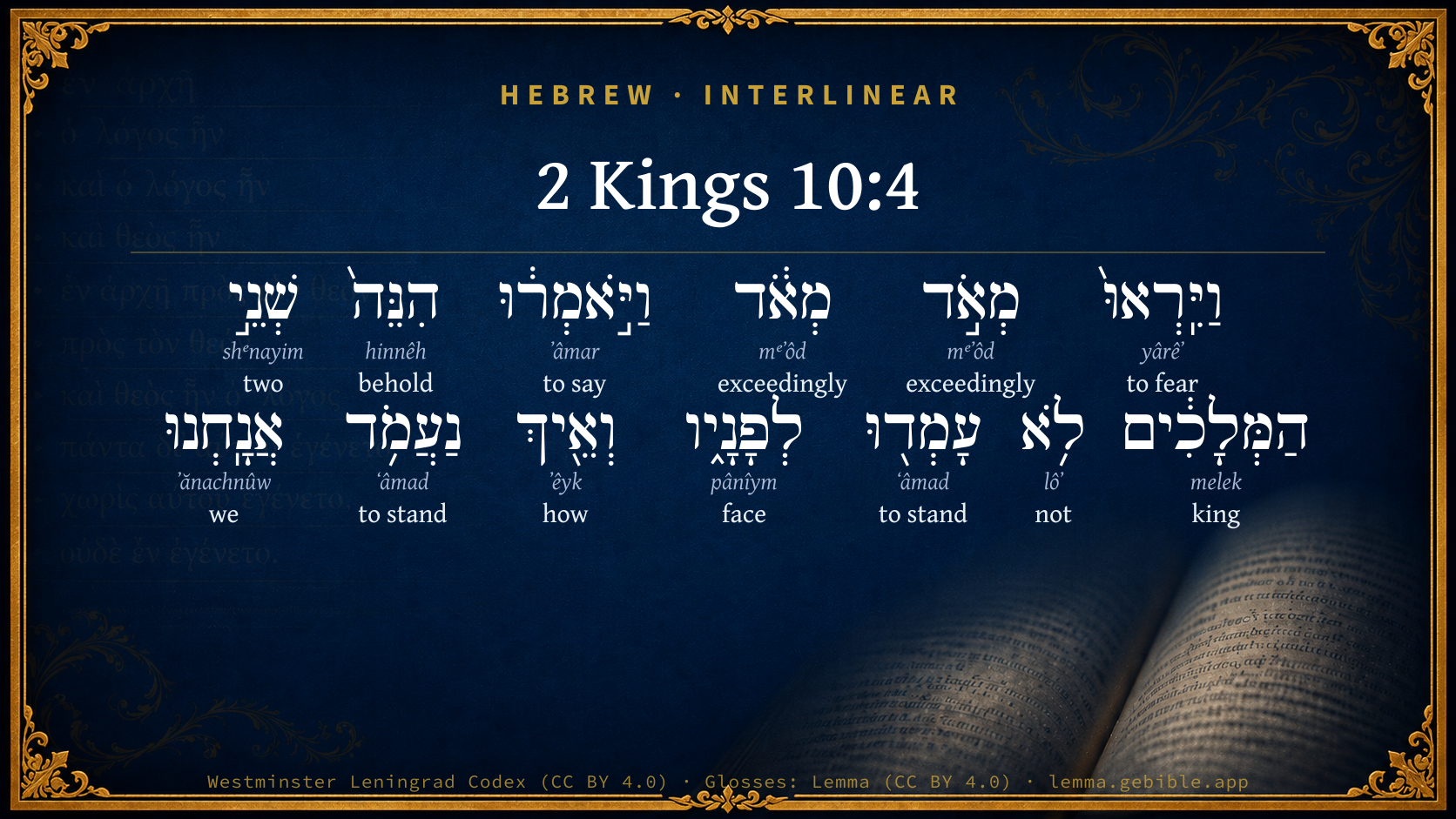
2 Kings 10:4

Hebrew (Westminster Leningrad Codex) 2 Kings 10:4 appears in the Hebrew Old Testament. The text above is from the Westminster Leningrad Codex. Each word links to its Strong’s number, a concise gloss, and parsing drawn from the Open Scriptures Hebrew Bible morphology. Click any word for its full Brown-Driver-Briggs (BDB) entry.
Download image
Cite this verse

2 Kings 10:4 (World English Bible). Public Domain. Lemma interlinear Bible study tool, https://lemma.gebible.app/v/2-kings/10/4.

Show BibTeX & RIS
BibTeX
RIS
English Translation
But they were exceedingly afraid, and said, Behold, the two kings didn't stand before him: how then shall we stand?
World English Bible · Public Domain
Download a study sheet

One document with this verse’s original text, its word-by-word gloss line, the meaning frame, cross-references with their text, attributed commentary, and full source and license credits — printable, and it pastes into notes with its structure intact.

This verse Autodidact and up

Study sheet (.html) Plain text (.txt)

A passage Seminary Student

Up to 50 verses in one chapter. A passage sheet keeps up to 6 commentary sources and 12 cross-references per verse, in the order this page ranks them, and says so on the sheet whenever that leaves anything out. Ask for a single verse and you get the Autodidact verse sheet above.

Everything on this page stays free to read, with no account — the sheet is a download of what is already on screen, not access to it.

Want to remove ads? Support Godless Engineer
Compare translations 3

The same verse in 3 English versions, stacked beneath the original-language interlinear above. Click any original word for its lexicon entry.

Each is an independent rendering of the whole verse — the interlinear is not word-aligned to these translations.

Highlighted words mark where these versions differ — a whole-verse word diff, not a word-by-word alignment.

  • World English Bible Public Domain
    But they were exceedingly afraid, and said, Behold, the two kings didn't stand before him: how then shall we stand?
  • King James Version Public Domain
    But they were exceedingly afraid, and said, Behold, two kings stood not before him: how then shall we stand?
  • unfoldingWord Literal Text CC BY-SA 4.0
    And they were very, very afraid, and they said, “Behold, two kings did not stand to his face, so we, how will we stand?”

unfoldingWord Literal Text — © unfoldingWord, licensed CC BY-SA 4.0. Word-aligned USFM3 via Door43 (git.door43.org/unfoldingWord/en_ult).

Versions to compare (up to 4)

3 of 4 selected

Show all 18 translations

Every available English version of this verse, each an independent rendering of the whole verse.

  • World English Bible Public Domain
    But they were exceedingly afraid, and said, Behold, the two kings didn't stand before him: how then shall we stand?
  • Berean Standard Bible Public Domain
    But they were terrified and reasoned, “If two kings could not stand against him, how can we?”
  • Majority Standard Bible Public Domain
    But they were terrified and reasoned, “If two kings could not stand against him, how can we?”
  • King James Version Public Domain
    But they were exceedingly afraid, and said, Behold, two kings stood not before him: how then shall we stand?
  • American Standard Version (1901) Public Domain
    But they were exceedingly afraid, and said, Behold, the two kings stood not before him: how then shall we stand?
  • Revised Version (1885) Public Domain
    But they were exceedingly afraid, and said, Behold, the two kings stood not before him: how then shall we stand?
  • Geneva Bible (1599) Public Domain
    But they were exceedingly afraid, and saide, Behold two Kings coulde not stande before him, how shall we then stand?
  • Douay-Rheims (1899) Public Domain
    But they were exceedingly afraid, and said: Behold two kings could not stand before him, and how shall we be able to resist?
  • Young's Literal Translation Public Domain
    And they fear very greatly, and say, `Lo, the two kings have not stood before him, and how do we stand -- we?'
  • Literal Standard Version CC BY-SA 4.0
    And they fear very greatly, and say, “Behold, the two kings have not stood before him, and how do we stand—we?”
  • Unlocked Literal Bible CC BY-SA 4.0
    But they were terrified and said among themselves, “See, the two kings could not stand before Jehu. So how can we stand?”
  • unfoldingWord Literal Text CC BY-SA 4.0
    And they were very, very afraid, and they said, “Behold, two kings did not stand to his face, so we, how will we stand?”
  • Darby Bible Public Domain
    And they were exceedingly afraid, and said, Behold, the two kings stood not before him; and how shall we stand?
  • World Messianic Bible Public Domain
    But they were exceedingly afraid, and said, “Behold, the two kings didn’t stand before him! How then shall we stand?”
  • Webster's Bible Public Domain
    But they were exceedingly afraid, and said, Behold, two kings stood not before him: how then shall we stand?
  • Free Bible Version CC BY-SA 4.0
    But they were extremely frightened, and said to themselves, “If two kings couldn't defeat him, how could we?”
  • Bible in Basic English Public Domain
    But they were full of fear, and said, The two kings have gone down before him: how may we keep our place?
  • JPS Tanakh (1917) Public Domain
    But they were exceedingly afraid, and said: 'Behold, the two kings stood not before him; how then shall we stand?'

Literal Standard Version (2020), Covenant Press — licensed CC BY-SA 4.0. Text via the HelloAO Bible API (eBible.org). Unlocked Literal Bible (unfoldingWord) — licensed CC BY-SA 4.0. Text via the HelloAO Bible API (eBible.org). unfoldingWord Literal Text — © unfoldingWord, licensed CC BY-SA 4.0. Word-aligned USFM3 via Door43 (git.door43.org/unfoldingWord/en_ult). Free Bible Version, Dr. Jonathan Gallagher — licensed CC BY-SA 4.0. Text via the HelloAO Bible API (eBible.org).

Word by word

More ways to search: Search by grammar → Find every occurrence → Compare this word →

Practice this passage: Drill this verse → Learn its vocabulary →

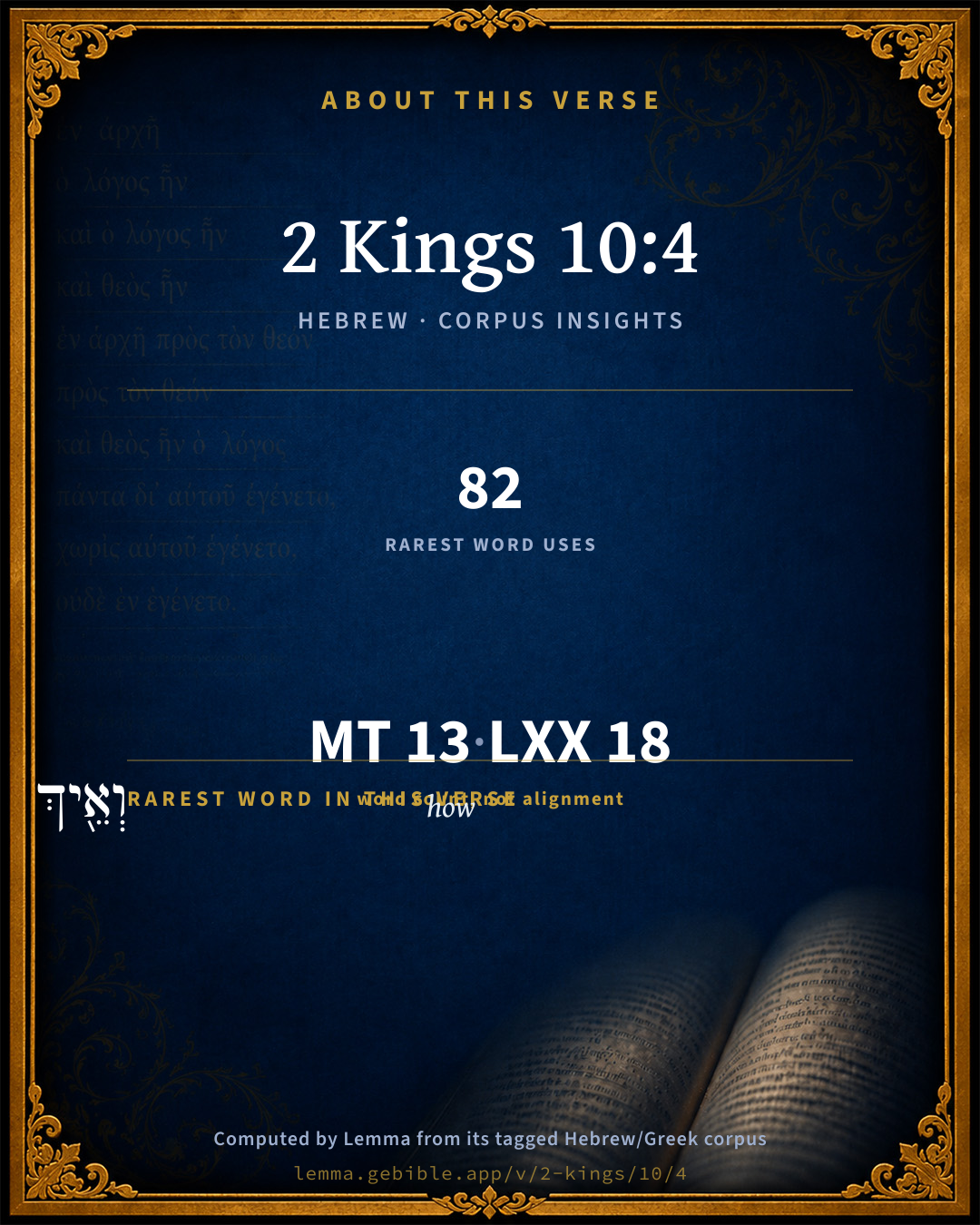
וְאֵ֖יךְ
ʼêyk
H349
“and · how”
Conjunction + Particle, Interrogative
Part of Speech
Conjunction + Particle
Type
Interrogative
Full BDB Definition

Origin: prolonged from H335

TWOT: 75

how? (interrogative adverb) - how! (in lamentation) (interjection) - expression of satisfaction (interjection)
  1. וַיִּֽרְאוּ֙ yârêʼ H3372 “and · to fear” Conjunction + Verb, Qal, Sequential Imperfect, 3rd Person, Masculine, Plural
  2. מְאֹ֣ד mᵉʼôd H3966 “exceedingly” Adverb
  3. מְאֹ֔ד mᵉʼôd H3966 “exceedingly” Adverb
  4. וַיֹּ֣אמְר֔וּ ʼâmar H559 “and · to say” Conjunction + Verb, Qal, Sequential Imperfect, 3rd Person, Masculine, Plural
  5. הִנֵּה֙ hinnêh H2009 “behold” Particle, Demonstrative
  6. שְׁנֵ֣י shᵉnayim H8147 “two” Adjective, Cardinal number, Masculine, Dual, Construct
  7. הַמְּלָכִ֔ים melek H4428 “the · kings” Particle, Definite Article + Noun, Common, Masculine, Plural, Absolute
  8. לֹ֥א lôʼ H3808 “not” Particle, Negative
  9. עָמְד֖וּ ʻâmad H5975 “to stand” Verb, Qal, Perfect, 3rd Person, Common, Plural
  10. לְפָנָ֑יו pânîym H6440 “to/for · face(s) · his” Preposition + Noun, Common, Both, Plural, Construct + Suffix, Personal, 3rd Person, Masculine, Singular
  11. נַעֲמֹ֥ד ʻâmad H5975 “to stand” Verb, Qal, Imperfect, 1st Person, Common, Plural
  12. אֲנָֽחְנוּ ʼănachnûw H587 “we” Pronoun, Personal, 1st Person, Common, Plural

About this verse

These counts appear in no published source. They are computed here, from the morphology-tagged text and Lemma’s own curated glosses. What Lemma adds →

13
words
11
distinct lemmas
Historical
section

Grammatical profile

  • 4 verbs
  • 2 nouns
  • 1 adjective
  • 1 pronoun
  • 2 adverbs
  • 3 particles

Verb forms

  • וַיִּֽרְאוּ֙ Qal · Sequential Imperfect
  • וַיֹּ֣אמְר֔וּ Qal · Sequential Imperfect
  • עָמְד֖וּ Qal · Perfect
  • נַעֲמֹ֥ד Qal · Imperfect

Repetition

Words recur within this verse — often emphatic in Hebrew:

  • מְאֹ֣ד exceedingly H3966 ×2
  • עָמְד֖וּ to stand H5975 ×2

Hebrew & Septuagint length

In English translation the verse runs 20 words from the Hebrew and 18 from the Septuagint (LXX English) — closely comparable.

A rough comparison of the two English renderings, which tokenize alike — not a word-level alignment.

Word counts can differ between the Hebrew and the Greek without any difference in meaning — e.g. the Hebrew direct-object marker אֵת has no separate Greek word, and Greek often adds the article ὁ.

In the original languages it is 13 Hebrew tokens and 18 Greek tokens — but the two are counted differently (Hebrew bundles its prefixes and suffixes into one token; the Greek is in lemma form), so that isn’t a like-for-like length.

Cross-references

6

Topical passages linked to 2 Kings 10:4 in the Treasury of Scripture Knowledge — connected by theme and wording, ordered by reader-vote popularity; previews shown in the World English Bible.

  • 2 Kings 9:24 Jehu drew his bow with his full strength, and struck Joram between his arms; and the arrow went out at his heart, and he sunk down in his chariot.
  • 2 Kings 9:27 But when Ahaziah the king of Judah saw this, he fled by the way of the garden-house. Jehu followed after him, and said, Smite him also in the chariot: [and they struck him] at the ascent of Gur, which is by Ibleam. He fled to Megiddo, and died there.
  • Isaiah 27:4 Wrath is not in me: would that the briers and thorns were against me in battle! I would march on them, I would burn them together.
  • Jeremiah 49:19 Behold, he shall come up like a lion from the pride of the Jordan against the strong habitation: for I will suddenly make them run away from it; and whoever is chosen, him will I appoint over it: for who is like me? and who will appoint me a time? and who is the shepherd who will stand before me?
  • Nahum 1:6 Who can stand before his indignation? Who can endure the fierceness of his anger? His wrath is poured out like fire, and the rocks are broken apart by him.
  • Luke 14:31 Or what king, as he goes to encounter another king in war, will not sit down first and consider whether he is able with ten thousand to meet him who comes against him with twenty thousand?

Cross-references courtesy of OpenBible.info (CC BY 4.0).

Hebrew and Greek witnesses Masoretic Hebrew ↔ Greek Septuagint

The same verse in the two great witnesses to the Old Testament, shown verse-for-verse.

These are two independent witnesses, not word-aligned to each other, and the Septuagint is shown in lemma (dictionary) form.

Hebrew 2 Kings 10:4 Masoretic · Westminster Leningrad Codex

וַיִּֽרְאוּ֙ מְאֹ֣ד מְאֹ֔ד וַיֹּ֣אמְר֔וּ הִנֵּה֙ שְׁנֵ֣י הַמְּלָכִ֔ים לֹ֥א עָמְד֖וּ לְפָנָ֑יו וְאֵ֖יךְ נַעֲמֹ֥ד אֲנָֽחְנוּ

But they were exceedingly afraid, and said, Behold, the two kings didn't stand before him: how then shall we stand?

World English Bible · Public Domain

Greek LXX 2 Kings 10:4 Septuagint · lemma form

καί φοβέω σφόδρα καί εἶπον ἰδού ὁ δύο βασιλεύς οὐ ἵστημι κατά πρόσωπον αὐτός καί πῶς ἵστημι ἐγώ

And they feared greatly, and said, Behold, two kings stood not before him: and how shall we stand?

LXX2012 (modern English Septuagint) · Public Domain

Hebrew: Westminster Leningrad Codex (CC BY 4.0). Greek: Septuagint (public domain); English from LXX2012 (modern English Septuagint) (Public Domain). How the Septuagint differs from the Hebrew →

Targum (Aramaic paraphrase)

1

The Targum is the ancient Jewish Aramaic paraphrase of the Hebrew Scriptures — an interpretive translation, not the Hebrew text itself. Onkelos (literal) and Pseudo-Jonathan (expansive) render the Torah, and Jonathan the Prophets. Coverage is partial: where no permissively-licensed English translation exists for a verse, only the Aramaic is shown. This is verse-level text, not a word-by-word alignment to the Hebrew.

  1. Targum Jonathan Prophets (Joshua–Malachi)
    וּדְחִילוּ לַחֲדָא לַחֲדָא וַאֲמַרוּ הָא תְּרֵין מַלְכַיָא לָא יְכִילוּ לְמֵיקַם קֳדָמוֹהִי וְאַכְדֵין נְקוּם אֲנַחְנָא:

    (no public-domain English translation for this verse)

    Targum Jonathan — Aramaic: “Mikraot Gedolot” (public domain). English: “Sefaria Community Translation” (CC0 1.0 (public-domain dedication)); “London "Chaldee Paraphrase," 1871” (public domain). Text via Sefaria.

Commentary

Notes on 2 Kings 10:4 from classic Christian and Jewish commentators (each source and its license shown beneath its notes). The classic Christian expositions comment on the surrounding passage and are grouped to its opening verse, so a note may address several verses; the Jewish commentaries on the Tanakh (Rashi and others) are per-verse, so they appear only where the commentator wrote on this verse.

Lemma curates 59 commentaries, every one of them public domain or Creative Commons licensed, each selected and text-cleaned for this edition rather than reprinted as found. About our sources →

Trapp's Complete Commentary

John Trapp

2Ki 10:4 But they were exceedingly afraid, and said, Behold, two kings stood not before him: how then shall we stand?

Ver. 4. But they were exceedingly afraid.] Such was their pusillanimity and perfidy, that they yield upon a little entreaty, and betray their trust. But God had an overruling hand in it, for the rooting out of Ahab’s progeny.

Behold, two kings, &c.: how then shall we stand?] Say we the same of God’s irresistible power. Ten thousand kings cannot stand before him; and how should we?

John Trapp, A Commentary or Exposition upon All the Books of the Old and New Testament (1647–1656) — public domain. Text from a community e-Sword module.

Joseph Benson's Commentary

2Ki 10:4. Behold, two kings stood not before him — All the power and interest of two kings, either in Jezreel or in the army, could not prevent his executing his design, his killing them both, and invading the kingdom of one of them. It is true, he surprised these kings, which considerably weakens their argument; but fear and self-love made them easily yield to it.

Joseph Benson's Commentary on the Old and New Testaments (1811–1818) — public domain. Text from a community e-Sword module.

Adam Clarke's Commentary

Verse 4. Two kings stood not before him] That is Joram and Ahaziah.

Adam Clarke's Commentary on the Bible (1810–1826) — public domain. Text from a community e-Sword/MySword module.

Ellicott's Commentary for English Readers

(4) But they were exceedingly afraid.—Literally, And they feared mightily, mightily. (Comp. Gen_7:19.)

Two kings.—Rather, the two kings. The word kings is emphatic.

A Bible Commentary for English Readers, edited by Charles John Ellicott (1878–1897) — public domain. Text from a community e-Sword module.

The Cambridge Bible for Schools and Colleges

gen. ed. J. J. S. Perowne

4. Behold, two kings stood not before him] Jehu’s prompt action had prevented any details of what had been done from reaching Samaria. Perhaps had they known how the two kings had been taken by surprise and shot down as they were expecting to hear a message from the army, the elders of Samaria might have offered some resistance.

The Cambridge Bible for Schools and Colleges (gen. ed. J. J. S. Perowne; Cambridge University Press, 1878–1918) — public domain. Text from a community e-Sword module.

John Gill's Exposition

But they were exceedingly afraid,.... They were intimidated at once; for they saw the purport of those letters, that should they attempt anything of this kind, he would come upon them with his forces:

and said, behold, two kings stood not before him; the kings of Israel and Judah, Joram and Ahaziah; but they were unarmed, and therefore how should they stand before an armed body of men Jehu had with him? this shows the pusillanimity of these men to make use of such an argument as this:

how then shall we stand? that is, before Jehu; but they were in much better circumstances than the two kings, as they are truly represented in Kg2 10:2.

John Gill's Exposition of the Whole Bible (1746–1763) — public domain (CC PDM 1.0). Text via the HelloAO Bible API.

Albert Barnes' Notes on the Bible

Two kings - literally, “the two kings,” i. e., Jehoram and Ahaziah 2Ki 9:21-28.

Albert Barnes' Notes on the Bible (1834–1885) — public domain. Text from a community e-Sword/MySword module.

Matthew Poole's English Annotations

All their power and interest, either in Jezreel, or in the army before or in Ramoth-gilead, could not hinder him from executing his design from killing the two kings, and from invading one of their kingdoms. It is true, he surprised the kings, which a little weakens their argument; but fear and self love made them easily yield to it.

Matthew Poole's English Annotations on the Holy Bible (1683–1685) — public domain. Text from a community e-Sword/MySword module.

Whedon's Commentary on the Bible

Daniel D. Whedon

4. Two kings — Joram and Ahaziah.

Daniel D. Whedon (gen. ed.), Commentary on the Old and New Testaments (1874–1909) — public domain. Text from a community e-Sword module.

The Pulpit Commentary

But they wore exceedingly afraid. They were men of peace, not men of war accustomed to discharge the duties of judges and magistrates, not of commandants and generals. They could not count on the obedience even of the troops in Samaria, much less on that of any others who might be in garrison elsewhere. They would naturally have been afraid of taking up arms under almost any circumstances. What, however, caused them now such excessive fear was probably the tone which Jehu had adopted his "scornful challenge," as it has been called. He evidently entertained no fear himself. He dared them to do that which he pretended to recommend them to do. They must have felt that he was laughing at them in his sleeve. And said, Behold, two kings stood not before him: how then shall we stand? The kings intended are Joram and Ahaziah, who had confronted Jehu, and had met their deaths. What were they that they should succeed where "two kings" had failed? The argument was fallacious, and a mere cloak for cowardice. The two kings had been taken by surprise, and treacherously murdered. Their fate could prove nothing concerning the probable issue of a civil war, had the "princes" ventured to commence it. It must be admitted, however, that the chance of success was but slight.

The Pulpit Commentary (1880–1919), ed. H.D.M. Spence-Jones & Joseph S. Exell — public domain. Text from a community e-Sword module.

Keil & Delitzsch

C. F. Keil & F. Delitzsch

This ruse had the desired result. The recipients of the letter were in great fear, and said, Two kings could not stand before him, how shall we? and sent messengers to announce their submission, and to say that they were willing to carry out his commands, and had no desire to appoint a king.

Keil & Delitzsch — Biblical Commentary on the Old Testament (1861–1891) — public domain (CC PDM 1.0). Text via the HelloAO Bible API. (Old Testament only.)

unfoldingWord translationNotes

Door43 World Missions Community

But they were terrified

"Then they were very afraid"

the two kings

"two kings, Joram and Ahaziah"

could not stand before Jehu

Here "stand" means to be able to endure under trouble. AT: "could not endure against Jehu" or "could not resist Jehu"

So how can we stand?

The descendants use the rhetorical question to imply that they cannot stand against Jehu. AT: "We cannot stand against him either!" or "We cannot resist him either!" (See: Rhetorical Question)

the man who was over the city

"the mayor of the city." Here to be "over" something means to have authority and responsibility over it. AT: "the man who was in charge of the city"

they who raised the children

This refers to the people who raised the king's children. AT: "they who raised the king's children" (See: Assumed Knowledge and Implicit Information)

Do what is good in your eyes

Here Jehu's "eyes" refer to his "sight." His "sight" refers to what he thinks. AT: "Do what you judge to be right" or "Do whatever you think is the best" (See: Metaphor)

translationWords

king

raise

servant

command

unfoldingWord translationNotes — © Distant Shores Media and the Door43 World Missions Community, licensed CC BY-SA 4.0. Source: git.door43.org/Door43/en_tn.

Rashi

Rabbi Shlomo Yitzchaki (Rashi)

Two kings. Yorom and Achazyohu.

Rashi on the Tanakh — English translations: “The Judaica Press complete Tanach with Rashi, translated by A. J. Rosenberg” (CC BY 4.0); “Pentateuch with Rashi's commentary by M. Rosenbaum and A.M. Silbermann, 1929-1934” (public domain); “The Metsudah Tanach series, Lakewood, N.J” (CC BY 4.0); and “The Book of Joshua, Metsudah Publications, 1997” (CC BY 4.0). Text via Sefaria.

Lesson kit

Teaching starters — assembled from the data on this page, not authored interpretation. Every prompt links to the verse data it draws on. Edit before teaching.

2 Kings, in the Historical, opens this verse with 13 words (11 distinct Hebrew lemmas). Its most distinctive word is ʼêyk (“how”). A historical commentator’s framing appears above. Read the whole chapter for the surrounding context.

Discussion questions

  1. The word ʼêyk carries the sense “how.” How does it shape the verse?
  2. How does 2 Kings 9:24, which shares this passage’s theme, read alongside this verse?
  3. What does the repetition of “exceedingly” (2× in this one verse) do in this verse?
  4. These translations render this verse differently. What is at stake in choosing one wording over another?
  5. «וַיִּֽרְאוּ֙» is a Qal Sequential Imperfect verb. How does that grammatical form shape the action described?
  6. Compare how Trapp's Complete Commentary and Joseph Benson's Commentary read this verse. Where do they agree or differ?

Things to notice

Reading settings

Reading text

Shown beneath each verse's original-language words.

Old Testament
Old Testament edition

Read the OT as the Masoretic Hebrew (MT) or the Greek Septuagint (LXX).

English shown for the Greek Septuagint (in the Hebrew ↔ Greek comparison).

Comparing translations? Open the Compare panel on any verse page to stack up to four side by side.