2 Kings 17:28

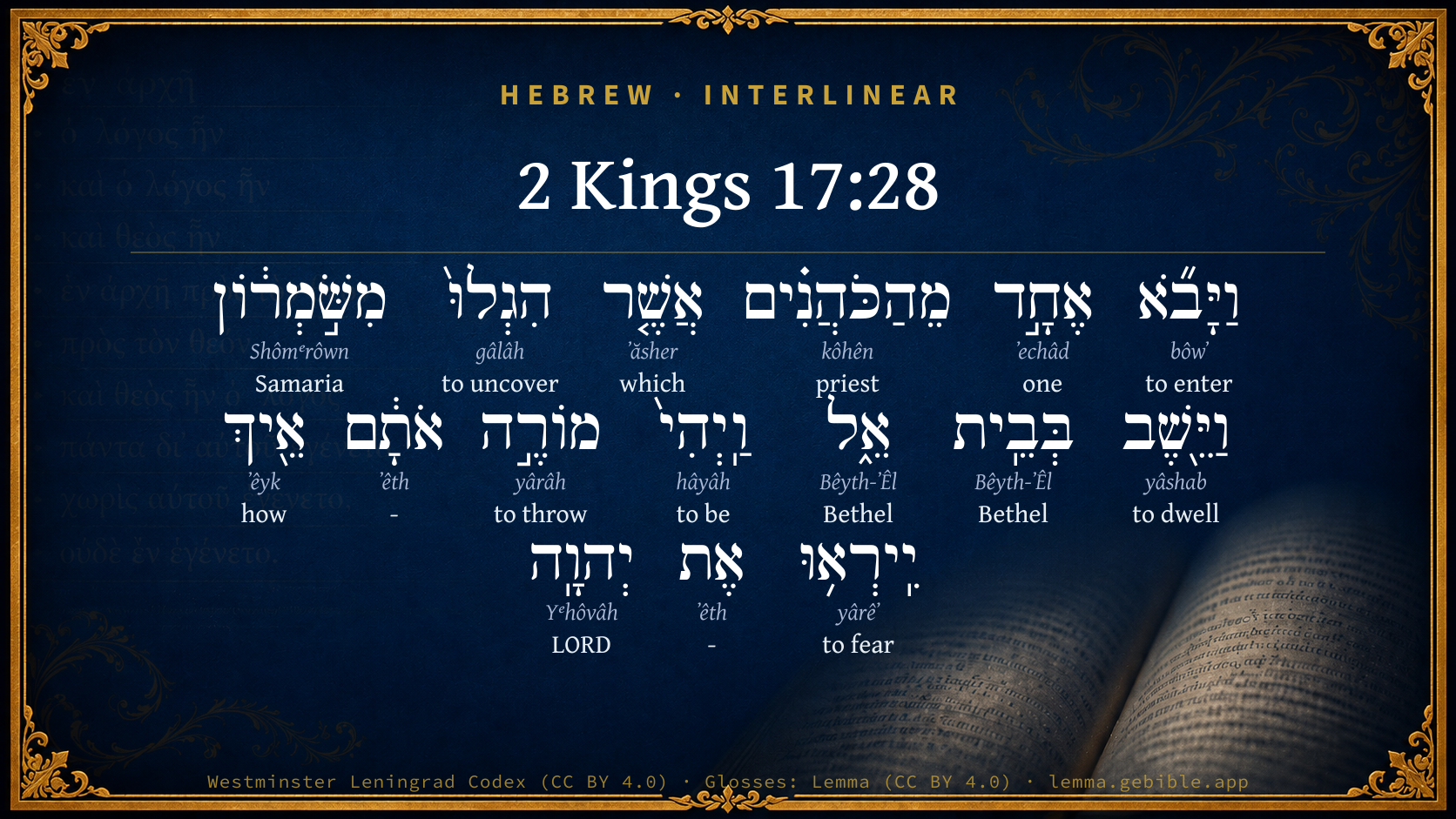
Hebrew (Westminster Leningrad Codex) 2 Kings 17:28 appears in the Hebrew Old Testament. The text above is from the Westminster Leningrad Codex. Each word links to its Strong’s number, a concise gloss, and parsing drawn from the Open Scriptures Hebrew Bible morphology. Click any word for its full Brown-Driver-Briggs (BDB) entry.
Download image
Cite this verse

2 Kings 17:28 (World English Bible). Public Domain. Lemma interlinear Bible study tool, https://lemma.gebible.app/v/2-kings/17/28.

Show BibTeX & RIS
BibTeX
RIS
English Translation
So one of the priests whom they had carried away from Samaria came and lived in Bethel, and taught them how they should fear Yahweh.
World English Bible · Public Domain
Download a study sheet

One document with this verse’s original text, its word-by-word gloss line, the meaning frame, cross-references with their text, attributed commentary, and full source and license credits — printable, and it pastes into notes with its structure intact.

This verse Autodidact and up

Study sheet (.html) Plain text (.txt)

A passage Seminary Student

Up to 50 verses in one chapter. A passage sheet keeps up to 6 commentary sources and 12 cross-references per verse, in the order this page ranks them, and says so on the sheet whenever that leaves anything out. Ask for a single verse and you get the Autodidact verse sheet above.

Everything on this page stays free to read, with no account — the sheet is a download of what is already on screen, not access to it.

Want to remove ads? Support Godless Engineer
Compare translations 3

The same verse in 3 English versions, stacked beneath the original-language interlinear above. Click any original word for its lexicon entry.

Each is an independent rendering of the whole verse — the interlinear is not word-aligned to these translations.

Highlighted words mark where these versions differ — a whole-verse word diff, not a word-by-word alignment.

  • World English Bible Public Domain
    So one of the priests whom they had carried away from Samaria came and lived in Bethel, and taught them how they should fear Yahweh.
  • King James Version Public Domain
    Then one of the priests whom they had carried away from Samaria came and dwelt in Bethel, and taught them how they should fear the LORD.
  • unfoldingWord Literal Text CC BY-SA 4.0
    And one from the priests whom they had exiled from Samaria came, and he settled in Bethel. And he was teaching them how they should fear Yahweh.

unfoldingWord Literal Text — © unfoldingWord, licensed CC BY-SA 4.0. Word-aligned USFM3 via Door43 (git.door43.org/unfoldingWord/en_ult).

Versions to compare (up to 4)

3 of 4 selected

Show all 18 translations

Every available English version of this verse, each an independent rendering of the whole verse.

  • World English Bible Public Domain
    So one of the priests whom they had carried away from Samaria came and lived in Bethel, and taught them how they should fear Yahweh.
  • Berean Standard Bible Public Domain
    Thus one of the priests they had carried away came and lived in Bethel, and he began to teach them how they should worship the LORD.
  • Majority Standard Bible Public Domain
    Thus one of the priests they had carried away came and lived in Bethel, and he began to teach them how they should worship the LORD.
  • King James Version Public Domain
    Then one of the priests whom they had carried away from Samaria came and dwelt in Bethel, and taught them how they should fear the LORD.
  • American Standard Version (1901) Public Domain
    So one of the priests whom they had carried away from Samaria came and dwelt in Beth-el, and taught them how they should fear Jehovah.
  • Revised Version (1885) Public Domain
    So one of the priests whom they had carried away from Samaria came and dwelt in Beth-el, and taught them how they should fear the LORD.
  • Geneva Bible (1599) Public Domain
    So one of the Priestes, which they had caryed from Samaria, came and dwelt in Beth-el, and taught them how they shoulde feare the Lord.
  • Douay-Rheims (1899) Public Domain
    So one of the priests who had been carried away captive from Samaria, came and dwelt in Bethel, and taught them how they should worship the Lord.
  • Young's Literal Translation Public Domain
    And one of the priests whom they removed from Samaria cometh in, and dwelleth in Beth-El, and he is teaching them how they do fear Jehovah,
  • Literal Standard Version CC BY-SA 4.0
    And one of the priests whom they removed from Samaria comes in, and dwells in Beth-El, and he is teaching them how they fear YHWH,
  • Unlocked Literal Bible CC BY-SA 4.0
    So one of the priests whom they had carried away from Samaria came and lived in Bethel; he taught them how they should honor Yahweh.
  • unfoldingWord Literal Text CC BY-SA 4.0
    And one from the priests whom they had exiled from Samaria came, and he settled in Bethel. And he was teaching them how they should fear Yahweh.
  • Darby Bible Public Domain
    Then one of the priests whom they had carried away from Samaria came and abode in Bethel, and taught them how they should fear Jehovah.
  • World Messianic Bible Public Domain
    So one of the priests whom they had carried away from Samaria came and lived in Bethel, and taught them how they should fear the LORD.
  • Webster's Bible Public Domain
    Then one of the priests whom they had carried away from Samaria came and dwelt in Beth-el, and taught them how they should fear the LORD.
  • Free Bible Version CC BY-SA 4.0
    So one of the priests who had been deported from Samaria returned to live in Bethel, and taught them how to worship the Lord.
  • Bible in Basic English Public Domain
    So one of the priests whom they had taken away as a prisoner from Samaria came back, and, living in Beth-el, became their teacher in the worship of the Lord.
  • JPS Tanakh (1917) Public Domain
    So one of the priests whom they had carried away from Samaria came and dwelt in Beth-el, and taught them how they should fear the LORD.

Literal Standard Version (2020), Covenant Press — licensed CC BY-SA 4.0. Text via the HelloAO Bible API (eBible.org). Unlocked Literal Bible (unfoldingWord) — licensed CC BY-SA 4.0. Text via the HelloAO Bible API (eBible.org). unfoldingWord Literal Text — © unfoldingWord, licensed CC BY-SA 4.0. Word-aligned USFM3 via Door43 (git.door43.org/unfoldingWord/en_ult). Free Bible Version, Dr. Jonathan Gallagher — licensed CC BY-SA 4.0. Text via the HelloAO Bible API (eBible.org).

Word by word

More ways to search: Search by grammar → Find every occurrence → Compare this word →

Practice this passage: Drill this verse → Learn its vocabulary →

אֵ֖יךְ
ʼêyk
H349
“how”
Particle, Interrogative
Part of Speech
Particle
Type
Interrogative
Full BDB Definition

Origin: prolonged from H335

TWOT: 75

how? (interrogative adverb) - how! (in lamentation) (interjection) - expression of satisfaction (interjection)
  1. וַיָּבֹ֞א bôwʼ H935 “and · to enter” Conjunction + Verb, Qal, Sequential Imperfect, 3rd Person, Masculine, Singular
  2. אֶחָ֣ד ʼechâd H259 “one” Adjective, Cardinal number, Masculine, Singular, Absolute
  3. מֵהַכֹּהֲנִ֗ים kôhên H3548 “from · the · priests” Preposition + Particle, Definite Article + Noun, Common, Masculine, Plural, Absolute
  4. אֲשֶׁ֤ר ʼăsher H834 “which” Particle, Relative
  5. הִגְלוּ֙ gâlâh H1540 “to uncover” Verb, Hiphil, Perfect, 3rd Person, Common, Plural
  6. מִשֹּׁ֣מְר֔וֹן Shômᵉrôwn H8111 “from · Samaria” Preposition + Noun, Proper
  7. וַיֵּ֖שֶׁב yâshab H3427 “and · to dwell” Conjunction + Verb, Qal, Sequential Imperfect, 3rd Person, Masculine, Singular
  8. בְּבֵֽית Bêyth-ʼÊl H1008 “in/at · Bethel” Preposition + Noun, Proper
  9. אֵ֑ל Bêyth-ʼÊl H1008 “Bethel” Noun, Proper
  10. וַֽיְהִי֙ hâyâh H1961 “and · to be” Conjunction + Verb, Qal, Sequential Imperfect, 3rd Person, Masculine, Singular
  11. מוֹרֶ֣ה yârâh H3384 “throwing” Verb, Hiphil, Participle Active, Masculine, Singular, Absolute
  12. אֹתָ֔ם ʼêth H853 “- · them” Particle, Direct Object + Suffix, Personal, 3rd Person, Masculine, Plural
  13. יִֽירְא֥וּ yârêʼ H3372 “to fear” Verb, Qal, Imperfect, 3rd Person, Masculine, Plural
  14. אֶת ʼêth H853 “-” Particle, Direct Object
  15. יְהוָֽה Yᵉhôvâh H3068 “LORD” Noun, Proper

About this verse

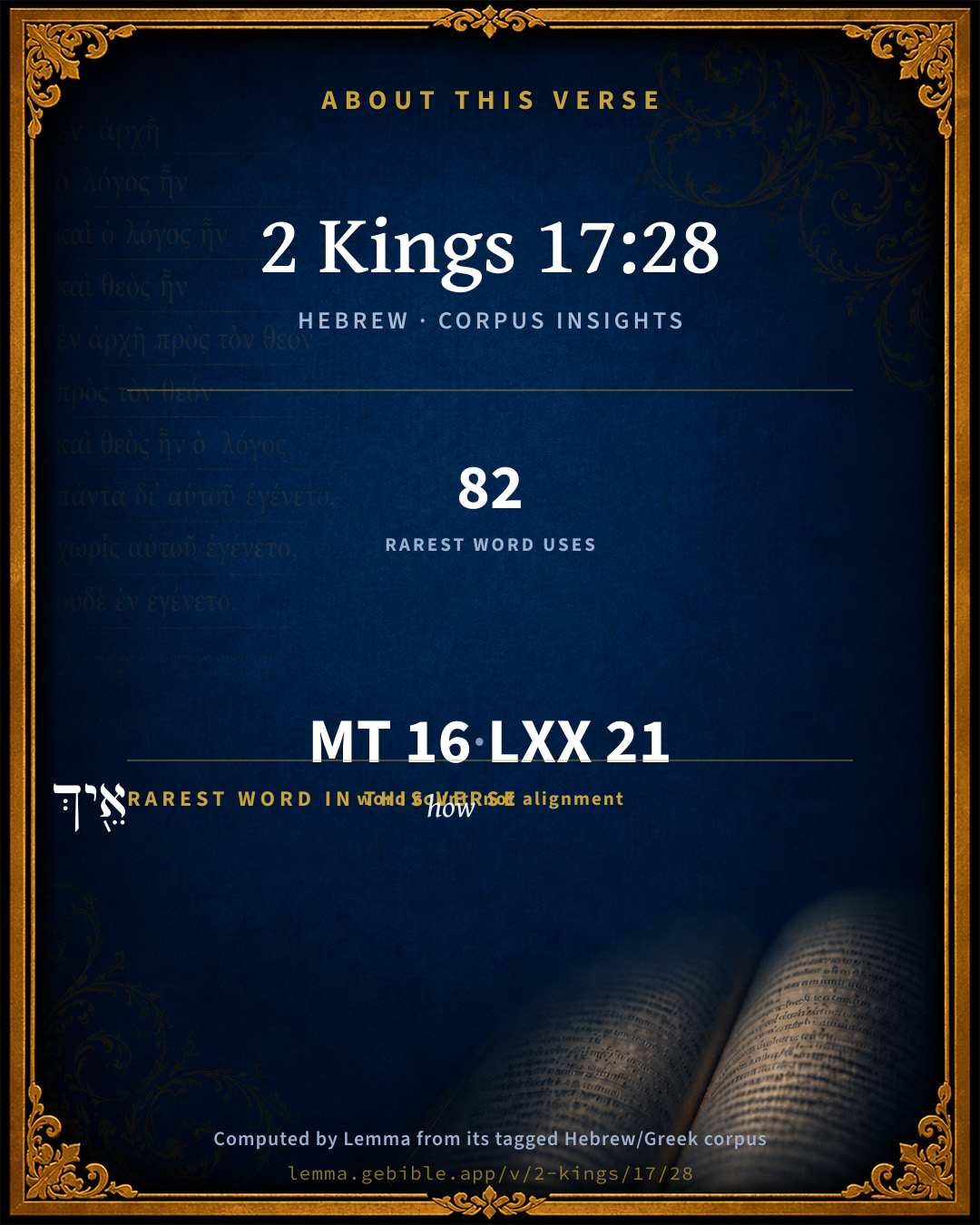
These counts appear in no published source. They are computed here, from the morphology-tagged text and Lemma’s own curated glosses. What Lemma adds →

16
words
14
distinct lemmas
Historical
section

Grammatical profile

  • 6 verbs
  • 5 nouns
  • 1 adjective
  • 4 particles

Verb forms

  • וַיָּבֹ֞א Qal · Sequential Imperfect
  • הִגְלוּ֙ Hiphil · Perfect
  • וַיֵּ֖שֶׁב Qal · Sequential Imperfect
  • וַֽיְהִי֙ Qal · Sequential Imperfect
  • מוֹרֶ֣ה Hiphil · Participle Active
  • יִֽירְא֥וּ Qal · Imperfect

Repetition

A word recurs within this verse — often emphatic in Hebrew:

  • בְּבֵֽית Bethel H1008 ×2

Hebrew & Septuagint length

In English translation the verse runs 25 words from the Hebrew and 27 from the Septuagint (LXX English) — closely comparable.

A rough comparison of the two English renderings, which tokenize alike — not a word-level alignment.

Word counts can differ between the Hebrew and the Greek without any difference in meaning — e.g. the Hebrew direct-object marker אֵת has no separate Greek word, and Greek often adds the article ὁ.

In the original languages it is 16 Hebrew tokens and 21 Greek tokens — but the two are counted differently (Hebrew bundles its prefixes and suffixes into one token; the Greek is in lemma form), so that isn’t a like-for-like length.

Cross-references

3

Topical passages linked to 2 Kings 17:28 in the Treasury of Scripture Knowledge — connected by theme and wording, ordered by reader-vote popularity; previews shown in the World English Bible.

  • 1 Kings 12:29–32 He set the one in Bethel, and the other put he in Dan.
  • Isaiah 29:13 The Lord said, Because this people draw near [to me], and with their mouth and with their lips to honor me, but have removed their heart far from me, and their fear of me is a commandment of men which has been taught [them];
  • Matthew 15:14 Leave them alone. They are blind guides of the blind. If the blind guide the blind, both will fall into a pit."

Cross-references courtesy of OpenBible.info (CC BY 4.0).

Hebrew and Greek witnesses Masoretic Hebrew ↔ Greek Septuagint

The same verse in the two great witnesses to the Old Testament, shown verse-for-verse.

These are two independent witnesses, not word-aligned to each other, and the Septuagint is shown in lemma (dictionary) form.

Hebrew 2 Kings 17:28 Masoretic · Westminster Leningrad Codex

וַיָּבֹ֞א אֶחָ֣ד מֵהַכֹּהֲנִ֗ים אֲשֶׁ֤ר הִגְלוּ֙ מִשֹּׁ֣מְר֔וֹן וַיֵּ֖שֶׁב בְּבֵֽית אֵ֑ל וַֽיְהִי֙ מוֹרֶ֣ה אֹתָ֔ם אֵ֖יךְ יִֽירְא֥וּ אֶת יְהוָֽה

So one of the priests whom they had carried away from Samaria came and lived in Bethel, and taught them how they should fear Yahweh.

World English Bible · Public Domain

Greek LXX 2 Kings 17:28 Septuagint · lemma form

καί ἄγω εἷς ὁ ἱερεύς ὅς ἀποοἰκίζω ἀπό σαμαρεία καί καταἵζω ἐν βαιθηλ καί εἰμί φωτίζω αὐτός πῶς φοβέω ὁ κύριος

And they brought one of the priests whom they had removed from Samaria, and he settled in Baethel, and taught them how they should fear the Lord.

LXX2012 (modern English Septuagint) · Public Domain

Hebrew: Westminster Leningrad Codex (CC BY 4.0). Greek: Septuagint (public domain); English from LXX2012 (modern English Septuagint) (Public Domain). How the Septuagint differs from the Hebrew →

Targum (Aramaic paraphrase)

1

The Targum is the ancient Jewish Aramaic paraphrase of the Hebrew Scriptures — an interpretive translation, not the Hebrew text itself. Onkelos (literal) and Pseudo-Jonathan (expansive) render the Torah, and Jonathan the Prophets. Coverage is partial: where no permissively-licensed English translation exists for a verse, only the Aramaic is shown. This is verse-level text, not a word-by-word alignment to the Hebrew.

  1. Targum Jonathan Prophets (Joshua–Malachi)
    וַאֲתָא חַד מִכַּהֲנַיָא דְאִתְגְלִיאוּ מִשֹׁמְרוֹן וִיתֵיב בְּבֵית אֵל וַהֲוָה מַלֵיף יַתְהוֹן אֵכְדֵין יִדְחֲלוּן מִן קֳדָם יְיָ:

    (no public-domain English translation for this verse)

    Targum Jonathan — Aramaic: “Mikraot Gedolot” (public domain). English: “Sefaria Community Translation” (CC0 1.0 (public-domain dedication)); “London "Chaldee Paraphrase," 1871” (public domain). Text via Sefaria.

Commentary

Notes on 2 Kings 17:28 from classic Christian and Jewish commentators (each source and its license shown beneath its notes). The classic Christian expositions comment on the surrounding passage and are grouped to its opening verse, so a note may address several verses; the Jewish commentaries on the Tanakh (Rashi and others) are per-verse, so they appear only where the commentator wrote on this verse.

Lemma curates 59 commentaries, every one of them public domain or Creative Commons licensed, each selected and text-cleaned for this edition rather than reprinted as found. About our sources →

Trapp's Complete Commentary

John Trapp

2Ki 17:28 Then one of the priests whom they had carried away from Samaria came and dwelt in Bethel, and taught them how they should fear the LORD.

Ver. 28. And taught them how they should fear the Lord.] Timore cultus, non culpae; fear him at least as the idolatrous Israelites did Servile fear materially is not evil, but formally and eventually, because joined with a hatred of him we fear, saith Ribera.

John Trapp, A Commentary or Exposition upon All the Books of the Old and New Testament (1647–1656) — public domain. Text from a community e-Sword module.

Joseph Benson's Commentary

2Ki 17:28. Then one of the priests whom they had carried away came, &c. — A prophet would have done them more good, especially as it appears this was but one of the priests of the calves, who therefore chose to dwell at Beth-el. And taught them how they should fear the Lord — That is, the manner of God’s worship as it had been practised in Israel: for as to any thing further, whether respecting their duty to God or man, though he might possibly teach them to know more than they knew before, and to do better than they did, it is not likely he should teach them to know the truth, or to do well, unless he had taught his own people better.

Joseph Benson's Commentary on the Old and New Testaments (1811–1818) — public domain. Text from a community e-Sword module.

Ellicott's Commentary for English Readers

(28) And taught.—And was teaching, implying a permanent work.

In Bethel.—Because he was a priest of the calfworship.

Fear the Lord.—Not in the modern ethical but in the ancient ceremonial sense.

A Bible Commentary for English Readers, edited by Charles John Ellicott (1878–1897) — public domain. Text from a community e-Sword module.

The Cambridge Bible for Schools and Colleges

gen. ed. J. J. S. Perowne

28. Then [R.V. So] one of the priests whom they had carried away] We can see from this that the events here spoken of took place within a very limited time. The priest who had been taken away from Samaria was still alive, and in vigour enough to be selected to go back again and to undertake the office of a teacher among the heathen colonists.

came and dwelt in Beth-el] The place where one of the golden calves had been set up. The worship of these objects would be what the priest taught as the national worship of the ten tribes.

how they should fear the Lord] For the worship of the ten tribes was professedly a worship of Jehovah, though performed in a manner contradictory to His express commandment.

The Cambridge Bible for Schools and Colleges (gen. ed. J. J. S. Perowne; Cambridge University Press, 1878–1918) — public domain. Text from a community e-Sword module.

John Gill's Exposition

Then one of the priests whom, they had carried away from Samaria came and dwelt in Bethel,.... According to an Arabic writer (r), his name was Uzziah; but Epiphanius (s) says his name was Esdras; but he wrongly makes him to be sent by Nebuchadnezzar, thirty years after the captivity of the Jews in Babylon: this priest was, doubtless, one of the priests of the calves; for there were none else in the kingdom of Israel carried captive, and as seems also by his choosing to dwell in Bethel, where probably he formerly dwelt, and officiated in the service of the calf there, and by teaching to make priests of the lowest order of the people, as Jeroboam's priests were, Kg2 17:32.

and taught them how they should fear the Lord; serve and worship him; he might not teach them the worship of the calves, that being a political business, and now no end to be answered by it; and besides, they were now carried out of the land. This priest taught, no doubt, according to the law of Moses, but was not the author of the Pentateuch; which ridiculous conceit of Le Clerc is sufficiently exposed by Witsius (t).

(r) Abulpharag. Hist. Dynast. Dyn. 3. p. 65. (s) Contr. Haeres. l. 1. Haer. 8. (t) Miscellan. tom. 1. l. 1. c. 14. sect. 7. 28.

John Gill's Exposition of the Whole Bible (1746–1763) — public domain (CC PDM 1.0). Text via the HelloAO Bible API.

Albert Barnes' Notes on the Bible

The priest sent to the colonists was not a true Yahweh-priest, but one of those who had been attached to the calf-worship, probably at Bethel. Hence, he would be willing to tolerate the mixed religion, which a true Yahweh-priest would have unsparingly condemned.

Albert Barnes' Notes on the Bible (1834–1885) — public domain. Text from a community e-Sword/MySword module.

Haydock's Catholic Bible Commentary

Bethel. Garizim was not then honoured with the temple, as the Samaritans would pretend. (Chronicles) They wished to join in building that at Jerusalem, under Esdras. (Calmet) --- Lord. Collins would make us believe, that the Samaritans continued "for a long time" without the Pentateuch, and all "heathens for many ages." But the first supposition "is to me incredible," says Kennicott; and Hottinger himself allows, that the priests did bring back a copy of the law "exactly corresponding with the autograph of Moses." (Exert. p. 8.) And as for the Samaritans being heathens, Prideaux, whom this infidel writer quotes, (Haydock) says, "consistently with his Bible, that they continued in that gross idolatry of worshipping other gods in conjunction with the True; which last words are very unfairly omitted." (Kennicott, Diss. ii. p. 115.) --- This was the true origin and state of this mixture of nations, who were sent to cultivate the lands of Samaria. (Haydock)

George Leo Haydock (1774–1849), Haydock's Catholic Family Bible and Commentary, 1859 edition — public domain. Excludes Psalms (Douay-Rheims chapter numbering differs from Protestant) and Deuterocanonical books (Catholic canon only).

Matthew Poole's English Annotations

i.e. The manner of God’s worship, as it was practised in Israel; as may be gathered both from the quality of this person, who was all Israelitish priest; and from the place of his residence, Beth-el, a place infamous for the worship of the calves, and from the manner of their making priests by this man’s direction, 2Ki 17:32.

Matthew Poole's English Annotations on the Holy Bible (1683–1685) — public domain. Text from a community e-Sword/MySword module.

Whedon's Commentary on the Bible

Daniel D. Whedon

28. One of the priests… from Samaria — Probably one of the priests of Jeroboam’s calf-worship, and therefore not Levitical. Compare 2Ki_17:32, note. As was natural with one of those priests, he came and dwelt in Bethel, which had been the principal seat of the calf-worship, (1Ki_12:28-33,) and perhaps, as Bahr supposes, he erected there images like the golden calves which had been taken away.

Taught them how they should fear the Lord — But taught them very imperfectly, as the sequel shows. As Jeroboam’s attempt to identify or associate the golden calves with the God of the Exodus (1Ki_12:28) became a sin to Israel, so this priest’s teaching by means of images, or from the standpoint of the old calf-worship, resulted, as the following verses show, in a mixed and confusing system of religion.

Daniel D. Whedon (gen. ed.), Commentary on the Old and New Testaments (1874–1909) — public domain. Text from a community e-Sword module.

The Pulpit Commentary

Then one of the priests whom they had carried away from Samaria the country, not the city, as in vers. 24 and 25came and dwelt in Bethel. Bethel from a very early time greatly eclipsed Dan. While the allusions to Bethel, commonly called "Bethaven" ("House of nothingness" for "House of God"), are frequent in the Israelitish prophets (Hos_4:15 Hos_5:8 Hos_10:5, Hos_10:8, Hos_10:15; Amo_3:14 Amo_4:4 Amo_5:5, 6 7:10-13) there is but a single distinct allusion to Dan. (Amo_8:14) Bethel was "the king"s chapel" and "the king"s court". (Amo_7:13) The priest selected by Sargon"s advisers was a Bethelite priest, and, returning thither, took up the worship familiar to him. And taught themi.e. , the new settlers how they should fear the Lord. This worship could only be that of the calf-priests instituted by Jeroboam, which was, however, most certainly a worship of Jehovah, and an imitation or travesty of the temple worship at Jerusalem. Whether the returned priest set up a new calf-idol to replace the one which had been carried off to Assyria, (Hos_10:5) is doubtful.

The Pulpit Commentary (1880–1919), ed. H.D.M. Spence-Jones & Joseph S. Exell — public domain. Text from a community e-Sword module.

John Wesley's Explanatory Notes

Taught them - The manner of God's worship, as it was practiced in Israel; as may be gathered both from the quality of this person, who was an Israelitish priest; and from the place of his residence, Beth-el, a place infamous for the worship of the calves, and from the manner of their making priests by this man's direction.

John Wesley, Explanatory Notes Upon the Whole Bible (1754–1765) — public domain. Text via the GEBible commentary corpus.

Lesson kit

Teaching starters — assembled from the data on this page, not authored interpretation. Every prompt links to the verse data it draws on. Edit before teaching.

2 Kings, in the Historical, opens this verse with 16 words (14 distinct Hebrew lemmas). Its most distinctive word is ʼêyk (“how”). A historical commentator’s framing appears above. Read the whole chapter for the surrounding context.

Discussion questions

  1. The word ʼêyk carries the sense “how.” How does it shape the verse?
  2. 1 Kings 12:29–32 shares this passage’s theme. How do the two illuminate each other?
  3. “Bethel” occurs 2× in this one verse. What is the effect of the repetition?
  4. These translations render this verse differently. What is at stake in choosing one wording over another?
  5. The verb «וַיָּבֹ֞א» is Qal Sequential Imperfect. How does its form color the action?
  6. Reading how Trapp's Complete Commentary and Joseph Benson's Commentary read this verse, where do the two commentators agree and where do they part?

Things to notice

Reading settings

Reading text

Shown beneath each verse's original-language words.

Old Testament
Old Testament edition

Read the OT as the Masoretic Hebrew (MT) or the Greek Septuagint (LXX).

English shown for the Greek Septuagint (in the Hebrew ↔ Greek comparison).

Comparing translations? Open the Compare panel on any verse page to stack up to four side by side.