Exodus 1:17

Hebrew (Westminster Leningrad Codex) Exodus 1:17 appears in the Hebrew Old Testament. The text above is from the Westminster Leningrad Codex. Each word links to its Strong’s number, a concise gloss, and parsing drawn from the Open Scriptures Hebrew Bible morphology. Click any word for its full Brown-Driver-Briggs (BDB) entry.
Download image
Cite this verse

Exodus 1:17 (World English Bible). Public Domain. Lemma interlinear Bible study tool, https://lemma.gebible.app/v/exodus/1/17.

Show BibTeX & RIS
BibTeX
RIS
English Translation
But the midwives feared God, and didn't do what the king of Egypt commanded them, but saved the baby boys alive.
World English Bible · Public Domain
Download a study sheet

One document with this verse’s original text, its word-by-word gloss line, the meaning frame, cross-references with their text, attributed commentary, and full source and license credits — printable, and it pastes into notes with its structure intact.

This verse Autodidact and up

Study sheet (.html) Plain text (.txt)

A passage Seminary Student

Up to 50 verses in one chapter. A passage sheet keeps up to 6 commentary sources and 12 cross-references per verse, in the order this page ranks them, and says so on the sheet whenever that leaves anything out. Ask for a single verse and you get the Autodidact verse sheet above.

Everything on this page stays free to read, with no account — the sheet is a download of what is already on screen, not access to it.

Want to remove ads? Support Godless Engineer
Compare translations 3

The same verse in 3 English versions, stacked beneath the original-language interlinear above. Click any original word for its lexicon entry.

Each is an independent rendering of the whole verse — the interlinear is not word-aligned to these translations.

Highlighted words mark where these versions differ — a whole-verse word diff, not a word-by-word alignment.

  • World English Bible Public Domain
    But the midwives feared God, and didn't do what the king of Egypt commanded them, but saved the baby boys alive.
  • King James Version Public Domain
    But the midwives feared God, and did not as the king of Egypt commanded them, but saved the men children alive.
  • unfoldingWord Literal Text CC BY-SA 4.0
    But the midwives feared God and did not do according to what the king of Egypt spoke to them, and they let the sons live.

unfoldingWord Literal Text — © unfoldingWord, licensed CC BY-SA 4.0. Word-aligned USFM3 via Door43 (git.door43.org/unfoldingWord/en_ult).

Versions to compare (up to 4)

3 of 4 selected

Show all 18 translations

Every available English version of this verse, each an independent rendering of the whole verse.

  • World English Bible Public Domain
    But the midwives feared God, and didn't do what the king of Egypt commanded them, but saved the baby boys alive.
  • Berean Standard Bible Public Domain
    The midwives, however, feared God and did not do as the king of Egypt had instructed; they let the boys live.
  • Majority Standard Bible Public Domain
    The midwives, however, feared God and did not do as the king of Egypt had instructed; they let the boys live.
  • King James Version Public Domain
    But the midwives feared God, and did not as the king of Egypt commanded them, but saved the men children alive.
  • American Standard Version (1901) Public Domain
    But the midwives feared God, and did not as the king of Egypt commanded them, but saved the men-children alive.
  • Revised Version (1885) Public Domain
    But the midwives feared God, and did not as the king of Egypt commanded them, but saved the men children alive.
  • Geneva Bible (1599) Public Domain
    Notwithstanding ye midwiues feared God, and did not as the King of Egypt commanded them, but preserued aliue the men children.
  • Douay-Rheims (1899) Public Domain
    But the midwives feared God, and did not do as the king of Egypt had commanded, but saved the men children.
  • Young's Literal Translation Public Domain
    And the midwives fear God, and have not done as the king of Egypt hath spoken unto them, and keep the lads alive;
  • Literal Standard Version CC BY-SA 4.0
    And the midwives fear God, and have not done as the king of Egypt has spoken to them, and they keep the boys alive;
  • Unlocked Literal Bible CC BY-SA 4.0
    But the midwives feared God and did not do as the king of Egypt ordered them; instead, they let the baby boys live.
  • unfoldingWord Literal Text CC BY-SA 4.0
    But the midwives feared God and did not do according to what the king of Egypt spoke to them, and they let the sons live.
  • Darby Bible Public Domain
    But the midwives feared God, and did not as the king of Egypt had said to them, but saved the male children alive.
  • World Messianic Bible Public Domain
    But the midwives feared God, and didn’t do what the king of Egypt commanded them, but saved the baby boys alive.
  • Webster's Bible Public Domain
    But the midwives feared God, and did not as the king of Egypt commanded them, but saved the male-children alive.
  • Free Bible Version CC BY-SA 4.0
    But because the midwives revered God, they didn't do what the king of Egypt had ordered. They let the boys live as well.
  • Bible in Basic English Public Domain
    But the women had the fear of God, and did not do as the king of Egypt said, but let the male children go on living.
  • JPS Tanakh (1917) Public Domain
    But the midwives feared God, and did not as the king of Egypt commanded them, but saved the men-children alive.

Literal Standard Version (2020), Covenant Press — licensed CC BY-SA 4.0. Text via the HelloAO Bible API (eBible.org). Unlocked Literal Bible (unfoldingWord) — licensed CC BY-SA 4.0. Text via the HelloAO Bible API (eBible.org). unfoldingWord Literal Text — © unfoldingWord, licensed CC BY-SA 4.0. Word-aligned USFM3 via Door43 (git.door43.org/unfoldingWord/en_ult). Free Bible Version, Dr. Jonathan Gallagher — licensed CC BY-SA 4.0. Text via the HelloAO Bible API (eBible.org).

Word by word

More ways to search: Search by grammar → Find every occurrence → Compare this word →

Practice this passage: Drill this verse → Learn its vocabulary →

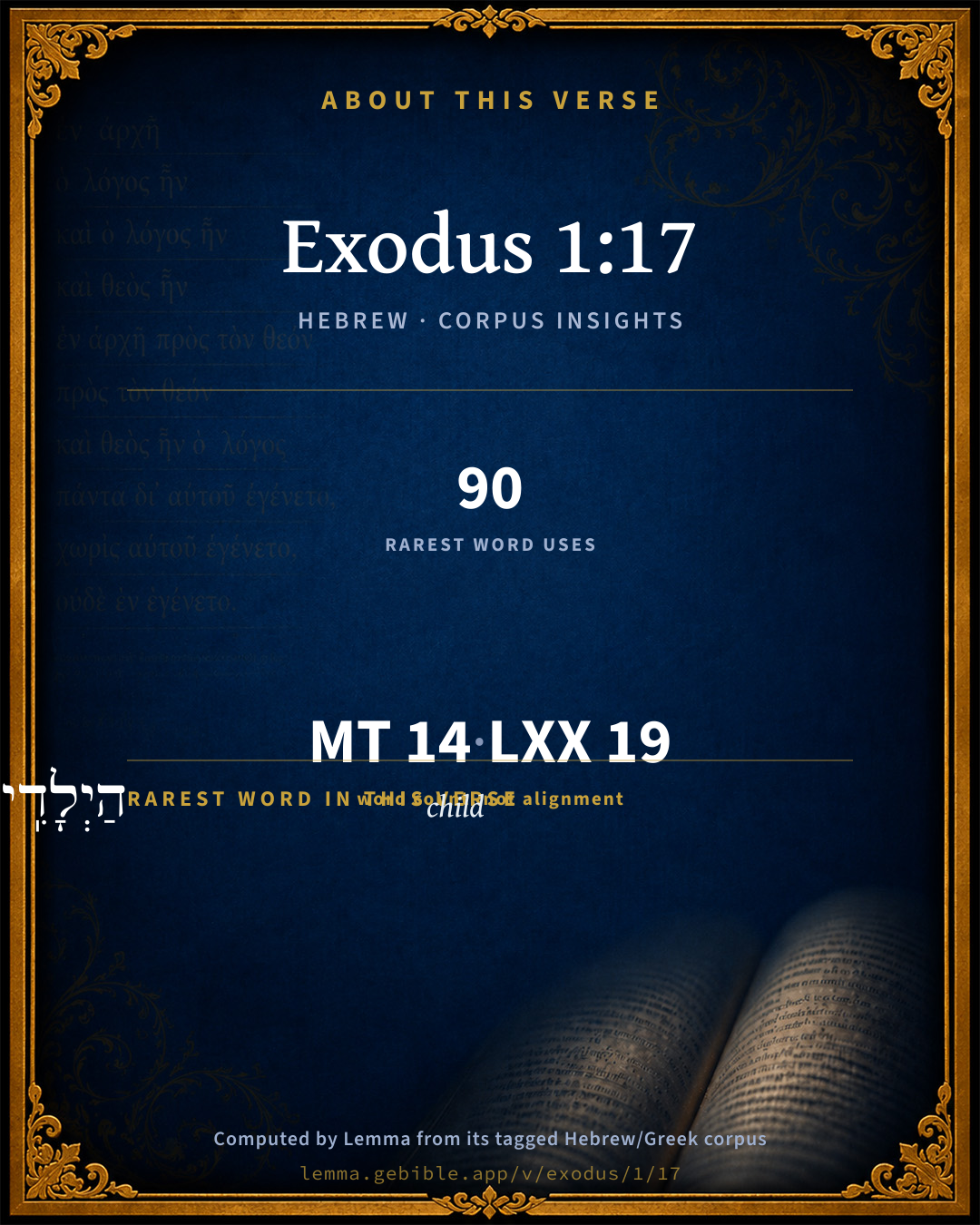
הַיְלָדִֽים
yeled
H3206
“the · children”
Particle, Definite Article + Noun, Common, Masculine, Plural, Absolute
Part of Speech
Particle + Noun
Type
Common
Gender
Masculine
Number
Plural
State
Absolute
Full BDB Definition

Origin: from H3205

TWOT: 867b

child, son, boy, offspring, youth - child, son, boy - child, children - descendants - youth - apostate Israelites (figuratively)
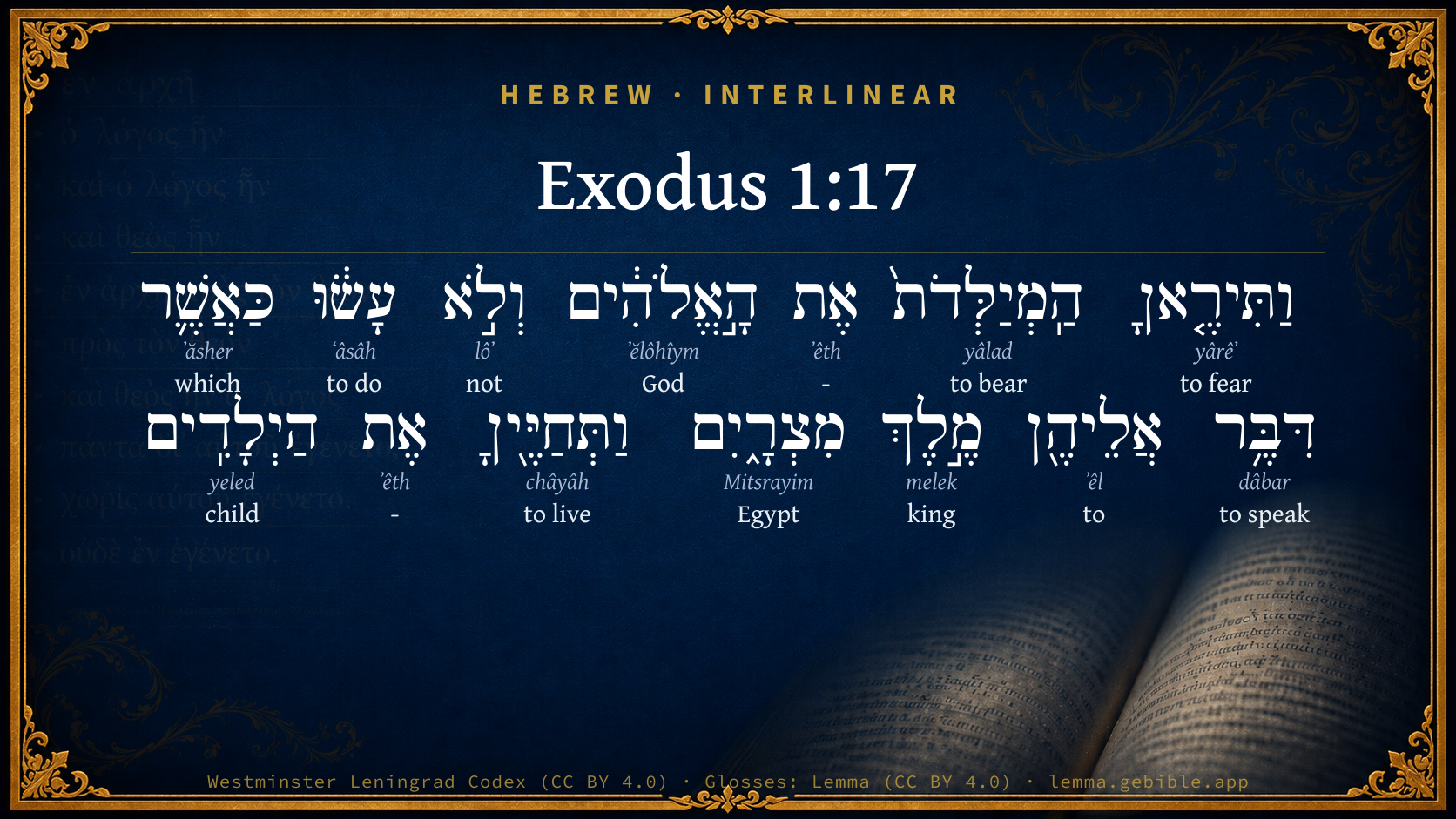
  1. וַתִּירֶ֤אןָ yârêʼ H3372 “and · to fear” Conjunction + Verb, Qal, Sequential Imperfect, 3rd Person, Feminine, Plural
  2. הַֽמְיַלְּדֹת֙ yâlad H3205 “the · bearing” Particle, Definite Article + Verb, Piel, Participle Active, Feminine, Plural, Absolute
  3. אֶת ʼêth H853 “-” Particle, Direct Object
  4. הָ֣אֱלֹהִ֔ים ʼĕlôhîym H430 “the · God(s)” Particle, Definite Article + Noun, Common, Masculine, Plural, Absolute
  5. וְלֹ֣א lôʼ H3808 “and · not” Conjunction + Particle, Negative
  6. עָשׂ֔וּ ʻâsâh H6213 “to do” Verb, Qal, Perfect, 3rd Person, Common, Plural
  7. כַּאֲשֶׁ֛ר ʼăsher H834 “like/as · which” Preposition + Particle, Relative
  8. דִּבֶּ֥ר dâbar H1696 “to speak” Verb, Piel, Perfect, 3rd Person, Masculine, Singular
  9. אֲלֵיהֶ֖ן ʼêl H413 “to · them” Preposition + Suffix, Personal, 3rd Person, Feminine, Plural
  10. מֶ֣לֶךְ melek H4428 “king of” Noun, Common, Masculine, Singular, Construct
  11. מִצְרָ֑יִם Mitsrayim H4714 “Egypt” Noun, Proper
  12. וַתְּחַיֶּ֖יןָ châyâh H2421 “and · to live” Conjunction + Verb, Piel, Sequential Imperfect, 3rd Person, Feminine, Plural
  13. אֶת ʼêth H853 “-” Particle, Direct Object

About this verse

These counts appear in no published source. They are computed here, from the morphology-tagged text and Lemma’s own curated glosses. What Lemma adds →

14
words
13
distinct lemmas
Pentateuch
section

Grammatical profile

  • 5 verbs
  • 4 nouns
  • 1 preposition
  • 4 particles

Verb forms

  • וַתִּירֶ֤אןָ Qal · Sequential Imperfect
  • הַֽמְיַלְּדֹת֙ Piel · Participle Active
  • עָשׂ֔וּ Qal · Perfect
  • דִּבֶּ֥ר Piel · Perfect
  • וַתְּחַיֶּ֖יןָ Piel · Sequential Imperfect

Hebrew & Septuagint length

In English translation the verse runs 21 words from the Hebrew and 22 from the Septuagint (LXX English) — closely comparable.

A rough comparison of the two English renderings, which tokenize alike — not a word-level alignment.

Word counts can differ between the Hebrew and the Greek without any difference in meaning — e.g. the Hebrew direct-object marker אֵת has no separate Greek word, and Greek often adds the article ὁ.

In the original languages it is 14 Hebrew tokens and 19 Greek tokens — but the two are counted differently (Hebrew bundles its prefixes and suffixes into one token; the Greek is in lemma form), so that isn’t a like-for-like length.

Cross-references

17

Topical passages linked to Exodus 1:17 in the Treasury of Scripture Knowledge — connected by theme and wording, ordered by reader-vote popularity; previews shown in the World English Bible.

  • Acts 5:29 But Peter and the apostles answered, "We must obey God rather than men.
  • Exodus 1:21 It happened, because the midwives feared God, that he gave them families.
  • Ecclesiastes 12:13 This is the end of the matter. All has been heard. Fear God, and keep his commandments; for this is the whole duty of man.
  • Matthew 10:28 Don't be afraid of those who kill the body, but are not able to kill the soul. Rather, fear him who is able to destroy both soul and body in Gehenna.
  • Luke 12:5 But I will warn you whom you should fear. Fear him, who after he has killed, has power to cast into Gehenna. Yes, I tell you, fear him.
  • Acts 4:18–20 They called them, and charged them not to speak at all nor teach in the name of Jesus.
  • Proverbs 16:6 By mercy and truth iniquity is atoned for. By the fear of Yahweh men depart from evil.
  • Daniel 3:16–18 Shadrach, Meshach, and Abednego answered the king, Nebuchadnezzar, we have no need to answer you in this matter.
  • Daniel 6:13 Then answered they and said before the king, That Daniel, who is of the children of the captivity of Judah, doesn't regard you, O king, nor the interdict that you have signed, but makes his petition three times a day.
  • Genesis 42:18 Joseph said to them the third day, "Do this, and live, for I fear God.
  • Psalms 31:19 Oh how great is your goodness, Which you have laid up for those who fear you, Which you have worked for those who take refuge in you, Before the sons of men!
  • Ecclesiastes 8:12 Though a sinner commits crimes a hundred times, and lives long, yet surely I know that it will be better with those who fear God, who are reverent before him.
  • Nehemiah 5:15 But the former governors who were before me were chargeable to the people, and took of them bread and wine, besides forty shekels of silver; yes, even their servants bore rule over the people: but I didn't do so, because of the fear of God.
  • Proverbs 8:13 The fear of Yahweh is to hate evil. I hate pride, arrogance, the evil way, and the perverse mouth.
  • Hosea 5:11 Ephraim is oppressed, He is crushed in judgment; Because he is intent in his pursuit of idols.
  • Micah 6:16 For the statutes of Omri are kept, And all the works of the house of Ahab. You walk in their counsels, That I may make you a ruin, And her inhabitants a hissing; And you will bear the reproach of my people."
  • Proverbs 24:11–12 Rescue those who are being led away to death! Indeed, hold back those who are staggering to the slaughter!

Cross-references courtesy of OpenBible.info (CC BY 4.0).

Hebrew and Greek witnesses Masoretic Hebrew ↔ Greek Septuagint

The same verse in the two great witnesses to the Old Testament, shown verse-for-verse.

These are two independent witnesses, not word-aligned to each other, and the Septuagint is shown in lemma (dictionary) form.

Hebrew Exodus 1:17 Masoretic · Westminster Leningrad Codex

וַתִּירֶ֤אןָ הַֽמְיַלְּדֹת֙ אֶת הָ֣אֱלֹהִ֔ים וְלֹ֣א עָשׂ֔וּ כַּאֲשֶׁ֛ר דִּבֶּ֥ר אֲלֵיהֶ֖ן מֶ֣לֶךְ מִצְרָ֑יִם וַתְּחַיֶּ֖יןָ אֶת הַיְלָדִֽים

But the midwives feared God, and didn't do what the king of Egypt commanded them, but saved the baby boys alive.

World English Bible · Public Domain

Greek LXX Exodus 1:17 Septuagint · lemma form

φοβέω δέ ὁ μαῖα ὁ θεός καί οὐ ποιέω καθότι συντάσσω αὐτός ὁ βασιλεύς αἴγυπτος καί ζωογονέω ὁ ἄρσην

But the midwives feared God, and did not as the king of Egypt appointed them; and they saved the male children alive.

LXX2012 (modern English Septuagint) · Public Domain

Hebrew: Westminster Leningrad Codex (CC BY 4.0). Greek: Septuagint (public domain); English from LXX2012 (modern English Septuagint) (Public Domain). How the Septuagint differs from the Hebrew →

Targum (Aramaic paraphrase)

2

The Targum is the ancient Jewish Aramaic paraphrase of the Hebrew Scriptures — an interpretive translation, not the Hebrew text itself. Onkelos (literal) and Pseudo-Jonathan (expansive) render the Torah, and Jonathan the Prophets. Coverage is partial: where no permissively-licensed English translation exists for a verse, only the Aramaic is shown. This is verse-level text, not a word-by-word alignment to the Hebrew.

  1. Targum Onkelos Torah (Genesis–Deuteronomy)
    וּדְחִילָא חַיָתָא מִן קֳדָם יְיָ וְלָא עֲבָדָא כְּמָא דְמַלִיל עִמְהֶן מַלְכָּא דְמִצְרָיִם וְקַיָמָא יָת בְּנַיָא:

    (no public-domain English translation for this verse)

    Targum Onkelos — Aramaic: “Onkelos Genesis” (public domain); “Onkelos Exodus” (public domain); “Onkelos Leviticus” (public domain); “Onkelos Numbers” (public domain); “Onkelos Deuteronomy” (public domain). English: “Sefaria Community Translation” (CC0 1.0 (public-domain dedication)); “J.W. Etheridge. The Targums of Onkelos and Jonathan Ben Uzziel on the Pentateuch. London: Longmans, Green, 1862” (public domain). Text via Sefaria.

  2. Targum Pseudo-Jonathan Torah (Genesis–Deuteronomy)
    דְחִילָא חַיְיתָא מִן קֳדָם יְיָ וְלָא עָבָדוּ הֵיכְמָא דְמַלֵל עִמְהוֹן מַלְכָּא דְמִצְרַיִם וְקַיָימָא יַת בְּנַיָיא

    But the midwives feared before the Lord, and would not do according to what the king of Mizraim had said to them, but they saved the children.

    Targum Pseudo-Jonathan — Aramaic: “Targum Jonathan on Genesis” (public domain); “Targum Jonathan on Exodus” (public domain); “Targum Jonathan on Leviticus” (public domain); “Targum Jonathan on Numbers” (public domain); “Targum Jonathan on Deuteronomy” (public domain). English: “The Targum of Jonathan ben Uzziel, trans. J. W. Etheridge, London, 1862” (public domain). Text via Sefaria.

Commentary

Notes on Exodus 1:17 from classic Christian and Jewish commentators (each source and its license shown beneath its notes). The classic Christian expositions comment on the surrounding passage and are grouped to its opening verse, so a note may address several verses; the Jewish commentaries on the Tanakh (Rashi and others) are per-verse, so they appear only where the commentator wrote on this verse.

Lemma curates 59 commentaries, every one of them public domain or Creative Commons licensed, each selected and text-cleaned for this edition rather than reprinted as found. About our sources →

Trapp's Complete Commentary

John Trapp

Exo 1:17 But the midwives feared God, and did not as the king of Egypt commanded them, but saved the men children alive.

Ver. 17. And did not as the king, &c.] Wherein they did no more, though out of a better principle, than nature itself dictateth. Antigona saith thus in Sophocles, Magis obtemperandum est Diis apud quos diutius manendum erit, quam hominibus quibuscum admodum brevi tempore vivendum est. {See Trapp on "Act 4:19"} "We must rather obey God than men."

John Trapp, A Commentary or Exposition upon All the Books of the Old and New Testament (1647–1656) — public domain. Text from a community e-Sword module.

Tyndale Open Study Notes

Tyndale Open Resources

1:17 The midwives . . . refused to obey the mighty Egyptian king because they feared God more than they feared Pharaoh (1:21). Fear of the Lord (reverent awe of him as the almighty Creator and Judge) is the foundation of true knowledge and of wisdom (Prov 1:7; 9:10). The Lord is a friend to those who fear him (Ps 25:14). The midwives understood that the Lord has more power than any human being.

Tyndale Open Study Notes — © Tyndale Open Resources, licensed CC BY-SA 4.0. Text via the HelloAO Bible API.

Jamieson, Fausset & Brown

Robert Jamieson, A. R. Fausset & David Brown

But the midwives feared God--Their faith inspired them with such courage as to risk their lives, by disobeying the mandate of a cruel tyrant; but it was blended with weakness, which made them shrink from speaking the truth, the whole truth, and nothing but the truth.

Jamieson, Fausset & Brown — Commentary Critical and Explanatory on the Whole Bible (1871) — public domain (CC PDM 1.0). Text via the HelloAO Bible API.

Adam Clarke's Commentary

Verse 17. The midwives feared God] Because they knew that God had forbidden murder of every kind; for though the law was not yet given, Ex 20:13, being Hebrews they must have known that God had from the beginning declared, Whosoever sheddeth man's blood, by man shall his blood be shed, Ge 9:6. Therefore they saved the male children of all to whose assistance they were called. See Clarke on Ex 1:19.

Adam Clarke's Commentary on the Bible (1810–1826) — public domain. Text from a community e-Sword/MySword module.

Ellicott's Commentary for English Readers

(17) The midwives feared God.—The midwives, whether Hebrews or Egyptians, believed in a God who would punish wrong-doing, and therefore resolved not to obey the Pharaoh.

A Bible Commentary for English Readers, edited by Charles John Ellicott (1878–1897) — public domain. Text from a community e-Sword module.

The Cambridge Bible for Schools and Colleges

gen. ed. J. J. S. Perowne

17. The midwives feared God; and would not be parties to such inhumanity.

The Cambridge Bible for Schools and Colleges (gen. ed. J. J. S. Perowne; Cambridge University Press, 1878–1918) — public domain. Text from a community e-Sword module.

John Gill's Exposition

But the midwives feared God,.... And therefore durst not take away the life of an human creature, which was contrary to the express law of God, Gen 9:6,

and did not as the king of Egypt commanded them; knowing it was right to obey God rather than man, though ever so great, or in so exalted a station:

but saved the men children alive; did not use any violence with them, by stifling them in the birth. The scheme was so barbarous and shocking, especially to the tender sex, to whom it was proposed, and so devoid of humanity, that one would think it should never enter into the heart of man.

John Gill's Exposition of the Whole Bible (1746–1763) — public domain (CC PDM 1.0). Text via the HelloAO Bible API.

Matthew Poole's English Annotations

1635

They feared God more than the king, and therefore chose to obey God rather than the king, their commands being contrary each to other.

Matthew Poole's English Annotations on the Holy Bible (1683–1685) — public domain. Text from a community e-Sword/MySword module.

Whedon's Commentary on the Bible

Daniel D. Whedon

17-19. But the midwives feared — Feared the (one only) God rather than Pharaoh, and would not execute his murderous mandate. Their excuse was plausible, for childbirth is usually easy with women of the pastoral class, especially in the East. Burckhardt and Tischendorf relate that the Bedouin mother seeks a spot by a spring or stream, and bears and dresses her infant without aid. She even sometimes alights from her camel to bear her child, which she washes in the sand and then resumes her place.

Daniel D. Whedon (gen. ed.), Commentary on the Old and New Testaments (1874–1909) — public domain. Text from a community e-Sword module.

The Pulpit Commentary

The midwives feared God. The midwives had a sense of religion, feared God sufficiently to decline imbruing their hands in the innocent blood of a number of defenceless infants, and, rather than do so wicked a thing, risked being punished by the monarch. They were not, as appears by ver. 19, highly religious not of the stuff whereof martyrs are made; they did not scruple at a falsehood, believing it necessary to save their lives; and it would seem that they succeeded in deceiving the king.

Duty of opposing authority when its commands are against God"s Law.

Few lessons are taught in Holy Scripture more plainly than this, that the wrongful commands of legitimate authority are to be disobeyed. "Saul spake to Jonathan his son, and to all his servants that they should kill David". (1Sa_19:1) But Jonathan positively refused, and rebuked his father: "Wherefore wilt thou sin against innocent blood?" (ib. ver. 5). Uzziah would have usurped the priest"s office; but Azariah the priest "withstood him", (2Ch_26:16-21) and God signified his approval by smiting the king with leprosy. Ahasuerus commanded that a "reverence" trenching upon God"s honour should be done to Haman. (Est_3:2) Mordecai "transgressed the king"s commandment," and it is recorded of him to his credit. The "Three Children" disobeyed Nebuchadnezzar when he would have had them "worship the golden image which he had set up". (Dan_3:18) on the plain of Dura. Daniel disobeyed Darius the Mede when required to discontinue his daily prayers. The Apostles disobeyed the Sanhedrim, when forbidden "to preach at all or teach in the name of Jesus". (Act_4:18) God"s law is paramount; and no human authority may require anything to be done which it forbids, or anything to be left undone which it commands. The argument is unanswerable: "Whether it be right in the sight of God to hearken unto you more than unto God, judge ye" (ib. ver. 19). So the midwives, because they "feared God," disobeyed the king. No doubt the lesson is to be applied with caution. We are not to be always flying in the face of authority, and claiming it as a merit. More especially, in States calling themselves Christian and retaining even partially a Christian character, opposition to the law is a serious matter, and, if resorted to, should only be resorted to under a clear and distinct conviction that the Divine law and the human are in absolute opposition. "Whatsoever is not of faith, is sin." If we are not sure of the Divine obligation we must accept the human one. Still, as the good man struggling against adversity is admitted to be one of the noblest of sights, so there is nothing grander, nothing finer, nothing more heroic, than the conscientious resistance of religious persons to the wicked and tyrannical commands of men, whether they be kings, or judges, or mobs. Daniel refusing to obey Darius, Peter and John rejecting the orders of the Sanhedrim, Socrates declining to take part in the arrests of the Thirty, the Seven Bishops refusing to read the proclamation of King James If., are among the most admirable and inspiriting facts of history. The men who rightfully resist authority are "the salt of the earth." They save the world from a rapid and complete corruption. The remembrance of their acts continues, and is a warning to authorities, preventing hundreds of iniquitous laws and orders, which would otherwise have been enjoined and enacted. Their example is an undying one, and encourages others on fitting occasion to do the like. All honour then to the noble band, who, when the crisis came, have "obeyed God rather than man," and taken their chance of the consequences! Not that the final consequences to themselves can be doubtful. "But and if ye suffer for righteousness" sake, blessed are ye!". (1Pe_3:14) In this life, the consequence may be success, severe punishment, or occasionally neglect and oblivion. But in the world to come there wilt be a reward for rightful resistance undoubtedly. "God made the midwives houses." For all whom a tyrannical authority makes to suffer because they fear and obey him, he will reserve in his own house "mansions" where they will enjoy bliss eternal.

The Pulpit Commentary (1880–1919), ed. H.D.M. Spence-Jones & Joseph S. Exell — public domain. Text from a community e-Sword module.

John Wesley's Explanatory Notes

But the midwives feared God - Dreaded his wrath more than Pharaoh's, and therefore saved the men-children alive.

John Wesley, Explanatory Notes Upon the Whole Bible (1754–1765) — public domain. Text via the GEBible commentary corpus.

Keil & Delitzsch

C. F. Keil & F. Delitzsch

But the midwives feared God (ha-Elohim, the personal, true God), and did not execute the king's command.

Keil & Delitzsch — Biblical Commentary on the Old Testament (1861–1891) — public domain (CC PDM 1.0). Text via the HelloAO Bible API. (Old Testament only.)

Scofield Reference Notes

C. I. Scofield

feared

(See Scofield "Psa 19:9").

The Scofield Reference Bible (1917 edition), notes by C. I. Scofield — public domain. Text from a community e-Sword module.

Rashi

Rabbi Shlomo Yitzchaki (Rashi)

ותחיין את הילדים This may mean THEY MAINTAINED THE CHILDREN IN LIFE — they provided them with food (Sotah 11b). The Targum renders ותחיין the first time it occurs (i. e. in this verse) by וקימא (which means, “and they — the women — preserved the babes”). and the second time (Exodus 1:18) by וקימתן (which means, “and ye women have preserved etc.”) The Targum is able to distinguish between the two meanings of this word, but this cannot be done in Hebrew because in the Hebrew language in the case of fem. plur. this word and similar forms (ending in נָה or ןָ) are used in the sense of “they did something” (3rd person) and in the sense of “ye did something” (2nd person). For example: (Exodus 2:19) “And they (the daughters of Jethro) said, (וַתֹּאמַרְןָ) “An Egyptian man etc.”, which is the past tense (the Rashi text must read here לשון עָבַר) (imperf. with Vau conv.), just as one would use וַיֹאמְרוּ if one were speaking of men; (Jeremiah 54:25) “Ye women have spoken (ותדברנה) with your mouths”, having the same meaning as דברתן, and corresponding to ותדברו when used of men; (Ezekiel 13:19) “And ye (women) have profaned Me (ותחללנה) among My people” which is a past tense, the same as חללתן corresponding to ותחללו when used of men.

Rashi on the Tanakh — English translations: “The Judaica Press complete Tanach with Rashi, translated by A. J. Rosenberg” (CC BY 4.0); “Pentateuch with Rashi's commentary by M. Rosenbaum and A.M. Silbermann, 1929-1934” (public domain); “The Metsudah Tanach series, Lakewood, N.J” (CC BY 4.0); and “The Book of Joshua, Metsudah Publications, 1997” (CC BY 4.0). Text via Sefaria.

Lesson kit

Teaching starters — assembled from the data on this page, not authored interpretation. Every prompt links to the verse data it draws on. Edit before teaching.

Exodus, in the Pentateuch, opens this verse with 14 words (13 distinct Hebrew lemmas). Its most distinctive word is yeled (“child”). A historical commentator’s framing appears above. Read the whole chapter for the surrounding context.

Discussion questions

  1. How does “child” (yeled) shape what this verse is saying?
  2. How does Acts 5:29, which shares this passage’s theme, read alongside this verse?
  3. These translations render this verse differently. What is at stake in choosing one wording over another?
  4. «וַתִּירֶ֤אןָ» is a Qal Sequential Imperfect verb. How does that grammatical form shape the action described?
  5. Compare how Trapp's Complete Commentary and Tyndale Open Study Notes read this verse. Where do they agree or differ?

Things to notice

Reading settings

Reading text

Shown beneath each verse's original-language words.

Old Testament
Old Testament edition

Read the OT as the Masoretic Hebrew (MT) or the Greek Septuagint (LXX).

English shown for the Greek Septuagint (in the Hebrew ↔ Greek comparison).

Comparing translations? Open the Compare panel on any verse page to stack up to four side by side.