Psalms 40:3

Hebrew (Westminster Leningrad Codex) Psalms 40:3 appears in the Hebrew Old Testament. The text above is from the Westminster Leningrad Codex. Each word links to its Strong’s number, a concise gloss, and parsing drawn from the Open Scriptures Hebrew Bible morphology. Click any word for its full Brown-Driver-Briggs (BDB) entry.
Download image
Cite this verse

Psalms 40:3 (World English Bible). Public Domain. Lemma interlinear Bible study tool, https://lemma.gebible.app/v/psalms/40/3.

Show BibTeX & RIS
BibTeX
RIS
English Translation
He has put a new song in my mouth, even praise to our God. Many shall see it, and fear, and shall trust in Yahweh.
World English Bible · Public Domain
Download a study sheet

One document with this verse’s original text, its word-by-word gloss line, the meaning frame, cross-references with their text, attributed commentary, and full source and license credits — printable, and it pastes into notes with its structure intact.

This verse Autodidact and up

Study sheet (.html) Plain text (.txt)

A passage Seminary Student

Up to 50 verses in one chapter. A passage sheet keeps up to 6 commentary sources and 12 cross-references per verse, in the order this page ranks them, and says so on the sheet whenever that leaves anything out. Ask for a single verse and you get the Autodidact verse sheet above.

Everything on this page stays free to read, with no account — the sheet is a download of what is already on screen, not access to it.

Want to remove ads? Support Godless Engineer
Compare translations 3

The same verse in 3 English versions, stacked beneath the original-language interlinear above. Click any original word for its lexicon entry.

Each is an independent rendering of the whole verse — the interlinear is not word-aligned to these translations.

Highlighted words mark where these versions differ — a whole-verse word diff, not a word-by-word alignment.

  • World English Bible Public Domain
    He has put a new song in my mouth, even praise to our God. Many shall see it, and fear, and shall trust in Yahweh.
  • King James Version Public Domain
    And he hath put a new song in my mouth, even praise unto our God: many shall see it, and fear, and shall trust in the LORD.
  • unfoldingWord Literal Text CC BY-SA 4.0
    And he put a new song in my mouth, praise to our God. Many will see and will fear and will trust in Yahweh.

unfoldingWord Literal Text — © unfoldingWord, licensed CC BY-SA 4.0. Word-aligned USFM3 via Door43 (git.door43.org/unfoldingWord/en_ult).

Versions to compare (up to 4)

3 of 4 selected

Show all 18 translations

Every available English version of this verse, each an independent rendering of the whole verse.

  • World English Bible Public Domain
    He has put a new song in my mouth, even praise to our God. Many shall see it, and fear, and shall trust in Yahweh.
  • Berean Standard Bible Public Domain
    He put a new song in my mouth, a hymn of praise to our God. Many will see and fear and put their trust in the LORD.
  • Majority Standard Bible Public Domain
    He put a new song in my mouth, a hymn of praise to our God. Many will see and fear and put their trust in the LORD.
  • King James Version Public Domain
    And he hath put a new song in my mouth, even praise unto our God: many shall see it, and fear, and shall trust in the LORD.
  • American Standard Version (1901) Public Domain
    And he hath put a new song in my mouth, even praise unto our God: Many shall see it, and fear, And shall trust in Jehovah.
  • Revised Version (1885) Public Domain
    And he hath put a new song in my mouth, even praise unto our God: many shall see it, and fear, and shall trust in the LORD.
  • Geneva Bible (1599) Public Domain
    And he hath put in my mouth a new song of praise vnto our God: many shall see it and feare, and shall trust in the Lord.
  • Douay-Rheims (1899) Public Domain
    And he heard my prayers, and brought me out of the pit of misery and the mire of dregs. And he set my feet upon a rock, and directed my steps.
  • Young's Literal Translation Public Domain
    And He putteth in my mouth a new song, `Praise to our God.' Many do see and fear, and trust in Jehovah.
  • Literal Standard Version CC BY-SA 4.0
    And He puts a new song in my mouth, “Praise to our God.” Many see and fear, and trust in YHWH.
  • Unlocked Literal Bible CC BY-SA 4.0
    He has put a new song in my mouth, praise to our God. Many will see it and honor him and will trust in Yahweh.
  • unfoldingWord Literal Text CC BY-SA 4.0
    And he put a new song in my mouth, praise to our God. Many will see and will fear and will trust in Yahweh.
  • Darby Bible Public Domain
    And he hath put a new song in my mouth, praise unto our God. Many shall see it, and fear, and shall confide in Jehovah.
  • World Messianic Bible Public Domain
    He has put a new song in my mouth, even praise to our God. Many shall see it, and fear, and shall trust in the LORD.
  • Webster's Bible Public Domain
    \\40:2\\He brought me up also out of a horrible pit, out of the miry clay, and set my feet upon a rock, and established my goings.
  • Free Bible Version CC BY-SA 4.0
    He gave me a new song to sing, a song of praise to our God. Many people will see and be in awe, and they will put their trust in him.
  • Bible in Basic English Public Domain
    And he put a new song in my mouth, even praise to our God; numbers have seen it with fear, and put their faith in the Lord.
  • JPS Tanakh (1917) Public Domain
    (40-4) And He hath put a new song in my mouth, even praise unto our God; many shall see, and fear, and shall trust in the LORD.

Literal Standard Version (2020), Covenant Press — licensed CC BY-SA 4.0. Text via the HelloAO Bible API (eBible.org). Unlocked Literal Bible (unfoldingWord) — licensed CC BY-SA 4.0. Text via the HelloAO Bible API (eBible.org). unfoldingWord Literal Text — © unfoldingWord, licensed CC BY-SA 4.0. Word-aligned USFM3 via Door43 (git.door43.org/unfoldingWord/en_ult). Free Bible Version, Dr. Jonathan Gallagher — licensed CC BY-SA 4.0. Text via the HelloAO Bible API (eBible.org).

Word by word

More ways to search: Search by grammar → Find every occurrence → Compare this word →

Practice this passage: Drill this verse → Learn its vocabulary →

חָדָשׁ֮
châdâsh
H2319
“new”
Adjective, Adjective, Masculine, Singular, Absolute
Part of Speech
Adjective
Type
Adjective
Gender
Masculine
Number
Singular
State
Absolute
Full BDB Definition

Origin: from H2318

TWOT: 613a

new, new thing, fresh
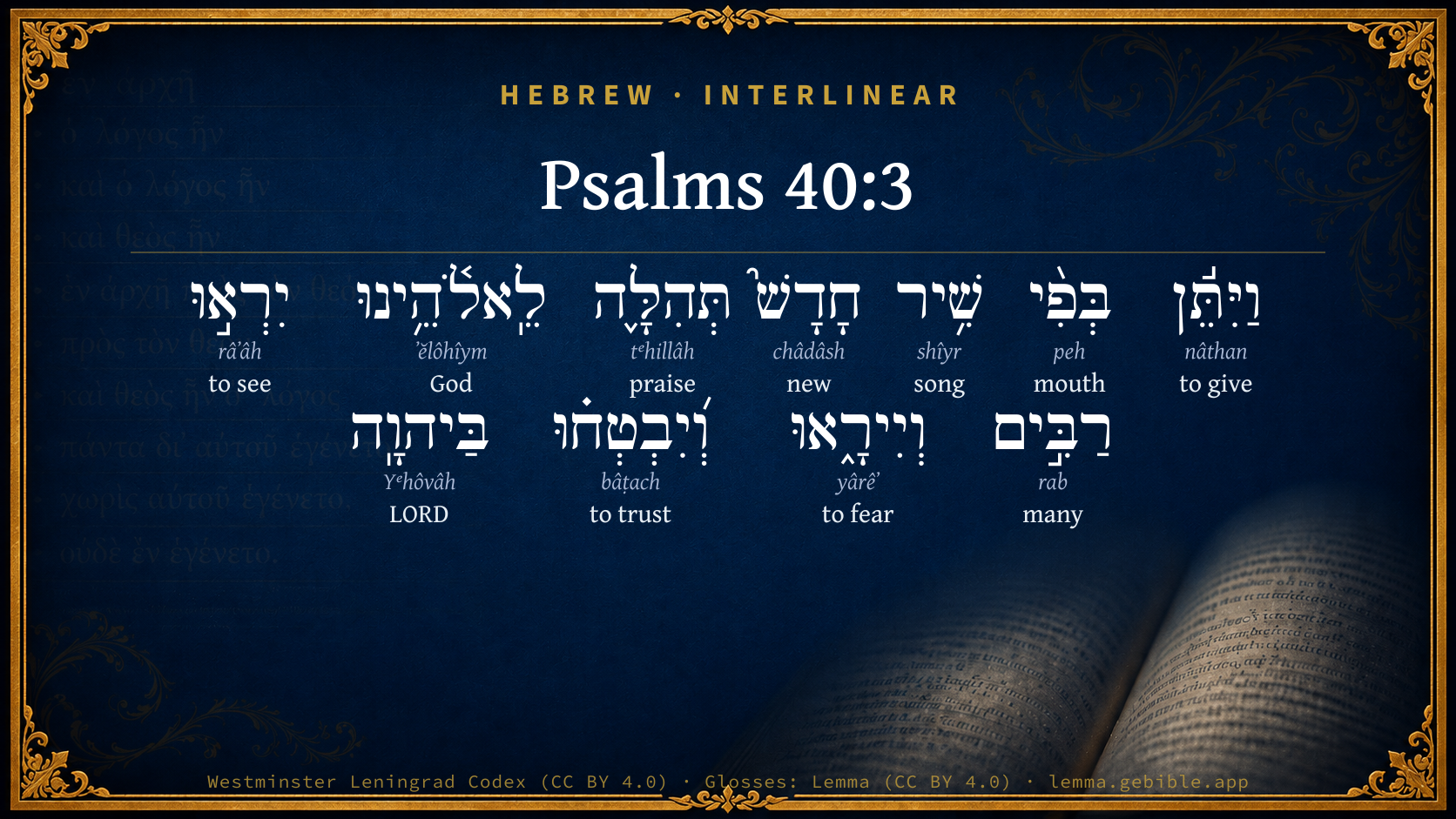
  1. וַיִּתֵּ֬ן nâthan H5414 “and · to give” Conjunction + Verb, Qal, Sequential Imperfect, 3rd Person, Masculine, Singular
  2. בְּפִ֨י peh H6310 “in/at · mouth · my” Preposition + Noun, Common, Masculine, Singular, Construct + Suffix, Personal, 1st Person, Common, Singular
  3. שִׁ֥יר shîyr H7892 “song” Noun, Common, Both, Singular, Absolute
  4. תְּהִלָּ֪ה tᵉhillâh H8416 “praise” Noun, Common, Feminine, Singular, Absolute
  5. לֵֽאלֹ֫הֵ֥ינוּ ʼĕlôhîym H430 “to/for · God(s) · our” Preposition + Noun, Common, Masculine, Plural, Construct + Suffix, Personal, 1st Person, Common, Plural
  6. יִרְא֣וּ râʼâh H7200 “to see” Verb, Qal, Imperfect, 3rd Person, Masculine, Plural
  7. רַבִּ֣ים rab H7227 “many” Adjective, Adjective, Masculine, Plural, Absolute
  8. וְיִירָ֑אוּ yârêʼ H3372 “and · to fear” Conjunction + Verb, Qal, Imperfect, 3rd Person, Masculine, Plural
  9. וְ֝יִבְטְח֗וּ bâṭach H982 “and · to trust” Conjunction + Verb, Qal, Imperfect, 3rd Person, Masculine, Plural
  10. בַּיהוָֽה Yᵉhôvâh H3068 “in/at · LORD” Preposition + Noun, Proper

About this verse

These counts appear in no published source. They are computed here, from the morphology-tagged text and Lemma’s own curated glosses. What Lemma adds →

11
words
11
distinct lemmas
Wisdom
section

Shared distinctive vocabulary

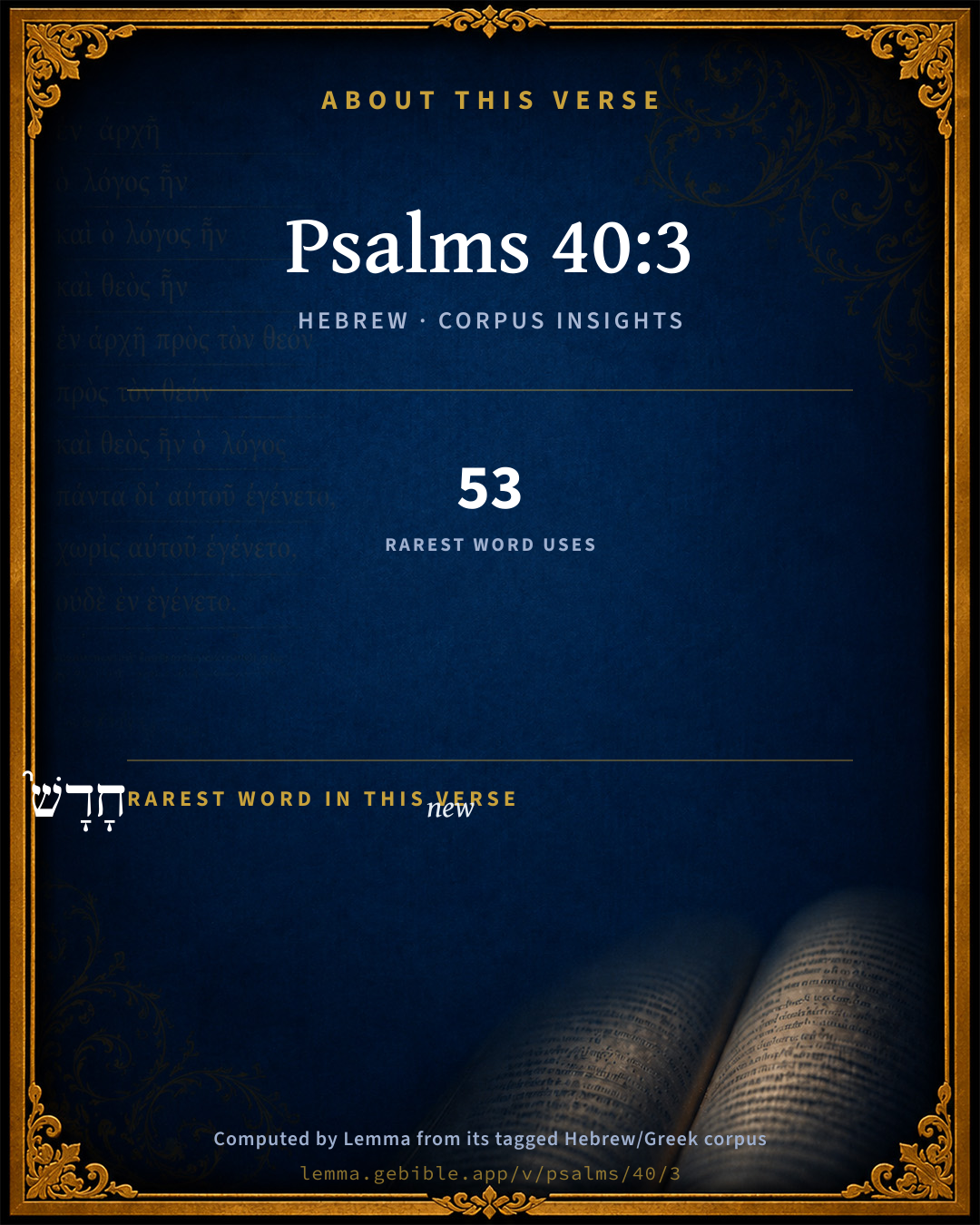
חָדָשׁ֮ new H2319 occurs in 48 verses of the Hebrew Bible. Also found in:

Grammatical profile

  • 4 verbs
  • 5 nouns
  • 2 adjectives

Verb forms

  • וַיִּתֵּ֬ן Qal · Sequential Imperfect
  • יִרְא֣וּ Qal · Imperfect
  • וְיִירָ֑אוּ Qal · Imperfect
  • וְ֝יִבְטְח֗וּ Qal · Imperfect

Hebrew & Septuagint length

In English translation the verse runs 25 words from the Hebrew and 27 from the Septuagint (LXX English) — closely comparable.

A rough comparison of the two English renderings, which tokenize alike — not a word-level alignment.

Word counts can differ between the Hebrew and the Greek without any difference in meaning — e.g. the Hebrew direct-object marker אֵת has no separate Greek word, and Greek often adds the article ὁ.

Cross-references

14

Topical passages linked to Psalms 40:3 in the Treasury of Scripture Knowledge — connected by theme and wording, ordered by reader-vote popularity; previews shown in the World English Bible.

  • Psalms 33:3 Sing to him a new song. Play skillfully with a shout of joy!
  • Psalms 103:1–5 Praise Yahweh, my soul! All that is within me, praise his holy name!
  • Psalms 34:1–6 I will bless Yahweh at all times. His praise will always be in my mouth.
  • Psalms 52:6 The righteous also will see it, and fear, And laugh at him, saying,
  • Revelation 5:9–10 They sang a new song, saying, "You are worthy to take the book, And to open its seals: For you were killed, And bought us for God with your blood, Out of every tribe, language, people, and nation,
  • Psalms 35:27 Let them shout for joy and be glad, who favor my righteous cause. Yes, let them say continually, "Yahweh be magnified, Who has pleasure in the prosperity of his servant!"
  • Psalms 144:9 I will sing a new song to you, God. On a ten-stringed lyre, I will sing praises to you.
  • Isaiah 12:1–4 In that day you will say, "I will give thanks to you, Yahweh; for though you were angry with me, your anger has turned away and you comfort me.
  • Revelation 14:3 They sing a new song before the throne, and before the four living creatures and the elders. No one could learn the song except the one hundred forty-four thousand, those who had been redeemed out of the earth.
  • Psalms 142:7 Bring my soul out of prison, That I may give thanks to your name. The righteous will surround me, For you will be good to me.
  • Psalms 64:9–10 All mankind shall be afraid. They shall declare the work of God, And shall wisely ponder what he has done.
  • Hosea 3:5 Afterward the children of Israel shall return, and seek Yahweh their God, and David their king, and shall come with trembling to Yahweh and to his blessings in the last days.
  • Acts 2:31–41 he foreseeing this spoke about the resurrection of the Christ, that neither was his soul left in Hades, nor did his flesh see decay.
  • Acts 4:4 But many of those who heard the word believed, and the number of the men came to be about five thousand.

Cross-references courtesy of OpenBible.info (CC BY 4.0).

Hebrew and Greek witnesses Masoretic Hebrew ↔ Greek Septuagint

The same verse in the two great witnesses to the Old Testament, shown verse-for-verse.

You’re reading Greek Psalm 39 (Hebrew Psalm 40). The Septuagint counts the superscription, so verse numbers can differ from the Hebrew — chapter-level alignment, not verse-by-verse. Numbering follows Rahlfs.

These are two independent witnesses, not word-aligned to each other, and the Septuagint is shown in lemma (dictionary) form.

Hebrew Psalms 40:3 Masoretic · Westminster Leningrad Codex

וַיִּתֵּ֬ן בְּפִ֨י שִׁ֥יר חָדָשׁ֮ תְּהִלָּ֪ה לֵֽאלֹ֫הֵ֥ינוּ יִרְא֣וּ רַבִּ֣ים וְיִירָ֑אוּ וְ֝יִבְטְח֗וּ בַּיהוָֽה

He has put a new song in my mouth, even praise to our God. Many shall see it, and fear, and shall trust in Yahweh.

World English Bible · Public Domain

Greek LXX Greek Psalm 39:3 Septuagint · lemma form

καί ἀναἄγω ἐγώ ἐκ λάκκος ταλαιπωρία καί ἀπό πηλός ἰλύς καί ἵστημι ἐπί πέτρα ὁ πούς ἐγώ καί καταεὐθύνω ὁ διάβημα ἐγώ

And he put a new song into my mouth, even a hymn to our God: many shall see it, and fear, and shall hope in the Lord.

LXX2012 (modern English Septuagint) · Public Domain

Hebrew: Westminster Leningrad Codex (CC BY 4.0). Greek: Septuagint (public domain); English from LXX2012 (modern English Septuagint) (Public Domain). How the Septuagint differs from the Hebrew →

Commentary

Notes on Psalms 40:3 from classic Christian and Jewish commentators (each source and its license shown beneath its notes). The classic Christian expositions comment on the surrounding passage and are grouped to its opening verse, so a note may address several verses; the Jewish commentaries on the Tanakh (Rashi and others) are per-verse, so they appear only where the commentator wrote on this verse.

Lemma curates 59 commentaries, every one of them public domain or Creative Commons licensed, each selected and text-cleaned for this edition rather than reprinted as found. About our sources →

Trapp's Complete Commentary

John Trapp

Psa 40:3 And he hath put a new song in my mouth, [even] praise unto our God: many shall see [it], and fear, and shall trust in the LORD.

Ver. 3. And he hath put a new song in my mouth] i.e. New matter, which I shall soon contrive into a new song, by the help of his Holy Spirit; for I cannot breathe out a desire after him except he first give me breath therewith, and so put a new song in my mouth.

Even praise unto our God] i.e. Unto Christ, saith Junius, to whom and of whom the Church singeth, saith he, in the following verses.

Many shall see it, and fear, and trust in the Lord] Their eye shall affect their heart, both with fear of and faith in the Lord, that bringeth greatest things to pass, and is fearful in praises, doing wonders, Exo 15:11.

John Trapp, A Commentary or Exposition upon All the Books of the Old and New Testament (1647–1656) — public domain. Text from a community e-Sword module.

The Biblical Illustrator

Joseph S. Exell

Psa_40:3

And He hath put a new song in my mouth.

The new song on earth

I. We have here A man wondering to find himself singing. God had put a new song into his mouth, and it was a marvel even to himself. What makes you wonder so? Other people sing: why is it at all a wonder that you should? He answers, It is a wonder that I should sing, because I have been so used to sighing. I had my evening moans and groans, for sin was heavy upon me, and an angry God seemed to make the darkness about me a darkness that might be felt. Had you seen me then, you would not think it strange that I should be a wonder to myself that now I sing. Well, I can see why you are astonished at your singing; is there any other reason? Yes, he answers, if you had known me a little farther back, before I came under the hand of God, and was awakened to a sense of sin, you would have known a fellow that could sing; but the wonder now is that I can sing a new song. I am glad, sir, that you did not hear me sing in those days, for my songs would have done you no good. It is not only called a new song because it is new to us, but because it is so uncommon. Rich and rare things are often called in the Bible new. There is a new covenant, a new commandment, etc. And, oh, the praises of God are indeed rich and rare! And, truth to tell, there is a wonder about our new song because it is always new. Do you ever tire--you who love your Lord--do you ever tire of Him? You who praise Him, do you ever weary of singing His praises?

II. We have here A man who is resolved to keep on singing, for, you notice, he says, He hath put a new song in my mouth, even praise unto our God: many shall see, and fear, add shall trust in the Lord; so that this man means to keep on singing. I must have you back again, old friend, and ask you why it is that you mean to keep on singing. He answers, first, Because I cannot help it. When God sets a man singing, he must sing. Good Rowland Hill once had sitting on the pulpit-stairs a person who sang with such a cracked, squeaking voice that it put the dear man out of heart; and this person with the cracked voice of course sang more loudly than anybody else. So Mr. Hill said to him, while the hymn was being sung, Be quiet, my good man, you make such a dreadful noise that you put us all out. Oh! said the man, I am singing from my heart, Mr. Hill. I beg your pardon, my friend, said the preacher, go on, go on, go on with your singing if it comes from your heart. So we would not stop any man, whatever his voice is, if he sings from his heart. But do not sing before everybody; perhaps it would be casting pearls before swine. Oh! says he, but I must; I mean to sing before many. Why? Well, I used to sing before many in my evil days. I was not ashamed to sing for the devil. When I ought to have been ashamed I was not; and now that I ought not to be ashamed, I will not be ashamed, and I will sing. Besides, why should I be so tender and considerate of their nerves? They are not thoughtful about mine. Still, do you think that it is worth while to sing at this rate? Yes, says he, I do, for I believe that it is good for them to hear it. Do you? What good can it do them? And he answers me thus. Look at your text, sir, and you will not need to ask me that question; what does your text say? . . . Many shall see, and fear, and shall trust in the Lord. (C. H. Spurgeon.)

The saved mans new song

When Charles Wesley was impressed with the thought that he ought to live a different life to that which he was living, a more distinctly Christian life--he was anxious from this very point to get a satisfactory answer to the question, Is it necessary to acknowledge Christ openly, to tell to people that I am a Christian? And, walking in the streets one day, he met a holy, saintly Moravian minister, and he asked him, in the course of conversation, Is it really necessary that I should openly confess Christ? That good, blessed man said to him, If you had a thousand tongues, use them all in telling of your Saviour. Well, he sought and found the great blessing of peace through Jesus Christ; and then you know what followed, and what always comes in Christian experience. He did not need to ask men whether he should tell others that he had found the pearl of great price; he sat down, and he wrote that hymn--

Oh, for a thousand tongues to sing

My great Redeemers praise,

The glories of my God and King,

The riches of His grace!

Many shall see it, and fear, and shall trust in the Lord,--

The power of a good life

We are not alone in anything we do. We are connected from the cradle to the grave with many others. We have our family, and our kindred, our social friends, our business connections, our neighbours and fellow-citizens. Upon all these we exercise influence, both consciously and unconsciously. By our uprightness they are strengthened, by our courage they are cheered, by our perseverance they are confirmed in the love of right. Every person is thus a preacher to his neighbour; and the most powerful of all eloquence is the eloquence of a virtuous life. It is a testimony to the whole world that religion is not utopian. It can be practised and realized; for here it is done. When a parent adds to the gentle precepts of true religion delivered to his children, the practice of a just, a patient, loving life, he preaches to his household in golden words. When a Christian tradesman shows a spirit of honour and rectitude in his dealings, a desire to afford full justice to his customer, as well as to himself, he preaches with the utmost force the sermon, Go thou and do likewise. The best sermon any one can preach on patience is actual calmness under provocation. The preaching of truly good lives is what the world now most needs. It is the one sweet note having the power to reduce to harmony all the discords of mankind. (J. Bailey, Ph. D.)

The Biblical Illustrator, edited by Joseph S. Exell (c. 1880s–1900s) — public domain. Text from a community e-Sword module.

Joseph Benson's Commentary

Psa 40:3. He hath put a new song into my mouth — Both by giving me new matter for a song, and by inspiring me with the very words of it. Many shall see it — Shall observe God’s wonderful mercies vouchsafed to me; and fear — Shall stand in awe of that God, whom they see to have so great power, either to save or to destroy; and shall trust in the Lord — Their fear shall not drive them from God, but draw them to him, and be attended with trusting in him.

Joseph Benson's Commentary on the Old and New Testaments (1811–1818) — public domain. Text from a community e-Sword module.

J. A. Alexander on Psalms

Joseph Addison Alexander

4. (Psa 40:3). And put in my mouth a new song, praise to our God; many shall see and shall fear, and shall trust in Jehovah. In this, as in Psa 40:3 (2), the construction is continued from the foregoing sentence. Put, literally gave, gave (to me) in my mouth. See above, on Psa 4:8 (7). A new song, implying a new subject or occasion. See above, on Psa 33:3. By the new song, we are not to understand this psalm exclusively, but fresh praise, of which this psalm is an instance or particular expression. Our God, the God of Israel, a further proof that this is not an expression of mere personal feeling, but a permanent formula of public praise. The effect of it, anticipated in the last clause, is the same as in Psa 22:26-31 (25-31). The original exhibits a paronomasia, which is lost in the translation, arising from the close resemblance of the verbs see and fear. The fear gious awe or reverence, which always accompanies true faith or trust in God.

Joseph Addison Alexander, The Psalms Translated and Explained (1850) — public domain. Text from a community e-Sword module.

Geneva Bible (1599)

Geneva Bible translators

That is, a special occasion to praise him: for God’s benefits are so many occasions for us to praise his Name.

Geneva Bible (1599) marginal notes — public domain. Text via Bolls.life.

Jamieson, Fausset & Brown

Robert Jamieson, A. R. Fausset & David Brown

a new song--(See on Psa 33:3).

fear, and . . . trust--revere with love and faith.

Jamieson, Fausset & Brown — Commentary Critical and Explanatory on the Whole Bible (1871) — public domain (CC PDM 1.0). Text via the HelloAO Bible API.

Adam Clarke's Commentary

Verse 3. A new song] Cheerfulness and joy had long been strangers to him. He seemed to live to utter the most doleful complaints, and be a prey to suffering and wretchedness. Praise for a sense of God's favour was a new song to him. The word is often used to signify excellence: I will sing a most excellent and eminent song.

Many shall see it] I will publish it abroad; and fear-to sin against the Lord, knowing by my example what a grievous and bitter thing it is.

And shall trust in the Lord.] Even the worst of sinners shall not despair of mercy, being penitent, when they see that I have found favour in his sight.

Adam Clarke's Commentary on the Bible (1810–1826) — public domain. Text from a community e-Sword/MySword module.

John Calvin's Commentaries

3. And he hath put into my mouth a new song In the first clause of the verse he concludes the description of what God had done for him. By God’s putting a new song into his mouth he denotes the consummation of his deliverance. In whatever way God is pleased to succor us, he asks nothing else from us in return but that we should be thankful for and remember it. As often, therefore, as he bestows benefits upon us, so often does he open our mouths to praise his name. Since God, by acting liberally towards us, encourages us to sing his praises, David with good reason reckons, that having been so wonderfully delivered, the matter of a new song had been furnished to him. He uses the word new in the sense of exquisite and not ordinary, even as the manner of his deliverance was singular and worthy of everlasting remembrance. It is true, that there is no benefit of God so small that it ought not to call forth our highest praises; but the more mightily he stretches forth his hand to help us, the more does it become us to stir up ourselves to fervent zeal in this holy exercise, so that our songs may correspond to the greatness of the favor which has been conferred upon us.

Many shall see it Here the Psalmist extends still farther the fruit of the aid which he had experienced, telling us, that it will prove the means of instruction common to all. And certainly it is the will of God that the benefits which he bestows upon any individual of the faithful should be proofs of the goodness which he constantly exercises towards all of them, so that the one, instructed by the example of the other, should not doubt that the same grace will be manifested towards himself. The terms fear, and hope, or trust, do not seem at first view to harmonise; but David has not improperly joined them together; for no man will ever entertain the hope of the favor of God but he whose mind is first imbued with the fear of God. I understand fear in general to mean the feeling of piety which is produced in us by the knowledge of the power, equity, and mercy of God. The judgment which God executed against the enemies of David served, it is true, to inspire all men with fear; but, in my opinion, David rather means, that by the deliverance which he had obtained, many would be induced to yield themselves to the service of God, and to submit with all reverence to his authority, because they would know him to be the Judge of the world. Now, whoever submits cordially to the will of God will of necessity join hope with fear; especially when there is presented to his view the evidence of the grace by which God commonly allures all men to himself; for I have already said that God is presented to our view as merciful and kind to others, that we may assure ourselves that he will be the same towards us. As to the word see, of which David makes use, we are to understand it as referring not only to the eyes, but chiefly to the perception of the mind. All without distinction saw what had happened, but to many of them it never occurred to recognize the deliverance of David as the work of God. Since, then, so many are blind regarding the works of God, let us learn, that those only are considered to see clearly to whom the Spirit of understanding has been given, that they may not occupy their minds in dwelling upon the mere events which take place, but may discern in them by faith the secret hand of God.

John Calvin's Commentaries (1540-1563) — public domain. Text from the Calvin Translation Society English edition (1840s-50s) via the Christian Classics Ethereal Library (ccel.org). Calvin's coverage is partial (roughly two-thirds of the Bible); uncommented books and verses are honest gaps, never fabricated. The 19th-century editor's footnotes and remarks are omitted so the notes are faithfully Calvin's own voice.

Ellicott's Commentary for English Readers

(3) New song.—See Psa_33:3. It seems natural to suppose that this new song is incorporated here; that we have at least the substance of it, if not the words. Possibly the very words are taken up in Psa_40:4. And we are to find the “newness” in the magnificent vindication of spiritual above formal worship.

Shall see it and fear.—Comp. Psa_52:6, where there is plainly a reminiscence of this passage.

A Bible Commentary for English Readers, edited by Charles John Ellicott (1878–1897) — public domain. Text from a community e-Sword module.

The Cambridge Bible for Schools and Colleges

gen. ed. J. J. S. Perowne

3. Such deliverance is a fresh theme of praise. Cp. Psa_33:3. The plural pronoun, ‘our God,’ implies that others were interested in the Psalmist and his fortunes.

many shall see it] Omit it, which only weakens the expression. The contemplation of God’s mercy in the deliverance of His servant, and God’s power in the discomfiture of his enemies which that deliverance implies, will inspire a reverent a we, and lead to trust. Cp. Psa_52:6; and generally, Psa_22:22 ff.

The Cambridge Bible for Schools and Colleges (gen. ed. J. J. S. Perowne; Cambridge University Press, 1878–1918) — public domain. Text from a community e-Sword module.

John Gill's Exposition

And he hath put a new song in my mouth, even praise to our God,.... Sung by him in the midst of the great congregation of angels and saints, upon his resurrection, ascension, and session at the right hand of God; see Psa 22:22; when he went to his God and ours, to his Father and ours; and in which song he is joined by all his people above and below, Rev 5:9;

many shall see it, and fear, and shall trust in the Lord; even all the elect of God, as many as are ordained to eternal life; the many whose sins Christ bore, for whom he became a ransom, whom he justifies and brings to glory: these all "see" him in the horrible pit and miry clay, in his state of humiliation, as bearing their sins, and the punishment due unto them; as wounded, bruised, and crucified; as rising again for their justification; and as on Mount Zion crowned with glory and honour; and a multitude of harpers with him, singing the new song; these see the salvation he has wrought out, the glory, fulness, and suitableness of it, and their interest in it; and they "fear" not with a fear of hell and damnation, which is inconsistent with the trust after mentioned; but with a godly and filial fear, which arises from and is encouraged by the grace and goodness of God, their faith in the sufferings, death, and resurrection of Christ Jesus, and which render him a proper object of trust and confidence; for he is so both as suffering, crucified, and slain, and as risen again, and exalted at the Father's right hand, Gal 2:20.

John Gill's Exposition of the Whole Bible (1746–1763) — public domain (CC PDM 1.0). Text via the HelloAO Bible API.

Albert Barnes' Notes on the Bible

And he hath put a new song in my mouth - See the notes at Psa 33:3. The idea is, that he had given a new or fresh “occasion” for praise. The deliverance was so marked, and was such an addition to former mercies, that a new expression of thanks was proper. It was an act of such surprising intervention on the part of God that the language used on former occasions, and which was adapted to express the mercies then received, would not be sufficient to convey the sense of gratitude felt for the present deliverance. As applied to the Messiah, and referring (as it was supposed in the notes at Psa 40:2) to his being raised up to glory after the depth of his sorrows, it would mean that no language hitherto employed to express gratitude to God would be adequate to the occasion, but that the language of a new song of praise would be demanded to celebrate so great an event.

Even praise unto our God - “To our God;” identifying himself, as the Messiah does, with his people, and expressing the idea that the new song of praise was appropriate to them as well as to “himself,” since they would be benefited by his work, and since God was their God as well as his. Compare Joh 20:17.

Many shall see it - Great numbers of the human race shall be made acquainted with the occasion which there was for such a song.

And fear - Learn to reverence, to worship, to honor God, as the result of what had been done.

And shall trust in the Lord - Shall confide in God; shall put their trust in him; shall become his true worshippers and friends:

(a) as the effect of this merciful interposition in behalf of him who had been thus in trouble or distress, and who was enabled to triumph;

(b) as the result of the work accomplished by him.

The effect of the Redeemer’s sorrows, and of God’s merciful help, would be that great numbers would learn to put their trust in God, or would become his true friends. No man, in fact, can compute the “numbers” of those who, in consequence of the work of the Messiah, will turn to God and become his true worshippers and friends.

Albert Barnes' Notes on the Bible (1834–1885) — public domain. Text from a community e-Sword/MySword module.

Matthew Poole's English Annotations

He hath put a new song in my mouth; partly by giving me new matter or occasion for a song; and partly by inspiring me with the very words of it.

Shall see it, i.e. shall observe God’s wonderful mercies vouchsafed to me.

And fear, i.e. shall stand in awe of that God, who by this instance they see to have so great power, either to save or to destroy, and tremble at his judgments, and give him that reverence, and worship, and obedience which he requires. Yet their fear shall not drive them from God, or bring them into despair, but shall draw them to God, and be attended with trusting in God.

Matthew Poole's English Annotations on the Holy Bible (1683–1685) — public domain. Text from a community e-Sword/MySword module.

The Treasury of David

Charles H. Spurgeon

Ver. 3. And he hath put a new song in my mouth, even praise unto our God. At the passover, before his passion, our Lord sang one of the grand old Psalms of praise; but what is the music of his heart now, in the midst of his redeemed! What a song is that in which his glad heart for ever leads the chorus of the elect! Not Miriam's tabor nor Moses' triumphant hymn over Miriam's chivalry can for a moment rival that ever new and exulting song. Justice magnified and grace victorious; hell subdued and heaven glorified; death destroyed and immortality established; sin overthrown and righteousness resplendent; what a theme for a hymn in that day when our Lord drinketh the red wine new with us all in our heavenly Father's kingdom! Even on earth, and before his great passion, he foresaw the joy which was set before him, and was sustained by the prospect. Our God. The God of Jesus, the God of Israel, "my God and your God." How will we praise him, but ah! Jesus will be the chief player on our stringed instruments; he will lead the solemn hallelujah which shall go up from the sacramental host redeemed by blood. Many shall see it, and fear, and shall trust in the Lord. A multitude that no man can number shall see the griefs and triumphs of Jesus, shall tremble because of their sinful rejection of him, and then through grace shall receive faith and become trusters in Jehovah. Here is our Lord's reward. Here is the assurance which makes preachers bold and workers persevering. Reader, are you one among the many? Note the way of salvation, a sight, a fear, a trust! Do you know what these mean by possessing and practising them in your own soul? Trusting in the Lord is the evidence, nay, the essence of salvation. He who is a true believer is evidently redeemed from the dominion of sin and Satan.

Ver. 3. A new song. See Notes on Ps 33:3.

Ver. 3. Many shall see it, and fear, and shall trust in the Lord. The terms fear, and hope, or trust, do not seem at first view to harmonise; but David has not improperly joined them together, for no man will ever entertain the hope of the favour of God but he whose mind is first imbued with the fear of God. I understand fear, in general, to mean the feeling of piety which is produced in us by the knowledge of the power, equity, and mercy of God. John Calvin.

Ver. 3. Many shall see it, and fear, and shall trust in the Lord. First of all they see. Their eyes are opened; and their opened eyes see and survey what they are, where they are, whence they came, and whither they are going...When the attention of sinners is really and decisively arrested by the propitiation of Jesus, not only are their eyes opened to their various moral relations, not only do they "see" but they fear too. They "see" and "fear." ...Conviction follows illumination...But while the sinner only sees and fears, he is but in the initial stage of conversion, only in a state of readiness to flee from the city of destruction. He may have set out on his pilgrimage, but he has not yet reached his Father to receive the kiss of welcome and forgiveness. The consummating step has not yet been taken. He has seen indeed; he has feared too; but he still requires to trust, to trust in the Lord, and banish all his fears. This is the culminating point in the great change; and, unless this be reached, the other experiences will either die away, like an untimely blossom, or they will only be fuel to the unquenchable fire. James Frame.

Ver. 3. The new song, the singer, the teacher.

Psalms 40:4*

Charles H. Spurgeon's The Treasury of David (1869–1885) — public domain. Psalms only. Text from a community e-Sword/MySword module.

Whedon's Commentary on the Bible

Daniel D. Whedon

3. New song—Because suited to a new occasion of mercy. Psa_33:3.

Many shall see it—The deliverance is such that all who knew of the affliction would take knowledge of the signal mercy, and give thanks to God. All divine dispensations to individuals are intended also for a social influence.

Daniel D. Whedon (gen. ed.), Commentary on the Old and New Testaments (1874–1909) — public domain. Text from a community e-Sword module.

The Pulpit Commentary

And he hath put a new song in my mouth. (see the comment on Psa_33:3) Even praise unto our God. Mercy and praise are cause and effect. The deliverance recorded in ver. 2 produces the praise of vers. 3-5. The phrase, "our God," shows us how David instinctively identifies himself with his people. A mercy shown to him is one shown to them. Many shall see it, and fear. (comp. Deu_13:11 Deu_17:13 Deu_19:20 Deu_21:21, where the phrase, "all Israel shall hear and fear," is used of the effect produced by the capital punishment of a high-handed transgressor of the Law) There may be an allusion here to Absalom"s end, which was probably followed by a certain number of executions. And shall trust in the Lord; i.e. shall have their faith in God strengthened.

The song learned in tribulation.

"He hath put a new song," etc. Trouble impoverishes the children of this world, but enriches the children of God. As St. Paul says, if our hope in Christ were an illusion, Christians would be of all men most pitiable; just as one who has been left heir to an immense fortune, and then by discovery of a later will loses all, is far poorer than he was before. But, as our hope is no illusion, but "a living hope," resting on a living Saviour, and the word of the living God, this life is immensely the richer for it. The "new song" of which the text speaks is one to learn which the heart must be tutored in the school of trouble.

I A SONG OF DELIVERANCE. An ungodly heart, emerging from trouble, has the sense of relief, escape, not deliverance. Like a shipwrecked man, swimming for his life, heaved by a high wave on shore; not like sinking Peter, caught in the hand of Jesus, treading the waves at his Saviour"s side. The difference is immense. Was it worth while for the mariner to be shipwrecked, half-drowned, and lose his all, for the pleasure of standing again on dry ground? Certainly not. He has lost much, gained nothing. But was it worth while for Peter to go through that terrible experience? Had the night been twice as dark, the storm twice as fierce, had he sunk to the very bottom, it would have been a small price to pay for the joy of feeling himself grasped and lifted up in the Saviour"s hand; the triumph of walking on the raging waters at his side. (see Psa_34:4-6, Psa_34:17)

II A SONG OF FORGIVENESS. The deliverance celebrated was not from mere calamity, but from guilt and its terrible consequences (see ver. 12). This is taking the psalm as uttering David"s own experience. But the contrast is so startling, even violent, between the tranquil thankfulness, sense of rectitude, and spiritual insight of vers. 4-10, and the awful sense of sin in ver. 12, that it seems very hard to reconcile, except by understanding that the Spirit of prophecy here made David the mouthpiece of an obedience, excelling and superseding sacrifice, only realized in Christ; and of that appalling, overwhelming view and sense of the terrific nature and amount of human guilt, which only he could have who "knew no sin," but "was made sin for us.

III A SONG OF PRAISE. Deliverance is sweetest, most joyful, in the exercise of God"s love, power, care; the answer to prayer; the fulfilment of promise. Forgiveness of sin is, of all God"s good gifts, that which most reveals his love in compassion for the unworthy and disobedient, and in the provision of atonement. "Herein is love". (1Jn_4:9, 10 Rom_5:8)

IV A SONG OF DEEPENED EXPERIENCE; enriched spiritual life; wiser, stronger," humbler faith. When tribulation has wrought patience; (Rom_5:3, Rom_5:4) when "our extremity has been God"s opportunity," and his presence has grown more real, his promises more precious and full of comfort; when we have learned to pray as never before, and prayer has been answered; when we have been made to feel our own utter weakness, and our Saviour"s strength has been perfected in us; then the very trial which threatened to confound and uproot our faith becomes the school in which we learn to trust God and know him, and therefore to praise him, as never before. (1Pe_1:7) So we gain some foretaste of the "new song" sung before the throne. (Rev_5:9, Rev_5:10)

The Pulpit Commentary (1880–1919), ed. H.D.M. Spence-Jones & Joseph S. Exell — public domain. Text from a community e-Sword module.

John Wesley's Explanatory Notes

And fear - Shall stand in awe of that God, whom they see to have so great power, either to save or to destroy.

John Wesley, Explanatory Notes Upon the Whole Bible (1754–1765) — public domain. Text via the GEBible commentary corpus.

Scofield Reference Notes

C. I. Scofield

fear

(See Scofield "Psa 19:9").

The Scofield Reference Bible (1917 edition), notes by C. I. Scofield — public domain. Text from a community e-Sword module.

unfoldingWord translationNotes

Door43 World Missions Community

He has put a new song in my mouth

Possible meanings are 1) "He has taught me the words to a new song" or 2) "He has given me a new reason to sing."

in my mouth

Here "my mouth" refers to the writer. AT: "in me" (See: Synecdoche)

praise to our God

The noun "praise" can be stated as a verb. AT: "a song to praise our God" (See: Abstract Nouns)

Many will see it

Here "see it" refers to hearing the writer sing his song about what God has done for him. AT: "Many people will hear me tell what Yahweh has done" (See: Metonymy)

Blessed is the man who makes Yahweh his trust

"Blessed is the man who trusts in Yahweh" or "Those who trust in Yahweh are blessed"

the proud

This refers to the people who are proud. AT: "proud people" (See: Nominal Adjectives)

to lies

The Hebrew word is unclear. Possible meanings are 1) "lies" or 2) "false gods."

translationWords

praise

God

honor

trust

bless

proud

turn

unfoldingWord translationNotes — © Distant Shores Media and the Door43 World Missions Community, licensed CC BY-SA 4.0. Source: git.door43.org/Door43/en_tn.

Rashi

Rabbi Shlomo Yitzchaki (Rashi)

out of the roaring pit From the imprisonment of Egypt and from the roaring of their tumult.

from the thick mire From the sea. היון is an expression of mud, fanyas in Old French (fange in modern French), slime.

He established Heb. כונן, He prepared my steps.

Rashi on the Tanakh — English translations: “The Judaica Press complete Tanach with Rashi, translated by A. J. Rosenberg” (CC BY 4.0); “Pentateuch with Rashi's commentary by M. Rosenbaum and A.M. Silbermann, 1929-1934” (public domain); “The Metsudah Tanach series, Lakewood, N.J” (CC BY 4.0); and “The Book of Joshua, Metsudah Publications, 1997” (CC BY 4.0). Text via Sefaria.

Lesson kit

Teaching starters — assembled from the data on this page, not authored interpretation. Every prompt links to the verse data it draws on. Edit before teaching.

Psalms, in the Wisdom, opens this verse with 11 words (11 distinct Hebrew lemmas). Its most distinctive word is châdâsh (“new”). A historical commentator’s framing appears above. Read the whole chapter for the surrounding context.

Discussion questions

  1. What does “new” (châdâsh) contribute to the verse as a whole?
  2. How does Exodus 1:8, which shares the word «new», read alongside this verse?
  3. These translations render this verse differently; the difference is in the English rendering, not the original. What questions does that raise?
  4. «וַיִּתֵּ֬ן» is a Qal Sequential Imperfect verb. How does that grammatical form shape the action described?
  5. Compare how Trapp's Complete Commentary and The Biblical Illustrator read this verse. Where do they agree or differ?

Things to notice

Reading settings

Reading text

Shown beneath each verse's original-language words.

Old Testament
Old Testament edition

Read the OT as the Masoretic Hebrew (MT) or the Greek Septuagint (LXX).

English shown for the Greek Septuagint (in the Hebrew ↔ Greek comparison).

Comparing translations? Open the Compare panel on any verse page to stack up to four side by side.