2 Samuel 11:24

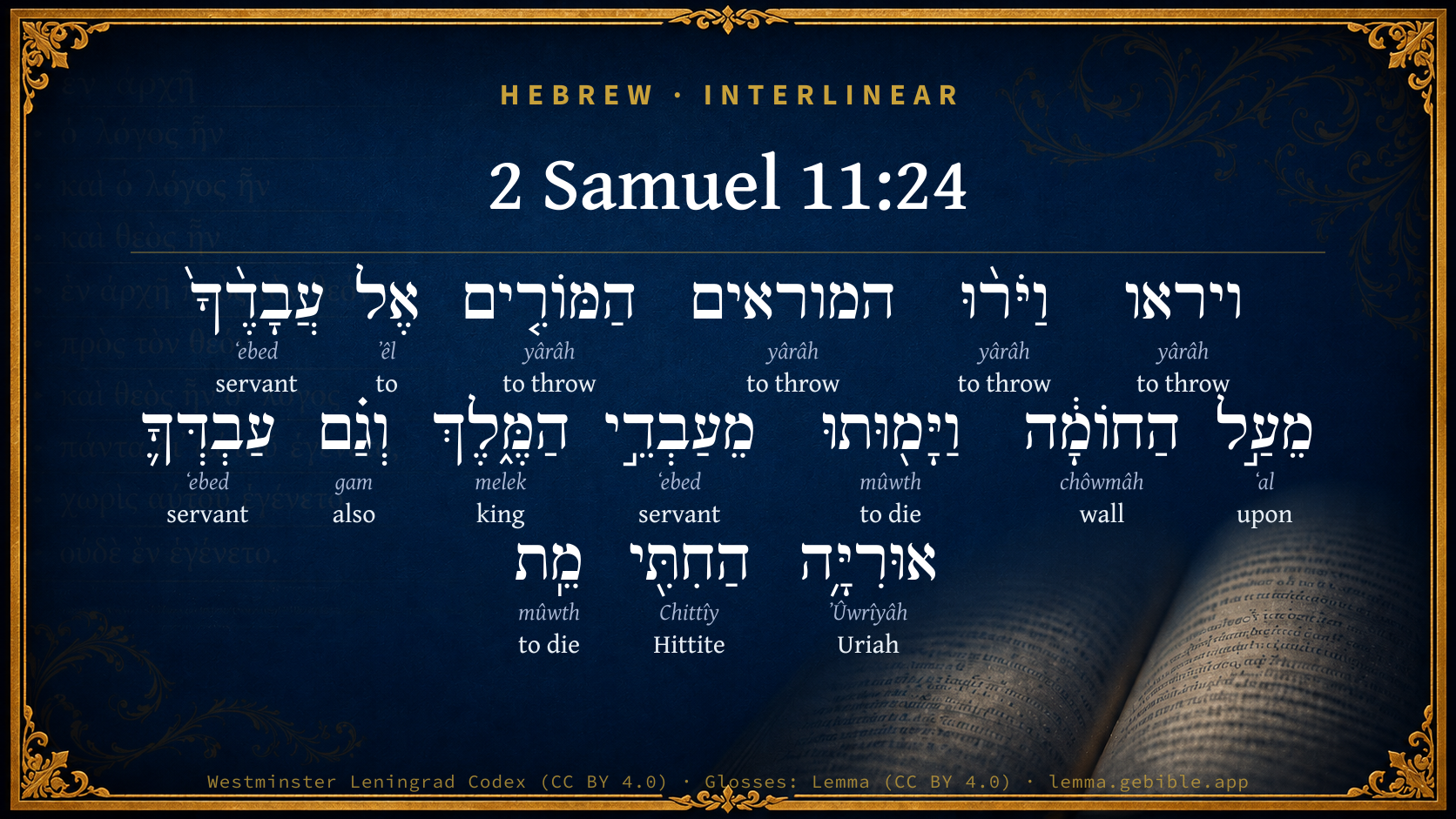
Hebrew (Westminster Leningrad Codex) 2 Samuel 11:24 appears in the Hebrew Old Testament. The text above is from the Westminster Leningrad Codex. Each word links to its Strong’s number, a concise gloss, and parsing drawn from the Open Scriptures Hebrew Bible morphology. Click any word for its full Brown-Driver-Briggs (BDB) entry.
Download image
Cite this verse

2 Samuel 11:24 (World English Bible). Public Domain. Lemma interlinear Bible study tool, https://lemma.gebible.app/v/2-samuel/11/24.

Show BibTeX & RIS
BibTeX
RIS
English Translation
The shooters shot at your servants from off the wall; and some of the king's servants are dead, and your servant Uriah the Hittite is dead also.
World English Bible · Public Domain
Download a study sheet

One document with this verse’s original text, its word-by-word gloss line, the meaning frame, cross-references with their text, attributed commentary, and full source and license credits — printable, and it pastes into notes with its structure intact.

This verse Autodidact and up

Study sheet (.html) Plain text (.txt)

A passage Seminary Student

Up to 50 verses in one chapter. A passage sheet keeps up to 6 commentary sources and 12 cross-references per verse, in the order this page ranks them, and says so on the sheet whenever that leaves anything out. Ask for a single verse and you get the Autodidact verse sheet above.

Everything on this page stays free to read, with no account — the sheet is a download of what is already on screen, not access to it.

Want to remove ads? Support Godless Engineer
Compare translations 3

The same verse in 3 English versions, stacked beneath the original-language interlinear above. Click any original word for its lexicon entry.

Each is an independent rendering of the whole verse — the interlinear is not word-aligned to these translations.

Highlighted words mark where these versions differ — a whole-verse word diff, not a word-by-word alignment.

  • World English Bible Public Domain
    The shooters shot at your servants from off the wall; and some of the king's servants are dead, and your servant Uriah the Hittite is dead also.
  • King James Version Public Domain
    And the shooters shot from off the wall upon thy servants; and some of the king's servants be dead, and thy servant Uriah the Hittite is dead also.
  • unfoldingWord Literal Text CC BY-SA 4.0
    And the shooters shot at your servants from the wall, and some of the servants of the king died, and also your servant Uriah the Hittite died.”

unfoldingWord Literal Text — © unfoldingWord, licensed CC BY-SA 4.0. Word-aligned USFM3 via Door43 (git.door43.org/unfoldingWord/en_ult).

Versions to compare (up to 4)

3 of 4 selected

Show all 18 translations

Every available English version of this verse, each an independent rendering of the whole verse.

  • World English Bible Public Domain
    The shooters shot at your servants from off the wall; and some of the king's servants are dead, and your servant Uriah the Hittite is dead also.
  • Berean Standard Bible Public Domain
    Then the archers shot at your servants from the wall, and some of the king’s servants were killed. And your servant Uriah the Hittite is dead as well.”
  • Majority Standard Bible Public Domain
    Then the archers shot at your servants from the wall, and some of the king’s servants were killed. And your servant Uriah the Hittite is dead as well.”
  • King James Version Public Domain
    And the shooters shot from off the wall upon thy servants; and some of the king's servants be dead, and thy servant Uriah the Hittite is dead also.
  • American Standard Version (1901) Public Domain
    And the shooters shot at thy servants from off the wall; and some of the king's servants are dead, and thy servant Uriah the Hittite is dead also.
  • Revised Version (1885) Public Domain
    And the shooters shot at thy servants from off the wall; and some of the king’s servants be dead, and thy servant Uriah the Hittite is dead also.
  • Geneva Bible (1599) Public Domain
    But the shooters shot from ye wall against thy seruants, and some of the Kings seruants be dead: and thy seruant Vriah the Hittite is also dead.
  • Douay-Rheims (1899) Public Domain
    And the archers shot their arrows at thy servants from off the wall above: and some of the king's servants are slain, and thy servant Urias the Hethite is also dead.
  • Young's Literal Translation Public Domain
    and those shooting shoot at thy servants from off the wall, and `some' of the servants of the king are dead, and also, thy servant Uriah the Hittite is dead.
  • Literal Standard Version CC BY-SA 4.0
    and those shooting shoot at your servants from off the wall, and [some] of the servants of the king are dead, and also, your servant Uriah the Hittite is dead.”
  • Unlocked Literal Bible CC BY-SA 4.0
    Then their shooters shot at your soldiers from off the wall, and some of the king's servants were killed, and your servant Uriah the Hittite was killed too.”
  • unfoldingWord Literal Text CC BY-SA 4.0
    And the shooters shot at your servants from the wall, and some of the servants of the king died, and also your servant Uriah the Hittite died.”
  • Darby Bible Public Domain
    And the shooters shot from upon the wall against thy servants; and some of the king's servants are dead, and thy servant Urijah the Hittite is dead also.
  • World Messianic Bible Public Domain
    The shooters shot at your servants from off the wall; and some of the king’s servants are dead, and your servant Uriah the Hittite is also dead.”
  • Webster's Bible Public Domain
    And the shooters shot from off the wall upon thy servants: and some of the king's servants are dead, and thy servant Uriah the Hittite is dead also.
  • Free Bible Version CC BY-SA 4.0
    Their archers shot at us from the wall, and killed some of the king's men. Your officer Uriah the Hittite was also killed.”
  • Bible in Basic English Public Domain
    And the archers sent their arrows at your servants from the wall, and some of the king's servants are dead, and among them is your servant Uriah the Hittite.
  • JPS Tanakh (1917) Public Domain
    And the shooters shot at thy servants from off the wall; and some of the king's servants are dead, and thy servant Uriah the Hittite is dead also.'

Literal Standard Version (2020), Covenant Press — licensed CC BY-SA 4.0. Text via the HelloAO Bible API (eBible.org). Unlocked Literal Bible (unfoldingWord) — licensed CC BY-SA 4.0. Text via the HelloAO Bible API (eBible.org). unfoldingWord Literal Text — © unfoldingWord, licensed CC BY-SA 4.0. Word-aligned USFM3 via Door43 (git.door43.org/unfoldingWord/en_ult). Free Bible Version, Dr. Jonathan Gallagher — licensed CC BY-SA 4.0. Text via the HelloAO Bible API (eBible.org).

Word by word

More ways to search: Search by grammar → Find every occurrence → Compare this word →

Practice this passage: Drill this verse → Learn its vocabulary →

אוּרִיָּ֥ה
ʼÛwrîyâh
H223
“Uriah”
Noun, Proper
Part of Speech
Noun
Type
Proper
Full BDB Definition

Origin: from H217 and H3050

TWOT: None

Uriah or Urijah = "Jehovah (Yahweh) is my light (flame)" - Hittite husband of Bathsheba - a priest who built king Ahaz' heathen altar - a priest who rebuilt Jerusalem's wall - a prophet slain by Jehoiakim
  1. ויראו yârâh H3384 “and · to throw” Conjunction + Verb, Hiphil, Sequential Imperfect, 3rd Person, Masculine, Plural
  2. וַיֹּר֨וּ yârâh H3384 “and · to throw” Conjunction + Verb, Hiphil, Sequential Imperfect, 3rd Person, Masculine, Plural
  3. המוראים yârâh H3384 “the · throwing” Particle, Definite Article + Verb, Hiphil, Participle Active, Masculine, Plural, Absolute
  4. הַמּוֹרִ֤ים yârâh H3384 “the · throwing” Particle, Definite Article + Verb, Hiphil, Participle Active, Masculine, Plural, Absolute
  5. אֶל ʼêl H413 “to” Preposition
  6. עֲבָדֶ֨ךָ֙ ʻebed H5650 “servants · your” Noun, Common, Masculine, Plural, Construct + Suffix, Personal, 2nd Person, Masculine, Singular
  7. מֵעַ֣ל ʻal H5921 “from · upon” Preposition + Preposition
  8. הַחוֹמָ֔ה chôwmâh H2346 “the · wall” Particle, Definite Article + Noun, Common, Feminine, Singular, Absolute
  9. וַיָּמ֖וּתוּ mûwth H4191 “and · to die” Conjunction + Verb, Qal, Sequential Imperfect, 3rd Person, Masculine, Plural
  10. מֵעַבְדֵ֣י ʻebed H5650 “from · servants of” Preposition + Noun, Common, Masculine, Plural, Construct
  11. הַמֶּ֑לֶךְ melek H4428 “the · king” Particle, Definite Article + Noun, Common, Masculine, Singular, Absolute
  12. וְגַ֗ם gam H1571 “and · also” Conjunction + Particle, Accusative
  13. עַבְדְּךָ֛ ʻebed H5650 “servant · your” Noun, Common, Masculine, Singular, Construct + Suffix, Personal, 2nd Person, Masculine, Singular
  14. הַחִתִּ֖י Chittîy H2850 “the · Hittite” Particle, Definite Article + Noun, Gentilic, Masculine, Singular, Absolute
  15. מֵֽת mûwth H4191 “to die” Verb, Qal, Perfect, 3rd Person, Masculine, Singular

About this verse

These counts appear in no published source. They are computed here, from the morphology-tagged text and Lemma’s own curated glosses. What Lemma adds →

16
words
10
distinct lemmas
Historical
section

Shared distinctive vocabulary

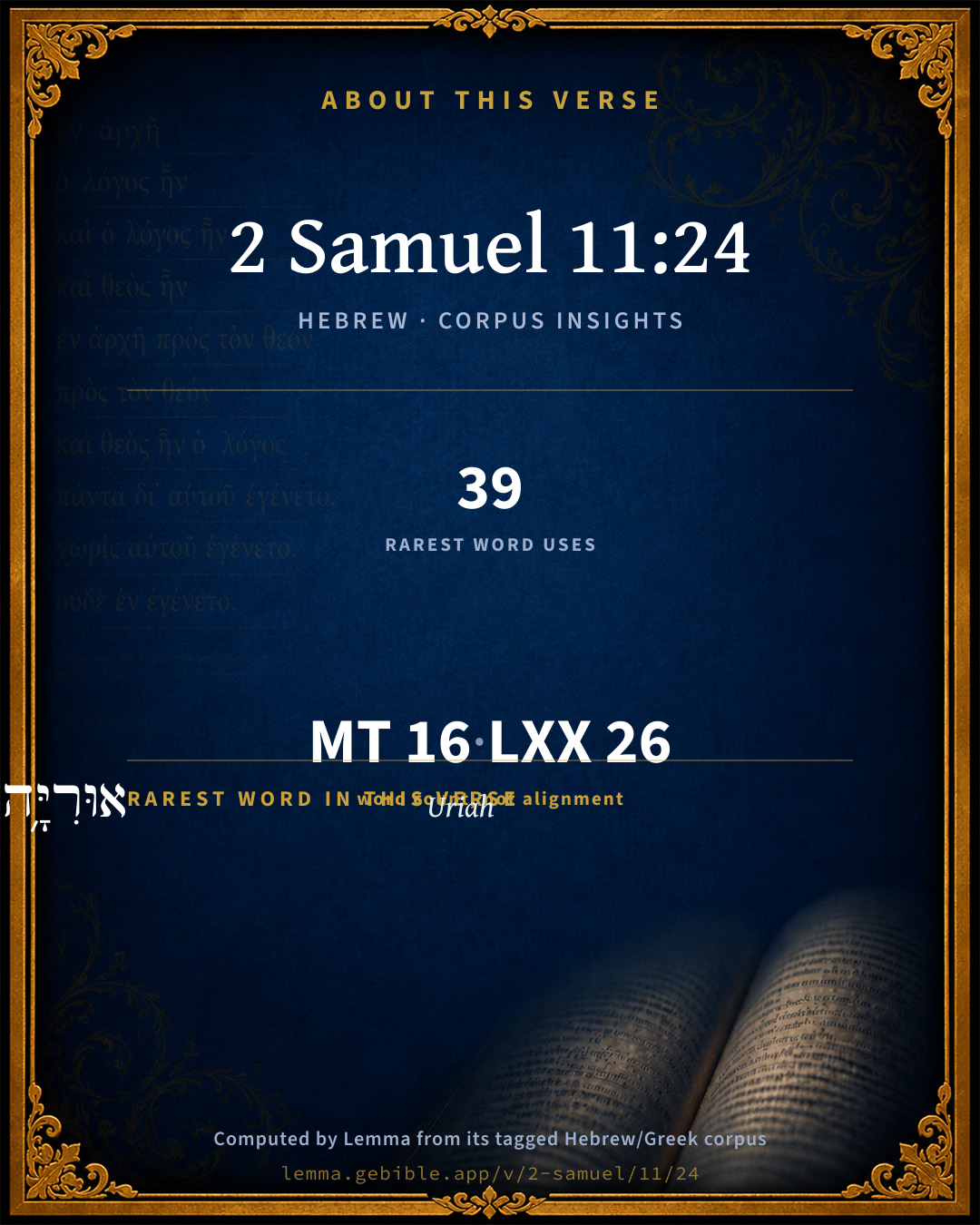
אוּרִיָּ֥ה Uriah H223 occurs in 33 verses of the Hebrew Bible. Also found in:

Grammatical profile

  • 6 verbs
  • 7 nouns
  • 2 prepositions
  • 1 particle

Verb forms

  • ויראו Hiphil · Sequential Imperfect
  • וַיֹּר֨וּ Hiphil · Sequential Imperfect
  • המוראים Hiphil · Participle Active
  • הַמּוֹרִ֤ים Hiphil · Participle Active
  • וַיָּמ֖וּתוּ Qal · Sequential Imperfect
  • מֵֽת Qal · Perfect

Repetition

Words recur within this verse — often emphatic in Hebrew:

  • ויראו to throw H3384 ×4
  • עֲבָדֶ֨ךָ֙ servant H5650 ×3
  • וַיָּמ֖וּתוּ to die H4191 ×2

Hebrew & Septuagint length

In English translation the verse runs 27 words from the Hebrew and 27 from the Septuagint (LXX English) — the same length.

A rough comparison of the two English renderings, which tokenize alike — not a word-level alignment.

Word counts can differ between the Hebrew and the Greek without any difference in meaning — e.g. the Hebrew direct-object marker אֵת has no separate Greek word, and Greek often adds the article ὁ.

In the original languages it is 16 Hebrew tokens and 26 Greek tokens — but the two are counted differently (Hebrew bundles its prefixes and suffixes into one token; the Greek is in lemma form), so that isn’t a like-for-like length.

Hebrew and Greek witnesses Masoretic Hebrew ↔ Greek Septuagint

The same verse in the two great witnesses to the Old Testament, shown verse-for-verse.

These are two independent witnesses, not word-aligned to each other, and the Septuagint is shown in lemma (dictionary) form.

Hebrew 2 Samuel 11:24 Masoretic · Westminster Leningrad Codex

ויראו וַיֹּר֨וּ המוראים הַמּוֹרִ֤ים אֶל עֲבָדֶ֨ךָ֙ מֵעַ֣ל הַחוֹמָ֔ה וַיָּמ֖וּתוּ מֵעַבְדֵ֣י הַמֶּ֑לֶךְ וְגַ֗ם עַבְדְּךָ֛ אוּרִיָּ֥ה הַחִתִּ֖י מֵֽת

The shooters shot at your servants from off the wall; and some of the king's servants are dead, and your servant Uriah the Hittite is dead also.

World English Bible · Public Domain

Greek LXX 2 Samuel 11:24 Septuagint · lemma form

καί τοξεύω ὁ τοξεύω πρός ὁ παῖς σύ ἀπάνωθεν ὁ τεῖχος καί ἀποθνήσκω ὁ παῖς ὁ βασιλεύς καί γέ ὁ δοῦλος σύ ουριας ὁ χετταῖος ἀποθνήσκω

And the archers shot at your servants from off the wall, and some of the king's servants died, and your servant Urias the Chettite is dead also.

LXX2012 (modern English Septuagint) · Public Domain

Hebrew: Westminster Leningrad Codex (CC BY 4.0). Greek: Septuagint (public domain); English from LXX2012 (modern English Septuagint) (Public Domain). How the Septuagint differs from the Hebrew →

Targum (Aramaic paraphrase)

1

The Targum is the ancient Jewish Aramaic paraphrase of the Hebrew Scriptures — an interpretive translation, not the Hebrew text itself. Onkelos (literal) and Pseudo-Jonathan (expansive) render the Torah, and Jonathan the Prophets. Coverage is partial: where no permissively-licensed English translation exists for a verse, only the Aramaic is shown. This is verse-level text, not a word-by-word alignment to the Hebrew.

  1. Targum Jonathan Prophets (Joshua–Malachi)
    וּשְׁדוֹ קַשָׁתַיָא בְּעַבְדָיִךְ מִן שׁוּרָא וְאִתְקְטִילוּ מֵעַבְדֵי מַלְכָּא וְאַף עַבְדָךְ אוּרִיָה חִתָּאָה מִית:

    (no public-domain English translation for this verse)

    Targum Jonathan — Aramaic: “Mikraot Gedolot” (public domain). English: “Sefaria Community Translation” (CC0 1.0 (public-domain dedication)); “London "Chaldee Paraphrase," 1871” (public domain). Text via Sefaria.

Commentary

Notes on 2 Samuel 11:24 from classic Christian and Jewish commentators (each source and its license shown beneath its notes). The classic Christian expositions comment on the surrounding passage and are grouped to its opening verse, so a note may address several verses; the Jewish commentaries on the Tanakh (Rashi and others) are per-verse, so they appear only where the commentator wrote on this verse.

Lemma curates 59 commentaries, every one of them public domain or Creative Commons licensed, each selected and text-cleaned for this edition rather than reprinted as found. About our sources →

Trapp's Complete Commentary

John Trapp

2Sa 11:24 And the shooters shot from off the wall upon thy servants; and [some] of the king’s servants be dead, and thy servant Uriah the Hittite is dead also.

Ver. 24. And thy servant Uriah the Hittite is dead also.] This the messenger maketh haste to tell, as that which would salve all; not staying till David should object as Josh had before conceived he would, and had accordingly devised a form of answer.

John Trapp, A Commentary or Exposition upon All the Books of the Old and New Testament (1647–1656) — public domain. Text from a community e-Sword module.

John Gill's Exposition

And the shooters shot from off of the wall upon thy servants,.... Arrows out of their bows, or stones out of their engines; the Israelites following them so closely to the gate of the city, came within the reach of their shot from the wall:

and some of the king's servants be dead; killed in the sally upon them, and by the shot from the wall:

and thy servant Uriah the Hittite is dead also; the messenger did not entirely obey the orders of Joab to wait and observe if the king's wrath arose, but was in haste to tell him the last piece of news; perhaps he had some suspicion, from the manner of Joab's telling him what he should say, that this would be acceptable to the king.

John Gill's Exposition of the Whole Bible (1746–1763) — public domain (CC PDM 1.0). Text via the HelloAO Bible API.

Whedon's Commentary on the Bible

Daniel D. Whedon

24. Uriah the Hittite is dead also — The messenger did not wait, as Joab directed, to announce Uriah’s death separately. His message was, like several other messages we have noticed, (2Sa_1:4; 1Sa_4:17,) climacteric, and Uriah’s death, as the most signal loss, is announced last. This messenger must have understood, however, that Uriah’s death was not afflictive to the king.

Daniel D. Whedon (gen. ed.), Commentary on the Old and New Testaments (1874–1909) — public domain. Text from a community e-Sword module.

unfoldingWord translationNotes

Door43 World Missions Community

their shooters shot

"their shooters shot arrows"

some of the king's servants were killed

This can be stated in active form. AT: "they killed some of the king's servants" (See: Active or Passive)

king's servants

Here "servants" refers to soldiers, not slaves, because soldiers were servants of the king.

your servant Uriah the Hittite was killed

This can be stated in active form. AT: "they killed your servant Uriah the Hittite" (See: Active or Passive)

for the sword devours one as well as another

Here "the sword" refers to a person who kills someone with sword. Also, killing someone with a sword is spoken of as if the sword were "eating" the people. AT: "for one man can be killed by a sword the same as another man" or "for any man can die in battle" (See: Metonymy and Metaphor)

Make your battle even stronger

"Fight even stronger"

translationWords

soldier

king

sword

devour

unfoldingWord translationNotes — © Distant Shores Media and the Door43 World Missions Community, licensed CC BY-SA 4.0. Source: git.door43.org/Door43/en_tn.

Lesson kit

Teaching starters — assembled from the data on this page, not authored interpretation. Every prompt links to the verse data it draws on. Edit before teaching.

2 Samuel, in the Historical, opens this verse with 16 words (10 distinct Hebrew lemmas). Its most distinctive word is ʼÛwrîyâh (“Uriah”). A historical commentator’s framing appears above. Read the whole chapter for the surrounding context.

Discussion questions

  1. How does “Uriah” (ʼÛwrîyâh) shape what this verse is saying?
  2. How does 2 Samuel 11:3, which shares the word «Uriah», read alongside this verse?
  3. What does the repetition of “to throw” (4× in this one verse) do in this verse?
  4. The translations on this page render this verse differently — a whole-verse word diff, not a word-by-word alignment. What might account for the different wordings?
  5. «ויראו» is a Hiphil Sequential Imperfect verb. How does that grammatical form shape the action described?
  6. Compare how Trapp's Complete Commentary and John Gill's Exposition read this verse. Where do they agree or differ?

Things to notice

Reading settings

Reading text

Shown beneath each verse's original-language words.

Old Testament
Old Testament edition

Read the OT as the Masoretic Hebrew (MT) or the Greek Septuagint (LXX).

English shown for the Greek Septuagint (in the Hebrew ↔ Greek comparison).

Comparing translations? Open the Compare panel on any verse page to stack up to four side by side.