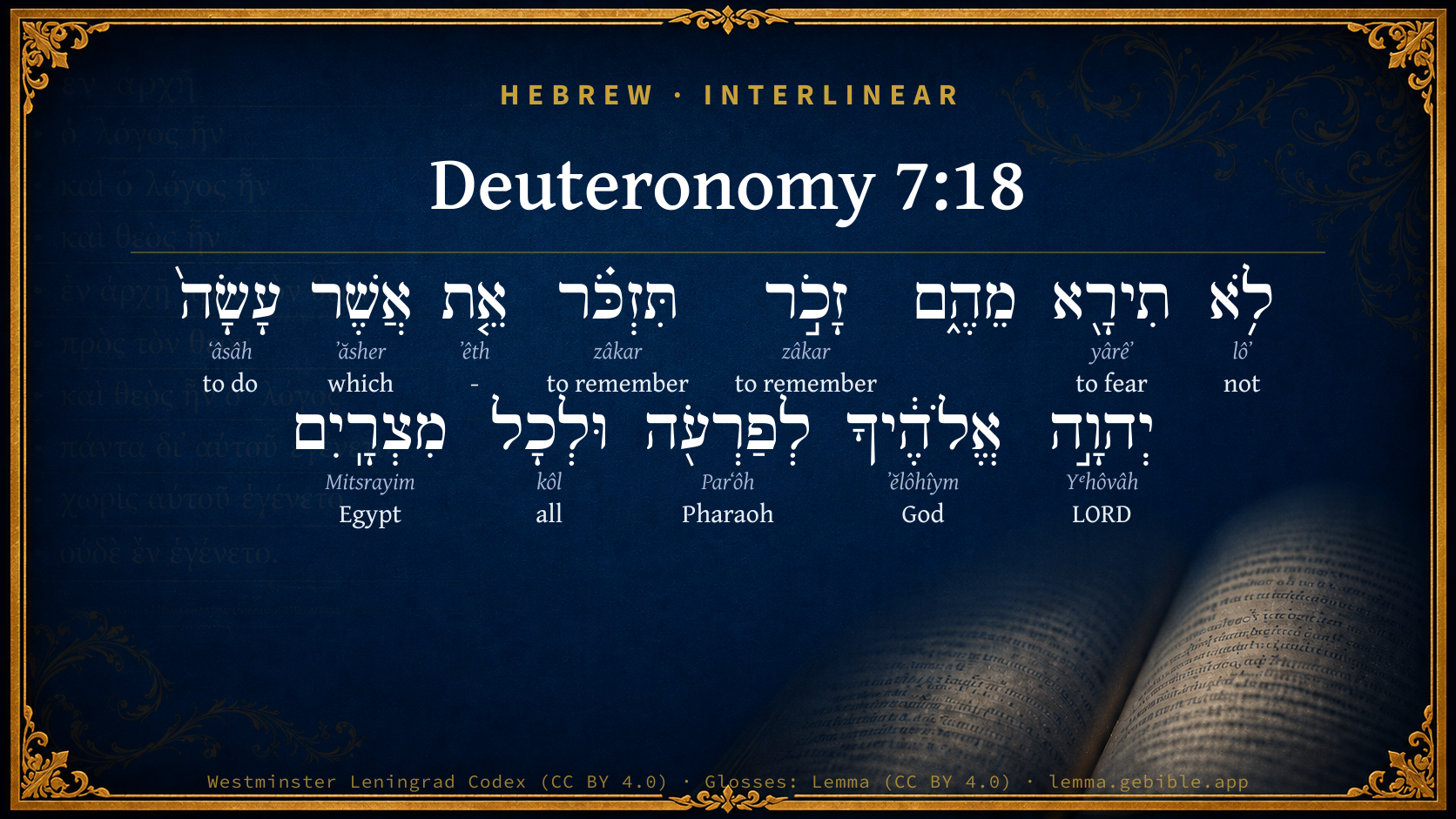
Deuteronomy 7:18

Hebrew (Westminster Leningrad Codex) Deuteronomy 7:18 appears in the Hebrew Old Testament. The text above is from the Westminster Leningrad Codex. Each word links to its Strong’s number, a concise gloss, and parsing drawn from the Open Scriptures Hebrew Bible morphology. Click any word for its full Brown-Driver-Briggs (BDB) entry.
Download image
Cite this verse

Deuteronomy 7:18 (World English Bible). Public Domain. Lemma interlinear Bible study tool, https://lemma.gebible.app/v/deuteronomy/7/18.

Show BibTeX & RIS
BibTeX
RIS
English Translation
you shall not be afraid of them: you shall well remember what Yahweh your God did to Pharaoh, and to all Egypt;
World English Bible · Public Domain
Download a study sheet

One document with this verse’s original text, its word-by-word gloss line, the meaning frame, cross-references with their text, attributed commentary, and full source and license credits — printable, and it pastes into notes with its structure intact.

This verse Autodidact and up

Study sheet (.html) Plain text (.txt)

A passage Seminary Student

Up to 50 verses in one chapter. A passage sheet keeps up to 6 commentary sources and 12 cross-references per verse, in the order this page ranks them, and says so on the sheet whenever that leaves anything out. Ask for a single verse and you get the Autodidact verse sheet above.

Everything on this page stays free to read, with no account — the sheet is a download of what is already on screen, not access to it.

Want to remove ads? Support Godless Engineer
Compare translations 3

The same verse in 3 English versions, stacked beneath the original-language interlinear above. Click any original word for its lexicon entry.

Each is an independent rendering of the whole verse — the interlinear is not word-aligned to these translations.

Highlighted words mark where these versions differ — a whole-verse word diff, not a word-by-word alignment.

  • World English Bible Public Domain
    you shall not be afraid of them: you shall well remember what Yahweh your God did to Pharaoh, and to all Egypt;
  • King James Version Public Domain
    Thou shalt not be afraid of them: but shalt well remember what the LORD thy God did unto Pharaoh, and unto all Egypt;
  • unfoldingWord Literal Text CC BY-SA 4.0
    do not be afraid of them. Remembering, you shall remember what Yahweh your God did to Pharaoh and to all Egypt,

unfoldingWord Literal Text — © unfoldingWord, licensed CC BY-SA 4.0. Word-aligned USFM3 via Door43 (git.door43.org/unfoldingWord/en_ult).

Versions to compare (up to 4)

3 of 4 selected

Show all 18 translations

Every available English version of this verse, each an independent rendering of the whole verse.

  • World English Bible Public Domain
    you shall not be afraid of them: you shall well remember what Yahweh your God did to Pharaoh, and to all Egypt;
  • Berean Standard Bible Public Domain
    But do not be afraid of them. Be sure to remember what the LORD your God did to Pharaoh and all Egypt:
  • Majority Standard Bible Public Domain
    But do not be afraid of them. Be sure to remember what the LORD your God did to Pharaoh and all Egypt:
  • King James Version Public Domain
    Thou shalt not be afraid of them: but shalt well remember what the LORD thy God did unto Pharaoh, and unto all Egypt;
  • American Standard Version (1901) Public Domain
    thou shalt not be afraid of them: thou shalt well remember what Jehovah thy God did unto Pharaoh, and unto all Egypt;
  • Revised Version (1885) Public Domain
    thou shalt not be afraid of them: thou shalt well remember what the LORD thy God did unto Pharaoh, and unto all Egypt;
  • Geneva Bible (1599) Public Domain
    Thou shalt not feare them, but remember what the Lord thy God did vnto Pharaoh, and vnto all Egypt:
  • Douay-Rheims (1899) Public Domain
    Fear not, but remember what the Lord thy God did to Pharao and to all the Egyptians,
  • Young's Literal Translation Public Domain
    thou art not afraid of them; thou dost surely remember that which Jehovah thy God hath done to Pharaoh, and to all Egypt,
  • Literal Standard Version CC BY-SA 4.0
    You are not afraid of them; you surely remember that which your God YHWH has done to Pharaoh and to all of Egypt,
  • Unlocked Literal Bible CC BY-SA 4.0
    do not be afraid of them; you will call to mind what Yahweh your God did to Pharaoh and to all Egypt;
  • unfoldingWord Literal Text CC BY-SA 4.0
    do not be afraid of them. Remembering, you shall remember what Yahweh your God did to Pharaoh and to all Egypt,
  • Darby Bible Public Domain
    fear them not; remember well what Jehovah thy God did unto Pharaoh, and unto all the Egyptians;
  • World Messianic Bible Public Domain
    you shall not be afraid of them. You shall remember well what the LORD your God did to Pharaoh and to all Egypt:
  • Webster's Bible Public Domain
    Thou shalt not be afraid of them: but shalt well remember what the LORD thy God did to Pharaoh, and to all Egypt;
  • Free Bible Version CC BY-SA 4.0
    But don't be afraid of them. Make sure you remember what the Lord your God did to Pharaoh and the whole of Egypt:
  • Bible in Basic English Public Domain
    Have no fear of them, but keep well in mind what the Lord your God did to Pharaoh and to all Egypt;
  • JPS Tanakh (1917) Public Domain
    thou shalt not be afraid of them; thou shalt well remember what the LORD thy God did unto Pharaoh, and unto all Egypt:

Literal Standard Version (2020), Covenant Press — licensed CC BY-SA 4.0. Text via the HelloAO Bible API (eBible.org). Unlocked Literal Bible (unfoldingWord) — licensed CC BY-SA 4.0. Text via the HelloAO Bible API (eBible.org). unfoldingWord Literal Text — © unfoldingWord, licensed CC BY-SA 4.0. Word-aligned USFM3 via Door43 (git.door43.org/unfoldingWord/en_ult). Free Bible Version, Dr. Jonathan Gallagher — licensed CC BY-SA 4.0. Text via the HelloAO Bible API (eBible.org).

Word by word

More ways to search: Search by grammar → Find every occurrence → Compare this word →

Practice this passage: Drill this verse → Learn its vocabulary →

זָכֹ֣ר
zâkar
H2142
“to remember”
Verb, Qal, Infinitive Absolute
Part of Speech
Verb
Stem
Qal
Form
Infinitive Absolute
Full BDB Definition

Origin: a primitive root

TWOT: 551

to remember, recall, call to mind - (Qal) to remember, recall - (Niphal) to be brought to remembrance, be remembered, be thought of, be brought to mind - (Hiphil) - to cause to remember, remind - to cause to be remembered, keep in remembrance - to mention - to record - to make a memorial, make remembrance
  1. לֹ֥א lôʼ H3808 “not” Particle, Negative
  2. תִירָ֖א yârêʼ H3372 “to fear” Verb, Qal, Imperfect, 2nd Person, Masculine, Singular
  3. תִּזְכֹּ֗ר zâkar H2142 “to remember” Verb, Qal, Imperfect, 2nd Person, Masculine, Singular
  4. אֵ֤ת ʼêth H853 “-” Particle, Direct Object
  5. אֲשֶׁר ʼăsher H834 “which” Particle, Relative
  6. עָשָׂה֙ ʻâsâh H6213 “to do” Verb, Qal, Perfect, 3rd Person, Masculine, Singular
  7. יְהוָ֣ה Yᵉhôvâh H3068 “LORD” Noun, Proper
  8. אֱלֹהֶ֔יךָ ʼĕlôhîym H430 “God(s) · your” Noun, Common, Masculine, Plural, Construct + Suffix, Personal, 2nd Person, Masculine, Singular
  9. לְפַרְעֹ֖ה Parʻôh H6547 “to/for · Pharaoh” Preposition + Noun, Proper
  10. וּלְכָל kôl H3605 “and · to/for · all of” Conjunction + Preposition + Noun, Common, Masculine, Singular, Construct
  11. מִצְרָֽיִם Mitsrayim H4714 “Egypt” Noun, Proper

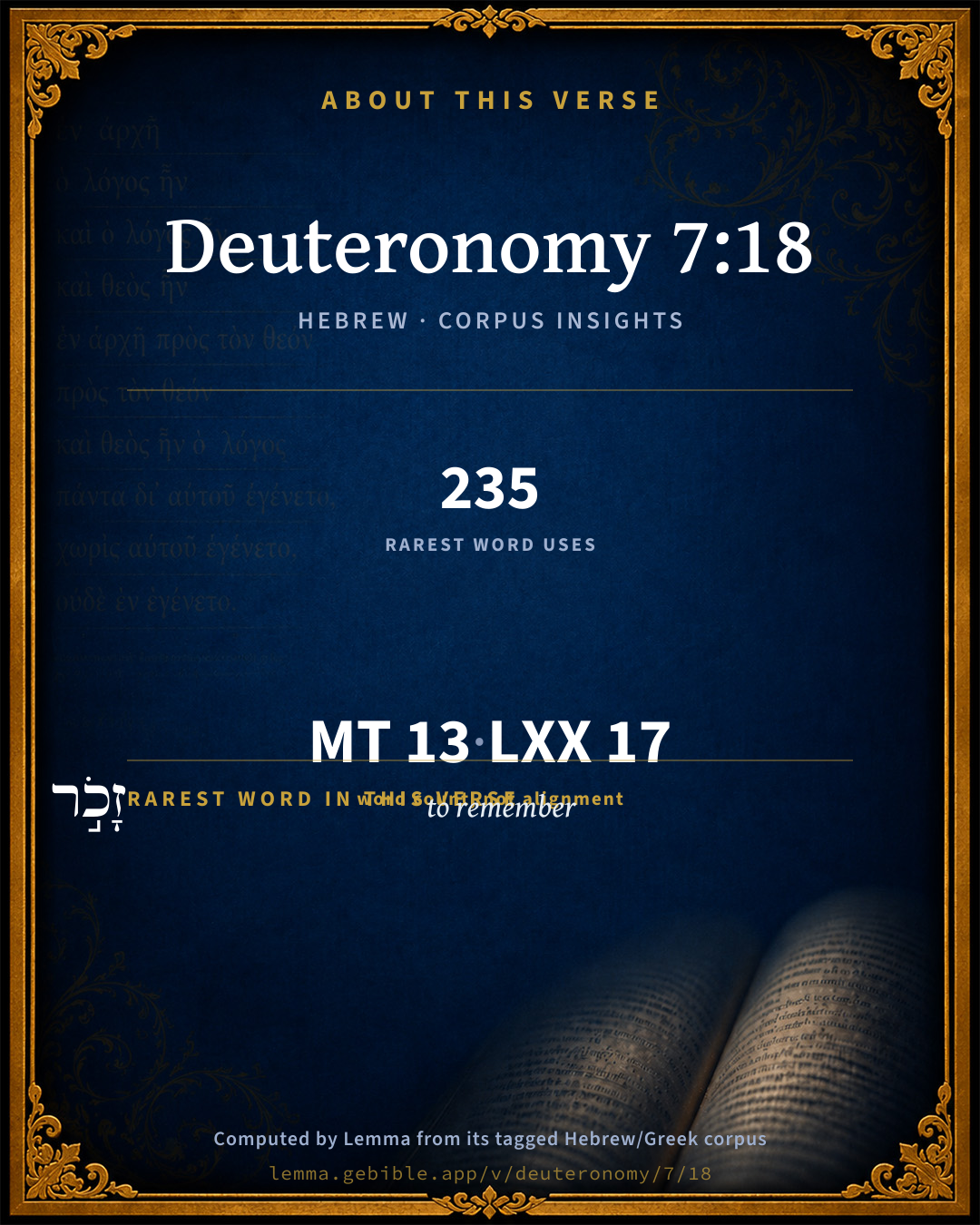
About this verse

These counts appear in no published source. They are computed here, from the morphology-tagged text and Lemma’s own curated glosses. What Lemma adds →

13
words
11
distinct lemmas
Pentateuch
section

Grammatical profile

  • 4 verbs
  • 5 nouns
  • 1 preposition
  • 3 particles

Verb forms

  • תִירָ֖א Qal · Imperfect
  • זָכֹ֣ר Qal · Infinitive Absolute
  • תִּזְכֹּ֗ר Qal · Imperfect
  • עָשָׂה֙ Qal · Perfect

Repetition

A word recurs within this verse — often emphatic in Hebrew:

  • זָכֹ֣ר to remember H2142 ×2

Hebrew & Septuagint length

In English translation the verse runs 22 words from the Hebrew and 23 from the Septuagint (LXX English) — closely comparable.

A rough comparison of the two English renderings, which tokenize alike — not a word-level alignment.

Word counts can differ between the Hebrew and the Greek without any difference in meaning — e.g. the Hebrew direct-object marker אֵת has no separate Greek word, and Greek often adds the article ὁ.

In the original languages it is 13 Hebrew tokens and 17 Greek tokens — but the two are counted differently (Hebrew bundles its prefixes and suffixes into one token; the Greek is in lemma form), so that isn’t a like-for-like length.

Cross-references

17

Topical passages linked to Deuteronomy 7:18 in the Treasury of Scripture Knowledge — connected by theme and wording, ordered by reader-vote popularity; previews shown in the World English Bible.

  • Psalms 105:5 Remember his marvelous works that he has done; His wonders, and the judgments of his mouth,
  • Deuteronomy 31:6 Be strong and of good courage, don't be afraid, nor be scared of them: for Yahweh your God, he it is who does go with you; he will not fail you, nor forsake you.
  • Deuteronomy 1:29 Then I said to you, Don't dread, neither be afraid of them.
  • Psalms 77:11 I will remember Yah's deeds; For I will remember your wonders of old.
  • Isaiah 51:9–10 Awake, awake, put on strength, arm of Yahweh; awake, as in the days of old, the generations of ancient times. Isn't it you who did cut Rahab in pieces, who pierced the monster?
  • Exodus 7:1–14 Yahweh said to Moses, "Behold, I have made you as God to Pharaoh; and Aaron your brother shall be your prophet.
  • Deuteronomy 3:6 We utterly destroyed them, as we did to Sihon king of Heshbon, utterly destroying every inhabited city, with the women and the little ones.
  • Judges 6:13 Gideon said to him, Oh, my lord, if Yahweh is with us, why then has all this happened to us? and where are all his wondrous works which our fathers told us of, saying, Did not Yahweh bring us up from Egypt? but now Yahweh has cast us off, and delivered us into the hand of Midian.
  • Psalms 27:1–2 Yahweh is my light and my salvation. Whom shall I fear? Yahweh is the strength of my life. Of whom shall I be afraid?
  • Psalms 46:1–2 God is our refuge and strength, A very present help in trouble.
  • Psalms 78:11 They forgot his doings, His wondrous works that he had shown them.
  • Psalms 78:42–51 They didn't remember his hand, Nor the day when he redeemed them from the adversary;
  • Psalms 105:26–36 He sent Moses, his servant, And Aaron, whom he had chosen.
  • Psalms 135:8–10 Who struck the firstborn of Egypt, Both of man and animal;
  • Psalms 136:10–15 To him who struck down the Egyptian firstborn; For his loving kindness endures forever;
  • Isaiah 41:10–14 Don't you be afraid, for I am with you; don't be dismayed, for I am your God; I will strengthen you; yes, I will help you; yes, I will uphold you with the right hand of my righteousness.
  • Isaiah 63:11–15 Then he remembered the days of old, Moses [and] his people, [saying], Where is he who brought them up out of the sea with the shepherds of his flock? where is he who put his holy Spirit in the midst of them?

Cross-references courtesy of OpenBible.info (CC BY 4.0).

Hebrew and Greek witnesses Masoretic Hebrew ↔ Greek Septuagint

The same verse in the two great witnesses to the Old Testament, shown verse-for-verse.

These are two independent witnesses, not word-aligned to each other, and the Septuagint is shown in lemma (dictionary) form.

Hebrew Deuteronomy 7:18 Masoretic · Westminster Leningrad Codex

לֹ֥א תִירָ֖א מֵהֶ֑ם זָכֹ֣ר תִּזְכֹּ֗ר אֵ֤ת אֲשֶׁר עָשָׂה֙ יְהוָ֣ה אֱלֹהֶ֔יךָ לְפַרְעֹ֖ה וּלְכָל מִצְרָֽיִם

you shall not be afraid of them: you shall well remember what Yahweh your God did to Pharaoh, and to all Egypt;

World English Bible · Public Domain

Greek LXX Deuteronomy 7:18 Septuagint · lemma form

οὐ φοβέω αὐτός μνεία μιμνήσκω ὅσος ποιέω κύριος ὁ θεός σύ ὁ φαραώ καί πᾶς ὁ αἰγύπτιος

you shall not fear them; you shall surely remember all that the Lord your God did to Pharao and to all the Egyptians:

LXX2012 (modern English Septuagint) · Public Domain

Hebrew: Westminster Leningrad Codex (CC BY 4.0). Greek: Septuagint (public domain); English from LXX2012 (modern English Septuagint) (Public Domain). How the Septuagint differs from the Hebrew →

Targum (Aramaic paraphrase)

2

The Targum is the ancient Jewish Aramaic paraphrase of the Hebrew Scriptures — an interpretive translation, not the Hebrew text itself. Onkelos (literal) and Pseudo-Jonathan (expansive) render the Torah, and Jonathan the Prophets. Coverage is partial: where no permissively-licensed English translation exists for a verse, only the Aramaic is shown. This is verse-level text, not a word-by-word alignment to the Hebrew.

  1. Targum Onkelos Torah (Genesis–Deuteronomy)
    לָא תִדְחַל מִנְהוֹן מִדְכַּר תִּדְכַּר יָת דִי עֲבַד יְיָ אֱלָהָךְ לְפַרְעֹה וּלְכָל מִצְרָיִם

    (no public-domain English translation for this verse)

    Targum Onkelos — Aramaic: “Onkelos Genesis” (public domain); “Onkelos Exodus” (public domain); “Onkelos Leviticus” (public domain); “Onkelos Numbers” (public domain); “Onkelos Deuteronomy” (public domain). English: “Sefaria Community Translation” (CC0 1.0 (public-domain dedication)); “J.W. Etheridge. The Targums of Onkelos and Jonathan Ben Uzziel on the Pentateuch. London: Longmans, Green, 1862” (public domain). Text via Sefaria.

  2. Targum Pseudo-Jonathan Torah (Genesis–Deuteronomy)
    לָא תִידַחֲלוּן מִנְהוֹן הֲווֹן דְּכִירִין יַת גְּבוּרָן דְּעָבַד יְיָ אֱלָהָךְ לְפַרְעה וּלְכָל מִצְרָאֵי

    Be not afraid of them; remember the work of power which the Lord thy God wrought upon Pharoh and all the Mizraee;

    Targum Pseudo-Jonathan — Aramaic: “Targum Jonathan on Genesis” (public domain); “Targum Jonathan on Exodus” (public domain); “Targum Jonathan on Leviticus” (public domain); “Targum Jonathan on Numbers” (public domain); “Targum Jonathan on Deuteronomy” (public domain). English: “The Targum of Jonathan ben Uzziel, trans. J. W. Etheridge, London, 1862” (public domain). Text via Sefaria.

Commentary

Notes on Deuteronomy 7:18 from classic Christian and Jewish commentators (each source and its license shown beneath its notes). The classic Christian expositions comment on the surrounding passage and are grouped to its opening verse, so a note may address several verses; the Jewish commentaries on the Tanakh (Rashi and others) are per-verse, so they appear only where the commentator wrote on this verse.

Lemma curates 59 commentaries, every one of them public domain or Creative Commons licensed, each selected and text-cleaned for this edition rather than reprinted as found. About our sources →

Joseph Benson's Commentary

Deu 7:18-19. Thou shalt remember what the Lord thy God did — Frequently and considerately, for thy encouragement; for people are said to forget those things which they do not remember to good purpose. The great temptations — The trials and exercises of thy faith, and obedience to my commands.

Joseph Benson's Commentary on the Old and New Testaments (1811–1818) — public domain. Text from a community e-Sword module.

Ellicott's Commentary for English Readers

(18) Thou shalt not be afraid of them: but shalt well remember . . . Egypt.—No free nation could ever have the same ground for terror as a nation of slaves rising up against its masters. If Israel had been delivered by Jehovah in that position, it was a security for all time that He would give them the victory in every enterprise He called them to undertake.

A Bible Commentary for English Readers, edited by Charles John Ellicott (1878–1897) — public domain. Text from a community e-Sword module.

The Cambridge Bible for Schools and Colleges

gen. ed. J. J. S. Perowne

18. afraid of them] So simply, Deu_20:1; for the longer characteristic phrases see on Deu_1:21.

what Jehovah thy God did] Deu_4:34, Deu_6:21 f.

The Cambridge Bible for Schools and Colleges (gen. ed. J. J. S. Perowne; Cambridge University Press, 1878–1918) — public domain. Text from a community e-Sword module.

John Gill's Exposition

Thou shalt not be afraid of them,.... Neither on account of their number, nor their strength:

but shall well remember what the Lord thy God did unto Pharaoh, and unto all Egypt; a people more numerous and potent than the Canaanites, among whom the Lord wrought such wonderful things by his power, which obliged them to let Israel go; and his power was now the same, he could do as great things to the Canaanites as he had to the Egyptians; and as he had delivered them out of the hands of the Egyptians, he could as easily deliver the Canaanites into their hands, and put them into the possession of their country.

John Gill's Exposition of the Whole Bible (1746–1763) — public domain (CC PDM 1.0). Text via the HelloAO Bible API.

Matthew Poole's English Annotations

Well remember, Heb. remembering remember, i.e. remember it frequently, considerately, practically, and for thy encouragement; for men are said to forget those things which they do not remember to good purpose.

Matthew Poole's English Annotations on the Holy Bible (1683–1685) — public domain. Text from a community e-Sword/MySword module.

Lesson kit

Teaching starters — assembled from the data on this page, not authored interpretation. Every prompt links to the verse data it draws on. Edit before teaching.

Deuteronomy, in the Pentateuch, opens this verse with 13 words (11 distinct Hebrew lemmas). Its most distinctive word is zâkar (“to remember”). A historical commentator’s framing appears above. Read the whole chapter for the surrounding context.

Discussion questions

  1. How does “to remember” (zâkar) shape what this verse is saying?
  2. How does Psalms 105:5, which shares this passage’s theme, read alongside this verse?
  3. What does the repetition of “to remember” (2× in this one verse) do in this verse?
  4. These translations render this verse differently; the difference is in the English rendering, not the original. What questions does that raise?
  5. «תִירָ֖א» is a Qal Imperfect verb. How does that grammatical form shape the action described?
  6. Compare how Joseph Benson's Commentary and Ellicott's Commentary for English Readers read this verse. Where do they agree or differ?

Things to notice

Reading settings

Reading text

Shown beneath each verse's original-language words.

Old Testament
Old Testament edition

Read the OT as the Masoretic Hebrew (MT) or the Greek Septuagint (LXX).

English shown for the Greek Septuagint (in the Hebrew ↔ Greek comparison).

Comparing translations? Open the Compare panel on any verse page to stack up to four side by side.