1 Samuel 17:11

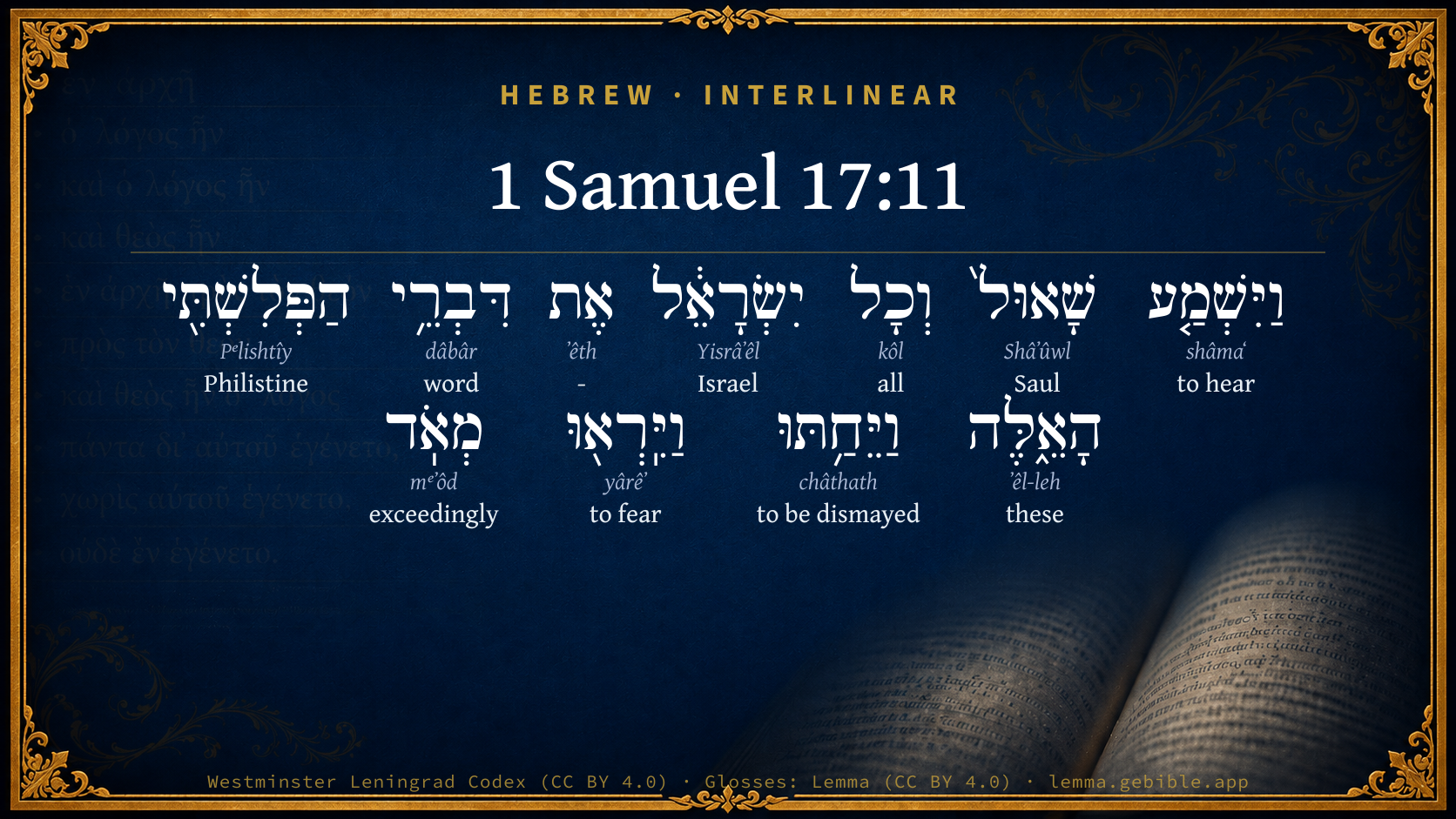
Hebrew (Westminster Leningrad Codex) 1 Samuel 17:11 appears in the Hebrew Old Testament. The text above is from the Westminster Leningrad Codex. Each word links to its Strong’s number, a concise gloss, and parsing drawn from the Open Scriptures Hebrew Bible morphology. Click any word for its full Brown-Driver-Briggs (BDB) entry.
Download image
Cite this verse

1 Samuel 17:11 (World English Bible). Public Domain. Lemma interlinear Bible study tool, https://lemma.gebible.app/v/1-samuel/17/11.

Show BibTeX & RIS
BibTeX
RIS
English Translation
When Saul and all Israel heard those words of the Philistine, they were dismayed, and greatly afraid.
World English Bible · Public Domain
Download a study sheet

One document with this verse’s original text, its word-by-word gloss line, the meaning frame, cross-references with their text, attributed commentary, and full source and license credits — printable, and it pastes into notes with its structure intact.

This verse Autodidact and up

Study sheet (.html) Plain text (.txt)

A passage Seminary Student

Up to 50 verses in one chapter. A passage sheet keeps up to 6 commentary sources and 12 cross-references per verse, in the order this page ranks them, and says so on the sheet whenever that leaves anything out. Ask for a single verse and you get the Autodidact verse sheet above.

Everything on this page stays free to read, with no account — the sheet is a download of what is already on screen, not access to it.

Want to remove ads? Support Godless Engineer
Compare translations 3

The same verse in 3 English versions, stacked beneath the original-language interlinear above. Click any original word for its lexicon entry.

Each is an independent rendering of the whole verse — the interlinear is not word-aligned to these translations.

Highlighted words mark where these versions differ — a whole-verse word diff, not a word-by-word alignment.

  • World English Bible Public Domain
    When Saul and all Israel heard those words of the Philistine, they were dismayed, and greatly afraid.
  • King James Version Public Domain
    When Saul and all Israel heard those words of the Philistine, they were dismayed, and greatly afraid.
  • unfoldingWord Literal Text CC BY-SA 4.0
    And Saul and all of Israel heard these words of the Philistine, and they were dismayed and feared greatly.

unfoldingWord Literal Text — © unfoldingWord, licensed CC BY-SA 4.0. Word-aligned USFM3 via Door43 (git.door43.org/unfoldingWord/en_ult).

Versions to compare (up to 4)

3 of 4 selected

Show all 18 translations

Every available English version of this verse, each an independent rendering of the whole verse.

  • World English Bible Public Domain
    When Saul and all Israel heard those words of the Philistine, they were dismayed, and greatly afraid.
  • Berean Standard Bible Public Domain
    On hearing the words of the Philistine, Saul and all the Israelites were dismayed and greatly afraid.
  • Majority Standard Bible Public Domain
    On hearing the words of the Philistine, Saul and all the Israelites were dismayed and greatly afraid.
  • King James Version Public Domain
    When Saul and all Israel heard those words of the Philistine, they were dismayed, and greatly afraid.
  • American Standard Version (1901) Public Domain
    And when Saul and all Israel heard those words of the Philistine, they were dismayed, and greatly afraid.
  • Revised Version (1885) Public Domain
    And when Saul and all Israel heard those words of the Philistine, they were dismayed, and greatly afraid.
  • Geneva Bible (1599) Public Domain
    When Saul and all Israel heard those wordes of the Philistim, they were discouraged, and greatly afraide.
  • Douay-Rheims (1899) Public Domain
    And Saul and all the Israelites hearing these words of the Philistine were dismayed, and greatly afraid.
  • Young's Literal Translation Public Domain
    And Saul heareth -- and all Israel -- these words of the Philistine, and they are broken down and greatly afraid.
  • Literal Standard Version CC BY-SA 4.0
    And Saul hears—and all Israel—these words of the Philistine, and they are broken down and greatly afraid.
  • Unlocked Literal Bible CC BY-SA 4.0
    When Saul and all Israel heard what the Philistine said, they were discouraged and greatly afraid.
  • unfoldingWord Literal Text CC BY-SA 4.0
    And Saul and all of Israel heard these words of the Philistine, and they were dismayed and feared greatly.
  • Darby Bible Public Domain
    And Saul and all Israel heard these words of the Philistine, and they were dismayed and greatly afraid.
  • World Messianic Bible Public Domain
    When Saul and all Israel heard those words of the Philistine, they were dismayed and greatly afraid.
  • Webster's Bible Public Domain
    When Saul and all Israel heard those words of the Philistine, they were dismayed, and greatly afraid.
  • Free Bible Version CC BY-SA 4.0
    Saul and all the Israelite soldiers were shattered and absolutely terrified when they heard what the Philistine said.
  • Bible in Basic English Public Domain
    And Saul and all Israel, hearing those words of the Philistine, were troubled and full of fear.
  • JPS Tanakh (1917) Public Domain
    And when Saul and all Israel heard those words of the Philistine, they were dismayed, and greatly afraid.

Literal Standard Version (2020), Covenant Press — licensed CC BY-SA 4.0. Text via the HelloAO Bible API (eBible.org). Unlocked Literal Bible (unfoldingWord) — licensed CC BY-SA 4.0. Text via the HelloAO Bible API (eBible.org). unfoldingWord Literal Text — © unfoldingWord, licensed CC BY-SA 4.0. Word-aligned USFM3 via Door43 (git.door43.org/unfoldingWord/en_ult). Free Bible Version, Dr. Jonathan Gallagher — licensed CC BY-SA 4.0. Text via the HelloAO Bible API (eBible.org).

Word by word

More ways to search: Search by grammar → Find every occurrence → Compare this word →

Practice this passage: Drill this verse → Learn its vocabulary →

וַיֵּחַ֥תּוּ
châthath
H2865
“and · to be dismayed”
Conjunction + Verb, Niphal, Sequential Imperfect, 3rd Person, Masculine, Plural
Part of Speech
Conjunction + Verb
Stem
Niphal
Form
Sequential Imperfect
Person
3rd Person
Gender
Masculine
Number
Plural
Full BDB Definition

Origin: a primitive root

TWOT: 784

to be shattered, be dismayed, be broken, be abolished, be afraid - (Qal) - to be shattered, be broken - to be dismayed - (Niphal) to be broken, be dismayed - (Piel) to be shattered, be dismayed, be scared - (Hiphil) - to cause to be dismayed - to dismay, terrify - to shatter
  1. וַיִּשְׁמַ֤ע shâmaʻ H8085 “and · to hear” Conjunction + Verb, Qal, Sequential Imperfect, 3rd Person, Masculine, Singular
  2. שָׁאוּל֙ Shâʼûwl H7586 “Saul” Noun, Proper
  3. וְכָל kôl H3605 “and · all of” Conjunction + Noun, Common, Masculine, Singular, Construct
  4. יִשְׂרָאֵ֔ל Yisrâʼêl H3478 “Israel” Noun, Proper
  5. אֶת ʼêth H853 “-” Particle, Direct Object
  6. דִּבְרֵ֥י dâbâr H1697 “words of” Noun, Common, Masculine, Plural, Construct
  7. הַפְּלִשְׁתִּ֖י Pᵉlishtîy H6430 “the · Philistine” Particle, Definite Article + Noun, Gentilic, Masculine, Singular, Absolute
  8. הָאֵ֑לֶּה ʼêl-leh H428 “the · these” Particle, Definite Article + Pronoun, Demonstrative, Common, Plural
  9. וַיִּֽרְא֖וּ yârêʼ H3372 “and · to fear” Conjunction + Verb, Qal, Sequential Imperfect, 3rd Person, Masculine, Plural
  10. מְאֹֽד mᵉʼôd H3966 “exceedingly” Adverb

About this verse

These counts appear in no published source. They are computed here, from the morphology-tagged text and Lemma’s own curated glosses. What Lemma adds →

11
words
11
distinct lemmas
Historical
section

Shared distinctive vocabulary

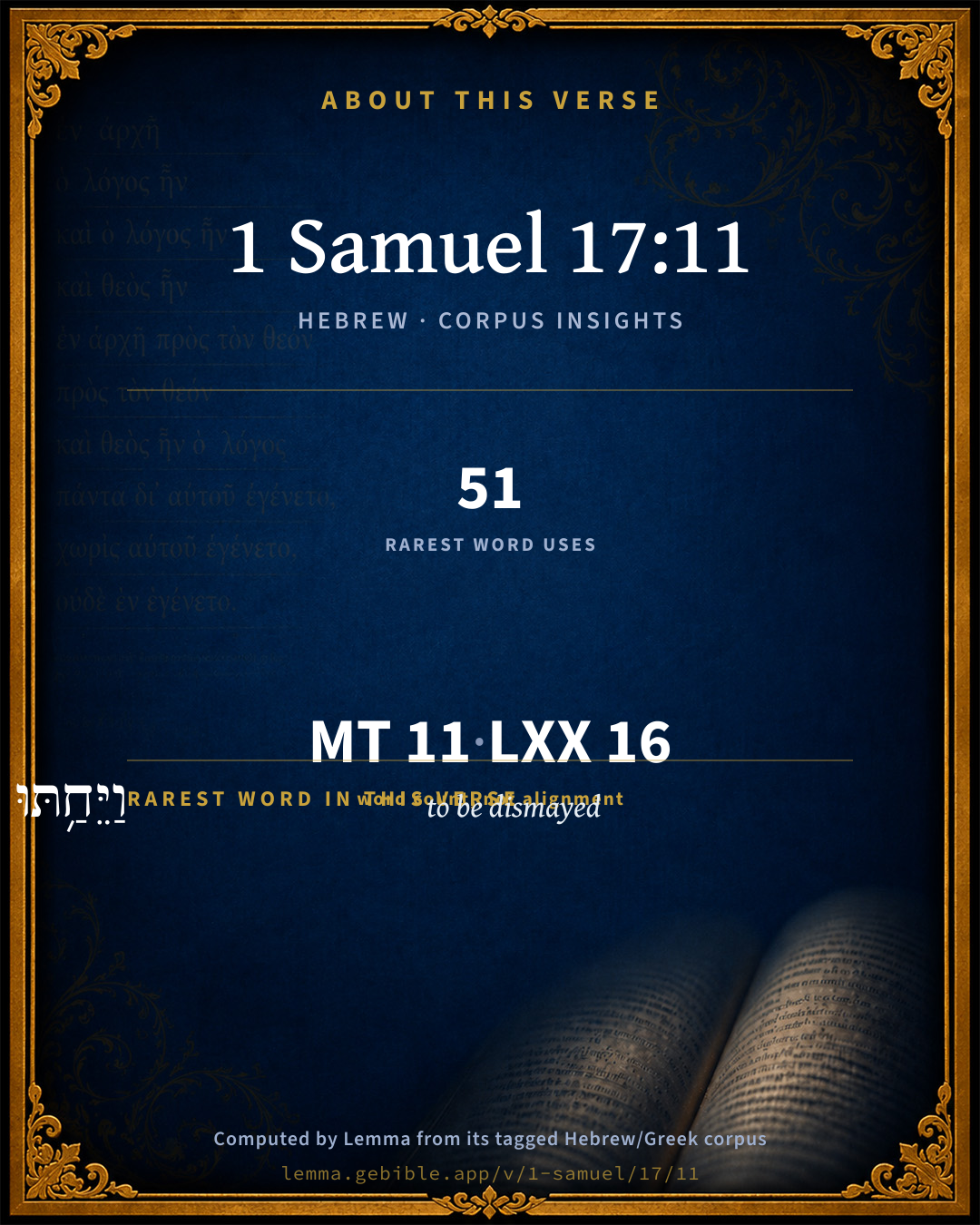
וַיֵּחַ֥תּוּ to be dismayed H2865 occurs in 45 verses of the Hebrew Bible. Also found in:

Grammatical profile

  • 3 verbs
  • 5 nouns
  • 1 pronoun
  • 1 adverb
  • 1 particle

Verb forms

  • וַיִּשְׁמַ֤ע Qal · Sequential Imperfect
  • וַיֵּחַ֥תּוּ Niphal · Sequential Imperfect
  • וַיִּֽרְא֖וּ Qal · Sequential Imperfect

Hebrew & Septuagint length

In English translation the verse runs 17 words from the Hebrew and 18 from the Septuagint (LXX English) — closely comparable.

A rough comparison of the two English renderings, which tokenize alike — not a word-level alignment.

Word counts can differ between the Hebrew and the Greek without any difference in meaning — e.g. the Hebrew direct-object marker אֵת has no separate Greek word, and Greek often adds the article ὁ.

In the original languages it is 11 Hebrew tokens and 16 Greek tokens — but the two are counted differently (Hebrew bundles its prefixes and suffixes into one token; the Greek is in lemma form), so that isn’t a like-for-like length.

Cross-references

6

Topical passages linked to 1 Samuel 17:11 in the Treasury of Scripture Knowledge — connected by theme and wording, ordered by reader-vote popularity; previews shown in the World English Bible.

  • Deuteronomy 31:8 Yahweh, he it is who does go before you; he will be with you, he will not fail you, neither forsake you: don't be afraid, neither be dismayed.
  • Joshua 1:9 Haven't I commanded you? Be strong and of good courage; don't be afraid, neither be dismayed: for Yahweh your God is with you wherever you go.
  • Psalms 27:1 Yahweh is my light and my salvation. Whom shall I fear? Yahweh is the strength of my life. Of whom shall I be afraid?
  • Proverbs 28:1 The wicked flee when no one pursues; But the righteous are as bold as a lion.
  • Isaiah 51:12–13 I, even I, am he who comforts you: who are you, that you are afraid of man who shall die, and of the son of man who shall be made as grass;
  • Isaiah 57:11 Of whom have you been afraid and in fear, that you lie, and have not remembered me, nor laid it to your heart? Haven't I held my peace even of long time, and you don't fear me?

Cross-references courtesy of OpenBible.info (CC BY 4.0).

Hebrew and Greek witnesses Masoretic Hebrew ↔ Greek Septuagint

The same verse in the two great witnesses to the Old Testament, shown verse-for-verse.

These are two independent witnesses, not word-aligned to each other, and the Septuagint is shown in lemma (dictionary) form.

Hebrew 1 Samuel 17:11 Masoretic · Westminster Leningrad Codex

וַיִּשְׁמַ֤ע שָׁאוּל֙ וְכָל יִשְׂרָאֵ֔ל אֶת דִּבְרֵ֥י הַפְּלִשְׁתִּ֖י הָאֵ֑לֶּה וַיֵּחַ֥תּוּ וַיִּֽרְא֖וּ מְאֹֽד

When Saul and all Israel heard those words of the Philistine, they were dismayed, and greatly afraid.

World English Bible · Public Domain

Greek LXX 1 Samuel 17:11 Septuagint · lemma form

καί ἀκούω σαούλ καί πᾶς ἰσραήλ ὁ ῥῆμα ὁ ἀλλόφυλος οὗτος καί ἐκἵστημι καί φοβέω σφόδρα

And Saul and all Israel heard these words of the Philistine, and they were dismayed, and greatly terrified.

LXX2012 (modern English Septuagint) · Public Domain

Hebrew: Westminster Leningrad Codex (CC BY 4.0). Greek: Septuagint (public domain); English from LXX2012 (modern English Septuagint) (Public Domain). How the Septuagint differs from the Hebrew →

Targum (Aramaic paraphrase)

1

The Targum is the ancient Jewish Aramaic paraphrase of the Hebrew Scriptures — an interpretive translation, not the Hebrew text itself. Onkelos (literal) and Pseudo-Jonathan (expansive) render the Torah, and Jonathan the Prophets. Coverage is partial: where no permissively-licensed English translation exists for a verse, only the Aramaic is shown. This is verse-level text, not a word-by-word alignment to the Hebrew.

  1. Targum Jonathan Prophets (Joshua–Malachi)
    וּשְׁמַע שָׁאוּל וְכָל יִשְׂרָאֵל יַת פִּתְגָמֵי פְּלִשְׁתָּאָה הָאִלֵין וְאִתְבָּרוּ וּדְחִילוּ לַחֲדָא:

    (no public-domain English translation for this verse)

    Targum Jonathan — Aramaic: “Mikraot Gedolot” (public domain). English: “Sefaria Community Translation” (CC0 1.0 (public-domain dedication)); “London "Chaldee Paraphrase," 1871” (public domain). Text via Sefaria.

Commentary

Notes on 1 Samuel 17:11 from classic Christian and Jewish commentators (each source and its license shown beneath its notes). The classic Christian expositions comment on the surrounding passage and are grouped to its opening verse, so a note may address several verses; the Jewish commentaries on the Tanakh (Rashi and others) are per-verse, so they appear only where the commentator wrote on this verse.

Lemma curates 59 commentaries, every one of them public domain or Creative Commons licensed, each selected and text-cleaned for this edition rather than reprinted as found. About our sources →

Trapp's Complete Commentary

John Trapp

1Sa 17:11 When Saul and all Israel heard those words of the Philistine, they were dismayed, and greatly afraid.

Ver. 11. They were dismayed, and greatly afraid.] Even valiant Jonathan also, who both knew the promises, and had lately found the performance in that glorious conquest he had over these Philistines. {1Sa 14:13-15} But it is the Lord who strengtheneth and weakeneth the arm of either party, {Eze 30:24} and he had decreed that David should have the glory of the day.

John Trapp, A Commentary or Exposition upon All the Books of the Old and New Testament (1647–1656) — public domain. Text from a community e-Sword module.

The Biblical Illustrator

Joseph S. Exell

1Sa_17:11

When Saul and all Israel heard those words of the Philistine, they were dismayed and greatly afraid.

The insulting attitude of worldliness towards religion

The insult was a symbol of the insulting attitude of worldliness towards religion. Brute force and power paraded themselves as contemptuous of the power of the Spirit. Religion cannot hold its own against the powers of the world except by spiritual forces and trust in God. When the guardians of religion, or those who should witness its inward power, fail in this trust, and in using the right weapons, then the world has its way. The symbol in this case is singularly vivid and complete. (W. J. Knox Little, M. A.)

The Biblical Illustrator, edited by Joseph S. Exell (c. 1880s–1900s) — public domain. Text from a community e-Sword module.

Adam Clarke's Commentary

Verse 11. Saul and all Israel - were dismayed] They saw no man able to accept the challenge.

Adam Clarke's Commentary on the Bible (1810–1826) — public domain. Text from a community e-Sword/MySword module.

Ellicott's Commentary for English Readers

(11) They were dismayed, and greatly afraid.—Saul the king, perhaps, was restrained from personally accepting the challenge by motives of dignity, but the marked silence on his part, and the utter hopelessness of his army, reads in strange contrast to the former records of Hebrew daring. Where was Jonathan, for instance, ever the bravest of the brave, and his gallant armour-bearer? There had assuredly been a time when neither motives of dignity nor prudence would have restrained Saul and his warriors from accepting the challenge of the uncircumcised enemy. We notice, too, here there is no inquiry of the Urim and Thummim, no mention of prayer to the God of the armies of Israel. An evil spirit was indeed upon the King of Israel.

A Bible Commentary for English Readers, edited by Charles John Ellicott (1878–1897) — public domain. Text from a community e-Sword module.

John Gill's Exposition

When Saul and all Israel heard these words of the Philistine,.... For they were delivered with such a tone and strength of voice, as to be heard very generally, at least by many, and which soon was reported through the whole army:

they were dismayed, and greatly afraid; which may seem strange, when there were so many valiant men among them, as Saul himself, who had behaved with so much courage against the Ammonites, Philistines, and Amalekites; but now the Spirit of God was departed from him, and he was become timorous and fearful; and though he was much better than he had been, yet still he was not the man of spirit and resolution as before: there was also Abner, the general of his army, a very valiant man, a great man in Israel, and yet appears not on this occasion; and, what is more wonderful, Jonathan the son of Saul was present, as appears from Sa1 18:1 who had not only smitten a garrison of the Philistines, but with one man more only had attacked another garrison, and routed the whole army of the Philistines, and yet now shows not his head against a single man: so it is when God cuts off the spirits of princes, or takes away their courage; victory over this man, and the glory of it, were reserved for David; and all this fear and dread throughout the armies of Israel were suffered, that he might appear the more glorious.

John Gill's Exposition of the Whole Bible (1746–1763) — public domain (CC PDM 1.0). Text via the HelloAO Bible API.

Matthew Poole's English Annotations

Which may seem strange, considering the glorious promises, and their late experiences of Divine assistance. But the truth is, all men do so entirely depend upon God in all things, that when he withdraws his help, the most valiant and resolute persons cannot find their hearts nor hands, as daily experience shows.

Matthew Poole's English Annotations on the Holy Bible (1683–1685) — public domain. Text from a community e-Sword/MySword module.

John Wesley's Explanatory Notes

Afraid - This may seem strange, considering the glorious promises, and their late experience of divine assistance. And where was Jonathan, who in the last war had so bravely engaged an whole army of the Philistines? Doubtless he did not feel himself so stirred up of God as he did at that time. As the best, so the bravest of men, are no more than what God makes them. Jonathan must sit still now, because this honour is reserved for David.

John Wesley, Explanatory Notes Upon the Whole Bible (1754–1765) — public domain. Text via the GEBible commentary corpus.

Lesson kit

Teaching starters — assembled from the data on this page, not authored interpretation. Every prompt links to the verse data it draws on. Edit before teaching.

1 Samuel, in the Historical, opens this verse with 11 words (11 distinct Hebrew lemmas). Its most distinctive word is châthath (“to be dismayed”). A historical commentator’s framing appears above. Read the whole chapter for the surrounding context.

Discussion questions

  1. The word châthath carries the sense “to be dismayed.” How does it shape the verse?
  2. Deuteronomy 1:21 shares the word «to be dismayed» with this verse. How do the two illuminate each other?
  3. The translations on this page render this verse differently — a whole-verse word diff, not a word-by-word alignment. What might account for the different wordings?
  4. The verb «וַיִּשְׁמַ֤ע» is Qal Sequential Imperfect. How does its form color the action?
  5. Reading how Trapp's Complete Commentary and The Biblical Illustrator read this verse, where do the two commentators agree and where do they part?

Things to notice

Reading settings

Reading text

Shown beneath each verse's original-language words.

Old Testament
Old Testament edition

Read the OT as the Masoretic Hebrew (MT) or the Greek Septuagint (LXX).

English shown for the Greek Septuagint (in the Hebrew ↔ Greek comparison).

Comparing translations? Open the Compare panel on any verse page to stack up to four side by side.