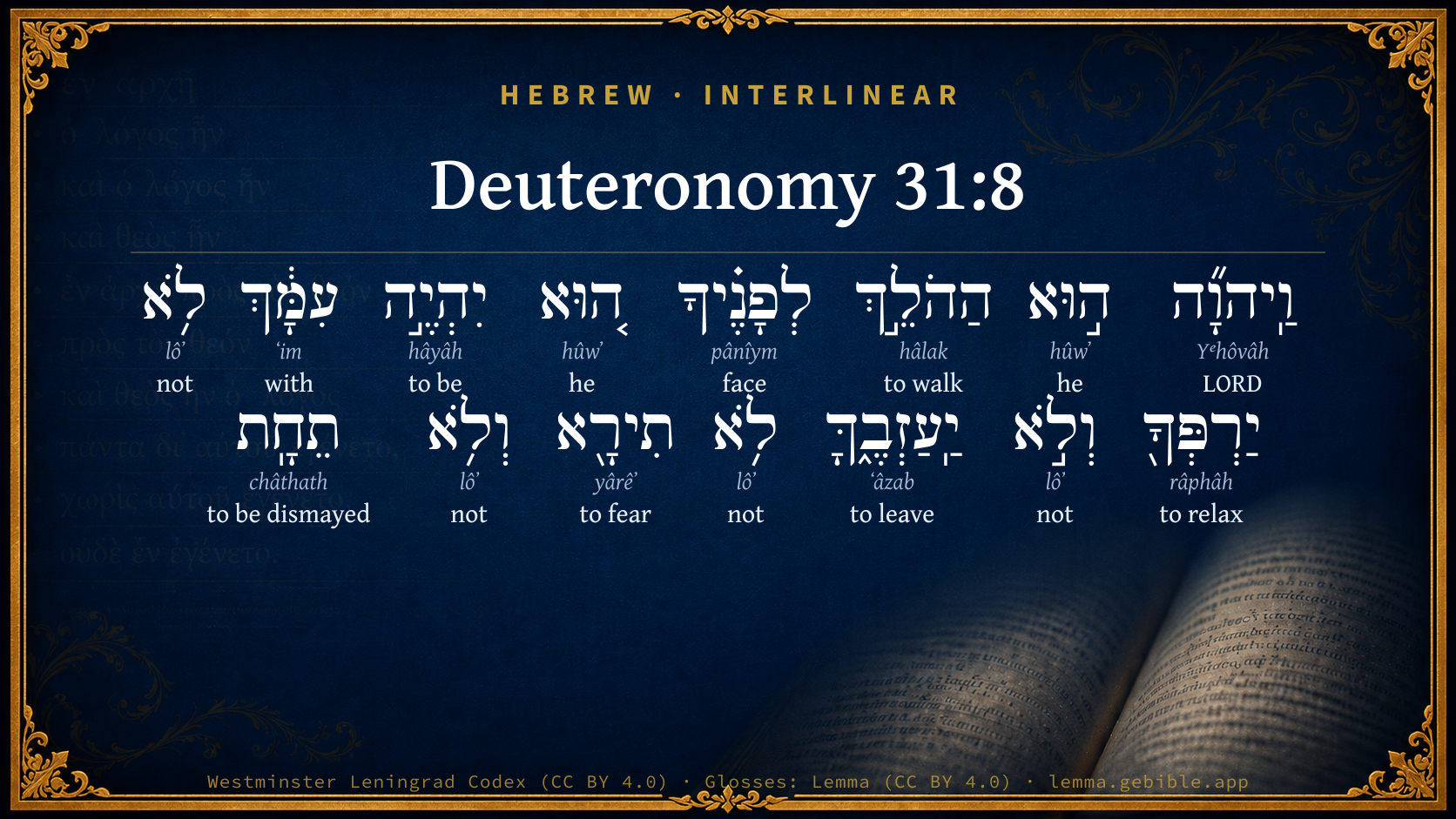
Deuteronomy 31:8

Hebrew (Westminster Leningrad Codex) Deuteronomy 31:8 appears in the Hebrew Old Testament. The text above is from the Westminster Leningrad Codex. Each word links to its Strong’s number, a concise gloss, and parsing drawn from the Open Scriptures Hebrew Bible morphology. Click any word for its full Brown-Driver-Briggs (BDB) entry.
Download image
Cite this verse

Deuteronomy 31:8 (World English Bible). Public Domain. Lemma interlinear Bible study tool, https://lemma.gebible.app/v/deuteronomy/31/8.

Show BibTeX & RIS
BibTeX
RIS
English Translation
Yahweh, he it is who does go before you; he will be with you, he will not fail you, neither forsake you: don't be afraid, neither be dismayed.
World English Bible · Public Domain
Download a study sheet

One document with this verse’s original text, its word-by-word gloss line, the meaning frame, cross-references with their text, attributed commentary, and full source and license credits — printable, and it pastes into notes with its structure intact.

This verse Autodidact and up

Study sheet (.html) Plain text (.txt)

A passage Seminary Student

Up to 50 verses in one chapter. A passage sheet keeps up to 6 commentary sources and 12 cross-references per verse, in the order this page ranks them, and says so on the sheet whenever that leaves anything out. Ask for a single verse and you get the Autodidact verse sheet above.

Everything on this page stays free to read, with no account — the sheet is a download of what is already on screen, not access to it.

Want to remove ads? Support Godless Engineer
Compare translations 3

The same verse in 3 English versions, stacked beneath the original-language interlinear above. Click any original word for its lexicon entry.

Each is an independent rendering of the whole verse — the interlinear is not word-aligned to these translations.

Highlighted words mark where these versions differ — a whole-verse word diff, not a word-by-word alignment.

  • World English Bible Public Domain
    Yahweh, he it is who does go before you; he will be with you, he will not fail you, neither forsake you: don't be afraid, neither be dismayed.
  • King James Version Public Domain
    And the LORD, he it is that doth go before thee; he will be with thee, he will not fail thee, neither forsake thee: fear not, neither be dismayed.
  • unfoldingWord Literal Text CC BY-SA 4.0
    And Yahweh, he goes to your faces; he will be with you; he will not fail you nor abandon you; you shall not fear, and you shall not be dismayed.”

unfoldingWord Literal Text — © unfoldingWord, licensed CC BY-SA 4.0. Word-aligned USFM3 via Door43 (git.door43.org/unfoldingWord/en_ult).

Versions to compare (up to 4)

3 of 4 selected

Show all 18 translations

Every available English version of this verse, each an independent rendering of the whole verse.

  • World English Bible Public Domain
    Yahweh, he it is who does go before you; he will be with you, he will not fail you, neither forsake you: don't be afraid, neither be dismayed.
  • Berean Standard Bible Public Domain
    The LORD Himself goes before you; He will be with you. He will never leave you nor forsake you. Do not be afraid or discouraged.”
  • Majority Standard Bible Public Domain
    The LORD Himself goes before you; He will be with you. He will never leave you nor forsake you. Do not be afraid or discouraged.”
  • King James Version Public Domain
    And the LORD, he it is that doth go before thee; he will be with thee, he will not fail thee, neither forsake thee: fear not, neither be dismayed.
  • American Standard Version (1901) Public Domain
    And Jehovah, he it is that doth go before thee; he will be with thee, he will not fail thee, neither forsake thee: fear not, neither be dismayed.
  • Revised Version (1885) Public Domain
    And the LORD, he it is that doth go before thee; he will be with thee, he will not fail thee, neither forsake thee: fear not, neither be dismayed.
  • Geneva Bible (1599) Public Domain
    And the Lord him selfe doeth go before thee: he will be with thee: he will not faile thee, neither forsake thee: feare not therefore, nor be discomforted.
  • Douay-Rheims (1899) Public Domain
    And the Lord who is your leader, he himself will be with thee: he will not leave thee, nor forsake thee: fear not, neither be dismayed.
  • Young's Literal Translation Public Domain
    and Jehovah `is' He who is going before thee, He himself is with thee; He doth not fail thee nor forsake thee; fear not, nor be affrighted.'
  • Literal Standard Version CC BY-SA 4.0
    and YHWH [is] He who is going before you, He Himself is with you; He does not fail you nor forsake you; do not fear, nor be frightened.”
  • Unlocked Literal Bible CC BY-SA 4.0
    Yahweh, he it is who goes before you; he will be with you; he will not fail you nor abandon you; do not be afraid, do not be discouraged.”
  • unfoldingWord Literal Text CC BY-SA 4.0
    And Yahweh, he goes to your faces; he will be with you; he will not fail you nor abandon you; you shall not fear, and you shall not be dismayed.”
  • Darby Bible Public Domain
    And Jehovah, he it is that goeth before thee: he will be with thee; he will not leave thee, nor forsake thee; fear not, neither be dismayed.
  • World Messianic Bible Public Domain
    The LORD himself is who goes before you. He will be with you. He will not fail you nor forsake you. Don’t be afraid. Don’t be discouraged.”
  • Webster's Bible Public Domain
    And the LORD, he it is that doth go before thee; he will be with thee, he will not fail thee, neither forsake thee: fear not, neither be dismayed.
  • Free Bible Version CC BY-SA 4.0
    The Lord himself goes ahead of you. He will be with you. He won't ever leave you or abandon you. Don't be afraid and don't be discouraged.”
  • Bible in Basic English Public Domain
    It is the Lord who goes before you; he will be with you, he will not take away his help from you or give you up: so have no fear.
  • JPS Tanakh (1917) Public Domain
    And the LORD, He it is that doth go before thee; He will be with thee, He will not fail thee, neither forsake thee; fear not, neither be dismayed.'

Literal Standard Version (2020), Covenant Press — licensed CC BY-SA 4.0. Text via the HelloAO Bible API (eBible.org). Unlocked Literal Bible (unfoldingWord) — licensed CC BY-SA 4.0. Text via the HelloAO Bible API (eBible.org). unfoldingWord Literal Text — © unfoldingWord, licensed CC BY-SA 4.0. Word-aligned USFM3 via Door43 (git.door43.org/unfoldingWord/en_ult). Free Bible Version, Dr. Jonathan Gallagher — licensed CC BY-SA 4.0. Text via the HelloAO Bible API (eBible.org).

Word by word

More ways to search: Search by grammar → Find every occurrence → Compare this word →

Practice this passage: Drill this verse → Learn its vocabulary →

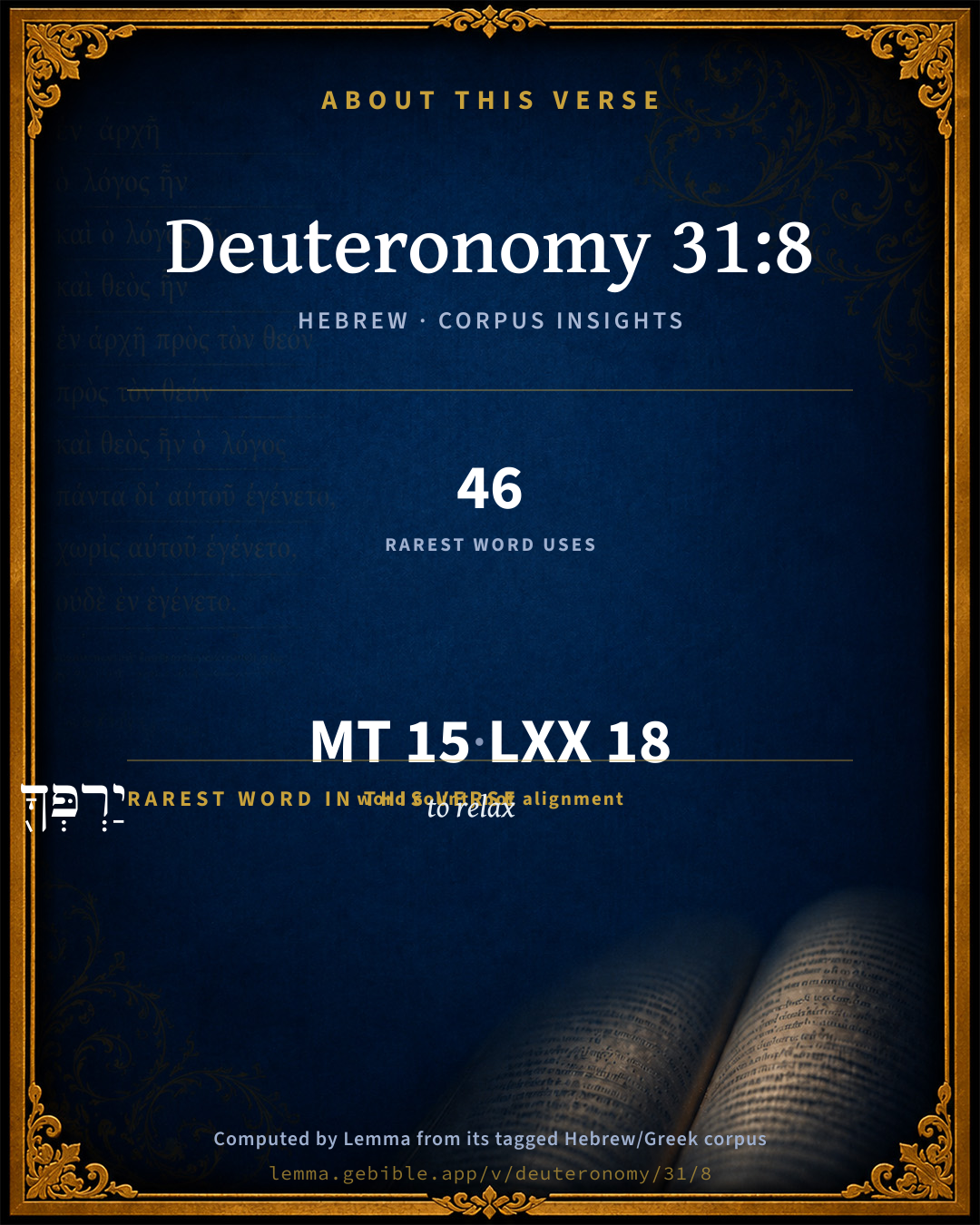
יַרְפְּךָ֖
râphâh
H7503
“to relax · you”
Verb, Hiphil, Imperfect, 3rd Person, Masculine, Singular + Suffix, Personal, 2nd Person, Masculine, Singular
Part of Speech
Verb
Stem
Hiphil
Form
Imperfect
Person
3rd Person
Gender
Masculine
Number
Singular
Full BDB Definition

Origin: a primitive root

TWOT: 2198

to sink, relax, sink down, let drop, be disheartened - (Qal) - to sink down - to sink, drop - to sink, relax, abate - to relax, withdraw - (Niphal) idle (participle) - (Piel) to let drop - (Hiphil) - to let drop, abandon, relax, refrain, forsake - to let go - to refrain, let alone - to be quiet - (Hithpael) to show oneself slack
  1. וַֽיהוָ֞ה Yᵉhôvâh H3068 “and · LORD” Conjunction + Noun, Proper
  2. ה֣וּא hûwʼ H1931 “he” Pronoun, Personal, 3rd Person, Masculine, Singular
  3. הַהֹלֵ֣ךְ hâlak H1980 “the · walking” Particle, Definite Article + Verb, Qal, Participle Active, Masculine, Singular, Absolute
  4. לְפָנֶ֗יךָ pânîym H6440 “to/for · face(s) · your” Preposition + Noun, Common, Both, Plural, Construct + Suffix, Personal, 2nd Person, Masculine, Singular
  5. ה֚וּא hûwʼ H1931 “he” Pronoun, Personal, 3rd Person, Masculine, Singular
  6. יִהְיֶ֣ה hâyâh H1961 “to be” Verb, Qal, Imperfect, 3rd Person, Masculine, Singular
  7. עִמָּ֔ךְ ʻim H5973 “with · you” Preposition + Suffix, Personal, 2nd Person, Feminine, Singular
  8. לֹ֥א lôʼ H3808 “not” Particle, Negative
  9. וְלֹ֣א lôʼ H3808 “and · not” Conjunction + Particle, Negative
  10. יַֽעַזְבֶ֑ךָּ ʻâzab H5800 “to leave · you” Verb, Qal, Imperfect, 3rd Person, Masculine, Singular + Suffix, Personal, 2nd Person, Masculine, Singular
  11. לֹ֥א lôʼ H3808 “not” Particle, Negative
  12. תִירָ֖א yârêʼ H3372 “to fear” Verb, Qal, Imperfect, 2nd Person, Masculine, Singular
  13. וְלֹ֥א lôʼ H3808 “and · not” Conjunction + Particle, Negative
  14. תֵחָֽת châthath H2865 “to be dismayed” Verb, Niphal, Imperfect, 2nd Person, Masculine, Singular

About this verse

These counts appear in no published source. They are computed here, from the morphology-tagged text and Lemma’s own curated glosses. What Lemma adds →

15
words
11
distinct lemmas
Pentateuch
section

Shared distinctive vocabulary

יַרְפְּךָ֖ to relax H7503 occurs in 45 verses of the Hebrew Bible. Also found in:

Grammatical profile

  • 6 verbs
  • 2 nouns
  • 2 pronouns
  • 1 preposition
  • 4 particles

Verb forms

  • הַהֹלֵ֣ךְ Qal · Participle Active
  • יִהְיֶ֣ה Qal · Imperfect
  • יַרְפְּךָ֖ Hiphil · Imperfect
  • יַֽעַזְבֶ֑ךָּ Qal · Imperfect
  • תִירָ֖א Qal · Imperfect
  • תֵחָֽת Niphal · Imperfect

Repetition

Words recur within this verse — often emphatic in Hebrew:

Hebrew & Septuagint length

In English translation the verse runs 28 words from the Hebrew and 19 from the Septuagint (LXX English) — the Septuagint runs noticeably shorter here. See the side-by-side →

A rough comparison of the two English renderings, which tokenize alike — not a word-level alignment.

Word counts can differ between the Hebrew and the Greek without any difference in meaning — e.g. the Hebrew direct-object marker אֵת has no separate Greek word, and Greek often adds the article ὁ.

In the original languages it is 15 Hebrew tokens and 18 Greek tokens — but the two are counted differently (Hebrew bundles its prefixes and suffixes into one token; the Greek is in lemma form), so that isn’t a like-for-like length.

Cross-references

11

Topical passages linked to Deuteronomy 31:8 in the Treasury of Scripture Knowledge — connected by theme and wording, ordered by reader-vote popularity; previews shown in the World English Bible.

  • Exodus 33:14 He said, "My presence will go with you, and I will give you rest."
  • Deuteronomy 31:6 Be strong and of good courage, don't be afraid, nor be scared of them: for Yahweh your God, he it is who does go with you; he will not fail you, nor forsake you.
  • Joshua 1:9 Haven't I commanded you? Be strong and of good courage; don't be afraid, neither be dismayed: for Yahweh your God is with you wherever you go.
  • Romans 8:31 What then shall we say about these things? If God is for us, who can be against us?
  • Joshua 1:5 There shall not any man be able to stand before you all the days of your life. As I was with Moses, so I will be with you; I will not fail you, nor forsake you.
  • Isaiah 43:1–2 But now thus says Yahweh who created you, Jacob, and he who formed you, Israel: Don't be afraid, for I have redeemed you; I have called you by your name, you are mine.
  • Exodus 13:21–22 Yahweh went before them by day in a pillar of cloud, to lead them on their way, and by night in a pillar of fire, to give them light, that they might go by day and by night:
  • Deuteronomy 9:3 Know therefore this day, that Yahweh your God is he who goes over before you as a devouring fire; he will destroy them, and he will bring them down before you: so shall you drive them out, and make them to perish quickly, as Yahweh has spoken to you.
  • 1 Chronicles 28:20 David said to Solomon his son, Be strong and of good courage, and do it: don't be afraid, nor be dismayed; for Yahweh God, even my God, is with you; he will not fail you, nor forsake you, until all the work for the service of the house of Yahweh is finished.
  • Deuteronomy 31:3 Yahweh your God, he will go over before you; he will destroy these nations from before you, and you shall dispossess them: [and] Joshua, he shall go over before you, as Yahweh has spoken.
  • Isaiah 8:9–10 Make an uproar, O you peoples, and be broken in pieces! And give ear, all you of far countries: gird yourselves, and be broken in pieces! Gird yourselves, and be broken in pieces!

Cross-references courtesy of OpenBible.info (CC BY 4.0).

Hebrew and Greek witnesses Masoretic Hebrew ↔ Greek Septuagint

The same verse in the two great witnesses to the Old Testament, shown verse-for-verse.

Here the Septuagint runs noticeably shorter than the Hebrew — LXX2012 (modern English Septuagint) 19 words vs World English Bible 28. A rough length comparison of the two English translations, not a word-level alignment — read both below.

These are two independent witnesses, not word-aligned to each other, and the Septuagint is shown in lemma (dictionary) form.

Hebrew Deuteronomy 31:8 Masoretic · Westminster Leningrad Codex

וַֽיהוָ֞ה ה֣וּא הַהֹלֵ֣ךְ לְפָנֶ֗יךָ ה֚וּא יִהְיֶ֣ה עִמָּ֔ךְ לֹ֥א יַרְפְּךָ֖ וְלֹ֣א יַֽעַזְבֶ֑ךָּ לֹ֥א תִירָ֖א וְלֹ֥א תֵחָֽת

Yahweh, he it is who does go before you; he will be with you, he will not fail you, neither forsake you: don't be afraid, neither be dismayed.

World English Bible · Public Domain

Greek LXX Deuteronomy 31:8 Septuagint · lemma form

καί κύριος ὁ συνπορεύομαι μετά σύ οὐ ἀναἵημι σύ οὐδέ μή ἐν καταλείπω σύ μή φοβέω μηδέ δειλιάω

And the Lord that goes with you shall not forsake you nor abandon you; fear not, neither be afraid.

LXX2012 (modern English Septuagint) · Public Domain

Hebrew: Westminster Leningrad Codex (CC BY 4.0). Greek: Septuagint (public domain); English from LXX2012 (modern English Septuagint) (Public Domain). How the Septuagint differs from the Hebrew →

Targum (Aramaic paraphrase)

2

The Targum is the ancient Jewish Aramaic paraphrase of the Hebrew Scriptures — an interpretive translation, not the Hebrew text itself. Onkelos (literal) and Pseudo-Jonathan (expansive) render the Torah, and Jonathan the Prophets. Coverage is partial: where no permissively-licensed English translation exists for a verse, only the Aramaic is shown. This is verse-level text, not a word-by-word alignment to the Hebrew.

  1. Targum Onkelos Torah (Genesis–Deuteronomy)
    וַיְיָ הוּא דִמְדַבַּר קֳדָמָךְ מֵימְרֵהּ יְהֵי בְסַעְדָךְ לָא יִשְׁבְּקִנָךְ וְלָא יַרְחֵקִנָךְ לָא תִדְחַל וְלָא תִתְּבַר

    (no public-domain English translation for this verse)

    Targum Onkelos — Aramaic: “Onkelos Genesis” (public domain); “Onkelos Exodus” (public domain); “Onkelos Leviticus” (public domain); “Onkelos Numbers” (public domain); “Onkelos Deuteronomy” (public domain). English: “Sefaria Community Translation” (CC0 1.0 (public-domain dedication)); “J.W. Etheridge. The Targums of Onkelos and Jonathan Ben Uzziel on the Pentateuch. London: Longmans, Green, 1862” (public domain). Text via Sefaria.

  2. Targum Pseudo-Jonathan Torah (Genesis–Deuteronomy)
    וּמֵימְרָא דַיְיָ שְׁכִינְתֵּיהּ מִידַבְּרָא קֳדָמָךְ וּמֵימְרֵיהּ יְהֵי בְסַעֲדָךְ לָא יִשְׁבְּקִינָךְ וְלָא יַרְחֲקִינָךְ לָא תִדְחַל וְלָא תִתְיָרַע

    And the Shekinah of the Word of the Lord will go before thee, and His Word will be thy helper; He will not forsake nor be far from thee; fear not, nor be dismayed.

    Targum Pseudo-Jonathan — Aramaic: “Targum Jonathan on Genesis” (public domain); “Targum Jonathan on Exodus” (public domain); “Targum Jonathan on Leviticus” (public domain); “Targum Jonathan on Numbers” (public domain); “Targum Jonathan on Deuteronomy” (public domain). English: “The Targum of Jonathan ben Uzziel, trans. J. W. Etheridge, London, 1862” (public domain). Text via Sefaria.

Commentary

Notes on Deuteronomy 31:8 from classic Christian and Jewish commentators (each source and its license shown beneath its notes). The classic Christian expositions comment on the surrounding passage and are grouped to its opening verse, so a note may address several verses; the Jewish commentaries on the Tanakh (Rashi and others) are per-verse, so they appear only where the commentator wrote on this verse.

Lemma curates 59 commentaries, every one of them public domain or Creative Commons licensed, each selected and text-cleaned for this edition rather than reprinted as found. About our sources →

Trapp's Complete Commentary

John Trapp

Deu 31:8 And the LORD, he [it is] that doth go before thee; he will be with thee, he will not fail thee, neither forsake thee: fear not, neither be dismayed.

Ver. 8. He will not fail thee.] See on Deu 31:6.

John Trapp, A Commentary or Exposition upon All the Books of the Old and New Testament (1647–1656) — public domain. Text from a community e-Sword module.

Geneva Bible (1599)

Geneva Bible translators

Signifying that man can never be of good courage, except he be persuaded of God’s favor and assistance.

Geneva Bible (1599) marginal notes — public domain. Text via Bolls.life.

Adam Clarke's Commentary

Verse 8. The Lord - doth go before thee] To prepare thy way, and to direct thee.

He will be with thee] Accompany thee in all thy journeys, and assist thee in all thy enterprises.

He will not fail thee] Thy expectation, however strong and extensive, shall never be disappointed: thou canst not expect too much from him.

Neither forsake thee] He knows that without him thou canst do nothing, and therefore he will continue with thee, and in such a manner too that the excellence of the power shall appear to be of him, and not of man.

Adam Clarke's Commentary on the Bible (1810–1826) — public domain. Text from a community e-Sword/MySword module.

The Cambridge Bible for Schools and Colleges

gen. ed. J. J. S. Perowne

8. See on Deu_31:6. On the phrase fear not, neither be dismayed, characteristic of the Sg. passages, see on Deu_1:21.

The Cambridge Bible for Schools and Colleges (gen. ed. J. J. S. Perowne; Cambridge University Press, 1878–1918) — public domain. Text from a community e-Sword module.

John Gill's Exposition

And Moses wrote this law,.... The book of Deuteronomy, or the Pentateuch, the five books of Moses, which he had now finished, and which all of them together are sometimes called the law, Gal 4:21,

and delivered it unto the priests, the sons of Levi; who were the teachers of the law, as Aben Ezra observes; see Mal 2:7; and therefore it was proper to put it into their hands, to instruct the people in it, and that the people might apply to them in any matter of difficulty, or when they wanted to have any particular law explained to them:

which bare the ark of the covenant of the Lord; for though they were the Levites, and particularly the Kohathites, who in journeying carried the ark; see Num 4:5; yet sometimes it was borne by the priests; see Jos 3:13,

and unto all the elders of Israel; the judges and civil magistrates in the respective tribes; for as there were in the book of the law several things which belonged to the priests to perform, and all of them they were to instruct in, so there were others which were to be the rule of judgment to judges, and all civil magistrates, and which they were to take care were put in execution; and therefore it was proper that they should have a copy of this law, and which must be here understood; for it cannot be thought that one and the same copy should be given both to the priests and to all the elders. The Jews say Moses wrote thirteen copies of the law, twelve for the twelve tribes, and one to be put into the ark, to convict of fraud or corruption, should any be made (s).

(s) Debarim Rabba, sect. 9. fol. 244. 2.

John Gill's Exposition of the Whole Bible (1746–1763) — public domain (CC PDM 1.0). Text via the HelloAO Bible API.

Lesson kit

Teaching starters — assembled from the data on this page, not authored interpretation. Every prompt links to the verse data it draws on. Edit before teaching.

Deuteronomy, in the Pentateuch, opens this verse with 15 words (11 distinct Hebrew lemmas). Its most distinctive word is râphâh (“to relax”). The Greek Septuagint runs shorter here. A historical commentator’s framing appears above. Read the whole chapter for the surrounding context.

Discussion questions

  1. The word râphâh carries the sense “to relax.” How does it shape the verse?
  2. How does Exodus 4:26, which shares the word «to relax», read alongside this verse?
  3. What does the repetition of “not” (4× in this one verse) do in this verse?
  4. The Septuagint runs shorter here than the Hebrew. What might account for the difference?
  5. The translations on this page render this verse differently — a whole-verse word diff, not a word-by-word alignment. What might account for the different wordings?
  6. «הַהֹלֵ֣ךְ» is a Qal Participle Active verb. How does that grammatical form shape the action described?
  7. Compare how Trapp's Complete Commentary and Geneva Bible (1599) read this verse. Where do they agree or differ?

Things to notice

Reading settings

Reading text

Shown beneath each verse's original-language words.

Old Testament
Old Testament edition

Read the OT as the Masoretic Hebrew (MT) or the Greek Septuagint (LXX).

English shown for the Greek Septuagint (in the Hebrew ↔ Greek comparison).

Comparing translations? Open the Compare panel on any verse page to stack up to four side by side.