
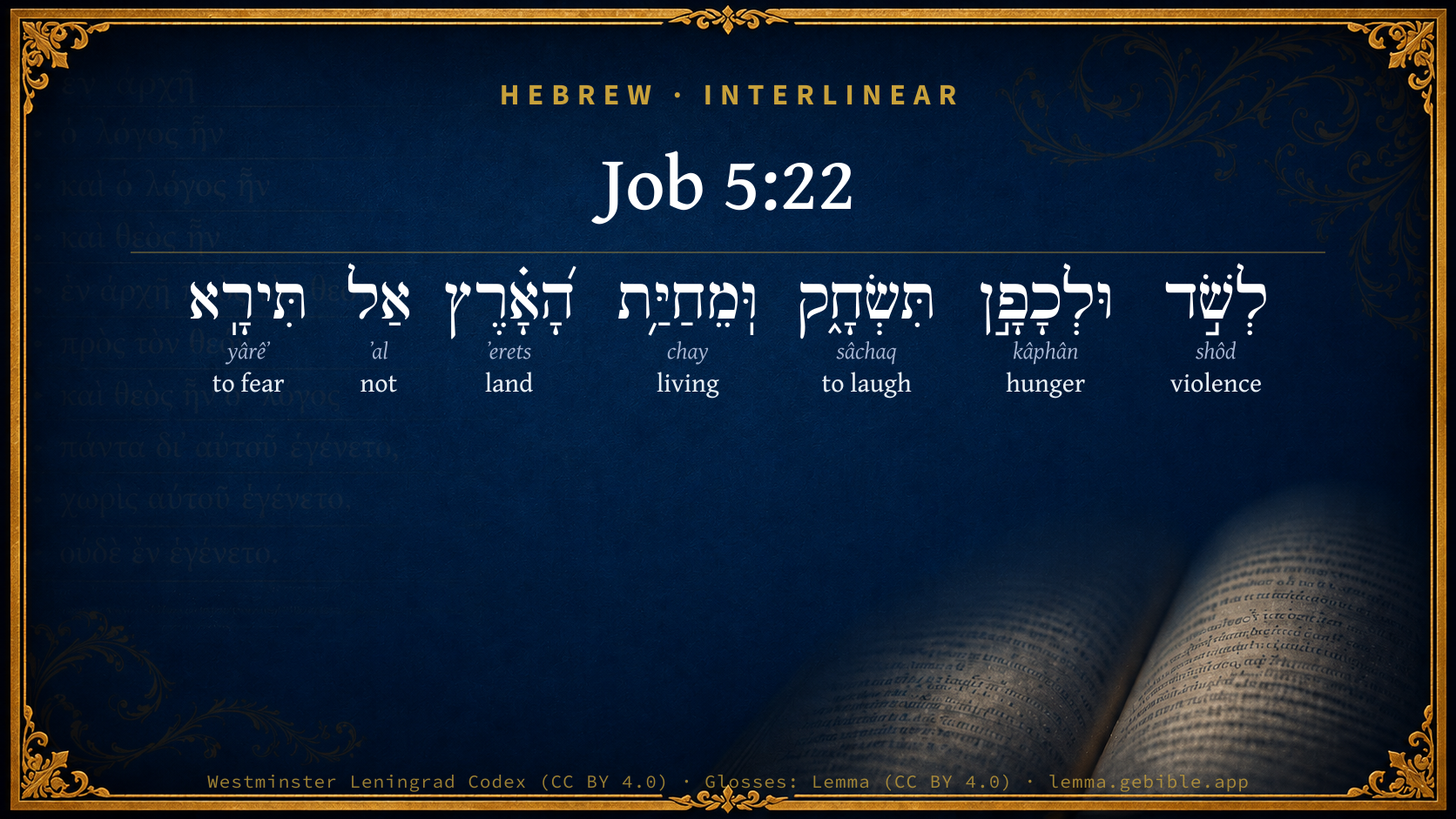
Job 5:22

Hebrew (Westminster Leningrad Codex) Job 5:22 appears in the Hebrew Old Testament. The text above is from the Westminster Leningrad Codex. Each word links to its Strong’s number, a concise gloss, and parsing drawn from the Open Scriptures Hebrew Bible morphology. Click any word for its full Brown-Driver-Briggs (BDB) entry.
Download image
Cite this verse

Job 5:22 (World English Bible). Public Domain. Lemma interlinear Bible study tool, https://lemma.gebible.app/v/job/5/22.

Show BibTeX & RIS
BibTeX
RIS
English Translation
At destruction and famine you shall laugh, Neither shall you be afraid of the animals of the earth.
World English Bible · Public Domain
Highlights
  • 1 first appearance in the Hebrew Bible
Full analysis ↓
Download a study sheet

One document with this verse’s original text, its word-by-word gloss line, the meaning frame, cross-references with their text, attributed commentary, and full source and license credits — printable, and it pastes into notes with its structure intact.

This verse Autodidact and up

Study sheet (.html) Plain text (.txt)

A passage Seminary Student

Up to 50 verses in one chapter. A passage sheet keeps up to 6 commentary sources and 12 cross-references per verse, in the order this page ranks them, and says so on the sheet whenever that leaves anything out. Ask for a single verse and you get the Autodidact verse sheet above.

Everything on this page stays free to read, with no account — the sheet is a download of what is already on screen, not access to it.

Want to remove ads? Support Godless Engineer
Compare translations 3

The same verse in 3 English versions, stacked beneath the original-language interlinear above. Click any original word for its lexicon entry.

Each is an independent rendering of the whole verse — the interlinear is not word-aligned to these translations.

Highlighted words mark where these versions differ — a whole-verse word diff, not a word-by-word alignment.

  • World English Bible Public Domain
    At destruction and famine you shall laugh, Neither shall you be afraid of the animals of the earth.
  • King James Version Public Domain
    At destruction and famine thou shalt laugh: neither shalt thou be afraid of the beasts of the earth.
  • unfoldingWord Literal Text CC BY-SA 4.0
    You will laugh at destruction and at famine, and you will not fear the beast of the earth.

unfoldingWord Literal Text — © unfoldingWord, licensed CC BY-SA 4.0. Word-aligned USFM3 via Door43 (git.door43.org/unfoldingWord/en_ult).

Versions to compare (up to 4)

3 of 4 selected

Show all 18 translations

Every available English version of this verse, each an independent rendering of the whole verse.

  • World English Bible Public Domain
    At destruction and famine you shall laugh, Neither shall you be afraid of the animals of the earth.
  • Berean Standard Bible Public Domain
    You will laugh at destruction and famine, and need not fear the beasts of the earth.
  • Majority Standard Bible Public Domain
    You will laugh at destruction and famine, and need not fear the beasts of the earth.
  • King James Version Public Domain
    At destruction and famine thou shalt laugh: neither shalt thou be afraid of the beasts of the earth.
  • American Standard Version (1901) Public Domain
    At destruction and dearth thou shalt laugh; Neither shalt thou be afraid of the beasts of the earth.
  • Revised Version (1885) Public Domain
    At destruction and dearth thou shalt laugh; neither shalt thou be afraid of the beasts of the earth.
  • Geneva Bible (1599) Public Domain
    But thou shalt laugh at destruction and dearth, and shalt not be afraide of the beast of the earth.
  • Douay-Rheims (1899) Public Domain
    In destruction and famine then shalt laugh: and thou shalt not be afraid of the beasts of the earth.
  • Young's Literal Translation Public Domain
    At destruction and at hunger thou mockest, And of the beast of the earth, Thou art not afraid.
  • Literal Standard Version CC BY-SA 4.0
    At destruction and at hunger you mock, || And of the beast of the earth, || You are not afraid.
  • Unlocked Literal Bible CC BY-SA 4.0
    You will laugh at destruction and famine, and you will not be afraid of beasts of the earth.
  • unfoldingWord Literal Text CC BY-SA 4.0
    You will laugh at destruction and at famine, and you will not fear the beast of the earth.
  • Darby Bible Public Domain
    At destruction and famine thou shalt laugh, and of the beasts of the earth thou shalt not be afraid.
  • World Messianic Bible Public Domain
    You will laugh at destruction and famine, neither will you be afraid of the animals of the earth.
  • Webster's Bible Public Domain
    At destruction and famine thou shalt laugh: neither shalt thou be afraid of the beasts of the earth.
  • Free Bible Version CC BY-SA 4.0
    You will laugh at violence and famine; you won't be afraid of wild animals—
  • Bible in Basic English Public Domain
    You will make sport of destruction and need, and will have no fear of the beasts of the earth.
  • JPS Tanakh (1917) Public Domain
    At destruction and famine thou shalt laugh; neither shalt thou be afraid of the beasts of the earth.

Literal Standard Version (2020), Covenant Press — licensed CC BY-SA 4.0. Text via the HelloAO Bible API (eBible.org). Unlocked Literal Bible (unfoldingWord) — licensed CC BY-SA 4.0. Text via the HelloAO Bible API (eBible.org). unfoldingWord Literal Text — © unfoldingWord, licensed CC BY-SA 4.0. Word-aligned USFM3 via Door43 (git.door43.org/unfoldingWord/en_ult). Free Bible Version, Dr. Jonathan Gallagher — licensed CC BY-SA 4.0. Text via the HelloAO Bible API (eBible.org).

Word by word

More ways to search: Search by grammar → Find every occurrence → Compare this word →

Practice this passage: Drill this verse → Learn its vocabulary →

About this verse

These counts appear in no published source. They are computed here, from the morphology-tagged text and Lemma’s own curated glosses. What Lemma adds →

7
words
7
distinct lemmas
Wisdom
section

Notable vocabulary

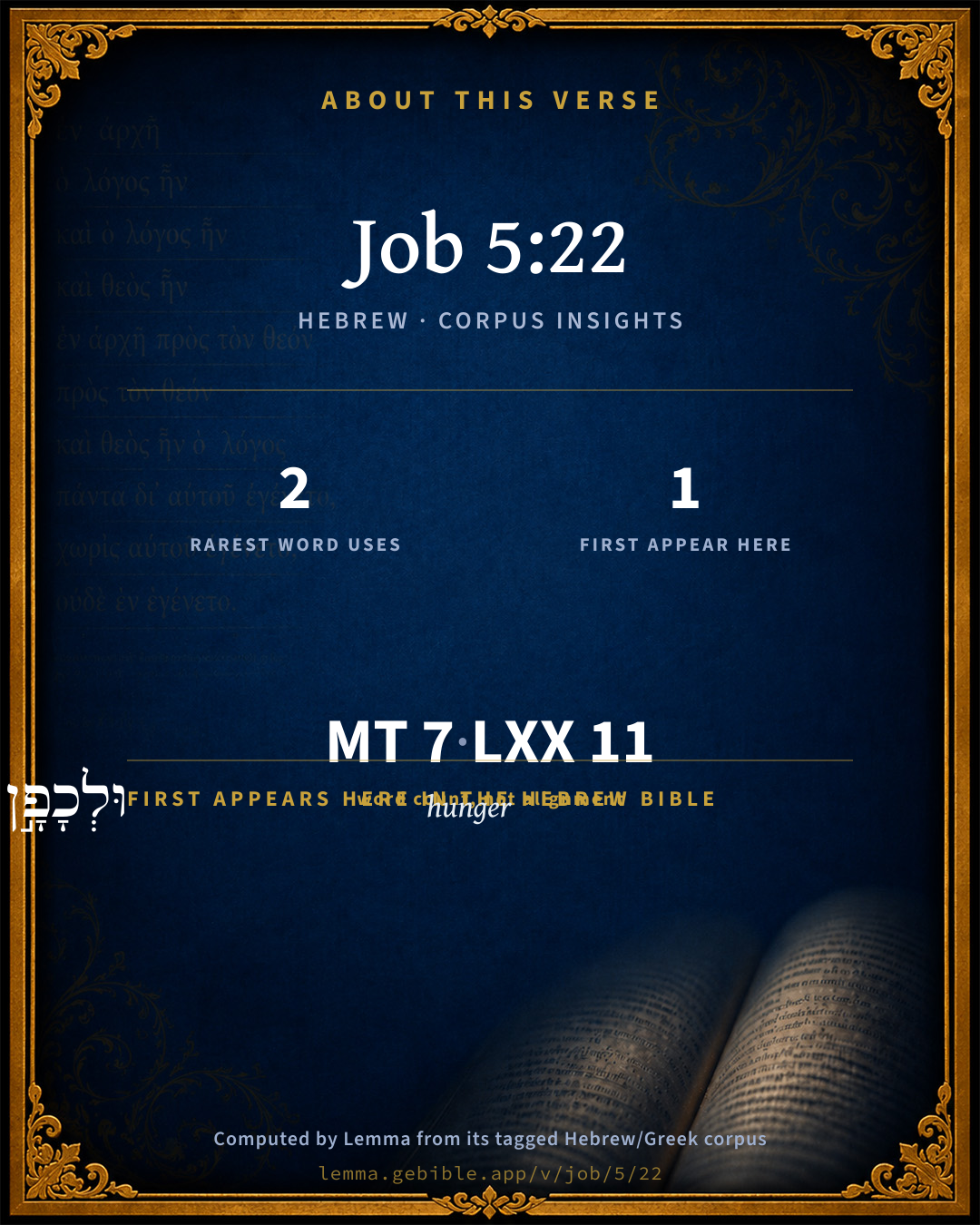
The rarest word here is וּלְכָפָ֣ן hunger H3720 — appearing just 2 times in the whole Hebrew Bible.

First appearance in Scripture

This word makes its first canonical appearance in the Hebrew Bible here:

  • וּלְכָפָ֣ן hunger H3720

Shared distinctive vocabulary

וּלְכָפָ֣ן hunger H3720 occurs in 2 verses of the Hebrew Bible. Also found in:

Grammatical profile

  • 2 verbs
  • 4 nouns
  • 1 particle

Verb forms

  • תִּשְׂחָ֑ק Qal · Imperfect
  • תִּירָֽא Qal · Jussive

Hebrew & Septuagint length

In English translation the verse runs 18 words from the Hebrew and 18 from the Septuagint (LXX English) — the same length.

A rough comparison of the two English renderings, which tokenize alike — not a word-level alignment.

Word counts can differ between the Hebrew and the Greek without any difference in meaning — e.g. the Hebrew direct-object marker אֵת has no separate Greek word, and Greek often adds the article ὁ.

In the original languages it is 7 Hebrew tokens and 11 Greek tokens — but the two are counted differently (Hebrew bundles its prefixes and suffixes into one token; the Greek is in lemma form), so that isn’t a like-for-like length.

Cross-references

5

Topical passages linked to Job 5:22 in the Treasury of Scripture Knowledge — connected by theme and wording, ordered by reader-vote popularity; previews shown in the World English Bible.

  • Ezekiel 34:25 I will make with them a covenant of peace, and will cause evil animals to cease out of the land; and they shall dwell securely in the wilderness, and sleep in the woods.
  • Isaiah 35:9 No lion shall be there, nor shall any ravenous animal go up thereon; they shall not be found there; but the redeemed shall walk [there]:
  • Psalms 91:13 You will tread on the lion and cobra. You will trample the young lion and the serpent underfoot.
  • Hosea 2:18 In that day I will make a covenant for them with the animals of the field, And with the birds of the sky, And with the creeping things of the ground. I will break the bow, the sword, and the battle out of the land, And will make them lie down safely.
  • Isaiah 65:25 The wolf and the lamb shall feed together, and the lion shall eat straw like the ox; and dust shall be the serpent's food. They shall not hurt nor destroy in all my holy mountain, says Yahweh.

Cross-references courtesy of OpenBible.info (CC BY 4.0).

Hebrew and Greek witnesses Masoretic Hebrew ↔ Greek Septuagint

The same verse in the two great witnesses to the Old Testament, shown verse-for-verse.

These are two independent witnesses, not word-aligned to each other, and the Septuagint is shown in lemma (dictionary) form.

Hebrew Job 5:22 Masoretic · Westminster Leningrad Codex

לְשֹׁ֣ד וּלְכָפָ֣ן תִּשְׂחָ֑ק וּֽמֵחַיַּ֥ת הָ֝אָ֗רֶץ אַל תִּירָֽא

At destruction and famine you shall laugh, Neither shall you be afraid of the animals of the earth.

World English Bible · Public Domain

Greek LXX Job 5:22 Septuagint · lemma form

ἄδικος καί ἄνομος καταγελάω ἀπό δέ θηρίον ἄγριος οὐ μή φοβέω

You shall laugh at the unrighteous and the lawless: and you shall not be afraid of wild beasts.

LXX2012 (modern English Septuagint) · Public Domain

Hebrew: Westminster Leningrad Codex (CC BY 4.0). Greek: Septuagint (public domain); English from LXX2012 (modern English Septuagint) (Public Domain). How the Septuagint differs from the Hebrew →

Commentary

Notes on Job 5:22 from classic Christian and Jewish commentators (each source and its license shown beneath its notes). The classic Christian expositions comment on the surrounding passage and are grouped to its opening verse, so a note may address several verses; the Jewish commentaries on the Tanakh (Rashi and others) are per-verse, so they appear only where the commentator wrote on this verse.

Lemma curates 59 commentaries, every one of them public domain or Creative Commons licensed, each selected and text-cleaned for this edition rather than reprinted as found. About our sources →

Trapp's Complete Commentary

John Trapp

Job 5:22 At destruction and famine thou shalt laugh: neither shalt thou be afraid of the beasts of the earth.

Ver. 22. At destruction and famine thou shalt laugh] viz. By the force of thy faith, which (like perfect love) casteth out sinful fear; as grounding upon God’s infallible promises, and knowing that all the paths of the Lord are mercy and truth unto such as keep his covenant and his testimonies, Psa 25:10. All the passages of his providence are to such not only mercy, but truth; they come to them in a way of a promise, as bound to them by covenant; and hence their holy courage lifteth them up so far above dangers and fears, that they even laugh at them, as Leviathan laugheth at the shaking of the spear, Job 41:29. They famish famine, and destroy destruction itself; like as Christ Jesus, the Captain of their salvation, swallowed up death in victory; and as many of the martyrs baffled it, deriding their tormentors.

Neither shall thou be afraid of the beasts of the earth] i.e. Wild beasts, that devour men and cattle, as lions, bears, boars, wolves, &c., whereunto we may add those cannibals, man-eating persecutors, who eat up God’s people as they eat bread, Psa 14:4. Such lycanthropi, or beasts in the shape of men, Paul fought with at Ephesus, and God had delivered him out of the mouth of that lion Nero, 2Ti 4:17, who yet afterwards martyred him. But the viper at Malta did him no harm; no more did the lions Daniel; neither would they meddle with some of the primitive martyrs, cast before them to be devoured.

John Trapp, A Commentary or Exposition upon All the Books of the Old and New Testament (1647–1656) — public domain. Text from a community e-Sword module.

Whedon's Commentary on the Bible

Daniel D. Whedon

Second strophe — The blessings that shall crown the life of such a favourite of heaven, Job_5:22-26.

22. Thou shalt laugh — The man of God, secure in his tower of faith, looks down upon the most formidable evils, and, in the bold imagery of the East, laughs at them. He thus expresses his sense of superiority; an idea that Hobbes has embodied in his theory of laughter.

Daniel D. Whedon (gen. ed.), Commentary on the Old and New Testaments (1874–1909) — public domain. Text from a community e-Sword module.

Keil & Delitzsch

C. F. Keil & F. Delitzsch

22 At destruction and famine thou shalt laugh,

And from the beasts of the earth thou hast nothing to fear.

23 For thou art in league with the stones of the field,

And the beasts of the field are at peace with thee.

24 And thou knowest that peace is thy pavilion;

And thou searchest thy household, and findest nothing wanting.

25 Thou knowest also that thy seed shall be numerous,

And thy offspring as the herb of the ground.

26 Thou shalt come to thy grave in a ripe age,

As shocks of corn are brought in in their season.

27 Lo! this we have searched out, so it is:

Hear it, and give thou heed to it.

The verb שׂחק is construed (Job 5:22) with ל of that which is despised, as Job 39:7, Job 39:18; Job 41:21 [Hebr.]. על־תּירא is the form of subjective negation [vid. Ges. 152, 1: Tr.]: only fear thou not = thou hast no occasion. In Job 5:23, בּריתך is the shortest substantive form for לך בּרית. The whole of nature will be at peace with thee: the stones of the field, that they do not injure the fertility of thy fields; the wild beasts of the field, that they do not hurt thee and thy herds. The same promise that Hosea (Hos 2:20) utters in reference to the last days is here used individually. From this we see how deeply the Chokma had searched into the history of Paradise and the Fall. Since man, the appointed lord of the earth, has been tempted by a reptile, and has fallen by a tree, his relation to nature, and its relation to him, has been reversed: it is an incongruity, which is again as a whole put right (שׁלום), as the false relation of man to God is put right. In Job 5:24, שׁלום (which might also be adj.) is predicate: thou wilt learn (וידעתּ, praet. consec. with accented ultima, as e.g., Deu 4:39, here with Tiphcha initiale s. anterius, which does not indicate the grammatical tone-syllable) that thy tent is peace, i.e., in a condition of contentment and peace on all sides. Job 5:24 is to be arranged: And when thou examinest thy household, then thou lackest nothing, goest not astray, i.e., thou findest everything, without missing anything, in the place where thou seekest it.

Job 5:25 reminds one of the Salomonic Psa 72:16. צאצאים in the Old Testament is found only in Isaiah and the book of Job. The meaning of the noun כּלח, which occurs only here and Job 30:2, is clear. Referring to the verb כּלח, Arabic qahila (qalhama), to be shrivelled up, very aged, it signifies the maturity of old age, - an idea which may be gained more easily if we connect כּלח with כּלה (to be completed), like קשׁח with קשׁה (to be hard).

(Note: We may also compare the Arabic khl (from which comes cuhulije, mature manhood, opp. tufulije, tender childhood).)

In the parallel there is the time of the sheaves, when they are brought up to the high threshing-floor, the latest period of harvest. עלה, of the raising of the sheaves to the threshing-floor, as elsewhere of the raising, i.e., the bringing up of the animals to the altar. גּדישׁ is here a heap of sheaves, Arab. kuds, as Job 21:32 a sepulchral heap, Arab. jadat, distinct from אלמּה, a bundle, a single sheaf.

The speech of Eliphaz, which we have broken up into nine strophes, is now ended. Eliphaz concludes it by an epimythionic distich, Job 5:27, with an emphatic nota bene. He speaks at the same time in the name of his companions. These are principles well proved by experience with which he confronts Job. Job needs to lay them to heart: tu scito tibi.

All that Eliphaz says, considered in itself, is blameless. He censures Job's vehemence, which was certainly not to be approved. He says that the destroying judgment of God never touches the innocent, but certainly the wicked; and at the same time expresses the same truth as that placed as a motto to the Psalter in Psa 1:1-6, and which is even brilliantly confirmed in the issue of the history of Job. When we find Isa 57:1, comp. Psa 12:2, in apparent opposition to this, אבד הצּדּיק, it is not meant that the judgment of destruction comes upon the righteous, but that his generation experiences the judgment of his loss (aetati suae perit). And these are eternal truths, that between the Creator and creature, even an angel, there remains an infinite distance, and that no creature possesses a righteousness which it can maintain before God. Not less true is it, that with God murmuring is death, and that it is appointed to sinful man to pass through sorrow. Moreover, the counsel of Eliphaz is the right counsel: I would turn to God, etc. His beautiful concluding exhortation, so rich in promises, crowns his speech.

It has been observed (e.g., by Lwenthal), that if it is allowed that Eliphaz (Job 5:17.) expresses a salutary spiritual design of affliction, all coherence in the book is from the first destroyed. But in reality it is an effect producing not only outward happiness, but also an inward holiness, which Eliphaz ascribes to sorrow. It is therefore to be asked, how it consists with the plan of the book. There is no doctrinal error to be discovered in the speech of Eliphaz, and yet he cannot be considered as a representative of the complete truth of Scripture. Job ought to humble himself under this; but since he does not, we must side with Eliphaz.

He does not represent the complete truth of Scripture: for there are, according to Scripture, three kinds of sufferings, which must be carefully distinguished.

(Note: Our old dogmatists (vid., e.g., Baier, Compendium Theologiae positivae, ii. 1, 15) and pastoral theologians (e.g., Danhauer) consider them as separate. Among the oldest expositors of the book of Job with which I am acquainted, Olympiodorus is comparatively the best.)

The godless one, who has fallen away from God, is visited with suffering from God; for sin and the punishment of sin (comprehended even in the language in עון and חטּאת) are necessarily connected as cause and effect. This suffering of the godless is the effect of the divine justice in punishment; it is chastisement (מוּסר) under the disposition of wrath (Psa 6:2; Psa 38:2; Jer 10:24.), though not yet final wrath; it is punitive suffering (נקם, נגע, τιμωρία, poena). On the other hand, the sufferings of the righteous flow from the divine love, to which even all that has the appearance of wrath in this suffering must be subservient, as the means only by which it operates: for although the righteous man is not excepted from the weakness and sinfulness of the human race, he can never become an object of the divine wrath, so long as his inner life is directed towards God, and his outward life is governed by the most earnest striving after sanctification. According to the Old and New Testaments, he stands towards God in the relation of a child to his father (only the New Testament idea includes the mystery of the new birth not revealed in the Old Testament); and consequently all sufferings are fatherly chastisements, Deu 8:5; Pro 3:12; Heb 12:6, Rev 3:19, comp. Tob. 12:13 (Vulg.). But this general distinction between the sufferings of the righteous and of the ungodly is not sufficient for the book of Job. The sufferings of the righteous even are themselves manifold. God sends affliction to them more and more to purge away the sin which still has power over them, and rouse them up from the danger of carnal security; to maintain in them the consciousness of sin as well as of grace, and with it the lowliness of penitence; to render the world and its pleasures bitter as gall to them; to draw them from the creature, and bind them to himself by prayer and devotion. This suffering, which has the sin of the godly as its cause, has, however, not God's wrath, but God's love directed towards the preservation and advancement of the godly, as its motive: it is the proper disciplinary suffering (מוּסר or תּוכחת, Pro 3:11; παιδεία, Heb 12). It is this of which Paul speaks, Co1 11:32. This disciplinary suffering may attain such a high degree as entirely to overwhelm the consciousness of the relation to God by grace; and the sufferer, as frequently in the Psalms, considers himself as one rejected of God, over whom the wrath of God is passing. The deeper the sufferer's consciousness of sin, the more dejected is his mood of sorrow; and still God's thoughts concerning him are thoughts of peace, and not of evil (Jer 29:11). He chastens, not however in wrath, but בּמשׁפּט, with moderation (Jer 10:24).

Nearly allied to this suffering, but yet, as to its cause and purpose, distinct, is another kind of the suffering of the godly. God ordains suffering for them, in order to prove their fidelity to himself, and their earnestness after sanctification, especially their trust in God, and their patience. He also permits Satan, who impeaches them, to tempt them, to sift them as wheat, in order that he may be confounded, and the divine choice justified, - in order that it may be manifest that neither death, nor life, nor angels, nor principalities, nor powers, are able to separate them from the love of God, and to tear away their faith (אמונה) from God, which has remained stedfast on Him, notwithstanding every apparent manifestation of wrath. The godly will recognise his affliction as such suffering when it comes upon him in the very midst of his fellowship with God, his prayer and watching, and his struggling after sanctification. For this kind of suffering - trial - Scripture employs the expressions נסּה (Deu 8:2, Deu 8:16) and בּחן (Pro 17:3), πειρασμός (Jam 1:12; Pe1 1:6., Job 4:19; comp. Sir. 2:1ff.). Such suffering, according to a common figure, is for the godly what the smelting-furnace or the fining-pot is to precious metals. A rich reward awaits him who is found proof against the trial, temptation, and conflict, and comes forth from it as pure, refined gold. Suffering for trial is nearly allied to that for chastisement, in so far as the chastisement is at the same time trial; but distinct from it, in so far as every trial is not also chastisement (i.e., having as its purpose the purging away of still existing sin).

A third kind of the suffering of the righteous is testimony borne by suffering, - reproach, persecution, and perhaps even martyrdom, which are endured for the sake of fidelity to God and His word. While he is blessed who is found proof against trial, he is blessed in himself who endures this suffering (Mat 5:11., and other passages); for every other suffering comes upon man for his own sake, this for God's. In this case there is not even the remotest connection between the suffering and the sinfulness of the sufferer. Ps 44 is a prayer of Israel in the midst of this form of suffering. Σταυρός is the name expressly used for it in the New Testament - suffering for the kingdom of heaven's sake.

Without a knowledge of these different kinds of human suffering, the book of Job cannot be understood. "Whoever sees with spiritual eyes," says Brentius, "does not judge the moral character of a man by his suffering, but his suffering by his moral character." Just the want of this spiritual discernment and inability to distinguish the different kinds of suffering is the mistake of the friends, and likewise, from the very first, the mistake of Eliphaz. Convinced of the sincere piety of his friend, he came to Job believing that his suffering was a salutary chastisement of God, which would at last turn out for his good. Proceeding upon this assumption, he blames Job for his murmuring, and bids him receive his affliction with a recognition of human sinfulness and the divine purpose for good. Thus the controversy begins. The causal connection with sin, in which Eliphaz places Job's suffering, is after all the mildest. He does not go further than to remind Job that he is a sinner, because he is a man.

But even this causal connection, in which Eliphaz connects Job's sufferings, though in the most moderate way, with previous sin deserving of punishment, is his πρώτον ψεῦδος. In the next place, Job's suffering is indeed not chastisement, but trial. Jehovah has decreed it for His servant, not to chasten him, but to prove him. This it is that Eliphaz mistakes; and we also should not know it but for the prologue and the corresponding epilogue. Accordingly, the prologue and epilogue are organic parts of the form of the book. If these are removed, its spirit is destroyed.

But the speech of Eliphaz, moreover, beautiful and true as it is, when considered in itself, is nevertheless heartless, haughty, stiff, and cold. For (1.) it does not contain a word of sympathy, and yet the suffering which he beholds is so terribly great: his first word to his friend after the seven days of painful silence is not one of comfort, but of moralizing. (2.) He must know that Job's disease is not the first and only suffering which has come upon him, and that he has endured his previous afflictions with heroic submission; but he ignores this, and acts as though sorrow were now first come upon Job. (3.) Instead of recognising therein the reason of Job's despondency, that he thinks that he has fallen from the love of God, and become an object of wrath, he treats him as self-righteous;

(Note: Oetinger: "Eliphaz mentioned the oracle to affect seriously the hidden hypocrisy of Job's heart.")

and to excite his feelings, presents an oracle to him, which contains nothing but what Job might sincerely admit as true. (4.) Instead of considering that Job's despair and murmuring against God is really of a different kind from that of the godless, he classes them together, and instead of gently correcting him, present to Job the accursed end of the fool, who also murmurs against God, as he has himself seen it. Thus, in consequence of the false application which Eliphaz makes of it, the truth contained in his speech is totally reversed. Thus delicately and profoundly commences the dramatical entanglement. The skill of the poet is proved by the difficulty which the expositor has in detecting that which is false in the speech of Eliphaz. The idea of the book does not float on the surface. It is clothed with flesh and blood. It is submerged in the very action and history.

Keil & Delitzsch — Biblical Commentary on the Old Testament (1861–1891) — public domain (CC PDM 1.0). Text via the HelloAO Bible API. (Old Testament only.)

Geneva Bible (1599)

Geneva Bible translators

Whereas the wicked lament in their troubles, thou shalt have occasion to rejoice.

Geneva Bible (1599) marginal notes — public domain. Text via Bolls.life.

Jamieson, Fausset & Brown

Robert Jamieson, A. R. Fausset & David Brown

famine thou shalt laugh--Not, in spite of destruction and famine, which is true (Hab 3:17-18), though not the truth meant by Eliphaz, but because those calamities shall not come upon thee. A different Hebrew word from that in Job 5:20; there, famine in general; here, the languid state of those wanting proper nutriment [BARNES].

Jamieson, Fausset & Brown — Commentary Critical and Explanatory on the Whole Bible (1871) — public domain (CC PDM 1.0). Text via the HelloAO Bible API.

Adam Clarke's Commentary

Verse 22. At destruction and famine thou shalt laugh] This most forcibly expresses the strongest security, and confidence in that security. "In the desolation of Sihon, and in the famine of the desert, thou shalt laugh; and of the camps of Og, who is compared to a wild beast of the earth, thou shalt not be afraid." - Targum.

Adam Clarke's Commentary on the Bible (1810–1826) — public domain. Text from a community e-Sword/MySword module.

Ellicott's Commentary for English Readers

(22) Neither shalt thou be afraid of the beasts of the earth.—Literally, and of the beasts of the earth be not thou afraid.

A Bible Commentary for English Readers, edited by Charles John Ellicott (1878–1897) — public domain. Text from a community e-Sword module.

John Gill's Exposition

At destruction and famine thou shalt laugh,.... Not deride and despise them, and make a jest of them; for good men have a reverence and awe of the righteous judgments of God upon them, when they are in the world, Psa 119:120; but the sense is, that such shall reckon themselves safe and secure amidst such calamities, provision being made for their protection and sustenance; and be cheerful and comfortable, putting their trust and confidence in the Lord, as Habakkuk was, in a time of great distress, when all the necessaries of life were cut off from the stall, the herds, the flocks, and the fields; Hab 3:17; just as a man that is in a good harbour, or has a good house over his head, laughs at blustering storms and winds (h), or thinks himself secure, and so is cheerful and pleasant amidst all the noise that is about him, see Hab 1:10,

neither shalt thou be afraid of the beasts of the earth; either, literally taken, beasts of prey, that wander about in the earth, noisome and pernicious ones; which are one of God's sore judgments which he threatens the disobedient with, and promises the obedient he will rid them of; and therefore they have no reason to be afraid of them, see Eze 14:21; some think serpents are particularly designed, which creep upon the earth, and whose, food is the dust of the earth, with all other poisonous animals, between which and men there is an antipathy; and yet good men need not be afraid of these; see Mar 16:18; or figuratively, cruel and barbarous men, thieves and robbers, as Jarchi; or rather fierce and furious persecutors, and particularly the beasts of Rome, Pagan and Papal; though the literal sense is to be preferred; the Targum interprets this of the camp of Og, comparable to the beasts of the earth.

(h) "Ridebis ventos hoc munere teetus et imbres", Martial.

John Gill's Exposition of the Whole Bible (1746–1763) — public domain (CC PDM 1.0). Text via the HelloAO Bible API.

Albert Barnes' Notes on the Bible

At destruction and famine thou shalt laugh - That is thou shalt be perfectly safe and happy. They shall not come upon thee; and when they approach with threatening aspect, thou shalt smile with conscious security. The word here rendered famine (כפן kâphân) is an unusual word, and differs from that occurring in Job 5:20, רעב râ‛âb. This word is derived from כפן kâphan - to languish, to pine from hunger and thirst. It then means the languid and feeble state which exists where there is a lack of proper nutriment. A sentiment similar to that which is here expressed occurs in Martial, iv. 19, 4. Ridebis ventos line munere tectus, et imbres. “Neither shalt thou be afraid of the beasts of the earth.” Wild beasts in new countries are always objects of dread, and in the fastnesses and deserts of Arabia, they were especially so. They abounded there; and one of the highest images of happiness there would be, that there would be perfect safety from them. A similar promise occurs in Psa 91:13 :

Thou shalt tread upon the lion and adder;

The young lion and the dragon shalt thou trample under foot.

And a promise similar to this was made by the Savior to his disciples: “They shall take up serpents; and if they drink any deadly thing, it shall not hurt them.” The sentiment of Eliphaz is, that they who put their trust in God would find protection, and have the consciousness that they were secure wherever they were.

Albert Barnes' Notes on the Bible (1834–1885) — public domain. Text from a community e-Sword/MySword module.

Matthew Poole's English Annotations

Thou shalt not only be redeemed from famine, Job 5:20, and not fear destruction, Job 5:21, but thou shalt laugh at them; not with a laughter of scorn and contempt, as this word is used, Job 39:18; Psa 2:4; 37:13; (for God’s judgments are to be entertained with reverence and godly fear;) but with a laughter of joy and triumph, arising from his just security and confidence in God’s watchful and gracious providence, which will either keep him from it or in it, or do him much good by it.

The beasts, i.e. the wild beasts, which were numerous and mischievous in those parts. See Deu 28:26; 1Sa 17:34; Jer 7:33.

Matthew Poole's English Annotations on the Holy Bible (1683–1685) — public domain. Text from a community e-Sword/MySword module.

The Pulpit Commentary

At destruction (rather, devas tation) and famine; rather, dearth. The word is not the same as that used in ver. 20, but a weaker cue.

Thou shalt laugh; "Thou shalt smile" (Lee). Neither shalt thou be afraid of the beasts of the earth. "The beasts of the earthi.e. destructive and ferocious wild beasts, like the Indian "man-eaters are enumerated among God"s "four sore plagues". (Eze_14:21; comp. 2Ki_17:25) In ancient times they were sometimes so numerous in a country that men were afraid to occupy it.

The Pulpit Commentary (1880–1919), ed. H.D.M. Spence-Jones & Joseph S. Exell — public domain. Text from a community e-Sword module.

John Wesley's Explanatory Notes

Laugh - With a laughter of joy and triumph, arising from a just security and confidence in God's watchful and gracious providence.

John Wesley, Explanatory Notes Upon the Whole Bible (1754–1765) — public domain. Text via the GEBible commentary corpus.

Lesson kit

Teaching starters — assembled from the data on this page, not authored interpretation. Every prompt links to the verse data it draws on. Edit before teaching.

Job, in the Wisdom, opens this verse with 7 words (7 distinct Hebrew lemmas). Its most distinctive word is kâphân (“hunger”). A historical commentator’s framing appears above. Read the whole chapter for the surrounding context.

Discussion questions

  1. The word kâphân carries the sense “hunger.” How does it shape the verse?
  2. The word “hunger” first appears here in Scripture. What is being introduced at this debut?
  3. Job 30:3 shares the word «hunger» with this verse. How do the two illuminate each other?
  4. The translations on this page render this verse differently — a whole-verse word diff, not a word-by-word alignment. What might account for the different wordings?
  5. The verb «תִּשְׂחָ֑ק» is Qal Imperfect. How does its form color the action?
  6. Reading how Trapp's Complete Commentary and Whedon's Commentary on the Bible read this verse, where do the two commentators agree and where do they part?

Things to notice

Reading settings

Reading text

Shown beneath each verse's original-language words.

Old Testament
Old Testament edition

Read the OT as the Masoretic Hebrew (MT) or the Greek Septuagint (LXX).

English shown for the Greek Septuagint (in the Hebrew ↔ Greek comparison).

Comparing translations? Open the Compare panel on any verse page to stack up to four side by side.