
Joshua 10:2

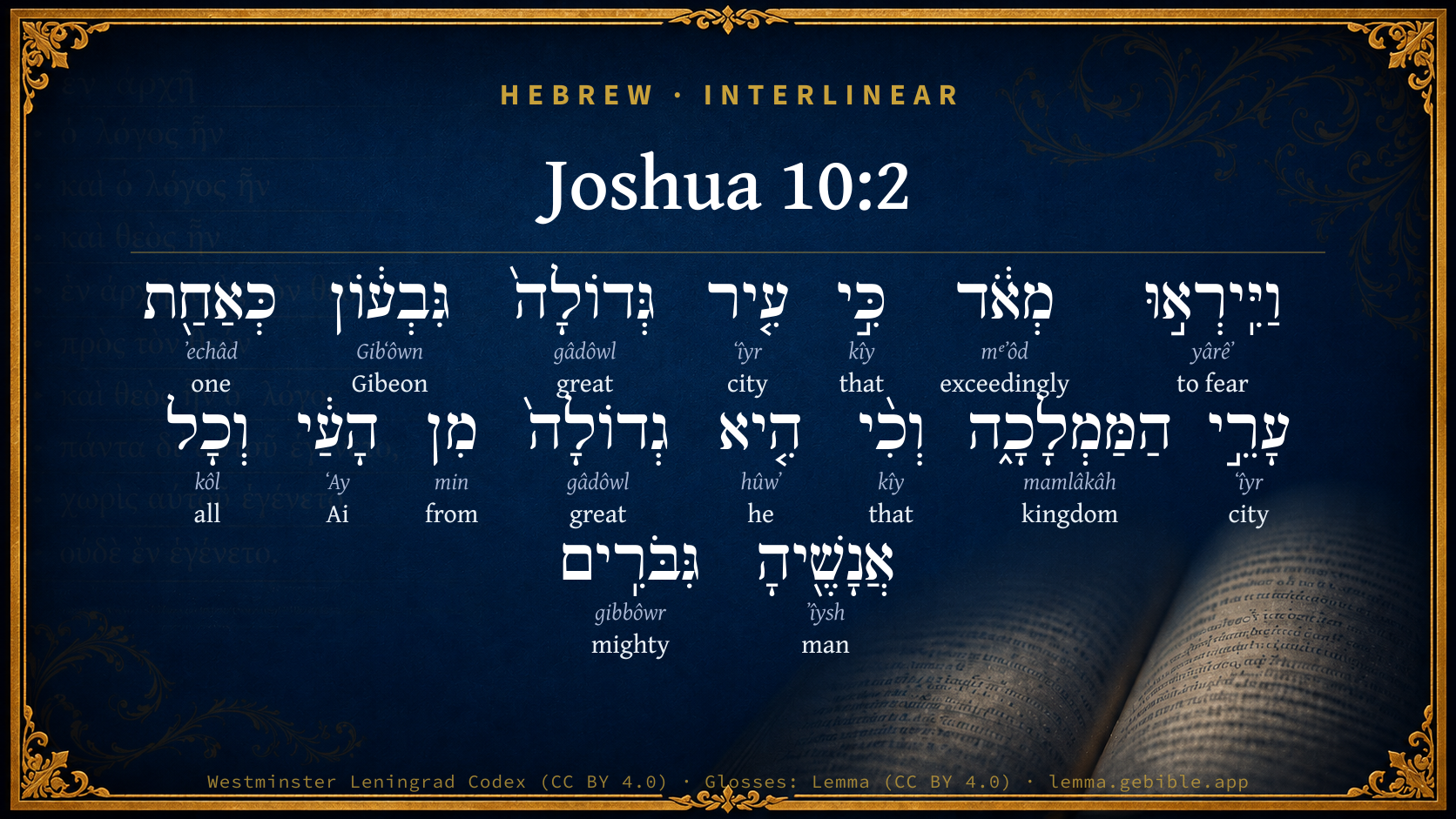
Hebrew (Westminster Leningrad Codex) Joshua 10:2 appears in the Hebrew Old Testament. The text above is from the Westminster Leningrad Codex. Each word links to its Strong’s number, a concise gloss, and parsing drawn from the Open Scriptures Hebrew Bible morphology. Click any word for its full Brown-Driver-Briggs (BDB) entry.
Download image
Cite this verse

Joshua 10:2 (World English Bible). Public Domain. Lemma interlinear Bible study tool, https://lemma.gebible.app/v/joshua/10/2.

Show BibTeX & RIS
BibTeX
RIS
English Translation
that they feared greatly, because Gibeon was a great city, as one of the royal cities, and because it was greater than Ai, and all the men of it were mighty.
World English Bible · Public Domain
Download a study sheet

One document with this verse’s original text, its word-by-word gloss line, the meaning frame, cross-references with their text, attributed commentary, and full source and license credits — printable, and it pastes into notes with its structure intact.

This verse Autodidact and up

Study sheet (.html) Plain text (.txt)

A passage Seminary Student

Up to 50 verses in one chapter. A passage sheet keeps up to 6 commentary sources and 12 cross-references per verse, in the order this page ranks them, and says so on the sheet whenever that leaves anything out. Ask for a single verse and you get the Autodidact verse sheet above.

Everything on this page stays free to read, with no account — the sheet is a download of what is already on screen, not access to it.

Want to remove ads? Support Godless Engineer
Compare translations 3

The same verse in 3 English versions, stacked beneath the original-language interlinear above. Click any original word for its lexicon entry.

Each is an independent rendering of the whole verse — the interlinear is not word-aligned to these translations.

Highlighted words mark where these versions differ — a whole-verse word diff, not a word-by-word alignment.

  • World English Bible Public Domain
    that they feared greatly, because Gibeon was a great city, as one of the royal cities, and because it was greater than Ai, and all the men of it were mighty.
  • King James Version Public Domain
    That they feared greatly, because Gibeon was a great city, as one of the royal cities, and because it was greater than Ai, and all the men thereof were mighty.
  • unfoldingWord Literal Text CC BY-SA 4.0
    that they feared greatly, because Gibeon a great city, like one of the cities of the kingdom, and because it greater than Ai, and all of its men warriors.

unfoldingWord Literal Text — © unfoldingWord, licensed CC BY-SA 4.0. Word-aligned USFM3 via Door43 (git.door43.org/unfoldingWord/en_ult).

Versions to compare (up to 4)

3 of 4 selected

Show all 18 translations

Every available English version of this verse, each an independent rendering of the whole verse.

  • World English Bible Public Domain
    that they feared greatly, because Gibeon was a great city, as one of the royal cities, and because it was greater than Ai, and all the men of it were mighty.
  • Berean Standard Bible Public Domain
    So Adoni-zedek and his people were greatly alarmed, because Gibeon was a great city, like one of the royal cities; it was larger than Ai, and all its men were mighty.
  • Majority Standard Bible Public Domain
    So Adoni-zedek and his people were greatly alarmed, because Gibeon was a great city, like one of the royal cities; it was larger than Ai, and all its men were mighty.
  • King James Version Public Domain
    That they feared greatly, because Gibeon was a great city, as one of the royal cities, and because it was greater than Ai, and all the men thereof were mighty.
  • American Standard Version (1901) Public Domain
    that they feared greatly, because Gibeon was a great city, as one of the royal cities, and because it was greater than Ai, and all the men thereof were mighty.
  • Revised Version (1885) Public Domain
    that they feared greatly, because Gibeon was a great city, as one of the royal cities, and because it was greater than Ai, and all the men thereof were mighty.
  • Geneva Bible (1599) Public Domain
    Then they feared exceedingly: for Gibeon was a great citie, as one of the royall cities: for it was greater then Ai, and all the men thereof were mightie.
  • Douay-Rheims (1899) Public Domain
    He was exceedingly afraid. For Gabaon was a great city, and one of the royal cities, and greater than the town of Hai, and all its fighting men were most valiant.
  • Young's Literal Translation Public Domain
    that they are greatly afraid, because Gibeon `is' a great city, as one of the royal cities, and because it `is' greater than Ai, and all its men -- heroes.
  • Literal Standard Version CC BY-SA 4.0
    that they are greatly afraid, because Gibeon [is] a great city, as one of the royal cities, and because it [is] greater than Ai, and all its men [are] heroes.
  • Unlocked Literal Bible CC BY-SA 4.0
    The people of Jerusalem were very afraid because Gibeon was a large city, like one of the royal cities. It was larger than Ai, and all its men were mighty warriors.
  • unfoldingWord Literal Text CC BY-SA 4.0
    that they feared greatly, because Gibeon a great city, like one of the cities of the kingdom, and because it greater than Ai, and all of its men warriors.
  • Darby Bible Public Domain
    that they feared greatly; for Gibeon was a great city, as one of the royal cities, and it was greater than Ai, and all its men were mighty.
  • World Messianic Bible Public Domain
    they were very afraid, because Gibeon was a great city, as one of the royal cities, and because it was greater than Ai, and all its men were mighty.
  • Webster's Bible Public Domain
    That they feared greatly, because Gibeon was a great city, as one of the royal cities, and because it was greater than Ai, and all the men of it were mighty.
  • Free Bible Version CC BY-SA 4.0
    The people of Jerusalem were very frightened by this because Gibeon was a large town—as large as any town ruled by the king, and larger than Ai, and its men were tough fighters.
  • Bible in Basic English Public Domain
    He was in great fear, because Gibeon was a great town, like one of the king's towns, greater than Ai, and all the men in it were men of war.
  • JPS Tanakh (1917) Public Domain
    that they feared greatly, because Gibeon was a great city, as one of the royal cities, and because it was greater than Ai, and all the men thereof were mighty.

Literal Standard Version (2020), Covenant Press — licensed CC BY-SA 4.0. Text via the HelloAO Bible API (eBible.org). Unlocked Literal Bible (unfoldingWord) — licensed CC BY-SA 4.0. Text via the HelloAO Bible API (eBible.org). unfoldingWord Literal Text — © unfoldingWord, licensed CC BY-SA 4.0. Word-aligned USFM3 via Door43 (git.door43.org/unfoldingWord/en_ult). Free Bible Version, Dr. Jonathan Gallagher — licensed CC BY-SA 4.0. Text via the HelloAO Bible API (eBible.org).

Word by word

More ways to search: Search by grammar → Find every occurrence → Compare this word →

Practice this passage: Drill this verse → Learn its vocabulary →

גִּבְע֔וֹן
Gibʻôwn
H1391
“Gibeon”
Noun, Proper
Part of Speech
Noun
Type
Proper
Full BDB Definition

Origin: from the same as H1387

TWOT: None

Gibeon = "hill city" - a Levitical city of Benjamin, modern 'el-Jib', which lies 5 miles or 8 kilometers from Jerusalem
  1. וַיִּֽירְא֣וּ yârêʼ H3372 “and · to fear” Conjunction + Verb, Qal, Sequential Imperfect, 3rd Person, Masculine, Plural
  2. מְאֹ֔ד mᵉʼôd H3966 “exceedingly” Adverb
  3. כִּ֣י kîy H3588 “that” Conjunction
  4. עִ֤יר ʻîyr H5892 “city” Noun, Common, Feminine, Singular, Absolute
  5. גְּדוֹלָה֙ gâdôwl H1419 “great” Adjective, Adjective, Feminine, Singular, Absolute
  6. כְּאַחַ֖ת ʼechâd H259 “like/as · one” Preposition + Adjective, Cardinal number, Feminine, Singular, Construct
  7. עָרֵ֣י ʻîyr H5892 “cities of” Noun, Common, Feminine, Plural, Construct
  8. הַמַּמְלָכָ֑ה mamlâkâh H4467 “the · kingdom” Particle, Definite Article + Noun, Common, Feminine, Singular, Absolute
  9. וְכִ֨י kîy H3588 “and · that” Conjunction + Conjunction
  10. הִ֤יא hûwʼ H1931 “he” Pronoun, Personal, 3rd Person, Feminine, Singular
  11. גְדוֹלָה֙ gâdôwl H1419 “great” Adjective, Adjective, Feminine, Singular, Absolute
  12. מִן min H4480 “from” Preposition
  13. הָעַ֔י ʻAy H5857 “the · Ai” Particle, Definite Article + Noun, Proper
  14. וְכָל kôl H3605 “and · all of” Conjunction + Noun, Common, Masculine, Singular, Construct
  15. אֲנָשֶׁ֖יהָ ʼîysh H376 “men · her” Noun, Common, Masculine, Plural, Construct + Suffix, Personal, 3rd Person, Feminine, Singular
  16. גִּבֹּרִֽים gibbôwr H1368 “mighty” Adjective, Adjective, Masculine, Plural, Absolute

About this verse

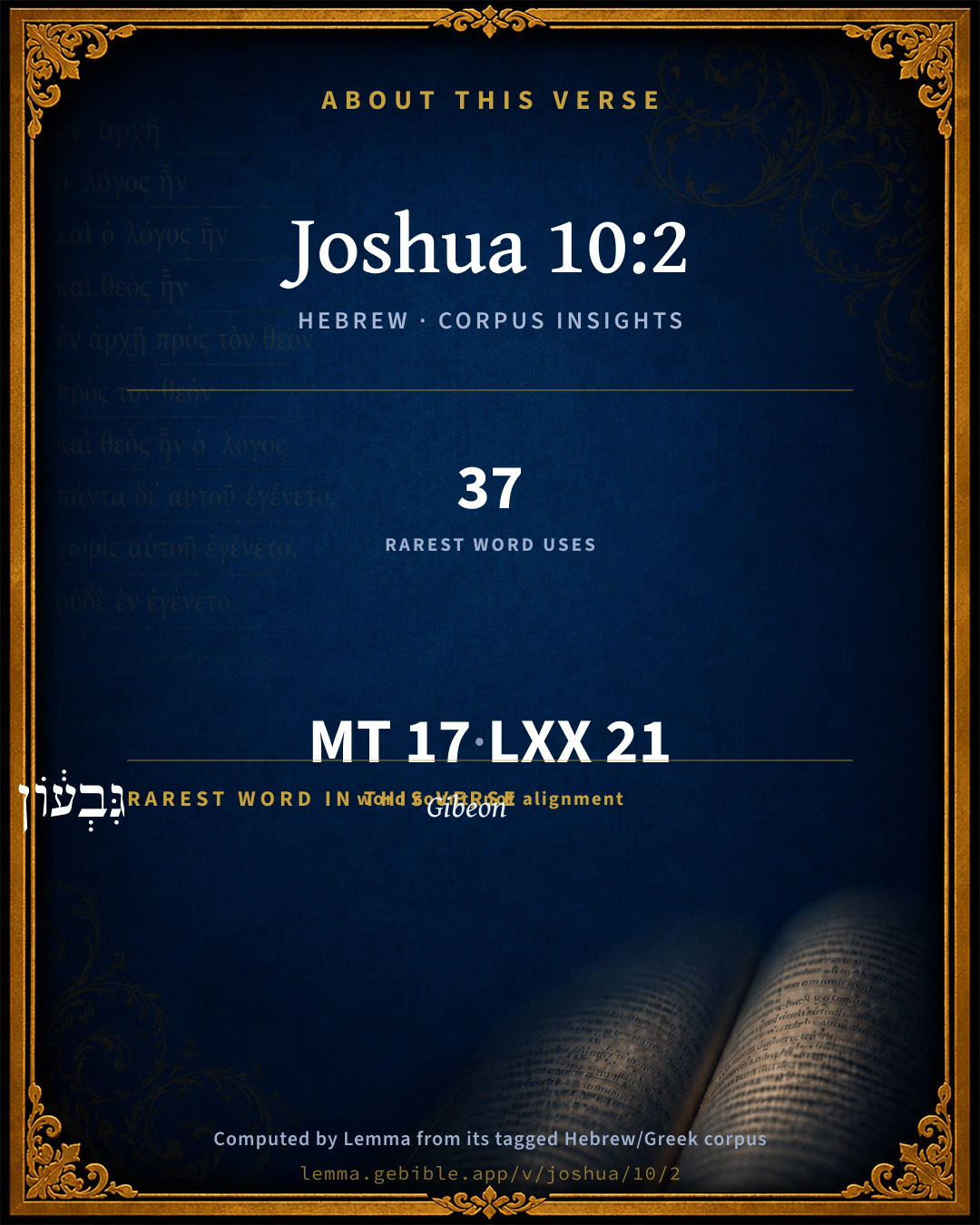
These counts appear in no published source. They are computed here, from the morphology-tagged text and Lemma’s own curated glosses. What Lemma adds →

17
words
14
distinct lemmas
Historical
section

Shared distinctive vocabulary

גִּבְע֔וֹן Gibeon H1391 occurs in 35 verses of the Hebrew Bible. Also found in:

Grammatical profile

  • 1 verb
  • 7 nouns
  • 4 adjectives
  • 1 pronoun
  • 1 preposition
  • 2 conjunctions
  • 1 adverb

Verb forms

  • וַיִּֽירְא֣וּ Qal · Sequential Imperfect

Repetition

Words recur within this verse — often emphatic in Hebrew:

  • עִ֤יר city H5892 ×2
  • גְּדוֹלָה֙ great H1419 ×2
  • כִּ֣י that H3588 ×2

Hebrew & Septuagint length

In English translation the verse runs 31 words from the Hebrew and 29 from the Septuagint (LXX English) — closely comparable.

A rough comparison of the two English renderings, which tokenize alike — not a word-level alignment.

Word counts can differ between the Hebrew and the Greek without any difference in meaning — e.g. the Hebrew direct-object marker אֵת has no separate Greek word, and Greek often adds the article ὁ.

In the original languages it is 17 Hebrew tokens and 21 Greek tokens — but the two are counted differently (Hebrew bundles its prefixes and suffixes into one token; the Greek is in lemma form), so that isn’t a like-for-like length.

Cross-references

13

Topical passages linked to Joshua 10:2 in the Treasury of Scripture Knowledge — connected by theme and wording, ordered by reader-vote popularity; previews shown in the World English Bible.

  • Deuteronomy 11:25 There shall no man be able to stand before you: Yahweh your God shall lay the fear of you and the dread of you on all the land that you shall tread on, as he has spoken to you.
  • Exodus 15:14–16 The peoples have heard. They tremble. Pangs have taken hold on the inhabitants of Philistia.
  • Joshua 2:24 They said to Joshua, Truly Yahweh has delivered into our hands all the land; and moreover all the inhabitants of the land do melt away before us.
  • Deuteronomy 28:10 All the peoples of the earth shall see that you are called by the name of Yahweh; and they shall be afraid of you.
  • Joshua 2:9–13 and she said to the men, I know that Yahweh has given you the land, and that the fear of you is fallen on us, and that all the inhabitants of the land melt away before you.
  • 1 Samuel 27:5 David said to Achish, If now I have found favor in your eyes, let them give me a place in one of the cities in the country, that I may dwell there: for why should your servant dwell in the royal city with you?
  • 2 Samuel 12:26 Now Joab fought against Rabbah of the children of Ammon, and took the royal city.
  • Psalms 48:4–6 For, behold, the kings assembled themselves, They passed by together.
  • Proverbs 1:26–27 I also will laugh at your disaster. I will mock when calamity overtakes you;
  • Proverbs 10:24 What the wicked fear, will overtake them, But the desire of the righteous will be granted.
  • Hebrews 10:27 but a certain fearful expectation of judgment, and a fierceness of fire which will devour the adversaries.
  • Hebrews 10:31 It is a fearful thing to fall into the hands of the living God.
  • Revelation 6:15–17 The kings of the earth, the princes, the commanding officers, the rich, the strong, and every slave and free person, hid themselves in the caves and in the rocks of the mountains.

Cross-references courtesy of OpenBible.info (CC BY 4.0).

Hebrew and Greek witnesses Masoretic Hebrew ↔ Greek Septuagint

The same verse in the two great witnesses to the Old Testament, shown verse-for-verse.

These are two independent witnesses, not word-aligned to each other, and the Septuagint is shown in lemma (dictionary) form.

Hebrew Joshua 10:2 Masoretic · Westminster Leningrad Codex

וַיִּֽירְא֣וּ מְאֹ֔ד כִּ֣י עִ֤יר גְּדוֹלָה֙ גִּבְע֔וֹן כְּאַחַ֖ת עָרֵ֣י הַמַּמְלָכָ֑ה וְכִ֨י הִ֤יא גְדוֹלָה֙ מִן הָעַ֔י וְכָל אֲנָשֶׁ֖יהָ גִּבֹּרִֽים

that they feared greatly, because Gibeon was a great city, as one of the royal cities, and because it was greater than Ai, and all the men of it were mighty.

World English Bible · Public Domain

Greek LXX Joshua 10:2 Septuagint · lemma form

καί φοβέω ἐν αὐτός σφόδρα οἶδα γάρ ὅτι μέγας πόλις γαβαων ὡσεί εἷς ὁ μητρόπολις καί πᾶς ὁ ἀνήρ αὐτός ἰσχυρός

then they were greatly terrified by them, for the king knew that Gabaon was a great city, as one of the chief cities, and all its men were mighty.

LXX2012 (modern English Septuagint) · Public Domain

On this verse, Haydock's Catholic Bible Commentary discusses the Septuagint’s reading. Read the note in Commentary ↓

Hebrew: Westminster Leningrad Codex (CC BY 4.0). Greek: Septuagint (public domain); English from LXX2012 (modern English Septuagint) (Public Domain). How the Septuagint differs from the Hebrew →

Targum (Aramaic paraphrase)

1

The Targum is the ancient Jewish Aramaic paraphrase of the Hebrew Scriptures — an interpretive translation, not the Hebrew text itself. Onkelos (literal) and Pseudo-Jonathan (expansive) render the Torah, and Jonathan the Prophets. Coverage is partial: where no permissively-licensed English translation exists for a verse, only the Aramaic is shown. This is verse-level text, not a word-by-word alignment to the Hebrew.

  1. Targum Jonathan Prophets (Joshua–Malachi)
    וּדְחִילוּ לַחֲדָא אֲרֵי קַרְתָּא רַבְּתָא גִבְעוֹן כַּחֲדָא מִקִרְוֵי מַלְכְּוָתָא וַאֲרֵי הִיא רַבָּא מִן עָי וְכָל גַבְרָהָא גִבָּרִין:

    (no public-domain English translation for this verse)

    Targum Jonathan — Aramaic: “Mikraot Gedolot” (public domain). English: “Sefaria Community Translation” (CC0 1.0 (public-domain dedication)); “London "Chaldee Paraphrase," 1871” (public domain). Text via Sefaria.

Commentary

Notes on Joshua 10:2 from classic Christian and Jewish commentators (each source and its license shown beneath its notes). The classic Christian expositions comment on the surrounding passage and are grouped to its opening verse, so a note may address several verses; the Jewish commentaries on the Tanakh (Rashi and others) are per-verse, so they appear only where the commentator wrote on this verse.

Lemma curates 59 commentaries, every one of them public domain or Creative Commons licensed, each selected and text-cleaned for this edition rather than reprinted as found. About our sources →

Trapp's Complete Commentary

John Trapp

Jos 10:2 That they feared greatly, because Gibeon [was] a great city, as one of the royal cities, and because it [was] greater than Ai, and all the men thereof [were] mighty.

Ver. 2. That they feared greatly.] And great cause they had, considering what supply and shelter the Israelites might have from thence, and how other cities might revolt by their example.

John Trapp, A Commentary or Exposition upon All the Books of the Old and New Testament (1647–1656) — public domain. Text from a community e-Sword module.

Matthew Poole's English Annotations

They feared, i.e. he and his people, the king being spoken of Jos 10:1, as a public person representing all his people. Or, he and the following kings, Jos 10:3. But this fear is mentioned, Jos 10:2, as the cause why he sent to those kings.

As one of the royal cities; either,

1. Really a royal city, the Hebrew particle caph oft signifying the truth of a thing, as Hos 4:4; 5:10, and oft elsewhere. Or,

2. Equal to one of the royal cities, though it had no king, but seems to be governed aristocratically by their elders, Jos 9:11.

Matthew Poole's English Annotations on the Holy Bible (1683–1685) — public domain. Text from a community e-Sword/MySword module.

Joseph Benson's Commentary

Jos 10:2-3. They feared greatly — Namely, Adoni-zedek and his people, he being spoken of (Jos 10:1) as a public person, representing all his people. Gibeon was — as one of the royal cities — Either really a royal city, and having a king, or equal to one of the royal cities, though it had not a king.

It seems indeed to have been governed by elders, Jos 9:11. Adoni- zedek sent — Either because he was superior to them, or because he was nearest the danger, and most forward in the work.

Joseph Benson's Commentary on the Old and New Testaments (1811–1818) — public domain. Text from a community e-Sword module.

Tyndale Open Study Notes

Tyndale Open Resources

10:2 Gibeon was apparently not one of the royal cities. Gibeon might have been subservient to Canaan-controlled Jerusalem before making the covenant with Joshua, or it might have been an independent town controlled by a few leading families.

Tyndale Open Study Notes — © Tyndale Open Resources, licensed CC BY-SA 4.0. Text via the HelloAO Bible API.

Jamieson, Fausset & Brown

Robert Jamieson, A. R. Fausset & David Brown

they feared greatly--The dread inspired by the rapid conquests of the Israelites had been immensely increased by the fact of a state so populous and so strong as Gibeon having found it expedient to submit to the power and the terms of the invaders.

as one of the royal cities--Although itself a republic (Jos 9:3), it was large and well-fortified, like those places in which the chiefs of the country usually established their residence.

Jamieson, Fausset & Brown — Commentary Critical and Explanatory on the Whole Bible (1871) — public domain (CC PDM 1.0). Text via the HelloAO Bible API.

Adam Clarke's Commentary

Verse 2. As one of the royal cities] Not a regal city, but great, well inhabited and well fortified, as those cities which served for the royal residence generally were. It does not appear that the Gibeonites had any king-they seem to have been a small but powerful republic, all the men thereof were mighty, merely governed by their elders: for in their address to Joshua, Jos 9:11, they mention no king, but simply state that they were sent by their elders and the inhabitants of their country; nor do we any where read of their king; and therefore we may naturally suppose that they had none.

Adam Clarke's Commentary on the Bible (1810–1826) — public domain. Text from a community e-Sword/MySword module.

Ellicott's Commentary for English Readers

(2) As one of the royal cities.—One of the cities of the kingdom. Gibeon was afterwards the city of the first king of Israel, Saul (1Ch_8:29-30; 1Ch_8:33).

A Bible Commentary for English Readers, edited by Charles John Ellicott (1878–1897) — public domain. Text from a community e-Sword module.

The Cambridge Bible for Schools and Colleges

gen. ed. J. J. S. Perowne

2. as one of the royal cities] See above, Jos_9:3.

2. When Sennacherib invaded Judah, he attacked and took “the fenced cities,” but Lachish appears to have foiled him, and he was constrained to raise the siege (2Ki_19:8; 2Ch_32:9).

The Cambridge Bible for Schools and Colleges (gen. ed. J. J. S. Perowne; Cambridge University Press, 1878–1918) — public domain. Text from a community e-Sword module.

John Gill's Exposition

That they feared greatly,.... The king of Jerusalem and his people, lest they should fall into the hands of the Israelites, and be used as Jericho and Ai, and the kings and inhabitants of them were, and that they would be the next that should fall a sacrifice to them; for Gibeon was fifty furlongs from Jerusalem, as Josephus says (a); and in another place he says (b) but forty, which were but five miles; and if fifty, but little more than six miles; according to Bunting (c), it was but four miles: and what added to their terror was:

because Gibeon was a great city; being a metropolitan city, and having others subject to it; therefore the surrender of that to the Israelites might intimidate other cities, and lead them by example to do the like, and so of bad consequence:

as one of the royal cities; the Vulgate Latin version omits the note of similitude, and reads, "and one of the royal cities"; and sometimes "caph" or "as" is not a note of likeness, but of reality; yet as we nowhere read of a king of Gibeon, the sense may be, that though it was not a royal seat, it was equal to those that were, and like one, being a metropolitan city: and

because it was greater than Ai: had more inhabitants in it, and perhaps better fortified:

and all the men thereof were mighty; men of strength, courage, and valour, warlike men, and therefore for such a city to yield so easily, and in such a base, mean, and cowardly way, was setting a very bad example.

(a) De Bello Jud. l. 2. c. 19. sect. 1. (b) Antiqu. l. 7. c. 11. sect. 7. (c) Travels of the Patriarchs, &c. p. 98.

John Gill's Exposition of the Whole Bible (1746–1763) — public domain (CC PDM 1.0). Text via the HelloAO Bible API.

Haydock's Catholic Bible Commentary

Cities. Yet we read not of its king, chap. ix. 11. (Calmet) --- Septuagint, "It was like a royal metropolis." (Haydock) --- Valiant. Prudence therefore, and not fear, had influenced them to take this step.

George Leo Haydock (1774–1849), Haydock's Catholic Family Bible and Commentary, 1859 edition — public domain. Excludes Psalms (Douay-Rheims chapter numbering differs from Protestant) and Deuterocanonical books (Catholic canon only).

Whedon's Commentary on the Bible

Daniel D. Whedon

2. They feared greatly — The loss to the Amorites of so powerful a commonwealth as Gibeon, and its alliance with Joshua, was a sufficient cause of fear, aside from the fact that Joshua, now securely established in this central position, had completely cut off northern from southern Palestine, so that he could conquer each in detail.

As one of the royal cities — It was not a royal capital, but as important. The fact that so large a city, in their immediate vicinity, renowned for bravery, had submitted to the invader without striking a blow, was indeed appalling.

Daniel D. Whedon (gen. ed.), Commentary on the Old and New Testaments (1874–1909) — public domain. Text from a community e-Sword module.

The Pulpit Commentary

That they feared greatly. Joshua had certainly obtained an excellent strategic position in the heart of the country; but it was not this which apparently most alarmed the kings who constituted the confederacy, though they did not fail to observe that, as the words "and were among them" show. It was the weight and importance of Gibeon itself, and the fact that its inhabitants were now enlisted, not on the side of the Canaanites, but against them. As one of the royal cities. Observe the minute accuracy of the historian. No king is mentioned in the narrative in Jos 9. We now earn indirectly that they had none. The Vulgate misses the point of the historian by leaving out "as" altogether.

The Pulpit Commentary (1880–1919), ed. H.D.M. Spence-Jones & Joseph S. Exell — public domain. Text from a community e-Sword module.

John Wesley's Explanatory Notes

Thy - That is, he and his people, the king being spoken of ver. 1, as a publick person representing all his people. Royal cities - Either really a royal city, or equal to one of the royal cities, though it had no king, but seems to have been governed by elders, chap. ix, 11.

John Wesley, Explanatory Notes Upon the Whole Bible (1754–1765) — public domain. Text via the GEBible commentary corpus.

Lesson kit

Teaching starters — assembled from the data on this page, not authored interpretation. Every prompt links to the verse data it draws on. Edit before teaching.

Joshua, in the Historical, opens this verse with 17 words (14 distinct Hebrew lemmas). Its most distinctive word is Gibʻôwn (“Gibeon”). A historical commentator’s framing appears above. Read the whole chapter for the surrounding context.

Discussion questions

  1. How does “Gibeon” (Gibʻôwn) shape what this verse is saying?
  2. How does Joshua 9:3, which shares the word «Gibeon», read alongside this verse?
  3. What does the repetition of “city” (2× in this one verse) do in this verse?
  4. The translations on this page render this verse differently — a whole-verse word diff, not a word-by-word alignment. What might account for the different wordings?
  5. «וַיִּֽירְא֣וּ» is a Qal Sequential Imperfect verb. How does that grammatical form shape the action described?
  6. Compare how Trapp's Complete Commentary and Matthew Poole's English Annotations read this verse. Where do they agree or differ?

Things to notice

Reading settings

Reading text

Shown beneath each verse's original-language words.

Old Testament
Old Testament edition

Read the OT as the Masoretic Hebrew (MT) or the Greek Septuagint (LXX).

English shown for the Greek Septuagint (in the Hebrew ↔ Greek comparison).

Comparing translations? Open the Compare panel on any verse page to stack up to four side by side.