
1 Kings 8:43

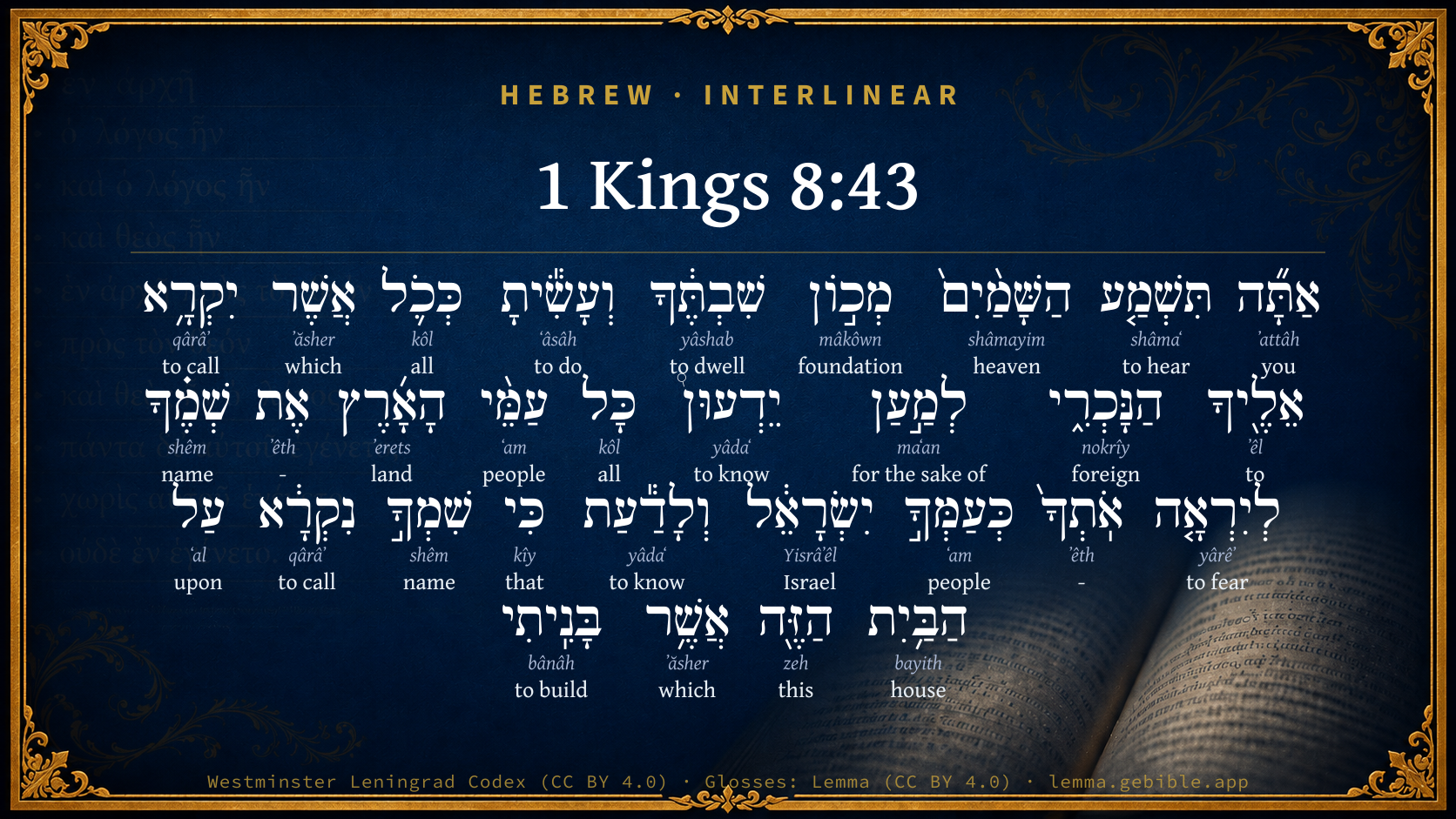
Hebrew (Westminster Leningrad Codex) 1 Kings 8:43 appears in the Hebrew Old Testament. The text above is from the Westminster Leningrad Codex. Each word links to its Strong’s number, a concise gloss, and parsing drawn from the Open Scriptures Hebrew Bible morphology. Click any word for its full Brown-Driver-Briggs (BDB) entry.
Download image
Cite this verse

1 Kings 8:43 (World English Bible). Public Domain. Lemma interlinear Bible study tool, https://lemma.gebible.app/v/1-kings/8/43.

Show BibTeX & RIS
BibTeX
RIS
English Translation
hear in heaven, your dwelling-place, and do according to all that the foreigner calls to you for; that all the peoples of the earth may know your name, to fear you, as does your people Israel, and that they may know that this house which I have built is called by my name.
World English Bible · Public Domain
Download a study sheet

One document with this verse’s original text, its word-by-word gloss line, the meaning frame, cross-references with their text, attributed commentary, and full source and license credits — printable, and it pastes into notes with its structure intact.

This verse Autodidact and up

Study sheet (.html) Plain text (.txt)

A passage Seminary Student

Up to 50 verses in one chapter. A passage sheet keeps up to 6 commentary sources and 12 cross-references per verse, in the order this page ranks them, and says so on the sheet whenever that leaves anything out. Ask for a single verse and you get the Autodidact verse sheet above.

Everything on this page stays free to read, with no account — the sheet is a download of what is already on screen, not access to it.

Want to remove ads? Support Godless Engineer
Compare translations 3

The same verse in 3 English versions, stacked beneath the original-language interlinear above. Click any original word for its lexicon entry.

Each is an independent rendering of the whole verse — the interlinear is not word-aligned to these translations.

Highlighted words mark where these versions differ — a whole-verse word diff, not a word-by-word alignment.

  • World English Bible Public Domain
    hear in heaven, your dwelling-place, and do according to all that the foreigner calls to you for; that all the peoples of the earth may know your name, to fear you, as does your people Israel, and that they may know that this house which I have built is called by my name.
  • King James Version Public Domain
    Hear thou in heaven thy dwelling place, and do according to all that the stranger calleth to thee for: that all people of the earth may know thy name, to fear thee, as do thy people Israel; and that they may know that this house, which I have builded, is called by thy name.
  • unfoldingWord Literal Text CC BY-SA 4.0
    you, may you hear in the heavens, the place of your dwelling, and may you act according to all that the foreigner has cried out to you, so that all of the peoples of the earth will know your name, to fear you as your people Israel and to know that your name has been called over this house that I have built.

unfoldingWord Literal Text — © unfoldingWord, licensed CC BY-SA 4.0. Word-aligned USFM3 via Door43 (git.door43.org/unfoldingWord/en_ult).

Versions to compare (up to 4)

3 of 4 selected

Show all 18 translations

Every available English version of this verse, each an independent rendering of the whole verse.

  • World English Bible Public Domain
    hear in heaven, your dwelling-place, and do according to all that the foreigner calls to you for; that all the peoples of the earth may know your name, to fear you, as does your people Israel, and that they may know that this house which I have built is called by my name.
  • Berean Standard Bible Public Domain
    then may You hear from heaven, Your dwelling place, and do according to all for which the foreigner calls to You. Then all the peoples of the earth will know Your name and fear You, as do Your people Israel, and they will know that this house I have built is called by Your Name.
  • Majority Standard Bible Public Domain
    then may You hear from heaven, Your dwelling place, and do according to all for which the foreigner calls to You. Then all the peoples of the earth will know Your name and fear You, as do Your people Israel, and they will know that this house I have built is called by Your Name.
  • King James Version Public Domain
    Hear thou in heaven thy dwelling place, and do according to all that the stranger calleth to thee for: that all people of the earth may know thy name, to fear thee, as do thy people Israel; and that they may know that this house, which I have builded, is called by thy name.
  • American Standard Version (1901) Public Domain
    hear thou in heaven thy dwelling-place, and do according to all that the foreigner calleth to thee for; that all the peoples of the earth may know thy name, to fear thee, as doth thy people Israel, and that they may know that this house which I have built is called by my name.
  • Revised Version (1885) Public Domain
    hear thou in heaven thy dwelling place, and do according to all that the stranger calleth to thee for; that all the peoples of the earth may know thy name, to fear thee, as doth thy people Israel, and that they may know that this house which I have built is called by thy name.
  • Geneva Bible (1599) Public Domain
    Heare thou in heauen thy dwelling place, and do according to all that the stranger calleth for vnto thee: that all the people of the earth may know thy Name, and feare thee, as do thy people Israel: and that they may know, that thy Name is called vpon in this house which I haue built.
  • Douay-Rheims (1899) Public Domain
    Then hear thou in heaven, in the firmament of thy dwelling place, and do all those things, for which that stranger shall call upon thee: that all the people of the earth may learn to fear thy name, as do thy people Israel, and may prove that thy name is called upon on this house, which I have built.
  • Young's Literal Translation Public Domain
    Thou dost hear in the heavens, the settled place of Thy dwelling, and hast done according to all that the stranger calleth unto Thee for, in order that all the peoples of the earth may know Thy name, to fear Thee like Thy people Israel, and to know that Thy name hath been called on this house which I have builded.
  • Literal Standard Version CC BY-SA 4.0
    You hear in the heavens, the settled place of Your dwelling, and have done according to all that the stranger calls to You for, in order that all the peoples of the earth may know Your Name, to fear You like Your people Israel, and to know that Your Name has been called on this house which I have built.
  • Unlocked Literal Bible CC BY-SA 4.0
    then please listen from heaven, the place where you live, and do whatever the foreigner asks of you. Do this so that all the peoples on earth may know your name and fear you, as do your own people Israel. Do this so they might know that this house I have built is called by your name.
  • unfoldingWord Literal Text CC BY-SA 4.0
    you, may you hear in the heavens, the place of your dwelling, and may you act according to all that the foreigner has cried out to you, so that all of the peoples of the earth will know your name, to fear you as your people Israel and to know that your name has been called over this house that I have built.
  • Darby Bible Public Domain
    hear thou in the heavens thy dwelling-place, and do according to all that the stranger calleth to thee for; in order that all peoples of the earth may know thy name, [and] that they may fear thee as do thy people Israel; and that they may know that this house which I have built is called by thy name.
  • World Messianic Bible Public Domain
    hear in heaven, your dwelling place, and do according to all that the foreigner calls to you for; that all the peoples of the earth may know your name, to fear you, as do your people Israel, and that they may know that this house which I have built is called by your name.
  • Webster's Bible Public Domain
    Hear thou in heaven thy dwelling-place, and do according to all that the stranger calleth to thee for: that all people of the earth may know thy name, to fear thee, as do thy people Israel; and that they may know that this house which I have built is called by thy name.
  • Free Bible Version CC BY-SA 4.0
    then hear from heaven, the place where you live, and give them what they're asking. That way, everyone on earth will come to know and respect you, just as your own people Israel do. They will also know that this Temple I have built is dedicated to you.
  • Bible in Basic English Public Domain
    Give ear in heaven your living-place, and give him his desire, whatever it may be; so that all the peoples of the earth may have knowledge of your name, worshipping you as do your people Israel, and that they may see that this house which I have put up is truly named by your name.
  • JPS Tanakh (1917) Public Domain
    hear Thou in heaven Thy dwelling-place, and do according to all that the stranger calleth to Thee for; that all the peoples of the earth may know Thy name, to fear Thee, as doth Thy people Israel, and that they may know that Thy name is called upon this house which I have built.

Literal Standard Version (2020), Covenant Press — licensed CC BY-SA 4.0. Text via the HelloAO Bible API (eBible.org). Unlocked Literal Bible (unfoldingWord) — licensed CC BY-SA 4.0. Text via the HelloAO Bible API (eBible.org). unfoldingWord Literal Text — © unfoldingWord, licensed CC BY-SA 4.0. Word-aligned USFM3 via Door43 (git.door43.org/unfoldingWord/en_ult). Free Bible Version, Dr. Jonathan Gallagher — licensed CC BY-SA 4.0. Text via the HelloAO Bible API (eBible.org).

Word by word

More ways to search: Search by grammar → Find every occurrence → Compare this word →

Practice this passage: Drill this verse → Learn its vocabulary →

מְכ֣וֹן
mâkôwn
H4349
“foundation of”
Noun, Common, Masculine, Singular, Construct
Part of Speech
Noun
Type
Common
Gender
Masculine
Number
Singular
State
Construct
Full BDB Definition

Origin: from H3559

TWOT: 964c

fixed or established place, foundation - fixed place - foundation
  1. אַתָּ֞ה ʼattâh H859 “you” Pronoun, Personal, 2nd Person, Masculine, Singular
  2. תִּשְׁמַ֤ע shâmaʻ H8085 “to hear” Verb, Qal, Imperfect, 2nd Person, Masculine, Singular
  3. הַשָּׁמַ֨יִם֙ shâmayim H8064 “the · heaven(s)” Particle, Definite Article + Noun, Common, Masculine, Plural, Absolute
  4. שִׁבְתֶּ֔ךָ yâshab H3427 “to dwell · you” Verb, Qal, Infinitive Construct + Suffix, Personal, 2nd Person, Masculine, Singular
  5. וְעָשִׂ֕יתָ ʻâsâh H6213 “and · to do” Conjunction + Verb, Qal, Sequential Perfect, 2nd Person, Masculine, Singular
  6. כְּכֹ֛ל kôl H3605 “like/as · all” Preposition + Noun, Common, Masculine, Singular, Absolute
  7. אֲשֶׁר ʼăsher H834 “which” Particle, Relative
  8. יִקְרָ֥א qârâʼ H7121 “to call” Verb, Qal, Imperfect, 3rd Person, Masculine, Singular
  9. אֵלֶ֖יךָ ʼêl H413 “to · you” Preposition + Suffix, Personal, 2nd Person, Masculine, Singular
  10. הַנָּכְרִ֑י nokrîy H5237 “the · foreign” Particle, Definite Article + Adjective, Adjective, Masculine, Singular, Absolute
  11. לְמַ֣עַן maʻan H4616 “for the sake of” Preposition
  12. יֵדְעוּן֩ yâdaʻ H3045 “to know” Verb, Qal, Imperfect, 3rd Person, Masculine, Plural + Suffix, n
  13. כָּל kôl H3605 “all of” Noun, Common, Masculine, Singular, Construct
  14. עַמֵּ֨י ʻam H5971 “peoples of” Noun, Common, Masculine, Plural, Construct
  15. הָאָ֜רֶץ ʼerets H776 “the · land” Particle, Definite Article + Noun, Common, Both, Singular, Absolute
  16. אֶת ʼêth H853 “-” Particle, Direct Object
  17. שְׁמֶ֗ךָ shêm H8034 “name · your” Noun, Common, Masculine, Singular, Construct + Suffix, Personal, 2nd Person, Masculine, Singular
  18. לְיִרְאָ֤ה yârêʼ H3372 “to fear” Preposition + Verb, Qal, Infinitive Construct
  19. אֹֽתְךָ֙ ʼêth H853 “- · you” Particle, Direct Object + Suffix, Personal, 2nd Person, Masculine, Singular
  20. כְּעַמְּךָ֣ ʻam H5971 “like/as · people · your” Preposition + Noun, Common, Masculine, Singular, Construct + Suffix, Personal, 2nd Person, Masculine, Singular
  21. יִשְׂרָאֵ֔ל Yisrâʼêl H3478 “Israel” Noun, Proper
  22. וְלָדַ֕עַת yâdaʻ H3045 “and · to know” Conjunction + Preposition + Verb, Qal, Infinitive Construct
  23. כִּי kîy H3588 “that” Conjunction
  24. שִׁמְךָ֣ shêm H8034 “name · your” Noun, Common, Masculine, Singular, Construct + Suffix, Personal, 2nd Person, Masculine, Singular
  25. נִקְרָ֔א qârâʼ H7121 “to call” Verb, Niphal, Perfect, 3rd Person, Masculine, Singular
  26. עַל ʻal H5921 “upon” Preposition
  27. הַבַּ֥יִת bayith H1004 “the · house” Particle, Definite Article + Noun, Common, Masculine, Singular, Absolute
  28. הַזֶּ֖ה zeh H2088 “the · this” Particle, Definite Article + Pronoun, Demonstrative, Masculine, Singular
  29. אֲשֶׁ֥ר ʼăsher H834 “which” Particle, Relative
  30. בָּנִֽיתִי bânâh H1129 “to build” Verb, Qal, Perfect, 1st Person, Common, Singular

About this verse

These counts appear in no published source. They are computed here, from the morphology-tagged text and Lemma’s own curated glosses. What Lemma adds →

31
words
24
distinct lemmas
Historical
section

Notable vocabulary

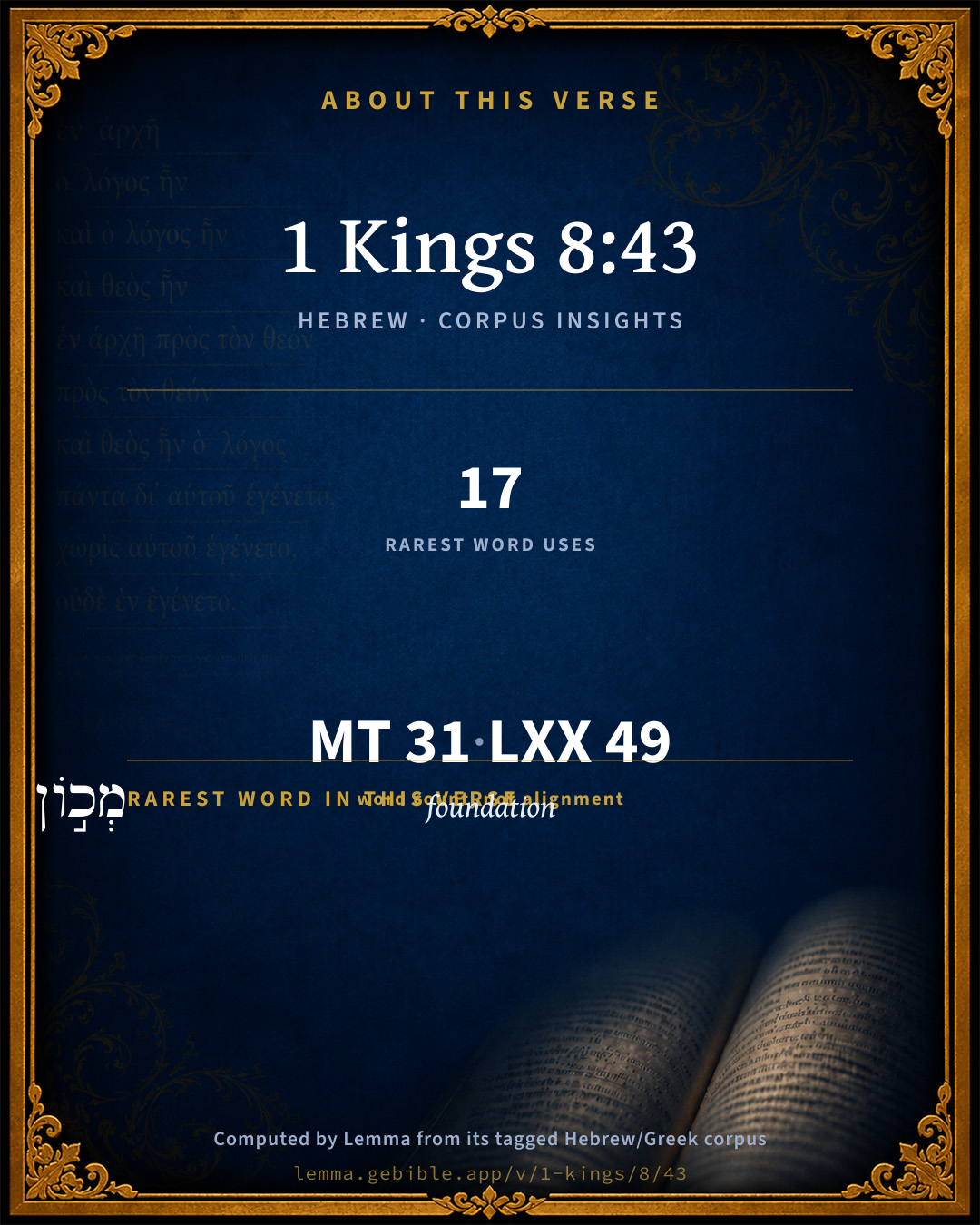
The rarest word here is מְכ֣וֹן foundation H4349 — appearing just 17 times in the whole Hebrew Bible.

Shared distinctive vocabulary

מְכ֣וֹן foundation H4349 occurs in 17 verses of the Hebrew Bible. Also found in:

Grammatical profile

  • 9 verbs
  • 11 nouns
  • 1 adjective
  • 2 pronouns
  • 3 prepositions
  • 1 conjunction
  • 4 particles

Verb forms

  • תִּשְׁמַ֤ע Qal · Imperfect
  • שִׁבְתֶּ֔ךָ Qal · Infinitive Construct
  • וְעָשִׂ֕יתָ Qal · Sequential Perfect
  • יִקְרָ֥א Qal · Imperfect
  • יֵדְעוּן֩ Qal · Imperfect
  • לְיִרְאָ֤ה Qal · Infinitive Construct
  • וְלָדַ֕עַת Qal · Infinitive Construct
  • נִקְרָ֔א Niphal · Perfect
  • בָּנִֽיתִי Qal · Perfect

Repetition

Words recur within this verse — often emphatic in Hebrew:

  • כְּכֹ֛ל all H3605 ×2
  • יִקְרָ֥א to call H7121 ×2
  • יֵדְעוּן֩ to know H3045 ×2
  • עַמֵּ֨י people H5971 ×2
  • שְׁמֶ֗ךָ name H8034 ×2
  • אֲשֶׁר which H834 ×2

Hebrew & Septuagint length

In English translation the verse runs 53 words from the Hebrew and 59 from the Septuagint (LXX English) — closely comparable.

A rough comparison of the two English renderings, which tokenize alike — not a word-level alignment.

Word counts can differ between the Hebrew and the Greek without any difference in meaning — e.g. the Hebrew direct-object marker אֵת has no separate Greek word, and Greek often adds the article ὁ.

In the original languages it is 31 Hebrew tokens and 49 Greek tokens — but the two are counted differently (Hebrew bundles its prefixes and suffixes into one token; the Greek is in lemma form), so that isn’t a like-for-like length.

Cross-references

12

Topical passages linked to 1 Kings 8:43 in the Treasury of Scripture Knowledge — connected by theme and wording, ordered by reader-vote popularity; previews shown in the World English Bible.

  • 1 Samuel 17:46 This day will Yahweh deliver you into my hand; and I will strike you, and take your head from off you; and I will give the dead bodies of the host of the Philistines this day to the birds of the sky, and to the wild animals of the earth; that all the earth may know that there is a God in Israel,
  • Psalms 102:15 So the nations will fear the name of Yahweh; All the kings of the earth your glory.
  • 2 Kings 19:19 Now therefore, Yahweh our God, save you us, I beg you, out of his hand, that all the kingdoms of the earth may know that you Yahweh are God alone.
  • Psalms 22:27 All the ends of the earth shall remember and turn to Yahweh. All the relatives of the nations shall worship before you.
  • Psalms 67:2 That your way may be known on earth, And your salvation among all nations,
  • Psalms 86:9 All nations you have made will come and worship before you, Lord. They shall glorify your name.
  • Isaiah 11:9 They shall not hurt nor destroy in all my holy mountain; for the earth shall be full of the knowledge of Yahweh, as the waters cover the sea.
  • Joshua 4:24 that all the peoples of the earth may know the hand of Yahweh, that it is mighty; that you may fear Yahweh your God forever.
  • 2 Chronicles 6:33 then hear from heaven, even from your dwelling-place, and do according to all that the foreigner calls to you for; that all the peoples of the earth may know your name, and fear you, as does your people Israel, and that they may know that this house which I have built is called by your name.
  • Psalms 72:10–11 The kings of Tarshish and of the isles will bring tribute. The kings of Sheba and Seba shall offer gifts.
  • Psalms 117:1–2 Praise Yahweh, all you nations! Extol him, all you peoples!
  • Revelation 11:15 The seventh angel sounded, and great voices in heaven followed, saying, "The kingdom of the world has become the Kingdom of our Lord, and of his Christ. He will reign forever and ever!"

Cross-references courtesy of OpenBible.info (CC BY 4.0).

Hebrew and Greek witnesses Masoretic Hebrew ↔ Greek Septuagint

The same verse in the two great witnesses to the Old Testament, shown verse-for-verse.

These are two independent witnesses, not word-aligned to each other, and the Septuagint is shown in lemma (dictionary) form.

Hebrew 1 Kings 8:43 Masoretic · Westminster Leningrad Codex

אַתָּ֞ה תִּשְׁמַ֤ע הַשָּׁמַ֨יִם֙ מְכ֣וֹן שִׁבְתֶּ֔ךָ וְעָשִׂ֕יתָ כְּכֹ֛ל אֲשֶׁר יִקְרָ֥א אֵלֶ֖יךָ הַנָּכְרִ֑י לְמַ֣עַן יֵדְעוּן֩ כָּל עַמֵּ֨י הָאָ֜רֶץ אֶת שְׁמֶ֗ךָ לְיִרְאָ֤ה אֹֽתְךָ֙ כְּעַמְּךָ֣ יִשְׂרָאֵ֔ל וְלָדַ֕עַת כִּי שִׁמְךָ֣ נִקְרָ֔א עַל הַבַּ֥יִת הַזֶּ֖ה אֲשֶׁ֥ר בָּנִֽיתִי

hear in heaven, your dwelling-place, and do according to all that the foreigner calls to you for; that all the peoples of the earth may know your name, to fear you, as does your people Israel, and that they may know that this house which I have built is called by my name.

World English Bible · Public Domain

Greek LXX 1 Kings 8:43 Septuagint · lemma form

καί σύ εἰςἀκούω ἐκ ὁ οὐρανός ἐκ ἕτοιμος κατοικητήριον σύ καί ποιέω κατά πᾶς ὅσος ἄν ἐπικαλέω σύ ὁ ἀλλότριος ὅπως γιγνώσκω πᾶς ὁ λαός ὁ ὄνομα σύ καί φοβέω σύ καθώς ὁ λαός σύ ἰσραήλ καί γιγνώσκω ὅτι ὁ ὄνομα σύ ἐπικαλέω ἐπί ὁ οἶκος οὗτος ὅς οἰκοδομέω

then shall you hear them from heaven, out of your established dwelling-place, and you shall do according to all that the stranger shall call upon you for, that all the nations may know your name, and fear you, as do your people Israel, and may know that your name has been called on this house which I have builded.

LXX2012 (modern English Septuagint) · Public Domain

On this verse, The Pulpit Commentary discusses the Septuagint’s reading. Read the note in Commentary ↓

Hebrew: Westminster Leningrad Codex (CC BY 4.0). Greek: Septuagint (public domain); English from LXX2012 (modern English Septuagint) (Public Domain). How the Septuagint differs from the Hebrew →

Targum (Aramaic paraphrase)

1

The Targum is the ancient Jewish Aramaic paraphrase of the Hebrew Scriptures — an interpretive translation, not the Hebrew text itself. Onkelos (literal) and Pseudo-Jonathan (expansive) render the Torah, and Jonathan the Prophets. Coverage is partial: where no permissively-licensed English translation exists for a verse, only the Aramaic is shown. This is verse-level text, not a word-by-word alignment to the Hebrew.

  1. Targum Jonathan Prophets (Joshua–Malachi)
    אַתְּ תְּקַבֵּל מִן שְׁמַיָא מֵאֲתַר בֵּית שְׁכִנְתָּךְ וְתַעֲבֵיד כְּכֹל דִי יְצַלֵי קֳדָמָךְ בַּר עַמְמִין בְּדִיל דְיֵדְעוּן כָּל עַמְמֵי אַרְעָא יַת שְׁמָךְ לְמִדְחַל קֳדָמָךְ כְּעַמָךְ יִשְׂרָאֵל וּלְמֵידַע אֲרֵי שְׁמָךְ אִתְקְרֵי עַל בֵּיתָא הָדֵין דִי בְּנֵיתִי:

    (no public-domain English translation for this verse)

    Targum Jonathan — Aramaic: “Mikraot Gedolot” (public domain). English: “Sefaria Community Translation” (CC0 1.0 (public-domain dedication)); “London "Chaldee Paraphrase," 1871” (public domain). Text via Sefaria.

Commentary

Notes on 1 Kings 8:43 from classic Christian and Jewish commentators (each source and its license shown beneath its notes). The classic Christian expositions comment on the surrounding passage and are grouped to its opening verse, so a note may address several verses; the Jewish commentaries on the Tanakh (Rashi and others) are per-verse, so they appear only where the commentator wrote on this verse.

Lemma curates 59 commentaries, every one of them public domain or Creative Commons licensed, each selected and text-cleaned for this edition rather than reprinted as found. About our sources →

Trapp's Complete Commentary

John Trapp

1Ki 8:43 Hear thou in heaven thy dwelling place, and do according to all that the stranger calleth to thee for: that all people of the earth may know thy name, to fear thee, as [do] thy people Israel; and that they may know that this house, which I have builded, is called by thy name.

Ver. 43. That all people of the earth.] "O thou that hearest prayer, unto thee shall all flesh come." {Psa 65:2} {See Trapp on "Psa 65:2"}

As do thy people Israel.] Either they do, or should do, for the good example of others. Aliter deteriores quidem sunt quia meliores esse deberent: {a} else they are so much the worse, because they ought to be better than others.

{a} Salvian.

John Trapp, A Commentary or Exposition upon All the Books of the Old and New Testament (1647–1656) — public domain. Text from a community e-Sword module.

Joseph Benson's Commentary

1Ki 8:43. Do according to all that the stranger calleth to thee for — That is, so far as is agreeable to thy word and will. It is observable, that his prayer for the stranger is more large and comprehensive than for the Israelites; that thereby he might both show his public spirit, and encourage strangers to the worship of the true God. Thus early were the indications of God’s favour toward the sinners of the Gentiles. As there was then one law for the native and for the stranger, so there was one gospel for both. That all the people of the earth may know thy name — Hereby we learn how sincerely and heartily the ancient and godly Jews desired the conversion of the Gentiles; whereas the latter and degenerate Jews, in the days of Christ and of the apostles, out of pride, envy, and malice, opposed and fretted at it. That they may know that this house is called by thy name — Is owned not only by us, but by thyself as thy house; the only place in the world to which thou wilt vouchsafe thy special presence and protection, and where thou wilt be publicly and solemnly worshipped.

Joseph Benson's Commentary on the Old and New Testaments (1811–1818) — public domain. Text from a community e-Sword module.

Geneva Bible (1599)

Geneva Bible translators

That this is the true religion wherewith thou wilt be worshipped.

Geneva Bible (1599) marginal notes — public domain. Text via Bolls.life.

The Cambridge Bible for Schools and Colleges

gen. ed. J. J. S. Perowne

43. that this house … is called by thy name] The literal rendering of the Hebrew ‘that thy name is called upon this house,’ though not so good English, brings out more of the true notion of the words viz., that God has taken up His abode there, and that there men may approach very near unto Him.

The Cambridge Bible for Schools and Colleges (gen. ed. J. J. S. Perowne; Cambridge University Press, 1878–1918) — public domain. Text from a community e-Sword module.

John Gill's Exposition

Hear thou in heaven thy dwellingplace,.... The prayer of the stranger:

and do according to all that the stranger calleth to thee for; which were consistent with the will of God and his glory, and for the good of the stranger; this is more absolutely and unconditionally expressed than the requests for the Israelites; it is not desired that he would do by them according to their ways, and if they turned from their sins, or knew the plague of their hearts; the reason of which is supposed to be, because the Israelites knew the will of God, when the strangers did not; and therefore it is desired that, notwithstanding their ignorance, and their non-compliance with the divine will, through that, they might be heard and answered:

that all people of the earth may know thy name, to fear thee, as do thy people Israel; might know him to be a God, hearing and answering prayer, forgiving sin, and bestowing favours, which might lead them to fear him and his goodness, as Israel did:

and that they may know that this house, which I have builded, is called by thy name; that he dwelt in it, granted his presence, heard and received the supplications of men, answered their requests, and accepted of their sacrifices here. Solomon seems to have had knowledge of the calling of the Gentiles, and to desire it.

John Gill's Exposition of the Whole Bible (1746–1763) — public domain (CC PDM 1.0). Text via the HelloAO Bible API.

Albert Barnes' Notes on the Bible

That all people of the earth may know thy name, to fear thee - Solomon prays that the result of Yahweh’s hearing the prayers of pagans addressed toward the temple may be the general conversion of the world to the worship of Him. Compare Psa 96:1-13; Psa 98:1-9.

This house ... - literally, as in the margin. In Scripture, when God’s Name is said to be “called upon” persons or things, it seems to be meant that God is really present in them, upholding them and sanctifying them. This passage therefore means, that the pagan, when their prayers, directed toward the temple, are granted, will have a full assurance that God is present in the building in some very special way.

Albert Barnes' Notes on the Bible (1834–1885) — public domain. Text from a community e-Sword/MySword module.

Matthew Poole's English Annotations

Do according to all that the stranger calleth to thee for, to wit, agreeable to thy will and word; for he would not have them heard, if they had prayed for any thing dishonourable to God, or destructive to his people. It is observable, that his prayer for the strangers is more large and comprehensive than for the Israelites, that thereby he might both show his public spiritedness, and encourage strangers to the worship of the true God.

That all people may know thy fame, to fear thee, as do thy people Israel; whereby we see how sincerely and heartily the ancient and godly Jews desired the conversion of the Gentiles; whereas the latter and degenerate Jews, in the days of Christ and of the apostles, did envy, oppose it, and fret at it.

Is called by thy name, i.e. is owned, not only by us, but by thyself, as thy house; the only place in the world to which thou wilt vouchsafe thy presence and protection, and wherein thou wilt be publicly and solemnly served.

Matthew Poole's English Annotations on the Holy Bible (1683–1685) — public domain. Text from a community e-Sword/MySword module.

Whedon's Commentary on the Bible

Daniel D. Whedon

43. That all people of the earth may know thy name — Here is one of the Old Testament intimations of the universality of the true religion and true worship of God. Though the national consciousness of Israel was that of separateness from all other nations, yet at times the Spirit lifted it above that exclusiveness, and thrilled it with a momentary grasping after universal brotherhood.

Daniel D. Whedon (gen. ed.), Commentary on the Old and New Testaments (1874–1909) — public domain. Text from a community e-Sword module.

The Pulpit Commentary

Hear thou in heaven thy dwell-lug place, and do according to an that the stranger calleth to thee for: that all people of the earth may know thy name It is interesting to notice this foreshadowing of the inclusion of the Gentiles in the one fold. The same thought is found in some of the Psalms and in Isaiah, as St. Paul witnesses (Rom_15:9 sqq.) Cf. Psa_22:27 Psa_72:11 Psa_86:9 Psa_98:3 Psa_102:15 Psa_117:1; Isa_49:6 Isa_52:10 to fear thee, as do thy people Israel; and that they may know that this house, which I have builded, is called by thy name. Heb. that thy name is called (or, has been called, arqni. LXX ejpikeklhtai) upon this house, i.e., that God has taken this house for His habitation: that He dwells there, works, hears, answers there. Same expression, Jer_7:10, Jer_7:11, 14 25:29 Deu_28:10 Isa_4:1. In Num_6:27 we have, "they shall put my name upon the children of Israel." In Deu_12:5, and 16:6, (cf. 1Ki_11:36) we read of the place God has "chosen to put his name there.

So far the royal suppliant has spoken of prayers offered in or at the temple. He now mentions two eases where supplications will be offered by penitents far distant from the holy city or even from the Holy Land. And first, he speaks of the armies of Israel on a campaign.

The Pulpit Commentary (1880–1919), ed. H.D.M. Spence-Jones & Joseph S. Exell — public domain. Text from a community e-Sword module.

John Wesley's Explanatory Notes

Calleth for - Agreeable to thy will and word. It is observable, that his prayer for the strangers is more large, and comprehensive, than for the Israelites; that thereby he might both shew his public- spiritedness, and encourage strangers to the worship of the true God. Thus early were the indications of God's favour, toward the sinners of the Gentiles. As there was then one law for the native and for the stranger, so there was one gospel for both.

John Wesley, Explanatory Notes Upon the Whole Bible (1754–1765) — public domain. Text via the GEBible commentary corpus.

Rashi

Rabbi Shlomo Yitzchaki (Rashi)

According to all that the stranger calls out to You. And relating to the Jew it states, “and give to each one according to all his ways,” because the Jew recognizes the Holy One Blessed Is He, and he knows that He has the ability in His power [to answer]; and if his prayers are not heard, he will blame the matter on himself and an account of his sins. But the non-Jew complains and says, “a house [i.e., Beis Hamikdosh], whose fame reaches to the ends of the world, I have exhausted myself on many roads, and have come and prayed in it and found no substance in it, just as there is no substance in idol worship.” Therefore, “according to all that the stranger calls out to You,” but a Jew, if You see that he uses his wealth to destroy his friend, do not give him.

Rashi on the Tanakh — English translations: “The Judaica Press complete Tanach with Rashi, translated by A. J. Rosenberg” (CC BY 4.0); “Pentateuch with Rashi's commentary by M. Rosenbaum and A.M. Silbermann, 1929-1934” (public domain); “The Metsudah Tanach series, Lakewood, N.J” (CC BY 4.0); and “The Book of Joshua, Metsudah Publications, 1997” (CC BY 4.0). Text via Sefaria.

Lesson kit

Teaching starters — assembled from the data on this page, not authored interpretation. Every prompt links to the verse data it draws on. Edit before teaching.

1 Kings, in the Historical, opens this verse with 31 words (24 distinct Hebrew lemmas). Its most distinctive word is mâkôwn (“foundation”). A historical commentator’s framing appears above. Read the whole chapter for the surrounding context.

Discussion questions

  1. How does “foundation” (mâkôwn) shape what this verse is saying?
  2. Exodus 15:17 shares the word «foundation» with this verse. How do the two illuminate each other?
  3. “all” occurs 2× in this one verse. What is the effect of the repetition?
  4. These translations render this verse differently. What is at stake in choosing one wording over another?
  5. The verb «תִּשְׁמַ֤ע» is Qal Imperfect. How does its form color the action?
  6. Reading how Trapp's Complete Commentary and Joseph Benson's Commentary read this verse, where do the two commentators agree and where do they part?

Things to notice

Reading settings

Reading text

Shown beneath each verse's original-language words.

Old Testament
Old Testament edition

Read the OT as the Masoretic Hebrew (MT) or the Greek Septuagint (LXX).

English shown for the Greek Septuagint (in the Hebrew ↔ Greek comparison).

Comparing translations? Open the Compare panel on any verse page to stack up to four side by side.