Exodus 15:11

Hebrew (Westminster Leningrad Codex) Exodus 15:11 appears in the Hebrew Old Testament. The text above is from the Westminster Leningrad Codex. Each word links to its Strong’s number, a concise gloss, and parsing drawn from the Open Scriptures Hebrew Bible morphology. Click any word for its full Brown-Driver-Briggs (BDB) entry.
Download image
Cite this verse

Exodus 15:11 (World English Bible). Public Domain. Lemma interlinear Bible study tool, https://lemma.gebible.app/v/exodus/15/11.

Show BibTeX & RIS
BibTeX
RIS
English Translation
Who is like you, Yahweh, among the gods? Who is like you, glorious in holiness, Fearful in praises, doing wonders?
World English Bible · Public Domain
Highlights
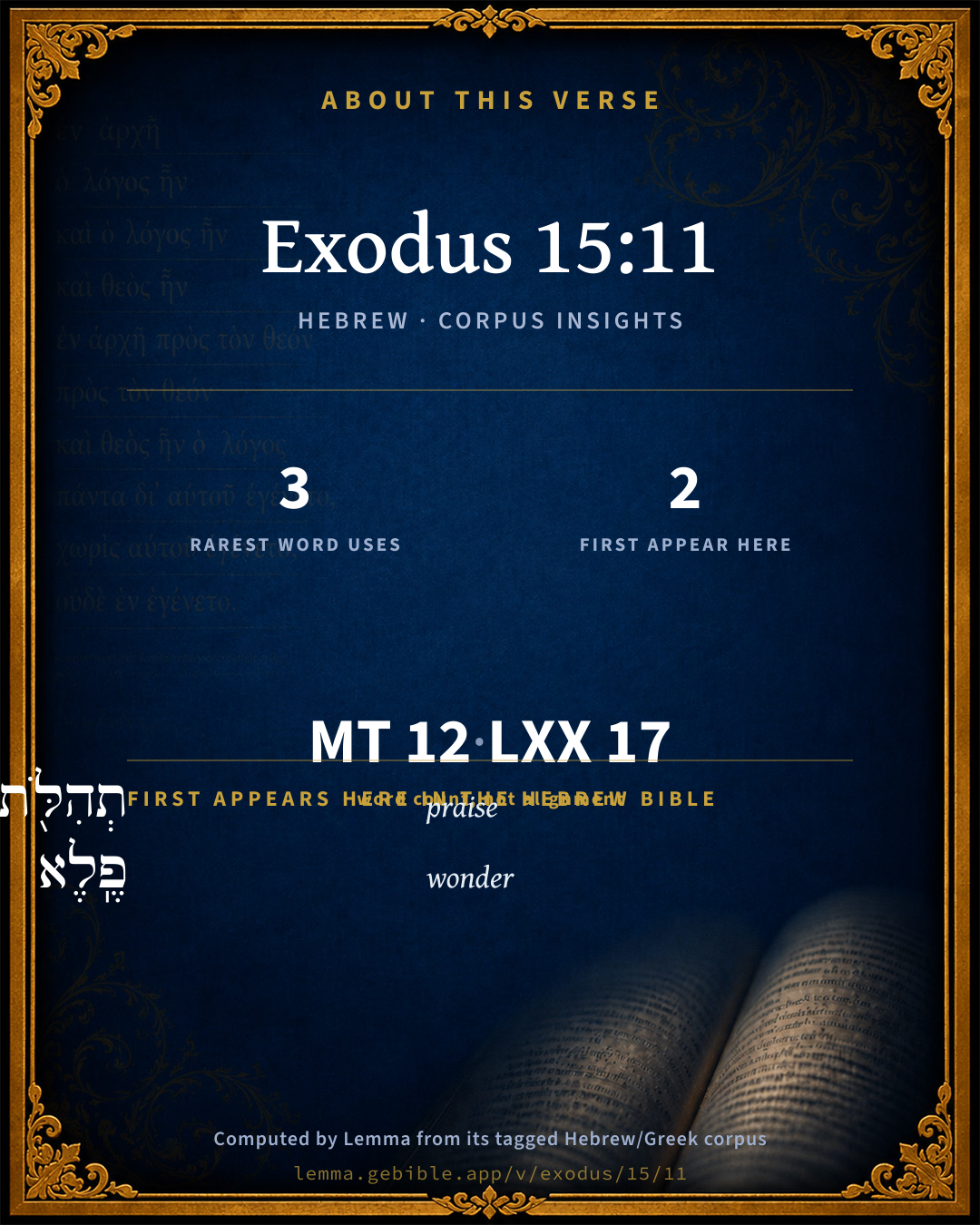
  • 2 first appearances in the Hebrew Bible
Full analysis ↓
Download a study sheet

One document with this verse’s original text, its word-by-word gloss line, the meaning frame, cross-references with their text, attributed commentary, and full source and license credits — printable, and it pastes into notes with its structure intact.

This verse Autodidact and up

Study sheet (.html) Plain text (.txt)

A passage Seminary Student

Up to 50 verses in one chapter. A passage sheet keeps up to 6 commentary sources and 12 cross-references per verse, in the order this page ranks them, and says so on the sheet whenever that leaves anything out. Ask for a single verse and you get the Autodidact verse sheet above.

Everything on this page stays free to read, with no account — the sheet is a download of what is already on screen, not access to it.

Want to remove ads? Support Godless Engineer
Compare translations 3

The same verse in 3 English versions, stacked beneath the original-language interlinear above. Click any original word for its lexicon entry.

Each is an independent rendering of the whole verse — the interlinear is not word-aligned to these translations.

Highlighted words mark where these versions differ — a whole-verse word diff, not a word-by-word alignment.

  • World English Bible Public Domain
    Who is like you, Yahweh, among the gods? Who is like you, glorious in holiness, Fearful in praises, doing wonders?
  • King James Version Public Domain
    Who is like unto thee, O LORD, among the gods? who is like thee, glorious in holiness, fearful in praises, doing wonders?
  • unfoldingWord Literal Text CC BY-SA 4.0
    Who is like you among the gods Yahweh? Who is like you, majestic in holiness, feared in praises, doing miracles?

unfoldingWord Literal Text — © unfoldingWord, licensed CC BY-SA 4.0. Word-aligned USFM3 via Door43 (git.door43.org/unfoldingWord/en_ult).

Versions to compare (up to 4)

3 of 4 selected

Show all 18 translations

Every available English version of this verse, each an independent rendering of the whole verse.

  • World English Bible Public Domain
    Who is like you, Yahweh, among the gods? Who is like you, glorious in holiness, Fearful in praises, doing wonders?
  • Berean Standard Bible Public Domain
    Who among the gods is like You, O LORD? Who is like You—majestic in holiness, revered with praises, performing wonders?
  • Majority Standard Bible Public Domain
    Who among the gods is like You, O LORD? Who is like You—majestic in holiness, revered with praises, performing wonders?
  • King James Version Public Domain
    Who is like unto thee, O LORD, among the gods? who is like thee, glorious in holiness, fearful in praises, doing wonders?
  • American Standard Version (1901) Public Domain
    Who is like unto thee, O Jehovah, among the gods? Who is like thee, glorious in holiness, Fearful in praises, doing wonders?
  • Revised Version (1885) Public Domain
    Who is like unto thee, O LORD, among the gods? Who is like thee, glorious in holiness, Fearful in praises, doing wonders?
  • Geneva Bible (1599) Public Domain
    Who is like vnto thee, O Lord, among the Gods! who is like thee so glorious in holinesse, fearefull in prayses, doing wonders!
  • Douay-Rheims (1899) Public Domain
    Who is like to thee, among the strong, O Lord? who is like to thee, glorious in holiness, terrible and praiseworthy, doing wonders?
  • Young's Literal Translation Public Domain
    Who `is' like Thee among the gods, O Jehovah? Who `is' like Thee -- honourable in holiness -- Fearful in praises -- doing wonders?
  • Literal Standard Version CC BY-SA 4.0
    Who [is] like You among the gods, O YHWH? Who [is] like You—honorable in holiness—Fearful in praises—doing wonders?
  • Unlocked Literal Bible CC BY-SA 4.0
    Who is like you, Yahweh, among the gods? Who is like you, majestic in holiness, honored in praises, doing miracles?
  • unfoldingWord Literal Text CC BY-SA 4.0
    Who is like you among the gods Yahweh? Who is like you, majestic in holiness, feared in praises, doing miracles?
  • Darby Bible Public Domain
    Who is like unto thee, Jehovah, among the gods? Who is like unto thee, glorifying thyself in holiness, Fearful [in] praises, doing wonders?
  • World Messianic Bible Public Domain
    Who is like you, LORD, among the gods? Who is like you, glorious in holiness, fearful in praises, doing wonders?
  • Webster's Bible Public Domain
    Who is like to thee, O LORD, among the gods? who is like thee, glorious in holiness, fearful in praises, doing wonders!
  • Free Bible Version CC BY-SA 4.0
    Who is like you among the gods, Lord? Who is like you, glorious in holiness, awesome in wonder, doing miracles?
  • Bible in Basic English Public Domain
    Who is like you, O Lord, among the gods? who is like you, in holy glory, to be praised with fear, doing wonders?
  • JPS Tanakh (1917) Public Domain
    Who is like unto Thee, O LORD, among the mighty? who is like unto Thee, glorious in holiness, fearful in praises, doing wonders?

Literal Standard Version (2020), Covenant Press — licensed CC BY-SA 4.0. Text via the HelloAO Bible API (eBible.org). Unlocked Literal Bible (unfoldingWord) — licensed CC BY-SA 4.0. Text via the HelloAO Bible API (eBible.org). unfoldingWord Literal Text — © unfoldingWord, licensed CC BY-SA 4.0. Word-aligned USFM3 via Door43 (git.door43.org/unfoldingWord/en_ult). Free Bible Version, Dr. Jonathan Gallagher — licensed CC BY-SA 4.0. Text via the HelloAO Bible API (eBible.org).

Word by word

More ways to search: Search by grammar → Find every occurrence → Compare this word →

Practice this passage: Drill this verse → Learn its vocabulary →

נֶאְדָּ֣ר
ʼâdar
H142
“being great”
Verb, Niphal, Participle Active, Masculine, Singular, Absolute
Part of Speech
Verb
Stem
Niphal
Form
Participle Active
Gender
Masculine
Number
Singular
State
Absolute
Full BDB Definition

Origin: a primitive root

TWOT: 28

to be great, be majestic, wide, noble (poetic) - (Niphal) majestic, glorious (participle) - (Hiphil) make glorious
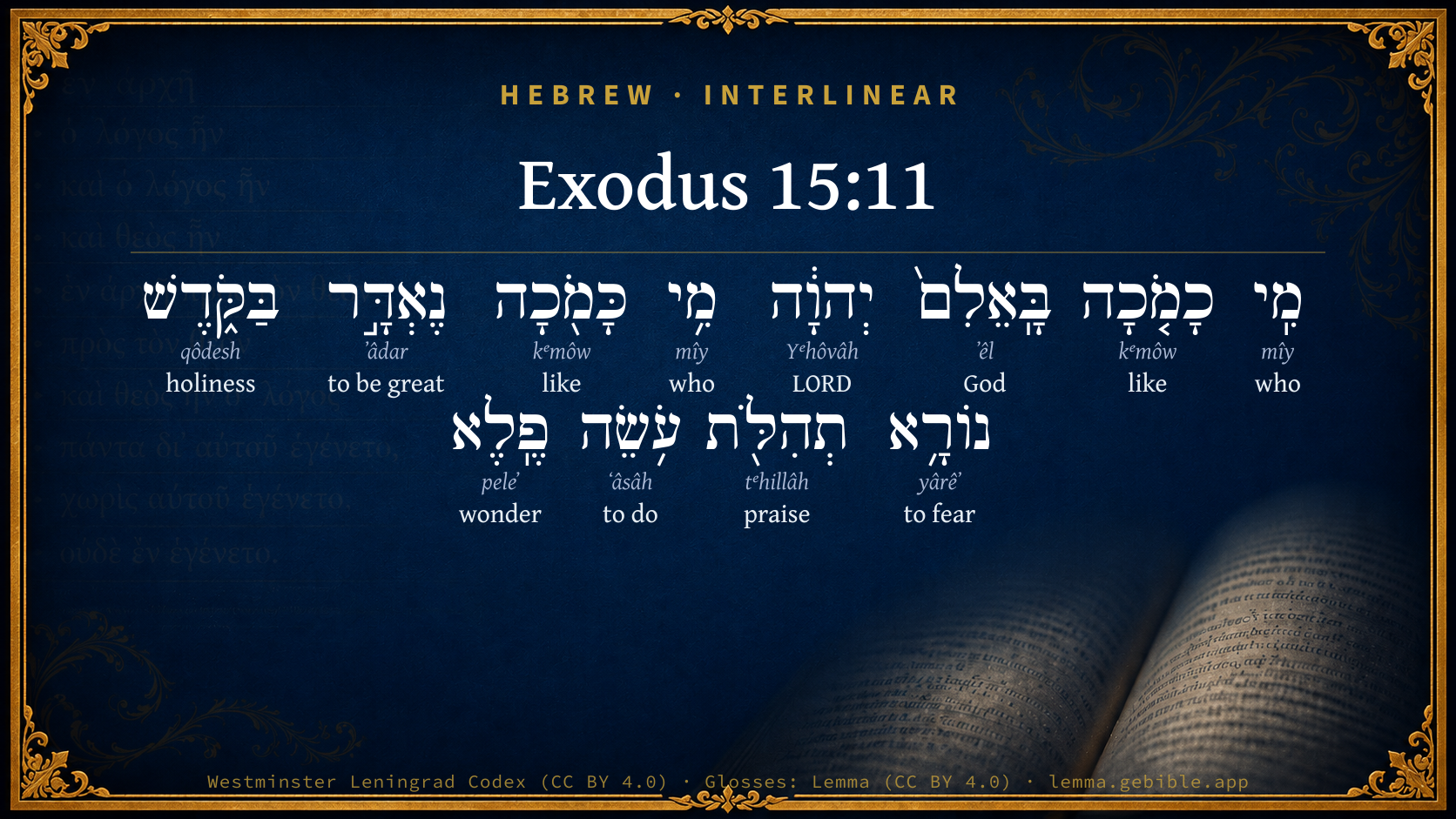
  1. מִֽי mîy H4310 “who” Particle, Interrogative
  2. כָמֹ֤כָה kᵉmôw H3644 “like · you” Preposition + Suffix, Personal, 2nd Person, Masculine, Singular
  3. בָּֽאֵלִם֙ ʼêl H410 “in/at the · gods” Preposition, Determined + Noun, Common, Masculine, Plural, Absolute
  4. יְהוָ֔ה Yᵉhôvâh H3068 “LORD” Noun, Proper
  5. מִ֥י mîy H4310 “who” Particle, Interrogative
  6. כָּמֹ֖כָה kᵉmôw H3644 “like · you” Preposition + Suffix, Personal, 2nd Person, Masculine, Singular
  7. בַּקֹּ֑דֶשׁ qôdesh H6944 “in/at the · holiness” Preposition, Determined + Noun, Common, Masculine, Singular, Absolute
  8. נוֹרָ֥א yârêʼ H3372 “fearing” Verb, Niphal, Participle Active, Masculine, Singular, Absolute
  9. תְהִלֹּ֖ת tᵉhillâh H8416 “praises” Noun, Common, Feminine, Plural, Absolute
  10. עֹ֥שֵׂה ʻâsâh H6213 “doing” Verb, Qal, Participle Active, Masculine, Singular, Construct
  11. פֶֽלֶא peleʼ H6382 “wonder” Noun, Common, Masculine, Singular, Absolute

About this verse

These counts appear in no published source. They are computed here, from the morphology-tagged text and Lemma’s own curated glosses. What Lemma adds →

12
words
10
distinct lemmas
Pentateuch
section

Notable vocabulary

The rarest word here is נֶאְדָּ֣ר to be great H142 — appearing just 3 times in the whole Hebrew Bible.

First appearance in Scripture

These words make their first canonical appearance in the Hebrew Bible here:

  • תְהִלֹּ֖ת praise H8416
  • פֶֽלֶא wonder H6382

Shared distinctive vocabulary

נֶאְדָּ֣ר to be great H142 occurs in 3 verses of the Hebrew Bible. Also found in:

Grammatical profile

  • 3 verbs
  • 5 nouns
  • 2 prepositions
  • 2 particles

Verb forms

  • נֶאְדָּ֣ר Niphal · Participle Active
  • נוֹרָ֥א Niphal · Participle Active
  • עֹ֥שֵׂה Qal · Participle Active

Repetition

Words recur within this verse — often emphatic in Hebrew:

  • כָמֹ֤כָה like H3644 ×2
  • מִֽי who H4310 ×2

Hebrew & Septuagint length

In English translation the verse runs 20 words from the Hebrew and 23 from the Septuagint (LXX English) — closely comparable.

A rough comparison of the two English renderings, which tokenize alike — not a word-level alignment.

Word counts can differ between the Hebrew and the Greek without any difference in meaning — e.g. the Hebrew direct-object marker אֵת has no separate Greek word, and Greek often adds the article ὁ.

In the original languages it is 12 Hebrew tokens and 17 Greek tokens — but the two are counted differently (Hebrew bundles its prefixes and suffixes into one token; the Greek is in lemma form), so that isn’t a like-for-like length.

Cross-references

32

Topical passages linked to Exodus 15:11 in the Treasury of Scripture Knowledge — connected by theme and wording, ordered by reader-vote popularity; previews shown in the World English Bible.

  • 1 Kings 8:23 and he said, Yahweh, the God of Israel, there is no God like you, in heaven above, or on earth beneath; who keep covenant and loving kindness with your servants, who walk before you with all their heart;
  • Psalms 89:5–8 The heavens will praise your wonders, Yahweh; Your faithfulness also in the assembly of the holy ones.
  • 1 Samuel 2:2 There is none holy as Yahweh; For there is none besides you, Neither is there any rock like our God.
  • 2 Samuel 7:22 Therefore you are great, Yahweh God: for there is none like you, neither is there any God besides you, according to all that we have heard with our ears.
  • Revelation 4:8 The four living creatures, each one of them having six wings, are full of eyes around about and within. They have no rest day and night, saying, "Holy, holy, holy, holy, holy, holy, holy, holy, holy is the Lord God, the Almighty, who was and who is and who is to come!"
  • Isaiah 6:3 One called to another, and said, "Holy, holy, holy, is Yahweh of Hosts! The whole earth is full of his glory!"
  • Jeremiah 10:6–7 There is none like you, Yahweh; you are great, and your name is great in might.
  • Deuteronomy 3:24 Lord Yahweh, you have begun to show your servant your greatness, and your strong hand: for what god is there in heaven or in earth, that can do according to your works, and according to your mighty acts?
  • Psalms 86:8 There is no one like you among the gods, Lord, Nor any deeds like your deeds.
  • Psalms 77:14 You are the God who does wonders. You have made your strength known among the peoples.
  • Deuteronomy 33:26 There is none like God, Jeshurun, Who rides on the heavens for your help, In his excellency on the skies.
  • Isaiah 40:25 To whom then will you liken me, that I should be equal [to him]? says the Holy One.
  • Revelation 15:4 Who wouldn't fear you, Lord, And glorify your name? For you only are holy. For all the nations will come and worship before you. For your righteous acts have been revealed."
  • Exodus 8:10 He said, "Tomorrow." He said, "Be it according to your word, that you may know that there is none like Yahweh our God.
  • Psalms 77:19 Your way was through the sea; Your paths through the great waters. Your footsteps were not known.
  • Isaiah 40:18 To whom then will you liken God? or what likeness will you compare to him?
  • Psalms 35:10 All my bones shall say, "Yahweh, who is like you, Who delivers the poor from him who is too strong for him, Yes, the poor and the needy from him who robs him?"
  • Isaiah 64:2–3 as when fire kindles the brushwood, [and] the fire causes the waters to boil; to make your name known to your adversaries, that the nations may tremble at your presence!
  • Psalms 66:5 Come, and see God's deeds-- Awesome work on behalf of the children of men.
  • Psalms 145:17 Yahweh is righteous in all his ways, And gracious in all his works.
  • Isaiah 57:15 For thus says the high and lofty One who inhabits eternity, whose name is Holy: I dwell in the high and holy place, with him also who is of a contrite and humble spirit, to revive the spirit of the humble, and to revive the heart of the contrite.
  • 1 Peter 1:15–16 but just as he who called you is holy, you yourselves also be holy in all of your behavior;
  • Jeremiah 49:19 Behold, he shall come up like a lion from the pride of the Jordan against the strong habitation: for I will suddenly make them run away from it; and whoever is chosen, him will I appoint over it: for who is like me? and who will appoint me a time? and who is the shepherd who will stand before me?
  • Revelation 19:1–6 After these things I heard something like a loud voice of a great multitude in heaven, saying, "Hallelujah! Salvation, power, and glory belong to our God:
  • Jeremiah 10:16 The portion of Jacob is not like these; for he is the former of all things; and Israel is the tribe of his inheritance: Yahweh of Hosts is his name.
  • Psalms 90:11 Who knows the power of your anger, Your wrath according to the fear that is due to you?
  • Psalms 119:120 My flesh trembles for fear of you. I am afraid of your judgments.
  • Hebrews 12:28–29 Therefore, receiving a Kingdom that can't be shaken, let us have grace, through which we serve God acceptably, with reverence and awe,
  • Luke 12:5 But I will warn you whom you should fear. Fear him, who after he has killed, has power to cast into Gehenna. Yes, I tell you, fear him.
  • Leviticus 19:2 "Speak to all the congregation of the children of Israel, and tell them, 'You shall be holy; for I Yahweh your God am holy.
  • Isaiah 30:11 get out of the way, turn aside out of the path, cause the Holy One of Israel to cease from before us."
  • Psalms 89:18 For our shield belongs to Yahweh; Our king to the Holy One of Israel.

Cross-references courtesy of OpenBible.info (CC BY 4.0).

Hebrew and Greek witnesses Masoretic Hebrew ↔ Greek Septuagint

The same verse in the two great witnesses to the Old Testament, shown verse-for-verse.

These are two independent witnesses, not word-aligned to each other, and the Septuagint is shown in lemma (dictionary) form.

Hebrew Exodus 15:11 Masoretic · Westminster Leningrad Codex

מִֽי כָמֹ֤כָה בָּֽאֵלִם֙ יְהוָ֔ה מִ֥י כָּמֹ֖כָה נֶאְדָּ֣ר בַּקֹּ֑דֶשׁ נוֹרָ֥א תְהִלֹּ֖ת עֹ֥שֵׂה פֶֽלֶא

Who is like you, Yahweh, among the gods? Who is like you, glorious in holiness, Fearful in praises, doing wonders?

World English Bible · Public Domain

Greek LXX Exodus 15:11 Septuagint · lemma form

τίς ὅμοιος σύ ἐν θεός κύριος τίς ὅμοιος σύ δοξάζω ἐν ἅγιος θαυμαστός ἐν δόξα ποιέω τέρας

Who is like to you among the gods, O Lord? who is like to you? glorified in holiness, marvelous in glories, doing wonders.

LXX2012 (modern English Septuagint) · Public Domain

On this verse, Haydock's Catholic Bible Commentary discusses the Septuagint’s reading. Read the note in Commentary ↓

Hebrew: Westminster Leningrad Codex (CC BY 4.0). Greek: Septuagint (public domain); English from LXX2012 (modern English Septuagint) (Public Domain). How the Septuagint differs from the Hebrew →

Targum (Aramaic paraphrase)

2

The Targum is the ancient Jewish Aramaic paraphrase of the Hebrew Scriptures — an interpretive translation, not the Hebrew text itself. Onkelos (literal) and Pseudo-Jonathan (expansive) render the Torah, and Jonathan the Prophets. Coverage is partial: where no permissively-licensed English translation exists for a verse, only the Aramaic is shown. This is verse-level text, not a word-by-word alignment to the Hebrew.

  1. Targum Onkelos Torah (Genesis–Deuteronomy)
    לֵית בַּר מִנָךְ דְאַתְּ הוּא אֱלָהָא יְיָ לֵית בַּר מִנָךְ אֱלָהָא אַתְּ אַדִיר בְּקוּדְשָׁא דָחֵל תֻּשְׁבְּחָן עָבֵד פָּרִישָׁן:

    (no public-domain English translation for this verse)

    Targum Onkelos — Aramaic: “Onkelos Genesis” (public domain); “Onkelos Exodus” (public domain); “Onkelos Leviticus” (public domain); “Onkelos Numbers” (public domain); “Onkelos Deuteronomy” (public domain). English: “Sefaria Community Translation” (CC0 1.0 (public-domain dedication)); “J.W. Etheridge. The Targums of Onkelos and Jonathan Ben Uzziel on the Pentateuch. London: Longmans, Green, 1862” (public domain). Text via Sefaria.

  2. Targum Pseudo-Jonathan Torah (Genesis–Deuteronomy)
    מָן כְּוָותָךְ בְּאֵילֵי מְרוֹמָא יְיָ מָן כְּוָותָךְ הָדוּר בְּקוּדְשָׁא דָּחֵיל בְּתוּשְׁבְּחָן עֲבֵד נִסִין וּפְרִשַׁן לְעַמֵּיהּ בֵּית יִשְרָאֵל

    Who is like Thee among the exalted gods, O Lord, who is like Thee, glorious in holiness, fearful in praises, doing wonders and manifestations for Thy people, the house of Israel?

    Targum Pseudo-Jonathan — Aramaic: “Targum Jonathan on Genesis” (public domain); “Targum Jonathan on Exodus” (public domain); “Targum Jonathan on Leviticus” (public domain); “Targum Jonathan on Numbers” (public domain); “Targum Jonathan on Deuteronomy” (public domain). English: “The Targum of Jonathan ben Uzziel, trans. J. W. Etheridge, London, 1862” (public domain). Text via Sefaria.

Commentary

Notes on Exodus 15:11 from classic Christian and Jewish commentators (each source and its license shown beneath its notes). The classic Christian expositions comment on the surrounding passage and are grouped to its opening verse, so a note may address several verses; the Jewish commentaries on the Tanakh (Rashi and others) are per-verse, so they appear only where the commentator wrote on this verse.

Lemma curates 59 commentaries, every one of them public domain or Creative Commons licensed, each selected and text-cleaned for this edition rather than reprinted as found. About our sources →

Trapp's Complete Commentary

John Trapp

Exo 15:11 Who [is] like unto thee, O LORD, among the gods? who [is] like thee, glorious in holiness, fearful [in] praises, doing wonders?

Ver. 11. Who is like unto thee?] One of the most stately descriptions of God that is found in Holy Writ. God is to be magnified: we must make room for him. This chapter Exo 15:1-27 and Jdg 5:1-31 are rightly called by one, "monumental chapters."

John Trapp, A Commentary or Exposition upon All the Books of the Old and New Testament (1647–1656) — public domain. Text from a community e-Sword module.

The Biblical Illustrator

Joseph S. Exell

Exo_15:11

Who is like unto Thee, O Lord, among the gods?

The incomparable God

I. Who is like unto thee, o lord, among the gods?

1. King of kings and Lord of lords! Who among the gods is like unto Thee in majesty and power? Well might Israel exultingly make this inquiry.

2. Who is like unto Thee in the ineffable purity of Thy nature? Glorious in holiness!

3. Who is like unto Thee in the solemnity and sanctity of Thy worship?--fearful in praises! The gloriously holy God is alone worthy to be praised, but that praise ought to be offered with reverence and godly fear.

II. Who does like Thee?--doing wonders.

1. The wonders alluded in the text were undoubtedly the miracles recently wrought by Jehovah for the salvation of His people. Thou art the God that doest wonders, etc. (Psa_77:14-20).

2. But not only miracles, which imply an inversion or suspension of the laws of nature, but nature and her laws--every part of the work of God in the heavens and in the earth is wonderful, and amply shows forth the power and wisdom of the Creator (Job_37:14-23; Psa_8:3-4; Psa_19:1-7). If we only study our own frame, we shall be led to exclaim with the Psalmist, I am fearfully and wonderfully made!

3. The Lord sometimes does wonders in judgment, flood, etc.

4. The Lord does wonders in mercy. Redemption. (B. Bailey.)

Glorious in holiness.--

The holiness of God

Plutarch said not amiss, that he should count himself less injured by that man that should deny that there was such a man as Plutarch, than by him that should affirm that there was such a one indeed, but he was a debauched fellow, a loose and vicious person. He that saith, God is not holy, speaks much worse than he that saith, There is no God at all. Let these two things be considered:

1. If any, this attribute hath an excellency above His other perfections.

(1) None is sounded out with such solemnity, and so frequently by angels that stand before His throne, as this.

(2) He singles it out to swear by (Psa_89:35; Amo_4:2).

(3) It is His glory and beauty. Holiness is the honour of the creature--sanctification and honour are linked together (1Th_4:4)--much more is it the honour of God; it is the image of God in the creature (Eph_4:24).

(4) It is His very life; so it is called (Eph_4:18).

2. As it seems to challenge an excellency above all His other perfections, so it is the glory of all the rest; as it is the glory of the Godhead, so it is the glory of every perfection in the Godhead; as His power is the strength of them, so His holiness is the beauty of them; as all would be weak without almightiness to back them, so all would be uncomely without holiness to adorn them. Should this be sullied, all the rest would lose their honour and their comfortable efficacy; as at the same instant that the sun should lose its light, it would lose its heat, its strength, its generative and quickening virtue.

I. The nature of Divine holiness. The holiness of God negatively is a perfect freedom from all evil. As we call gold pure that is not imbased by any dross, and that garment clean that is free from any spot, so the nature of God is estranged from all shadow of evil, all imaginable contagion. Positively, it is the rectitude of the Divine nature, or that conformity of it in affection and action to the Divine will as to His eternal law, whereby He works with a becomingness to His own excellency, and whereby He hath a complacency in everything agreeable to His will, and an abhorrency of everything contrary thereunto. In particular. This property of the Divine nature is--

1. An essential and necessary perfection. He is essentially and necessarily holy. His holiness is as necessary as His being, as necessary as His omniscience.

2. God is absolutely holy (1Sa_2:2).

3. God is so holy, that He cannot possibly approve of any evil done by another, but doth perfectly abhor it; it would not else be a glorious holiness (Psa_5:3), He hath no pleasure in wickedness. He doth not only love that which is just, but abhor with a perfect hatred all things contrary to the rule of righteousness. Holiness can no more approve of sin than it can commit it.

4. God is so holy, that He cannot but love holiness in others. Not that He owes anything to His creature, but from the unspeakable holiness of His nature, whence affections to all things that bear a resemblance of Him do flow; as light shoots out from the sun, or any glittering body. It is essential to the infinite righteousness of His nature, to love righteousness wherever He beholds it (Psa_11:7).

5. God is so holy, that He cannot positively will or encourage sin in any.

6. God cannot act any evil in or by Himself.

II. The proof that God is holy.

1. His holiness appears as He is Creator, in framing man in a perfect uprightness.

2. His holiness appears in His laws, as He is a Lawgiver and a Judge. This purity is evident--

(1) In the moral law, or law of nature;

(2) In the ceremonial law;

(3) In the allurements annexed to it for keeping it, and the affrightments to restrain from the breaking of it;

(4) In the judgments inflicted for the violation of it.

3. The holiness of God appears in our restoration. It is in the glass of the gospel we behold the glory of the Lord (2Co_3:18); that is, the glory of the Lord, into whose image we are changed; but we are changed into nothing as the image of God but into holiness. We bore not upon us by creation, nor by regeneration, the image of any other perfection. We cannot be changed into His omnipotence, omniscience, etc., but into the image of His righteousness. This is the pleasing and glorious sight the gospel mirror darts in our eyes. The whole scene of redemption is nothing else but a discovery of judgment and righteousness. Zion shall be redeemed with judgment, and her converts with righteousness (Isa_1:27).

(1) This holiness of God appears in the manner of our restoration, viz., by the death of Christ.

(2) The holiness of God in His hatred of sin appears in our justification, and the conditions He requires of all that would enjoy the benefit of redemption.

(3) It appears in the actual regeneration of the redeemed soul, and a carrying it on to a full perfection. As election is the effect of Gods sovereignty, our pardon the fruit of His mercy, our knowledge a stream from His wisdom, our strength an impression of His power, so our purity is a beam from His holiness. The whole work of sanctification, and the preservation of it, our Saviour begs for His disciples of His Father under this title (Joh_17:11; Joh_17:17).

III. The third thing I am to do, is to lay down some propositions in the defence of Gods holiness in all His acts about or concerning sin.

1. Gods holiness is not chargeable with any blemish, for His creating man in a mutable slate. It was suitable to the wisdom of God to give the rational creature, whom He had furnished with a power of acting righteously, the liberty of choice, and not fix him in an unchangeable state, without a trial of him in his natural. And if he did obey, his obedience might be the more valuable; and if he did freely offend, his offence might be more inexcusable.

(1) No creature can be capable of immutability by nature. Mutability is so essential to a creature, that a creature cannot be supposed without it.

(2) Though God made the creature mutable, yet He made Him not evil. There could be nothing of evil in him that God created after His own image, and pronounced good (Gen_1:27; Gen_1:31).

(3) Therefore it follows, that though God created man changeable, yet He was not the cause of his change by his fall.

2. Gods holiness is not blemished by enjoining man a law which He knew he would not observe.

(1) The law was not above his strength.

(2) Though the law now be above the strength of man, yet is not the holiness of God blemished by keeping it up. It is true, God hath been graciously pleased t,, mitigate the severity of the law by the entrance of the gospel; yet, where men refuse the terms of the gospel they continue themselves under the condemnation of the law, and are justly guilty of the breach of it, though they have no strength to observe it.

(3) Gods foreknowledge that His law would not be observed lays no blame upon Him. Though the foreknowledge of God be infallible, yet it doth not necessitate the creature in acting.

3. The holiness of God is not blemished by decreeing the eternal rejection of some men.

4. The holiness of God is not blemished by His secret will to suffer sin to enter into the world. God never willed sin by His preceptive will. It was never founded upon, or produced by any word of His, as the creation was. Nor doth He will it by His approving will; it is detestable to Him, nor ever can be otherwise. He cannot approve it either before commission or after.

IV. The point was, that holiness is a glorious perfection of the nature of God. We have showed the nature of this holiness in God, what it is, and we have demonstrated it, and proved that God is holy, and must needs be so, and also the purity of His nature in all His acts about sin. Let us now improve it by way of use.

1. Is holiness a transcendent perfection belonging to the nature of God? The first use shall be of instruction and information.

(1) How great and how frequent is the contempt of this eminent perfection in the Deity!

(2) It may inform us how great is our fall from God, and how distant we are from Him.

(3) All unholiness is vile and opposite to the nature of God.

(4) Sin cannot escape a due punishment. A hatred of unrighteousness, and consequently a will to punish it, is as essential to God as a love of righteousness.

(5) There is therefore a necessity of the satisfaction of the holiness of God by some sufficient mediator. The Divine purity could not meet with any acquiescence in all mankind after the Fall.

(6) Hence it will follow, there is no justification of a sinner by anything in himself.

2. The second use is for comfort. This attribute frowns upon lapsed nature, but smiles in the restorations made by the gospel.

3. Is holiness an eminent perfection of the Divine nature? Then--

(1) Let us get and preserve right and strong apprehensions of this Divine perfection.

(2) Is holiness a perfection of the Divine nature? Is it the glory of the Deity? Then let us glorify this holiness of God.

(3) Since holiness is an eminent perfection of the Divine nature, let us labour after a conformity to God in this perfection.

(4) If holiness be a perfection belonging to the nature of God, then, where there is some weak conformity to the holiness of God, let us labour to grow up in it, and breathe after fuller measures of it.

(5) Let us carry ourselves holily in a spiritual manner in all our religious approaches to God (Psa_93:5).

(6) Let us address for holiness to God the fountain of it. As He is the author of bodily life in the creature, so He is the author of His own life, the life of God in the soul. (S. Charnock, B. D.)

God the pattern of holiness

No creature can be essentially holy but by participation from the chief fountain of holiness, but we must have the same kind of holiness, the same truth of holiness; as a short line may be as straight as another, though it parallel it not in the immense length of it; a copy may have the likeness of the original, though not the same perfection. We cannot be good without eyeing some exemplar of goodness as the pattern. No pattern, is so suitable as that which is the highest goodness and purity. That limner that would draw the most excellent piece fixes his eye upon the most excellent pattern. He that would be a good orator, or poet, or artificer, considers some person most excellent in each kind as the object of his imitation. Who so fit as God to be viewed as the pattern of holiness in our intendment of, and endeavours after, holiness? The Stoics, one of the best sects of philosophers, advised their disciples to pitch upon some eminent example of virtue, according to which to form their lives, as Socrates, etc. But true holiness doth not only endeavour to live the life of a good man, but chooses to live a Divine life. As before the man was alienated from the life of God, so upon his return he aspires after the life of God. To endeavour to be like a good man is to make one image like another, to set our clocks by other clocks without regarding the sun; but true holiness consists in a likeness to the most exact sampler. God being the first purity, is the rule as well as the spring of all purity in the creature, the chief and first object of imitation. (S. Charnock, B. D.)

The holiness of God and that of His best saints

There is as little proportion between the holiness of the Divine majesty and that of the most righteous creature, as there is between the nearness of a person that stands upon a mountain to the sun, and of him that beholds him in a vale; one is nearer than the other, but it is an advantage not to be boasted, in regard of the vast distance that is between the sun and the elevated spectator. (S. Charnock, B. D.)

God loves holiness

God is essentially, originally, and efficiently holy: all the holiness in men and angels is but a crystal stream that runs from this glorious ocean. God loves holiness, because it is His own image. A king cannot but love to see his own effigies stamped on coin. God counts holiness His own glory, and the most sparkling jewel of His crown. Glorious in holiness. (T. Watson.)

The Biblical Illustrator, edited by Joseph S. Exell (c. 1880s–1900s) — public domain. Text from a community e-Sword module.

Joseph Benson's Commentary

Exo 15:11. Who is like unto thee, O Lord, among the gods? — So called; the idols or princes. To the wonderful relation above mentioned, succeeds a wonderful expression of praise. And how, indeed, could the writer possibly avoid being transported, and carried, as it were, out of himself at the sight of such a wonder? Well might he describe Jehovah, that performed it, as glorious in holiness — In justice, mercy, and truth; fearful in praises — A Being that ought to be praised with the deepest reverence, and most exalted adoration.

Joseph Benson's Commentary on the Old and New Testaments (1811–1818) — public domain. Text from a community e-Sword module.

Tyndale Open Study Notes

Tyndale Open Resources

15:11 The gods of the pagan nations are not in the same category as the Lord. They do not deserve to be called holy (see study note on 3:5).

Tyndale Open Study Notes — © Tyndale Open Resources, licensed CC BY-SA 4.0. Text via the HelloAO Bible API.

Geneva Bible (1599)

Geneva Bible translators

Which oughtest to be praised with all fear and reverence.

For so oftentimes the Scripture calleth the mighty men of the world.

Geneva Bible (1599) marginal notes — public domain. Text via Bolls.life.

Adam Clarke's Commentary

Verse 11. Who is like unto thee, O Lord, among the gods?] We have already seen that all the Egyptian gods, or the objects of the Egyptians' idolatry, were confounded, and rendered completely despicable, by the ten plagues, which appear to have been directed principally against them. Here the people of God exult over them afresh: Who among these gods is like unto THEE? They can neither save nor destroy; THOU dost both in the most signal manner.

As the original words מי כמכה באלם יהוה mi chamochah baelim Yehovah are supposed to have constituted the motto on the ensign of the Asmoneans, and to have furnished the name of Maccabeus to Judas, their grand captain, from whom they were afterwards called Maccabeans, it may be necessary to say a few words on this subject It is possible that Judas Maccabeus might have had this motto on his ensign, or at least the initial letters of it, for such a practice was not uncommon. For instance, on the Roman standard the letters S. P. Q. R. stood for Senatus Populus Que Romanus, i.e. the Senate and Roman People, and מ כ ב י M. C. B. I. might have stood for Mi Chamochah Baelim Jehovah, "Who among the gods (or strong ones) is like unto thee, O Jehovah!" But it appears from the Greek Μακκαβαιος, and also the Syriac [Syriac] makabi, that the name was written originally with ק koph, not כ caph. It is most likely, as Michaelis has observed, that the name must have been derived from מקב makkab, a hammer or mallet; hence Judas, because of his bravery and success, might have been denominated the hammer or mallet by which the enemies of God had been beaten, pounded, and broken to pieces. Judas, the hammer of the Lord.

Glorious in holiness] Infinitely resplendent in this attribute, essential to the perfection of the Divine nature.

Fearful in praises] Such glorious holiness cannot be approached without the deepest reverence and fear, even by angels, who veil their faces before the majesty of God. How then should man, who is only sin and dust, approach the presence of his Maker!

Doing wonders?] Every part of the work of God is wonderful; not only miracles, which imply an inversion or suspension of the laws of nature, but every part of nature itself. Who can conceive how a single blade of grass is formed; or how earth, air, and water become consolidated in the body of the oak? And who can comprehend how the different tribes of plants and animals are preserved, in all the distinctive characteristics of their respective natures? And who can conceive how the human being is formed, nourished, and its different parts developed? What is the true cause of the circulation of the blood? or, how different ailments produce the solids and fluids of the animal machine? What is life, sleep, death? And how an impure and unholy soul is regenerated, purified, refined, and made like unto its great Creator? These are wonders which God alone works, and to himself only are they fully known.

Adam Clarke's Commentary on the Bible (1810–1826) — public domain. Text from a community e-Sword/MySword module.

Ellicott's Commentary for English Readers

(11) Who is like unto thee . . . Among the gods ?—This is undoubtedly the true meaning. It had been a main object of the entire series of miraculous visitations to show that Jehovah was “exalted far above all other gods.” (See Exo_7:5; Exo_14:4; Exo_14:18.) Moses now emphasises the contrast by adducing three points on which Jehovah is unapproachable—holiness, awefulness, and miraculous power. God is (1) “glorious in holiness,” exalted in this respect far, far above all other beings; (2) “fearful in praises”—the proper object of the profoundest awe, even to those who approach Him with praise and thanksgiving; and (3) one who “doeth wonders,” who both through nature, and on occasions overruling nature, accomplishes the most astonishing results, causing all men to marvel at His Almighty power. The gods of the heathen were, in fact, either nonentities or evil spirits. So far as they were the former, they could come into no comparison at all with Jehovah; so far as they were the latter, they fell infinitely short of Him in every respect. Of holiness they possessed no remnant; in awfulness they were immeasurably inferior; in the ability to work wonders they did not deserve to be mentioned in the same breath. “Among the gods,” as the Psalmist says, “there is none like unto thee, O Lord; there is none that can do as thou doest” (Psa_86:8).

(11, 12) Stanza 3 is a short one, entering into no details—simply summing up the entire result in two sentences: one, parallel to Exo_15:2-3; Exo_15:6-7, setting forth the glory of God, as shown in the occurrences; the other emphasising the great fact of the occasion, and stating it in the briefest possible terms: “Thou stretchedst out thy right hand; the earth swallowed them.” This second clause is parallel to Exo_15:4-5; Exo_15:8-10. It concentrates into four words the gist of those two passages.

A Bible Commentary for English Readers, edited by Charles John Ellicott (1878–1897) — public domain. Text from a community e-Sword module.

The Cambridge Bible for Schools and Colleges

gen. ed. J. J. S. Perowne

11. No god is comparable to Jehovah, whether among the gods of Egypt or those of any other country. Cf. Exo_18:11; Psa_71:19 c, Psa_77:13, Psa_86:8, Psa_89:6; Psa_89:8, Psa_95:3, Psa_96:4, Psa_97:9; Jer_10:6.

glorious (v. 6) in holiness] i.e. in loftiness, greatness, unapproachableness,—in a word in all the transcendent attributes which combine to constitute the idea of supreme Godhead; the ethical ideas which we associate with ‘holiness’ seem hardly to be thought of in passages like this. Cf. 1Sa_6:20; and Skinner in DB. ii. 396 f.; Davidson, OT. Theol. pp. 145 ff., 155; and below, on Exo_22:31.

Fearful in praises] i.e. in praiseworthy attributes; so Psa_9:14; Psa_78:4, Isa_60:6; Isa_63:7. Cf. Psa_66:5 ‘fearful in operation.’

doing wonders] The Heb., as Psa_77:14 (with allusion to the Exodus), Psa_78:12 (‘In the sight of their fathers he did wonders’), Isa_25:1.

11–17. Jehovah, the Incomparable One, thus saved Israel from its foes (vv. 11–12); and afterwards, in His goodness, led His people whom He had redeemed to their promised home, while the nations of Canaan and surrounding regions looked on, awestruck and powerless to arrest their advance.

The Cambridge Bible for Schools and Colleges (gen. ed. J. J. S. Perowne; Cambridge University Press, 1878–1918) — public domain. Text from a community e-Sword module.

John Gill's Exposition

Who is like unto thee, O Lord, among the gods?.... For the perfections of his nature, for the blessings of his goodness, and for the works of his hands; and especially for the greatness and excellency of his power, seen in the salvation of his people, and the ruin of their enemies: there is none like him "among the mighty ones", as it may be rendered; among the mighty angels, who excel in strength, and are sometimes called gods; or among the mighty ones on earth; or the sons of the mighty, kings, princes, judges, and civil magistrates of every rank and order; especially for the following things:

who is like thee, glorious in holiness? some understand this of the holy place, either heaven, where Christ is glorious above all created beings; or the church, where he shows himself glorious to his people: others, of holy persons, either holy angels, among whom he was at Sinai, and when he ascended on high, and will be when he comes again, in his own and his Father's glory; or the saints, when he will bring them with him, and be glorified in them; but rather it is to be understood of the attribute of his holiness, which is eminently and perfectly in him; in his person, with respect to both his natures, divine and human; the glory of which is displayed in all the works he has wrought, especially in the great work of redemption, which was undertook both for the honour of the holiness and righteousness of God, and to redeem his people from sin, and make them righteous and holy: it appears in the holy doctrines he taught, and in the holy commandments and ordinances he enjoined his people, and in his judgments on his enemies; in all which it is plainly seen that he loves righteousness and hates iniquity, and there is none like him for it; there is none holy as the Lord among angels or men, Sa1 2:2.

fearful in praises; or, in the things for which he is to be praised; as the glories and excellencies of his person, the blessings received from him, and through him, both temporal and spiritual; grace, and all the blessings of it here, now communicated, and glory and happiness promised and expected: and many things, for which he is to be praised, he is "fearful", awful, and tremendous in them; there are some things his right hand teaches him, and it does, deserving of praise, which yet are terrible, and such were they which are here literally, referred to; the plagues upon the Egyptians, and the destruction of Pharaoh and his host, called the wondrous works done in the land of Ham, and terrible things by the Red sea, Psa 106:22 and yet these were matter of praise to Israel, and gave occasion for this song; and such are they, in a spiritual sense, which he has done to his and our enemies: when the year of his redeemed was come, it was a day of vengeance in his heart, and he exercised it; he made an end of sin, abolished death, destroyed him which had the power of it, and spoiled principalities and powers; and a dreadful slaughter will be made of antichrist and his followers, when the song of Moses and the Lamb will be sung on account of it; and such dispensations of Providence, and judgments on men, as on Pharaoh and antichrist, as they are terrible to wicked men, they strike an awe on the people of God, at the same time they furnish out a song of praise to them: moreover, this may respect not only the matter of praise, but the reverend manner in which it is performed by good men; who, as they have a concern that they cannot sufficiently praise the Lord, and fear they shall not perform it aright, and sensible of their weakness and imperfection, like the seraphim, cover their faces while they applaud his perfections, particularly that of his holiness, and declare the earth is full of his glory; so they desire to perform this, as all their other services, with a holy fear and trembling, with reverence and godly fear since holy and reverend is his name: it follows:

doing wonders; and for which there is none like him; wonders Christ did before his incarnate state, both in eternity, in the goings forth of his heart, in acts of love to his people, in asking for them, and betrothing them, in becoming the surety of them, in proposing to be a sacrifice in their stead, in entering into a covenant with his Father on their account, in taking the care and charge of their persons, and in being the treasury of all grace and glory for them; and likewise in time, being concerned in the wondrous works of creation, which are a wonderful display of divine wisdom, power, and goodness, and in all the affairs of Providence; for there was not any remarkable occurrence, from the beginning of the world to the time of his coming in the flesh, but he was concerned therein; as the drowning of the old world, to whom previously he preached by his Spirit in Noah; the burning of Sodom and Gomorrah, the plagues of Egypt, and the destruction of Pharaoh and his host, the deliverance of the children of Israel, both out of Egypt and Babylon, and many others: and when he became incarnate, how many wonders were wrought by him? the incarnation itself was a wonderful instance of his grace and condescension, to take upon him the nature of man, be made flesh, and dwell among them; and during his incarnate state on earth many wonders were done by him; the doctrines he taught, the miracles he wrought, and especially the great work of our redemption and salvation, which will be for ever the wonder of men and angels; his raising himself from the dead, his ascension to heaven, and his appearance there for his people, as well as his second coming to judgment, are all marvellous things; and on account of all this, and more, he may well be called "wonderful"; for working wonders there is none like him.

John Gill's Exposition of the Whole Bible (1746–1763) — public domain (CC PDM 1.0). Text via the HelloAO Bible API.

Haydock's Catholic Bible Commentary

Who....Lord. The initials of these four Hebrew letters, which the Maccabees placed on their banners, (m c b i) probably gave that title to those stout heroes, who rose up in defence of their religion. (Haydock) --- Strong, may be applied either to men, or to the pretended gods of the Gentiles, which seems to agree best with the sequel. Septuagint, "among the gods....wonderful in praises." --- Terrible and. Hebrew, "terrible to praise," requiring that we should perform that duty with awe. (Calmet)

George Leo Haydock (1774–1849), Haydock's Catholic Family Bible and Commentary, 1859 edition — public domain. Excludes Psalms (Douay-Rheims chapter numbering differs from Protestant) and Deuterocanonical books (Catholic canon only).

Matthew Poole's English Annotations

Amongst the gods, so called and esteemed; or prince or potentates, as Psa 29:1; Eze 32:21.

Glorious in holiness, or, righteousness: thy power is great and glorious; but thou dost not abuse it to unrighteous and unworthy purposes, but to holy and honourable designs; to the punishment of wicked tyrants, and to the vindication of thy oppressed and holy people.

Fearful in praises; in praise-worthy actions; the act being put for the object, as fear is put for a thing to be feared, as Psa 14:5; 1Pe 3:14. Or, to be feared or had in reverence when thou art praised; to be both loved and feared at the same time.

Matthew Poole's English Annotations on the Holy Bible (1683–1685) — public domain. Text from a community e-Sword/MySword module.

Whedon's Commentary on the Bible

Daniel D. Whedon

11-13. Fourth strain. Now Jehovah is compared with the imaginary gods of the heathen.

Who like thee among the gods, Jehovah — This is four words in Hebrew, whose initials stand thus, מכבי, which, it is said, were inscribed as a motto upon the banner of the Maccabees, giving them their name. Ewald doubts this derivation, (since Maccabi is spelled with a ק,) but it is poetically true, for here is the flame whence that family of heroes caught their fire. (See Apocrypha, Books of Maccabees.) So also the names Micha and Michael signify, “Who is like God?”

Holiness — This is the distinguishing attribute of Jehovah among the imperfect and sinful deities created by man’s imagination.

Fearful in praises — Fearful because of the awful judgments which call forth these praises. The first triplet of this strain is an apostrophe setting forth Jehovah’s attributes against those of the heathen gods; the second returns once more to the deliverance of his people, and gliding in the last line into the prophetic strain which follows. The Red Sea deliverance being the pledge of grander things in store for Israel, the inspired bard now turns away from the past, and is borne forth into the future on the long, final wave of the song.

Daniel D. Whedon (gen. ed.), Commentary on the Old and New Testaments (1874–1909) — public domain. Text from a community e-Sword module.

The Pulpit Commentary

Vers. 11, 12 contain the third stanza of the first division of the ode. It is short compared to the other two, containing merely a fresh ascription of praise to God, cast in anew form; and a repetition of the great fact which the poem commemorates the Egyptian overthrow. We conceive that Miriam"s chorus (ver. 21) was again interposed between verses 10 and 11.

Who is like unto thee, O Lord, among the gods? It was one great object of the whole series of miraculous visitations whereof Egypt had been the scene, that the true God, Jehovah, should be exalted far above all the gods of the heathen. (see Exo_7:5 Exo_14:4, Exo_14:18) Moses therefore makes this one of his topics of praise; and at the same time notes three points in which God has no rival

1. Holiness;

2. Awfulness; and

3. Miraculous power.

Compare Psa_86:8; "Among the gods there is none like unto thee, O Lord; neither are there any works like thy works." Fearful in praisesi.e. , "to be viewed with awe even when we praise Him.

Jehovah among the gods.

As long as these deities the deities, say, of Egypt, Philistia, Edom, Moab, Canaan were simply to be compared among themselves, there might be room for rivalries among them; there might be reasons for asserting superiority because of a more splendid worship and a larger host of worshippers. But, when Jehovah steps in upon the scene, all discussions as to the comparative excellences of other deities cease to have interest. The most renowned of them becomes of no more account than the most obscure. Even the temple of the great goddess Diana is then despised, and her magnificence destroyed, whom all Asia and the world worshippeth. At Ephesus, under the very shadow of the far famous building, Paul persuades and turns away much people, saying that they be no gods which are made with hands. Whether stars be of the first magnitude or not ceases to be a question of interest when the sun rises; for then they all vanish alike. "Who is like unto thee, Jehovah, among the gods?" Nor is this question left as a mere vague vociferation. It is pursued into instructive detail, and illustrated by the mention of three particular features of pre-eminence. These words are spoken with the signs of Jehovah"s glory right before the eyes of those who speak. Not mere symbolic signs, such as the burning bush, the rod changed to a serpent, and the leprous hand; but signs that were also great benefits and judgments. Fresh from the miraculous passage, and with the destruction of Pharaoh"s host scarcely faded from their eyes, these singers of praise very fitly ask, Who is like to Jehovah, glorious in holiness, fearful in praises doing wonders?

I GLORIOUS IN HOLINESS. Some word is needed to indicate the distinction between deity and all lesser existence, and that word we find in "holiness." Hence holiness and even some sort of glory in their holiness might be attributed to all the gods. All places and symbols associated with them would be approached with scrupulous veneration and only too often with abject terror. But who had such holiness as Jehovah possessed? We may take the question as running glory in holiness is like unto thine?" Then, standing in our position as Christians, with the light we thus enjoy, and considering all the conceptions of Deity which our present knowledge of the world, in all lands and through past ages, supplies, we can put this question with a richness of meaning which was not possible to Moses or to his brother Israelites. Consider the deities of the Grecian and Roman mythology for with that we are perhaps best acquainted or any deities the wide world over, either among barbarous peoples or civilised; and then consider the Jehovah of the Hebrew Scriptures, the God who revealed himself more fully and in due time by his Son. Look how the worship of an idolater drags him down. Think of the unutterable prostitution and sensualities connected with certain idolatries. Think of those miserable parents in whom idolatry had so destroyed natural affection that they could cause their sons and daughters to pass through the fire to Moloch. Many are rigorous, fanatical and even furious in their religion, who yet show by their lives that they care nothing for great duties; their religion, alas! seems to make them worse instead of better. How great, then, is the privilege of him who has indeed come to perceive that Jehovah is glorious in holiness! He is light, and in him is no darkness at all. lie is love such love as is set forth in Joh_3:16. His wrath isrevealed against all unrighteousness of men. The very nation that he chose, sanctified and cherished, he made to be "scattered and peeled," because it would not do righteousness according to his will. What a cheering and inspiring thing to turn from the inspection of our own hearts with its dismal results, and from our observation of the seething selfishness of the world, to think of the God and Father of the Lord Jesus Christ! For Christ moves before us in the beauty of holiness, a great, attractive, rebuking reality; and we know that as is the Son, so is the Father; as is the visible and Incarnate One, so is the invisible and purely spiritual Jehovah above. It is through the Son we know the Father; and it is everything to feel that he is not a mere imagination. He is drawing us to himself; so that as he is glorious in the holiness of the Uncreated and Pure, so we, even though sadly fallen, may become glorious in the holiness of the restored and the perfected. We have yet to sing the new song from those who are glorious in the holiness of matured sonship to him who is glorious in the holiness of our Father in heaven.

II FEARFUL IN PRAISES. Though this expression is beyond exact definition, yet it is obvious that a certain way of understanding it is appropriate to the present occasion. Jehovah is a God to be praised for his terrible doings. It is part of his very holiness that he makes that holiness to be respected by his treatment of those who presumptuously despise it. If he he not approached with reverence and obeyed with promptitude, and from the heart, he can make the irreverent ones to feel the evil consequences. He is not one to make claims which he cannot authenticate and enforce. It was not as the priest of some foreign deity, with empty pomp, that Moses came forth before Pharaoh, trusting by a great show to terrify him into acquiescence. There is manifested power; power so widespread and various in its manifestations, so overwhelming in its concluding operations, that even the most ignorant can appreciate it. If God is not loved, he must be feared; if his good and perfect gifts are not accepted, then his visitations of perfect and holy wrath must take their place. The mercies for which Israel had now to praise Jehovah were such as could not be sung without recounting an awful story. Nor must we ever shrink from dwelling on such scenes when needed. We must praise God for his severity to the wicked, as much as for anything else. We could not truly praise him for his love, unless we were also able to praise him far his wrath.

III DOING WONDERS. Here is another peculiar Divine prerogative. Jehovah does wonders such as none among the gods can do. One has almost forgotten the magicians, it is so long since they retreated into obscurity and shame. This is praise to Jehovah, which at once pushed aside all magicians and pretenders to the supernatural. The wonders they do would cease to be wonders, if they would only allow us to become a little better acquainted with them; and not only would they cease to be wonders, they would even become despicable, as we consider the lying with which they are supported, and the knavish ends for which they are produced. A conjurer"s tricks are only like common things hidden away; show us where they are hidden, and the mystery ceases. The mystery is in the concealment and nothing else. But Jehovah"s dealings, as in Egypt, are true wonders. They are brought out to the light so that all men can gaze on them and examine them, and the more they are examined the more mysterious they prove, it would not be good for us it would, indeed, be very bad, as starving a thing as could happen to our imagination and our highest capacities of enjoyment were we to cease from wondering in the presence of God. Wonder must ever arise within us when we consider his operations, alike in nature and in grace. Y.

The Pulpit Commentary (1880–1919), ed. H.D.M. Spence-Jones & Joseph S. Exell — public domain. Text from a community e-Sword module.

John Wesley's Explanatory Notes

The gods - So called: Idols, or Princes: Glorious in holiness - In justice, mercy and truth: Fearful in praises - To be praised with reverence.

John Wesley, Explanatory Notes Upon the Whole Bible (1754–1765) — public domain. Text via the GEBible commentary corpus.

Rashi

Rabbi Shlomo Yitzchaki (Rashi)

באלם means AMONGST THE MIGHTY, just as (Ezekiel 17:13) “and the mighty of (אילי) the land he took away”; (Psalms 22:20) “O, thou my strength (אילותי) hasten to my help”.

נורא תהלות means Thou art an object of dread so that people do not recount thy praises fearing lest these may be enumerated less then they really are, just as it is written (Psalms 65:2) “To Thee, silence is praise”.

Rashi on the Tanakh — English translations: “The Judaica Press complete Tanach with Rashi, translated by A. J. Rosenberg” (CC BY 4.0); “Pentateuch with Rashi's commentary by M. Rosenbaum and A.M. Silbermann, 1929-1934” (public domain); “The Metsudah Tanach series, Lakewood, N.J” (CC BY 4.0); and “The Book of Joshua, Metsudah Publications, 1997” (CC BY 4.0). Text via Sefaria.

Ramban (Nachmanides)

Rabbi Moshe ben Nachman (Ramban / Nachmanides)

WHO IS LIKE UNTO THEE, O ETERNAL, ‘BA’EILIM’. “I.e., among the mighty ones, just as in the verses: And ‘eilei’ (the mighty) of the land he took away; ‘eyaluthi’ (O Thou my strength), hasten to help me.” Thus the language of Rashi.Now it is true that the word eilim is an expression of power and strength, but Who is like unto Thee ‘ba’eilim’ is a reference to the angels who are called eilim, the usage of the word being similar to that in the verse, This is ‘E-ili’ (my G-d), and I will glorify Him, and the Holy One, blessed be He, is called E-il Elyon (G-d the Most High) above all powers. Similarly, And he shall speak strange things against the G-d of ‘eilim’ is like the expression, He is G-d of gods. Also, Ascribe unto the Eternal, O ye ‘b’nei eilim’ (sons of might) is like the expression b’nei ha’elohim, since they are at times called eilim or b’nei eilim, and sometimes also ha’elohim or b’nei elohim. Thus: For the Eternal is greater than all ‘ha’elohim;’ And the ‘b’nei ha’elohim’ came to present themselves before the Eternal. Some scholars is not in the construct state, b’nei eilim will not mean “sons of the mighty ones,” as it would if the word b’nei were in the construct state. Instaed, it means “the sons who are the mighty ones.” say that the word b’nei is not in the construct state, nor are these expressions: b’nei shileishim, ‘anshei’ (men) portrayed upon the wall. (men) is vocalized with a tzeirei, as is the rule in the construct state. See Vol. I, p. 503. Yet it is not in the construct state. So also the word b’nei, although vocalized with a tzeirei, is not in the construct state. And this is the meaning of Who is like Thee, ‘ne’edar’ (majestic) in holiness? since there is no adir (lofty one) like Him in the celestial holy abode. And so we find in the Mechilta: “Who is like unto Thee among those who serve before Thee in heaven, as it is said, For who in the skies can be compared unto the Eternal, who among the sons of might can be likened unto the Eternal, a G-d to be feared in the great council of the holy ones?”

NORA TH’HILOTH’ (FEARFUL IN PRAISES). “He is feared by those who recount His praises lest they enumerate fewer than there really are, [and thus fail to praise Him adequately], just as it is written, To thee silence is praise.”, 65:2. Thus Rashi’s language. Rabbi Abraham ibn Ezra also explained “that all who praise Him are fearful when praising His Name, for Who can make all His praise to be heard?, 106:2. And they are duty-bound to praise His Name, for He alone does wonders.”In my opinion, nora th’hiloth means: “fearful with praises, for He does fearful things and He is praised for them, as when He wreaks vengeance on those who transgress His will and thereby helps those who serve Him. Thus He is [both] feared and highly praised.” And because earthly kings are feared because of their oppression and perverseness, Moses said that G-d is feared through the very things for which He is praised. Similarly, To Thee ‘dumiyah’ is praise, 65:2. means, by way of the plain meaning of Scripture, “that hoping to Thee is praise, for all who hope to Thee obtain their wish, and they praise Thy Name in Zion and there they perform their vows which they have vowed in the time of their trouble.” The usage [of the word dumiyah as “hope”] is similar to that found in these verses: Only to G-d ‘dumi’ (wait) thou, my soul, for from Him cometh my hope;, 62:6. One who hopes waits in expectation of something to happen. ‘vayidom hashemesh’ and the moon stayed.. Ramban obviously takes it to mean: “and the sun ‘waited,’” a term akin to hoping, for he who hopes waits. Similarly, Only to G-d ‘dumiyah’ my soul means: “only to G-d doth my soul hope.” Thus it appears to me.In the name of other scholars, in the name of “some commentators.” I have heard that it means: “to Thee, praise becomes silent, for no amount of praise can fathom Thy great and fearful deeds.” The usage is similar to the verse: And at night there is no ‘dumiyah’ (respite) for me. Accordingly, the meaning of the expression, O G-d, in Zion, 65:2. The verse reads: To Thee ‘dumiyah’ praise, O G-d in Zion, and unto Thee the vow is performed. Now Ramban had first presented his own interpretation that the word dumiyah means hope, and the purport of the verse is that hoping to G-d is praise, for all who hope to G-d obtain their favor from Him and then they praise His name in Zion where they come to perform their vows. But according to the explanation of the other scholars, i.e., that dumiyah expresses a sense of silence, the verse means: “praise unto Thee becomes silent, O G-d Who dwells in Zion, for no amount of praise can fathom Thy deeds, and unto Thee the vow is performed.” is “the G-d Who is in Zion.” That is to say, the One Who dwells there. The correct interpretation is as we have said, [i.e., that dumiyah signifies “hope”].

Ramban (Nachmanides) on the Tanakh — English translation: “Commentary on the Torah by Ramban (Nachmanides). Translated and annotated by Charles B. Chavel. New York, Shilo Pub. House, 1971-1976” (CC BY 4.0). Text via Sefaria.

Ibn Ezra

Rabbi Abraham ibn Ezra

Among the mighty (eilim). This refers to the angels. By contrast, the term b’nei eilim—literally, “sons of the mighty” (Tehillim 29:1)—refers to the stars.

Adorned in holiness. That is, upon His holy Throne.

Awesome in praise, doing wonders. People are afraid to sing His praises, knowing that they will inevitably fall short. Nevertheless they are obliged to do so to acknowledge that He alone does wonders.

Ibn Ezra on the Tanakh — English translations: “Sefaria Community Translation” (CC0 1.0 (public-domain dedication)); “Yalkut, Sifsei Chachomim Chumash, Metsudah Publications, 2009” (CC BY 4.0); and “Commentary of Ibn Ezra on Isaiah - trans. by M. Friedlander, 1873” (public domain). Text via Sefaria.

Lesson kit

Teaching starters — assembled from the data on this page, not authored interpretation. Every prompt links to the verse data it draws on. Edit before teaching.

Exodus, in the Pentateuch, opens this verse with 12 words (10 distinct Hebrew lemmas). Its most distinctive word is ʼâdar (“to be great”). A historical commentator’s framing appears above. Read the whole chapter for the surrounding context.

Discussion questions

  1. How does “to be great” (ʼâdar) shape what this verse is saying?
  2. 2 words here appear for the first time in Scripture. What is being introduced at this debut?
  3. Exodus 15:6 shares the word «to be great» with this verse. How do the two illuminate each other?
  4. “like” occurs 2× in this one verse. What is the effect of the repetition?
  5. These translations render this verse differently; the difference is in the English rendering, not the original. What questions does that raise?
  6. The verb «נֶאְדָּ֣ר» is Niphal Participle Active. How does its form color the action?
  7. Reading how Trapp's Complete Commentary and The Biblical Illustrator read this verse, where do the two commentators agree and where do they part?

Things to notice

Reading settings

Reading text

Shown beneath each verse's original-language words.

Old Testament
Old Testament edition

Read the OT as the Masoretic Hebrew (MT) or the Greek Septuagint (LXX).

English shown for the Greek Septuagint (in the Hebrew ↔ Greek comparison).

Comparing translations? Open the Compare panel on any verse page to stack up to four side by side.