
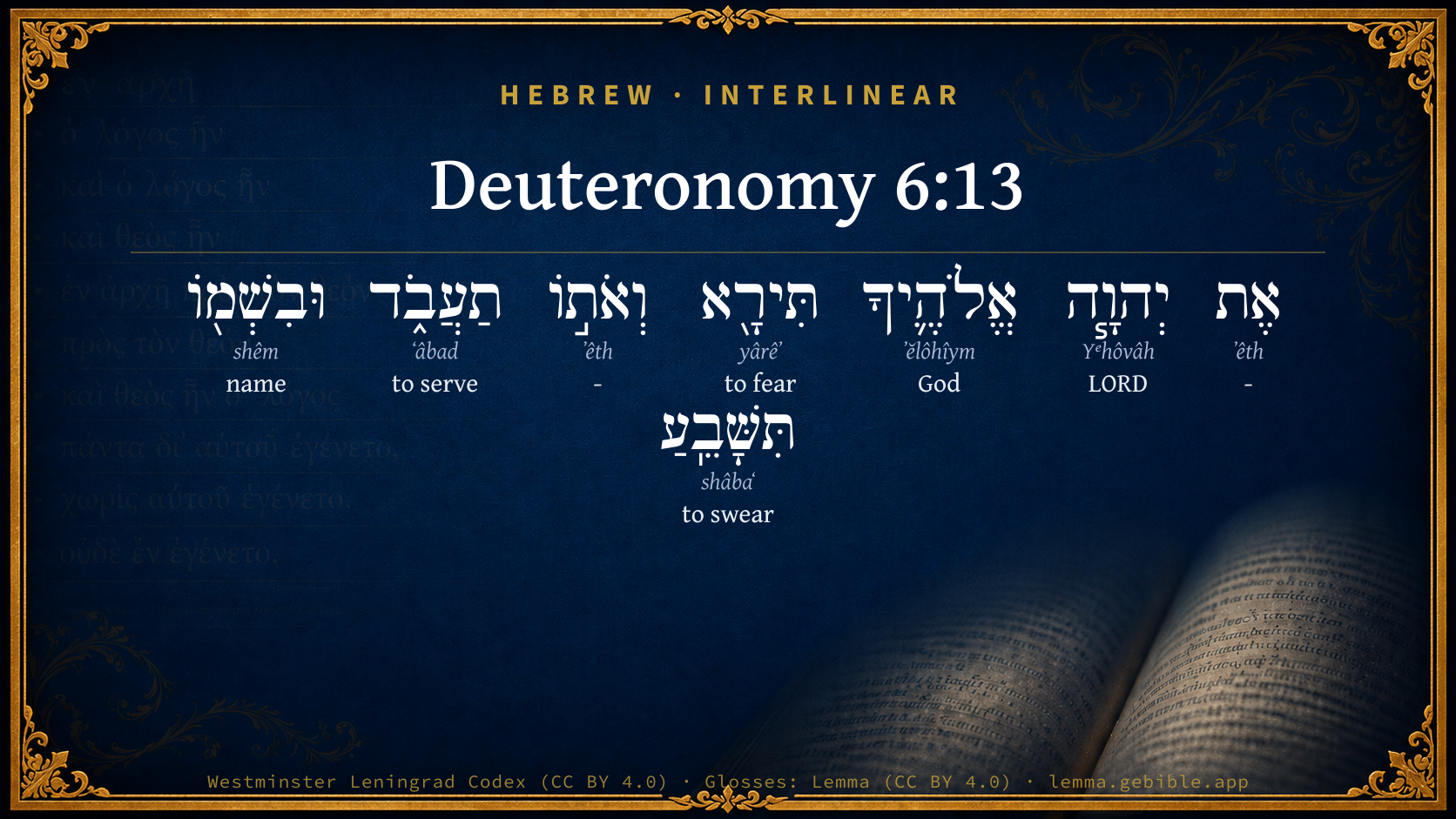
Deuteronomy 6:13

Hebrew (Westminster Leningrad Codex) Deuteronomy 6:13 appears in the Hebrew Old Testament. The text above is from the Westminster Leningrad Codex. Each word links to its Strong’s number, a concise gloss, and parsing drawn from the Open Scriptures Hebrew Bible morphology. Click any word for its full Brown-Driver-Briggs (BDB) entry.
Download image
Cite this verse

Deuteronomy 6:13 (World English Bible). Public Domain. Lemma interlinear Bible study tool, https://lemma.gebible.app/v/deuteronomy/6/13.

Show BibTeX & RIS
BibTeX
RIS
English Translation
You shall fear Yahweh your God; and him shall you serve, and shall swear by his name.
World English Bible · Public Domain
Download a study sheet

One document with this verse’s original text, its word-by-word gloss line, the meaning frame, cross-references with their text, attributed commentary, and full source and license credits — printable, and it pastes into notes with its structure intact.

This verse Autodidact and up

Study sheet (.html) Plain text (.txt)

A passage Seminary Student

Up to 50 verses in one chapter. A passage sheet keeps up to 6 commentary sources and 12 cross-references per verse, in the order this page ranks them, and says so on the sheet whenever that leaves anything out. Ask for a single verse and you get the Autodidact verse sheet above.

Everything on this page stays free to read, with no account — the sheet is a download of what is already on screen, not access to it.

Want to remove ads? Support Godless Engineer
Compare translations 3

The same verse in 3 English versions, stacked beneath the original-language interlinear above. Click any original word for its lexicon entry.

Each is an independent rendering of the whole verse — the interlinear is not word-aligned to these translations.

Highlighted words mark where these versions differ — a whole-verse word diff, not a word-by-word alignment.

  • World English Bible Public Domain
    You shall fear Yahweh your God; and him shall you serve, and shall swear by his name.
  • King James Version Public Domain
    Thou shalt fear the LORD thy God, and serve him, and shalt swear by his name.
  • unfoldingWord Literal Text CC BY-SA 4.0
    Yahweh your God you shall fear and him you shall serve and by his name you shall swear.

unfoldingWord Literal Text — © unfoldingWord, licensed CC BY-SA 4.0. Word-aligned USFM3 via Door43 (git.door43.org/unfoldingWord/en_ult).

Versions to compare (up to 4)

3 of 4 selected

Show all 18 translations

Every available English version of this verse, each an independent rendering of the whole verse.

  • World English Bible Public Domain
    You shall fear Yahweh your God; and him shall you serve, and shall swear by his name.
  • Berean Standard Bible Public Domain
    Fear the LORD your God, serve Him only, and take your oaths in His name.
  • Majority Standard Bible Public Domain
    Fear the LORD your God, serve Him only, and take your oaths in His name.
  • King James Version Public Domain
    Thou shalt fear the LORD thy God, and serve him, and shalt swear by his name.
  • American Standard Version (1901) Public Domain
    Thou shalt fear Jehovah thy God; and him shalt thou serve, and shalt swear by his name.
  • Revised Version (1885) Public Domain
    Thou shalt fear the LORD thy God; and him shalt thou serve, and shalt swear by his name.
  • Geneva Bible (1599) Public Domain
    Thou shalt feare the Lord thy God, and serue him, and shalt sweare by his Name.
  • Douay-Rheims (1899) Public Domain
    Take heed diligently lest thou forget the Lord, who brought thee out of the land of Egypt, out of the house of bondage. Thou shalt fear the Lord thy God, and shalt serve him only, and thou shalt swear by his name.
  • Young's Literal Translation Public Domain
    Jehovah thy God thou dost fear, and Him thou dost serve, and by His name thou dost swear;
  • Literal Standard Version CC BY-SA 4.0
    You fear your God YHWH, and you serve Him, and you swear by His Name.
  • Unlocked Literal Bible CC BY-SA 4.0
    You will honor Yahweh your God; him you will worship, and you will swear by his name.
  • unfoldingWord Literal Text CC BY-SA 4.0
    Yahweh your God you shall fear and him you shall serve and by his name you shall swear.
  • Darby Bible Public Domain
    Thou shalt fear Jehovah thy God, and serve him, and shalt swear by his name.
  • World Messianic Bible Public Domain
    You shall fear the LORD your God; and you shall serve him, and shall swear by his name.
  • Webster's Bible Public Domain
    Thou shalt fear the LORD thy God, and serve him, and shalt swear by his name.
  • Free Bible Version CC BY-SA 4.0
    Respect the Lord your God. Worship only him, and make promises only in his name.
  • Bible in Basic English Public Domain
    Let the fear of the Lord your God be in your hearts, and be his servants, taking your oaths by his name.
  • JPS Tanakh (1917) Public Domain
    Thou shalt fear the LORD thy God; and Him shalt thou serve, and by His name shalt thou swear.

Literal Standard Version (2020), Covenant Press — licensed CC BY-SA 4.0. Text via the HelloAO Bible API (eBible.org). Unlocked Literal Bible (unfoldingWord) — licensed CC BY-SA 4.0. Text via the HelloAO Bible API (eBible.org). unfoldingWord Literal Text — © unfoldingWord, licensed CC BY-SA 4.0. Word-aligned USFM3 via Door43 (git.door43.org/unfoldingWord/en_ult). Free Bible Version, Dr. Jonathan Gallagher — licensed CC BY-SA 4.0. Text via the HelloAO Bible API (eBible.org).

Word by word

More ways to search: Search by grammar → Find every occurrence → Compare this word →

Practice this passage: Drill this verse → Learn its vocabulary →

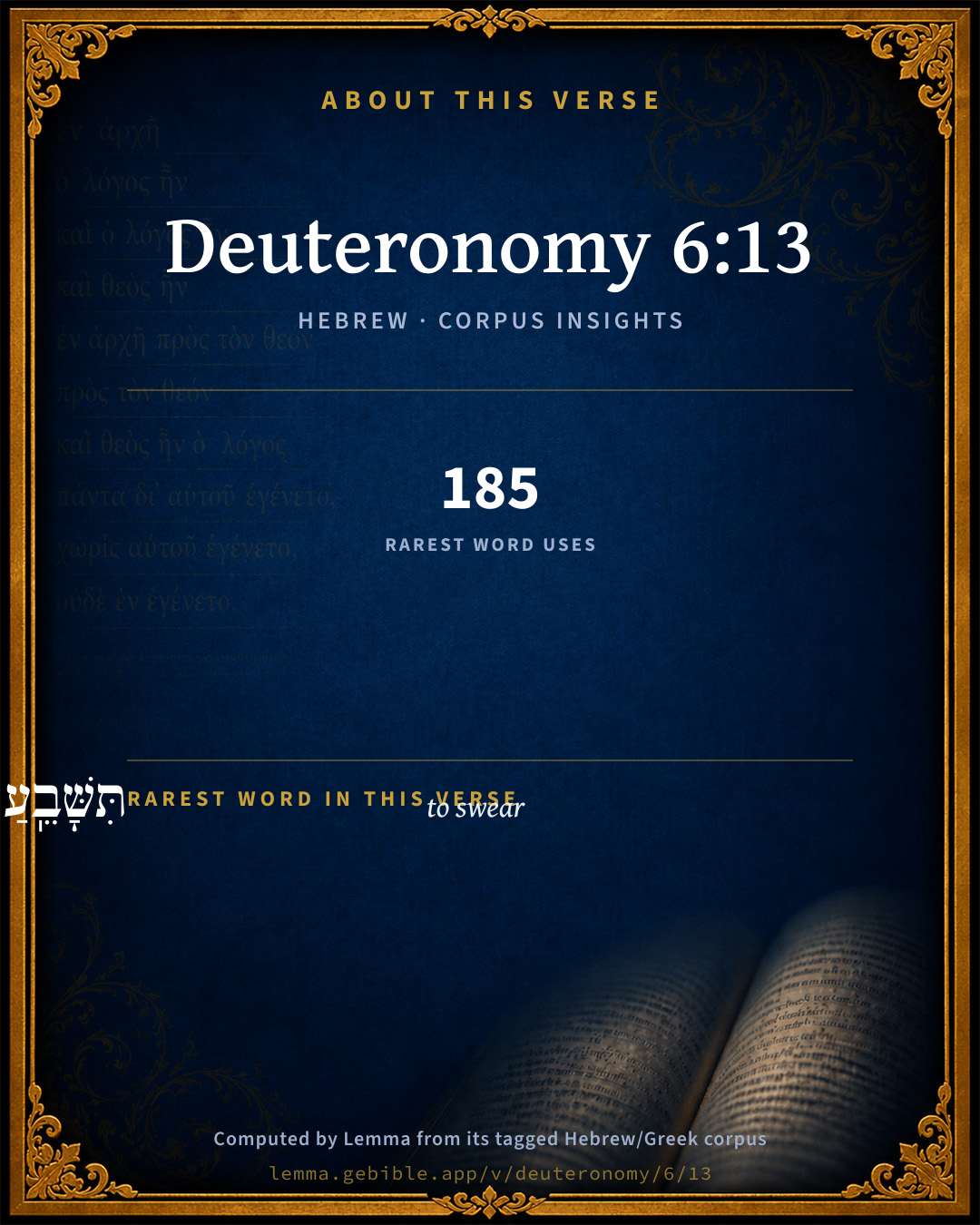
תִּשָּׁבֵֽעַ
shâbaʻ
H7650
“to swear”
Verb, Niphal, Imperfect, 2nd Person, Masculine, Singular
Part of Speech
Verb
Stem
Niphal
Form
Imperfect
Person
2nd Person
Gender
Masculine
Number
Singular
Full BDB Definition

Origin: a primitive root

TWOT: 2318

to swear, adjure - (Qal) sworn (participle) - (Niphal) - to swear, take an oath - to swear (of Jehovah by Himself) - to curse - (Hiphil) - to cause to take an oath - to adjure
  1. אֶת ʼêth H853 “-” Particle, Direct Object
  2. יְהוָ֧ה Yᵉhôvâh H3068 “LORD” Noun, Proper
  3. אֱלֹהֶ֛יךָ ʼĕlôhîym H430 “God(s) · your” Noun, Common, Masculine, Plural, Construct + Suffix, Personal, 2nd Person, Masculine, Singular
  4. תִּירָ֖א yârêʼ H3372 “to fear” Verb, Qal, Imperfect, 2nd Person, Masculine, Singular
  5. וְאֹת֣וֹ ʼêth H853 “and · - · him” Conjunction + Particle, Direct Object + Suffix, Personal, 3rd Person, Masculine, Singular
  6. תַעֲבֹ֑ד ʻâbad H5647 “to serve” Verb, Qal, Imperfect, 2nd Person, Masculine, Singular
  7. וּבִשְׁמ֖וֹ shêm H8034 “and · in/at · name · his” Conjunction + Preposition + Noun, Common, Masculine, Singular, Construct + Suffix, Personal, 3rd Person, Masculine, Singular

About this verse

These counts appear in no published source. They are computed here, from the morphology-tagged text and Lemma’s own curated glosses. What Lemma adds →

8
words
7
distinct lemmas
Pentateuch
section

Grammatical profile

  • 3 verbs
  • 3 nouns
  • 2 particles

Verb forms

  • תִּירָ֖א Qal · Imperfect
  • תַעֲבֹ֑ד Qal · Imperfect
  • תִּשָּׁבֵֽעַ Niphal · Imperfect

Hebrew & Septuagint length

In English translation the verse runs 17 words from the Hebrew and 26 from the Septuagint (LXX English) — the Septuagint runs noticeably longer here. See the side-by-side →

A rough comparison of the two English renderings, which tokenize alike — not a word-level alignment.

Word counts can differ between the Hebrew and the Greek without any difference in meaning — e.g. the Hebrew direct-object marker אֵת has no separate Greek word, and Greek often adds the article ὁ.

Cross-references

17

Topical passages linked to Deuteronomy 6:13 in the Treasury of Scripture Knowledge — connected by theme and wording, ordered by reader-vote popularity; previews shown in the World English Bible.

  • Luke 4:8 Jesus answered him, "Get behind me Satan! For it is written, 'You shall worship the Lord your God, and him only shall you serve.'"
  • Deuteronomy 10:20 You shall fear Yahweh your God; him shall you serve; and to him shall you cleave, and by his name shall you swear.
  • Matthew 4:10 Then Jesus said to him, "Get behind me, Satan! For it is written, 'You shall worship the Lord your God, and him only shall you serve.'"
  • Deuteronomy 13:4 You shall walk after Yahweh your God, and fear him, and keep his commandments, and obey his voice, and you shall serve him, and cleave to him.
  • Leviticus 19:12 "'You shall not swear by my name falsely, and profane the name of your God. I am Yahweh.
  • Deuteronomy 10:12 Now, Israel, what does Yahweh your God require of you, but to fear Yahweh your God, to walk in all his ways, and to love him, and to serve Yahweh your God with all your heart and with all your soul,
  • Psalms 63:11 But the king shall rejoice in God. Everyone who swears by him will praise him, For the mouth of those who speak lies shall be silenced.
  • Isaiah 45:23 By myself have I sworn, the word is gone forth from my mouth [in] righteousness, and shall not return, that to me every knee shall bow, every tongue shall swear.
  • Isaiah 65:16 so that he who blesses himself in the earth shall bless himself in the God of truth; and he who swears in the earth shall swear by the God of truth; because the former troubles are forgotten, and because they are hid from my eyes.
  • Jeremiah 12:16 It shall happen, if they will diligently learn the ways of my people, to swear by my name, As Yahweh lives; even as they taught my people to swear by Baal; then shall they be built up in the midst of my people.
  • Deuteronomy 5:29 Oh that there were such a heart in them, that they would fear me, and keep all my commandments always, that it might be well with them, and with their children forever!
  • Deuteronomy 6:2 that you might fear Yahweh your God, to keep all his statutes and his commandments, which I command you, you, and your son, and your son's son, all the days of your life; and that your days may be prolonged.
  • Joshua 2:12 Now therefore, please swear to me by Yahweh, since I have dealt kindly with you, that you also will deal kindly with my father's house, and give me a true token;
  • Jeremiah 4:2 and you shall swear, As Yahweh lives, in truth, in justice, and in righteousness; and the nations shall bless themselves in him, and in him shall they glory.
  • Psalms 15:4 In whose eyes a vile man is despised, But who honors those who fear Yahweh; He who keeps an oath even when it hurts, and doesn't change;
  • Jeremiah 5:2 Though they say, As Yahweh lives; surely they swear falsely.
  • Jeremiah 5:7 How can I pardon you? your children have forsaken me, and sworn by them that are no gods: when I had fed them to the full, they committed adultery, and assembled themselves in troops at the prostitutes' houses.

Cross-references courtesy of OpenBible.info (CC BY 4.0).

Hebrew and Greek witnesses Masoretic Hebrew ↔ Greek Septuagint

The same verse in the two great witnesses to the Old Testament, shown verse-for-verse.

Here the Septuagint runs noticeably longer than the Hebrew — LXX2012 (modern English Septuagint) 26 words vs World English Bible 17. A rough length comparison of the two English translations, not a word-level alignment — read both below.

These are two independent witnesses, not word-aligned to each other, and the Septuagint is shown in lemma (dictionary) form.

Hebrew Deuteronomy 6:13 Masoretic · Westminster Leningrad Codex

אֶת יְהוָ֧ה אֱלֹהֶ֛יךָ תִּירָ֖א וְאֹת֣וֹ תַעֲבֹ֑ד וּבִשְׁמ֖וֹ תִּשָּׁבֵֽעַ

You shall fear Yahweh your God; and him shall you serve, and shall swear by his name.

World English Bible · Public Domain

Greek LXX Deuteronomy 6:13 Septuagint · lemma form

κύριος ὁ θεός σύ φοβέω καί αὐτός λατρεύω καί πρός αὐτός κολλάω καί ὁ ὄνομα αὐτός ὄμνυμι

You shall fear the Lord your God, and him only shall you serve; and you shall cleave to him, and by his name you shall swear.

LXX2012 (modern English Septuagint) · Public Domain

On this verse, Adam Clarke's Commentary discusses the Septuagint’s reading. Read the note in Commentary ↓

Hebrew: Westminster Leningrad Codex (CC BY 4.0). Greek: Septuagint (public domain); English from LXX2012 (modern English Septuagint) (Public Domain). How the Septuagint differs from the Hebrew →

Targum (Aramaic paraphrase)

2

The Targum is the ancient Jewish Aramaic paraphrase of the Hebrew Scriptures — an interpretive translation, not the Hebrew text itself. Onkelos (literal) and Pseudo-Jonathan (expansive) render the Torah, and Jonathan the Prophets. Coverage is partial: where no permissively-licensed English translation exists for a verse, only the Aramaic is shown. This is verse-level text, not a word-by-word alignment to the Hebrew.

  1. Targum Onkelos Torah (Genesis–Deuteronomy)
    יָת יְיָ אֱלָהָךְ תִּדְחַל וְקָדָמוֹהִי תִּפְלָח וּבִשְׁמֵהּ תְּקַיַם

    (no public-domain English translation for this verse)

    Targum Onkelos — Aramaic: “Onkelos Genesis” (public domain); “Onkelos Exodus” (public domain); “Onkelos Leviticus” (public domain); “Onkelos Numbers” (public domain); “Onkelos Deuteronomy” (public domain). English: “Sefaria Community Translation” (CC0 1.0 (public-domain dedication)); “J.W. Etheridge. The Targums of Onkelos and Jonathan Ben Uzziel on the Pentateuch. London: Longmans, Green, 1862” (public domain). Text via Sefaria.

  2. Targum Pseudo-Jonathan Torah (Genesis–Deuteronomy)
    מִן קֳדָם יְיָ אֱלָהָכוֹן תֶּהֱווֹן דַּחֲלִין וּקְדָמוֹי תִּפְלְחוּן וּבְשׁוּם מֵימְרֵי יְיָ בִּקְשׁוֹט תּוּמוּן

    but fear the Lord your God, and worship before Him, and swear by the Name of the Word of the Lord in truth.

    Targum Pseudo-Jonathan — Aramaic: “Targum Jonathan on Genesis” (public domain); “Targum Jonathan on Exodus” (public domain); “Targum Jonathan on Leviticus” (public domain); “Targum Jonathan on Numbers” (public domain); “Targum Jonathan on Deuteronomy” (public domain). English: “The Targum of Jonathan ben Uzziel, trans. J. W. Etheridge, London, 1862” (public domain). Text via Sefaria.

Commentary

Notes on Deuteronomy 6:13 from classic Christian and Jewish commentators (each source and its license shown beneath its notes). The classic Christian expositions comment on the surrounding passage and are grouped to its opening verse, so a note may address several verses; the Jewish commentaries on the Tanakh (Rashi and others) are per-verse, so they appear only where the commentator wrote on this verse.

Lemma curates 59 commentaries, every one of them public domain or Creative Commons licensed, each selected and text-cleaned for this edition rather than reprinted as found. About our sources →

Trapp's Complete Commentary

John Trapp

Deu 6:13 Thou shalt fear the LORD thy God, and serve him, and shalt swear by his name.

Ver. 13. And shalt swear by his name.] An oath rightly taken, is a piece of our holy service to God, and may well be reckoned amongst our prayers and other pious performances.

John Trapp, A Commentary or Exposition upon All the Books of the Old and New Testament (1647–1656) — public domain. Text from a community e-Sword module.

Joseph Benson's Commentary

Deu 6:13. Shall swear by his name — Not by idols, or any creatures, but only by his name, when thou hast a call and just cause to swear. But some think, from comparing this with other passages, the words rather mean, that they were to be steadfast in the acknowledgment and worship of the true God, and in professing that religion which he had instituted. Thus, (Isa 19:18,) to swear to the Lord of hosts, is to profess the true religion. And God’s words, by the same prophet, (Isa 45:23,) Unto me every knee shall bow, and every tongue shall swear, are interpreted by St. Paul to mean, Every tongue shall confess to God, Rom 14:11. Thus, (Psa 63:11,) Every one that sweareth by him, signifies, every worshipper of the true God.

Joseph Benson's Commentary on the Old and New Testaments (1811–1818) — public domain. Text from a community e-Sword module.

Tyndale Open Study Notes

Tyndale Open Resources

6:13 Jesus quoted this verse when tempted by Satan (Matt 4:10; Luke 4:8).

Tyndale Open Study Notes — © Tyndale Open Resources, licensed CC BY-SA 4.0. Text via the HelloAO Bible API.

Geneva Bible (1599)

Geneva Bible translators

We must fear God, serve him only, and confess his Name, which is done by swearing lawfully.

Geneva Bible (1599) marginal notes — public domain. Text via Bolls.life.

Adam Clarke's Commentary

Verse 13. Thou shalt fear the Lord thy God] Thou shalt respect and reverence him as thy Lawgiver and Judge; as thy Creator, Preserver, and the sole object of thy religious adoration.

And serve him] Our blessed Lord, in Mt 4:10; Lu 4:8, quotes these words thus: And him ONLY (αυτω μονω) shalt thou serve. It appears, therefore, that לבדו lebaddo was anciently in the Hebrew text, as it was and is in the SEPTUAGINT, (αυτωμονω,) from which our Lord quoted it. The COPTIC preserves the same reading; so do also the VULGATE, (illi soli,) and the ANGLO-SAXON, ([Anglo-Saxon]) Dr. Kennicott argues, that without the word only the text would not have been conclusive for the purpose for which our Lord advanced it; for as we learn from Scripture that some men worshipped false gods in conjunction with the true, the quotation here would not have been full to the point without this exclusive word. It may be proper to observe that the omitted word לבדו lebaddo, retained in the above versions, does not exist in the Hebrew printed text, nor in any MS. hitherto discovered.

Shalt swear by his name.] תשבע tishshabea, from שבע shaba, he was full, satisfied, or gave that which was full or satisfactory. Hence an oath and swearing, because appealing to God, and taking him for witness in any case of promise, c., gave full and sufficient security for the performance and if done in evidence, or to the truth of any particular fact, it gave full security for the truth of that evidence. An oath, therefore, is an appeal to God, who knows all things, of the truth of the matter in question: and when a religious man takes such an oath, he gives full and reasonable satisfaction that the thing is so, as stated; for it is ever to be presumed that no man, unless in a state of the deepest degradation, would make such an appeal falsely, for this would imply an attempt to make God a party in the deception.

Adam Clarke's Commentary on the Bible (1810–1826) — public domain. Text from a community e-Sword/MySword module.

Ellicott's Commentary for English Readers

(13) Thou shalt fear the Lord thy God, and serve him.—Literally, Jehovah thy God thou shalt fear, and him shalt thou serve: i.e., Him only, as translated by the LXX., and cited by our Lord in His temptation. It is remarkable that all His answers to the tempter were taken not only from Deuteronomy, but from one and the same portion of Deuteronomy—Deuteronomy 5-10 inclusive—the portion which applies the principles of the Decalogue to Israel’s life.

And shalt swear by his name.—Comp. Exo_23:13. “Make no mention of the name of other gods.” The principle was not unknown to the patriarchs. Laban appealed to the “God of Nahor,” but “Jacob sware by the fear of his father Isaac” (Gen_31:53). (Comp. Jer_5:7 : “Thy children have forsaken me, and sworn by . . . no-gods.”)

A Bible Commentary for English Readers, edited by Charles John Ellicott (1878–1897) — public domain. Text from a community e-Sword module.

The Cambridge Bible for Schools and Colleges

gen. ed. J. J. S. Perowne

13. him shalt thou fear … serve … swear by his name] Intended to cover the whole sphere of religion: the spiritual temper (on the frequent enforcement of the fear of God and its meaning see on Deu_4:10); acts of worship (the Hebrew term, though technically used of these, may cover other duties as well, see Driver, i. l. and cp. on Deu_10:12); and loyalty to God in all one’s intercourse by word and deed with one’s fellows. The reason for this last, which to our ears sounds strange in so brief a summary of religious duty, is clear. All the details of life are more explicitly connected with religion by primitive man than by ourselves. He naively and constantly appeals to his god for the truth of his statements and the honesty of his business transactions. So was it in the Israel of the deuteronomists’ time, Jer_5:2. Thus a man’s oaths were in his everyday life the profession of his faith. If he swore by Baal, Baal was his god. Hence the need of the command to Israel here and in Jer_4:2; Jer_12:16. It is the duty of carrying out one’s religion into the momentary details of life. Hence, too, the definition of Jehovah’s true worshipper as he that sweareth by Jehovah, Psa_63:11. But hence also the need for the presence among the Ten Commandments of one not to take Jehovah’s name in vain. For the practice, however sincere in its origins, was terribly open to abuse, and was (and is) abused among Semitic nations beyond all others. Of the modern Arabs Doughty says, ‘they all day take God’s name in vain (as it was perhaps in ancient Israel), confirming every light and laughing word with cheerful billahs,’ and ‘they will confirm any word with an oath’ (Ar. Des. i. 265, 269). So Christ commanded, swear not at all.

The Cambridge Bible for Schools and Colleges (gen. ed. J. J. S. Perowne; Cambridge University Press, 1878–1918) — public domain. Text from a community e-Sword module.

John Gill's Exposition

Thou shalt fear the Lord thy God, and serve him,.... Serve him through fear; not through slavish fear, a fear of hell and damnation; but through filial fear, a reverential affection for that God that had brought them out of a state of bondage into great and glorious liberty, out of Egypt into Canaan's land, out of a place of misery into a land of plenty; and therefore should fear the Lord and his goodness, and from such a fear of him serve him, in every part of worship, public and private, enjoined; this passage Christ refers to Mat 4:10.

and shalt swear by his name; when they made a covenant with any, or were called to bear a testimony for the decision of any controversy which could not be otherwise finished; or whenever they took an oath on any account, which should never be taken rashly or on any trivial account, and much less falsely; it should be taken not in the name of any idol, or of any other but the true and living God; the Targum of Jonathan is,"in the name of the Word of the Lord, in truth ye shall swear.''

John Gill's Exposition of the Whole Bible (1746–1763) — public domain (CC PDM 1.0). Text via the HelloAO Bible API.

Haydock's Catholic Bible Commentary

Only. This is omitted in Hebrew; but the Septuagint and Jesus Christ retain it, (Matthew iv. 10,) as the sense requires. You cannot serve God and mammon, Luke xvi. 13. (Calmet) --- Name, and not by that of idols, whenever you may be authorized to take an oath. (Haydock) --- To swear by any other, is to acknowledge him in some sort for a god. When we take an oath on proper occasions, and with due respect and caution, we perform and act of religion. (Calmet)

George Leo Haydock (1774–1849), Haydock's Catholic Family Bible and Commentary, 1859 edition — public domain. Excludes Psalms (Douay-Rheims chapter numbering differs from Protestant) and Deuterocanonical books (Catholic canon only).

Matthew Poole's English Annotations

When thou hast a call and just cause to swear. By his name, understand only, as Deu 5:2, not by idols, or any creatures.

Matthew Poole's English Annotations on the Holy Bible (1683–1685) — public domain. Text from a community e-Sword/MySword module.

Whedon's Commentary on the Bible

Daniel D. Whedon

13. Swear by his name — Not servile fear, but reverential awe, is enjoined. This was the essential basis of Hebrew worship. The oath in the name of Jehovah was equivalent to a solemn acknowledgment of belief in him. This command is not to be considered inconsistent with what the Saviour enjoins in Mat_5:34.

Daniel D. Whedon (gen. ed.), Commentary on the Old and New Testaments (1874–1909) — public domain. Text from a community e-Sword module.

The Pulpit Commentary

Vers. 13-18. Thou shalt fear the Lord thy God. The fear of the Lord that reverent awe which is akin to love is the beginning of wisdomand the foundation of piety; where it is in the heart it will lead to serving of the Lord in holy obedience; and they in whom it dwells will swear by his Name, recognizing his presence and omniscience, and not daring to asseverate anything but what they know to be true. Thus, really believing in God and reverently worshipping him, the Israelites would be careful not to go after other gods, or to give to any object that homage which is due unto Jehovah alone, knowing that this he will not endure or suffer with impunity; for he is a jealous God, and them that thus dishonor him he will destroy (Exo_20:5; Deu_4:24, etc.) Thus also they should be kept from murmuring against God, and thereby tempting him putting him, as it were, to the proof, and calling in question his presence and his power, as they had done at Massah. (Exo_17:1-7) Without this genuine religious principle there will be no sincere worship, no true reverence, no real obedience, rendered unto God. But where this dwells in the heart it will influence the whole life, so that the commandments of God shall be diligently kept, and that which is good and right in his sight shall be done.

The Pulpit Commentary (1880–1919), ed. H.D.M. Spence-Jones & Joseph S. Exell — public domain. Text from a community e-Sword module.

John Wesley's Explanatory Notes

Shalt swear by his name - When thou hast a call and just cause to swear, not by idols, or any creatures.

John Wesley, Explanatory Notes Upon the Whole Bible (1754–1765) — public domain. Text via the GEBible commentary corpus.

Scofield Reference Notes

C. I. Scofield

fear

(See Scofield "Psa 19:9").

The Scofield Reference Bible (1917 edition), notes by C. I. Scofield — public domain. Text from a community e-Sword module.

unfoldingWord translationNotes

Door43 World Missions Community

General Information:

Moses continues to tell the people of Israel Yahweh's words as if the Israelites are one person. (See: Forms of You)

You will honor Yahweh your God; him you will worship, and you will swear by his name

"It is Yahweh your God and no one else whom you will honor; it is he alone whom you will worship, and it is by his name and only his name that you will swear." Your language may have another way of emphasizing that Yahweh is telling the Israelites not to worship or serve any other god.

you will swear by his name

To swear by the name of Yahweh means to make Yahweh the basis or the power on which the oath is made. The metonym "his name" refers to Yahweh himself. AT: "you will swear and ask Yahweh to confirm it" or "when you swear you will speak his name" (See: Metonymy)

in the midst of you

"who lives among you"

the anger of Yahweh your God will be kindled against you

Moses compares Yahweh's anger to someone starting a fire to destroy things. This can be stated in active form. To kindle anger is a metaphor for becoming very angry. AT: "Yahweh your God will kindle his anger" or "Yahweh your God will become very angry" (See: Active or Passive and Metaphor)

destroy you from

"destroy you so that there is nothing left of you anywhere on"

translationWords

honor

Yahweh

God

worship

oath

name

false god

people group

jealous

anger

earth

unfoldingWord translationNotes — © Distant Shores Media and the Door43 World Missions Community, licensed CC BY-SA 4.0. Source: git.door43.org/Door43/en_tn.

Rashi

Rabbi Shlomo Yitzchaki (Rashi)

ובשמו תשבע AND THOU SHALT SWEAR BY HIS NAME — If thou hast all the characteristics mentioned here, i.e. that thou reverest His name and servest Him, then thou mayest take an oath by mention of His name, for just because thou reverest His name, thou wilt be cautious with thy oath; but if not, thou shalt not so swear.

Rashi on the Tanakh — English translations: “The Judaica Press complete Tanach with Rashi, translated by A. J. Rosenberg” (CC BY 4.0); “Pentateuch with Rashi's commentary by M. Rosenbaum and A.M. Silbermann, 1929-1934” (public domain); “The Metsudah Tanach series, Lakewood, N.J” (CC BY 4.0); and “The Book of Joshua, Metsudah Publications, 1997” (CC BY 4.0). Text via Sefaria.

Ramban (Nachmanides)

Rabbi Moshe ben Nachman (Ramban / Nachmanides)

THOU SHALT FEAR THE ETERNAL THY G-D. The purport thereof is that after he commanded concerning the love of G-d, he mentioned that [one is] to fear Him so that he not sin and be punished.

AND HIM SHALT THOU SERVE — to do whatever He commands you, like a servant who obeys the command of his master. It is possible that this is an allusion to the Service of the offerings to His Name. And so the Rabbis have said in the Sifre 85. on the verse, After the Eternal your G-d shall ye walk, and Him shall ye fear, and His commandments shall ye keep, and unto His voice shall ye hearken, and Him shall ye serve: “Serve Him by [studying] His Torah, serve Him in His Sanctuary.” By this the Sifre meant to explain that after he admonished concerning the observance of all the commandments and hearkening to His voice, the expression and Him shall ye serve means to serve Him in the Sanctuary with offerings, songs and prostrations [that are prescribed] there. This is termed “service” as He said, I give you the priesthood as ‘a service’ of gift, and it further says, And the Levites alone shall do ‘the service.’, Verse 23. Now the service of the Levites was by song. Thus it is clear that song is also a service of G-d. The Rabbis further interpreted [in the above-mentioned Sifre]: “Serve Him through His Torah,” meaning to study the Torah and meditate therein; this, too, is a “service” before Him. Accordingly, and Him shalt thou serve [mentioned in the verse before us] is also a reference to serving Him by the offerings. And Rabbi Abraham ibn Ezra wrote: “Thou shalt fear the Eternal thy G-d — you should not transgress the negative commandments; and Him shalt thou serve — fulfill the positive commandments.” But this is not correct, for he stated in the other verse [mentioned above], and Him shall ye fear, and His commandments shall ye keep … and Him shall ye serve. does not refer to the positive commandments, as Ibn Ezra says, for that charge is included in the phrase, and His commandments shall ye keep.

AND BY HIS NAME SHALT THOU SWEAR. This is not a commandment to swear [by His Name], but it is an admonishment that [in the event one is required to take an oath] he should swear only by His Name and not by the name of another deity. After this [injunction to swear only by the name of G-d] it is written, Ye shall not go after other gods, meaning that you should not follow them in any of these matters: that you not fear them, that you not serve them, and that you not swear by their names. However, in the Gemara of Tractate Temurah the Rabbis interpreted this verse to teach that a true oath is permissible. Thus they said: “Why did the Merciful One state and by His Name shalt thou swear? Since it cannot refer to the oaths administered by the judges, because they have already been derived from the verse the oath of the Eternal shall be between them, apply it to indicate that other oaths are permissible. And since it cannot refer to an oath by which one binds himself to perform a commandment, as that is derived from the expression, and to Him shalt thou cleave, then apply it to an oath about a non-sacred [i.e., a permissible, but non-obligatory] matter.”Now, I have further seen the following text in the Tanchuma: 7. “The Holy One, blessed be He, said to Israel: Do not think that it has been made permissible to you to swear by My Name. You are not permitted to swear by My Name even truthfully unless you possess all these qualities: Thou shalt fear the Eternal thy G-d, that you will be like those who were called ‘men who fear the Eternal G-d,’ such as Abraham, Job, and Joseph. And Him shalt thou serve, that you will devote yourself to [the study of] Torah and [the observance of] the commandments and you will have no other preoccupation. Therefore it is stated, and Him thou shalt serve. And to Him shalt thou cleave — but is it possible for a human being to cleave to the Divine Glory? Has it not been stated, For the Eternal thy G-d is a devouring fire? But this statement is intended to teach you that whoever gives his daughter in marriage to a scholar who learns Torah and studies Mishnah, and who trades on his behalf and who benefits him from his wealth — of this He says, and to Him shalt thou cleave. If you possess all these virtues, you may swear [by My Name] and if not, you may not swear.” Thus far is the text of this Agadah. Thus, the interpretation of the verse [before us], and by His Name shalt thou swear, in the opinion of the Rabbis, is a grant of permission, that He allows us, as an expression of esteem, to do so. It is as if he had said, “Thou shalt fear the Eternal thy G-d; nevertheless you may swear by His Name and you need not fear doing so.” And because this permission is placed after the commands to fear G-d and to serve Him, the Rabbis inferred that there is no authorization to swear until after these virtues have been attained. Or Scripture may be stating Thou shalt fear the Eternal thy G-d and His awe will be so great upon you that His very Name will be an oath to you, so that even when you wish to confirm something you will swear by His Name even to your disadvantage and you will not misrepresent. And in the opinion of the Rabbis, the meaning of the expression and Him shalt thou serve is that you should act toward him at all times like a bondsman constantly in service before his master, considering the work of his master as primary and his own needs as casual, until, [resulting] from this [attitude] he attains what the Rabbis have said, “And let all thy deeds be done for the sake of Heaven.” For even bodily needs should be for the purpose of G-d’s worship. Thus a person should eat and sleep and attend to his needs to assure the existence of the body to serve G-d. This is similar to what the Rabbis have said, “And G-d saw every thing that He had made, and, behold, it was very good — this refers to sleep. Is sleep good? [It is ‘good’] because, if a person sleeps a little, he rises and engages in the study of Torah.”, Vol. I, pp. 58-59. Thus, in satisfying bodily needs, one should concentrate upon the verse I will praise the Eternal while I live; I will sing praises unto my G-d while I have my being. This is a correct interpretation.

Ramban (Nachmanides) on the Tanakh — English translation: “Commentary on the Torah by Ramban (Nachmanides). Translated and annotated by Charles B. Chavel. New York, Shilo Pub. House, 1971-1976” (CC BY 4.0). Text via Sefaria.

Lesson kit

Teaching starters — assembled from the data on this page, not authored interpretation. Every prompt links to the verse data it draws on. Edit before teaching.

Deuteronomy, in the Pentateuch, opens this verse with 8 words (7 distinct Hebrew lemmas). Its most distinctive word is shâbaʻ (“to swear”). The Greek Septuagint runs longer here. A historical commentator’s framing appears above. Read the whole chapter for the surrounding context.

Discussion questions

  1. What does “to swear” (shâbaʻ) contribute to the verse as a whole?
  2. How does Luke 4:8, which shares this passage’s theme, read alongside this verse?
  3. The Septuagint runs longer here than the Hebrew. What might account for the difference?
  4. These translations render this verse differently; the difference is in the English rendering, not the original. What questions does that raise?
  5. «תִּירָ֖א» is a Qal Imperfect verb. How does that grammatical form shape the action described?
  6. Compare how Trapp's Complete Commentary and Joseph Benson's Commentary read this verse. Where do they agree or differ?

Things to notice

Reading settings

Reading text

Shown beneath each verse's original-language words.

Old Testament
Old Testament edition

Read the OT as the Masoretic Hebrew (MT) or the Greek Septuagint (LXX).

English shown for the Greek Septuagint (in the Hebrew ↔ Greek comparison).

Comparing translations? Open the Compare panel on any verse page to stack up to four side by side.