Exodus 9:20

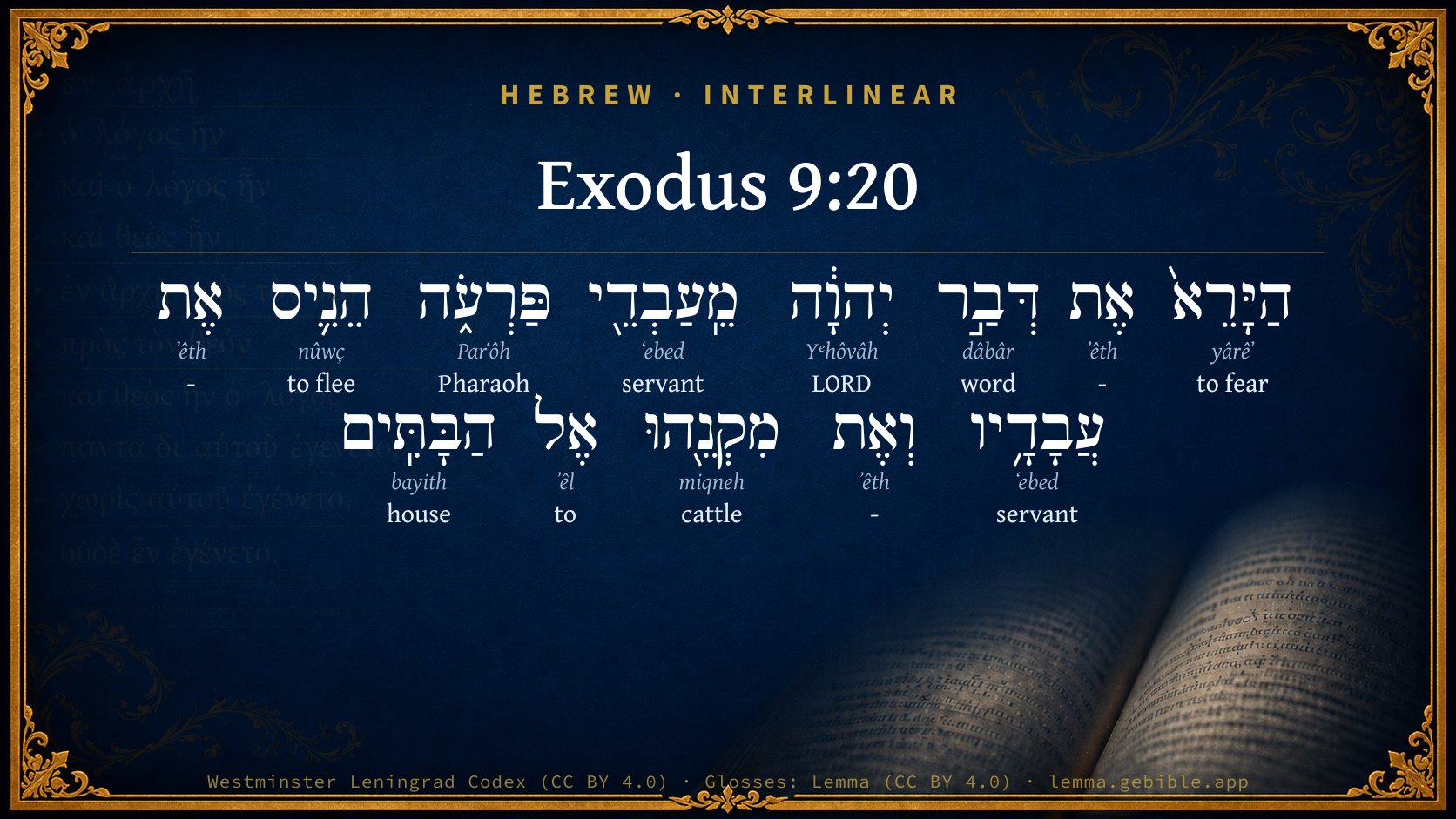
Hebrew (Westminster Leningrad Codex) Exodus 9:20 appears in the Hebrew Old Testament. The text above is from the Westminster Leningrad Codex. Each word links to its Strong’s number, a concise gloss, and parsing drawn from the Open Scriptures Hebrew Bible morphology. Click any word for its full Brown-Driver-Briggs (BDB) entry.
Download image
Cite this verse

Exodus 9:20 (World English Bible). Public Domain. Lemma interlinear Bible study tool, https://lemma.gebible.app/v/exodus/9/20.

Show BibTeX & RIS
BibTeX
RIS
English Translation
Those who feared the word of Yahweh among the servants of Pharaoh made their servants and their cattle flee into the houses.
World English Bible · Public Domain
Download a study sheet

One document with this verse’s original text, its word-by-word gloss line, the meaning frame, cross-references with their text, attributed commentary, and full source and license credits — printable, and it pastes into notes with its structure intact.

This verse Autodidact and up

Study sheet (.html) Plain text (.txt)

A passage Seminary Student

Up to 50 verses in one chapter. A passage sheet keeps up to 6 commentary sources and 12 cross-references per verse, in the order this page ranks them, and says so on the sheet whenever that leaves anything out. Ask for a single verse and you get the Autodidact verse sheet above.

Everything on this page stays free to read, with no account — the sheet is a download of what is already on screen, not access to it.

Want to remove ads? Support Godless Engineer
Compare translations 3

The same verse in 3 English versions, stacked beneath the original-language interlinear above. Click any original word for its lexicon entry.

Each is an independent rendering of the whole verse — the interlinear is not word-aligned to these translations.

Highlighted words mark where these versions differ — a whole-verse word diff, not a word-by-word alignment.

  • World English Bible Public Domain
    Those who feared the word of Yahweh among the servants of Pharaoh made their servants and their cattle flee into the houses.
  • King James Version Public Domain
    He that feared the word of the LORD among the servants of Pharaoh made his servants and his cattle flee into the houses:
  • unfoldingWord Literal Text CC BY-SA 4.0
    The fearers of the word of Yahweh from the servants of Pharaoh made their slaves and their livestock run to the houses,

unfoldingWord Literal Text — © unfoldingWord, licensed CC BY-SA 4.0. Word-aligned USFM3 via Door43 (git.door43.org/unfoldingWord/en_ult).

Versions to compare (up to 4)

3 of 4 selected

Show all 18 translations

Every available English version of this verse, each an independent rendering of the whole verse.

  • World English Bible Public Domain
    Those who feared the word of Yahweh among the servants of Pharaoh made their servants and their cattle flee into the houses.
  • Berean Standard Bible Public Domain
    Those among Pharaoh’s officials who feared the word of the LORD hurried to bring their servants and livestock to shelter,
  • Majority Standard Bible Public Domain
    Those among Pharaoh’s officials who feared the word of the LORD hurried to bring their servants and livestock to shelter,
  • King James Version Public Domain
    He that feared the word of the LORD among the servants of Pharaoh made his servants and his cattle flee into the houses:
  • American Standard Version (1901) Public Domain
    He that feared the word of Jehovah among the servants of Pharaoh made his servants and his cattle flee into the houses.
  • Revised Version (1885) Public Domain
    He that feared the word of the LORD among the servants of Pharaoh made his servants and his cattle flee into the houses:
  • Geneva Bible (1599) Public Domain
    Such then as feared the word of the Lord among the seruants of Pharaoh, made his seruants and his cattell flee into the houses:
  • Douay-Rheims (1899) Public Domain
    He that feared the word of the Lord among Pharao's servants, made his servants and his cattle flee into houses:
  • Young's Literal Translation Public Domain
    He who is fearing the word of Jehovah among the servants of Pharaoh hath caused his servants and his cattle to flee unto the houses;
  • Literal Standard Version CC BY-SA 4.0
    He who is fearing the word of YHWH among the servants of Pharaoh has caused his servants and his livestock to flee to the houses;
  • Unlocked Literal Bible CC BY-SA 4.0
    Then those of Pharaoh's servants who believed in Yahweh's message hurried to bring their slaves and cattle into the houses.
  • unfoldingWord Literal Text CC BY-SA 4.0
    The fearers of the word of Yahweh from the servants of Pharaoh made their slaves and their livestock run to the houses,
  • Darby Bible Public Domain
    He that feared the word of Jehovah among the bondmen of Pharaoh made his bondmen and his cattle flee into the houses.
  • World Messianic Bible Public Domain
    Those who feared the LORD’s word among the servants of Pharaoh made their servants and their livestock flee into the houses.
  • Webster's Bible Public Domain
    He that feared the word of the LORD, among the servants of Pharaoh, made his servants and his cattle flee into the houses:
  • Free Bible Version CC BY-SA 4.0
    Those of Pharaoh's officials who took seriously what the Lord said rushed to bring their servants and livestock inside.
  • Bible in Basic English Public Domain
    Then everyone among the servants of Pharaoh who had the fear of the Lord, made his servants and his cattle come quickly into the house:
  • JPS Tanakh (1917) Public Domain
    He that feared the word of the LORD among the servants of Pharaoh made his servants and his cattle flee into the houses;

Literal Standard Version (2020), Covenant Press — licensed CC BY-SA 4.0. Text via the HelloAO Bible API (eBible.org). Unlocked Literal Bible (unfoldingWord) — licensed CC BY-SA 4.0. Text via the HelloAO Bible API (eBible.org). unfoldingWord Literal Text — © unfoldingWord, licensed CC BY-SA 4.0. Word-aligned USFM3 via Door43 (git.door43.org/unfoldingWord/en_ult). Free Bible Version, Dr. Jonathan Gallagher — licensed CC BY-SA 4.0. Text via the HelloAO Bible API (eBible.org).

Word by word

More ways to search: Search by grammar → Find every occurrence → Compare this word →

Practice this passage: Drill this verse → Learn its vocabulary →

מִקְנֵ֖הוּ
miqneh
H4735
“cattle · his”
Noun, Common, Masculine, Singular, Construct + Suffix, Personal, 3rd Person, Masculine, Singular
Part of Speech
Noun
Type
Common
Gender
Masculine
Number
Singular
State
Construct
Full BDB Definition

Origin: from H7069

TWOT: 2039b

cattle, livestock - cattle, livestock - in general of a purchasable domestic animal - cows, sheep, goats (in herds and flocks)
  1. הַיָּרֵא֙ yârêʼ H3372 “the · fearing” Particle, Definite Article + Verb, Qal, Participle Active, Masculine, Singular, Absolute
  2. אֶת ʼêth H853 “-” Particle, Direct Object
  3. דְּבַ֣ר dâbâr H1697 “word of” Noun, Common, Masculine, Singular, Construct
  4. יְהוָ֔ה Yᵉhôvâh H3068 “LORD” Noun, Proper
  5. מֵֽעַבְדֵ֖י ʻebed H5650 “from · servants of” Preposition + Noun, Common, Masculine, Plural, Construct
  6. פַּרְעֹ֑ה Parʻôh H6547 “Pharaoh” Noun, Proper
  7. הֵנִ֛יס nûwç H5127 “to flee” Verb, Hiphil, Perfect, 3rd Person, Masculine, Singular
  8. אֶת ʼêth H853 “-” Particle, Direct Object
  9. עֲבָדָ֥יו ʻebed H5650 “servants · his” Noun, Common, Masculine, Plural, Construct + Suffix, Personal, 3rd Person, Masculine, Singular
  10. וְאֶת ʼêth H853 “and · -” Conjunction + Particle, Direct Object
  11. אֶל ʼêl H413 “to” Preposition
  12. הַבָּתִּֽים bayith H1004 “the · houses” Particle, Definite Article + Noun, Common, Masculine, Plural, Absolute

About this verse

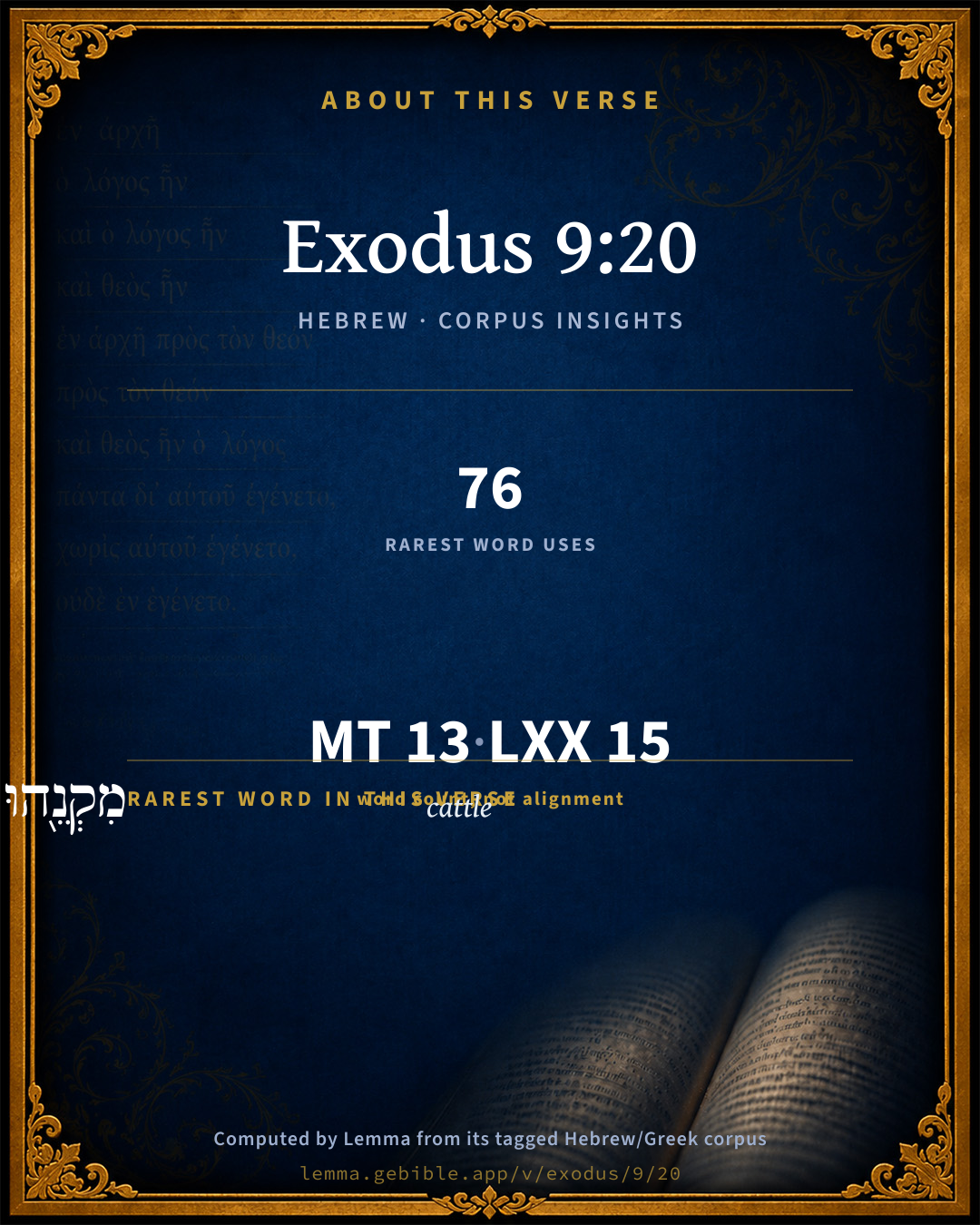
These counts appear in no published source. They are computed here, from the morphology-tagged text and Lemma’s own curated glosses. What Lemma adds →

13
words
10
distinct lemmas
Pentateuch
section

Grammatical profile

  • 2 verbs
  • 7 nouns
  • 1 preposition
  • 3 particles

Verb forms

  • הַיָּרֵא֙ Qal · Participle Active
  • הֵנִ֛יס Hiphil · Perfect

Repetition

A word recurs within this verse — often emphatic in Hebrew:

  • מֵֽעַבְדֵ֖י servant H5650 ×2

Hebrew & Septuagint length

In English translation the verse runs 22 words from the Hebrew and 19 from the Septuagint (LXX English) — closely comparable.

A rough comparison of the two English renderings, which tokenize alike — not a word-level alignment.

Word counts can differ between the Hebrew and the Greek without any difference in meaning — e.g. the Hebrew direct-object marker אֵת has no separate Greek word, and Greek often adds the article ὁ.

In the original languages it is 13 Hebrew tokens and 15 Greek tokens — but the two are counted differently (Hebrew bundles its prefixes and suffixes into one token; the Greek is in lemma form), so that isn’t a like-for-like length.

Cross-references

7

Topical passages linked to Exodus 9:20 in the Treasury of Scripture Knowledge — connected by theme and wording, ordered by reader-vote popularity; previews shown in the World English Bible.

  • Proverbs 13:13 Whoever despises instruction will pay for it, But he who respects a command will be rewarded.
  • Proverbs 22:3 A prudent man sees danger, and hides himself; But the simple pass on, and suffer for it.
  • Hebrews 11:7 By faith, Noah, being warned about things not yet seen, moved with godly fear, prepared an ark for the saving of his house, through which he condemned the world, and became heir of the righteousness which is according to faith.
  • Jonah 3:5–6 The people of Nineveh believed God; and they proclaimed a fast, and put on sackcloth, from the greatest of them even to the least of them.
  • Mark 13:14–16 But when you see the abomination of desolation, spoken of by Daniel the prophet, standing where it ought not (let the reader understand), then let those who are in Judea flee to the mountains,
  • Proverbs 16:16 How much better it is to get wisdom than gold! Yes, to get understanding is to be chosen rather than silver.
  • Proverbs 22:23 For Yahweh will plead their case, And plunder the life of those who plunder them.

Cross-references courtesy of OpenBible.info (CC BY 4.0).

Hebrew and Greek witnesses Masoretic Hebrew ↔ Greek Septuagint

The same verse in the two great witnesses to the Old Testament, shown verse-for-verse.

These are two independent witnesses, not word-aligned to each other, and the Septuagint is shown in lemma (dictionary) form.

Hebrew Exodus 9:20 Masoretic · Westminster Leningrad Codex

הַיָּרֵא֙ אֶת דְּבַ֣ר יְהוָ֔ה מֵֽעַבְדֵ֖י פַּרְעֹ֑ה הֵנִ֛יס אֶת עֲבָדָ֥יו וְאֶת מִקְנֵ֖הוּ אֶל הַבָּתִּֽים

Those who feared the word of Yahweh among the servants of Pharaoh made their servants and their cattle flee into the houses.

World English Bible · Public Domain

Greek LXX Exodus 9:20 Septuagint · lemma form

ὁ φοβέω ὁ ῥῆμα κύριος ὁ θεράπων φαραώ συνἄγω ὁ κτῆνος αὐτός εἰς ὁ οἶκος

He of the servants of Pharao that feared the word of the Lord, gathered his cattle into the houses.

LXX2012 (modern English Septuagint) · Public Domain

Hebrew: Westminster Leningrad Codex (CC BY 4.0). Greek: Septuagint (public domain); English from LXX2012 (modern English Septuagint) (Public Domain). How the Septuagint differs from the Hebrew →

Targum (Aramaic paraphrase)

2

The Targum is the ancient Jewish Aramaic paraphrase of the Hebrew Scriptures — an interpretive translation, not the Hebrew text itself. Onkelos (literal) and Pseudo-Jonathan (expansive) render the Torah, and Jonathan the Prophets. Coverage is partial: where no permissively-licensed English translation exists for a verse, only the Aramaic is shown. This is verse-level text, not a word-by-word alignment to the Hebrew.

  1. Targum Onkelos Torah (Genesis–Deuteronomy)
    דְדָחִיל מִפִּתְגָמָא דַיְיָ מֵעַבְדֵי פַּרְעֹה כְּנַשׁ יָת עַבְדוֹהִי וְיָת גֵיתוֹהִי לְבָתַּיָא:

    (no public-domain English translation for this verse)

    Targum Onkelos — Aramaic: “Onkelos Genesis” (public domain); “Onkelos Exodus” (public domain); “Onkelos Leviticus” (public domain); “Onkelos Numbers” (public domain); “Onkelos Deuteronomy” (public domain). English: “Sefaria Community Translation” (CC0 1.0 (public-domain dedication)); “J.W. Etheridge. The Targums of Onkelos and Jonathan Ben Uzziel on the Pentateuch. London: Longmans, Green, 1862” (public domain). Text via Sefaria.

  2. Targum Pseudo-Jonathan Torah (Genesis–Deuteronomy)
    אִיוֹב דַהֲוָה דָחִיל מִפִּתְגָמָא דַיְיָ מֵעַבְדוֹי דְפַרְעה כְּנַש יַת עַבְדוֹי וְיַת גֵיתוֹי לְגוֹ בֵיתָא

    Hiob, (Job,) who reverenced the word of the Lord, among the servants of Pharoh, gathered together his servants and his flocks within the house.

    Targum Pseudo-Jonathan — Aramaic: “Targum Jonathan on Genesis” (public domain); “Targum Jonathan on Exodus” (public domain); “Targum Jonathan on Leviticus” (public domain); “Targum Jonathan on Numbers” (public domain); “Targum Jonathan on Deuteronomy” (public domain). English: “The Targum of Jonathan ben Uzziel, trans. J. W. Etheridge, London, 1862” (public domain). Text via Sefaria.

Commentary

Notes on Exodus 9:20 from classic Christian and Jewish commentators (each source and its license shown beneath its notes). The classic Christian expositions comment on the surrounding passage and are grouped to its opening verse, so a note may address several verses; the Jewish commentaries on the Tanakh (Rashi and others) are per-verse, so they appear only where the commentator wrote on this verse.

Lemma curates 59 commentaries, every one of them public domain or Creative Commons licensed, each selected and text-cleaned for this edition rather than reprinted as found. About our sources →

Trapp's Complete Commentary

John Trapp

Exo 9:20 He that feared the word of the LORD among the servants of Pharaoh made his servants and his cattle flee into the houses:

Ver. 20. He that feared the word of the Lord.] As few will do till they feel his hand. But they that tremble not in hearing shall be crushed to pieces in feeling, said that martyr. {a}

{a} Bradford.

John Trapp, A Commentary or Exposition upon All the Books of the Old and New Testament (1647–1656) — public domain. Text from a community e-Sword module.

Joseph Benson's Commentary

Exo 9:20. He that feared the word of the Lord among the servants of Pharaoh — By this time it appears that these terrible judgments had not been executed entirely in vain. A few, at least, were hereby brought to stand in awe of God and perhaps truly to turn to him. Such persons, believing the discoveries which he had given of his displeasure at the slavery and oppression of his people, and not concurring in this part of the national crimes, regarded the notice God had given, and saved their servants and the remnant of their cattle.

Joseph Benson's Commentary on the Old and New Testaments (1811–1818) — public domain. Text from a community e-Sword module.

Tyndale Open Study Notes

Tyndale Open Resources

9:20-21 Some of Pharaoh’s officials were beginning to make appropriate deductions from their experiences thus far and to take precautions, while others imitated their master’s refusal to submit. Pride often dominates reason.

Tyndale Open Study Notes — © Tyndale Open Resources, licensed CC BY-SA 4.0. Text via the HelloAO Bible API.

Jamieson, Fausset & Brown

Robert Jamieson, A. R. Fausset & David Brown

He that feared the word of the Lord . . . regarded not, &c.--Due premonition, it appears, had been publicly given of the impending tempest--the cattle seem to have been sent out to graze, which is from January to April, when alone pasturage can be obtained, and accordingly the cattle were in the fields. This storm occurring at that season, not only struck universal terror into the minds of the people, but occasioned the destruction of all--people and cattle--which, in neglect of the warning, had been left in the fields, as well as of all vegetation [Exo 9:25]. It was the more appalling because hailstones in Egypt are small and of little force; lightning also is scarcely ever known to produce fatal effects; and to enhance the wonder, not a trace of any storm was found in Goshen [Exo 9:26].

Jamieson, Fausset & Brown — Commentary Critical and Explanatory on the Whole Bible (1871) — public domain (CC PDM 1.0). Text via the HelloAO Bible API.

Ellicott's Commentary for English Readers

(20, 21) He that feared . . . —Some impression, we see, had been made by the preceding plagues, and the warning was taken to some extent; but it was otherwise with many. So in Gospel times, “Some believed the things which were spoken, and some believed not” (Act_28:24). The result was death, both to the cattle and their keepers (Exo_9:19). (Comp. Jos_10:11.)

A Bible Commentary for English Readers, edited by Charles John Ellicott (1878–1897) — public domain. Text from a community e-Sword module.

The Cambridge Bible for Schools and Colleges

gen. ed. J. J. S. Perowne

20, 21. How the Pharaoh’s servants—i.e. his courtiers and minister—act in consequence.

22, 23a (E). The hail comes at the signal given by Moses with his rod. The rod in Moses’ hand is a mark of E: see on Exo_4:17.

23a. sent thunder] lit. gave voices. ‘Voices’ is a common expression in Heb. for ‘thunder’ (vv. 29, 33, 34, Exo_19:16, Exo_20:18, 1Sa_12:17-18 [with ‘gave,’ as here], Job_28:26; Job_38:25; cf. Rev_4:5; Rev_8:5; Rev_11:15, &c.): in a thunderstorm the Hebrews imagined Jehovah, enveloped in light, to be borne along in the dark thunder cloud; the flashes of lightning were glimpses of the brilliancy within, caused by the clouds parting; and the thunder was His voice. See especially Psa_18:10-13; Psa_29:3-9 (where ‘the voice of Jehovah’ means the thunder), Job_36:29; Job_37:2. With ‘gave voices’ here, cf. ‘gave (i.e. uttered) his voice’ (in thunder), Psa_18:13; Psa_46:6; Psa_68:33 al.

23b (J). The sequel of v. 18 [vv. 19–21 being parenthetic) in J.

The Cambridge Bible for Schools and Colleges (gen. ed. J. J. S. Perowne; Cambridge University Press, 1878–1918) — public domain. Text from a community e-Sword module.

John Gill's Exposition

He that feared the word of the Lord among the servants of Pharaoh,.... Who, if they had not the true fear of God, and were not sincere proselytes, yet had a servile fear of him, and dreaded his word, his threatening, his denunciations of judgments and predictions of future punishments; of which they had had many instances wherein they were fulfilled, and therefore had reason to fear that this also would, even the word that had been just now spoken:

made his servants and cattle flee into the houses; called home his servants, and drove his cattle in great haste out of the fields, and brought them home as fast as he could, and housed them; in which he acted the wise and prudent part, and showed a concern for his servants and his cattle, as well as believed the word of the Lord.

John Gill's Exposition of the Whole Bible (1746–1763) — public domain (CC PDM 1.0). Text via the HelloAO Bible API.

The Pulpit Commentary

He that feared the word of the Lord among the servants of Pharaoh. It is a new fact that any of the Egyptians had been brought to "fear the word of Jehovah." Probably, the effect of the plagues had been gradually to convince a considerable number, not so much that Jehovah was the one True God as that he was a great and powerful god, whose chastisements were to be feared. Consequently there were now a certain number among the "servants of Pharaoh" who pro-fired by the warning given (ver. 19), and housed their cattle and herdsmen, in anticipation of the coming storm.

The Pulpit Commentary (1880–1919), ed. H.D.M. Spence-Jones & Joseph S. Exell — public domain. Text from a community e-Sword module.

unfoldingWord translationNotes

Door43 World Missions Community

translationWords

Pharaoh

Yahweh

servant

unfoldingWord translationNotes — © Distant Shores Media and the Door43 World Missions Community, licensed CC BY-SA 4.0. Source: git.door43.org/Door43/en_tn.

Rashi

Rabbi Shlomo Yitzchaki (Rashi)

הניס means HE MADE THEM FLEE.

Rashi on the Tanakh — English translations: “The Judaica Press complete Tanach with Rashi, translated by A. J. Rosenberg” (CC BY 4.0); “Pentateuch with Rashi's commentary by M. Rosenbaum and A.M. Silbermann, 1929-1934” (public domain); “The Metsudah Tanach series, Lakewood, N.J” (CC BY 4.0); and “The Book of Joshua, Metsudah Publications, 1997” (CC BY 4.0). Text via Sefaria.

Lesson kit

Teaching starters — assembled from the data on this page, not authored interpretation. Every prompt links to the verse data it draws on. Edit before teaching.

Exodus, in the Pentateuch, opens this verse with 13 words (10 distinct Hebrew lemmas). Its most distinctive word is miqneh (“cattle”). A historical commentator’s framing appears above. Read the whole chapter for the surrounding context.

Discussion questions

  1. What does “cattle” (miqneh) contribute to the verse as a whole?
  2. How does Proverbs 13:13, which shares this passage’s theme, read alongside this verse?
  3. What does the repetition of “servant” (2× in this one verse) do in this verse?
  4. These translations render this verse differently. What is at stake in choosing one wording over another?
  5. «הַיָּרֵא֙» is a Qal Participle Active verb. How does that grammatical form shape the action described?
  6. Compare how Trapp's Complete Commentary and Joseph Benson's Commentary read this verse. Where do they agree or differ?

Things to notice

Reading settings

Reading text

Shown beneath each verse's original-language words.

Old Testament
Old Testament edition

Read the OT as the Masoretic Hebrew (MT) or the Greek Septuagint (LXX).

English shown for the Greek Septuagint (in the Hebrew ↔ Greek comparison).

Comparing translations? Open the Compare panel on any verse page to stack up to four side by side.