

Daniel 9:4

Hebrew (Westminster Leningrad Codex) Daniel 9:4 appears in the Hebrew Old Testament. The text above is from the Westminster Leningrad Codex. Each word links to its Strong’s number, a concise gloss, and parsing drawn from the Open Scriptures Hebrew Bible morphology. Click any word for its full Brown-Driver-Briggs (BDB) entry.
Download image
Cite this verse

Daniel 9:4 (World English Bible). Public Domain. Lemma interlinear Bible study tool, https://lemma.gebible.app/v/daniel/9/4.

Show BibTeX & RIS
BibTeX
RIS
English Translation
I prayed to Yahweh my God, and made confession, and said, Oh, Lord, the great and dreadful God, who keeps covenant and loving kindness with those who love him and keep his commandments,
World English Bible · Public Domain
Download a study sheet

One document with this verse’s original text, its word-by-word gloss line, the meaning frame, cross-references with their text, attributed commentary, and full source and license credits — printable, and it pastes into notes with its structure intact.

This verse Autodidact and up

Study sheet (.html) Plain text (.txt)

A passage Seminary Student

Up to 50 verses in one chapter. A passage sheet keeps up to 6 commentary sources and 12 cross-references per verse, in the order this page ranks them, and says so on the sheet whenever that leaves anything out. Ask for a single verse and you get the Autodidact verse sheet above.

Everything on this page stays free to read, with no account — the sheet is a download of what is already on screen, not access to it.

Want to remove ads? Support Godless Engineer
Compare translations 3

The same verse in 3 English versions, stacked beneath the original-language interlinear above. Click any original word for its lexicon entry.

Each is an independent rendering of the whole verse — the interlinear is not word-aligned to these translations.

Highlighted words mark where these versions differ — a whole-verse word diff, not a word-by-word alignment.

  • World English Bible Public Domain
    I prayed to Yahweh my God, and made confession, and said, Oh, Lord, the great and dreadful God, who keeps covenant and loving kindness with those who love him and keep his commandments,
  • King James Version Public Domain
    And I prayed unto the LORD my God, and made my confession, and said, O Lord, the great and dreadful God, keeping the covenant and mercy to them that love him, and to them that keep his commandments;
  • unfoldingWord Literal Text CC BY-SA 4.0
    I prayed to Yahweh my God, and I made confession and said, “O Lord, the great and awesome God, who keeps covenant and steadfast love for those who love him and keep his commandments.

unfoldingWord Literal Text — © unfoldingWord, licensed CC BY-SA 4.0. Word-aligned USFM3 via Door43 (git.door43.org/unfoldingWord/en_ult).

Versions to compare (up to 4)

3 of 4 selected

Show all 18 translations

Every available English version of this verse, each an independent rendering of the whole verse.

  • World English Bible Public Domain
    I prayed to Yahweh my God, and made confession, and said, Oh, Lord, the great and dreadful God, who keeps covenant and loving kindness with those who love him and keep his commandments,
  • Berean Standard Bible Public Domain
    And I prayed to the LORD my God and confessed, “O, Lord, the great and awesome God, who keeps His covenant of loving devotion to those who love Him and keep His commandments,
  • Majority Standard Bible Public Domain
    And I prayed to the LORD my God and confessed, “O, Lord, the great and awesome God, who keeps His covenant of loving devotion to those who love Him and keep His commandments,
  • King James Version Public Domain
    And I prayed unto the LORD my God, and made my confession, and said, O Lord, the great and dreadful God, keeping the covenant and mercy to them that love him, and to them that keep his commandments;
  • American Standard Version (1901) Public Domain
    And I prayed unto Jehovah my God, and made confession, and said, Oh, Lord, the great and dreadful God, who keepeth covenant and lovingkindness with them that love him and keep his commandments,
  • Revised Version (1885) Public Domain
    And I prayed unto the LORD my God, and made confession, and said, O Lord, the great and dreadful God, which keepeth covenant and mercy with them that love him and keep his commandments;
  • Geneva Bible (1599) Public Domain
    And I prayed vnto the Lord my God, and made my confession, saying, Oh Lord God, which art great and fearefull, and keepest couenant and mercy toward them which loue thee, and toward them that keepe thy commandements,
  • Douay-Rheims (1899) Public Domain
    And I prayed to the Lord my God, and I made my confession, and said: I beseech thee, O Lord God, great and terrible, who keepest the covenant, and mercy to them that love thee, and keep thy commandments.
  • Young's Literal Translation Public Domain
    And I pray to Jehovah my God, and confess, and say: `I beseech Thee, O Lord God, the great and the fearful, keeping the covenant and the kindness to those loving Him, and to those keeping His commands;
  • Literal Standard Version CC BY-SA 4.0
    And I pray to my God YHWH, and confess, and say: Ah, now, O Lord God, the great and the fearful, keeping the covenant and the kindness to those loving Him and to those keeping His commands;
  • Unlocked Literal Bible CC BY-SA 4.0
    I prayed to Yahweh my God, and I made confession of our sins. I said, “Please, Lord—you are the great and awesome God—you are the one who keeps the covenant and is faithful to love those who love you and keep your commandments.
  • unfoldingWord Literal Text CC BY-SA 4.0
    I prayed to Yahweh my God, and I made confession and said, “O Lord, the great and awesome God, who keeps covenant and steadfast love for those who love him and keep his commandments.
  • Darby Bible Public Domain
    and I prayed unto Jehovah my God, and made my confession, and said, Alas Lord! the great and terrible ùGod, keeping covenant and loving-kindness with them that love him, and that keep his commandments:
  • World Messianic Bible Public Domain
    I prayed to the LORD my God, and made confession, and said, “Oh, Lord, the great and dreadful God, who keeps covenant and loving kindness with those who love him and keep his commandments,
  • Webster's Bible Public Domain
    And I prayed to the LORD my God, and made my confession, and said, O Lord, the great and dreadful God, keeping the covenant and mercy to them that love him, and to them that keep his commandments;
  • Free Bible Version CC BY-SA 4.0
    I prayed to the Lord my God, and confessed, saying, “Lord, you are a great and awesome God! You always keep your promises and show your trustworthy love to those who love you and keep your commandments.
  • Bible in Basic English Public Domain
    And I made prayer to the Lord my God, putting our sins before him, and said, O Lord, the great God, greatly to be feared. keeping your agreement and mercy with those who have love for you and do your orders;
  • JPS Tanakh (1917) Public Domain
    And I prayed unto the LORD my God, and made confession, and said: 'O Lord, the great and awful God, who keepest covenant and mercy with them that love Thee and keep Thy commandments,

Literal Standard Version (2020), Covenant Press — licensed CC BY-SA 4.0. Text via the HelloAO Bible API (eBible.org). Unlocked Literal Bible (unfoldingWord) — licensed CC BY-SA 4.0. Text via the HelloAO Bible API (eBible.org). unfoldingWord Literal Text — © unfoldingWord, licensed CC BY-SA 4.0. Word-aligned USFM3 via Door43 (git.door43.org/unfoldingWord/en_ult). Free Bible Version, Dr. Jonathan Gallagher — licensed CC BY-SA 4.0. Text via the HelloAO Bible API (eBible.org).

Word by word

More ways to search: Search by grammar → Find every occurrence → Compare this word →

Practice this passage: Drill this verse → Learn its vocabulary →

אָנָּ֤א
ʼânnâʼ
H577
“I beseech you”
Particle, Exhortation
Part of Speech
Particle
Type
Exhortation
Full BDB Definition

Origin: apparent contracted from H160 and H4994

TWOT: 122

ah now! I/we beseech you, oh now!, pray now! (participle of entreaty usually followed by the imperative verb)
  1. וָֽאֶתְפַּֽלְלָ֛ה pâlal H6419 “and · to pray” Conjunction + Verb, Hithpael, Sequential Imperfect, 1st Person, Common, Singular + Suffix, h
  2. לַיהוָ֥ה Yᵉhôvâh H3068 “to/for · LORD” Preposition + Noun, Proper
  3. אֱלֹהַ֖י ʼĕlôhîym H430 “God(s) · my” Noun, Common, Masculine, Plural, Construct + Suffix, Personal, 1st Person, Common, Singular
  4. וָאֶתְוַדֶּ֑ה yâdâh H3034 “and · to throw” Conjunction + Verb, Hithpael, Sequential Imperfect, 1st Person, Common, Singular
  5. וָאֹֽמְרָ֗ה ʼâmar H559 “and · to say” Conjunction + Verb, Qal, Sequential Imperfect, 1st Person, Common, Singular + Suffix, h
  6. אֲדֹנָי֙ ʼĂdônây H136 “Lord · my” Noun, Common, Masculine, Plural, Construct + Suffix, Personal, 1st Person, Common, Singular
  7. הָאֵ֤ל ʼêl H410 “the · God” Particle, Definite Article + Noun, Common, Masculine, Singular, Absolute
  8. הַגָּדוֹל֙ gâdôwl H1419 “the · great” Particle, Definite Article + Adjective, Adjective, Masculine, Singular, Absolute
  9. וְהַנּוֹרָ֔א yârêʼ H3372 “and · the · fearing” Conjunction + Particle, Definite Article + Verb, Niphal, Participle Active, Masculine, Singular, Absolute
  10. שֹׁמֵ֤ר shâmar H8104 “keeping” Verb, Qal, Participle Active, Masculine, Singular, Absolute
  11. הַבְּרִית֙ bᵉrîyth H1285 “the · covenant” Particle, Definite Article + Noun, Common, Feminine, Singular, Absolute
  12. וְֽהַחֶ֔סֶד chêçêd H2617 “and · the · kindness” Conjunction + Particle, Definite Article + Noun, Common, Masculine, Singular, Absolute
  13. לְאֹהֲבָ֖יו ʼâhab H157 “to/for · loving · him” Preposition + Verb, Qal, Participle Active, Masculine, Plural, Construct + Suffix, Personal, 3rd Person, Masculine, Singular
  14. וּלְשֹׁמְרֵ֥י shâmar H8104 “and · to/for · keeping” Conjunction + Preposition + Verb, Qal, Participle Active, Masculine, Plural, Construct
  15. מִצְוֺתָֽיו mitsvâh H4687 “commandments · his” Noun, Common, Feminine, Plural, Construct + Suffix, Personal, 3rd Person, Masculine, Singular

About this verse

These counts appear in no published source. They are computed here, from the morphology-tagged text and Lemma’s own curated glosses. What Lemma adds →

16
words
15
distinct lemmas
Prophets
section

Notable vocabulary

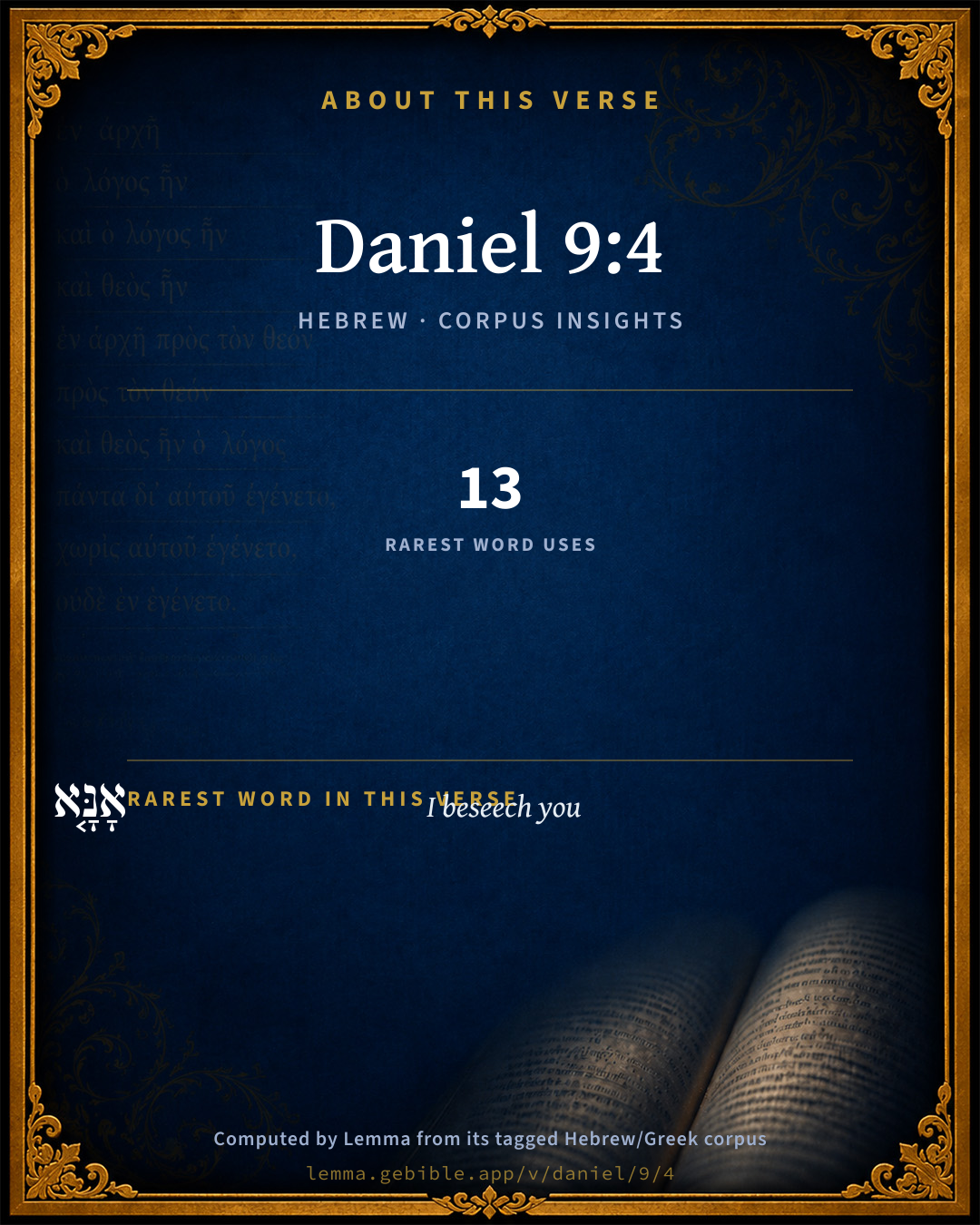
The rarest word here is אָנָּ֤א I beseech you H577 — appearing just 13 times in the whole Hebrew Bible.

Shared distinctive vocabulary

אָנָּ֤א I beseech you H577 occurs in 12 verses of the Hebrew Bible. Also found in:

Grammatical profile

  • 7 verbs
  • 7 nouns
  • 1 adjective
  • 1 particle

Verb forms

  • וָֽאֶתְפַּֽלְלָ֛ה Hithpael · Sequential Imperfect
  • וָאֶתְוַדֶּ֑ה Hithpael · Sequential Imperfect
  • וָאֹֽמְרָ֗ה Qal · Sequential Imperfect
  • וְהַנּוֹרָ֔א Niphal · Participle Active
  • שֹׁמֵ֤ר Qal · Participle Active
  • לְאֹהֲבָ֖יו Qal · Participle Active
  • וּלְשֹׁמְרֵ֥י Qal · Participle Active

Repetition

A word recurs within this verse — often emphatic in Hebrew:

  • שֹׁמֵ֤ר to keep H8104 ×2

Hebrew & Septuagint length

In English translation the verse runs 33 words from the Hebrew and 40 from the Septuagint (LXX English) — closely comparable.

A rough comparison of the two English renderings, which tokenize alike — not a word-level alignment.

Word counts can differ between the Hebrew and the Greek without any difference in meaning — e.g. the Hebrew direct-object marker אֵת has no separate Greek word, and Greek often adds the article ὁ.

Cross-references

25

Topical passages linked to Daniel 9:4 in the Treasury of Scripture Knowledge — connected by theme and wording, ordered by reader-vote popularity; previews shown in the World English Bible.

  • Romans 8:28 We know that all things work together for good for those who love God, to those who are called according to his purpose.
  • Exodus 20:6 and showing loving kindness to thousands of those who love me and keep my commandments.
  • Deuteronomy 5:10 and showing loving kindness to thousands of those who love me and keep my commandments.
  • Exodus 34:6–7 Yahweh passed by before him, and proclaimed, "Yahweh! Yahweh, a merciful and gracious God, slow to anger, and abundant in loving kindness and truth,
  • Daniel 9:5–12 we have sinned, and have dealt perversely, and have done wickedly, and have rebelled, even turning aside from your precepts and from your ordinances;
  • Jeremiah 32:17–19 Ah Lord Yahweh! behold, you have made the heavens and the earth by your great power and by your outstretched arm; there is nothing too hard for you,
  • 2 Chronicles 7:14 if my people, who are called by my name, shall humble themselves, and pray, and seek my face, and turn from their wicked ways; then will I hear from heaven, and will forgive their sin, and will heal their land.
  • Deuteronomy 7:9 Know therefore that Yahweh your God, he is God, the faithful God, who keeps covenant and loving kindness with them who love him and keep his commandments to a thousand generations,
  • Nehemiah 9:32 Now therefore, our God, the great, the mighty, and the awesome God, who keep covenant and loving kindness, don't let all the travail seem little before you, that has come on us, on our kings, on our princes, and on our priests, and on our prophets, and on our fathers, and on all your people, since the time of the kings of Assyria to this day.
  • 1 Kings 8:23 and he said, Yahweh, the God of Israel, there is no God like you, in heaven above, or on earth beneath; who keep covenant and loving kindness with your servants, who walk before you with all their heart;
  • Numbers 14:18–19 Yahweh is slow to anger, and abundant in loving kindness, forgiving iniquity and disobedience; and that will by no means clear [the guilty], visiting the iniquity of the fathers on the children, on the third and on the fourth generation.
  • Deuteronomy 7:21 You shall not be scared of them; for Yahweh your God is in the midst of you, a great and awesome God.
  • Nehemiah 9:2–3 The seed of Israel separated themselves from all foreigners, and stood and confessed their sins, and the iniquities of their fathers.
  • Psalms 32:5 I acknowledged my sin to you. I didn't hide my iniquity. I said, I will confess my transgressions to Yahweh, And you forgave the iniquity of my sin. Selah.
  • Micah 7:18–20 Who is a God like you, who pardons iniquity, And passes over the disobedience of the remnant of his heritage? He doesn't retain his anger forever, Because he delights in loving kindness.
  • 1 John 1:8–10 If we say that we have no sin, we deceive ourselves, and the truth is not in us.
  • 1 Kings 8:47–49 yet if they shall repent themselves in the land where they are carried captive, and turn again, and make supplication to you in the land of those who carried them captive, saying, We have sinned, and have done perversely, we have dealt wickedly;
  • Nehemiah 1:5 and said, I beg you, Yahweh, the God of heaven, the great and awesome God, who keeps covenant and loving kindness with those who love him and keep his commandments:
  • Jeremiah 3:13 Only acknowledge your iniquity, that you have transgressed against Yahweh your God, and have scattered your ways to the strangers under every green tree, and you have not obeyed my voice, says Yahweh.
  • Nahum 1:2–7 Yahweh is a jealous God and avenges. Yahweh avenges and is full of wrath. Yahweh takes vengeance on his adversaries, and he maintains wrath against his enemies.
  • Luke 1:72 To show mercy towards our fathers, To remember his holy covenant,
  • James 1:12 Blessed is the man who endures temptation, for when he has been approved, he will receive the crown of life, which the Lord promised to those who love him.
  • James 2:5 Listen, my beloved brothers. Didn't God choose those who are poor in this world to be rich in faith, and heirs of the Kingdom which he promised to those who love him?
  • 1 John 5:2–3 By this we know that we love the children of God, when we love God and keep his commandments.
  • Leviticus 26:40–42 "'If they confess their iniquity, and the iniquity of their fathers, in their trespass which they trespassed against me, and also that, because they walked contrary to me,

Cross-references courtesy of OpenBible.info (CC BY 4.0).

Hebrew and Greek witnesses Masoretic Hebrew ↔ Greek Septuagint

The same verse in the two great witnesses to the Old Testament, shown verse-for-verse.

These are two independent witnesses, not word-aligned to each other, and the Septuagint is shown in lemma (dictionary) form.

Hebrew Daniel 9:4 Masoretic · Westminster Leningrad Codex

וָֽאֶתְפַּֽלְלָ֛ה לַיהוָ֥ה אֱלֹהַ֖י וָאֶתְוַדֶּ֑ה וָאֹֽמְרָ֗ה אָנָּ֤א אֲדֹנָי֙ הָאֵ֤ל הַגָּדוֹל֙ וְהַנּוֹרָ֔א שֹׁמֵ֤ר הַבְּרִית֙ וְֽהַחֶ֔סֶד לְאֹהֲבָ֖יו וּלְשֹׁמְרֵ֥י מִצְוֺתָֽיו

I prayed to Yahweh my God, and made confession, and said, Oh, Lord, the great and dreadful God, who keeps covenant and loving kindness with those who love him and keep his commandments,

World English Bible · Public Domain

Greek LXX Daniel 9:4 Septuagint · lemma form

καί προςεὔχομαι πρός κύριος ὁ θεός καί ἐκὁμολογέω καί εἶπον ἰδού κύριος σύ εἰμί ὁ θεός ὁ μέγας καί ὁ ἰσχυρός καί ὁ φοβερός τηρέω ὁ διαθήκη καί ὁ ἔλεος ὁ ἀγαπάω σύ καί ὁ φυλάσσω ὁ πρόσταγμα σύ

And I prayed to the Lord my God, and confessed, and said, O Lord, the great and wonderful God, keeping your covenant and your mercy to them that love you, and to them that keep your commandments; we have sinned,

LXX2012 (modern English Septuagint) · Public Domain

Hebrew: Westminster Leningrad Codex (CC BY 4.0). Greek: Septuagint (public domain); English from LXX2012 (modern English Septuagint) (Public Domain). How the Septuagint differs from the Hebrew →

Commentary

Notes on Daniel 9:4 from classic Christian and Jewish commentators (each source and its license shown beneath its notes). The classic Christian expositions comment on the surrounding passage and are grouped to its opening verse, so a note may address several verses; the Jewish commentaries on the Tanakh (Rashi and others) are per-verse, so they appear only where the commentator wrote on this verse.

Lemma curates 59 commentaries, every one of them public domain or Creative Commons licensed, each selected and text-cleaned for this edition rather than reprinted as found. About our sources →

Matthew Henry's Commentary

We have here Daniel's prayer to God as his God, and the confession which he joined with that prayer: I prayed, and made my confession. Note, In every prayer we must make confession, not only of the sins we have been guilty of (which we commonly call confession), but of our faith in God and dependence upon him, our sorrow for sin and our resolutions against it. It must be our confession, must be the language of our own convictions and that which we ourselves do heartily subscribe to.

Let us go over the several parts of this prayer, which we have reason to think that he offered up much more largely than is here recorded, these being only the heads of it.

I. Here is his humble, serious, reverent address to God, 1. As a God to be feared, and whom it is our duty always to stand in awe of: "O Lord! the great and dreadful God, that art able to deal with the greatest and most terrible of the church's enemies." 2. As a God to be trusted, and whom it is our duty to depend upon and put a confidence in: Keeping the covenant and mercy to those that love him, and, as a proof of their love to him, keep his commandments. If we fulfil our part of the bargain, he will not fail to fulfil his. He will be to his people as good as his word, for he keeps covenant with them, and not one iota of his promise shall fall to the ground; nay, he will be better than his word, for he keeps mercy to them, something more than was in the covenant. It was proper for Daniel to have his eye upon God's mercy now that he was to lay before him the miseries of his people, and upon God's covenant now that he was to sue for the performance of a promise. Note, We should, in prayer, look both at God's greatness and his goodness, his majesty and mercy in conjunction.

II. Here is a penitent confession of sin, the procuring cause of all the calamities which his people had for so many years been groaning under, Dan 9:5, Dan 9:6. When we seek to God for national mercies we ought to humble ourselves before him for national sins. These are the sins Daniel here laments; and we may here observe the variety of words he makes use of to set forth the greatness of their provocations (for it becomes penitents to lay load upon themselves): We have sinned in many particular instances, nay, we have committed iniquity, we have driven a trade of sin, we have done wickedly with a hard heart and a stiff neck, and herein we have rebelled, have taken up arms against the King of kings, his crown and dignity. Two things aggravated their sins: - 1. That they had violated the express laws God had given them by Moses: "We have departed from they precepts and from thy judgments, and have not conformed to them. And (Dan 9:10) we have not obeyed the voice of the Lord our God." That which speaks the nature of sin, that it is the transgression of the law, does sufficiently speak the malignity of it; if sin be made to appear sin, it cannot be made to appear worse; its sinfulness is its greatest hatefulness, Rom 7:13. God has set his laws before us plainly and fully, as the copy we should write after, yet we have not walked in them, but turned aside, or turned back. 2. That they had slighted the fair warnings God had given them by the prophets, which in every age he had sent to them, rising up betimes and sending them (Dan 9:6): "We have not hearkened to thy servants the prophets, who have put us in mind of thy laws, and of the sanctions of them; though they spoke in thy name, we have not regarded them; though they delivered their message faithfully, with a universal respect to all orders and degrees of men, to our kings and princes, whom they had the courage and confidence to speak to, to our fathers, and to all the people of the land, whom they had the condescension and compassion to speak to, yet we have not hearkened to them, nor heard them, or not heeded them, or not complied with them." Mocking God's messengers, and despising his words, were Jerusalem's measure-filling sins, Ch2 36:16. This confession of sin is repeated here, and much insisted on; penitents should again and again accuse and reproach themselves till they find their hearts thoroughly broken. All Israel have transgressed thy law, Dan 9:11. It is Israel, God's professing people, who have known better, and from whom better is expected - Israel, God's peculiar people, whom he has surrounded with his favours; not here and there one, but it is all Israel, the generality of them, the body of the people, that have transgressed by departing and getting out of the way, that they might not hear, and so might not obey, thy voice. This disobedience is that which all true penitents do most sensibly charge upon themselves (Dan 9:14): We obeyed not his voice, and (Dan 9:15) we have sinned, we have done wickedly. Those that would find mercy must thus confess their sins.

III. Here is a self-abasing acknowledgment of the righteousness of God in all the judgments that were brought upon them; and it is evermore the way of true penitents thus to justify God, that he may be clear when he judges, and the sinner may bear all the blame. 1. He acknowledges that it was sin that plunged them in all these troubles. Israel is dispersed through all the countries about, and so weakened, impoverished, and exposed. God's hand has driven them hither and thither, some near, where they are known and therefore the more ashamed, others afar off, where they are not known and therefore the more abandoned, and it is because of their trespass that they have trespassed (Dan 9:7); they mingled themselves with the nations that they might be debauched by them, and now God mingles them with the nations that they might be stripped by them. 2. He owns the righteousness of God in it, that he had done them no wrong in all he had brought upon them, but had dealt with them as they deserved (Dan 9:7): "O Lord! righteousness belongs to thee; we have no fault to find with thy providence, no exceptions to make against thy judgments, for (Dan 9:14) the Lord our God is righteous in all his works which he does, even in the sore calamities we are now under, for we obeyed not the words of his mouth, and therefore justly feel the weight of his hand." This seems to be borrowed from Lam 1:18. 3. He takes notice of the fulfilling of the scripture in what was brought upon them. In very faithfulness he afflicted them; for it was according to the word which he had spoken. The curse is poured upon us and the oath, that is, the curse that was ratified by an oath in the law of Moses, Dan 9:11. This further justifies God in their troubles, that he did but inflict the penalty of the law, which he had given them fair notice of. It was necessary for the preserving of the honour of God's veracity, and saving his government from contempt, that the threatenings of his word should be accomplished, otherwise they look but as bugbears, nay, they seem not at all frightful. Therefore he has confirmed his words which spoke against us because we broke his laws, and against our judges that judged us because they did not according to the duty of their place punish the breach of God's laws. He told them many a time that if they did not execute justice, as terrors to evil-workers, he must and would take the work into his own hands; and now he has confirmed what he said by bringing upon us a great evil, in which the princes and judges themselves deeply shared. Note, It contributes very much to our profiting by the judgments of God's hand to observe how exactly they agree with the judgments of his mouth. 4. He aggravates the calamities they were in, lest they should seem, having been long used to them, to make light of them, and so to lose the benefit of the chastening of the Lord by despising it. "It is not some of the common troubles of life that we are complaining of, but that which has in it some special marks of divine displeasure; for under the whole heaven has not been done as has been done upon Jerusalem," Dan 9:12. It is Jeremiah's lamentation in the name of the church, Was ever sorrow like unto my sorrow? which must suppose another similar question, Was ever sin like unto my sin? 5. He puts shame upon the whole nation, from the highest to the lowest; and if they will say Amen to his prayer, as it was fit they should if they would come in for a share in the benefit of it, they must all put their hand upon their mouth, and their mouth in the dust: "To us belongs confusion of faces as at this day (Dan 9:7); we lie under the shame of the punishment of our iniquity, for shame is our due." If Israel had retained their character, and had continued a holy people, they would have been high above all nations in praise, and mane, and honour (Deu 26:19); but now that they have sinned and done wickedly confusion and disgrace belong to them, to the men of Judah and the inhabitants of Jerusalem, the inhabitants both of the country and of the city, for they have been all alike guilty before God; it belongs to all Israel, both to the two tribes, that are near, by the rivers of Babylon, and to the ten tribes, that are afar off, in the land of Assyria. "Confusion belongs not only to the common people of our land, but to our kings, our princes, and our fathers (Dan 9:8), who should have set a better example, and have used their authority and influence for the checking of the threatening torrent of vice profaneness." 6. He imputes the continuance of the judgment to their incorrigibleness under it (Dan 9:13, Dan 9:14): "All this evil has come upon us, and has lain long upon us, yet made we not our prayer before the Lord our God, not in a right manner, as we should have made it, with a humble, lowly, penitent, and obedient heart. We have been smitten, but have not returned to him that smote us. We have not entreated the face of the Lord our God" (so the word is); "we have taken no care to make our peace with God and reconcile ourselves to him." Daniel set his brethren a good example of praying continually, but he was sorry to see how few there were that followed his example; in their affliction it was expected that they would seek God early, but they sought him not, that they might turn from their iniquities and understand his truth. The errand upon which afflictions are sent is to bring men to turn from their iniquities and to understand God's truth; so Elihu had explained them, Job 36:10. God by them opens men's ears to discipline and commands that they return from iniquity. And if men were brought rightly to understand God's truth, and to submit to the power and authority of it, they would turn from the error of their ways. Now the first step towards this is to make our prayer before the Lord our God, that the affliction may be sanctified before it is removed, and that the grace of God may go along with the providence of God, to make it answer the end. Those who in their affliction make not their prayer to God, who cry not when he binds them, are not likely to turn from iniquity or to understand his truth. "Therefore, because we have not improved the affliction, the Lord has watched upon the evil, as the judge takes care that execution be done according to the sentence. Because we have not been melted, he has kept us still in the furnace, and watched over it, to make the heat yet more intense;" for when God judges he will overcome, and will be justified in all his proceedings.

IV. Here is a believing appeal to the mercy of God, and to the ancient tokens of his favour to Israel, and the concern of his own glory in their interests. 1. It is some comfort to them (and not a little) that God has been always ready to pardon sin (Dan 9:9): To the Lord our God belong mercies and forgiveness; this refers to that proclamation of his name, Exo 34:6, Exo 34:7, The Lord God, gracious and merciful, forgiving iniquity. Note, It is very encouraging to poor sinners to recollect that mercies belong to God, as it is convincing and humbling to them to recollect that righteousness belongs to him; and those who give him the glory of his righteousness may take to themselves the comfort of his mercies, Psa 62:12. There are abundant mercies in God, and not only forgiveness but forgivenesses; he is a God of pardons (Neh 9:17, marg.); he multiplies to pardon, Isa 55:7. Though we have rebelled against him, yet with him there is mercy, pardoning mercy, even for the rebellious. 2. It is likewise a support to them to think that God had formerly glorified himself by delivering them out of Egypt; so far he looks back for the encouragement of his faith (Dan 9:15): "Thou hast formerly brought thy people out of Egypt with a mighty hand, and wilt thou not now with the same mighty hand bring them out of Babylon? Were they then formed into a people, and shall they not now be reformed and new-formed? Are they now sinful and unworthy, and were they not so then? Are their oppressors now mighty and haughty, and were they not so then? And has not God said the their deliverance out of Babylon shall outshine even that out of Egypt?" Jer 16:14, Jer 16:15. The force of this plea lies in that, "Thou hast gotten thyself renown, hast made thyself a name" (so the word is) "as at this day, even to this day, by bringing us out of Egypt; and wilt thou lose the credit of that by letting us perish in Babylon? Didst thou get a renown by that deliverance which we have so often commemorated, and wilt thou not now get thyself a renown by this which we have so often prayed for, and so long waited for?"

V. Here is a pathetic complaint of the reproach that God's people lay under, and the ruins that God's sanctuary lay in, both which redounded very much to the dishonour of God and the diminution of that name and renown which God had gained by bringing them out of Egypt. 1. God's holy people were despised. By their sins and the iniquities of their fathers they had profaned their crown and made themselves despicable, and then though they are, in name and profession, God's people, and upon that account truly great and honourable, yet they become a reproach to all that are round about them. Their neighbours laugh them to scorn, and triumph in their disgrace. Note, Sin is a reproach to any people, but especially to God's people, that have more eyes upon them and have more honour to lose than other people. 2. God's holy place was desolate. Jerusalem, the holy city, was a reproach (Dan 9:16) when it lay in ruins; it was an astonishment and a hissing to all that passed by. The sanctuary, the holy house, was desolate (Dan 9:17), the altars were demolished, and all the buildings laid in ashes. Note, The desolations of the sanctuary are the grief of all the saints, who reckon all their comforts in this world buried in the ruins of the sanctuary.

VI. Here is an importunate request to God for the restoring of the poor captive Jews to their former enjoyments again. The petition is very pressing, for God gives us leave in prayer to wrestle with him: "O Lord! I beseech thee, Dan 9:16. If ever thou wilt do any thing for me, do this; it is my heart's desire and prayer. Now therefore, O our God! hear the prayer of thy servant and his supplication (Dan 9:17), and grant an answer of peace." Now what are his petitions? What are his requests? 1. That God would turn away his wrath from them; that is it which all the saints dread and deprecate more than any thing: O let thy anger be turned away from thy Jerusalem, thy holy mountain! Dan 9:16. He does not pray for the turning again of their captivity (let the Lord do with them as seems good in his eyes), but he prays first for the turning away of God's wrath. Take away the cause, and the effect will cease. 2. That he would lift up the light of his countenance upon them (Dan 9:17): "Cause thy face to shine upon thy sanctuary that is desolate; return in thy mercy to us, and show that thou art reconciled to us, and then all shall be well." Note, The shining of God's face upon the desolations of the sanctuary is all in all towards the repair of it; and upon that foundation it must be rebuilt. If therefore its friends would begin their work at the right end, they must first be earnest with God in prayer for his favour, and recommend his desolate sanctuary to his smiles. Cause thy face to shine and then we shall be saved, Psa 80:3. 3. That he would forgive their sins, and then hasten their deliverance (Dan 9:19): O Lord! hear; O Lord! forgive. "That the mercy prayed for may be granted in mercy, let the sin that threatens to come between us and it be removed: O Lord! hearken and do, not hearken and speak only, but hearken and do; do that for us which none else can, and that speedily - defer not, O my God!" Now that he saw the appointed day approaching he could in faith pray that God would make haste to them and not defer. David often prays, Make haste, O God! to help me.

VII. Here are several pleas and arguments to enforce the petitions. God gives us leave not only to pray, but to plead with him, which is not to move him (he himself knows what he will do), but to move ourselves, to excite our fervency and encourage our faith. 1. They disdain a dependence upon any righteousness of their own; they pretend not to merit any thing at God's hand but wrath and the curse (Dan 9:18): "We do not present our supplications before thee with hope to speed for our righteousness, as if we were worthy to receive thy favour for any good in us, or done by us, or could demand any thing as a debt; we cannot insist upon our own justification, no, though we were more righteous than we are; nay, though we knew nothing amiss of ourselves, yet are we not thereby justified, nor would we answer, but we would make supplication to our Judge." Moses had told Israel long before that, whatever God did for them, it was not for their righteousness, Deu 9:4, Deu 9:5. And Ezekiel had of late told them that their return out of Babylon would be not for their sakes, Eze 36:22, Eze 36:32. Note, Whenever we come to God for mercy we must lay aside all conceit of, and confidence in, our own righteousness. 2. They take their encouragement in prayer from God only, as knowing that his reasons of mercy are fetched from within himself, and therefore from him we must borrow all our pleas for mercy, and so give honour to him when we are suing for grace and mercy from him. (1.) "Do it for thy own sake (Dan 9:19), for the accomplishment of thy own counsel, the performance of thy own promise, and the manifestation of thy own glory." Note, God will do his own work, not only in his own way and time, but for his own sake, and so we must take it. (2.) "Do it for the Lord's sake, that is, for the Lord Christ's sake," for the sake of the Messiah promised, who is the Lord (so the most and best of our Christian interpreters understand it), for the sake of Adonai, so David called the Messiah (Psa 110:1), and mercy is prayed for for the church for the sake of the Son of man (Psa 80:17), and for thy Word's sake, he is Lord of all. It is for his sake that God causes his face to shine upon sinners when they repent and turn to him, because of the satisfaction he has made. In all our prayers that therefore must be our plea; we must make mention of his righteousness, even of his only, Psa 71:16. Look upon the face of the anointed. He has himself directed us to ask in his name. (3.) "Do it according to all thy righteousness (Dan 9:16), that is, plead for us against our persecutors and oppressors according to thy righteousness. Though we are ourselves unrighteous before God, yet with reference to them we have a righteous cause, which we leave it with the righteous God to appear in the defence of." Or, rather, by the righteousness of God here is meant his faithfulness to his promise. God had, according to his righteousness, executed the threatening, Dan 9:11. "Now, Lord, wilt thou not do according to all thy righteousness? Wilt thou not be as true to thy promises as thou hast been to thy threatenings and accomplish them also?" (4.) "Do it for thy great mercies (Dan 9:18), to make it to appear that thou art a merciful God." The good things we ask of God we call mercies, because we expect them purely from God's mercy. And, because misery is the proper object of mercy, the prophet here spreads the deplorable condition of the church before God, as it were to move his compassion: "Open thy eyes and behold our desolations, especially the desolations of the sanctuary. O look with pity upon a pitiable case!" Note, The desolations of the church must in prayer be laid before God and then left with him. (5.) "Do it for the sake of the relation we stand in to thee. The sanctuary that is desolate is thy sanctuary (Dan 9:17), dedicated to thy honour, employed in thy service, and the place of thy residence. Jerusalem is thy city and thy holy mountain (Dan 9:16); it is the city which is called by thy name," Dan 9:18. It was the city which God had chosen out of all the tribes of Israel, to put his name there. "The people that have become a reproach are thy people, and thy name suffers in the reproach cast upon them (Dan 9:16); they are called by thy name, Dan 9:19. Lord, thou hast a property in them, and therefore art interested in their interests; wilt thou not provide for thy own, for those of thy own house? They are thine, save them," Psa 119:94.

Matthew Henry's Commentary on the Whole Bible (1708–1710) — public domain (CC PDM 1.0). Text via the HelloAO Bible API.

Trapp's Complete Commentary

John Trapp

Dan 9:4 And I prayed unto the LORD my God, and made my confession, and said, O Lord, the great and dreadful God, keeping the covenant and mercy to them that love him, and to them that keep his commandments;

Ver. 4. And I prayed unto the Lord my God, and made my confession.] The saints themselves, when they sin against God, are suspended from the covenant; hence it is their custom when they seek the Lord for any special mercy, to begin with humble confessions, as doth David, Ezra, Daniel.

O Lord, the great and dreadful God.] It is good in the beginnings of our prayers to propound God to ourselves under such attributes and spiritual notions as wherein we may see the very thing we pray for. Haec est ars orandi et mendicandi.

John Trapp, A Commentary or Exposition upon All the Books of the Old and New Testament (1647–1656) — public domain. Text from a community e-Sword module.

Joseph Benson's Commentary

Dan 9:4. I prayed unto the Lord my God — Daniel could approach God with confidence, knowing him to be his God in covenant, his reconciled God and Father. Observe, reader, we must know God to be our God, if we would pray in faith, and with success, when we apply to him for any blessing. And made my confession — Both acknowledging his justice and holiness, and my own and my people’s iniquity. The more pious men are, and the better they are acquainted with themselves and God, the greater is the sense they have of their past guilt and present unworthiness, and the deeper is their humiliation: see Job 42:6; and 1Ti 1:15. Observe, reader, in every prayer we must make confession, not only of the sins we have committed, (which is what we commonly call confession,) but of our faith in God, and dependance upon him; our sorrow for sin, and our resolutions against it. It must be our confession, the language of our own convictions, and what we ourselves do heartily subscribe to. And said, O Lord, the great and dreadful God — A God of whom it is our duty always to stand in awe, and who art well able to deal with the greatest and most terrible of thy churches enemies; keeping covenant and mercy to them that love him — Fulfilling his promises to his people, and showing them mercy and loving-kindness, even beyond what he hath promised.

Joseph Benson's Commentary on the Old and New Testaments (1811–1818) — public domain. Text from a community e-Sword module.

Tyndale Open Study Notes

Tyndale Open Resources

9:4-11 God’s faithfulness contrasted sharply with his people’s unfaithfulness and rebellion. When Daniel confessed the sins of his people, he included himself among them (9:5), though he had lived a laudatory life (see “Community Identity” Theme Note). Daniel prayed the equivalent of a high priestly prayer on behalf of his people, using many quotations from and allusions to the Torah, prophets, and psalms.

9:4 the Lord (Hebrew Yahweh): The covenant name of God (Exod 6:2-3; 20:2) is found in Daniel only in this chapter. • God is faithful to his covenant with his people who love . . . and obey him (cp. Exod 34:6-7; Deut 7:9; Rom 8:28). God’s unfailing love (Hebrew khesed, elsewhere translated “grace,” “mercy,” “kindness”) is his fundamental nature that is the cause of faith, hope, and worship throughout the Bible (see Num 14:18; Neh 9:17; Pss 108:4; 136:1-26; Jon 2:4; 1 Jn 4:7-8).

Tyndale Open Study Notes — © Tyndale Open Resources, licensed CC BY-SA 4.0. Text via the HelloAO Bible API.

Geneva Bible (1599)

Geneva Bible translators

Hebrew, him.

That is, hast all power in thyself to execute thy terrible judgments against obstinate sinners, as thou art rich in mercy to comfort them which obey thy word and love thee.

Geneva Bible (1599) marginal notes — public domain. Text via Bolls.life.

Jamieson, Fausset & Brown

Robert Jamieson, A. R. Fausset & David Brown

my confession--according to God's promises in Lev 26:39-42, that if Israel in exile for sin should repent and confess, God would remember for them His covenant with Abraham (compare Deu 30:1-5; Jer 29:12-14; Jam 4:10). God's promise was absolute, but prayer also was ordained as about to precede its fulfilment, this too being the work of God in His people, as much as the external restoration which was to follow. So it shall be at Israel's final restoration (Psa 102:13-17). Daniel takes his countrymen's place of confession of sin, identifying himself with them, and, as their representative and intercessory priest, "accepts the punishment of their iniquity." Thus he typifies Messiah, the Sin-bearer and great Intercessor. The prophet's own life and experience form the fit starting point of the prophecy concerning the sin atonement. He prays for Israel's restoration as associated in the prophets (compare Jer 31:4, Jer 31:11-12, Jer 31:31, &c.) with the hope of Messiah. The revelation, now granted, analyzes into its successive parts that which the prophets, in prophetical perspective, heretofore saw together in one; namely, the redemption from captivity, and the full Messianic redemption. God's servants, who, like Noah's father (Gen 5:29), hoped many a time that now the Comforter of their afflictions was at hand, had to wait from age to age, and to view preceding fulfilments only as pledges of the coming of Him whom they so earnestly desired to see (Mat 13:17); as now also Christians, who believe that the Lord's second coming is nigh, are expected to continue waiting. So Daniel is informed of a long period of seventy prophetic weeks before Messiah's coming, instead of seventy years, as he might have expected (compare Mat 18:21-22) [AUBERLEN].

great and dreadful God--as we know to our cost by the calamities we suffer. The greatness of God and His dreadful abhorrence of sin should prepare sinners for reverent, humble acknowledgment of the justice of their punishment.

keeping . . . covenant and mercy--that is, the covenant of Thy mercy, whereby Thou hast promised to deliver us, not for our merits, but of Thy mercy (Eze 36:22-23). So weak and sinful is man that any covenant for good on God's part with him, to take effect, must depend solely on His grace. If He be a God to be feared for His justice, He is one to be trusted for His "mercy."

love . . . keep his commandments--Keeping His commandments is the only sure test of love to God (Joh 14:15).

Jamieson, Fausset & Brown — Commentary Critical and Explanatory on the Whole Bible (1871) — public domain (CC PDM 1.0). Text via the HelloAO Bible API.

Adam Clarke's Commentary

Verse 4. Keeping the covenant] Fidelity and truth are characteristics of God. He had never yet broken his engagements to his followers, and was ever showing mercy to men.

Adam Clarke's Commentary on the Bible (1810–1826) — public domain. Text from a community e-Sword/MySword module.

John Calvin's Commentaries

Here Daniel relates the substance of his prayer. He says, He prayed and confessed before God The greatest part of this prayer is an entreaty that God would pardon his people. Whenever we ask for pardon, the testimony of repentance ought to precede our request. For God announces that he will be propitious and easily entreated when men seriously and heartily repent. (Isaiah 58:9.) Thus confession of guilt is one method of obtaining pardon; and for this reason Daniel fills up the greater part of his prayer with the confession of his sinfulness. He reminds us of this, not for the sake of boasting, but to instruct us by his own example to pray as we ought. He says, therefore, he prayed and made confession The addition of “my God” to the word Jehovah is by no means superfluous. I prayed, he says, to my God. He here shews that he did not utter prayers with trembling, as men too often do, for unbelievers often flee to God, but without any confidence. They dispute with themselves whether their prayers will produce any fruit; Daniel, therefore, shews us two things openly and distinctly, since he prayed with faith and repentance. By the word confession he implies his repentance, and by saying he prayed to God, he expresses faith, and the absence of all rashness in throwing away his prayers, as unbelievers do when they pray to God confusedly, and are all the while distracted by a variety of intruding thoughts. I prayed, says he, to my God No one can use this language without a firm reliance on the promises of God, and assuming that he will prove himself ready to be entreated. He now adds, I entreat thee, O Lord The particle אנא, ana, is variously translated; but it is properly, in the language of grammarians, the particle of beseeching. O Lord God, says he, great and terrible Daniel seems to place an obstacle in his own way by using this language; for such is the sanctity of God that it repels us to a distance as soon as we conceive it in the mind: wherefore this terror seems to be removed when we seek a familiar approach to the Almighty. One might suppose this method of prayer by no means suitable, as Daniel places God before his eyes as great and formidable. It seems something like frightening himself; yet the Prophet deserves a due moderation, while on the one hand he acknowledges God to be great and terrible, and on the other he allows him to keep his covenant towards those who love him and obey his statutes We shall afterwards see a third point added — God will receive the ungrateful and all who have departed from his covenant. The Prophet joins these two things together.

With reference to the epithets great and terrible, we must maintain what I have already stated, namely, the impossibility of our praying rightly, unless we humble ourselves before God; and this humility is a preparation for repentance. Daniel, therefore, sets before himself the majesty of God, to urge both himself and others to cast themselves down before the Almighty, that, in accordance with his example, they may really feel penitent before him. God, therefore, says he, is great and terrible We shall never attribute just honor to God unless we become cast down, as if dead, before him. And we ought diligently to notice this, because we are too often careless in prayer to God, and we treat it as a mere matter of outward observance. We ought to know how impossible it is to obtain anything from God, unless we appear in his sight with fear and trembling, and become truly humbled in his presence. This is the first point to be noticed. Then Daniel mitigates the asperity of his assertion by adding, keeping his covenant, and taking pity upon those who love him. Here is a change of person: the third is substituted for the second, but there is no obscurity in the sense; as if he had said, Thou keepest thy covenant with those who love thee and observe thy statutes Here Daniel does not yet fully explain the subject, for this statement is too weak for gaining the confidence of the people; they had perfidiously revolted from God, and as far as related to him, his agreement had come to an end. But Daniel descends by degrees and by sure steps to lay a foundation for inspiring the people with assured trust in the lovingkindness of God. Two points are embraced in this clause: first of all, it shews us there is no reason why the Jews should expostulate with God and complain of being too severely treated by him. Daniel, therefore, silences all expressions of rebellion by saying, Thou, O God, keepest thy covenant We must here notice the real condition of the people: the Israelites were in exile; we know how hard that tyranny was — how they were oppressed by the most cruel reproaches and disgrace, and how brutally they were treated by their conquerors. This might impel many to cry out, as doubtless they really did, “What does God want with us? What, the better are we for being chosen as his peculiar people? What is the good of our adoption if we are still the most miserable of all nations?” Thus the Jews might complain with the bitterest grief and weariness of the weight of punishment which God had inflicted upon them. But Daniel here asserts his presenting himself before God, not to cavil and murmur, but only to entreat his pardon. For this reason, therefore, he first says, God keeps his covenant towards all who love him; but at the same time he passes on to pray for pardon, as we shall afterwards perceive. We shall treat of this covenant and the Almighty’s lovingkindness in the next Lecture.

John Calvin's Commentaries (1540-1563) — public domain. Text from the Calvin Translation Society English edition (1840s-50s) via the Christian Classics Ethereal Library (ccel.org). Calvin's coverage is partial (roughly two-thirds of the Bible); uncommented books and verses are honest gaps, never fabricated. The 19th-century editor's footnotes and remarks are omitted so the notes are faithfully Calvin's own voice.

Ellicott's Commentary for English Readers

(4) The covenant.—See Exo_19:5.

A Bible Commentary for English Readers, edited by Charles John Ellicott (1878–1897) — public domain. Text from a community e-Sword module.

The Cambridge Bible for Schools and Colleges

gen. ed. J. J. S. Perowne

4. and made confession] Lev_5:5; Lev_16:21; Lev_26:40, Num_5:7, 2Ch_30:22; and in a context similar to the present one, Ezr_10:1, Neh_1:6; Neh_9:2-3, as well as below, Dan_9:20.

O Lord] Ah, now! Lord, beginning with a strong particle of entreaty. So Neh_1:5, where the same particle is equally obliterated in A.V., R.V. In Neh_1:11, Isa_38:3, Psa_116:4 (but not in Dan_9:16), Psa_118:25, it is rendered I (or we) beseech thee.

the great … commandments] A quotation from Deu_7:9, with the substitution of great and terrible (as Deu_7:21) for faithful. The whole verse, from and said, is also almost identical with Neh_1:5 (cf. Neh_9:32 a).

The Cambridge Bible for Schools and Colleges (gen. ed. J. J. S. Perowne; Cambridge University Press, 1878–1918) — public domain. Text from a community e-Sword module.

John Gill's Exposition

And I prayed unto the Lord my God,.... Not to idols, nor to angels or saints departed; but to the Lord God of heaven and earth, who is omniscient, omnipotent, omnipresent, &c.: a God hearing and answering prayer; and to whom he directed his prayer, not only as the God of nature and providence, but as his own covenant God and Father; thereby encouraging his faith in him, and using his interest with him: and made my confession; of his own sins, and of the sins of his people; of the favours bestowed on him and them; of his justice in afflicting them, and his mercy in appointing a time for their deliverance; of his own faith in him, love to him, and submission to his will:

and said, O Lord, the great and dreadful God; great in his being and perfections, and in all his works of nature, providence, and grace; "and dreadful" in his threatenings and judgments, in his wrath and vengeance: or, to be "feared" (e); and reverenced by all men, especially by his saints; and particularly when they draw near unto him, as Daniel now did; and that because of his greatness and goodness: this Daniel observes to raise in his mind a proper awe and reverence of God, whose presence he was now approaching:

keeping the covenant and mercy to them that love him, and to them that keep his commandments; faithful to his word of promise; large and liberal in the distribution of his grace and mercy to such that love him sincerely and heartily; and, as an evidence of it, observe his precepts from a principle of love, and with a view to his glory: respect seems to be had to Exo 20:6, this is observed, by the prophet, to encourage his own faith, and that of others, as to the fulfilment of the promise of their deliverance from captivity at the end of the seventy years; and to raise, in his mind and theirs, love to God, who was thus merciful; and to show the obligations they lay under, in gratitude, to keep his commandments.

(e) "reverendus", Vatablus; "summe reverende", Junius & Tremellius; "metuende", Cocceius.

John Gill's Exposition of the Whole Bible (1746–1763) — public domain (CC PDM 1.0). Text via the HelloAO Bible API.

Albert Barnes' Notes on the Bible

And I prayed unto the Lord my God - Evidently a set and formal prayer. It would seem probable that; he offered this prayer, and then re corded the substance of it afterward. We have no reason to suppose that we have the whole of it, but we have doubtless its principal topics.

And made my confession - Not as an individual, or not of his own sins only, but a confession in behalf of the people, and in their name. There is no reason to suppose that what he here says did “not” express their feelings. They had been long in captivity - far away from their desolate city and temple. They could not but be sensible that these calamities had come upon them on account of their sins; and they could not but feel that the calamities could not be expected to be removed but by confession of their sins, and by acknowledging the justice of the Divine dealings toward them. When we have been afflicted - when we are called to pass through severe trials - and when, borne down by trial, we go to God, and pray that the evil may be removed, the first thing that is demanded is, that we should confess our sins, and acknowledge the justice of God in the judgments that have come upon us. If we attempt to vindicate and justify ourselves, we can have no hope that the judgment will be averted. Daniel, therefore, in the name of the people, began his prayer with the humble and penitent acknowledgment that all that they had suffered was deserved.

O Lord, the great and dreadful God - A God great, and to be feared or venerated - הנורא hanôrâ'. This does not mean “dreadful” in the sense that there is anything stern or unamiable in his character, but mainly that he is to be regarded with veneration.

Keeping the covenant and mercy - Keeping his covenant and showing mercy. This is often ascribed to God, that he is faithful to his covenant; that is, that he is faithful to his promises to his people, or to those who sustain a certain relation to him, and who are faithful to “their” covenant vows. If there is alienation and estrangement, and want of faithfulness on either side, it does not begin with him. He is faithful to all his promises, and his fidelity may always be assumed as a basis of calculation in all our intercourse with him. See the word “covenant,” in Cruden’s “Concordance.” The word mercy seems to be added here to denote that mercy enters into his dealings with us even in keeping the covenant. We are so sinful and so unfaithful ourselves, that if “he” is faithful to his covenant, it must be by showing mercy to us.

To them that love him ... - The conditions of the covenant extend no farther than this, since, in a compact of any kind, one is bound to be faithful only while the terms are maintained by the other party. So God binds himself to show favor only while we are obedient, and we can plead his covenant only when we are obedient, when we confess our sins and plead his promises in this sense - that he has assured us that he will restore and receive us if we are penitent. It was this which Daniel pleaded on this occasion. He could not plead that his people had been obedient, and had thus any claims to the Divine favor; but he could cast himself and them on the mercy of a covenant-keeping God, who would remember his covenant with them if they were penitent, and who would graciously pardon.

Albert Barnes' Notes on the Bible (1834–1885) — public domain. Text from a community e-Sword/MySword module.

Haydock's Catholic Bible Commentary

Covenant. God never breaks it first. (Calmet) --- Deus sua gratia semel justificatos non deserit, nisi ab eis prius diseratur. (Council of Trent, Session vi. 11.)

George Leo Haydock (1774–1849), Haydock's Catholic Family Bible and Commentary, 1859 edition — public domain. Excludes Psalms (Douay-Rheims chapter numbering differs from Protestant) and Deuterocanonical books (Catholic canon only).

Matthew Poole's English Annotations

By this it appeared he prayed in faith, to the true God, and his God.

2. He made confession of sin when he prayed for deliverance, because hereby he justified God in the captivity of his people.

3. He knew if God vouchsafed pardon of sin, upon this confession, that would be a sure foundation of future mercy.

4. He set down here the words of his prayer, because it is the prayer of a righteous man, and one of God’s eminent saints and favourites in Scripture, who had great power with God in prayer, Job 42:7-9; Eze 14:14,20; Jas 5:16. Keeping the covenant; he puts God in mind of his covenant, Deu 7:8; Neh 1:5; he calls him great and dreadful, as to his severe justice and wrath: now though the covenant hath promises and mercy, yet it includeth obedience on our part, as here is expressed.

Matthew Poole's English Annotations on the Holy Bible (1683–1685) — public domain. Text from a community e-Sword/MySword module.

Whedon's Commentary on the Bible

Daniel D. Whedon

4-6. This is a model prayer, including adoration and praise, confession of sin, and petition for further mercies. (Compare Nehemiah’s prayer, Neh_1:5-11.) The phraseology used is distinctly scriptural. (See Exo_20:6; Deu_7:9; 2Ch_36:15-16, and compare Neh_9:30; Neh_9:32.)

Daniel D. Whedon (gen. ed.), Commentary on the Old and New Testaments (1874–1909) — public domain. Text from a community e-Sword module.

The Pulpit Commentary

And I prayed unto the Lord my God, and made my confession, and maid, O Lord, the great and dreadful God, keeping the covenant and mercy to them that love him, and to them that keep his commandments. The versions do not call for remark. The first clause is somewhat of a repetition of the end of the previous verse, and may thus be the indication of there having been two recensions; at the same time, the Oriental style allows greater repetition and redundancy than in Western countries would be permitted. There is a reference here to Deu_7:9, from which the latter clause is quoted verbatim. It is also quoted with equal exactness in Neh_1:5. The chapter in Deuteronomy exhibits God"s love for Israel, and hence, as that love is his plea, Daniel appeals to it. We note the evidence of careful acquaintance with preceding Scripture.

The Pulpit Commentary (1880–1919), ed. H.D.M. Spence-Jones & Joseph S. Exell — public domain. Text from a community e-Sword module.

Rashi

Rabbi Shlomo Yitzchaki (Rashi)

and I confessed the sins of my people.

O great and awesome God but he did not say, “mighty.” He said [to himself], “Heathens are enslaving His children, so where are His mighty deeds?”

Rashi on the Tanakh — English translations: “The Judaica Press complete Tanach with Rashi, translated by A. J. Rosenberg” (CC BY 4.0); “Pentateuch with Rashi's commentary by M. Rosenbaum and A.M. Silbermann, 1929-1934” (public domain); “The Metsudah Tanach series, Lakewood, N.J” (CC BY 4.0); and “The Book of Joshua, Metsudah Publications, 1997” (CC BY 4.0). Text via Sefaria.

Lesson kit

Teaching starters — assembled from the data on this page, not authored interpretation. Every prompt links to the verse data it draws on. Edit before teaching.

Daniel, in the Prophets, opens this verse with 16 words (15 distinct Hebrew lemmas). Its most distinctive word is ʼânnâʼ (“I beseech you”). A historical commentator’s framing appears above. Read the whole chapter for the surrounding context.

Discussion questions

  1. What does “I beseech you” (ʼânnâʼ) contribute to the verse as a whole?
  2. Genesis 50:17 shares the word «I beseech you» with this verse. How do the two illuminate each other?
  3. “to keep” occurs 2× in this one verse. What is the effect of the repetition?
  4. The translations on this page render this verse differently — a whole-verse word diff, not a word-by-word alignment. What might account for the different wordings?
  5. The verb «וָֽאֶתְפַּֽלְלָ֛ה» is Hithpael Sequential Imperfect. How does its form color the action?
  6. Reading how Matthew Henry's Commentary and Trapp's Complete Commentary read this verse, where do the two commentators agree and where do they part?

Things to notice

Reading settings

Reading text

Shown beneath each verse's original-language words.

Old Testament
Old Testament edition

Read the OT as the Masoretic Hebrew (MT) or the Greek Septuagint (LXX).

English shown for the Greek Septuagint (in the Hebrew ↔ Greek comparison).

Comparing translations? Open the Compare panel on any verse page to stack up to four side by side.