
Deuteronomy 31:13

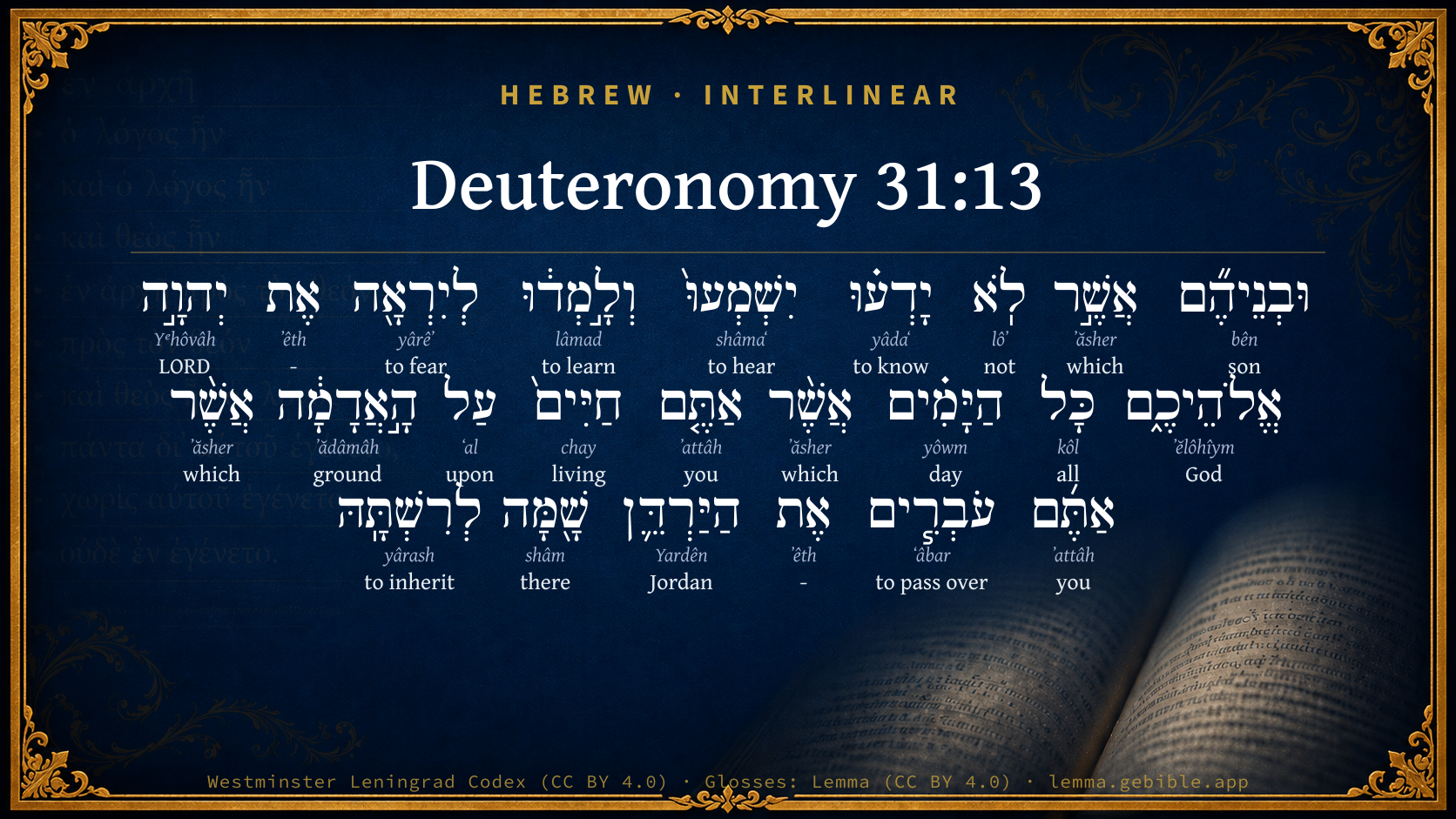
Hebrew (Westminster Leningrad Codex) Deuteronomy 31:13 appears in the Hebrew Old Testament. The text above is from the Westminster Leningrad Codex. Each word links to its Strong’s number, a concise gloss, and parsing drawn from the Open Scriptures Hebrew Bible morphology. Click any word for its full Brown-Driver-Briggs (BDB) entry.
Download image
Cite this verse

Deuteronomy 31:13 (World English Bible). Public Domain. Lemma interlinear Bible study tool, https://lemma.gebible.app/v/deuteronomy/31/13.

Show BibTeX & RIS
BibTeX
RIS
English Translation
and that their children, who have not known, may hear, and learn to fear Yahweh your God, as long as you live in the land where you go over the Jordan to possess it.
World English Bible · Public Domain
Download a study sheet

One document with this verse’s original text, its word-by-word gloss line, the meaning frame, cross-references with their text, attributed commentary, and full source and license credits — printable, and it pastes into notes with its structure intact.

This verse Autodidact and up

Study sheet (.html) Plain text (.txt)

A passage Seminary Student

Up to 50 verses in one chapter. A passage sheet keeps up to 6 commentary sources and 12 cross-references per verse, in the order this page ranks them, and says so on the sheet whenever that leaves anything out. Ask for a single verse and you get the Autodidact verse sheet above.

Everything on this page stays free to read, with no account — the sheet is a download of what is already on screen, not access to it.

Want to remove ads? Support Godless Engineer
Compare translations 3

The same verse in 3 English versions, stacked beneath the original-language interlinear above. Click any original word for its lexicon entry.

Each is an independent rendering of the whole verse — the interlinear is not word-aligned to these translations.

Highlighted words mark where these versions differ — a whole-verse word diff, not a word-by-word alignment.

  • World English Bible Public Domain
    and that their children, who have not known, may hear, and learn to fear Yahweh your God, as long as you live in the land where you go over the Jordan to possess it.
  • King James Version Public Domain
    And that their children, which have not known any thing, may hear, and learn to fear the LORD your God, as long as ye live in the land whither ye go over Jordan to possess it.
  • unfoldingWord Literal Text CC BY-SA 4.0
    And their sons, who do not know, may hear and learn to fear Yahweh your God all the days that you live in the land to which you are crossing over the Jordan to possess it.”

unfoldingWord Literal Text — © unfoldingWord, licensed CC BY-SA 4.0. Word-aligned USFM3 via Door43 (git.door43.org/unfoldingWord/en_ult).

Versions to compare (up to 4)

3 of 4 selected

Show all 18 translations

Every available English version of this verse, each an independent rendering of the whole verse.

  • World English Bible Public Domain
    and that their children, who have not known, may hear, and learn to fear Yahweh your God, as long as you live in the land where you go over the Jordan to possess it.
  • Berean Standard Bible Public Domain
    Then their children who do not know the law will listen and learn to fear the LORD your God, as long as you live in the land that you are crossing the Jordan to possess.”
  • Majority Standard Bible Public Domain
    Then their children who do not know the law will listen and learn to fear the LORD your God, as long as you live in the land that you are crossing the Jordan to possess.”
  • King James Version Public Domain
    And that their children, which have not known any thing, may hear, and learn to fear the LORD your God, as long as ye live in the land whither ye go over Jordan to possess it.
  • American Standard Version (1901) Public Domain
    and that their children, who have not known, may hear, and learn to fear Jehovah your God, as long as ye live in the land whither ye go over the Jordan to possess it.
  • Revised Version (1885) Public Domain
    and that their children, which have not known, may hear, and learn to fear the LORD your God, as long as ye live in the land whither ye go over Jordan to possess it.
  • Geneva Bible (1599) Public Domain
    And that their children which haue not knowen it, may heare it, and learne to feare the Lord your God, as long as ye liue in the lande, whither ye goe ouer Iorden to possesse it.
  • Douay-Rheims (1899) Public Domain
    That their children also, who now are ignorant, may hear, and fear the Lord their God, all the days that they lire in the land whither you are going over the Jordan to possess it.
  • Young's Literal Translation Public Domain
    and their sons, who have not known, do hear, and have learned to fear Jehovah your God all the days which ye are living on the ground whither ye are passing over the Jordan to possess it.'
  • Literal Standard Version CC BY-SA 4.0
    and their sons, who have not known, hear and have learned to fear your God YHWH [for] all the days which you are living on the ground to where you are passing over the Jordan to possess it.”
  • Unlocked Literal Bible CC BY-SA 4.0
    Do this so that their children, who have not known, may hear and learn to honor Yahweh your God, as long as you live in the land that you are going over the Jordan to possess.”
  • unfoldingWord Literal Text CC BY-SA 4.0
    And their sons, who do not know, may hear and learn to fear Yahweh your God all the days that you live in the land to which you are crossing over the Jordan to possess it.”
  • Darby Bible Public Domain
    and that their children who do not know it may hear it and learn, that they may fear Jehovah your God, as long as ye live in the land, whereunto ye pass over the Jordan to possess it.
  • World Messianic Bible Public Domain
    and that their children, who have not known, may hear and learn to fear the LORD your God, as long as you live in the land where you go over the Jordan to possess it.”
  • Webster's Bible Public Domain
    And that their children who have not known any thing, may hear, and learn to fear the LORD your God, as long as ye live in the land whither ye go over Jordan to possess it.
  • Free Bible Version CC BY-SA 4.0
    Then their children who are ignorant of the law will listen and learn to respect the Lord your God for as long as you live in the country you are going to occupy once you cross the Jordan.”
  • Bible in Basic English Public Domain
    And so that your children, to whom it is new, may give ear and be trained in the fear of the Lord your God, while you are living in the land which you are going over Jordan to take for your heritage.
  • JPS Tanakh (1917) Public Domain
    and that their children, who have not known, may hear, and learn to fear the LORD your God, as long as ye live in the land whither ye go over the Jordan to possess it.'

Literal Standard Version (2020), Covenant Press — licensed CC BY-SA 4.0. Text via the HelloAO Bible API (eBible.org). Unlocked Literal Bible (unfoldingWord) — licensed CC BY-SA 4.0. Text via the HelloAO Bible API (eBible.org). unfoldingWord Literal Text — © unfoldingWord, licensed CC BY-SA 4.0. Word-aligned USFM3 via Door43 (git.door43.org/unfoldingWord/en_ult). Free Bible Version, Dr. Jonathan Gallagher — licensed CC BY-SA 4.0. Text via the HelloAO Bible API (eBible.org).

Word by word

More ways to search: Search by grammar → Find every occurrence → Compare this word →

Practice this passage: Drill this verse → Learn its vocabulary →

וְלָ֣מְד֔וּ
lâmad
H3925
“and · to learn”
Conjunction + Verb, Qal, Sequential Perfect, 3rd Person, Common, Plural
Part of Speech
Conjunction + Verb
Stem
Qal
Form
Sequential Perfect
Person
3rd Person
Gender
Common
Number
Plural
Full BDB Definition

Origin: a primitive root

TWOT: 1116

to learn. teach, exercise in - (Qal) to learn - (Piel) to teach - (Pual) to be taught, be trained
  1. וּבְנֵיהֶ֞ם bên H1121 “and · sons · their” Conjunction + Noun, Common, Masculine, Plural, Construct + Suffix, Personal, 3rd Person, Masculine, Plural
  2. אֲשֶׁ֣ר ʼăsher H834 “which” Particle, Relative
  3. לֹֽא lôʼ H3808 “not” Particle, Negative
  4. יָדְע֗וּ yâdaʻ H3045 “to know” Verb, Qal, Perfect, 3rd Person, Common, Plural
  5. יִשְׁמְעוּ֙ shâmaʻ H8085 “to hear” Verb, Qal, Imperfect, 3rd Person, Masculine, Plural
  6. לְיִרְאָ֖ה yârêʼ H3372 “to fear” Preposition + Verb, Qal, Infinitive Construct
  7. אֶת ʼêth H853 “-” Particle, Direct Object
  8. יְהוָ֣ה Yᵉhôvâh H3068 “LORD” Noun, Proper
  9. אֱלֹהֵיכֶ֑ם ʼĕlôhîym H430 “God(s) · your” Noun, Common, Masculine, Plural, Construct + Suffix, Personal, 2nd Person, Masculine, Plural
  10. כָּל kôl H3605 “all of” Noun, Common, Masculine, Singular, Construct
  11. הַיָּמִ֗ים yôwm H3117 “the · days” Particle, Definite Article + Noun, Common, Masculine, Plural, Absolute
  12. אֲשֶׁ֨ר ʼăsher H834 “which” Particle, Relative
  13. אַתֶּ֤ם ʼattâh H859 “you” Pronoun, Personal, 2nd Person, Masculine, Plural
  14. חַיִּים֙ chay H2416 “living” Adjective, Adjective, Masculine, Plural, Absolute
  15. עַל ʻal H5921 “upon” Preposition
  16. הָ֣אֲדָמָ֔ה ʼădâmâh H127 “the · ground” Particle, Definite Article + Noun, Common, Feminine, Singular, Absolute
  17. אֲשֶׁ֨ר ʼăsher H834 “which” Particle, Relative
  18. אַתֶּ֜ם ʼattâh H859 “you” Pronoun, Personal, 2nd Person, Masculine, Plural
  19. עֹבְרִ֧ים ʻâbar H5674 “passing over” Verb, Qal, Participle Active, Masculine, Plural, Absolute
  20. אֶת ʼêth H853 “-” Particle, Direct Object
  21. הַיַּרְדֵּ֛ן Yardên H3383 “the · Jordan” Particle, Definite Article + Noun, Proper
  22. שָׁ֖מָּה shâm H8033 “there · toward” Adverb + Suffix, Demonstrative
  23. לְרִשְׁתָּֽהּ yârash H3423 “to inherit · her” Preposition + Verb, Qal, Infinitive Construct + Suffix, Personal, 3rd Person, Feminine, Singular

About this verse

These counts appear in no published source. They are computed here, from the morphology-tagged text and Lemma’s own curated glosses. What Lemma adds →

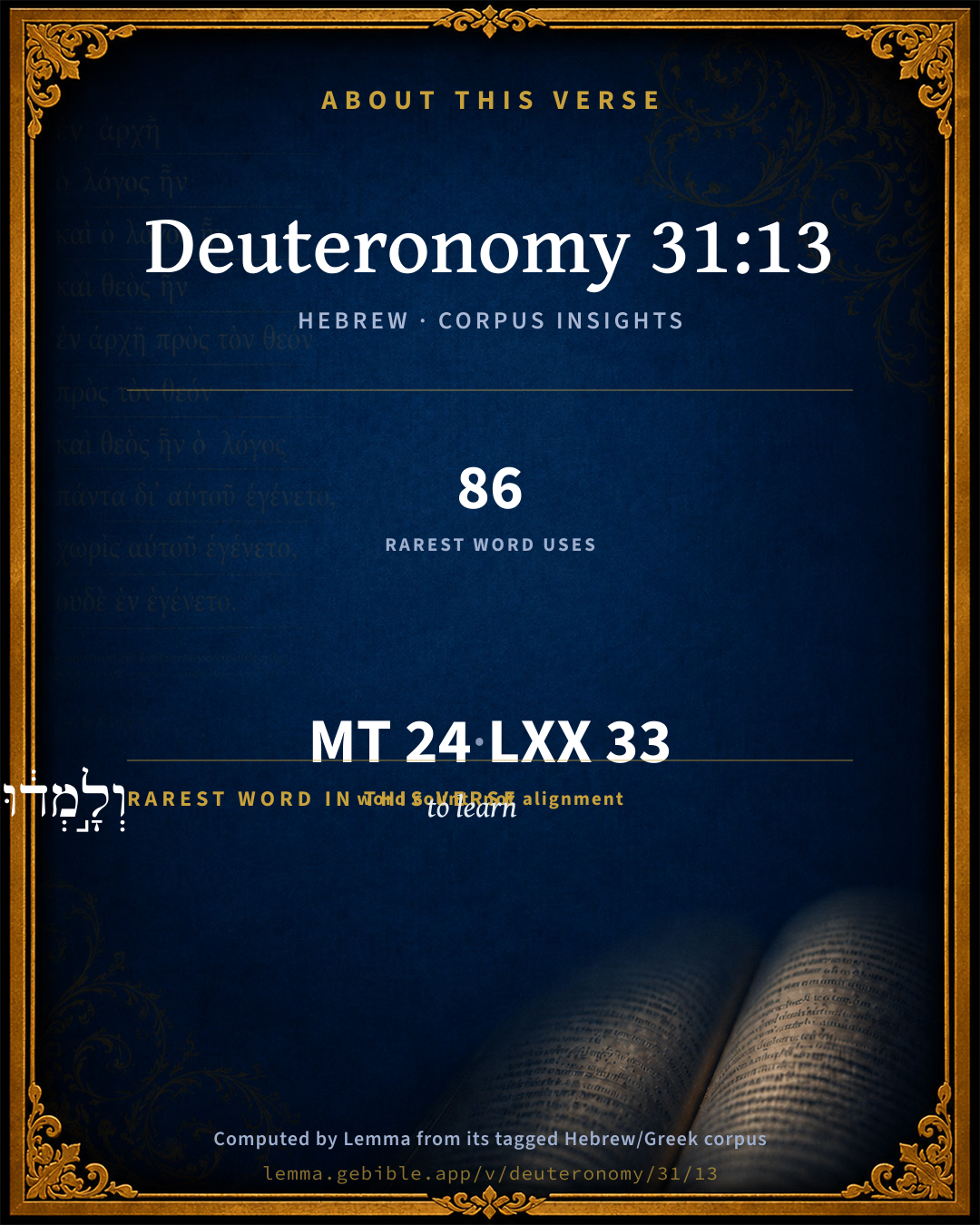
24
words
20
distinct lemmas
Pentateuch
section

Grammatical profile

  • 6 verbs
  • 7 nouns
  • 1 adjective
  • 2 pronouns
  • 1 preposition
  • 1 adverb
  • 6 particles

Verb forms

  • יָדְע֗וּ Qal · Perfect
  • יִשְׁמְעוּ֙ Qal · Imperfect
  • וְלָ֣מְד֔וּ Qal · Sequential Perfect
  • לְיִרְאָ֖ה Qal · Infinitive Construct
  • עֹבְרִ֧ים Qal · Participle Active
  • לְרִשְׁתָּֽהּ Qal · Infinitive Construct

Repetition

Words recur within this verse — often emphatic in Hebrew:

  • אֲשֶׁ֣ר which H834 ×3
  • אַתֶּ֤ם you H859 ×2

Hebrew & Septuagint length

In English translation the verse runs 34 words from the Hebrew and 36 from the Septuagint (LXX English) — closely comparable.

A rough comparison of the two English renderings, which tokenize alike — not a word-level alignment.

Word counts can differ between the Hebrew and the Greek without any difference in meaning — e.g. the Hebrew direct-object marker אֵת has no separate Greek word, and Greek often adds the article ὁ.

In the original languages it is 24 Hebrew tokens and 33 Greek tokens — but the two are counted differently (Hebrew bundles its prefixes and suffixes into one token; the Greek is in lemma form), so that isn’t a like-for-like length.

Cross-references

5

Topical passages linked to Deuteronomy 31:13 in the Treasury of Scripture Knowledge — connected by theme and wording, ordered by reader-vote popularity; previews shown in the World English Bible.

  • Deuteronomy 11:2 Know you this day: for I don't speak with your children who have not known, and who have not seen the chastisement of Yahweh your God, his greatness, his mighty hand, and his outstretched arm,
  • Deuteronomy 6:7 and you shall teach them diligently to your children, and shall talk of them when you sit in your house, and when you walk by the way, and when you lie down, and when you rise up.
  • Psalms 78:4–8 We will not hide them from their children, Telling to the generation to come the praises of Yahweh, His strength, and his wondrous works that he has done.
  • Proverbs 22:6 Train up a child in the way he should go, And when he is old he will not depart from it.
  • Ephesians 6:4 You fathers, don't provoke your children to wrath, but nurture them in the discipline and instruction of the Lord.

Cross-references courtesy of OpenBible.info (CC BY 4.0).

Hebrew and Greek witnesses Masoretic Hebrew ↔ Greek Septuagint

The same verse in the two great witnesses to the Old Testament, shown verse-for-verse.

These are two independent witnesses, not word-aligned to each other, and the Septuagint is shown in lemma (dictionary) form.

Hebrew Deuteronomy 31:13 Masoretic · Westminster Leningrad Codex

וּבְנֵיהֶ֞ם אֲשֶׁ֣ר לֹֽא יָדְע֗וּ יִשְׁמְעוּ֙ וְלָ֣מְד֔וּ לְיִרְאָ֖ה אֶת יְהוָ֣ה אֱלֹהֵיכֶ֑ם כָּל הַיָּמִ֗ים אֲשֶׁ֨ר אַתֶּ֤ם חַיִּים֙ עַל הָ֣אֲדָמָ֔ה אֲשֶׁ֨ר אַתֶּ֜ם עֹבְרִ֧ים אֶת הַיַּרְדֵּ֛ן שָׁ֖מָּה לְרִשְׁתָּֽהּ

and that their children, who have not known, may hear, and learn to fear Yahweh your God, as long as you live in the land where you go over the Jordan to possess it.

World English Bible · Public Domain

Greek LXX Deuteronomy 31:13 Septuagint · lemma form

καί ὁ υἱός αὐτός ὅς οὐ οἶδα ἀκούω καί μανθάνω φοβέω κύριος ὁ θεός σύ πᾶς ὁ ἡμέρα ὅσος αὐτός ζάω ἐπί ὁ γῆ εἰς ὅς σύ διαβαίνω ὁ ἰορδάνης ἐκεῖ κληρονομέω αὐτός

And their sons who have not known shall hear, and shall learn to fear the Lord your God all the days that they live upon the land, into which you⌃ go over Jordan to inherit it.

LXX2012 (modern English Septuagint) · Public Domain

On this verse, The Cambridge Bible for Schools and Colleges discusses the Septuagint’s reading. Read the note in Commentary ↓

Hebrew: Westminster Leningrad Codex (CC BY 4.0). Greek: Septuagint (public domain); English from LXX2012 (modern English Septuagint) (Public Domain). How the Septuagint differs from the Hebrew →

Targum (Aramaic paraphrase)

2

The Targum is the ancient Jewish Aramaic paraphrase of the Hebrew Scriptures — an interpretive translation, not the Hebrew text itself. Onkelos (literal) and Pseudo-Jonathan (expansive) render the Torah, and Jonathan the Prophets. Coverage is partial: where no permissively-licensed English translation exists for a verse, only the Aramaic is shown. This is verse-level text, not a word-by-word alignment to the Hebrew.

  1. Targum Onkelos Torah (Genesis–Deuteronomy)
    וּבְנֵיהוֹן דִי לָא יָדְעוּן יִשְׁמְעוּן וְיַלְפוּן (נ''א וְיֵלְפוּן) לְמִדְחַל יָת יְיָ אֱלָהֲכוֹן כֹּל יוֹמַיָא דִי אַתּוּן קְיָמִין עַל אַרְעָא דִי אַתּוּן עָבְרִין יָת יַרְדְנָא תַּמָן לְמֵירְתַהּ

    (no public-domain English translation for this verse)

    Targum Onkelos — Aramaic: “Onkelos Genesis” (public domain); “Onkelos Exodus” (public domain); “Onkelos Leviticus” (public domain); “Onkelos Numbers” (public domain); “Onkelos Deuteronomy” (public domain). English: “Sefaria Community Translation” (CC0 1.0 (public-domain dedication)); “J.W. Etheridge. The Targums of Onkelos and Jonathan Ben Uzziel on the Pentateuch. London: Longmans, Green, 1862” (public domain). Text via Sefaria.

  2. Targum Pseudo-Jonathan Torah (Genesis–Deuteronomy)
    וּבְנֵיהוֹן דְלָא יָדְעוּ יִשְׁמְעוּן וְיִלְפוּן לְמִדְחַל מִן קֳדָם יְיָ אֱלָהָכוֹן כָּל יוֹמַיָא דְאַתּוּן קַיָימִין עַל אַרְעָא דְאַתּוּן עָבְרִין יַת יוֹרְדְנָא תַּמָן לְמֵירְתָהּ

    Let their children also, who know not, hear, and learn to fear the Lord your God all the days that you live in the land to inherit which you pass over Jordan.

    Targum Pseudo-Jonathan — Aramaic: “Targum Jonathan on Genesis” (public domain); “Targum Jonathan on Exodus” (public domain); “Targum Jonathan on Leviticus” (public domain); “Targum Jonathan on Numbers” (public domain); “Targum Jonathan on Deuteronomy” (public domain). English: “The Targum of Jonathan ben Uzziel, trans. J. W. Etheridge, London, 1862” (public domain). Text via Sefaria.

Commentary

Notes on Deuteronomy 31:13 from classic Christian and Jewish commentators (each source and its license shown beneath its notes). The classic Christian expositions comment on the surrounding passage and are grouped to its opening verse, so a note may address several verses; the Jewish commentaries on the Tanakh (Rashi and others) are per-verse, so they appear only where the commentator wrote on this verse.

Lemma curates 59 commentaries, every one of them public domain or Creative Commons licensed, each selected and text-cleaned for this edition rather than reprinted as found. About our sources →

Trapp's Complete Commentary

John Trapp

Deu 31:13 And [that] their children, which have not known [any thing], may hear, and learn to fear the LORD your God, as long as ye live in the land whither ye go over Jordan to possess it.

Ver. 13. That they may hear, and that they may learn.] Hearing and seeing are by the philosopher called the learned senses. Faith also comes by hearing, {Rom 10:17} and the Spirit. {Gal 3:2}

John Trapp, A Commentary or Exposition upon All the Books of the Old and New Testament (1647–1656) — public domain. Text from a community e-Sword module.

The Biblical Illustrator

Joseph S. Exell

Deu_31:13

That their children . . . may hear, and learn to fear the Lord.

Early piety

I. Godliness in children is accounted by Christians generally to be extraordinary, or at least uncommon; and perhaps there are but few godly children. Compared with the number of children who are blessed with godly parentage, and taught in Christian schools, who are present when the public ordinances of Christs Church are administered, the children who manifest true piety are certainly not many. If our observation be accurate, Christian parents and teachers and pastors do not, with sufficient confidence, look for, or expect to find, godliness in children. If we employ those means which are divinely ordained for the conversion of human beings in our efforts On behalf of children, why should we not expect immediate and early results?

II. It is true that the sighs of a child are not heavy; they are not, as in the soul of manhood and womanhood, ocean waves, but they are rather like the ripple upon the waters of some sheltered lake. It is true that the emotions of a child are not the hardy blossoms of a sturdy fruit tree, but the tender and delicate bloom of a tree that has as yet yielded little more than promise of fruit. Nevertheless, that blossom, which winds will tear and shake, is the outflowing of life; that ripple on the lake shows susceptibility in the water towards its sister element, air; and those dewdrop tears show that earth and heaven, man and God, are working upon the childs nature. If the understanding of a child be less enlightened, the soul is more sensitive; if the judgment be less formed, the conscience is more tender; if there be but little strength of purpose, the heart is less hardened by the deceitfulness of sin.

III. If decided piety be within reach of a child, how is it that the absence of godliness from children does not more distress us, and that piety in children is not more our aim and hope, and that it is not more frequently the burden of our prayer? Why, as some, always suspect a child who professes to be godly? Godly children are Gods workmanship, created by Jesus Christ, and if we would be the means of leading children into true godliness, we must bid them look to our Saviour Jesus. I say to Him, not at Him. There is a vast difference between these things. The child looks at the King when he goes to see him proceed in state to open the Parliament; but he looks to his mother when he relies on her for the supply of his daily wants. (S. Martin, D. D.)

Susceptible periods of life

In fresco painting it is necessary to throw on the colours while the plaster to be decorated is damp. The rule is, Work while the moisture remains; hence the need in this particular branch of art of a definite plan of well-mixed colours, and of a swift and steady hand. The principle has a wider application. There are times when the human character is especially susceptible to impression, such as the period of early youth, the occasion of a great sorrow, a great joy, or a great change--times when the influence you exert will be received readily and sink deeply. Would you stamp lives and hearts around you with the beauty of heavenly patterns, make them glow with the hues of heavenly grace? Be sure of your plan, have your materials ready, and paint while the plaster is wet. (W. A. Gray.)

The Biblical Illustrator, edited by Joseph S. Exell (c. 1880s–1900s) — public domain. Text from a community e-Sword module.

Geneva Bible (1599)

Geneva Bible translators

Which were not born when the law was given.

Geneva Bible (1599) marginal notes — public domain. Text via Bolls.life.

The Cambridge Bible for Schools and Colleges

gen. ed. J. J. S. Perowne

13. their children] Again the characteristic inclusion of these; see on Deu_4:9 f., Deu_6:7; which have not known, Deu_11:2.

The text of the forms of address in this v. is uncertain:—your God, some Sam. readings have your, others their, LXX B has thy, but AF etc. your, and others our. Ye live, some Sam. you, others they, LXX they. Ye go over, so Sam. and LXX, on this last phrase see Deu_4:14, Deu_6:1, Deu_9:1, and cp. Deu_5:31.

The Cambridge Bible for Schools and Colleges (gen. ed. J. J. S. Perowne; Cambridge University Press, 1878–1918) — public domain. Text from a community e-Sword module.

John Gill's Exposition

And the Lord said unto Moses,.... Either at the same time, or quickly after; rather, perhaps, the same day:

behold, thy days approach that thou must die; which does not necessarily imply that he had some days to live, though but few; but that the time of his death drew nigh, his last moments were approaching; the time of his death being, as every man's is, fixed by the Lord, with whom is the number of his years, months, days, and moments, beyond which he cannot pass, Job 14:5,

call Joshua, and present yourselves in the tabernacle of the congregation, that I may give him a charge; this looks as if the people had been dismissed after the above exhortations given; and now Joshua was called, and Moses with him, to have a charge given him:

and Moses and Joshua went and presented themselves in the tabernacle of the congregation; before the Lord. Aben Ezra says, Moses went from the camp of Israel where he was, to the camp of the Shechinah; the Jews pretend to know in what form they walked thither. Moses, they say (a), went on the left hand of Joshua; and they went to the tabernacle, and the pillar of cloud descended and separated between them.

(a) Debarim Rabba, sect. 9. fol. 244. 2.

John Gill's Exposition of the Whole Bible (1746–1763) — public domain (CC PDM 1.0). Text via the HelloAO Bible API.

Ramban (Nachmanides)

Rabbi Moshe ben Nachman (Ramban / Nachmanides)

AND THAT THEIR CHILDREN, WHO HAVE NOT KNOWN, MAY HEAR, AND LEARN TO FEAR. This refers to the little children [mentioned in the preceding verse], for they will hear and inquire, and the fathers will accustom them [to the words of the Law] and educate them. For the little children [mentioned here] are not those who suckle at the breasts, but rather the young in years who are nearly old enough to be educated, this being the sense of the expression and learn to fear — in the future [when they are grown up]. But above [when speaking of the men and the women] he stated, that they may learn, and fear [now, since they are adults]. However, our Rabbis have said, “The men came to learn, and the women to listen. And the little children — why did they come? In order to reward those who bring them.” as applying to the very young who are not yet old enough to ask questions.

Ramban (Nachmanides) on the Tanakh — English translation: “Commentary on the Torah by Ramban (Nachmanides). Translated and annotated by Charles B. Chavel. New York, Shilo Pub. House, 1971-1976” (CC BY 4.0). Text via Sefaria.

Lesson kit

Teaching starters — assembled from the data on this page, not authored interpretation. Every prompt links to the verse data it draws on. Edit before teaching.

Deuteronomy, in the Pentateuch, opens this verse with 24 words (20 distinct Hebrew lemmas). Its most distinctive word is lâmad (“to learn”). A historical commentator’s framing appears above. Read the whole chapter for the surrounding context.

Discussion questions

  1. What does “to learn” (lâmad) contribute to the verse as a whole?
  2. How does Deuteronomy 11:2, which shares this passage’s theme, read alongside this verse?
  3. What does the repetition of “which” (3× in this one verse) do in this verse?
  4. The translations on this page render this verse differently — a whole-verse word diff, not a word-by-word alignment. What might account for the different wordings?
  5. «יָדְע֗וּ» is a Qal Perfect verb. How does that grammatical form shape the action described?
  6. Compare how Trapp's Complete Commentary and The Biblical Illustrator read this verse. Where do they agree or differ?

Things to notice

Reading settings

Reading text

Shown beneath each verse's original-language words.

Old Testament
Old Testament edition

Read the OT as the Masoretic Hebrew (MT) or the Greek Septuagint (LXX).

English shown for the Greek Septuagint (in the Hebrew ↔ Greek comparison).

Comparing translations? Open the Compare panel on any verse page to stack up to four side by side.