
Deuteronomy 6:24

Hebrew (Westminster Leningrad Codex) Deuteronomy 6:24 appears in the Hebrew Old Testament. The text above is from the Westminster Leningrad Codex. Each word links to its Strong’s number, a concise gloss, and parsing drawn from the Open Scriptures Hebrew Bible morphology. Click any word for its full Brown-Driver-Briggs (BDB) entry.
Download image
Cite this verse

Deuteronomy 6:24 (World English Bible). Public Domain. Lemma interlinear Bible study tool, https://lemma.gebible.app/v/deuteronomy/6/24.

Show BibTeX & RIS
BibTeX
RIS
English Translation
Yahweh commanded us to do all these statutes, to fear Yahweh our God, for our good always, that he might preserve us alive, as at this day.
World English Bible · Public Domain
Download a study sheet

One document with this verse’s original text, its word-by-word gloss line, the meaning frame, cross-references with their text, attributed commentary, and full source and license credits — printable, and it pastes into notes with its structure intact.

This verse Autodidact and up

Study sheet (.html) Plain text (.txt)

A passage Seminary Student

Up to 50 verses in one chapter. A passage sheet keeps up to 6 commentary sources and 12 cross-references per verse, in the order this page ranks them, and says so on the sheet whenever that leaves anything out. Ask for a single verse and you get the Autodidact verse sheet above.

Everything on this page stays free to read, with no account — the sheet is a download of what is already on screen, not access to it.

Want to remove ads? Support Godless Engineer
Compare translations 3

The same verse in 3 English versions, stacked beneath the original-language interlinear above. Click any original word for its lexicon entry.

Each is an independent rendering of the whole verse — the interlinear is not word-aligned to these translations.

Highlighted words mark where these versions differ — a whole-verse word diff, not a word-by-word alignment.

  • World English Bible Public Domain
    Yahweh commanded us to do all these statutes, to fear Yahweh our God, for our good always, that he might preserve us alive, as at this day.
  • King James Version Public Domain
    And the LORD commanded us to do all these statutes, to fear the LORD our God, for our good always, that he might preserve us alive, as it is at this day.
  • unfoldingWord Literal Text CC BY-SA 4.0
    And Yahweh commanded us to do all these statutes, to fear Yahweh our God for good to us all of the days, to keep us alive as this day.

unfoldingWord Literal Text — © unfoldingWord, licensed CC BY-SA 4.0. Word-aligned USFM3 via Door43 (git.door43.org/unfoldingWord/en_ult).

Versions to compare (up to 4)

3 of 4 selected

Show all 18 translations

Every available English version of this verse, each an independent rendering of the whole verse.

  • World English Bible Public Domain
    Yahweh commanded us to do all these statutes, to fear Yahweh our God, for our good always, that he might preserve us alive, as at this day.
  • Berean Standard Bible Public Domain
    And the LORD commanded us to observe all these statutes and to fear the LORD our God, that we may always be prosperous and preserved, as we are to this day.
  • Majority Standard Bible Public Domain
    And the LORD commanded us to observe all these statutes and to fear the LORD our God, that we may always be prosperous and preserved, as we are to this day.
  • King James Version Public Domain
    And the LORD commanded us to do all these statutes, to fear the LORD our God, for our good always, that he might preserve us alive, as it is at this day.
  • American Standard Version (1901) Public Domain
    And Jehovah commanded us to do all these statutes, to fear Jehovah our God, for our good always, that he might preserve us alive, as at this day.
  • Revised Version (1885) Public Domain
    And the LORD commanded us to do all these statutes, to fear the LORD our God, for our good always, that he might preserve us alive, as at this day.
  • Geneva Bible (1599) Public Domain
    Therefore the Lord hath commanded vs, to doe all these ordinances, and to feare the Lord our God, that it may goe euer well with vs, and that he may preserue vs aliue as at this present.
  • Douay-Rheims (1899) Public Domain
    And the Lord commanded that we should do all these ordinances, and should fear the Lord our God, that it might be well with us all the days of our life, as it is at this day.
  • Young's Literal Translation Public Domain
    And Jehovah commandeth us to do all these statutes, to fear Jehovah our God, for good to ourselves all the days, to keep us alive, as `at' this day;
  • Literal Standard Version CC BY-SA 4.0
    And YHWH commands us to do all these statutes, to fear our God YHWH, for good to ourselves [for] all the days, to keep us alive, as [at] this day;
  • Unlocked Literal Bible CC BY-SA 4.0
    Yahweh commanded us to always keep all these statutes, to fear Yahweh our God for our good, so that he might keep us alive, as we are today.
  • unfoldingWord Literal Text CC BY-SA 4.0
    And Yahweh commanded us to do all these statutes, to fear Yahweh our God for good to us all of the days, to keep us alive as this day.
  • Darby Bible Public Domain
    And Jehovah commanded us to do all these statutes, to fear Jehovah our God, for our good continually, that he might preserve us alive, as it is this day.
  • World Messianic Bible Public Domain
    The LORD commanded us to do all these statutes, to fear the LORD our God, for our good always, that he might preserve us alive, as we are today.
  • Webster's Bible Public Domain
    And the LORD commanded us to do all these statutes, to fear the LORD our God, for our good always, that he might preserve us alive, as it is at this day.
  • Free Bible Version CC BY-SA 4.0
    The Lord ordered us to keep all these laws and to respect the Lord our God, so that we would always be safe and well, as we are today
  • Bible in Basic English Public Domain
    And the Lord gave us orders to keep all these laws, in the fear of the Lord our God, so that it might be well for us for ever, and that he might keep us from death, as he has done to this day.
  • JPS Tanakh (1917) Public Domain
    And the LORD commanded us to do all these statutes, to fear the LORD our God, for our good always, that He might preserve us alive, as it is at this day.

Literal Standard Version (2020), Covenant Press — licensed CC BY-SA 4.0. Text via the HelloAO Bible API (eBible.org). Unlocked Literal Bible (unfoldingWord) — licensed CC BY-SA 4.0. Text via the HelloAO Bible API (eBible.org). unfoldingWord Literal Text — © unfoldingWord, licensed CC BY-SA 4.0. Word-aligned USFM3 via Door43 (git.door43.org/unfoldingWord/en_ult). Free Bible Version, Dr. Jonathan Gallagher — licensed CC BY-SA 4.0. Text via the HelloAO Bible API (eBible.org).

Word by word

More ways to search: Search by grammar → Find every occurrence → Compare this word →

Practice this passage: Drill this verse → Learn its vocabulary →

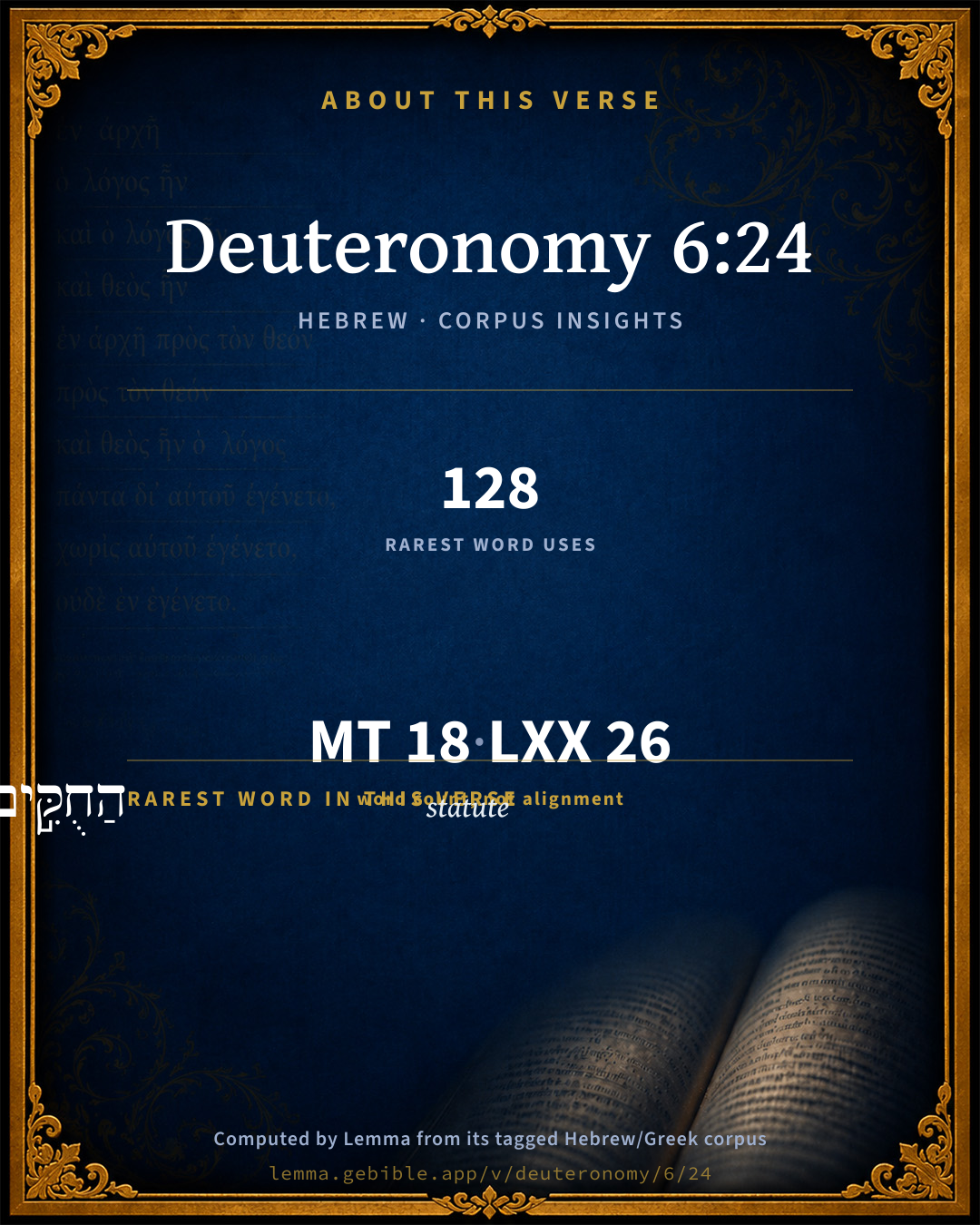
הַחֻקִּ֣ים
chôq
H2706
“the · statutes”
Particle, Definite Article + Noun, Common, Masculine, Plural, Absolute
Part of Speech
Particle + Noun
Type
Common
Gender
Masculine
Number
Plural
State
Absolute
Full BDB Definition

Origin: from H2710

TWOT: 728a

statute, ordinance, limit, something prescribed, due - prescribed task - prescribed portion - action prescribed (for oneself), resolve - prescribed due - prescribed limit, boundary - enactment, decree, ordinance - specific decree - law in general - enactments, statutes - conditions - enactments - decrees - civil enactments prescribed by God
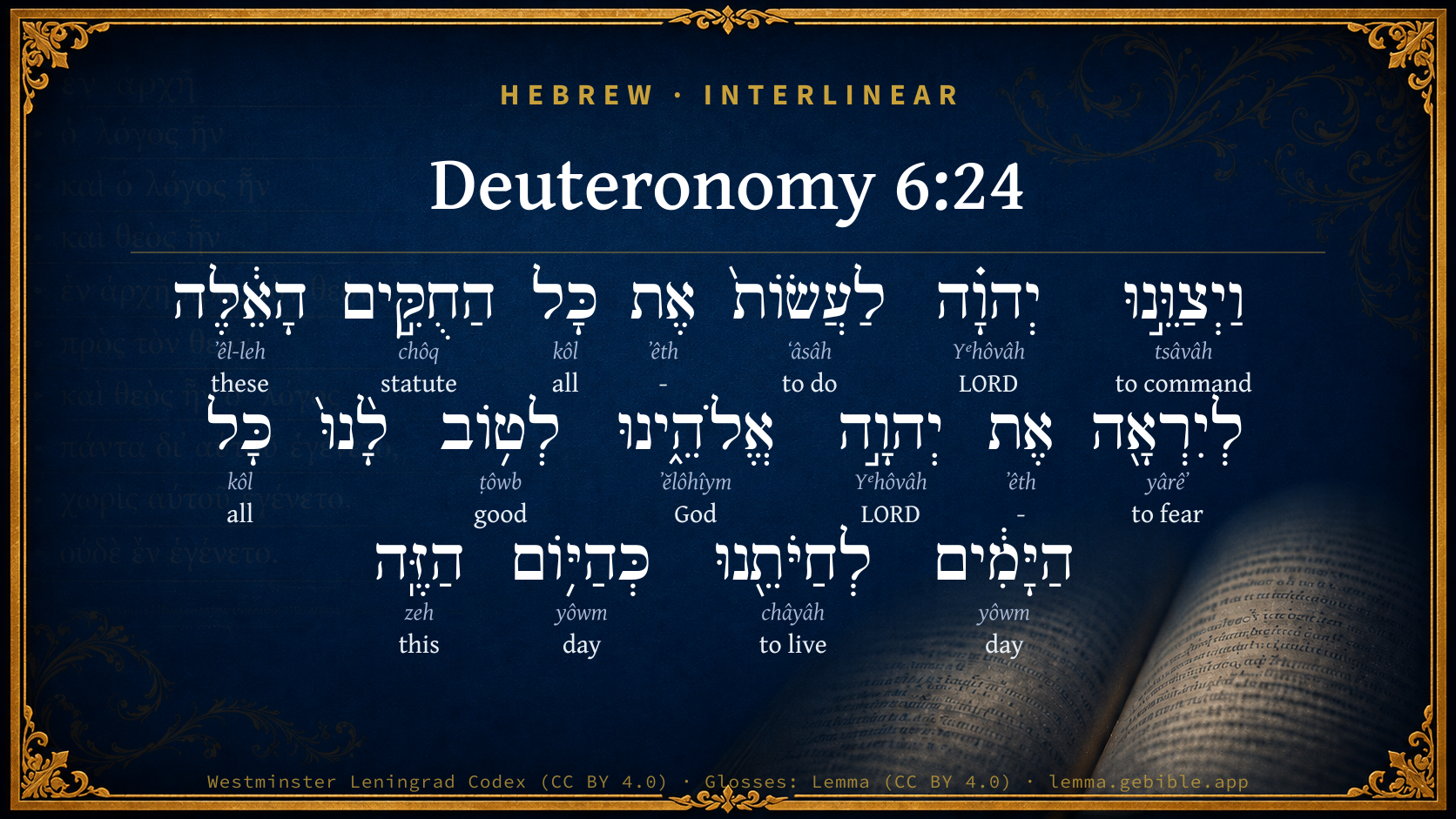
  1. וַיְצַוֵּ֣נוּ tsâvâh H6680 “and · to command · us” Conjunction + Verb, Piel, Sequential Imperfect, 3rd Person, Masculine, Singular + Suffix, Personal, 1st Person, Common, Plural
  2. יְהוָ֗ה Yᵉhôvâh H3068 “LORD” Noun, Proper
  3. לַעֲשׂוֹת֙ ʻâsâh H6213 “to do” Preposition + Verb, Qal, Infinitive Construct
  4. אֶת ʼêth H853 “-” Particle, Direct Object
  5. כָּל kôl H3605 “all of” Noun, Common, Masculine, Singular, Construct
  6. הָאֵ֔לֶּה ʼêl-leh H428 “the · these” Particle, Definite Article + Pronoun, Demonstrative, Common, Plural
  7. לְיִרְאָ֖ה yârêʼ H3372 “to fear” Preposition + Verb, Qal, Infinitive Construct
  8. אֶת ʼêth H853 “-” Particle, Direct Object
  9. יְהוָ֣ה Yᵉhôvâh H3068 “LORD” Noun, Proper
  10. אֱלֹהֵ֑ינוּ ʼĕlôhîym H430 “God(s) · our” Noun, Common, Masculine, Plural, Construct + Suffix, Personal, 1st Person, Common, Plural
  11. לְט֥וֹב ṭôwb H2896 “to/for · good” Preposition + Adjective, Adjective, Masculine, Singular, Absolute
  12. כָּל kôl H3605 “all of” Noun, Common, Masculine, Singular, Construct
  13. הַיָּמִ֔ים yôwm H3117 “the · days” Particle, Definite Article + Noun, Common, Masculine, Plural, Absolute
  14. לְחַיֹּתֵ֖נוּ châyâh H2421 “to live · us” Preposition + Verb, Piel, Infinitive Construct + Suffix, Personal, 1st Person, Common, Plural
  15. כְּהַיּ֥וֹם yôwm H3117 “like/as · the · day” Preposition + Particle, Definite Article + Noun, Common, Masculine, Singular, Absolute
  16. הַזֶּֽה zeh H2088 “the · this” Particle, Definite Article + Pronoun, Demonstrative, Masculine, Singular

About this verse

These counts appear in no published source. They are computed here, from the morphology-tagged text and Lemma’s own curated glosses. What Lemma adds →

18
words
13
distinct lemmas
Pentateuch
section

Grammatical profile

  • 4 verbs
  • 8 nouns
  • 1 adjective
  • 2 pronouns
  • 1 preposition
  • 2 particles

Verb forms

  • וַיְצַוֵּ֣נוּ Piel · Sequential Imperfect
  • לַעֲשׂוֹת֙ Qal · Infinitive Construct
  • לְיִרְאָ֖ה Qal · Infinitive Construct
  • לְחַיֹּתֵ֖נוּ Piel · Infinitive Construct

Repetition

Words recur within this verse — often emphatic in Hebrew:

  • יְהוָ֗ה LORD H3068 ×2
  • כָּל all H3605 ×2
  • הַיָּמִ֔ים day H3117 ×2

Hebrew & Septuagint length

In English translation the verse runs 27 words from the Hebrew and 32 from the Septuagint (LXX English) — closely comparable.

A rough comparison of the two English renderings, which tokenize alike — not a word-level alignment.

Word counts can differ between the Hebrew and the Greek without any difference in meaning — e.g. the Hebrew direct-object marker אֵת has no separate Greek word, and Greek often adds the article ὁ.

In the original languages it is 18 Hebrew tokens and 26 Greek tokens — but the two are counted differently (Hebrew bundles its prefixes and suffixes into one token; the Greek is in lemma form), so that isn’t a like-for-like length.

Cross-references

15

Topical passages linked to Deuteronomy 6:24 in the Treasury of Scripture Knowledge — connected by theme and wording, ordered by reader-vote popularity; previews shown in the World English Bible.

  • Jeremiah 32:39 and I will give them one heart and one way, that they may fear me forever, for the good of them, and of their children after them:
  • Psalms 41:2 Yahweh will preserve him, and keep him alive, He shall be blessed on the earth, And he will not surrender him to the will of his enemies.
  • Deuteronomy 10:12–13 Now, Israel, what does Yahweh your God require of you, but to fear Yahweh your God, to walk in all his ways, and to love him, and to serve Yahweh your God with all your heart and with all your soul,
  • Isaiah 3:10 Tell the righteous "Good!" For they shall eat the fruit of their deeds.
  • Deuteronomy 4:1 Now, Israel, listen to the statutes and to the ordinances, which I teach you, to do them; that you may live, and go in and possess the land which Yahweh, the God of your fathers, gives you.
  • Deuteronomy 8:1 All the commandment which I command you this day shall you observe to do, that you may live, and multiply, and go in and possess the land which Yahweh swore to your fathers.
  • Romans 10:5 For Moses writes about the righteousness of the law, "The one who does them will live by them."
  • Romans 6:21–22 What fruit then did you have at that time in the things of which you are now ashamed? For the end of those things is death.
  • Deuteronomy 4:4 But you who did cleave to Yahweh your God are alive everyone of you this day.
  • Deuteronomy 8:3 He humbled you, and allowed you to hunger, and fed you with manna, which you didn't know, neither did your fathers know; that he might make you know that man does not live by bread only, but by everything that proceeds out of the mouth of Yahweh does man live.
  • Job 35:7–8 If you are righteous, what do you give him? Or what does he receive from your hand?
  • Psalms 66:9 Who preserves our life among the living, And doesn't allow our feet to be moved.
  • Proverbs 9:12 If you are wise, you are wise for yourself. If you mock, you alone will bear it.
  • Proverbs 22:4 The result of humility and the fear of Yahweh Is wealth, honor, and life.
  • Matthew 6:33 But seek first God's Kingdom, and his righteousness; and all these things will be given to you as well.

Cross-references courtesy of OpenBible.info (CC BY 4.0).

Hebrew and Greek witnesses Masoretic Hebrew ↔ Greek Septuagint

The same verse in the two great witnesses to the Old Testament, shown verse-for-verse.

These are two independent witnesses, not word-aligned to each other, and the Septuagint is shown in lemma (dictionary) form.

Hebrew Deuteronomy 6:24 Masoretic · Westminster Leningrad Codex

וַיְצַוֵּ֣נוּ יְהוָ֗ה לַעֲשׂוֹת֙ אֶת כָּל הַחֻקִּ֣ים הָאֵ֔לֶּה לְיִרְאָ֖ה אֶת יְהוָ֣ה אֱלֹהֵ֑ינוּ לְט֥וֹב לָ֨נוּ֙ כָּל הַיָּמִ֔ים לְחַיֹּתֵ֖נוּ כְּהַיּ֥וֹם הַזֶּֽה

Yahweh commanded us to do all these statutes, to fear Yahweh our God, for our good always, that he might preserve us alive, as at this day.

World English Bible · Public Domain

Greek LXX Deuteronomy 6:24 Septuagint · lemma form

καί ἐντέλλομαι ἐγώ κύριος ποιέω πᾶς ὁ δικαίωμα οὗτος φοβέω κύριος ὁ θεός ἐγώ ἵνα εὖ εἰμί ἐγώ πᾶς ὁ ἡμέρα ἵνα ζάω ὥσπερ καί σήμερον

And the Lord charged us to observe all these ordinances; to fear the Lord our God, that it may be well with us for ever, that we may live, as even today.

LXX2012 (modern English Septuagint) · Public Domain

Hebrew: Westminster Leningrad Codex (CC BY 4.0). Greek: Septuagint (public domain); English from LXX2012 (modern English Septuagint) (Public Domain). How the Septuagint differs from the Hebrew →

Targum (Aramaic paraphrase)

2

The Targum is the ancient Jewish Aramaic paraphrase of the Hebrew Scriptures — an interpretive translation, not the Hebrew text itself. Onkelos (literal) and Pseudo-Jonathan (expansive) render the Torah, and Jonathan the Prophets. Coverage is partial: where no permissively-licensed English translation exists for a verse, only the Aramaic is shown. This is verse-level text, not a word-by-word alignment to the Hebrew.

  1. Targum Onkelos Torah (Genesis–Deuteronomy)
    וּפַּקְדָנָא יְיָ לְמֶעְבַּד יָת כָּל קְיָמַיָא הָאִלֵין לְמִדְחַל יָת יְיָ אֱלָהָנָא לְטַב לָנָא כָּל יוֹמַיָא לְקַיָמוּתָנָא כְּיוֹמָא הָדֵין

    (no public-domain English translation for this verse)

    Targum Onkelos — Aramaic: “Onkelos Genesis” (public domain); “Onkelos Exodus” (public domain); “Onkelos Leviticus” (public domain); “Onkelos Numbers” (public domain); “Onkelos Deuteronomy” (public domain). English: “Sefaria Community Translation” (CC0 1.0 (public-domain dedication)); “J.W. Etheridge. The Targums of Onkelos and Jonathan Ben Uzziel on the Pentateuch. London: Longmans, Green, 1862” (public domain). Text via Sefaria.

  2. Targum Pseudo-Jonathan Torah (Genesis–Deuteronomy)
    וּפַקֵּיד עֲלָנָא יְיָ לְמֶעֱבַד יַת כָּל קְיָמַיָא הָאִילֵין לְמִדְחַל מִן קֳדָם יְיָ אֱלָהָנָא לְטַב לָנָא כָּל יוֹמַיָא לְקַיָּימוּתָנָא כִּזְמַן יוֹמָא הָדֵין

    And the Lord commanded us to perform all these statutes, that we may fear the Lord our God for good to us in all days, that He may preserve us alive as at the time of this day;

    Targum Pseudo-Jonathan — Aramaic: “Targum Jonathan on Genesis” (public domain); “Targum Jonathan on Exodus” (public domain); “Targum Jonathan on Leviticus” (public domain); “Targum Jonathan on Numbers” (public domain); “Targum Jonathan on Deuteronomy” (public domain). English: “The Targum of Jonathan ben Uzziel, trans. J. W. Etheridge, London, 1862” (public domain). Text via Sefaria.

Commentary

Notes on Deuteronomy 6:24 from classic Christian and Jewish commentators (each source and its license shown beneath its notes). The classic Christian expositions comment on the surrounding passage and are grouped to its opening verse, so a note may address several verses; the Jewish commentaries on the Tanakh (Rashi and others) are per-verse, so they appear only where the commentator wrote on this verse.

Lemma curates 59 commentaries, every one of them public domain or Creative Commons licensed, each selected and text-cleaned for this edition rather than reprinted as found. About our sources →

The Biblical Illustrator

Joseph S. Exell

Deu_6:24

The Lord commanded us to do all these statutes.

The moral significance of Gods laws

The doctrine of this text is that Gods laws are for the good of His subjects; that the basis of all His laws is benevolence; that their foundation is love.

I. This fact is well attested.

1. In the nature of the commands.

2. In the experience of His subjects. The loyal have ever been the happiest.

II. This fact reveals the divine character.

1. Unbounded love.

2. Complete wisdom.

3. Absolute independence.

III. This fact explains the condition of all human happiness. What is it? Not the search for it as an end. He that seeketh his life shall lose it. Obey, because it is right to obey the Infinitely Holy and the Supremely Good. (U. R. Thomas.)

Obligation, nature, and advantages of religion

I. The obligation of religion. The Lord commanded us.

1. The will of God is the proper ground of moral obligation.

2. The will of God, as made known to us, is the statement and rule of religion.

II. The particular nature of religion.

1. To fear the Lord our God--the mind constituted so as that certain affections may be produced by certain objects. The true knowledge of God will produce reverence, admiration, and dread. At first this, with a deep sense of guilt, will be the spirit of bondage unto fear. When the Spirit of adoption is received the fear is filial, reverential, producing hatred to sin.

2. To do all these statutes. Religion is to be practical and external, as well as experimental and internal.

(1) It is not talking about the Divine laws, but doing them.

(2) It is not doing what we please, but the commands of God.

(3) It is not selecting such as we prefer, but doing all these statutes.

(4) It is not doing them carelessly, but with due thought, observe.

(5) It is not doing them formally or to please man, but in reference to God Himself; before the Lord.

(6) Obedience is not to be in opposition to the covenant of mercy, but connected with it; before the Lord our God.

III. Value and advantages of religion.

1. It shall be our righteousness. Mercy comes only through merit and intercession of Christ. Is at first received only by faith. Still, He is Author of eternal salvation only to them that obey Him. For Christs sake continued obedience to the law of our dispensation is the channel of continual acceptance.

2. For our good always. We enjoy the favour of God, and the light of His countenance is our happiness. His providence takes care of us. His glory will receive us. (G. Cubitt.)

The Biblical Illustrator, edited by Joseph S. Exell (c. 1880s–1900s) — public domain. Text from a community e-Sword module.

The Cambridge Bible for Schools and Colleges

gen. ed. J. J. S. Perowne

24. Jehovah commanded us to do all these statutes] This phrase is natural to the time and standpoint assumed throughout Deu_6:20-25, viz. those of the later generation before which the statutes will already have been published. Notice, too, how naturally Jehovah is used instead of the deuteronomic Jehovah thy God; for here we have, not Moses addressing Israel, but Moses quoting what Israel are to say to their children; so, too, Jehovah our God (thrice) is to be explained. Thus two of Steuernagel’s reasons for counting the passage as secondary (that Sg. does not elsewhere in the introductory discourses take the laws as already published and that Jehovah our God does not elsewhere occur in the Sg.) are disposed of. He has missed the standpoint of the speakers whom Moses quotes. Steuernagel’s third reason for the secondariness of the passage—that it interrupts by its emphasis on obedience the Sg. course of thought, which before and after it warns against the worship of other gods—is insufficient.

might preserve us alive] Sustain the national existence which He had begun by the redemption from Egypt (Deu_6:21). The Law is given to preserve the life born in that deed of grace. See above.

alive, as at this day] ‘It deserves attention that this points to the composition [of the passage] as pre-exilic, for the Exile was felt as death’ (Bertholet). This would be a good argument if the words were part of Moses’ direct address to Israel, but they are spoken from the standpoint of a generation settled in Palestine.

The Cambridge Bible for Schools and Colleges (gen. ed. J. J. S. Perowne; Cambridge University Press, 1878–1918) — public domain. Text from a community e-Sword module.

John Gill's Exposition

And the Lord commanded us to do all these statutes,.... Some of which were designed on purpose to commemorate the wonderful deliverance out of Egypt, as particularly the passover; and all of them they were obliged in gratitude to obey, in consideration of such great favours bestowed upon them:

to fear the Lord our God, for our good always: as it is always for the good of men, temporal, spiritual, and eternal, to fear the Lord; for there is no want to them that fear him, nor will the Lord withhold good things from them; see Psa 34:9,

that he might preserve us alive, as it is at this day; in bodily health and strength, and in the enjoyment of the good land, and all the blessings and benefits of it.

John Gill's Exposition of the Whole Bible (1746–1763) — public domain (CC PDM 1.0). Text via the HelloAO Bible API.

Matthew Poole's English Annotations

The benefit of obedience is ours, not God’s Job 35:7 and therefore our obedience is highly reasonable, and absolutely necessary.

Matthew Poole's English Annotations on the Holy Bible (1683–1685) — public domain. Text from a community e-Sword/MySword module.

unfoldingWord translationNotes

Door43 World Missions Community

General Information:

Moses continues to tell the people of Israel Yahweh's words as if the Israelites are one person. He tells them what they should tell their children about Yahweh's commandments. (See: Forms of You)

before Yahweh

"in the presence of Yahweh" or "where Yahweh can see us"

keep

obey at all times and for a long time

this will be our righteousness

The word "this" refers to keeping Yahweh's commands. This is a metonym for Yahweh considering them righteous. AT: "he will consider us righteous" (See: Metonymy)

translationWords

Yahweh

command

statute

fear

God

good

life

righteous

unfoldingWord translationNotes — © Distant Shores Media and the Door43 World Missions Community, licensed CC BY-SA 4.0. Source: git.door43.org/Door43/en_tn.

Lesson kit

Teaching starters — assembled from the data on this page, not authored interpretation. Every prompt links to the verse data it draws on. Edit before teaching.

Deuteronomy, in the Pentateuch, opens this verse with 18 words (13 distinct Hebrew lemmas). Its most distinctive word is chôq (“statute”). A historical commentator’s framing appears above. Read the whole chapter for the surrounding context.

Discussion questions

  1. The word chôq carries the sense “statute.” How does it shape the verse?
  2. How does Jeremiah 32:39, which shares this passage’s theme, read alongside this verse?
  3. What does the repetition of “LORD” (2× in this one verse) do in this verse?
  4. These translations render this verse differently; the difference is in the English rendering, not the original. What questions does that raise?
  5. «וַיְצַוֵּ֣נוּ» is a Piel Sequential Imperfect verb. How does that grammatical form shape the action described?
  6. Compare how The Biblical Illustrator and The Cambridge Bible for Schools and Colleges read this verse. Where do they agree or differ?

Things to notice

Reading settings

Reading text

Shown beneath each verse's original-language words.

Old Testament
Old Testament edition

Read the OT as the Masoretic Hebrew (MT) or the Greek Septuagint (LXX).

English shown for the Greek Septuagint (in the Hebrew ↔ Greek comparison).

Comparing translations? Open the Compare panel on any verse page to stack up to four side by side.